Volume 2007, Article ID 29749,9pages doi:10.1155/2007/29749
Research Article
Eigenstructures of MIMO Fading Channel Correlation
Matrices and Optimum Linear Precoding Designs for
Maximum Ergodic Capacity
Hamid Reza Bahrami and Tho Le-Ngoc
Department of Electrical and Computer Engineering, McGill University, 3480 University Street, Montr´eal, QC, Canada H3A 2A7
Received 27 October 2006; Revised 10 February 2007; Accepted 25 March 2007
Recommended by Nicola Mastronardi
The ergodic capacity of MIMO frequency-flat and -selective channels depends greatly on the eigenvalue distribution of spatial cor-relation matrices. Knowing the eigenstructure of corcor-relation matrices at the transmitter is very important to enhance the capacity of the system. This fact becomes of great importance in MIMO wireless systems where because of the fast changing nature of the underlying channel, full channel knowledge is difficult to obtain at the transmitter. In this paper, we first investigate the effect of eigenvalues distribution of spatial correlation matrices on the capacity of frequency-flat and -selective channels. Next, we introduce a practical scheme known as linear precoding that can enhance the ergodic capacity of the channel by changing the eigenstructure of the channel by applying a linear transformation. We derive the structures of precoders using eigenvalue decomposition and linear algebra techniques in both cases and show their similarities from an algebraic point of view. Simulations show the ability of this technique to change the eigenstructure of the channel, and hence enhance the ergodic capacity considerably.
Copyright © 2007 H. R. Bahrami and T. Le-Ngoc. This is an open access article distributed under the Creative Commons Attribution License, which permits unrestricted use, distribution, and reproduction in any medium, provided the original work is properly cited.
1. INTRODUCTION
It has been shown that the capacity of a MIMO system is greatly reduced by spatial correlation in the underlying chan-nel [1,2]. Spatial correlation can reduce the rank of the chan-nel matrix, and hence greatly surpasses the multiplexing gain of a MIMO system. Various techniques that have been pro-posed in the literature to reduce the correlation effects are based on two main approaches. One aims to avoid corre-lation in the channel by antenna beamforming [3,4]. The other tries tocancelthe existing channel correlation by suit-able methods at the transmitter or receiver. In this paper, our focus is on the linear precoding technique based on the knowledge of correlation at the transmitter, aiming to in-crease the ergodic capacity of fading channels by modifying the eigenvalue spread of the channel correlation matrices.
Linear precoder design in MIMO systems is a relatively simple (in term of implementation and design complexity) strategy that tries to improve the transmission quality and rate by optimal allocation of resources such as power and bits over multiple antennas, based on the channel properties. Design of the precoders based on full channel knowledge for MIMO systems in frequency-flat and -selective channels has
been investigated by many works. For a detailed overview on the designs for frequency-flat channels, see [5,6]. While we see a number of different precoder structures for frequency-flat fading channel proposed in the literature, there are fewer papers addressing MIMO precoding designs in a frequency-selective fading environment [7]. In designs based on full channel knowledge, it is assumed that the transmitter has the instantaneous channel information and based on this information, a metric related to performance, such as pair-wise error probability (PEP) or minimum mean-square error (MMSE) or rate (ergodic capacity or probability of outage), is defined and optimized by selection of proper linear pre-coder.
In a fast fading environment, however, the assumption of full channel knowledge at the transmitter is no longer real-istic due to the finite delay in channel response estimation and reporting. Hence, it is more reasonable to assume that the transmitter knows only partial channel knowledge such as spatial correlation information, that is, transmit and re-ceive correlation matrices.
on both transmit and receive correlation matrices were de-veloped for three different criteria, that is, PEP, MMSE, and ergodic capacity. The results indicate that the optimal pre-coder structures for these criteria are very similar. All of the above designs are for flat fading channels.
In this paper, we investigate the channel correlation effects on the capacity of flat and frequency-selective fading channels from an algebraic viewpoint and develop the corresponding linear precoding structures to maximize their ergodic capacity. We show that the eigen-values of the correlation matrices play a key role in the er-godic capacity of fading channels. In particular, the effect of correlation on the capacity of the system becomes more pronounced with increase in the eigenvalue spread of the spatial correlation matrices. Therefore, in general, our focus is to find how we can modify the eigenvalues of the chan-nel correlation matrices to enhance the capacity. Based on linear algebraic structures of flat and frequency-selective fading MIMO channels, we construct suitable ana-lytical models to include channel spatial correlations in both cases, and derive the precoding matrix structures that can maximize their ergodic channel capacity. In both cases, the precoding matrices are closely related to the eigenstructures (eigenvalues and eigenvectors) of spatial correlation matri-ces. We further show that the structure of the precoder in the frequency-flat case is an eigenbeamformer with beams point-ing to the eigenmodes of the transmit correlation matrix. For a frequency-selective fading channel withLindependent ef-fective paths, the precoder can be constructed as a number of parallel precoders for frequency-flat fading channels. In this sense, there is a kind of duality between precoder design for frequency-flat and -selective channels.
The rest of this paper is organized as follows. InSection 2, we consider the case of frequency-flat fading channels. The so-called Kronecker model is introduced to represent the spatial correlation effects in MIMO system. Based on this channel model, we investigate the effects of eigenvalues of spatial correlation matrix and their spread on the ergodic channel capacity and develop the corresponding precoding structure based on the eigenstructure of the channel spatial correlation matrix in order to maximize the ergodic capacity. InSection 3, we consider the case of frequency-selective fad-ing channels. We develop a comprehensive linear algebraic model of a frequency-selective fading channel withLeffective paths in terms of channel correlation matrices. Furthermore, we analyze the effects of the eigenstructures of the channel correlation matrices on the ergodic capacity of a frequency-selective fading channel and develop the optimum precoder based on the eigenstructures of spatial correlation matrices ofLeffective channel paths for maximum ergodic capacity. It is shown that the structure includesLparallel precoders, each for one frequency-flat fading channel path, with specific power loadings.Section 4presents illustrative examples with numerical results and plots. The effects of eigenvalues of spa-tial correlation matrices on the capacity of both frequency-flat and frequency-selective fading channels in various con-ditions are presented. The effects of precoding on the eigen-value spreads of the channel correlation matrices are also
shown. Furthermore, performance in terms of achievable er-godic capacity versus SNR of the proposed precoders is eval-uated and compared with that of systems using no precoding in various scenarios by means of simulation. It is shown that the precoders perform well in changing the eigenstructure (mainly eigenvalue spread) of the channels in favor of chan-nel capacity. In other words, the precoders are capable of pro-viding a considerable capacity gain in different propagation scenarios by changing the characteristics of the channel cor-relation matrices. Finally,Section 5includes with concluding remarks.
2. FREQUENCY-FLAT FADING CHANNEL
2.1. System model
Consider a MIMO transmission system over a frequency-flat fading channel, using transmitter and receiver equipped with
M andN antennas, respectively. The discrete-time wireless MIMO fading channel impulse response can be assumed to be anN×MmatrixHand the system model (input-output relationship) at thekth time instant can be written as
y(k)=H(k)·s(k) +n(k), (1)
wheres[k] is the transmittedM×1 data vector with statisti-cally independent entries andy[k] andn[k] denote theN×1 received and noise vectors, respectively. We assume that the elements ofHandnare complex Gaussian random variables with 1/2 variance per dimension, andE{nnH} =σ2
nIN, where
σ2
n is the noise variance andIN is the identity matrix of size
N. Besides, E{·} denotes expectation and superscriptH is Hermitian (conjugate transpose) operator.
For simplicity, we assume the receiver (e.g., mobile unit) to be surrounded by local scatterers so that fading at the mo-bile unit is spatially uncorrelated while transmitter (e.g., base station) is located in a high altitude, and therefore the fading is correlated at base station. However, it is straightforward to generalize the model to the case when both transmitter and receiver are spatially correlated.1Due to the assumed spatial
correlation at transmit side, the elements of each row ofH are correlated and for each row, we can write
RT=EhHi hi, i=0· · ·N−1, (2) wherehiis theith row ofH.RT is theM×Mtransmit non-negative, semidefinite correlation matrix, and hence can be represented asRT =R1T/2RH/T 2(Choleski factorization). Sub-sequently, the channel matrixHcan be represented as
H=GR1T/2, (3)
whereGis an uncorrelatedN×M matrix with i.i.d. zero-mean normalized Gaussian distributed entries, that is,G∼
CN(0, 1). The model proposed here is usually known as Kro-necker model in the related literature [11].
2.2. Effect of correlation
We start by defining the mutual information in each channel use. We assume an independent and invariant realization of the channel matrix in each channel. Using (1), the mutual information of such a system is defined as [12,13]
I(s;y)=log
det
IN+ 1
σ2
nHΣH
H, (4)
whereΣis theM×Mcovariance matrix of Gaussian input xwith a maximum power limit due to the total power limi-tation at transmitter, that is, tr(Σ)≤P. Note that the instan-taneous capacity of the system is defined as the maximum of mutual information over all covariance matricesΣthat sat-isfy the power constraint, and the ergodic capacity is the en-semble average over instantaneous capacity.
In the following analysis, for simplicity we assume an equal power allocationΣ=(P/N)IM. Based on this assump-tion, the mutual information in (4) can be written as
I(s;y)=log
det
IN+ P
Nσ2
nHH
H. (5)
This is in fact the instantaneous channel capacity when trans-mitter has no knowledge about the channel. Our objective is to understand the effect of transmit correlation matrix (more specifically its eigenvalues) on the ergodic capacity of the sys-tem.
Lemma 1. Instantaneous mutual information has the follow-ing distribution:
I∼log det
IM+ P
Nσ2
nΔG
HG, (6)
whereΔ=diag{δi(RT)}Mi=−01, that is,δi’s are the eigenvalues of
transmit correlation matrix.
Proof. SubstitutingHfrom (3) into (5) will result in
I=log
det
IN + P
Nσ2
nGRTG
H. (7)
By applying the eigenvalue decomposition ofRT = ΦΔΦH and the fact thatGΦ∼G(and henceΦHGH∼GH), (7) can be rewritten as
I∼log det
IN+ P
Nσ2
nGΔG
H. (8)
Using the matrix equality det(I+AB) = det(I+BA) will complete the proof.
As previously mentioned, the ergodic capacity is defined asC =E{I}. The importance ofCcomes from the fact that at transmission rates lower thanC, the error probability of a good code decays exponentially with the transmission rate. Here, our objective is to investigate the effects of the eigen-values of transmit correlation matrix onC. We show the im-portance of these eigenvalues in two ways. First, following the
same approach as in [14], we consider the asymptotic case of large number of receive antennas, based on the law of large numbers, when the number of receive antennas (N) is large (1/N)GHG→IM, and is hence in the limit
C=Elog det
IM+ P
Nσ2
nΔG
HG
=log det
IM+ P
σ2
nΔ
=M
i=1
log
1 + P
σ2
nδi
,
(9)
whereδi’s are the diagonal entries ofΔ, the eigenvalue matrix check of transmit correlation matrixRT. This clearly shows the effect of the eigenvalues of correlation matrix on the er-godic capacity of a frequency-flat MIMO channel. It is also possible to derive the same result by applying Jensen’s in-equality [15] to the first equation in (9) to compute an upper bound on ergodic capacity. Using Jensen’s inequality,
C≤CUB=log detE
IM+ P
Nσ2
nΔG
HG . (10)
Since the entries ofGare Gaussian with zero mean and 1/2 variance per dimension, it follows that
C≤CUB=log detE
IM+ P
σ2
nΔ
=M
i=1
log
1 + P
σ2
nδi
.
(11)
This bound gets tighter by increasingN, the number of the receive antennas, and the inequality in (11) becomes equality in the limit of largeN.
The following lemma specifies the optimal case for eigen-values in order to maximize the ergodic capacity. We borrow this lemma from [14].
Lemma 2. Fortr(RT)=1, the ergodic capacity is maximized whenδi=1/N,i=1· · ·N.
The proof is straightforward and can be obtained by sym-metry argument.
Lemma 2shows that the best case is when the channel is indeed uncorrelated, that is,RT =(1/N)IN. Now the ques-tion is what transmit strategy can be used when the channel is correlated. Our focus here is to devise a linear transmission strategy to maximize the ergodic capacity when the transmit correlation matrix is not identity.
second-order statistics) of the channel changes much slowly compared to instantaneous channel response,H. Therefore, it is possible in fast fading environment to obtain an accu-rate transmit correlation matrix at the transmitter. Some-times in the related literature, such information is called partial channel information. In state-of-the-art communi-cations systems, these types of channel information become more and more important as we are interested in transmit-ting information to high-speed mobile units.
Our objective through this paper is to apply anM×M linear transformation (precoding)Wover information sym-bolssto get anM×1 transmit vectorx, that is,x=Ws, under the power constraint. The precoding matrix is selected such that a performance metric (e.g., the ergodic capacity) is op-timized. We assume that the transmitter is just informed of the transmit correlation matrixRT. We treat the flat-fading channel in this section and the frequency-selective fading cases in the next section.
2.3. Precoder design
We assume that the receiver has the perfect channel informa-tion but the transmitter knows only spatial and path correla-tion matrices. Our objective is to design the precoding matrix Wto maximize the ergodic capacity for a given total trans-mit power. Applying precoding matrix, the ergodic capacity of the MIMO system in a frequency-flat fading channel can now be written as
C=Elog2
det
IM+ 1
Nσ2
nW
HHHH W. (12)
Note that the power constantP in (7) is now considered in the elements of precoder matrix, and hence a power con-straint is applied to its entries, that is, tr{WWH} ≤ P. Get-ting expectation from the log-function in (12) is very hard (if not impossible). By applying Jensen’s inequality [15] to log-det function, that is,E{log[det(A)]} ≤ log[det(E{A})], we can derive an upper bound on the ergodic capacity as
C≤CUB=log2
detE
IM+ 1
Nσ2
nW
HRH/2
T GHGR1T/2W
,
(13)
whereHhas been substituted from (3).
Lemma 3. The optimum precoding matrix for frequency-flat fading channel is directly related to the eigenvector matrix of transmit correlation matrixRT and can be written as W = ΦΣ1/2Γ, whereΦis the eigenvector matrix ofR
T,Σis a
diago-nal matrix called power loading matrix whose entries should be computed for optimality, andΓis an arbitrary unitary matrix.
Proof. By taking the expectation in (13) and eigendecompo-sitionsWWH=ΨΣΨHandR
T=ΦΔΦH, we obtain
C≤CUB=log2
det
IM+ κ
σ2
nΨΣΨ
HΦΔΦH, (14)
whereκis a constant that can be calculated by taking the ex-pectation of the components ofG. Our aim is to findWthat maximizes (14) under the power constraint, that is,
max log2
det
IM+ κ
σ2
nΨΣΨ
HΦΔΦH s.t. tr(Σ)≤P. (15)
Note that tr{WWH} ≤Pwill directly result in tr{Σ} ≤P. Us-ing Hadamard’s inequality [16], the above optimization can be achieved when the argument of the determinant is a di-agonal matrix. To this end, we should haveΨ=Φ. In other words, the singular matrix of the precoder matrix should be the same as the singular matrix of transmit correlation ma-trix. Therefore, the precoder structure can be written as
W=ΦΣ1/2Γ, (16)
whereΓis an arbitrary unitary matrix that has no effect on the system performance, and therefore can be set to iden-tity for simplicity andΣ(the eigenvalue matrix ofW) is the power loading matrix that should be optimized.
By substituting (16) into (13), the optimization problem can be rewritten as
max Σ log2
det
I+ κ
σ2
nΣΔ
s.t. tr(Σ)≤P, (17)
with the following solution for elements ofΣ:
σi=
v−κδσn2
i +
, i=0 :M−1, (18)
where [x]+ = max[0,x] for a scalarx,σ
iandδi are the di-agonal entries ofΣandΔ, respectively andvis the constant determined by the power constraint. At the optimum point, the power inequality tr{Σ} ≤Pbecomes equality.
In fact, the precoder changes the eigenvalues of the chan-nel to optimize the ergodic capacity. The new eigenvalues of the product of the channel matrix and precoder matrix are σiδi, i=0· · ·M−1 (instead of δi). Precoder tends to increase the larger eigenvalues compared to small eigenval-ues and increase the eigenvalue spread of the product matrix HW. Therefore,δi> δjresults inσi> σj. This power alloca-tion process is known as waterpouring in which the precoder pours more power to stronger eigenvalues (or eigenmodes) and allocates less to weaker ones.
3. FREQUENCY-SELECTIVE FADING CHANNEL
3.1. System model
· · ·
· · ·
· · ·
HL−1
Δ
H0 H1
Δ Δ
s
y + +
Figure1: Frequency-selective MIMO channel model.
Consider a transmitted block ofK+Lvectors of sizeM× 1, organized as a long (K+L)M×1 vector, where K is an arbitrary value,s(k)=[s(k(K+L)),. . .,s(k(K+L) +K+L− 1)]T. At the receiver, we eliminated the firstLvectors of size
N×1 to remove the interblock interference (IBI), and stack
K remaining received vectors of sizeM×1 to form a long
KM×1 vector,y(k)=[y(k(K+L) +L),. . .,y(k(K+L) +K+
L−1)]T,
y(k)=H·s(k) +n(k), (19)
wheren(k)=[n(k(K+L)+L),. . .,n(k(K+L)+K+L−1)]Tis the longKM×1 vector ofKsubsequent noise vectors of size
M×1, andHis theNK×M(K+L) block-Toeplitz channel matrix: H= ⎡ ⎢ ⎢ ⎢ ⎢ ⎢ ⎢ ⎣
HL−1 HL−2 · · · H0 0 · · · 0
0 HL−1 HL−2 · · · H0 · · · 0
..
. ... ... ... ... ... ... 0 · · · HL−1 HL−2 · · · H0 0
0 · · · 0 HL−1 HL−2 · · · H0 ⎤ ⎥ ⎥ ⎥ ⎥ ⎥ ⎥ ⎦ . (20)
TheN×MmatrixHl(k) represents the spatial response cor-responding to the resolvable channel pathl,l=0, 1,. . .,L−1, at the instantk. Its entry,hnm(k) is the complex-valued ran-dom gain from themth transmit tonth receive antennas over the effective pathlat the instantk, assumed to be unchanged during a frame transmission. Assuming that the receive cor-relation matrix is identity for all paths, the channel path ma-trixHl(k) can be written as
Hl(k)=Gl(k)R1T/,2l, l=0 :L−1. (21)
Note that the spatial correlation matrix is a function of trans-mit antennas (such as antenna spacing and antenna pat-tern) and channel physical characteristics (angular spread and power angular spread). The former parameter is the same for all paths while the latter is different from one path to another. This results in different channel path transmit correlation matricesRT,l,l = 0· · ·L−1. We assume that the power of thelth path has been considered in the diago-nal entries of its spatial correlation matrixRT,l. Due to the
different delays betweenLeffective paths, (20) can provide a frequency-selective fading MIMO channel model, while each individualHl(k) just represents a frequency-flat fading MIMO channel.
The block-Toeplitz channel matrix in (20) can be written as H= ⎡ ⎢ ⎢ ⎢ ⎢ ⎢ ⎢ ⎣ H HE HE2 .. . HEK−1
⎤ ⎥ ⎥ ⎥ ⎥ ⎥ ⎥ ⎦
=IK⊗H·
⎡ ⎢ ⎢ ⎢ ⎢ ⎢ ⎢ ⎣
IM(K+L)
E E2
.. . EK−1
⎤ ⎥ ⎥ ⎥ ⎥ ⎥ ⎥ ⎦
=IK⊗H·E,
(22)
where⊗stands for Kronecker product, theN×M(K +L) matrixH =[HL−1,HL−2,. . .,H0, 0,. . ., 0] is the first row of
Hin (20), andIKis theK×Kidentity matrix. TheM(K+
L)×M(K+L) matrixEis a column switching matrix and has the following structure:
E=
0M(K+L−1)×M IM(K+L−1)
IM 0M×M(K+L−1)
, (23)
where0M(K+L−1)×Mand0M×M(K+L−1)are theM(K+L−1)×M
andM×M(K+L−1) zero-matrices, respectively. We can verify the following properties ofEi,i=0, 1,. . .,K−1.
(i) Eican be obtained by applying column switching in an identity matrix, andEi(Ei)T =I. Therefore, the eigen-values ofIandEihave the same absolute values, and det(Ei)= ±1.
(ii) For an arbitraryM(K+L)×M(K+L) matrixAthat can be eigendecomposed asA = UΛUH andAEi = U1Λ1UH1, it follows thatΛ1=ΛandU1=UEi.
From the above properties, (21), and (22), the channel model can be written as
H=IK⊗GR1T/2E=IK⊗GIK⊗R1T/2E, (24) whereG=[GL−1,GL−2,. . .,G0, 0,. . ., 0] is anN×M(K+L)
matrix whose elementsGl’s areN×M matrices with i.i.d. zero-mean complex Gaussian entries and 1/2 variance per dimension. The remaining entries are zero, that is, 0N×M denotes an N ×M zero matrix. Furthermore, RT is the
M(K+L)×M(K+L) transmit correlation matrix with the following structures:
RT =
⎡ ⎢ ⎢ ⎢ ⎢ ⎢ ⎢ ⎢ ⎢ ⎢ ⎢ ⎢ ⎢ ⎣
RT,L−1
RT,L−2 0
. .. RT,0
0
0 . ..
0 ⎤ ⎥ ⎥ ⎥ ⎥ ⎥ ⎥ ⎥ ⎥ ⎥ ⎥ ⎥ ⎥ ⎦ , (25)
whereRT,lis theM×Mtransmit correlation matrix associ-ated with thelth channel path as defined in (21).
3.2. Effect of correlation
Lemma 4. The upper bound on ergodic capacity of a frequen-cy-selective channel is a function of a matrix representing the sum of the eigenvalue matrices of spatial correlation matrices of different paths,Λ=L−1
i=0(Ei)Tdiag(Δl)Ei.
Starting by the mutual information equation for frequency-selective channel [17–19], write
I(s;y)=P1log
det
IM(K+L)+NKσP 2
nH
H H
. (26)
Subsequently, for sufficiently largeP,the ergodic capacity of a frequency-selective fading channel is
C=EI(s;y)= 1
P E
log
det
IM(K+L)+NKσP 2
nH
H H .
(27)
Using the eigenvalue decompositionRT =diag(ΦlΔlΦHl ),l= 0,. . ., (L−1), and(24)forH, one obtains
HHH=ETIK⊗GHdiagΦldiagΔldiagΦHl GE ∼ETIK⊗GHdiagΔlGE,
(28)
sincediag(ΦHl )G ∼GandGHdiag(Φl)∼ GH. The ergodic capacity of a frequency-selective fading channel in(27)can now be rewritten as
C≈ 1
P E
log
det
IM(K+L)
+ P
NKσ2
nE
T
IK⊗GHdiagΔlGE . (29)
By using Jensen’s inequality and taking the expectation, derive an upper bound on(29)as
C≤CUB
=P1log2detE
IM(K+L)
+ P
NKσ2
nE
T
IK⊗GHdiagΔlGE
=P1log2det
IM(K+L)+KσP2
nE
T
IK⊗diagΔlE
.
(30)
The right-hand side matrices in (30)can be multiplied, and hence it can be written as the sum ofKproducts:
C≤CUB=
1
Plog2det
IM(K+L)+KσP2 n
L−1
i=0
EiTdiagΔlEi
,
(31)
whereEi(i=0· · ·L−1)denote the column-shifted versions of Edefined in(23). Therefore, the upper bound on ergodic capac-ity of a frequency-selective channel is a function of the sum of eigenvalue matrices of spatial correlation matrices of different paths, that is,Λ=L−1
i=0(Ei)Tdiag(Δl)Ei.
Lemma 4shows the importance of the eigenvalues of the spatial correlation matrices (of different paths in a frequency-selective fading channel) in the upper bound on ergodic ca-pacity, and hence in ergodic capacity itself. The exact analysis of the effect of eigenvalue matrices on the ergodic capacity is however not easy. Nevertheless, generally, when the cor-relation matrices are such that matrixΛis a scaled identity matrix, the most convenient case is of course when there is no spatial correlation for different paths, that is, when all the eigenvalues are one (Δl =(1/M)IM, (l =0· · ·L−1)), yet we can also find other cases that correlation matrices are not identity but the ergodic capacity of the channel is maximized.
3.3. Precoder design
Our objective in this subsection is to find the optimal pre-coder matrixW, to maximize the ergodic capacity in (27) for frequency-selective channel based on the partial chan-nel knowledge of only the spatial correlation matrices RT,l (l=0· · ·L−1) available at the transmitter. Recall that the precoding matrix at the transmitter is only needed to recom-pute over a long interval whenever the spatial correlation ma-trices are changed. This point makes this precoder suitable for the channels with fast fading.
Lemma 5specifies the structure of the precoder in this case.
Lemma 5. TheM(K+L)×M(K+L)linear precoding ma-trix W that maximizes the ergodic capacity of a frequency-selective fading channel of (24) is a block diagonal matrix W=diag(Wi), with(K+L)optimalM×MmatricesWi = ΦiΣ1i/2Γi, whereΓi’s areM×Marbitrary unitary matrices,Σi’s
are diagonal matrices, andΦi’s are theM×Munitary matri-ces resulting from eigendecomposition of transmit correlation matricesRT,l’s,l=0, 1,. . ., (L−1).
Proof. Based on (27), the ergodic capacity of the system using the precoder can be written as
C= 1
P E
log2det
IM(K+L)+NKσP 2
nW
HHHHW .
(32)
Following the same steps as in the previous case, we can de-rive the upper bound on ergodic capacity as
C≤CUB=P1log2det
IM(K+L)+KσP2
nRTΨΣΨ
H, (33)
whereRTis defined in (25), andRT =K−1
l=1 (El)TRTEl. Note
thatRTis also a block diagonal matrix.
Considering thatRT =diag(ΦiΔiΦHi ),i=0, 1,. . ., (K+
L−1), and using det(I+AB)=det(I+BA), one can findΨ= diag(Φi),i=0, 1,. . ., (K+L−1). Therefore, the precoding matrix can be written as
W=diagΦiΣ1/2Γ
=diag(ΦiΣ1i/2Γi, i=0, 1,. . ., (K+L−1),
· · ·
WK+L−1 WK+L−2
Δ
Δ Δ
W0 x(k)
y(k) Stacking
Figure2: Precoder structure for a frequency-selective fading chan-nel withLindependenteffective paths.
whereΓiis an arbitrary unitary matrix that can be set to iden-tity for simplicity. Therefore, the transmit precoding matrix Wis also a block diagonal matrix with (K+L) optimalM×M
matricesWi =ΦiΣi1/2Γi, whereΦiis one diagonal block of the eigenvector matrix ofRT =K−1
l=1 (El)TRTEl.
Lemma 5shows the structure of the optimal precoder matrix in this case. Applying this precoder matrix changes the eigenvalues of the correlation matrices of the channel from (Ei)Tdiag(Δl)Ei, (i=0· · ·L−1) toΣi(Ei)Tdiag(Δl)Ei, (i= 0· · ·L−1). It remains to find the diagonal entries of the multiplier matricesΣi’s (i =0· · ·L−1) to modify the eigenvalues in order to achieve the maximum upper bound on ergodic capacity in (33), that is,
max Σ log2det
IM(K+L)+KσP2
ndiag
ΔiΣ
s.t. tr(Σ) : constant.
(35)
Solving (35) results in the following relation:
σi=
ν−
P
Kσ2
nδ(imodM)
−1+
, i=1, 2,. . .,M(L+K), (36)
whereσi’s (called power loading coefficients) andδi’s are the diagonal entries ofΣandΔi, respectively, andvis the con-stant determined by the power constraint. The waterpouring equation in this case is a function ofΔi the eigenvalue ma-trices ofRT = diag(ΦiΔiΦHi ),i =0, 1,. . ., (K+L−1). In other words, these equations are not directly related to trans-mit correlation matrixRTdefined in (25).
In other words, the precoding matrix for a frequency-selective fading channel with Lindependent effective paths is block diagonal. Therefore, the corresponding structure can be decoupled into (K+L)M×Mprecoders for frequency-flat fading channels as shown inFigure 2.Δblocks in the pre-coder structure are just time delays. The construction of the (K+L) precoders requires to solve the eigendecomposition of anM(K+L)×M(K +L) matrixRT, or equivalentlyL different transmit correlation matrices of sizeM×M.
4. NUMERICAL RESULTS
At first, we investigate the effect of eigenvalues of spatial cor-relation matrix on ergodic capacity of a frequency-selective channel. We consider a system with two receive antennas (N = 2) and different number of transmit antennas and
Capacit
y
(bps/Hz)
SNR (dB) Frequency-selective, no precoding Frequency-selective, with precoding Frequency-flat, no precoding Frequency-flat, with precoding Frequency-flat, uncorrelated 0
2 4 6 8 10 12 14 16
−15 −10 −5 0 5 10 15 20 25 30
Figure3: Performance comparison in partially correlated channels.
Capacit
y
(bps/Hz)
SNR (dB) Frequency-selective, no precoding Frequency-selective, with precoding Frequency-flat, no precoding Frequency-flat, with precoding Frequency-flat, uncorrelated 0
2 4 6 8 10 12 14 16
−15 −10 −5 0 5 10 15 20 25 30
Figure4: Performance comparison in fully correlated channels.
channel paths (i.e.,M =2, 4 andL =2, 4).Figure 5shows the ergodic capacity of the system for different eigenvalue spreads (λmax/λmin): 1 (no correlation), 2 (partial
correla-tion), and∞(full correlation). The results clearly indicate that the capacity decreases with an increase in eigenvalue spread of the spatial correlation matrices.
0 5 10 15 20 25 30 2
4 8 6 10 12 14
Capacit
y
(bps/Hz)
SNR (dB) No correlation,M=L=2
No correlation,M=2,L=4 No correlation,M=L=4 Partial correlation,M=L=2 Partial correlation,M=2,L=4
Partial correlation,M=L=4 Full correlation,M=L=2 Full correlation,M=2,L=4 Full correlation,M=L=4
Figure5: Ergodic capacity with different eigenvalue spreads and numbers of transmit antennas and channel paths.
2 1
Ei
gen
va
lu
e
sp
re
ad
Frequency-flat, no precoding Frequency-selective, no precoding Frequency-flat, with precoding Frequency-selective, with precoding 1.5
2 2.5 3 3.5
3 4 5 6 7 8 9 10
Number of transmit antennas (M)
Figure6: Eigenvalue spread before and after applying precoding.
large eigenvalues (magnifies the strong eigenmodes) while it decreases small eigenvalues (weakens the weak eigenvalues) in order to improve ergodic capacity. The function of the precoders in changing the eigenvalues of spatial correlation matrices is also clear from (18) and (36).
Next, we investigate the precoder performance in two dif-ferent cases of spatial correlation at the transmit and receive sides:
(i) partial spatial correlation, that is, with eigenvalue spread close to unity, and full-rank correlation matri-ces,
(ii) full spatial correlation, that is, with very large eigen-value spread, and rank-deficient spatial correlation matrices.
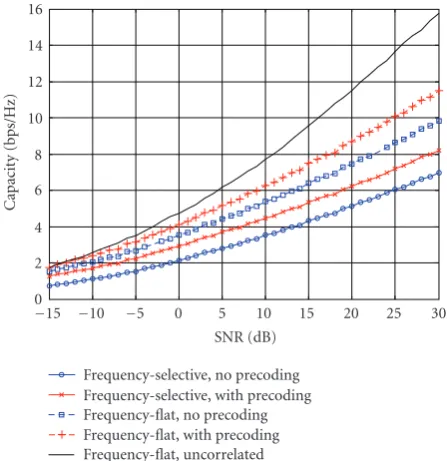
As an illustrative example, we consider a MIMO system with 2 transmit and 2 receive antennas (M = N = 2) in both frequency-flat and frequency-selective fading channels. The frequency-selective fading channel under consideration is represented by a 2-path model (L=2). Furthermore, we assume that the channel paths are temporally uncorrelated.
Figures3and4illustrate the achievable capacity curves. For benchmark purpose, the capacity curve of an uncorre-lated frequency-flat fading channel is also included. In both cases, precoders designed for flat and frequency-selective fading channels offer noticeable increases in the er-godic capacity of the system. In the case of partially cor-related channel, the curves are closer to the uncorcor-related frequency-flat fading case. On the other hand, the precoders perform better when the channels are highly spatially corre-lated.
5. CONCLUDING REMARKS
We investigated the importance of eigenvalues of spatial cor-relation matrices on the ergodic capacity of frequency-flat and -selective MIMO channels. We showed that the ergodic capacity depends greatly on the eigenvalue distribution of spatial correlation matrices. In other words, knowing the eigenstructure of correlation matrices at the transmitter is very important to enhance the capacity of the system. Based on this fact, we first investigated the effect of eigenvalues distribution of spatial and path correlation matrices on the capacity of frequency-flat and -selective channels. Next, we introduced a linear scheme known as linear precoding that can enhance the ergodic capacity of the channel by chang-ing the eigenstructure of the channel by applychang-ing a linear transformation. We derived the structures of precoders us-ing eigenvalue decomposition and linear algebra techniques in both cases and show their similarities from an algebraic point of view. Simulations showed the ability of this tech-nique to change the eigenstructure of the channel, and hence to enhance the ergodic capacity considerably.
REFERENCES
[1] D. Chizhik, G. J. Foschini, M. J. Gans, and R. A. Valenzuela, “Keyholes, correlations, and capacities of multi-element trans-mit and receive antennas,”IEEE Transactions on Wireless Com-munications, vol. 1, no. 2, pp. 361–368, 2002.
[2] D. Gesbert, H. B¨olcskei, D. A. Gore, and A. J. Paulraj, “Out-door MIMO wireless channels: models and performance prediction,” IEEE Transactions on Communications, vol. 50, no. 12, pp. 1926–1934, 2002.
[4] A. O. Boukalov and S. G. H¨aggman, “System aspects of smart-antenna technology in cellular wireless communications: an overview,”IEEE Transactions on Microwave Theory and Tech-niques, vol. 48, no. 6, pp. 919–929, 2000.
[5] H. Sampath, P. Stoica, and A. J. Paulraj, “Generalized linear precoder and decoder design for MIMO channels using the weighted MMSE criterion,”IEEE Transactions on Communi-cations, vol. 49, no. 12, pp. 2198–2206, 2001.
[6] H. Sampath,Linear precoding and decoding for multiple input multiple output (MIMO) wireless channels, Ph.D. thesis, Stan-ford University, StanStan-ford, Calif, USA, May 2001.
[7] A. Scaglione, P. Stoica, S. Barbarossa, G. B. Giannakis, and H. Sampath, “Optimal designs for space-time linear precoders and decoders,”IEEE Transactions on Signal Processing, vol. 50, no. 5, pp. 1051–1064, 2002.
[8] H. Sampath and A. J. Paulraj, “Linear precoding for space-time coded systems with known fading correlations,” IEEE Communications Letters, vol. 6, no. 6, pp. 239–241, 2002. [9] S. Zhou and G. B. Giannakis, “Optimal transmitter
eigen-beamforming and space-time block coding based on chan-nel correlations,”IEEE Transactions on Information Theory, vol. 49, no. 7, pp. 1673–1690, 2003.
[10] H. R. Bahrami and T. Le-Ngoc, “Precoder design based on correlation matrices for MIMO systems,”IEEE Transactions on Wireless Communications, vol. 5, no. 12, pp. 3579–3587, 2006. [11] D. Gesbert, H. B¨olcskei, D. A. Gore, and A. J. Paulraj, “Out-door MIMO wireless channels: models and performance prediction,” IEEE Transactions on Communications, vol. 50, no. 12, pp. 1926–1934, 2002.
[12] I. E. Telatar, “Capacity of multi-antenna Gaussian channel,” Tech. Rep., Bell Labs, Murray Hills, NJ, USA, 1995.
[13] G. J. Foschini and M. J. Gans, “On limits of wireless commu-nications in a fading environment when using multiple an-tennas,”Wireless Personal Communications, vol. 6, no. 3, pp. 311–335, 1998.
[14] H. B¨olcskei, D. Gesbert, and A. J. Paulraj, “On the capacity of OFDM-based spatial multiplexing systems,”IEEE Transactions on Communications, vol. 50, no. 2, pp. 225–234, 2002. [15] T. M. Cover and J. A. Thomas,Elements of Information Theory,
John Wiley & Sons, New York, NY, USA, 1991.
[16] R. A. Horn and C. R. Johnson,Matrix Analysis, Cambridge University Press, New York, NY, USA, 1985.
[17] G. G. Raleigh and J. M. Cioffi, “Spatio-temporal coding for wireless communication,”IEEE Transactions on Communica-tions, vol. 46, no. 3, pp. 357–366, 1998.
[18] V. Kafedziski, “Capacity of frequency selective fading chan-nels with side information,” inProceedings of the 32nd Asilo-mar Conference on Signals, Systems and Computers, vol. 2, pp. 1758–1762, Pacific Grove, Calif, USA, November 1998. [19] K. Liu, T. Kadous, and A. M. Sayeed, “Orthogonal
time-frequency signaling over doubly dispersive channels,” IEEE Transactions on Information Theory, vol. 50, no. 11, pp. 2583– 2603, 2004.
Hamid Reza Bahramireceived his B.S. and M.S. degrees both in electrical engineering from Sharif University of Technology and University of Tehran in 2001 and 2003, re-spectively. He is currently a Ph.D. Candidate at McGill University. His research interest is in the area of wireless communications with emphasis on transmission techniques in MIMO systems.
Tho Le-Ngoc obtained his B.Eng. degree (with distinction) in electrical engineering in 1976, his M.Eng. degree in micropro-cessor applications in 1978 from McGill University, Montreal, and his Ph.D. degree in digital communications in 1983 from the University of Ottawa, Canada. During 1977–1982, he was with Spar Aerospace Limited, involved in the development and design of satellite communications systems.