Volume 2011, Article ID 283020,5pages doi:10.1155/2011/283020
Research Article
Improvement on EVESPA for Beamforming and Direction of
Arrival Estimation
Emmanuel Racine and Dominic Grenier
Department of Electrical and Computer Engineering, Laval University 1065, Avenue de la M´edecine, Qu´ebec (QC), Canada G1V 0A6
Correspondence should be addressed to Emmanuel Racine,[email protected]
Received 9 September 2010; Revised 18 January 2011; Accepted 22 February 2011
Academic Editor: Laurence Mailaender
Copyright © 2011 E. Racine and D. Grenier. This is an open access article distributed under the Creative Commons Attribution License, which permits unrestricted use, distribution, and reproduction in any medium, provided the original work is properly cited.
This paper presents an alternative estimation procedure of the generalized steering matrix of the sources in EVESPA, suitable for both beamforming and direction of arrival estimation. It is shown how the estimation of such a matrix can be restricted to that of its corresponding coefficient matrix in the signal subspace, providing both performance enhancement and computational complexity reduction. Performance comparison through numerical simulations is presented to confirm the effectiveness of the proposed procedure.
1. Introduction
The EVESPA algorithm was introduced by G¨onen et al. in [1] as an adapted version of VESPA to handle the case of coherent signals. Using fourth-order cumulants, this algorithm properly generates an unbiased estimation of the generalized steering matrix (GSM) B of the sources from which an analysis of the signal parameters can be performed for each coherent group in an independent fashion. The same estimation procedure is also undertaken in [2] as a means of computing the weights of an optimal beamformer capable of maximizing the signal-to-interference plus noise ratio (SINR) in a coherent environment. EVESPA has also been considered in [3] under a slight variation for the problem of direction of arrival (DOA) estimation in mobile communications, and in [4] where it was adapted for a two-dimensional scenario. Steps 1 to 7 in [2] describe the EVESPA algorithm where the M×G matrix B is considered in its whole. However, since the latter lies in the signal subspace, only the search of its correspondingG×Gcoefficient matrix proves sufficient. In this paper, we present a new estimation procedure of B based on this principle which is shown to bring significant performance enhancement both in terms of computational complexity and quality estimation.
Throughout the paper, “∗ and “†are, respectively,
used as the conjugate and Hermitian transpose operators, and nonscalar quantities such as vectors and matrices are labeled in bold.
2. Background Theory
In this section we recall the main guidelines of the EVESPA algorithm [1,2], as it will be assumed that the reader has a sufficient knowledge on the matter. The signal model used in this paper is the same as that used by the original authors, namely,
xk=Buk+nk, (1)
of signals impinging on theM-element array. Without loss of generality, matrixBmay be expressed as
B=AΞ=A1 A2 · · · AG ⎡ ⎢ ⎢ ⎢ ⎢ ⎢ ⎢ ⎢ ⎣
α1 0 · · · 0
0 α2 · · · 0 ..
. ... ...
0 0 · · · αG ⎤ ⎥ ⎥ ⎥ ⎥ ⎥ ⎥ ⎥ ⎦ , (2)
where Ag and αg are theM ×pg steering matrix and the pg×1 coefficients vector of theg-th coherent group. The total number of sources impinging on the array is thusGg=1pg. EVESPA may be suitable for any type of signals provided that a complex envelope of interestug(tk) admits a nonzero fourth-order cumulant, that is,
γ4,g=cum
ug(tk),u∗g(tk),ug(tk),u∗g(tk)
/
=0. (3)
The algorithm proceeds to the evaluation of the two cumu-lant matrices:
Cm=cumxm(tk),x1∗(tk),xk,x†k
, m∈ {1, 2}, (4)
from which an estimationB ofB is obtained by following steps 1 through 7 in [2]. Upon calculation of B, whose columns match those ofBto within scale and permutation, one can freely proceed to beamforming or DOA estimation as described in [1,2].
In the case of DOA estimation, the covariance matrix of theg-th coherent group of signals is first estimated asRxxg =
bgb†g, wherebg is theg-th column ofB. Spatial smoothing is then applied toRxxg in order to estimate the DOAs of that group. Any other DOA estimation algorithm could also be applied onceBhas been obtained from EVESPA.
In the case of beamforming, an optimum weight vector is initially computed as wg,opt = cgRxx−1bg, where Rxx is the covariance matrix of the received signals, and where cg = 1/(b†gR−xx1bg) is a constant ensuring a unit response in the “look” direction. This beamforming vector is then used to recover the elementary signalug(tk) of that particular group. Here again, any other beamforming scheme can be implemented after estimation ofB. One interesting example is that of the null steering beamformer [5], where the array response can be made null for all signals of a particular group instead of synthesizing nulls for each of these signals independently.
Note finally that although the EVESPA algorithm has been developed in a context of narrowband multipath prop-agation, its application remains valid in any environment provided that the received signals can be modeled as in (1), and that the appropriate requirements onB,uk, andnkbe met. Those are essentially given by assumptions A1 through A6 in [1], but can be summarized in a more general way as follows.
(i) Elementsug(tk), g ∈ {1, 2,. . .,G}, ofuk are statis-tically independent and possess a nonzero fourth-order cumulant.
(ii)BhasG≤Mcolumns linearly independent from one another.
(iii) The fourth-order cumulant of the noise vectornkis zero.
One interesting example of environment where the EVESPA algorithm may also be applied is that of narrowband near-field sources [6], where the signal model also finds its corre-spondence to (1). In this paper, though, we will focus on the description of an enhanced estimation procedure ofBwith the aim of improving performance for both beamforming and direction of arrival estimation in a coherent narrowband scenario, since each of these subjects were covered in [1,2]. Note however that this estimation procedure is general, and may in fact be applied regardless of the type of subsequent processing.
3. Proposed Estimation Procedure
Consider the covariance matrix of the received signals:
Rxx=E
xkx†k=BEuku†kB†+Enkn†k
≡BRuuB†+σn2I,
(5)
whereE{·}denotes the expected value operator. Note that
Ruu is always diagonal since uk is a vector of zero-mean and uncorrelated elements. Expressing Rxx in terms of its eigenvalue decomposition yields
Rxx=EsΛsE†s +σn2I, (6)
whereEsrepresents a set of orthonormal basis vectors of the signal subspace. From (5) and (6), it follows thatBcan be expressed in terms ofEssuch that
B=EsQ, (7)
whereQis aG×Gcoefficient matrix ensured to be full rank under assumptions A1 to A4 in [2]. In the same issue, it is also shown that matricesC1andC2of (4) evaluate to
C1=BΛB†, C2=BDΛB†, (8)
where Λ and D are both full-rank diagonal matrices. Our alternative estimation procedure begins by forming the two G×Gmatrices (recall from (7) thatE†sB=Q, sinceE†sEs=I)
C1=E†sC1Es=QΛQ†, C2=E†sC2Es=QDΛQ†, (9)
where Es is obtained from the eigenvalue decomposition (EVD) ofRxx. We now apply an estimation procedure similar to steps 2 through 7 in [2], but in the aim of identifyingQ. Consider for this the single value decomposition (SVD) of a 2G×GmatrixCsuch that
C=
⎡ ⎣C1
C2 ⎤ ⎦= ⎡ ⎣ Q QD ⎤
Table1: Summary of the main computational steps involved in the original EVESPA and the proposed estimation procedure.
Step Original EVESPA Proposed procedure
1 SVD ofC(2M×M) EVD ofRxx(M×M)
2 SVD of [U11U12](M×2G) SVD ofC(2G×G)
3 EVD of−FxF−1
y (G×G) EVD ofH(G×G)
4 Estimation ofB Estimation ofB
5∗ EVD ofRxx(M×M) —
6∗ Estimation ofB —
∗: Additional steps required for the covariance based improvement method
in [1]. This improvement is applied by default in steps 1 to 4 of the proposed procedure.
where matrixUmay be partitioned into
U=Us Un
, Un= ⎡ ⎣Un1
Un2 ⎤
⎦, (11)
and whereUn1andUn2are bothG×G. Since theGlast rows ofΣare zeros, it follows that
(C)†Un=Q†Un1+D∗Q†Un2=0, (12) which implies that
−Un1U −1 n2 =Q
−†D∗Q†≡H. (13)
Hence, the eigenvalues of H must match the diagonal elements ofD∗. If these elements are distinct, there exists a unique mapping betweenEH, the eigenvectors matrix ofH, andQ−†such that
EHZ†=Q−†, (14)
where Z is a scale permutation matrix containing only one non-zero element per line and column. Therefore, the columns ofE−†H =QZmatch those ofQto within scale and permutation and a straightforward estimation ofBbecomes
B=EsQ =EsE−†H . (15)
4. Performance Comparison
4.1. Computational Complexity. Table 1presents a summary of the main computational steps involved in both the original EVESPA and the proposed algorithm using their respective notations. It can be seen that the proposed procedure requires only one SVD, whereas two are required in the original EVESPA. Moreover, the only M-dependant decomposition involved in the proposed method is that of the initial EVD. Hence, as the number of sensors M increases for a fixed number of coherent groups G, there will obviously come a point where the proposed procedure outperforms the original EVESPA in terms of computational complexity. However, note that the final step of our proposed method involves the inverse of the nondiagonal matrix
2 4 6 8 10 12 14 16 18 20 0
0.1 0.2 0.3 0.4 0.5 0.6 0.7 0.8 0.9 1
M
N
o
rm
aliz
ed
ex
ecution
time
G=2 G=4 G=8 G=12
Figure1: Normalized execution time of the original EVESPA (solid lines) and the proposed estimation procedure (dashed lines) in terms ofMandG.
EH, which for a minimum value of G represents a higher complexity operation than (25) in [2]. Thus, the gain in computational complexity of our proposed method does not appear evident for low values ofM. In order to appreciate the computational complexity of each algorithm, Figure 1 displays their normalized average execution time curves for M ∈ {2, 3,. . ., 20} and M ≥ G ∈ {2, 4, 8, 12}, where each point was obtained from 20000 trials and randomly generated matricesC1,C2, andRxx. Note that even though the original EVESPA (without improvement) does not make use ofRxx, its computation does not increase the complexity of the proposed method since it already represents an intermediate step in the evaluation of bothC1andC2.
No improvement was considered for the original EVESPA. As expected, the performance of the proposed procedure is at its worse for low values ofMandGwhere it is slightly outperformed by the original EVESPA. However, this situation quickly changes asMandGincrease where the gain in computational complexity obtained with the proposed procedure becomes obvious. This could also have been predicted from Table 1. All in all, the proposed estimation procedure thus constitutes an improvement in terms of computational complexity over the original one.
4.2. Statistical Performance. SinceEscan be estimated from second-order statistics, we now show that the proposed esti-mation procedure achieves a better statistical performance than the original EVESPA. Consider the complex angle
Table2: Signal parameters used for the simulation ofFigure 2.
Groups θ α Groups θ α
1
40◦ 0.2 +j0.8
2
50◦ 0.9 +j0.3
68◦ 1 70◦ 1
80◦ 0.8−j0.5 90◦ 0.9−j0.3
115◦ 0.75 +j0.65 120◦ 0.8 +j0.7
130◦ 0.8−j0.2 135◦ 0.95
3
45◦ 1
4
60◦ 0.3−j0.8
65◦ 0.8−j0.7 85◦ 0.4 +j0.9
85◦ 0.7 +j0.7 105◦ 0.8 +j0.6
110◦ 0.65−j0.8 118◦ 0.9 +j0.7
125◦ 0.9 +j0.1 140◦ 1
obtained fromKsnapshots from either the original EVESPA or the proposed algorithm. It follows that
cosβg(K)= b
†
gbg(K) bgbg(K)
. (16)
Hence, under assumptions A1 to A4 in [2] and forG≤M, the MSE of this latter quantity can be computed as follow:
MSEcosβg(K)
=E1−cosβg(K) 2
≡eg. (17)
Ideally, |cos(βg(K))| = 1 meaning that bg and bg(K) are collinear. Using such a performance criterion, the best algorithm is thus the one that maximizes E{|cos(βg(K))|} for allgand a givenK <∞. Taking the average of (17) over G, a global RMSE criterion can thus be defined as
E=
1
G G
g=1
eg. (18)
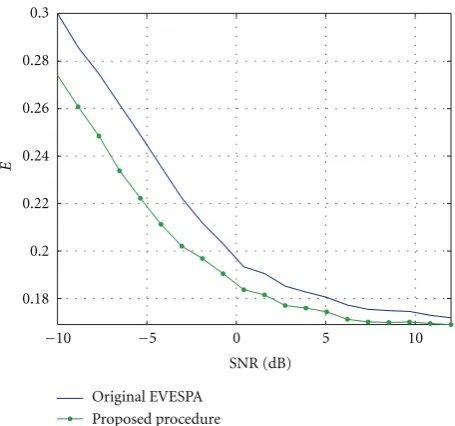
Figure 2 displays the RMSE curves of both the original EVESPA and the proposed algorithm obtained from 10000 runs of 50 snapshots for SNR values ranging from−10 dB to 12 dB. BPSK signals are considered using parameters of Table 2. The receiver consists of a ten-element uniform linear array (ULA) with equal power and independent AWGN on all elements. It can be seen that the proposed estimation procedure achieves a better performance than the original EVESPA for all SNRs, namely, becauseEsis estimated from second-order statistics which possess a lower variance than fourth-order statistics.
Note however that the use of second-order statistics as a means of improving the quality estimate of B was also considered inSection 4of [1], corresponding to steps 5 and 6 ofTable 1. Upon a first estimationBofB, a new estimation
B was computed such thatB = EsE†sB. The performance of such an estimator would have been similar to that of the proposed estimation procedure in Figure 2. However, the computational complexity involved in a first evaluation
Original EVESPA Proposed procedure 0.3
0.28
0.26
0.24
0.22
0.2
0.18
−10 −5 0 5 10
SNR (dB)
^E
Figure2: Statistical performance comparison between the original and the proposed estimation procedures.
ofB from the original procedure followed by an additional EVD ofRxx in order to computeEs would clearly become higher than that of the proposed algorithm. Hence, the latter does still represent an advantageous alternative in this context.
5. Conclusion
In this paper, we have shown how the original EVESPA algorithm could be improved both in terms of computational complexity and statistical performance by restricting the estimation of B to that of its corresponding coefficient
References
[1] E. G¨onen, J. M. Mendel, and M. C. Dogan, “Applications of cumulants to array processing—part IV: direction finding in coherent signals case,”IEEE Transactions on Signal Processing, vol. 45, no. 9, pp. 2265–2276, 1997.
[2] E. G¨onen and J. M. Mendel, “Applications of cumulants to array processing—part III: blind beamforming for coherent signals,”
IEEE Transactions on Signal Processing, vol. 45, no. 9, pp. 2252– 2264, 1997.
[3] H. Jiang, S. X. Wang, and H. J. Lu, “An effective direction estimation algorithm in multipath environment based on fourth-order cyclic cumulants,” inProceedings of the 5th IEEE Workshop on Signal Processing Advances in Wireless Communi-cations (SPAWC ’04), pp. 263–267, July 2004.
[4] C. Jian, S. Wang, and L. Lin, “Two-dimensional DOA estima-tion of coherent signals based on 2D unitary ESPRIT method,” in Proceedings of the 8th International Conference on Signal Processing (ICSP ’06), vol. 1, November 2006.
[5] L. C. Godara,Smart Antennas, CRC Press LLC, Boca Raton, Fla, USA, 2004.