Secure Two-party Threshold ECDSA
from ECDSA Assumptions
Jack Doerner
[email protected] Northeastern University
Yashvanth Kondi
[email protected] Northeastern University
Eysa Lee
[email protected] Northeastern University
abhi shelat
[email protected] Northeastern University
Abstract—The Elliptic Curve Digital Signature Algorithm (ECDSA) is one of the most widely used schemes in deployed cryptography. Through its applications in code and binary authentication, web security, and cryptocurrency, it is likely one of the few cryptographic algorithms encountered on a daily basis by the average person. However, its design is such that executing multi-party or threshold signatures in a secure manner is challenging: unlike other, less widespread signature schemes, secure multi-party ECDSA requires custom protocols, which has heretofore implied reliance upon additional cryptographic assumptions and primitives such as the Paillier cryptosystem.
We propose new protocols for multi-party ECDSA key-generation and signing with a threshold of two, which we prove secure against malicious adversaries in the Random Oracle Model using only the Computational Diffie-Hellman Assumption and the assumptions already relied upon by ECDSA itself. Our scheme requires only two messages, and via implementation we find that it outperforms the best prior results in practice by a factor of 56 for key generation and 11 for signing, coming to within a factor of 18 of local signatures. Concretely, two parties can jointly sign a message in just over three milliseconds.
I. INTRODUCTION
Threshold Digital Signature Schemes, a classic notion in the field of Cryptography [2], allow a group of individuals to delegate their joint authority to sign a message to any subcommittee among themselves that is larger than a certain size. Though extensively studied, threshold signing is seldom used in practice, in part because threshold techniques for standard signatures tend to be highly inefficient, reliant upon unacceptable assumptions, or otherwise undesirable, while bespoke threshold schemes are incompatible with familiar and widely-accepted standards.
Consider the specific case of the Elliptic Curve Digital Signature Algorithm (ECDSA), perhaps the most widespread of signatures schemes: all existing threshold techniques for generating ECDSA signatures require the invocation of heavy cryptographic primitives such as Paillier encryption [3]–[5]. This leads both to poor performance and to reliance upon as-sumptions that are foreign to the mathematics on which ECDSA is based. This is troublesome, because performance concerns and avoidance of certain assumptions often motivate the use
This document revises and expands a paper that appeared in the 2018 IEEE S&P Conference under the same title (doi:10.1109/SP.2018.00036, [1]). This version differs in that the protocol has been modified and reorganized in order to simplify our security analysis at the cost of a slight performance penalty, and the appendix now contains a complete proof of security.
of ECDSA in the first place. We address this shortcoming by devising the first threshold signing algorithm for ECDSA that is based solely upon Elliptic Curves and the assumptions that the ECDSA signature scheme itself already makes. Furthermore, we improve upon the performance of previous works by a factor of eleven or more.
ECDSA is a standardized [6]–[8] derivative of the earlier Dig-ital Signature Algorithm (DSA), devised by David Kravitz [9]. Where DSA is based upon arithmetic modulo a prime, ECDSA uses elliptic curve operations over finite fields. Compared to its predecessor, it has the advantage of being more efficient and requiring much shorter key lengths for the same level of security. In addition to the typical use cases of authenticated messaging, code and binary signing, remote login, &c., ECDSA has been eagerly adopted where high efficiency is important. For example, it is used by TLS [10], DNSSec [11], and many cryptocurrencies, including Bitcoin [12] and Ethereum [13].
A t-of-n threshold signature scheme is a set of protocols which allow nparties to jointly generate a single public key, along with n private shares of a joint secret key, and then privately sign messages if and only ift (some predetermined number) of those parties participate in the signing operation. In addition to satisfying the standard properties of signature schemes, it is necessary that threshold signature schemes be secure in a similar sense to other protocols for multi-party computation. That is, it is necessary that no malicious party can subvert the protocols to extract another party’s share of the secret key, and that no subset of fewer than tparties can collude to generate signatures.
The concept of threshold signatures originates with the work of Yvo Desmedt [2], who proposed that multi-party and threshold cryptographic protocols could be designed to mirror societal structures, and thus cryptography could take on a new role, replacing organizational policy and social convention with mathematical assurance. Although this laid the motivational groundwork, it was the subsequent work of Desmedt and Frankel [14] that introduced the first true threshold encryption and signature schemes. These are based upon a combination of the well-known ElGamal [15] and Shamir Secret-Sharing [16] primitives, and carry the disadvantage that they require a trusted party to distribute private keys. Pedersen [17] later removed the need for a trusted third party.
Frankel [14] recognized the difficulties inherent in designing threshold systems for standard signature schemes. Nevertheless, they later returned to the problem [18], proposing a non-interactive threshold system for RSA signatures [19]. This was subsequently improved and proven secure in a series of works [20]–[23]. Threshold schemes were also developed for Schnorr [24], [25] and DSA [26]–[28] signatures. Many of these schemes were too inefficient to be practical, however.
The efficiency and widespread acceptance of ECDSA make it a natural target for similar work, and indeed threshold ECDSA signatures are such a useful primitive that many cryptocurrencies are already implementing a similar concept in an ad-hoc manner [29]. Unfortunately, the design of the ECDSA algorithm poses a unique problem: the fact that it uses its nonce in a multiplicative fashion frustrates attempts to use typical linear secret sharing systems as primitives. The recent works of Gennaro et al.[4] and Lindell [3] solve this problem by usingmultiplicative sharing in combination with homomorphic Paillier encryption [30]; the former focuses on the general t-of-n threshold case, with an emphasis on the honest-majority setting, while the latter focuses on the difficult 2-of-2 case specifically. The resulting schemes (and the latter in particular) are very efficient in comparison to previous threshold schemes for plain DSA signatures: Lindell reports that his scheme requires only 37ms (including communication) per signature over the standard P-256 [8] curve.
Unfortunately, both Lindell and Gennaro et al.’s schemes depend upon the Paillier cryptosystem, and thus their security relies upon the Decisional Composite Residuosity Assumption. In some applications (cryptocurrencies, for example), the choice of ECDSA is made carefully in consideration of the required assumptions, and thus the use of a threshold scheme that requires new assumptions may not be acceptable. Additionally, if it is to be proven secure via simulation, Lindell’s scheme requires a new (though reasonable) assumption about the Paillier cryptosystem to be made. Furthermore, the Paillier cryptosystem is so computationally expensive that even a single Paillier operation represents a significant cost relative to typical Elliptic Curve operations. Thus in this work we ask whether an efficient, secure, multi-party ECDSA signing scheme can be constructed using only elliptic curve primitives and elliptic curve assumptions, and find the answer in the affirmative.
A. Our Technique
Lindell observes that the problem of securely computing an ECDSA signature among two parties under a public key pk can be reduced to that of securely computing just twosecure multiplications over the integers modulo the ECDSA curve order q. Lindell uses multiplicative shares of the secret key and nonce (hereafter called theinstance key), and computes the signature using the Paillier additive homomorphic encryption scheme. We propose a new method to share the products which eliminates the need for homomorphic encryption.
Recall the signing equation for ECDSA,
sig..=H(m) +sk·rx k
where m is the message, H is a hash function, sk is the secret key,k is the instance key, and rx is the x-coordinate of the elliptic curve pointR=k·G(Gbeing the generator for the curve). Suppose that k = kA·kB such that kA and
kB are randomly chosen by Alice and Bob respectively, and
R= (kA·kB)·G, and suppose thatsk=skA·skB. Alice and
Bob can learnR(and thusrx) securely via Diffie-Hellman [31] exchange, and they receivemas input. Rearranging, we have
sig=H(m)·
1
kA · 1
kB
+rx·
sk
A
kA ·skB
kB
which identifies the two multiplications on private inputs that are necessary. In our scheme, the results of of these multiplications are returned asadditive secret shares to Alice and Bob. Since the rest of the equation is distributive over these shares, Alice and Bob can assemble shares of the signature without further interaction. Alice sends her share to Bob, who reconstructssig and checks that it verifies.
To compute these multiplications, one could apply generic multi-party computation over arithmetic circuits, but generic MPC techniques incur large practical costs in order to achieve malicious security. Instead, we construct a new two-party multiplication protocol, based upon the semi-honest Oblivious-Transfer (OT) multiplication technique of Gilboa [32], which we harden to tolerate malicious adversaries. Note that even if the original Gilboa multiplication protocol is instantiated with a malicious-secure OT protocol, it is vulnerable to a simple selective failure attack whereby the OT sender (Alice) can learn one or more bits of the secret input of the OT receiver (Bob). We mitigate this attack by encoding the Bob’s input randomly, such that Alice must learn more than a statistical security parameter number of bits in order to determine his unencoded input.
Unfortunately Bob may also cheat and learn something about Alice’s secrets by using inconsistent inputs in the two different multiplication protocols, or by using inconsistent inputs between the multiplications and the Diffie-Hellman exchange. In order to mitigate this issue, we introduce a simple consistency check which ensures that Bob’s inputs correspond to his shares of the established secret key and instance key. In essence, Alice and Bob combine their shares with the secret key and instance keyin the exponent, such that if the shares are consistent then they evaluate to a constant value. This check is a novel and critical element of our protocol, and we conjecture that it can be applied to other domains.
Our signing protocol can easily be adapted for threshold signing amongnparties with a threshold of two. This requires the addition of a special n-party setup protocol, and the modification of the signing protocol to allow the parties to provide additive shares of their joint secret key rather than multiplicative shares. Surprisingly, this incurs an overhead equivalent to less than half of an ordinary multiplication.
B. Our Contributions
under the Computational Diffie-Hellman assumption. 2) We present an efficient two-party, two-round ECDSA
signing protocol that is secure under the Computational Diffie-Hellman assumption and the assumption that the resulting signature is itself secure. Since CDH is implied by the Generic Group Model, under which ECDSA is proven secure, we require no additional assumptions relative to ECDSA itself.
3) We formulate a new ideal functionality for multi-party ECDSA signing that permits our signing protocol to achieve much better practical efficiency than it could if it were required to adhere to the standard functionality. We reduce the security of our functionality to the security of the classic signature game in the Generic Group Model. 4) In service of our main protocol, we devise a variant of Gilboa’s multiplication by oblivious transfer tech-nique [32] that may be of independent interest. It uses randomized input-encoding along with a new consistency check to maintain security against malicious adversaries. 5) At the core of our multiplication protocol is an oblivious transfer scheme based upon the Simplest OT [33] and KOS [34] OT-extension protocols. We introduce a new check system to avoid the issues that have recently cast doubt on the UC-security of Simplest OT [35].
6) We provide an implementation of our protocol in Rust, and demonstrate its efficiency under real-world conditions. We find our implementation can produce roughly 320 signatures per second per core on commodity hardware.
C. Organization
The remainder of this document is organized as follows. In Section II we review essential concepts and definitions, and in Section III we discuss the ideal functionality that our protocols will realize. In Section IV we specify a basic two-party protocol, which we extend to support 2-of-nthreshold signing in Section V. In Section VI we describe the multi-plication primitive that we use. In Section VII we present a comparative analysis of our protocols. In Section VIII, we describe our implementation and present benchmark results. In the appendices we describe our OT primitive, further discuss the functionalities we use, and prove our protocols secure.
II. PRELIMINARIES ANDDEFINITIONS A. Notation and Conventions
We denote curve points with capitalized variables and scalars with lower case. Vectors are given in bold and indexed by subscripts, while matrices are denoted by bold capitals, with subscripts and superscripts representing row indices and column indices respectively. Thus xi is the ith element of the vector
x, which is distinct from the variable x. We use=to denote equality,..=for assignment,←for sampling an instance from a distribution, and ≡c to indicate computational indistinguishabil-ity for two distributions. Theithparty participating in a protocol
is denoted withPi, and when only two parties participate, they are called Alice and Bob for convenience. Throughout this document, we use κto represent the security parameter of the
elliptic curve over which our equations are evaluated, and we usesfor a statistical security parameter.
In functionalities, we assume standard and implicit bookkeep-ing. In particular, we assume that along with the other messages we specify, session IDs and party IDs are transmitted so that the functionality knows to which instance a message belongs and who is participating in that instance, and we assume that the functionality aborts if a party tries to reuse a session ID, send messages out of order, &c. We useslab-serifto denote message tokens, which communicate the function of a message to its recipients. For simplicity we omit from a functionality’s specifier all parameters that we do not actively use. So, for example, many of our functionalities are parameterized by a groupGof orderq, but we leave implicit the fact that in any given instantiation all functionalities use the same group.
Finally, we useHthroughout this document to denote a hash function, which is modeled as a random oracle. It takes the formHn :{0,1}∗ 7→
Znq. That is, the range of the function is n elements from Zq, where n is given as a superscript, and assumed to be 1 if absent. If a subscript is present in a call to H, then the function returns only the element from its output that is indexed by the subscript. Thus, for example, H2(x) = (H12(x), H22(x)).
B. Digital Signatures
Definition 1 (Digital Signature Scheme [36]).
ADigital Signature Scheme is a tuple of probabilistic polyno-mial time (PPT) algorithms,(Gen,Sign,Verify)such that:
1) Given a security parameterκ, theGen algorithm outputs a public key/secret key pair:(pk,sk)←Gen(1κ) 2) Given a secret keyskand a messagem, theSignalgorithm
outputs a signatureσ:σ←Signsk(m)
3) Given a message m, signatureσ, and public keypk, the Verify algorithm outputs a bit b indicating whether the signature is valid or invalid:b..=Verifypk(m, σ)
A Digital Signature Scheme satisfies two properties:
1) (Correctness) With overwhelmingly high probability, all valid signatures must verify. Formally, we require that over (pk,sk)←Gen(1κ) and all messagesm in the message
space,
Pr
pk,sk,m
h
Verifypk(m,Signsk(m)) = 1i>1−negl(κ)
2) (Existential Unforgeability) No adversary can forge a signature for any message with greater than negligible probability, even if that adversary has seen signatures for polynomially many messages of its choice. Formally, for all PPT adversariesAwith access to the signing oracle Signsk(·), whereQis the set of queriesAasks the oracle,
Pr
pk,sk "
Verifypk(m, σ) = 1∧m /∈Q:
(m, σ)← ASignsk(·)(pk)
#
<negl(κ)
C. ECDSA
The ECDSA algorithm is parameterized by a group Gof
finite field Zp of integers modulo a primep. The algorithm makes use of the hash function H. Curve coordinates and scalars are represented inκ=|q|bits, which is also the security parameter. A number of standard curves with various security parameters have been promulgated [8]. Assuming a curve has been fixed, the ECDSA algorithms are as follows [36]:
Algorithm 1. Gen(1κ):
1) Uniformly choose a secret key sk←Zq. 2) Calculate the public key aspk..=sk·G. 3) Output (pk,sk).
Algorithm 2. Sign(sk∈Zq, m∈ {0,1}∗):
1) Uniformly choose an instance keyk←Zq.
2) Calculate (rx, ry) =R..=k·G. 3) Calculate
sig..=H(m) +sk·rx k 4) Output σ..= (sig modq, rx modq).
Algorithm 3. Verify(pk∈G, m, σ∈(Zq,Zq)):
1) Parse σas (sig, rx). 2) Calculate
(r0x, ry0) =R0..=H(m)·G+rx·pk sig
3) Output 1 if and only if(r0x modq) = (rx modq).
The initial publication of the ECDSA algorithm did not include a rigorous proof of security; this proof was later provided by Brown [37] in the Generic Group Model, based upon the hardness of discrete logarithms and the assumption that the hash function H is collision resistant and uniform. Vaudenay [38] surveys this and other ECDSA security results, and Koblitz and Menezes provide some analysis and critique of the proof technique [39]. In this work, we simply assume that ECDSA is secure as specified in Definition 1.
D. Oblivious Transfer
Our construction uses a 1-of-2 Oblivious Transfer (OT) system, which is a cryptographic protocol evaluated by two parties: a sender and a receiver. The sender submits as input two private messages,m0andm1; the receiver submits a single bitb, indicating its choice between those two. At the end of the protocol, the receiver learns the message mb, and the sender learns nothing. In particular, the sender does not learn the value of the bit b, and the receiver does not learn the value of the message m¯b. 1-of-2 OT was introduced by Evanet al. [40], and is distinct from the earlier Rabin-style OT [41], [42]. For a complete formal definition, we refer the reader to Naor and Pinkas [43]. Beaver [44] later introduced the notion of OT-extension, by which a few instances of Oblivious Transfer can be extended to transfer polynomially many messages using only symmetric-key primitives. For reasons of efficiency, many modern protocols use OT-extension rather than plain OT.
III. TWOFUNCTIONALITIES
As our scheme is a multi-party computation protocol in the malicious security model, its security will be defined relative to an ideal functionality. Prior works on threshold ECDSA [3], [4] present a functionalityFECDSA that applies the threshold
model directly to the original ECDSA algorithms. The ECDSA Gen algorithm becomes the first phase of FECDSA, and the
ECDSASignalgorithm becomes the second.
Functionality 1. FECDSA:
This functionality is parameterized by a group Gof order
q (represented in κ bits) generated by G, as well as hash function H. The setup phase runs once with a group of parties{Pi}i∈[1,n], and the signing phase may be run many times between any two specific parties from this group. For convenience, we refer to these two parties as Alice and Bob.
Setup (2-of-n):On receiving(init)from all parties: 1) Sample and store the joint secret key,sk←Zq.
2) Compute and store the joint public key,pk..=sk·G. 3) Send(public-key,pk)to all parties.
4) Store (ready)in memory.
Signing:On receiving (sign,idsig,B, m) from Alice and (sign,idsig,A, m) from Bob, if (ready) exists in memory
but(complete,idsig)does not exist in memory: 1) Samplek←Zq and store it as the instance key. 2) Compute(rx, ry) =R..=k·G.
3) Compute
sig..= H(m) +sk·rx k
4) Collect the signature, σ..= (sig modq, rx modq). 5) Send(signature,idsig, σ)to Bob.
6) Store (complete,idsig)in memory.
Our scheme does not realize FECDSA, but instead a new
functionalityFSampledECDSA, which we have formulated to allow
us to build a protocol that requires only two rounds. It is well known that generic Multi-party Computation can computeany function in two rounds [45], [46] (or even one round, with a complex setup procedure), but the challenge is to do so efficiently. It is natural to use a Diffie-Hellman exchange to computeR, which would otherwise require expensive secure point multiplication techniques, but this precludes either a two-round protocol or use of the standard functionality for an intuitive reason: in the (basic) Diffie-Hellman exchange, Bob sends DB ..=kB·G to Alice, who replies to Bob with
DA ..=kA·G. Both Alice and Bob can computeR..=kA·kB·G.
While Alice cannot learn the discrete logarithm ofR, she does have the power to determine Ritself due to the fact that she chooses kA after having seenDB. This conflicts with FECDSA,
which requires that the functionality pick R. It is not obvious how to solve this without adding rounds or using a much more expensive primitive, though we conjecture that a more elaborate one-time setup procedure may provide a resolution. Instead, we have devisedFSampledECDSA. Relative toFECDSA,
allowing the parties to abort between them. In the first two parts, Alice and Bob initiate a new signature for a messagem, and a random instance key k is chosen by the functionality, along with R =k·G, which is returned to Alice. Alice is permitted to request a new sampling ofRfrom the functionality arbitrarily many times (with a negligible chance of receiving a favorable value), and to choose from the sampled set one value under which the signature will be performed. If neither party aborts, then in the third part the functionality will return a signature under the chosenR. This accounts for Alice’s ability to manipulate the Diffie-Hellman exchange, and yet it ensures that she does not know the discrete logarithm of the value that is eventually chosen, and that the value is uniform over G.
In Appendix C we prove in the Generic Group Model [47] that FSampledECDSA is no less secure than ECDSA itself. We
also believe that a four-round variant of our protocol can realize the FECDSA functionality directly.
Functionality 2. FSampledECDSA:
This functionality is parametrized in a manner identical to FECDSA. Note that Alice may engage in the Offset
Determination phase as many times as she wishes. Setup (2-of-n):On receiving(init)from all parties:
1) Sample and store the joint secret key sk←Zq. 2) Compute and store the joint public key pk..=sk·G. 3) Send (public-key,pk)to all parties.
4) Store (ready)in memory.
Instance Key Agreement:On receiving (new,idsig, m,B) from Alice and(new,idsig, m,A)from Bob, if(ready)exists in memory, and if (message,idsig,·,·) does not exist in memory, and if Alice and Bob both supply the same message mand each indicate the other as their counterparty, then:
1) SamplekB ←Zq.
2) Store (message,idsig, m, kB)in memory.
3) Send (nonce-shard,idsig, DB ..=kB·G) to Alice. Offset Determination: On receiving (nonce,idsig, i, Ri) from Alice, if(message,idsig, m, kB)exists in memory, but
(nonce,idsig, j,·)forj=i does not exist in memory: 4) Samplek∆
i ←Zq.
5) Store (nonce,idsig, i, Ri, k∆
i )in memory. 6) Compute k∆
i,A =k∆i /kB and send (offset,idsig, ki,∆A)
to Alice.
Signing:On receiving (sign,idsig, i, kA) from Alice and
(sign,idsig) from Bob, if (message,idsig, m, kB) exists in
memory and (nonce,idsig, j, Ri, ki∆) for j = i exists in memory, but(complete,idsig)does not exist in memory:
7) Abort if kA·kB·G6=Ri.
8) Set k..=kA·kB+ki∆and store (rx, ry) =R..=k·G. 9) Compute
sig..=H(m) +sk·rx k
10) Collect the signature,σ..= (sig modq, rx modq). 11) Send (signature,idsig, R, k∆
i , σ)to Bob. 12) Store(complete,idsig)in memory.
IV. A BASIC2-OF-2 SCHEME
We describe a simplified 2-of-2 version of our scheme initially, abstracting away the multiplication protocols for the sake of clarity. In Section V we extend our scheme to support 2-of-nthreshold signing. The fundamental structure of our 2-of-2 scheme is similar to that of Lindell [3] in that the signing protocol ingests multiplicative shares of both the private key and the instance key from each party.
A. Signing
Alice and Bob begin withm, the message to be signed, and multiplicative shares of a secret key (skAandskB respectively),
as well as a public keypkthat is consistent with those shares. The protocol is divided into four logical steps:
1) Multiplication: The parties transform multiplicative shares of the instance key into additive shares. A second multiplication converts multiplicative shares of the secret key divided by the instance key into additive shares. Due to the presence of the consistency check and verification steps (below), the multiplication protocols employed are not required to enforce correctness or consistency of inputs; thus we model multiplication viaFMul (given in
Section VI), which allows for well-specified cheating. To instantiate this functionality, we use the custom OT-based multiplication protocol that we describe in Section VI-B. 2) Instance Key Exchange:The parties calculateR=k·G
using a modified Diffie-Hellman exchange.
3) Consistency Check: The parties verify that the first multiplication uses inputs consistent with the Instance Key Exchange. This is achieved by adding a random pad φto Alice’s input, and then combining the pad with the multiplication output and the known value R in such a way that Bob can retrieve the pad only if he acted honestly. A second check ensures that the multiplications are consistent with each other and with the public key, by combining the multiplication outputs with the public key in the exponent.
4) Signature and Verification:The parties reconstruct the signature, which is given to Bob. If the signature verifies in the usual way, then Bob outputs it.
The Instance Key Exchange component implements the second and third phases of the FSampledECDSA functionality,
functionalityFRDL
ZK , which is specified in Appendix B. This can
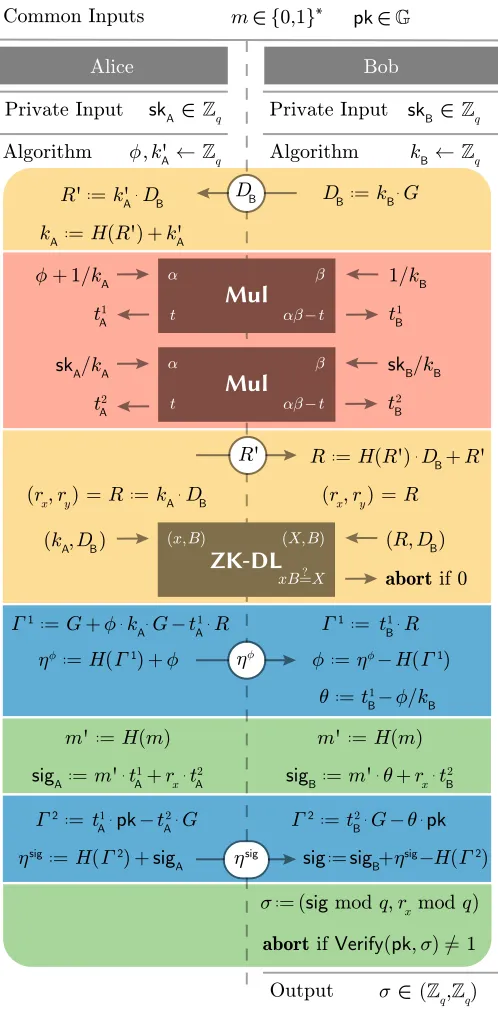
be concretely instantiated by a Schnorr proof [24] and the Fiat-Shamir [48] or Fischlin [49] transform. We give the signing protocol below, and in Figure 1 we provide an illustration, along with annotations indicating the logical component associated with each step.
Protocol 1. Two-party Signing π2PSign-ECDSA
:
This protocol is parameterized by the Elliptic curve(G, G, q)
and the hash functionH. It relies upon theFMul andFZKRDL
functionalities. Alice and Bob provide their multiplicative secret key sharesskA,skBas input, along with identical copies
of the messagem, and Bob receives as output a signature σ. Multiplication and Instance Key Exchange:
1) Bob chooses his secret instance key,kB ←Zq, and Alice
chooses her instance key seed,k0A←Zq. Bob computes DB..=kB·Gand sendsDB to Alice.
2) Alice computes
R0..=kA0 ·DB
kA..=H(R0) +kA0
R..=kA·DB
3) Alice chooses a padφ←Zq, and then Alice and Bob invoke the FMul functionality with inputs φ+ 1/kA and
1/kB respectively, and receive sharest1A and t1B of their
padded joint inverse instance key
t1A+t1B = φ kB
+ 1
kA·kB
Alice and Bob also invokeFMulwith inputsskA/kA and
skB/kB. They receive shares t2A and t
2
B of their joint
secret key over their joint instance key
t2A+t2B= skA·skB kA·kB
The protocol instances that instantiate FMul are
inter-leaved such that the messages from Bob to Alice are transmitted first, followed by Alice’s replies.
4) Alice transmits R0 to Bob, who computes
R..=H(R0)·DB+R0
For both Alice and Bob let (rx, ry) =R.
5) Alice submits(prove, kA, DB)toFZKRDL, and Bob
sub-mits (prove, R, DB). Bob receives a bit indicating
whether the proof was sound. If it was not, he aborts. Consistency Check, Signature, and Verification:
6) Alice and Bob both computem0=H(m).
7) Alice computes the first check value Γ1, encrypts her pad φwithΓ1, and transmits the encryption ηφ to Bob.
Γ1..=G+φ·kA·G−t1A·R
ηφ ..=H(Γ1) +φ
8) Alice computes her share of the signaturesigA and the second check value Γ2. She encryptssig
A with Γ2 and
then transmits the encryption ηsig to Bob
sigA ..= (m0·t1A) + (rx·t2A) Γ2..= (t1A·pk)−(t2A·G)
ηsig ..=H(Γ2) +sigA
9) Bob computes the check values and reconstructs the signature
Γ1..=t1B·R φ..=ηφ−H(Γ1)
θ..=t1B−φ/kB
sigB ..= (m0·θ) + (rx·t2B)
Γ2..= (t2B·G)−(θ·pk) sig..=sigB+ηsig−H(Γ2)
10) Bob uses the public keypkto verify thatσ..= (sig, rx) is a valid signature on message m. If the verification fails, Bob aborts. If it succeeds, he outputsσ.
On the Structure of the Consistency Check: Because the consistency check mechanism is non-obvious, we present an informal justification for it here. In Appendix F, we prove the mechanism formally secure. Suppose that we reorganized our protocol to omit Alice’s padφ. Then we would have
t1A+t1B= 1 kA·kB
t2A+t2B= skA·skB kA·kB
(t1A+t1B)·pk= (t2A+t2B)·G
If Bob behaves honestly, he should use 1/kB and skB/kB
as his inputs to the two multiplications. Suppose Bob cheats by using different inputs; without loss of generality, we can interpret his cheating as using inputsx+ 1/kB andskB/kB, in
essence offsetting his input for the first multiplication by some valuexrelative to his input for the second multiplication:
t1A+t1B= 1/k+x/kA
(t1A+t
1
B)·pk= (t
2
A+t
2
B)·G+x·pk/kA
To pass the consistency check, Bob would need to calculate pk/kA, which we show by means of a reduction is as hard as
breaking the Computational Diffie-Hellman problem.
In our hypothetical scenario, it is tempting to take advantage of the fact that(t1A+t1B)·R=Gto design a similar mechanism to verify that the first multiplication is consistent with the instance key exchange, but a check based upon this principle is insecure. Again, if we suppose that Bob cheats by offsetting his input for the multiplication by some valuexrelative to his input for the Diffie-Hellman exchange that producesR, then
t1A+t1B= 1/k+x/kA
(t1A+t1B)·R=G+x·kB·G
abort if Verify(pk,σ) /= 1
Mul
α
t αβ−t
β
φ+1/kA
tA1
1/kB
tB1
skA/kA
tA2
skB/kB
tB2
Mul
α
t αβ−t
β
kB←Zq
skA∈Zq
Alice Bob
Private Input Private Input
Algorithm Algorithm Common Inputs
skB∈ Zq
pk∈G
m∈{0,1}*
m':= H(m) m':= H(m)
sig:= sig
B+η
sig−H(Γ2)
σ:= (sig mod q, rx mod q)
Output σ∈ (Zq,Zq)
sigA:= m'·tA1+r
x·tA2
Γ1:= t B
1 ·R φ, k'A←Zq
DB:= kB·G DB
R':= k' A·DB
kA:= H(R' )+k'A
R' R:= H(R' )·DB+R'
(rx, ry) = R (rx, ry) = R:= kA·D
B
Γ1 := G+φ·k A·G−tA
1 ·R
sigB:= m'·θ+rx·tB2
ηsig:= H(Γ2)+sig
A η
sig
ηφ:= H(Γ1)+φ ηφ φ:= ηφ
−H(Γ1)
Γ2 := t B
2 ·G−θ· pk Γ2:= t
A
1 ·pk−t
A
2 ·G
θ:= tB1−φ/k
B
(kA,DB) (R,DB)
ZK-DL
(x,B)
xB=X
(X,B)
? abort if 0
Fig. 1: Illustrated Two-party Signing Scheme. Operations are
color-coded according to the logical component with which
they are associated: Multiplication , Instance Key Exchange ,
Consistency Check , and Verification/Signing . We specify how to instantiate the multiplication subprotocol(πMul)in Section VI-B.
equation a term that Bob cannot predict. Alice intentionally offsets her input to the multiplication using a padφ, giving us the system presented in πSign2P-ECDSA. If Bob is honest, then
t1A+t1B= 1/k+φ/kB
t1B·R=G+φ·kA·G−t1A·R
which implies that both Alice and Bob can compute t1
B·R.
On the other hand, if Bob is dishonest, then
t1A+t1B = 1/k+φ/kB+x/kA+x·φ
t1B·R=G+φ·kA·G+x·kB·G+x·φ·R−t1A·R
Because x is unknown to Alice and φ is unknown to Bob, neither party is capable of calculating the offset that has been induced. Consequently, if Alice masks φusing the value of t1
B·R that sheexpectsBob to have, then he will be able to
remove the mask and retrieveφif and only if he has behaved honestly. Without knowledge ofφ, he will not be able to pass the second consistency check or reconstruct the signature. We note that there is an assumption of circular security in this construction, which we resolve via the Random Oracle Model.
B. Setup
We now present a simplified setup protocol for two parties. This protocol does not implement the setup phase of the
FSampledECDSA functionality, as it does not support threshold
signing (we extend it to do so in Section V), but it does provide a similar functionality to the setup protocol of Lindell [3]. In short, it implements the ECDSA Gen algorithm, combining multiplicative secret key shares via a simple Diffie-Hellman key exchange. Proofs of knowledge are necessary in order to ensure that if the protocol completes then the parties are capable of signing; in addition to theFRDL
ZK functionality, this
protocol makes use of a commit-and-prove variant FRDL
Com-ZK,
which is specified in Appendix B. Finally, the parties notify theFMul functionality that they are ready, which corresponds
to the initialization of OT-extensions.
Protocol 2. Two-party Setup πSetup 2P-ECDSA
:
This protocol is parameterized by the Elliptic curve(G, G, q), and relies upon theFMul,FZKRDL, and F
RDL
Com-ZK functionalities.
It takes no input and yields the secret key sharesskA andskB
to Alice and Bob respectively, along with the joint public key pkto both parties.
Public Key Generation:
1) Alice and Bob sample skA ← Zq and skB ← Zq, respectively, and then they compute pkA ..= skA ·G
andpkB..=skB·G.
2) Alice submits (com-proof,skA, G) to FComRDL-ZK, and
Bob becomes aware of Alice’s commitment.
3) Bob sendspkB to Alice and submits(prove,skB, G)to FRDL
ZK . Alice submits(prove,pkB, G), and receives a bit
indicating whether the proof was sound. If it was not, she aborts.
4) Alice sendspkA to Bob and instructsFRDL
Com-ZKto release
the proof associated with her previous commitment. Bob submits (prove,pkA, G), and receives a bit indicating whether the proof was sound. If it was not, he aborts. 5) Alice and Bob computepk..=skA·pkB=skB·pkA. Auxilliary Setup:
6) Alice and Bob both send the (init) messages to the
V. 2-OF-nTHRESHOLDSIGNING
We now demonstrate a simple extension of our two-party ECDSA protocol for performing threshold signatures among n parties, with a threshold of two. With this extension, our protocol realizes the FSampledECDSA functionality that we
gave in Section III. In πSetup
2P-ECDSA, Alice and Bob supplied
multiplicative shares skA andskB of their joint secret key. In
the threshold setting we will be working with a set of parties
P of size n, each party i with a secret key share ski, and we demand that if the setup does not abort then any pair of parties can sign. In order to achieve this, we specify that in the threshold setting, the joint secret key skis calculated as the sum of the parties’ contributions, rather than as the product:
sk..=X i∈[1,n]
ski
In other words, the parties’ individual secret keys represent an n-of-nsharing ofsk. It is natural to use a threshold secret sharing scheme to convert these into a 2-of-nsharing. Specifically, we use Shamir Secret Sharing [16], and a simple consistency check allows us to guarantee security against malicious adversaries. From Shamir shares, any two parties can generate additive shares of the joint secret key. However, our 2-of-2 signing protocol (πSign
2P-ECDSA) required multiplicative shares as its input.
We will need to modify the signing protocol slightly to account for the change. First, we present our 2-of-n setup procedure.
A. Setup
Protocol 3. 2-of-n Setup π2P-Setup
nP-ECDSA
:
This protocol is parameterized by the Elliptic curve(G, G, q), and reliesFMul and FComRDL-ZK functionalities. It runs among a
group of partiesP of sizen, taking no input, and yielding to each partyPi a pointp(i)on the polynomialp, a secret key shareski, and the joint public keypk.
Public Key Generation:
1) For alli∈[1, n], Party Pi samples ski←Zq.
2) For all i∈[1, n], PartyPi calculatespki ..=ski·Gand submits(com-proof,ski, G)toFRDL
Com-ZK, which notifies
the other parties thatPiis committed. WhenPibecomes aware of all other parties’ commitments, it sends pki to the other parties and instructs FRDL
Com-ZKto release its
proof to them. All other parties submit (prove,pki, G) and receive a bit indicating whether the proof was sound. If any party’s proof fails to verify, then all parties abort. 3) All parties compute the shared public key
pk..=X i∈[1,n]
pki
4) For alli∈[1, n],Pichooses a random line given by the degree-1 polynomial pi(x), such thatpi(0) =ski. For all j∈[1, n],Pi sendspi(j)toPj and receives pj(i).
5) For alli∈[1, n],Pi computes its point
p(i)..=X j∈[1,n]
pj(i)
It also computes a commitment to its share of the secret key,Ti..=p(i)·G, and broadcastsTito all other parties. 6) All parties abort if there existsi∈[2, n] such that
λ(i−1),i·Ti−1+λi,(i−1)·Ti6=pk
whereλ(i−1),iandλi,(i−1)are the appropriate Lagrange coefficients for Shamir-reconstruction betweenPi−1and
Pi. If any party holds a point p(i) that is inconsistent with the polynomial held by the other parties, then this check will fail.
Auxilliary Setup:
7) Every pair of partiesPi andPj such thati < j send the(init)message to the FMul functionality.
A Note on General Thresholds: We note that a slight generalization of theπ2P-Setup
nP-ECDSA protocol allows it to perform
setup for any thresholdt such thatt≤n. The only required changes are the use of polynomials of the appropriate degree (as in Shamir Secret Sharing), and the evaluation of the consistency check in Step 6 over contiguous threshold-sized groups of parties. However, our signing protocol is not so easily generalized; therefore we leave general threshold signing to future work, and focus here on the 2-of-n case.
B. Signing
Once the setup is complete, suppose two parties from the set
P (we will resume referring to them as Alice and Bob) wish to sign. They can use Lagrange interpolation [50] to construct additive shares t0A and t0B of the secret key, but the signing algorithm we have previously described requiresmultiplicative shares. To account for this, we modify our signing algorithm in the following intuitive way: originally, the second invocation ofFMul tookskA/kA from Alice and skB/kB from Bob and
computed additive shares of the product skA·skB
kA·kB
We replace this with two invocations ofFMul that calculate
t0
A
kA·kB
and t
0
B
kA·kB
respectively. Alice and Bob can then locally sum their outputs from these two multiplications to yield shares of
t0A+t0B kA·kB
=sk k
What follows is our 2-of-n signing protocol, in its entirety. We note that the Consistency Check, Signature, and Verification phase of this protocol is identical to the corresponding phase in theπSign
Protocol 4. 2-of-n Signing π2P-Sign
nP-ECDSA
: This protocol is parameterized identically toπSign
2P-ECDSA, except
that Alice and Bob provide Shamir-sharesp(A), p(B)ofsk as input, rather than multiplicative shares.
Key Share Reconstruction:
1) Alice locally calculates the correct Lagrange coefficient λA,B for Shamir-reconstruction with Bob. Bob likewise
calculates λB,A. They then use their respective points
p(A), p(B) on the polynomial p to calculate additive shares of the secret key
t0A ..=λA,B·p(A) t0B..=λB,A·p(B) Multiplication and Instance Key Exchange:
2) Bob chooses his instance key, kB ← Zq, and Alice chooses her instance key seed,k0A←Zq. Bob computes DB..=kB·Gand sendsDB to Alice.
3) Alice computes
R0..=kA0 ·DB
kA..=H(R0) +kA0
R..=kA·DB
4) Alice chooses a padφ←Zq, and then Alice and Bob
invoke the FMul functionality with inputs φ+ 1/kA and
1/kB respectively, and receive sharest1A and t1B of their
padded joint inverse instance key.
5) Alice and Bob invoke theFMul functionality with inputs
t0A/kAand1/kBrespectively. They receive sharest2aA, t
2a
B
of Alice’s secret key share over their joint instance key
t2aA +t2aB = t 0
A
kA·kB
6) Alice and Bob invoke theFMul functionality with inputs
1/kAandt0B/kBrespectively. They receive sharest2bA , t2bB
of Bob’s secret key share over their joint instance key
t2bA +t2bB = t 0
B
kA·kB
7) Alice and Bob merge their respective shares
t2A..=t2aA +t2bA t2B..=t2aB +t2bB 8) Alice transmits R0 to Bob, who computes
R..=H(R0)·DB+R0
For both Alice and Bob let (rx, ry) =R.
9) Alice submits(prove, kA, DB)toFZKRDLand Bob submits
(prove, R, DB). Bob receives a bit indicating that the
proof was sound. If it was not, he aborts. Consistency Check, Signature, and Verification:
10) Alice and Bob both computem0=H(m).
11) Alice computes the first check valueΓ1, encrypts her pad φwithΓ1, and transmits the encryption ηφ to Bob.
Γ1..=G+φ·kA·G−t1A·R
ηφ..=H(Γ1) +φ
12) Alice computes her share of the signaturesigA and the second check value Γ2. She encryptssig
A with Γ2 and
then transmits the encryption ηsig to Bob
sigA ..= (m0·t1A) + (rx·t2A) Γ2..= (t1A·pk)−(t2A·G)
ηsig ..=H(Γ2) +sigA
13) Bob computes the check values and reconstructs the signature
Γ1..=t1B·R φ..=ηφ−H(Γ1)
θ..=t1B−φ/kB
sigB ..= (m0·θ) + (rx·t2B)
Γ2..= (t2B·G)−(θ·pk) sig..=sigB+ηsig−H(Γ2)
14) Bob uses the public keypkto verify thatσ..= (sig, rx) is a valid signature on message m. If the verification fails, Bob aborts. If it succeeds, he outputsσ.
VI. MULTIPLICATION WITHOT EXTENSIONS Both our 2-of-2 and 2-of-nsigning protocols depend upon a functionality that computes an additive sharing of the product of two inputs. We wish the protocol that implements this functionality to be secure against malicious adversaries and practically efficient in the non-amortized setting. Furthermore, if our signing protocols are to be only two messages overall, then our multiplication protocol must comprise a single message from Bob to Alice, followed by a reply, and no further interaction. These requirements preclude generic approaches such SPDZ [51] or MASCOT [52]. Instead, we devise a new variant of the classic Gilboa oblivious multiplication construction [32], which is based upon Oblivious Transfer. Whereas Gilboa’s original formulation is only semi-honest secure, our modified technique ensures security against active adversaries, while allowing one party to induce (simulatable) additive errors into the output, which can be detected via the final signature verification in the broader context of our signing scheme. Specifically, our multiplication protocol realizes the following multiplication-with-errors functionality.
Functionality 3. FMul:
This functionality is parameterized by the group orderq. It runs with two parties, Alice and Bob, who may participate in the Init phase once, and the Bob-input and Multiply phases as many times as they wish.
Init:Wait for message (init) from Alice and Bob. Store (init-complete)in memory and send (init-complete)
to Bob.
and if β ∈ Zq, then sample tA ← Zq uniformly at random, store(bob-input,idmul, β, tA)in memory, and send
(bob-ready,idmul, tA) to Alice.
Multiply:On receiving (input,idmul, α, δ, c)from Alice, if there exists a message of the form(bob-input,idmul, β, tA)
in memory with the same idmul, and if (complete,idmul) does not exist in memory, and ifα, δ∈Zq and c∈Z∗ such
thatc≥1 ⇐⇒ δ6= 0, then:
1) Toss c coins, and if any of them output 1, then send (cheat-detected)to Bob.
2) Otherwise, calculate tB ..= α·β +δ−tA and send
(output,idmul, tB)to Bob.
3) Store (complete,idmul)in memory.
A. Oblivious Transfer
In order to improve the practical efficiency of our algorithm, we base our multiplier upon Correlated Oblivious Transfer Extensions rather than traditional OT. Whereas in plain OT, the sender provides two messages, in Correlated OT, the sender provides one correlation (in our case, an additive correlation), and the messages are generated randomly under this constraint. What follows is a Correlated OT-extension functionality that allows arbitrarily many Correlated OT instances to be executed in batches of size `. For each batch, the receiver inputs a vector of choice bits ω∈ {0,1}`, following which the sender inputs a vector of correlations α ∈ G1×G2× . . .×G` (each elementαi being in some agreed-upon group
Gi). The functionality samples ` random pads, each pad i
being from the corresponding groupGi, and sends them to the
sender. To the receiver it sends only the pads if the sender’s corresponding choice bits were 0, or the sum of the pads and their corresponding correlations if the sender’s corresponding choice bits were 1. Note that this functionality is nearly identical to the one presented by Kelleret al. [34], but we add flexible correlation lengths, an initialization phase, and the ability to perform extensions (each batch of extensions indexed by a fresh extension index idext) only after the initialization has been performed.
Functionality 4. F`
COTe:
This functionality is parameterized by the group orderq and the batch size`. It runs with two parties, a senderS and a receiverR, who may participate in the Init phase once, and the Choice and Transfer phases as many times as they wish. Init:On receiving(init)from both parties, store(ready) in memory and send(init-complete)to the receiver. Choice:On receiving choose,idext,ω
from the receiver, if choice,idext,·
with the same idext does not exist in memory, and if(ready)does exist in memory, and ifω is of the correct form, then send(chosen)to the sender and store choice,idext,ωin memory.
Transfer: On receiving transfer,idext,α from the sender, if a message of the form choice,idext,ω
exists in memory with the sameidext, and if complete,idext
does not exist in memory, and ifα is of the correct form, then:
1) Sample a vector of random padstS←G1×G2×. . .×G` 2) Send(pads,tS)to the sender.
3) Compute{tRi}i∈[1,`]..={ωi·αi−tSi}i∈[1,`]. 4) Send(padded-correlation,tR)to the receiver.
5) Store (complete,idext)in memory.
We instantiate this functionality using the protocol of Keller et al. [34]. As with all OT-extension protocols, a base-OT protocol is required. Here we use the Simplest OT protocol of Chou and Orlandi [33], which we modify by adding a new check, to overcome a weakness in the proof of the original formulation. The details of these protocols and of our modifications are given in Appendix A.
B. Single Multiplication
The classic Gilboa OT-multiplication [32] takes an input from Alice and an input from Bob, and returns to them additive secret shares of the product of those two inputs. It works essentially by performing binary multiplication with a single oblivious transfer for each bit in Bob’s input. Unfortunately, this protocol is vulnerable to selective failure attacks in the malicious setting. Alice can corrupt one of the two messages during any single transfer, and in doing so learn the value of Bob’s input bit for that transfer according to whether or not their outputs are correct. We address this by encoding Bob’s input with enough redundancy that learning s (a statistical security parameter) of Bob’s choice bits via selective failure does not leak information about the original input value. A bit-by-bit consistency check ensures that the parties abort with high probability if an inconsistent message is selected by Bob, and thus the probability that Alice succeeds in more than s selective failures is exponentially small. A proposition of Impagliazzo and Naor [53] gives us the following encoding scheme: for an inputβ of lengthκ, sampleκ+ 2srandom bits γ ← {0,1}κ+2s and take the dot product with some public random vector gR ∈
Zκ+2sq . Use this dot product as a mask for the original input. The encoding function is defined as
Algorithm 4. Encode(gR ∈
Zκ+2sq , β∈Zq): 1) Sampleγ← {0,1}κ+2s
2) Output Bits(β− hgR,γi)kγ
In Appendix E, we prove formally that this encoding scheme produces codewords with the property that even if one knows the message encoded, guessing any substring of a codeword is almost as hard as guessing a uniformly sampled string of the same length. We also prove that the following protocol realizes
FMul.
Protocol 5. Multiplication (πMul):
This protocol is parameterized by the statistical security parameters, the curve order q, and the symmetric security parameterκ=|q|. It also makes use of a coefficient vector
g = gGkgR, where gG ∈ Zκq is a gadget vector such that gG
functionalityF`
COTe. Alice supplies some input integerα∈Zq,
and Bob supplies some input integerβ∈Zq. Alice and Bob receive tA and tB ∈ Zq as output, respectively, such that tA+tB=α·β.
Encoding:
1) Bob encodes his input
ω..=Encode(gR, β)
2) Alice samplesαˆ←Zq and sets
α..={αkαˆ}j∈[1,2κ+2s]
Multiplication:
3) Alice and Bob access theF`
COTefunctionality, with batch
size `..= 2κ+ 2s. Alice plays the sender, supplyingα as her input, and Bob, the receiver, supplies ω. They receive as outputs, respectively, the arrays
n
tAj
ˆtAj
o
j∈[1,2κ+2s] and
n
tBj
ˆtBj
o
j∈[1,2κ+2s] That is,tAis a vector wherein each element contains the
first half of the corresponding element in Alice’s output from F`
COTe, andˆtA is a vector wherein each element
contains the second half. tB andˆtB play identical roles
for Bob.
4) Alice and Bob generate two shared, random values by calling the random oracle. As input they use the shared components of the transcript of the protocol that implements F`
COTe, in order the ensure that these values
have a temporal dependency on the completion of the previous step. In our proofs, we abstract this step as a coin tossing protocol.
(χ,χ)ˆ ←H2(transcript) 5) Alice computes
r..=nχ·tAj+ ˆχ·ˆtAj
o
j∈[1,2κ+2s] u..=χ·α+ ˆχ·αˆ
and sends randuto Bob 6) Bob aborts if
_
j∈[1,2κ+2s]
χ·tBj+ ˆχ·ˆtBj 6=ωj·u−rj
7) Alice and Bob compute their output shares
tA..= X
j∈[1,2κ+2s]
gj·tAj tB..=
X
j∈[1,2κ+2s]
gj·tBj
C. Coalesced Multiplication
The multiplication protocol described in the foregoing section supports the multiplication of only a single integer α by a single integer β, and in our two-party and 2-of-n signing protocols (πSign
2P-ECDSA and πn2PP--SignECDSA respectively) we invoke
the multiplication protocol two or three times. An optimization allows these multiple invocations to be combined at reduced cost, albeit by breaking some of our previous abstractions.
Consider first the case of two-party signing, wherein two multiplications must be performed. Each multiplication indi-vidually encodes its input, enlarging it by κ+ 2s bits, and then individually calls upon theF`
COTeCorrelated OT-extension
functionality with batch size`= 2κ+ 2s. The protocol that realizes this functionality incurs some overhead, proportionate to a security parameterκOT, and two multiplications performed in the naïve way incur this cost twice. However, we observe that two multiplication protocol instances can share a single invocation ofF`
COTesimply by doubling the batch size, thereby
reducing the extension cost by an amount proportionate toκOT. Furthermore, we observe that when the inputs are combined into a single extension instance, we can also combine the encodings of the inputs, reducing the overhead due to encoding from2κ+ 4sadditional OT instances to 2κ+ 2s. In a future version of this paper, we show that this coalesced encoding maintains security.
Algorithm 5.Encode2(gR∈
Zκ+2sq , β1∈Zq, β2∈Zq): 1) Sampleγ1← {0,1}κ,γ2← {0,1}κ,γ3← {0,1}2s 2) Output
Bits(β1− hgR,γ1kγ3i)kγ1
k Bits(β2− hgR,γ2kγ3i)kγ2kγ3
Further consider the case of 2-of-n signing, in which three multiplications are used to compute the products
α1·β1 α2a·β2 α2b·β1
Notice that in the first and third multiplications, Bob’s inputs are identical, while in the second it differs. Consequently, we can perform the third multiplication by extending the appropriate part Alice’s input, while keeping Bob’s input the same.
Protocol 6. Coalesced Triple Multiplication(πMul3):
This protocol is parameterized identically toπMul, except that
Alice supplies three inputs, α1, α2a, α2b and receives three outputs, t1
A, t
2a
A , t
2b
A . Bob supplies only two inputs, β
1, β2, and likewise receivest1
B, t
2a
B, t
2b
B . Encoding:
1) Bob encodes his input
ω..=Encode2(gR, β1, β2) 2) Alice samplesαˆ1,αˆ2a,αˆ2b←
Zq and sets
α..=nα1
αˆ
1
α
2a
αˆ
2ao j∈[1,2κ]
knα2b
αˆ
2bo j∈[1,2κ]
knα1
αˆ
1
α
2a
αˆ
2a
α
2b
αˆ
2bo j∈[1,2s] Multiplication:
3) Alice and Bob access theF`
COTefunctionality, with batch
as her input, and Bob, the receiver, supplies ω. Alice receives as output the array
n
t1Aj
ˆt1
Aj
t
2a
Aj
ˆ
t2aAjo
j∈[1,2κ]
knt2bAj
ˆt2b
Aj
o
j∈[1,2κ]
knt1Aj
ˆt
1
Aj
t
2a
Aj
ˆt
2a
Aj
t
2b
Aj
ˆt
2b
Aj
o
j∈[2κ,2κ+2s] and Bob receives a corresponding output array. The remainder of the protocol is identical toπMul, except that
the linear check process is repeated for each of the tuples
t1A,t1B,ˆt
1
A,ˆt
1
B
t2aA ,t2aB ,ˆt
2a
A ,ˆt
2a
B
t2bA ,t2bB ,ˆt
2b
A ,ˆt
2b
B
To compute three products in the naïve way, κ·(3κOT+ 24κ+ 24s+ 9) bits must be transferred, with a proportionate amount of computation being performed. Using our optimized, coalesced multiplication, onlyκ·(κOT+ 22κ+ 20s+ 5)bits must be transferred (again, with a proportionate amount of computation). Concretely, if we use κ = 256, s = 80, and κOT = 128 +s (this being the overhead induced by the OT-extension protocol; our choice follows KOS [34]), then the total communication is reduced from to 271.8 to 232.7 KiB.
VII. COSTANALYSIS
When all of the optimizations have been applied and all functionalities and sub-protocols have been collapsed, we find that our protocols have communication and computation costs as reported in Table I. Though we account completely for com-munications, we count only elliptic curve point multiplications and calls to the hash function H toward computation cost. We assume that both commitments and the PRG are implemented via the random oracle H, and that proofs-of-knowledge-of-discrete-logarithm are implemented via Schnorr protocols with the Fiat-Shamir heuristic.
The 2-of-n setup protocol is somewhat more complex than Table I indicates. Over its course, each of thenparties commits to and then sends a single proof-of-knowledge-of-discrete-logarithm to all other parties in broadcast and then verifies the n−1proofs that it receives. The parties then compute and send Lagrange coefficients to one another, which requires O(n2) (parallel) communication in total, and this pattern repeats for verification. Finally, each party evaluates a single KOS Setup instance with every other party, for (n2−n)/2 instances in total. The entire protocol requires four broadcast rounds, plus the messages required by the KOS Setup instances.
For ease of comparison, concrete communication costs for our signing protocol along with the signing protocols of Gennaroet al. [4], Bonehet al.[5], and Lindell [3] are listed in Table II. The former pair of schemes are related: Boneh et al. reduce the number of messages in Gennaro et al.’s signing protocol from six to four, with the goal of reducing the communication cost. Apart from requiring only two messages, our signing protocol requires roughly one seventh of the communication incurred by either.
Lindell’s signing scheme requires four messages and excels in terms of communication cost, only transferring a com-mitment, two curve points, two zero-knowledge proofs, and one Paillier ciphertext. However, the Paillier homomorphic operations it requires are quite expensive. Lindell’s scheme requires one encryption, one homomorphic scalar multiplica-tion, and one homomorphic addition with a Paillier modulus N > 2q4+q3; concretely, a standard 2048-bit modulus is sufficient for a 256-bit curve. Gennaroet al.and Bonehet al.’s schemes both require one to three encryptions and three to five homomorphic additions and scalar multiplications per party, withN > q8, which likewise implies that for 256-bit curves, a 2048-bit modulus is sufficient. In addition, Lindell’s protocol requires 12 Elliptic Curve multiplications, while the protocols of the other two require roughly 100. These Paillier and curve operations dominate the computation cost of the protocols.
VIII. IMPLEMENTATION
We created a proof-of-concept implementation of our 2-of-2 and 2-of-nsetup and signing protocols in the Rust language. As a prerequisite, we also created an elliptic curve library in Rust. We use SHA-256 to instantiate the random oracle H, per the ECDSA specification, and in addition we use it to instantiate the PRG. As a result, our protocol makes no concrete cryptographic assumptions other than those already required by ECDSA itself. The SHA-256 implementation used in signing is capable of parallelizing vectors of hash operations, and the 2-of-nsetup protocol is capable of parallelizing OT-extension initializations, but otherwise the code is strictly single-threaded. This approach has likely resulted in reduced performance relative to an optimized C implementation, but we believe that the safety afforded by Rust makes the trade worthwhile.
We benchmarked our implementation on a pair of Amazon C5.2xlarge instances from Amazon’s Virginia datacenter, both running Ubuntu 16.04 with Linux kernel 4.4.0, and we compiled our code using Rust 1.27 with the default level of optimization. The bandwidth between our instances was measured to be be 5GBits/Second, and the round-trip latency to be 0.2 ms. Our signatures were calculated over the secp256k1 curve, as standardized by NIST [6]. Thus κ= 256, and we chose s = 80 and κOT = 128 +s, following the analysis of KOS [34]. We performed both strictly single-threaded benchmarks, and benchmarks allowing parallel hashing with three threads per party, collecting 10,000 samples for setup and 100,000 for signing. Note that signatures were not batched, and thus each sample was impacted individually by the full latency of the network. The average wall-clock times for both signing protocols and the 2-of-2 setup protocol are reported in Table III, along with results from previous works for comparison. These results are taken directly from their respective sources, and were not produced in our benchmarking environment. Nevertheless, we believe them to be comparable, due to the fact that they were collected using a similar type of hardware and in similar network conditions.
Rounds Communication (Bits) EC Multiplications Hash Function Invocations
Alice Bob Alice Bob
2-of-2 Setup 5 κ·(5κ+ 11) + 6 3κ+ 6 2κ+ 6 6κ+ 4 6κ+ 4
2-of-2 Signing 2 κ·(κOT
+ 16κ+ 14s+ 10) + 3 7 9 2κOT
+ 24κ+ 20s+ 9 3κOT
+ 20κ+ 14s+ 9
2-of-nSigning 2 κ·(κOT
+ 22κ+ 20s+ 11) + 3 7 9 2κOT
+ 32κ+ 28s+ 9 3κOT
+ 24κ+ 18s+ 9
Max Min Max Min
2-of-nSetup 5 (n2−n)·(2.5κ2+ 8κ+ 4) nκ−κ+ 4 n+ 3 5nκ−5κ+ 1 4nκ−4κ+ 1
TABLE I:Communication and Computation Cost Equations For Our Protocol. We assume that the hash functionHis used to implement the PRG. Note that communication costs are totals for all parties over all rounds, whereas computation costs are given per party. In the 2-of-nprotocol the computation cost depends upon the identity of the party; consequently we give the minimum and maximum.
κ= 256 κ= 384 κ= 521
Lindell [3] 769 B 897 B 1043 B
This Work (2-of-2) 169.8 KiB 350.7 KiB 615.3 KiB
Gennaroet al.[4] ∼1808 KiB ∼4054 KiB ∼7454 KiB
Bonehet al.[5] ∼1680 KiB ∼3768 KiB ∼6924 KiB
This Work (2-of-n) 232.8 KiB 481.3 KiB 844.7 KiB
TABLE II:Concrete Signing Communication Costs. Assuming
2-of-nsigning for Gennaroet al.and Bonehet al., and 2-of-2 signing for the protocol of Lindell. For our protocols, we uses = 80and
κOT
= 128 +s.
This Work (3 threads) [3]
2-of-2 Setup 43.41 – 2435
2-of-2 Signing 3.26 3.12 36.8
This Work (3 threads) [4] [5]
2-of-nSigning 3.77 3.55 ∼650 ∼350
TABLE III: Wall-clock Times in Milliseconds over LAN, as
compared to the prior approaches of Lindell [3], Gennaroet al. [4], and Bonehet al.[5]. Note that hardware and networking environments are not necessarily equivalent, but all benchmarks were performed with a single thread except where specified.
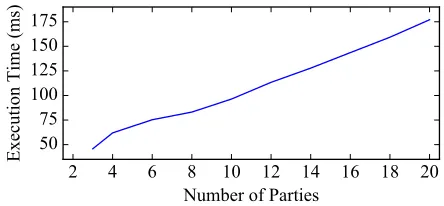
configured as before with one instance per party. For initializing OT-extensions, each machine was allowed to use as many threads as there were parties, but the code was otherwise single-threaded. We collected 1000 samples for groups of parties ranging in size from 3 to 20, and we report the results in Figure 2.
Transoceanic Benchmarks: We repeated our 2-of-2 setup, 2-of-2 signing, and 2-of-nsigning benchmarks with one of the machines relocated to Amazon’s Paris datacenter, collecting 1,000 samples for setup and 10,000 for signing, and in the latter case allowing three threads for hashing. In this configuration, the bandwidth between our instances was measured to be 155 Mbps and the round-trip latency to be 78.2 ms. In addition, we performed a 2-of-4 setup benchmark among four instances in
2
4
6
8
10 12 14 16 18 20
Number of Parties
50
75
100
125
150
175
Execution Time (ms)
Fig. 2:Wall Clock Times for 2-of-n Setup over LAN. Note that all 20 parties reside on individual machines in the same datacenter, and latency is on the order of a few tenths of a millisecond.
Setup Signing
2-of-2 2-of-4 (US) 2-of-10 (World) 2-of-2 2-of-n
354.36 376.86 1228.46 81.34 81.83
TABLE IV: Wall-clock Times in Milliseconds over WAN. All
benchmarks were performed between one party in the eastern US and one in Paris, except the 2-of-4 setup benchmark, which was performed among four parties in four different US states, and the 2-of-10 setup benchmark, which was performed among ten parties in America, Europe, Asia, and Australia.