CENTRE FOR
ADV
ANCED
SP
A
TIAL
ANAL
YSIS
W
orking Paper Series
Paper 59
TECHNIQUES FOR
AUGMENTING THE
VISUALISATION OF
DYNAMIC RASTER
SURFACES
Centre for Advanced Spatial Analysis University College London
1-19 Torrington Place Gower Street
London WC1E 6BT
[t] +44 (0) 20 7679 1782 [f] +44 (0) 20 7813 2843 [e] [email protected] [w] www.casa.ucl.ac.uk
http//www.casa.ucl.ac.uk/working_papers/paper59.pdf
Date: November 2002
ISSN: 1467-1298
© Copyright CASA, UCL
Techniques for augmenting the visualisation of dynamic raster surfaces
Sanjay Rana and Jason Dykes†
Centre for Advanced Spatial Analysis, University College London, 1-19 Torrington Place, London WC1E 6BT, UK
†
Department of Information Science, City University, London EC1V OHB
Techniques for augmenting the visualisation of dynamic raster surfaces
Sanjay Rana Jason Dykes
Centre for Advanced Spatial Analysis Department of Information Science
University College London City University
London WC1E 6BT London EC1V OHB
[email protected] [email protected]
Abstract
Despite their aesthetic appeal and condensed nature, dynamic raster surface representations
such as a temporal series of a landform and an attribute series of a socio-economic attribute of
an area, are often criticised for the lack of an effective information delivery and interactivity.
In this work, we readdress some of the earlier raised reasons for these limitations -
information-laden quality of surface datasets, lack of spatial and temporal continuity in the
original data, and a limited scope for a real-time interactivity. We demonstrate with examples
that the use of four techniques namely the re-expression of the surfaces as a framework of
morphometric features, spatial generalisation, morphing, graphic lag and brushing can
1. Introduction
Cartographers and researchers in the scientific- and cartographic- visualisation fields have
produced dynamic maps or animated maps over the last three decades, initially as paper-based
cartoons and, after the eighties, in the form of sophisticated 2D and 3D digital representations.
Although it is generally accepted that dynamic maps are a simple and appealing way of
providing a mental model of the dynamic information, their effectiveness has been debated
from as early as the 1960’s (Bertin, 1967). Recent works that have raised doubts on the
effectiveness of dynamic map include Slocum et al. (1990), Ogao and Kraak (2001), Ogao
and Block (2001), and Emmer (2001). Despite the general apprehension, there is a consensus
that the most suitable visual representation of large information collected over continuous
long period, such as weather (Earnshaw and Watson, 1993) and landscape processes (Mitas et
al., 1997), and multiple attributes would be an dynamic map. Other supporters of dynamic
maps including those who have suggested ways to alleviate the limitations of dynamic maps
include Hayward (1984), Koussoulakou (1990), Dibiase et al. (1992), McCloud (1993),
Peterson (1993), and MacEachren (1994).
Bertins’ main criticism of dynamic maps is that the presence of motion distracts a
user’s attention from the important visual variables such as size, colour, and others, thereby
resulting in a limited interpretation. In other words, a dynamic map necessitates an active
attention to interpret the stream of information. In response to this issue, Dibiase et al. (1992)
and MacEachren (1994) proposed the addition of controls called dynamic visual variables,
such as duration, rate of change, frequency, display time and others to manage the flux of
information available during an animation. In essence, the purpose of dynamic visual
variables is to allow a user-defined attention period to interpret the dynamic information.
However, in the absence of formal and generic guidelines on the use of these controls, we
believe that Bertins’ objection is still not satisfied.
Another demanding requirement and limitation has been the interactive visualisation
of the dynamic maps. Refer to Ware (2000) for an overview of the issues related to interacting
with visualisation. Despite the development of excellent two-dimensional (cdv – Dykes,
1999) and three-dimensional (Kreuseler, 2000) visualisation systems, interactivity in dynamic
maps remains a challenge. Recently, Ogao and Kraak (2001) and Ogao and Block (2001)
have objected about the passivity of dynamic map animations and thus raised issues such as
their limited exploratory capabilities.
We believe that the limitations mentioned above arise due to practical and conceptual
bottlenecks. Certainly, our hardware and software to render satisfactory animation with
interactivity in dynamic maps has been improving all the time (Earnshaw and Watson, 1993;
The conceptual limitations are more ill defined and vague but it is something we can address
without requiring a research expertise in hardware limitation. We posed the following two
conceptual questions to us:
(i) Is there an information overload (also raised by Gahegan, 1999), which is causing the
distraction and poor retention?
(ii) Could the lack of a spatial and temporal continuity within our dynamic map series be
the cause of a limited interpretation?
2. Methodology
2.1 Proposal
For simplicity, we decided to address a specific case of dynamic maps in our investigation
viz. The widely used raster surfaces e.g., digital elevation models (DEMs) and population
density surfaces. Formally, a surface in this work refers to a rasterised smooth doubly
continuous function (i.e., no holes or overhangs) of the form
z
=
f
(
x
,
y
)
, wherez
is theproperty (e.g., elevation, population density etc.) being mapped and associated with a point
)
,
(
x
y
. However, the proposals are generic enough to be applied for piece-wise surfaces aswell.
Dynamic raster surfaces can broadly belong to two types of dynamic map processes
namely the temporal series and the attribute series. A temporal series depicts the
transformation of a property of the surface from a state
z
at timet
to a state z' at time t'i.e.,
'
'
tt
z
z
→
... (1)On the other hand, by attribute series generally depicts the different states of a property say
z
and z' at a particular timet
i.e.,t t
z
z
→
'
... (2)For example, the animation of the evolution of a landscape over a period of time constitutes a
temporal series (Mitas et al., 1997) while the animation of the population density for the
different age groups of a city in a year should be regarded as an attribute series.
We will now introduce a visualisation strategy composed of three techniques for
2.1.1 Ensure high or increased spatial- and temporal- continuity
A coarse spatial- and thematic- resolution of raster surfaces results into a stepped appearance
that makes it difficult to understand and identify spatial patterns in the surfaces (Herzog,
1993). For instance, the population density surfaces in Figure 1 have spatial resolution of 200
m, which in a thematic sense has been found to be the most appropriate resolution for the
description of the distribution (URL#1) but it is clearly not appealing for the visualisation
purpose. While in temporal datasets, sometimes due to practical limitations the sampling of
surface datasets cannot be done frequently enough to create a continuous temporal series. This
leads to abrupt jumps in the visualisation of dynamic surfaces.
Openshaw et al. (1994) suggested the use of density estimation methods such as proposed
by Gatrell (1994) and Bracken (1994) for creating a smooth map display of socio-economic
data. In a recent work, Paddenburg and Wachowicz (2001) studied the use of spatial
generalisation to reduce noise in raster surfaces and concluded that this pre-processing reveals
the true information otherwise suppressed by the noise.
In this work, we suggest the use of visualisation-oriented solutions to create spatial and
temporal continuity in the surfaces. This basically means that we enhance the continuity with
out any knowledge of the surface’s particular process or model partly because this
information is generally missing in most datasets.
For spatial continuity, we fit a bivariate quadratic polynomial function (Wood, 1998)
through the surface to derive the smooth interpolated forms of the surface in the following
two ways:
(i) Interpolation to the current spatial resolution (Figure 2)
(ii) Interpolation to a higher spatial resolution (Figure 2)
A typical example of lack of temporal continuity in the case of a dynamic sand spit on
Norfolk coast is shown in Figure 3. Due to practical limitations the elevation data was
collected only twice a year although the sand spit undergoes constant denudation. One of the
common methods adopted to resolve the lack of a temporal continuity in the dynamic raster
surfaces has been the controlling the “Duration” and “Rate of Change” dynamic visual
variables to fill in the temporal gaps between successive surfaces. It helps but is not the
generic solution.
In this work, we propose and demonstrate the use of the technique of image morphing for
generating the intermediate surfaces. Image morphing is used widely in the computer graphics
field for moulding objects from a shape into another using sophisticated mathematical
(URL #2) provides tools for morphing both raster and vector surfaces. However, an academic
license of 3D studio Max costs approximately £200, requires suitable hardware and provides
minimal data interoperability to a cartographer.
We suggest the following two simple methods for generating the intermediate surfaces
between two surfaces separated by some time period.
(i) Linear interpolation of the change between the two end-surfaces
The value at a location of an intermediate surface could be derived by a linear
interpolation of the values at that location in the first or the last surface or it could be
a weighted combination of the values in the first and last surfaces. Parametrically i.e.,
Let,
g = Number of generations or intermediate surfaces
s
z
= z at time t=0e
z
= z at time t =g∴ using eq. 1 z at time t =iwhere0
≤
i
≥
g
g e s z z z
z = =
∴ 0,
In the case of linear equal-interval interpolation –
× − +
= z z z ig
zi s ( e s)
In the case of linear weighted interpolation –
e i e s i s
i w z w z
z = × + × ; wis =1−(i/g),wei =1−wsi
(ii) Non-Linear interpolation of the change between the first and last frame.
In this case, the fundamental concept remains as in (i) but the interpolation takes a
non-linear trend. It is expected that some sophisticated interpolations could even be
punctuated. We do not present any treatment of this approach in this work.
Our aim is to demonstrate the potentials of the morphing technique, which we do here
2.1.2 Highlight the information content
We the humans have an acute limitation in grasping parallel processes that characterise most
dynamic processes. Human cognition process especially the working memory (Ware, 2000)
can follow at most three to seven simultaneous cues (Ware, 2000). Tobler (1970) first
suggested that complicated processes could be broken down to simple rules. Dransch (2000)
suggested four functions, which could enhance the cognition processes in multimedia systems
viz., (i) Increase the important information, (ii) Avoid the overload of a single sense, (iii)
Support double encoding of information and (iv) support creation of mental models. We
believe that the underlying notions of these functions are applicable to our work. In our
proposal, we show an idea, which converges the functions (i), (ii) and (iv).
Two key information streams in a dynamic surface are the structure of the surface and the
local importance of points. In the most common representations of surfaces such as the colour
map and contour map, the delivery of the structural information is subjective to the contour
interval, spatial resolution and thematic resolution (Bajaj and Schikore, 1996).
Fowler and Little (1979) proposed that the fundamental morphometric feature networks
of a surface, constructed by connecting the peaks to passes with ridges and the pits to passes
with channels, are sufficient to describe the significant information about a surface. Later,
Helman and Hesselink (1991) and Bajaj and Schikore (1996) demonstrated that the
morphometric feature representation could enhance the visualisation of vector and scalar
surfaces significantly as compared to the colourmaps and contour maps. We suggest that the
re-expression of dynamic surfaces as morphometric feature networks will improve the grasp
of information flow in a dynamic map series. To put this in the terms of the proposal of
Dransch (2000), the morphometric feature re-expression will increase the important
information, reduce the information overload, which would help in creation of a better mental
model of the dynamic processes. Bajaj and Schikore (1996) summarised the following
advantages of using morphometric feature representation of surface:
(i) Contours and Colourmaps tend to wash out the information present within the contour
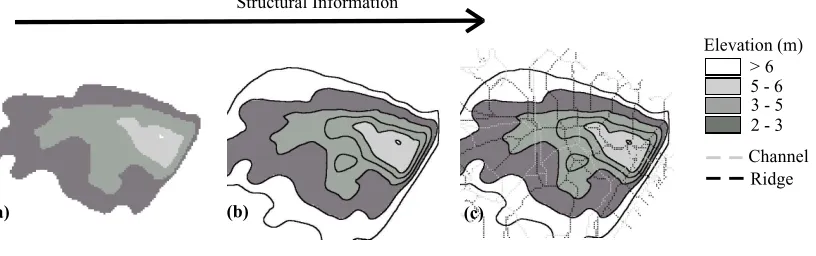
intervals and class intervals respectively. However, the morphometric features will
represent both the spatial and elevation structure of the surface (Figure 4).
(ii) Morphometric features are objective and scale invariant i.e., the definition of
morphometric feature doesn’t vary with scales.We suggest that the morphometric
(i) As the definition of morphometric feature is objective they can be used to reference
and monitor changes (quantification of movement). The use of the surface network
provides a frame of reference, which could be used to track changes in the surface for
example the rate of the displacement of the ridge lines over time could indicate the
behaviour of the surface under certain conditions (earthquakes, sea-level rise )The use
of a point and line representation of surfaces makes it more easy to follow the
dynamism in a surface as the human eye is particularly suited to monitor these
motions.2.1.2.1 Extraction of the morphometric features
Geographic Information Science and Computer Science researchers have suggested various
ways of extracting the peaks, pits, passes, ridges and channels. Wood (1996) has given a good
treatment for the various ways of extracting the topographic features. We briefly mention the
three popular methods for the classification of the points on the surface into the various
feature types:
(i) Manually by Digitising
This is the most tedious approach for the classification of the points and lines but it
remains as the final resort for the extraction of a structurally consistent (i.e., no
disconnected lines and unidentified points) set of the fundamental topographic
features from contour maps (Wolf, 1984). The automated classification of the
topographic feature suffers from a number of limitations arising out of data-specific
and algorithm-specific issues (Wood, 1998, Wood and Rana, 2000).
(ii) Triangulation
This method involves the triangulation of the surface points over a local
neighbourhood and comparing the elevations of a point with all its adjacent vertices.
The points are then classified based on this comparison (Douglas and Peucker, 1975;
Takahashi et. al., 1995).
(iii) Polynomial Surface Fitting
This method involves fitting a smooth surface through the surface points and the
points are classified based on the curvature of the fitted surface (Wood, 1998). The
advantages of using a polynomial surface fitting, specifically the bivariate quadratic
surface fitting, are described by Wood (1996, 1998).
2.1.2.2 Issues related to feature extraction
It is well known that automated raster processing suffers from the limitation that the results of
centred at the study point, used to perform the processing. This has been termed in the
literature as the scale dependency of the feature extraction (Quattrochi and Goodchild, 1996).
The topographic features exist across various scales of magnitude. While, there have been
many efforts to model the scale-space (Lindeberg, 1994) of surfaces using wavelets
(Quattrochi and Goodchild, 1996; Starck et. al, 1998), Fractals (Emerson and Quattrochi,
2000), scale-space theory (Lindeberg, 1994), Quadtrees (Csillag, 1996) to-date a unified
treatment is not agreed upon. The triangulation based feature extraction method has the
limitation that it only triangulates over a 3 points x 3 points window therefore features of a
larger magnitude may remain undetected. In contrast, the bivariate quadratic surface fitting
has the advantage that window size can be increased/decreased iteratively until a visually
acceptable level of extraction has been achieved. However, it is clear that the extraction of the
features at all the scales cannot be guaranteed.
2.1.3 Ensure periodicity and interactivity
In this proposal, our aim is to provide ways in which the information delivery can be adjusted
to data-specific and user-specific learning requirements. There is always a danger with points
and lines based dynamic maps that the duration of their display may not be suitable for
data-specific requirements (e.g., too much change displayed too much quickly) or user-data-specific
requirements (e.g., beginners). Previously, Dibiase et al. (1992) and MacEachren (1994)
proposed the use of dynamic visual variables such as moment, duration and others, which
could be used to control the information delivery pace. Openshaw et al. (1994) proposed the
idea of a progressive decay of luminosity with time until the points or symbols disappear
altogether after some fixed time. We introduce a similar capability called graphic lag
between successive events that provides more flexibility in the map interpretation process.
This has been widely in the video media as the Fading in and Fading out effect. Such a
control will provide a reference for the grasping the change, which could be useful in
observing the evolution of the map. Technically graphic lag would control the lag in time for
which a previous graphic remains on the display until the new one appears. The essential aim
of the graphic lag is to augment the working memory (Ware, 2000).For interactivity, we
propose the use of application programming environments such as Tcl/Tk (URL #3) that can
easily be coded to provide interactive graphic user interfaces (GUI) with sophisticated query
functionalities (Dykes, 1999).
The overall flow of the implementation process in our proposal is shown in Figure 5. For the
attribute series, we decided to compare the population density of an area Northeast of
Leicester, UK, between different age groups (Figure 1). The population density surfaces are
raster of 200m spatial resolution obtained from the Small Area Statistics Dataset maintained
by the Census Dissemination Unit at the Manchester Information and Associated Services,
UK.
For the temporal series, we obtained the DEM of an active sand spit located at the
Scolt Head, Norfolk coast, UK, to model a temporal series. The point elevation data was
collected by Jonathan Raper based at City University (For a more detailed treatment of this
dataset refer to Raper, 2000) twice a year from 1992 to 1999 (Figure 2).
2.2.1 Increasing the spatial and temporal continuity
The population density surfaces of 200m spatial resolution were interpolated into 50m (i.e.,
interpolation to a higher spatial resolution) and 200m (i.e., interpolation to the existing spatial
resolution) spatial resolutions using the software LandSerf. LandSerf is a freeware developed
by Jo Wood (URL #4) provides functions for a bivariate quadratic interpolation of a raster
surface to an arbitrary spatial resolution.
The point elevation data were gridded into raster format of 6.6m spatial resolution
using Inverse Distance Weighted interpolation in the software ArcView (URL #5). This
particular spatial resolution was calculated by ArcView to be suitable to cover the geographic
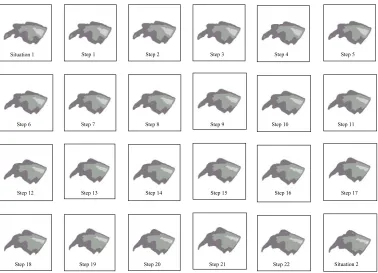
extent of the point dataset. Thereafter, the temporal gap (7 months) in each pair of
consecutive surfaces was filled with 22 intermediate surfaces by morphing the first surface in
the pair into the last surface in the pair. Morphing was done in ArcView using ArcViews’
scripting language Avenue. The user has the flexibility to specify the number of intermediate
surfaces and any number of pairs of consecutive surfaces. Perspective view of all the surfaces
was then generated using the 3D Analyst Extension in ArcView to visualise the terrain
denudation processes better. Screen grabs of a sequence of perspective grabs was then
converted into animation using the software Animation Shop (URL# 6). However, it will be
trivial to assemble all above steps into one single Avenue script in ArcView.
2.2.2 Morphometric feature extraction
The morphometric features were extracted from the population density and elevation surfaces
using the software LandSerf (URL #4). LandSerf utilises the polynomial surface fitting
extract the features defines the spatial extent of the surface’s structure yielded by the feature
extraction process. A filter size of 9 i.e., 450 m x 450 m, was used to extract the
morphometric features in the population density surfaces. In the case of elevation rasters, after
a few iterations with different filter window sizes and visual inspection a 7 x 7 window i.e.,
46.2m x 46.2m, was observed to be suitable for representing the elevation structure.
2.2.3 Graphic Lag
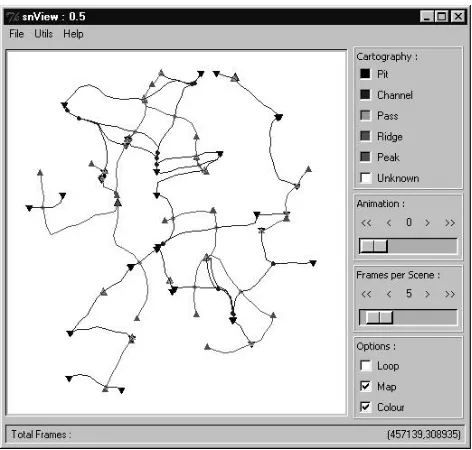
Graphic Lag has been implemented in an application called surface network
visualisation (SNV) (Figure 6; URL #6) developed by JD in Tcl/TK. The input in the
SNV is the morphometric feature dataset of the temporal and attribute series.
Sometimes the feature dataset, especially the ridges and channels, could have too
many vertices, which slows down the performance of the SNV. Therefore, a simple
line simplification utility has been built-in the SNV, which can downsample a ridge or
channel by skipping a user-defined number of vertices. SNV provides the flexibility to
select a user-defined graphic lag and allows querying the features, while the animation
is on display.
3. Results
3.1 Temporal Series
Figure 7 shows an example of the temporal continuity achieved by morphing the February
1997 terrain into the September 1997 terrain. While we can feel the relief changes, however it
is not possible to assess the changes in the structure of the surface, as the structure is not
obvious from the field view. Figure 8 shows a part of the same sequence of the morphing with
the overlay of the surface network, in which the changes in the structure can be spotted,
especially note the detection of the evolution of minor morphometric features in the NE
otherwise suppressed in Figure 7. The animation can be viewed at
http://www.soi.city.ac.uk/~jad7/snv/. For a more detailed discussion on the
coastal-sedimentological processes at the sand spit refer to Livingstone and Raper (1999) and Raper
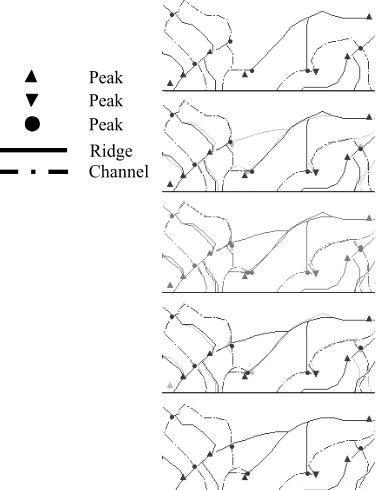
et al (1999). Figure 9 shows the application of graphic lag in monitoring the splitting of the
central ridge in the sandpit with a graphic lag of? frames (can we quantify graphic lag?). As
can be clearly seen the graphic lag prolongs the working memory about the splitting of the
3.2 Attribute Series
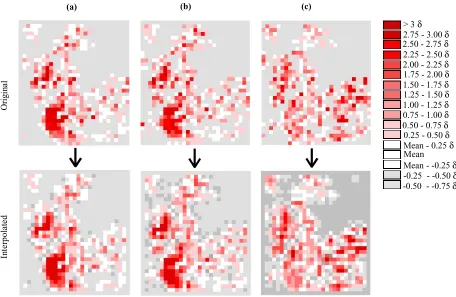
The interpolation of population density surfaces into 200m spatial resolution (Figure 10)
improves the spatial continuity from Figure 1 but the cell edges are still visible. However,
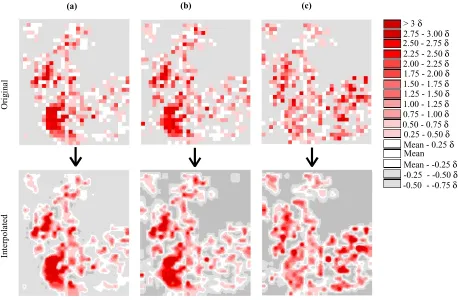
interpolation into 50m spatial resolution gives a much smoother appearance albeit it increases
the data file sizes by 4 times (Figure 11). As the morphometric feature extraction is based on
the curvature therefore, the smoother the local neighbourhood, the more reliable will be the
polynomial surface fitting. Therefore, we decided to use the 50m spatial resolution
interpolated surfaces.
During the morphometric feature extraction, the characteristic spatial distribution of
the different age groups was revealed successfully (Figure 12). The morphometric feature
representation of the population density surfaces reveals the following interesting
observations:
- The morphometric feature networks of the 5-15 years and 60+ years age group are
generally more sparse than the 15-59 years age group.
- Some of the local population density peaks suppressed in the colour maps (Figure
11) are revealed by the morphometric feature representation. For example see the
cluster of points in the NW quadrant with some of the highest deviation from the
average population density.
4. Conclusion and Future Work
Information visualisation is not a mathematical equation, which has fixed solution domain.
One could solve mathematical equations in many ways but all the methods have to achieve an
exactly same result. The definition of information lies in the “eye of the beholder”. Therefore,
we believe (at least SR does), a good information visualisation method will always be judged
based on its qualities for a particular application. Therefore, it would be most fruitful to
combine visualisation methods employed in various disciplines to propose a working model.
Dynamic maps are perhaps the most abused forms of cartographic representations
especially now with the availability of inexpensive sophisticated hardware and software (data
and applications). It may sound daring but we would like to pose the question that does an
average human has the physical capability to fully understand a dynamic maps, especially
with our limited cognitive capabilities for parallel processing?
However, getting back to our work, generally, there is a lack of guidance on the
optimal exploitation of animated maps. We, with the examples of two types of animated
- Use of morphometric data derivatives to attract user’s attention and objective
visualisation - This achieves to attract user’s attention.
- Increasing/Enhancing the spatial/temporal autocorrelation – This helps to maintain the
attention. Use of Graphic Lag for providing more ways of feeding user’s attention time
span – This allows the user-defined flexibility in the attention span.
It is difficult to conclude on the advantages so we have left our ideas the WEB
CARTOGRAPHY FORUM (URL #8) for a field test. As part of future work, we anticipate to
work on improving the interactivity of SNV with functionalities such as the addition of colour
graphic lags, zooming in a particular part of the map during animation and others.
Acknowledgements
Thanks to Jonathan Raper for giving us the point elevation data of Scolt Head. Any
References
Bajaj, C., and Schikore, D.R., 1996. Visualization of scalar topology for structural
enhancement. Technical Report CSD-TR-96-006, Department of Computer Sciences, Purdue
University.
Bertin, J., 1967. Semiologie Graphique. Den Hagg: Mouton.
Bracken, I., 1994. Towards improved visualization of socio-economic data, In: H. M.
Hearnshaw and D. J. Unwin (Editors) Visualization in Geographical Information Systems,
Wiley and Sons, Chichester, 76-84
Csillag, F., 1996. Quadtrees: Hierarchical Multiresolution Data Structures for Analysis of
Digital Images. In: D. A. Quattrochi and M. F. Goodchild (Eds.), Scale in Remote Sensing
and GIS, Lewis Publishers: Boca Raton, Fla., 247-272.
Dibiase, D., MacEchren, A.M., Krygier, J.B., Reeves, C., 1992. Animation and the role of
map design in scientific visualization. Cartography and Geographic Information Systems, 19
(4), 201-204.
Douglas, D. and T. K. Peucker, 1975, "Detection of surface-specific points by local parallel
processing of discrete terrain elevation data". Computer graphics, Visions and Image
Processing, Vol. 4, No. 2, pp. 375-387.
Dransch, D., 2000. The use of different media in visualizing spatial data, Computers and
GeoSciences, v. 26(4), 5-9
Dykes, J.A., 1999. Scripting Dynamic Maps: Some Examples and Experiences with Tcl/Tk,
in Cartwright, W., Peterson, M.P. & Gartner, G., Multimedia Cartography, Springer-Verlag,
Berlin, 195-204.
Earnshaw, R.A., and Watson, D., 1993. Animation and scientific visualization: tools and
applications. Academic Press: London ;San Diego.
Emmer, N.N.M., 2001. Determining the effectiveness of animations to represent geo-spatial
Information Science, Association of Geographic Information Laboratories in Europe. Brno,
585-589.
Emerson, C.W., and Quattrochi, D.A., 2000. Applications of fractal analytical techniques in
the estimation of operational scale, Proceedings IAPRS, v. XXXIII, Amsterdam, Netherlands.
Fowler, R. J., Little, J.J, 1979. Automated extraction of irregular network digital terrain
models. Computer Graphics 13,199 - 207.
Gahegan, M., 1999. Four barriers to the development of effective exploratory visualisation for
the geosciences. International Journal of Geographical Information Science, 13(4), 289-309.
Gatrell, A., 1994. Density estimation and the visualization of point systems, In: H. M.
Hearnshaw and D. J. Unwin (Editors) Visualization in Geographical Information Systems,
Wiley and Sons, Chichester, 65-75
Gomes, J., Costa, B., Darsa, L., and Velho, L., 1999. Warping & Morphing of Graphical
Objects, Morgan Kaufman, 490 pp
Hayward, S., 1984. Computers for animation. Page Bros.: Norwich, UK.
Helman, J.L., and Hesselink, L., 1991. Visualizing Vector Field Topology in Fluid Flows.
IEEE Computer Graphics and Applications, 11(3), 36-46.
Koussoulakou, A., 1990. Computer-assisted cartography for monitoring spatio-temporal
aspects of urban air pollution. PhD Thesis, Delft Press: University of Delft, Netherlands.
Kreuseler, M., 2000. Visualization of geographically related multidimensional data in virtual
3D scenes, Computers and GeoSciences, v. 26, 101-108
Lindeberg, T., 1994. Scale-space Theory in Computer Vision. Kluwer Academic Press:
Dordrecht.
Livingstone, D.L., and Raper, J.F., 1999. Developing a visualisation system for simulating the
Livingstone, D.L., Raper, J.F., and McCarthy, T.M., 1999. Integrating aerial videography and
digital photography with terrain modelling. Geomorphology, 29(1), 77-92.
MacEchren, A.M., 1994. How Maps Work: Issues in Representations and Design, Guildford
Press: New York.
McCloud, S., 1993, Understanding comics. Kitchensink Press: Northampton, USA.
Mitas, L., and Brown, W.M., and Mitasova, H. , 1997. Role of dynamic cartography in
simulations of landscape processes based on multi-variate fields. Computers and Geosciences,
23(4), 437-446.
Morse, S.P., 1968. A Mathematical Model for the Analysis of Contour-Line data. Journal of
the Association for Computing Machinery, 205 – 220.
Morse, S.P., 1969. Concepts of Use in Contour Map Processing. Communications of the
Association for Computing Machinery, 147 – 152.
Ogao, P.J. and C.A. Blok, 2001. Cognitive aspects on the representation of dynamic
environmental phenomena using animations. In: C. Rautenstrauch and S. Patig (Eds).
Environmental Information Systems in Industry and Public Administration, Idea Group
Publishers, USA,13-24.
Ogao, P.J. and Kraak, M-J., 2001. Geospatial data exploration using interactive and intelligent
cartographic animations. Proceedings of the International cartographic conference, August
Beijing, China.
Openshaw, S., Waugh, D., and Cross, A., 1994. Some ideas about the use of map animation
as a spatial analysis tool. In: H. M. Hearnshaw and D. J. Unwin (Editors) Visualization in
Geographical Information Systems, Wiley and Sons, Chichester, 131-138.
Paddenburg, A.V. and Wachowicz, M., 2001. The effect of generalisation on filtering noise
for spatio-temporal analyses
Peterson, M.P., 1993. Interactive cartographic animation. Cartography and GIS, 20(1), 40-44.
Pfaltz, J.L., 1978. Surface Networks, An Analytic Tool for the study of Functional Surfaces.
Final Report NSF Grant DCR-74-13353, Department of Applied Math and Computer
Science, University of Virginia.
Quattrochi, D.A. and Goodchild, M.F., 1996. Scale in Remote Sensing and GIS. Lewis
Publishers: Boca Raton, Fla.
Slocum, T.A., Robeson, S.H., Egbert, S.L., 1990. Traditional versus sequenced choropleth
maps: an experimental investigation. Cartographica, 27(1), 67-88.
Stark, J.L., Murtagh, F., and Bijaoui, A., 1998. Image Processing and Data Analysis – The
Multiscale Approach, Cambridge University Press: Cambridge.
Ware, C., 2000. Information Visualisation: Perception for Design, Morgan Kaufmann, CA, p.
368
Werner, C., 1988. Formal Analysis of Ridge and Channel Patterns in Maturely Eroded
Terrain. Annals of the Association of American Geographers, 253-270.
Takahashi, S., Ikeda, T., Shinagawa, Y., Kunii, T.L., and Ueda, M., 1995. Algorithms for
Extracting Correct Critical Points and Constructing Topological Graphs from Discrete
Geographical Elevation Data. The International Journal of the Eurographics Association, 14
(3), C-181- C-192.
Tobler, W.R., 1970. A computer movie simulating urban growth in the Detroit region,
Economic Geography, 46, 234 - 240
Whigham, P., 2001. Spatial Information: Problems, Challenges and Directions. Key Note
Lecture at the GeoComputation 2001 September 24 -26, University of Queensland, Australia.
Wolf, G.W., 1984. A mathematical model of cartographic generalization. Geo-Processing, 2
(3), 271-286.
Wood, J.D., 1996. The geomorphological characterisation of Digital Elevation Models. PhD
Wood, J.D., 1998. Modelling the continuity of Surface form using Digital Elevation Models.
In: Proceedings 8th International Symposium on Spatial Data Handling, Vancouver, Canada, 725-736.
Wood, J., and Rana, S., 2000, Construction of Weighted Surface Networks for the
Representation and Analysis of Surface Topology, In: Proceedings Geocomputation 2000
August 23 -25, University of Greenwich, UK.
URLS:
1. http://census.ac.uk/cdu/surpop/background.html
2. http://www.discreet.com
3. http://www.scriptics.com
4. http://www.soi.city.ac.uk/~jwo/landserf/
5. http://www.esri.com
6. http://www.jasc.com
7. http://www.soi.city.ac.uk/~jad7/snv/
> 3 δ 2.75 - 3.00 δ Population Density
2.25 - 2.50 δ
1.75 - 2.00 δ
0.25 - 0.50 δ 1.25 - 1.50 δ
Mean 0.75 - 1.00 δ
-0.25 - -0.50 δ 2.50 - 2.75δ
2.00 - 2.25 δ
1.50 - 1.75 δ
Mean - 0.25 δ 1.00 - 1.25 δ
Mean - -0.25 δ 0.50 - 0.75 δ
-0.50 - -0.75 δ
(a) (b) (c)
Figure 1. Population density surfaces of an area in NE Leicestershire. (a) 5-15 years (b) 15-59 years (c) 60-60+ years. The rasters have been classified in 1/4 standard deviation classes.
To same spatial resolution Original surface with a data value
Interpolated surface with a data value
To higher spatial resolution
Figure 3. Digital elevation models of a sand spit at Scolt Head, Norfolk coast during (a) February, 1997 and (b) September, 1997.
?
> 65 - 6Elevation (m)
3 - 5 2 - 3
Figure 4. Increase in the structural information delivery with the addition of (a) Raster colour map of a part of Scolt Head sand spit, (b) Contour map of (a), and (c) Morphometric features in the sand spit.
morphometric features.
> 6 5 - 6
Channel Ridge Structural Information
Elevation (m)
3 - 5 2 - 3
Figure 5 Proposed implementation of techniques to augment the visualisation of dynamic raster surfaces
Increase spatial continuity
Techniques:
- Spatial interpolation - Thematic interpolation
Technique: - Morphing
Techniques: - Graphic Lag - Interactivity Technique:
- Use of morphometric features
Prolong working memory Decrease Information Load
Figure 7. 22 Intermediate surfaces (microsteps) generated by blending the February, 1997 surface (Situation 1) into the September, 1997 (Situation 2) surface.
Situation 2 Step 6
Step 12
Step 18 Step 19
Step 13 Step 14
Step 7 Step 8 Step 9 Step 10 Step 11
Situation 1 Step 1 Step 2 Step 3 Step 4 Step 5
Step 15 Step 16 Step 17
Figure 8. Use of the morphometric features to highlight the changes in the morphometry of the sand spit. A box is used to indicate an area of interest. Note that the morphometric features identify changes that are not evident from the representation that uses color to show variation in elevation.
time
5 - 6 4 - 5 Channel Ridge Peak Pass Pit
Elevation (m)
Frame 1: initial state shows a split ridge (centre of frame - see key) with bifurcation. This is the main feature in the sand bar.
Frame 2: a light outline of the network associated with the subsequent event is added ensuring visual smoothing
Frame 3: the network associated with the first event is lightened whilst that of the subsequent event is darkened
Frame 4: the process continues with the subsequent event clearly showing the development of an additional bifurcation: a discernable ridge joining two other ridge features
Frame 5: all evidence of the initial event is removed. The process continues between successive frames in the animation.
Figure 9. Use of the graphic lag to the highlight the changes in the Scolt Head dynamic sand spit.
Figure 10. Interpolation of the NE Leicestershire population density surfaces to 200 m spatial resolution. (a) 5-15 years (b) 15-59 years (c) 60-60+ years. The rasters have been classified in 1/4 standard deviation classes.
> 3 δ 2.75 - 3.00 δ
O
ri
gi
na
l
In
te
rpol
at
ed
2.25 - 2.50 δ
1.75 - 2.00 δ
0.25 - 0.50 δ 1.25 - 1.50 δ
Mean 0.75 - 1.00 δ
-0.25 - -0.50 δ 2.50 - 2.75δ
2.00 - 2.25 δ
1.50 - 1.75 δ
Mean - 0.25 δ 1.00 - 1.25 δ
Mean - -0.25 δ 0.50 - 0.75 δ
-0.50 - -0.75 δ
> 3 δ 2.75 - 3.00 δ
O
ri
gi
na
l
In
te
rpol
at
ed
2.25 - 2.50 δ
1.75 - 2.00 δ
0.25 - 0.50 δ 1.25 - 1.50 δ
Mean 0.75 - 1.00 δ
-0.25 - -0.50 δ 2.50 - 2.75δ
2.00 - 2.25 δ
1.50 - 1.75 δ
Mean - 0.25 δ 1.00 - 1.25 δ
Mean - -0.25 δ 0.50 - 0.75 δ
-0.50 - -0.75 δ
(a) (b) (c)
> 3 δ 2.75 - 3.00 δ
O ri gin al In te rp o lat ed M o rphom et ri c F ea tu re s
2.25 - 2.50 δ
1.75 - 2.00 δ
0.25 - 0.50 δ 1.25 - 1.50 δ
Mean 0.75 - 1.00 δ
-0.25 - -0.50 δ 2.50 - 2.75δ
2.00 - 2.25 δ
1.50 - 1.75 δ
Mean - 0.25 δ 1.00 - 1.25 δ
Mean - -0.25 δ 0.50 - 0.75 δ
-0.50 - -0.75 δ
(a) (b) (c)
Channel Ridge Peak Pass Pit