Meaning-Making in an
Engineering Problem-Based Learning Classroom:
An Analysis of Activity and Multimodality
Mohammed Al Huthali
College of Arts
Victoria University
Melbourne
Submitted in fulfilment of the requirements
for the degree of
Doctor of Philosophy
Author’s Declaration
This is to certify this work contains no material which has been accepted for the
award of any other degree or diploma in university or tertiary institution and, to the
best of the candidate’s knowledge and belief, contain no material previously
published or written by another person except where due reference has been made in
the text.
Furthermore, this thesis meets The Victoria University’s Human Research Ethics
Committee (VUHREC) requirements for implementing the research.
Also, I give my consent to this copy of my thesis, when deposited in Victoria
University library being available for loan and photocopying.
Signature
………
Name
………
Date
Dedication
This thesis is dedicated to the memory of my mum, Sa’diyyah, my wife, Moneerah,
Acknowledgements
Special and sincere thanks go to my helpful supervisor, Professor Helen Borland. The
supervision and support that she gave truly assisted me in progressing this research.
She wholeheartedly helped to overcome the difficulties I faced during this project and
she gave much advice and made valuable suggestions. Her cooperation is much
indeed appreciated and can neither be rewarded nor forgotten since without her help
and support, this research would have come to nothing.
I would also like to thank both my associate supervisors, Dr Srikanth Venkatesan and
Dr Gwen Gilmore. Dr Venkatesan helped me greatly to conduct the data collection,
particularly in the final stage, and also helped me with understanding how the
engineering curriculum is taught at Victoria University and provided me with further
relevant information, including about problem-based learning. Dr Gilmore assisted
me in many ways and particularly with activity theory. I benefitted greatly from both
their assistance.
I would also like to thank the PBL team students and their facilitator who so
generously gave their consent to be observed and filmed. I also thank the staff from
the Media Centre at Victoria University for allowing me to borrow their video camera
for such a long time, and teaching me how to edit my recordings for the transcripts.
I wish to acknowledge and sincerely thank Dr Guenter A Plum also for his invaluable
assistance in copy editing and final formatting of the thesis.
Special thanks also go to my Mum for being so patient with my absence, and to my
wife who found me busy with the research in the early stages and then being away,
leaving her to look after our kids while I was working in Australia in the last six
Abstract
Problem-based learning (PBL) is a pedagogic approach now widely used across
higher education. Its goal is to encourage student-centred learning supported by the
provision of information and the active support of a facilitator. PBL can be seen as a
process of meaning making, and, in this research, this meaning making occurs in the
context of an academic subject in the first year of an engineering degree and a
particular PBL module within that degree.
The overarching goal of the research is to contribute to a greater and deeper
understanding of the process of students’ meaning making in the course of a PBL
task. Specifically, the aim of the study is to investigate the role of multimodal
representational, communicative resources in enhancing learning and meaning
making. The objectives of the research have been to:
1) Understand the role of context in the PBL task;
2) Understand the role of the students in the meaning-making process;
3) Understand the role of the tutor/facilitator in the meaning-making process; and
4) Evaluate the overall performance of the student group in terms of task performance and the students’ construction of meaning.
Two conceptual frameworks have been utilised to study learning within PBL
engineering: multimodality and activity theory. Activity theory is adopted to review
the extended period of meaning making across five PBL classes, capturing the
importance of context and, in particular, the rules adopted for a given task.
Multimodality looks at how knowledge is created employing different modalities of
communication (verbally and through non-verbal semiotic resources ranging from
tools, images, online multimedia resources to gestures and other aspects of body
language).
A group of five first year engineering students’ meaning making in an engineering
PBL task was recorded over five separate classroom sessions generating 425 pages of
lesson transcripts. The footage was analysed considering the verbal and non-verbal
resources used by the students and the facilitator. The data was coded in terms of
The analysis drawing on activity theory had two aims; the first was to explore context,
rules and types of interaction across the entire PBL module, while the second was to
identify a number of excerpts that exemplified the varying foci and activities of the
students and the facilitator. In addition, the selection aimed to capture the shift of
focus between theory and practical work, in this case from the theory of designing a
model bridge to the process of actually building this model. The excerpts formed the
data that was analysed in detail, using the multimodal coding scheme.
From this dual analysis a number of key findings emerged. First, the context provided
by engineering as a subject discipline and the PBL task provided the critical context
for the activity of both the students and the facilitator. Three primary contextual
dimensions were identified: theoretical, methodological and procedural, and their
impact was explored from the perspective of resemiosis and meaning making.
Second, as the focus shifted from theory to model building, different semiotic modes
were employed. This provides strong evidence that the mode of meaning making
shifts according to changes in the object, in part as attention moved from theory to
model building and in part as understanding of the task developed. In a number of
instances, one mode (verbal or non-verbal) was clearly dominant.
In addition, key differences in how the students acted were observed and four distinct
learning approaches were evident: the fully multimodally engaged learner, the
engaged peer learner, the facilitator-focused learner, and the passive learner. In
addition, the facilitator made use of different semiotic resources compared to the
students. In particular, his statements were complex and he made extensive use of
scaffolding, as he tried to guide the group’s meaning making. On the other hand, his
actions were also informed by the nature of the task (timescale, resources and
assessment criteria) to the extent that in some stages he tended to dominate discussion
with the students and adopted a very directive role.
Overall this thesis makes a substantial contribution by elaborating on Jewitt’s (2008)
methodology of combining Activity Theory and Multimodality to understand the
meaning making process. Both approaches made distinct contributions and, in
combination, allowed exploration both of the variations in semiotic mode and the
impact of context on the task. The thesis also contributes as an evaluation of PBL in
and prior knowledge, combined with the role of the facilitator, are all important in
Conference Presentation
During the course of the research, the following refereed paper was presented at
AILA 2011, 23 – 28 August, 2011, Beijing.
Al Huthali, Mohammed, Borland, Helen and Venkatesan, Srikanth (2011).
‘Investigating the multimodal nature of the PBL engineering discourse and its
List of Abbreviations
Ack Acknowledgement of contribution AF Agreement with Facilitator
AM Agreement with PBL Member Antec Causal Antecedent
AS Affective Scaffolding BA Brief Answer
CA Conceptual Agreement CD Conceptual Disagreement CK Conceptual Knowledge Clarif Seeking Clarification Cons Causal Consequence CS Conceptual Scaffolding CT Concept-related Talk DP Data-driven Planning EE Elaborated Explanation Enab Enablement
ET Elaborated Telling Expec Expectation
FE Facilitator’s Explanation FM Facilitator’s Monitoring
FT Facilitator Explaining Tool-related Utterances
GD Group Dynamics
GM Group Monitoring GrB Grounded Belief
IFS Facilitator-to-Student Internalisation IH High-Level Interpretation
IL Low-Level Interpretation IM Individual Monitoring IPP Peer-to-Peer Internalisation
ISF Student-to-Facilitator Internalisation LA Local Analogue
LC Comparison
LD Definition
LE Example
LI Interpretation
LJ Judgement
MS Metacognitive Scaffolding MSDL Self-Directed Learning
N New ideas
NC Need Clarification PE Prior Experience PQ Plan-related Questions PresE Personal Experience PS Procedural Scaffolding PT Personal Talk
QF Questioning Facilitator Quant Quantification
RA Regional Analogue Ref Reflection
Requ Request
SC Conceptual Question SD Disjunctive
SDL Self-Directed Learning SF Feature Specification SI Summaries of group’s Idea SQ Self-answered Question SS Strategic Scaffolding SV Verification
TA Task-related Agreement TD Task-related Disagreement ThP Theory-driven Planning TM Task-oriented Monitoring TR Tool-related Talk
Table of Contents
Author’s Declaration ...ii
Dedication ... iii
Acknowledgements ... iv
Abstract ... v
Conference Presentation ... viii
List of Abbreviations ... ix
Table of Contents ... xi
List of Tables ... xv
List of Figures ...xvii
Chapter One Introduction ... 1
1.1 Introduction ... 1
1.2 Key concepts from literature ... 3
1.2.1 Problem-Based Learning (PBL)... 3
1.2.1.1 Role of the PBL tutor ... 4
1.2.1.2 Students’ meaning making ... 5
1.2.2 Multimodality... 6
1.2.3 Activity theory and socio-cultural theory ... 8
1.2.4 Defining Key Terms... 9
1.3 Research goals ... 11
1.4 Rationale for conducting current research ... 12
1.5 Structure of thesis ... 13
Chapter Two Literature Review ... 14
2.1 Introduction ... 14
2.2 Problem-Based Learning (PBL) ... 14
2.2.1 Development and controversies ... 14
2.2.2 Nature of PBL ... 20
2.2.2.1 Construction of meaning within PBL... 20
2.2.2.2 Role of tutor/facilitator ... 24
2.2.2.3 Implications for students ... 26
2.2.3 Multimedia and PBL ... 29
2.2.4 Conclusions ... 31
2.3 Multimodality and meaning making ... 31
2.3.1 Social semiotics... 32
2.3.2 Multimodality... 32
2.3.2.1 MDA and SF-MDA... 34
2.3.2.2 Resemiosis and intersemiosis ... 36
2.3.3 Multimodality and secondary and tertiary education ... 41
2.3.4 Summary ... 43
2.4 Activity theory and socio-cultural theory ... 44
2.4.1 Introduction ... 44
2.4.2 Socio-cultural theory ... 45
2.4.3 Activity theory ... 46
2.4.4 Educational applications of activity theory ... 50
2.4.5 Summary ... 52
2.5 Interaction of PBL, multimodality and activity theory ... 52
3.1.1 Research epistemology ... 67
3.1.2 Quantitative and qualitative approaches to data analysis ... 69
3.1.3 Research design of current study ... 73
3.2 Data collection ... 74
3.2.1 Data collection methods in other studies ... 74
3.2.2 Data collection method in current study ... 76
3.2.2.1 Using a video camera as data collection tool for researching multimodal learning contexts ... 77
3.2.2.2 Early approaches to data collection ... 78
3.2.2.3 Data Collection in the full study ... 83
3.3 Data transcription ... 86
3.3.1 Transcription processes in previous studies ... 86
3.3.1.1 General issues... 86
3.3.1.2 Recording individual semiotic modes ... 87
3.3.1.3 Transcribing multimodality ... 90
3.3.1.4 Software for data transcription ... 92
3.3.2 Transcription approach adopted in current study ... 93
3.4 Data analysis ... 96
3.4.1 Data analysis approaches in other studies ... 97
3.4.1.1 Coding in terms of time ... 98
3.4.1.2 Creating categories based on purpose ... 101
3.4.2 Data analysis in current study ... 107
3.4.2.1 Activity theory ... 108
3.4.2.1.1 Definition of ‘object’ ... 109
3.4.2.1.2 Definition of ‘subject’ ... 109
3.4.2.1.3 Definition of ‘tools’ ... 110
3.4.2.1.4 Definition of ‘rules’ ... 110
3.4.2.1.5 Definition of ‘community’ ... 111
3.4.2.1.6 Definition of ‘division of labour’ ... 112
3.4.2.1.7 Example of coding structure in current study ... 112
3.4.2.2 Multimodality ... 114
3.4.2.2.1 Coding of speech ... 114
3.4.2.2.2 Coding of non-verbal resources ... 120
3.4.2.2.3 Coding of resemiosis ... 120
3.5 Summary ... 123
Chapter Four Activity Theory: Overview of PBL Sessions ... 124
4.1 Introduction ... 124
4.2 Overview of PBL sessions ... 125
4.2.1 Session 1 (16 September 2010) ... 126
4.2.2 Session 2 (23 September 2010) ... 132
4.2.3 Session 3 (7 October 2010) ... 137
4.2.4 Session 4 (11 October 2010) ... 139
4.2.5 Session 5 (21 October 2010) ... 141
4.3 Analysis ... 144
4.3.1 Overview ... 144
4.3.2 Importance of context in the problem-solving process ... 147
4.3.3 Summary of forms of interaction ... 152
4.3.3.1 Student interaction within group ... 152
4.3.3.2 Student interaction with community ... 154
4.3.4 Tool use ... 155
4.3.5 Meaning making and knowledge development ... 156
4.4 Selection of excerpts from sessions for multimodal analysis ... 157
4.5.1 Importance of context ... 158
4.5.2 Students’ meaning making ... 158
4.5.3 Facilitator’s role in meaning-making process ... 159
4.5.4 Analysis of task performance ... 160
Chapter Five Multimodal Analysis of Students’ Meaning Making ... 161
5.1 Introduction ... 161
5.2 Analysis of individual excerpts ... 163
5.2.1 Excerpt 1: Session 1 (2 min, 35 sec) ... 163
5.2.1.1 Overview ... 163
5.2.1.2 Role of PBL facilitator ... 165
5.2.1.3 Process of student learning ... 168
5.2.1.4 Intersemiosis and resemiosis ... 172
5.2.2 Excerpt 2: Session 1 (3 min, 11 sec ) ... 175
5.2.2.1 Context ... 175
5.2.2.2 Excerpt development ... 175
5.2.2.3 Meaning construction ... 181
5.2.2.4 Interaction of verbal and non-verbal resources ... 182
5.2.3 Excerpt 3: Session 1 (2 min, 6 sec) ... 183
5.2.3.1 Context ... 183
5.2.3.2 Excerpt development ... 184
5.2.3.3 Meaning construction ... 195
5.2.4 Excerpt 4: Session 2 (5 min, 25 sec) ... 197
5.2.4.1 Context ... 197
5.2.4.2 Excerpt development ... 198
5.2.4.3 Meaning construction ... 211
5.2.5 Excerpt 5: Session 3 (4 min, 44 sec) ... 213
5.2.5.1 Context ... 213
5.2.5.2 Excerpt development ... 213
5.2.5.3 Meaning construction ... 225
5.2.6 Excerpt 6: Session 4 (3 min, 39 sec) ... 227
5.2.6.1 Context ... 227
5.2.6.2 Excerpt Development ... 227
5.2.6.3 Meaning construction ... 238
5.2.7 Excerpt 7: Session 5 (4 min, 24 sec) ... 239
5.2.7.1 Context ... 239
5.2.7.2 Excerpt development ... 239
5.2.7.3 Meaning construction ... 254
5.3 Analysis of semiotic content of all seven excerpts ... 256
5.3.1 Students’ meaning making: transition from theory to practice ... 259
5.3.1.1 Content and complexity of the semiotic resources ... 259
5.3.1.2 Use of verbal and non-verbal resources ... 263
5.3.1.3 Use of scaffolding by the students ... 266
5.3.1.4 Discussion of students’ role ... 268
5.3.1.5 Speech ... 270
5.3.1.6 Use of non-verbal resources by the students ... 275
5.3.2 Differences in meaning making by facilitator... 279
5.3.2.1 Facilitator’s use of semiotic resources ... 280
5.3.2.1.1 Verbal resources ... 283
5.3.2.1..2 Non-verbal resources ... 288
5.3.2.2 Interaction between facilitator and students ... 290
5.3.2.3.3 Scaffolding during a facilitator-dominated session (practical focus) ... 299
5.3.2.3.4 Scaffolding during an interactive session (technical focus) ... 302
5.3.2.3.5 Scaffolding during an interactive session (practical focus) ... 303
5.3.2.4 Discussion of facilitator’s role ... 304
5.3.2.4.1 Interaction ... 304
5.3.2.4.2 Scaffolding ... 305
5.4 Summary ... 306
5.4.1 Importance of context ... 306
5.4.2 Students’ meaning making ... 307
5.4.3 Facilitator’s role in meaning-making process ... 308
5.4.4 An analysis of task performance ... 308
Chapter Six Discussion ... 310
6.1 Introduction ... 310
6.2 Review of research questions ... 311
6.2.1 Contexts for meaning making ... 311
6.2.1.1 Theoretical Context ... 312
6.2.1.2 Methodological Context ... 313
6.2.1.3 Procedural Context ... 314
6.2.1.4 Are contexts shared? ... 315
6.2.1.5 Summary ... 317
6.2.2 Students’ meaning making ... 317
6.2.2.1 Student response to the expectations of PBL ... 318
6.2.2.2 Learning environment ... 322
6.2.2.3 Student use of scaffolding and tools ... 324
6.2.2.4 Different modes of meaning among the students ... 325
6.2.3 Facilitator’s role ... 331
6.2.3.1 Scaffolding ... 332
6.2.3.2 Semiotic resources used in meaning making by facilitator ... 334
6.2.4 Task performance ... 335
6.3 Implications ... 337
6.3.1 Student meaning making ... 337
6.3.2 The facilitator ... 338
6.3.3 Contributions ... 338
Chapter Seven Conclusions ... 340
7.1 Introduction ... 340
7.1.1 Context ... 340
7.1.2 Students ... 341
7.1.3 Facilitator ... 341
7.2 Contribution of this research ... 342
7.3 Limitations of this research ... 344
7.4 Next steps ... 346
7.5 Final words ... 347
References ... 349
Appendices ... 361
Appendix 1: Multimodal transcription – Example Session 1 ... 362
Appendix 2: Multimodal transcription – Example Session 2 ... 364
Appendix 3: Multimodal transcription – Example Session 3 ... 367
Appendix 4: Multimodal transcription – Example Session 4 ... 371
Appendix 5: Multimodal transcription – Example Session 5 ... 375
List of Tables
Table 2-1: Semiosis, intersemiosis and resemiosis in classroom settings ... 39
Table 3-1: Outline of PBL sessions* ... 84
Table 3-2: Typical transcription of video recordings ... 95
Table 3-3: Use of different modes for different roles (Márquez et al., 2006, p. 214) ... 103
Table 3-4: Time sequence, focus and modalities in use (adapted from Jaipal, 2009, p. 56) ... 105
Table 3-5: Sequence of semiotic modalities and functions (Jaipal, 2009, p. 59) ... 106
Table 3-6: Activity theory overview ... 108
Table 3-7: Example of session coding process (extract from Session 1) ... 113
Table 3-8: Coding of content of talk ... 116
Table 3-9: Coding structure for collaboration ... 117
Table 3-10: Coding of responses ... 118
Table 3-11: Coding of knowledge ... 118
Table 3-12: Coding of metacognition ... 118
Table 3-13: Coding of interpretation ... 118
Table 3-14: Coding of internalisation ... 119
Table 3-15: Coding of scaffolding ... 119
Table 3-16: Example of multimodal analysis structure ... 122
Table 4-1: Group dynamics – Session 1 ... 127
Table 4-2: Student interaction – Session 2 ... 132
Table 4-3: Group dynamics – Session 3 ... 138
Table 4-4: Group dynamics – Session 5 ... 143
Table 4-5: Time spent by students within ‘group interaction’ by session ... 152
Table 4-6: Student interaction with community ... 154
Table 5-1: Selection of excerpts for closer analysis ... 162
Table 5-3: Student activity, start of session ... 170
Table 5-4: Student activity, mid-session ... 171
Table 5-5: Sequence of comments, end of second presentation by facilitator ... 171
Table 5-6: Examples of intersemiosis ... 173
Table 5-7: Block 1, Excerpt 2 – student interaction at start (25 sec) ... 176
Table 5-8: Block 2, Excerpt 2 – student discussions (43 sec) ... 177
Table 5-9: Block 3, Excerpt 2 – final interaction (34 sec) ... 179
Table 5-10: Block 1, Excerpt 3 – opening discussion (9 sec) ... 185
Table 5-11: Block 2, Excerpt 3 – detailed instructions (30 sec) ... 187
Table 5-12: Block 3, Excerpt 3 – construction of the frame (39 sec) ... 189
Table 5-13: Block 4, Excerpt 3 – model building (39 sec) ... 192
Table 5-14: Block 1, Excerpt 4 – initial student interaction (1 min, 9 sec) ... 199
Table 5-15: Block 2, Excerpt 4 – loss of focus (44 sec) ... 204
Table 5-16: Block 3, Excerpt 4 – model review by facilitator (1 min, 45 sec) ... 207
Table 5-17: Block 1, Excerpt 5 – initial interaction (28 sec) ... 214
Table 5-18: Block 2, Excerpt 5 – facilitator explanation (50 sec) ... 217
Table 5-19: Block 3, Excerpt 5 – Interactive meaning making (48 sec) ... 219
Table 5-20: Block 4, Excerpt 5 – student discussion (56 sec) ... 222
Table 5-21: Block 1, Excerpt 6 – opening discussion (1 min, 57 sec) ... 228
Table 5-24: Block 1, Excerpt 7 – review of model (1 min, 35 sec) ... 240
Table 5-25: Block 2, Excerpt 7 – model development (1 min, 9 sec) ... 244
Table 5-26: Block 3, Excerpt 7 – supporting the frame (1 min, 32 sec) ... 249
Table 5-27: Session coding and allocation ... 257
Table 5-28: Interaction of verbal and non-verbal resources in model building – Example 1 ... 265
Table 5-29: Interaction of verbal and non-verbal resources – Example 2 ... 266
Table 5-30: Shifting verbal meaning making from model building to theory (students) ... 271
Table 5-31: Shifting non-verbal meaning making (students) ... 277
Table 5-32: Facilitator-student interaction (summary) ... 280
Table 5-33: Verbal semiotic modes (facilitator) ... 284
Table 5-34: Use of non-verbal resources (facilitator) ... 289
Table 5-35: Spread of semiotic resources between facilitator and student ... 290
Table 5-36: Type of interaction and purpose of session ... 291
Table 5-37: Student-facilitator interaction by excerpt ... 291
Table 5-38: Division of excerpts in terms of scaffolding ... 296
List of Figures
Figure 2-1: Scaffolding mechanisms (Hill & Hannafin, 2001, p. 45) ... 22
Figure 2-2: Aligning teaching and assessment in a PBL curriculum (adapted from Stojcevski & Du, 2008, p. 2) ... 29
Figure 2-3: Different modes in classroom discourse (adapted from Márquez et al., 2006, p. 213) ... 42
Figure 2-4: Classroom activity systems (Engeström’s model’s of a human activity system, 1987, p. 78) ... 51
Figure 2-5: Multimodal representations in science teaching (adapted from Jaipal, 2009, p. 54) ... 58
Figure 2-6: Content and collaboration coding systems (adapted from Hmelo-Silver et al., 2008, p. 417) ... 60
Figure 2-7: Other coding categories for dialogue (adapted from Hmelo-Silver et al., 2008, pp. 417-8) ... 61
Figure 2-8: Principles behind effective learning (Moreno & Mayer, 2007, p. 316) .... 63
Figure 3-1: First student group ... 80
Figure 3-2: Second student group ... 80
Figure 3-3: Second phase: Student group in laboratory ... 82
Figure 3-4: Example of transcription (Edwards-Groves, 2011, p. 58) ... 87
Figure 3-5: Transcription conventions for semiotic resources (adapted from Norris, 2004, p. 59) ... 88
Figure 3-6: Screen shot of image from “50 Below Zero” (Maher, 2011, p. 241)... 89
Figure 3-7: Teacher-student discussion after showing image (Maher, 2011, p. 241) . 89 Figure 3-8: Integration of speech with other semiotic resources (Jaipal, 2009, p. 57) 90 Figure 3-9: Example of multimodal coding system (Márquez et al., 2006, p. 211) .... 91
Figure 3-10: Multimodal analysis including images (O’Halloran, 2011b, p. 17) ... 92
Figure 3-11: Five types of interactivity (Moreno & Mayer, 2007, p. 311) ... 97
Figure 3-12: Recording structure for a PBL tutorial (Hmelo-Silver et al., 2008, p. 412) ... 98
Figure 3-13: Example of coding structure (adapted from Hmelo-Silver et al., 2008, p. 417) ... 99
Figure 3-14: Use of different tools across a session (Hmelo-Silver et al., 2008, p. 419) ... 99
Figure 3-15: Organisation of a PBL session (Yeo & Tan, 2010, p. 1750) ... 101
Figure 3-16: Focal mode by excerpt (Márquez et al., 2006, p. 218) ... 101
Figure 4-1: Student interaction – Session 1 ... 127
Figure 4-2: Whiteboard information ... 128
Figure 4-3: Combination of laptop and bridge design ... 129
Figure 4-4: Facilitator’s input – entire class ... 130
Figure 4-5: Facilitator-whole group interaction ... 131
Figure 4-6: Student interaction – Session 2 ... 133
Figure 4-7: Interaction of tools – Session 2 ... 134
Figure 4-8: Facilitator advice on bridge design – Session 2 ... 136
Figure 4-9: Student interaction – Session 3 ... 138
Figure 4-10: Process of bridge design – Session 4 ... 140
Figure 4-11: Bridge design – Session 4 ... 141
Figure 4-14: Representation of meaning making within PBL session ... 144
Figure 4-15: Student interaction by session ... 153
Figure 4-16: Subject-community interaction by session ... 155
Figure 5-1: Student – individual work ... 169
Figure 5-2: Student focus – second part of presentation ... 170
Figure 5-3: Excerpt 2 – semiotic resources in use (24.38)* ... 183
Figure 5-4: Content of students’ verbal semiotic resources (N=257) ... 260
Figure 5-5: Content of students’ non-verbal semiotic resources (N=102) ... 261
Figure 5-6: Students’ meaning making – verbal complexity of resources (N=254).. 262
Figure 5-7: Students’ meaning making – non-verbal complexity of resources (N=20) ... 262
Figure 5-8: Variation in quantity of verbal and non-verbal resources (N=359) ... 263
Figure 5-9: Varying content talk (students) ... 272
Figure 5-10: Modes of students’ collaboration (verbal) ... 273
Figure 5-11: Complexity of verbal utterances (students) ... 274
Figure 5-12: Students’ internalisation (verbal only) ... 275
Figure 5-13: Content of non-verbal resources (students) ... 278
Figure 5-14: Students’ collaboration (non-verbal) ... 278
Figure 5-15: Complexity of non-verbal resources (students) ... 279
Figure 5-16: Content of facilitator’s verbal semiotic resources (N=165) ... 281
Figure 5-17: Content of facilitator’s non-verbal semiotic resources (N=83) ... 282
Figure 5-18: Complexity of facilitator’s speech (N=168) ... 283
Figure 5-19: Use of content (facilitator) ... 285
Figure 5-20: Use of collaborative speech (facilitator) ... 286
Figure 5-21: Use of complexity (facilitator) ... 286
Figure 5-22: Use of interpretation (facilitator) ... 287
Figure 5-23: Verbal instances of scaffolding by facilitator (N=62) ... 294
Figure 5-24: Non-verbal instances of scaffolding by facilitator (N=30) ... 295
Figure 5-25: Relationship between type of scaffolding by facilitator and mode of delivery (N=88) ... 296
Figure 6-1: Student-facilitator task understanding ... 316
Figure 6-2: Level of individual students’ interactions (verbal) ... 319
Figure 6-3: Students’ verbal interactions when excerpt is ‘student dominated’ ... 319
Figure 6-4: Students’ interactions (non-verbal resources) ... 320
Figure 6-5: Shift of dominant mode in students’ meaning making from theory to model building ... 330
Chapter One
Introduction
1.1 Introduction
The process of meaning making has been researched from a variety of perspectives
including psychology, sociology and linguistics. These academic fields offer a
variety of insights into the process and stress the importance of existing knowledge of
the participants, the nature of the task and the social setting of the task as having an
influence on the meaning making and problem solving process. The relatively new
field of social semiotics (O’Halloran, 2008) indicates that meaning making can
involve a range of processes (speech, gesture, tools) depending on the circumstances.
In this research, the focus is on the shifting usage of semiotic resources in
meaning making and problem solving. The study takes place in a Problem Based
Learning (PBL) class focussing on an engineering design problem (to construct a
model bridge to given specifications and to meet set requirements). As discussed
below, PBL is structured around individual and group learning by students and
expects them to take the lead in constructing their understanding of the task, aided by
a facilitator, so understanding how meaning making occurs is particularly pertinent.
The facilitator is there to guide their meaning making and assist the students as
needed, but ideally should not provide the solutions to the problem. Thus in a PBL
session, there are two active sets of meaning makers – the students and the tutor –
with different levels of subject domain expertise. This creates the scope to explore
how differences in position and expertise affect the meaning process and usage of
semiotic resources in constructing understanding.
Problem-Based Learning (PBL) initially emerged in a group of US universities
that taught medicine in the late 1960s as a reaction against the then dominant mode of
tutor-led instruction (Savin-Baden, 2000; Savin-Baden & Major, 2004). In particular,
PBL adopted the core philosophy that student learning was enhanced when the
student had to take an active role in creating meaning in a lecture rather than
remaining a passive recipient of knowledge. To its supporters, PBL is more than just
one of a number of techniques designed to encourage student-centred learning and
wider problem-solving and group work skills. Critical to PBL is the concept of
scaffolding (Choo, 2012; Greening, 1998; Hmelo-Silver, Duncan, & Chinn, 2007)
where a tutor or facilitator, sometimes replaced by an electronic system (Kaliyadan,
Amri, Dhufiri, Amin, & Khan, 2012), provides support by helping the students frame
the set problem so as to ensure their meaning making remains focussed on the specific
task demands.
However, there are two frequently cited problems that affect PBL sessions:
1) The frustration of being presented with a problem before having the knowledge to solve the problem (Hmelo-Silver, 2004; Ribeiro & Mizukami, 2005; Savin-Baden, 2000; Tan, 2004); and
2) Some or all the group disengaging from the task (Woodward-Kron & Remedios, 2007).
Both these issues are explored in more detail in Section 2.2.2, but there are two
key areas within PBL, student-led problem solving and group problem solving, where
students have been found to most often struggle (Hmelo-Silver, 2004; Ribeiro &
Mizukami, 2005; Savin-Baden, 2000; Tan, 2004). For this reason, individual and
group problem solving by the students will be a key focus of concern for this study.
Jewitt (2008) argues that PBL can be effectively studied by taking a multimodal
approach to understanding the learning process. In this sense, multimodality focuses
on the interaction of various semiotic resources (speech, gestures, physical objects) to
convey meaning. An analysis of multimodality seeks to elucidate how meaning is
constructed and how meaning is modified both by the use of different semiotic
resources (intersemiosis) and, at least notionally, the wider environment (resemiosis)
(Iedema, 2003; Jewitt, 2008; Norris, 2004b).
However, there are two specific problems with a purely multimodal approach.
One is that, unless the coding is purely quantitative (explored in more detail in
Chapter Three), then the complexity of any coding structure as it captures the
interaction between speech, gesture and tool use, means that it has to focus on
relatively short periods of interaction (O’Halloran, 2011a). The second is that
although the concept of resemiosis (Iedema, 2003) is seen as important, it is actually
rarely effectively applied in an analysis of multimodality (an argument developed
further in Chapter Two). To address these issues, this thesis has adapted Jewitt’s
Activity theory offers two valuable elaborations of a purely multimodal approach.
Firstly, it can be used to analyse much longer blocks of meaning making than can be
dealt with using conventional techniques of multimodal analysis (O’Halloran, 2011a).
Secondly, activity theory is particularly valuable for situating the students’ meaning
making in the wider environment of the subject studied, the process of PBL and the
requirements for the class.
With this perspective this research directly addresses two questions. First, does
the usage of semiotic resources vary according to knowledge, role and social setting
of the participants? Second, how can the methodological issues of gathering and
interpreting this data be addressed? Since the setting of the research is a PBL class, it
is hoped that those with an interest in PBL, or student-centred learning pedagogies,
may also find the insights and findings of interest.
1.2 Key concepts from literature
This thesis draws on three fields. The empirical setting for the work was a Problem
Based Learning class and the classroom interactions have been analysed using a
combination of multimodality and activity theory. This section briefly summarises
each of these fields in turn, with all three being explored in more detail in Chapter
Two.
In effect, the process of meaning making in a problem based learning context
has been analysed using two theoretical domains following Jewitt (2006). Here
Activity Theory provides theoretical insights in its own right, in particular about how
process of how meaning making adjusts to changes in the overall situation, but
fundamentally it is used to gain an overview of activity across the entire PBL session.
From this analysis of activity, representative smaller blocks were then able to be
selected and analysed in detail using concepts drawn from multimodality.
1.2.1 Problem-Based Learning (PBL)
Problem-Based Learning (PBL) was introduced as a student-centred learning
participant in meaning making and that he or she can learn this by researching a topic,
integrating new and existing knowledge and constructing an explanation or solution
(Savery & Duffy, 1996). Advocates of PBL (Hmelo-Silver et al., 2007) argue that
students are much more likely to retain their knowledge with this approach more
self-directed and active approach to learning than if it was presented by a conventional
mixture of lectures and tutorials (Camp, 1996). However, despite almost 40 years of
practice and use across a range of subject areas the evidence is mixed as to whether
PBL does lead to either improved knowledge acquisition or to better learning of
generic skills, such as problem solving and in-group empathy (Berkson, 1993; Tan,
2004). However, a variety of findings are suggesting that the range of activities
described as PBL, are as much what leads to its effectiveness as the overall focus on
problem-based learning (Strobel & Barneveld, 2009).
1.2.1.1 Role of the PBL tutor
In the early stages of the adoption of PBL pedagogy the tutor was seen as an expert in
facilitating group discussion and group problem solving rather than as an expert in the
particular subject field (Dolmans et al., 2002). The tutor’s key role was to guide the
students, but to allow them to take control of their own learning process (Tan, 2004),
with the tutor required to gauge how to respond at different stages (Holmes &
Kaufman, 1994). In particular, it was argued that problem solving is never a linear
process and that there is a need to leave space for students to make mistakes and
backtrack (Simon, 1978; Sternberg & Frensch, 1991).
However, as discussed below, some student dissatisfaction with PBL can be
related to having to work out a solution from limited knowledge when they are aware
that the tutor could provide the information they lack. Further, as discussed below,
many PBL sessions are time-limited and have a clearly defined end goal (and
assessment). As a consequence the conventional role of the facilitator, who allows
students the space they need for problem solving, is less easy to sustain in practice
than in theory as they can be easily drawn into a more directive role in an attempt to
1.2.1.2 Students’ meaning making
The core element of PBL is that the students become active in the process of meaning
making as they solve a task using the information and tools provided within the
overall confines of the academic study. A key concept in delivering PBL is that of
‘scaffolding’ (Choo, 2012; Greening, 1998; Hmelo-Silver et al., 2007). This means
providing the students with the information and the environment needed to
successfully deal with the task they were set. It also means enabling students to work
as individuals and to make use of the group learning aspect of PBL (Ribeiro &
Mizukami, 2005). Critically important in this regard is the role of the tutor who needs
to provide enough information, in an appropriate form, to help the students, but not do
so in a manner that removes their independence as learners.
Although PBL has been adopted across a number of disciplines (see Section 2.2)
the effectiveness of PBL has remained problematic. Students often cite frustration
with being expected to solve a problem ab-initio when their tutors already possess the knowledge to guide them (Tan, 2004). Overall, there is mixed evidence that PBL
leads to either enhanced acquisition of subject knowledge (Polanco, Calderon, &
Delgado, 2004; Tan, 2004; Zumback, Kumpf, & Koch, 2004) or the related skills of
problem solving and group work. However, Prosser and Sze (2014) have suggested
that when the focus is on the process of learning, rather than its evaluation, PBL leads
to improved retention of knowledge and skills acquisition. Equally, their research
suggests that student preparation and attitudes are important in influencing how much
they gain from PBL (Prosser and Sze, 2014).
Students’ meaning making in a PBL context is a combination of their prior
knowledge, the information they access as they progress with the task, the tools
available to support them in the task (books, ICT, physical resources) and the
constraints imposed on that task by the wider environment. In addition, there is an
interaction between the students as active learners and a tutor/facilitator who has the
role of guiding that learning. Furthermore, PBL is an instance of what Kress (2001)
describes as multiliteracy, in other words, that as they progress through a task,
students must draw on a wide range of resources presented in different modalities as
they construct and amend their interpretation of the nature of the problem.
need to be completed in a particular time frame, and assessed in a particular way).
The tutor/facilitator faces a significant challenge (Dolmans et al., 2002; Holmes &
Kaufman, 1994; Spronken-Smith & Harland, 2009) in creating an environment where
the students have the scope for independent learning, but at the same time are allowed
to meet the academic expectations of their programme of study.
1.2.2 Multimodality
Multimodality is a perspective that can be brought to bear on the study of the process
by which knowledge is constructed and transmitted. A major aim of the current study
is to evaluate students’ meaning making in PBL from a multi-semiotic perspective. As
discussed above, PBL is often cited as a valuable tool to encourage student-centred
learning. However, there are persistent issues with the use of PBL and questions as to
whether or not it really leads to deeper learning, defined as the internalisation of
information due to having to take an active role in constructing the meaning, on the
part of students. In addition, the relatively recent, widespread addition of a far broader
range of multimedia resources to PBL (via the ICT-supported resources, such as the
internet) may have changed the nature of the student learning experience (Yeo & Tan,
2011). Since the student problem-solving process is key to the successful applications
of PBL, the current study argues that this can be assisted if proper attention is paid to
both the semiotic elements of the interaction and the wider social aspects of learning.
Understanding meaning making, and the use of the tools available, such as computers,
books and other resources, will lead to insights that can improve student learning in
PBL environments.
Multimodality as a concept is based on the study of semiotics, a study with a long
history (Berger, 1994), that was extended by Halliday (1978) to include the means by
which the social environment and the prevalent social norms affected meaning
making as much as the actual structure of a text. This concept of Systemic Functional Linguistics (SFL) (Halliday, 1978) remained focussed on language (both written and spoken) as the dominant mode of meaning making (Iedema, 2003). SFL was, in turn,
extended through the context of interactional analysis (Norris, 2004b), as well as the
(O’Halloran, 2008), such as vision, gesture, colour, setting and abstract notation
systems. MDA in turn was given a stronger social element in the structure of Systemic Functional Multimodal Discourse Analysis (SF-MDA). This insight is important in the current study as a key argument is that the meaning making adopted in the PBL
task can only be understood in the terms of the rules set for that task.
As MDA has developed, one question has been to consider, firstly, how different
semiotic resources interact and, secondly, how to take account of the wider context.
Intersemiosis (O’Halloran, 2008) has become the means by which different semiotic
tools are combined. So at a simple level when giving directions, speech and gesture
may be used to provide a clear idea of what is meant, although usually in a given
situation one mode is dominant (Kress & van Leeuwen, 2006). Resemiosis in turn is
the process by which meaning shifts due to the wider context, in theory as changes to
both context and social space change the process by which meaning is built up
(Iedema, 2003).
In a pedagogic context the analysis of multimodality can focus on one of two key
aspects of classroom interaction: understanding students’ meaning making or helping
students become aware of the importance of non-verbal gestures and of dominant
means of thinking in imposing meaning (van Leeuwen, 2006). Regardless, at its core
is the study of meaning making. Some authors, for example, Airey and Linder (2009),
Maher (2011), Martinec (2000) and Márquez, Izquierdo, and Espinet (2006), stress
that science, for example, is inherently multimodal as teaching will involve practical
demonstrations, verbal descriptions, visual images (graphs and pictures) as well as the
use of specialist scientific notation.
In the current study, the analysis of multimodality is concerned with the first
aspect (i.e. understanding the students’ meaning-making process). It provides a tool
that allows careful consideration of the learning (both individual and group) within
the PBL group studied. In turn a focus on multimodality allows exploration of the
ways in which the learning approach of the students can be related to both the
resources on offer and the manner in which they operated as a group. However,
although in principle an analysis of multimodality seeks to take account of the wider
context of learning via the concept of resemiosis (where meaning making takes on a
theories that can be broadly situated within a social constructionist paradigm
(O’Halloran, 2011b), in practice many studies assume the process of resemiosis
happens, but offer no detailed analysis of how it can take place (it is taken for
granted).
1.2.3 Activity theory and socio-cultural theory
The antecedents of both activity theory and socio-cultural theory are found in work by
scholars in the then Soviet Union. Activity theory is derived from Vygotsky’s theories
of how meaning making is shaped (Vygotsky, 1962) by the social environment and
the cultural tools for understanding (Leontev, 1978). Other researchers more recently,
egs Hedegaard (2001) and Mercer and Howe (2012), discuss how existing tools are
appropriated in new situations and highlight that one important function in any
learning situation is to enable learners to recognise and adopt such existing resources.
Kress (2010) argues that this connects with the concepts in multimodal semiotic
research as
learning is the result of a semiotic (…) meaning-making engagement with an aspect of the world, as the result of which the learner’s semiotic (…) resources for making meaning and, therefore, for acting in the world, are changed – they are augmented. (p. 174)
Social-cultural theory was initially developed by the Russian psychologist Lev
Vygotsky in the late 1920s. He sought to challenge the ‘behaviourist’ models of
psychology then gaining popularity by placing the focus on how the individual uses
the tools available to him. Initially Vygotsky focussed on language, but eventually
included social norms and physical tools and resources – to make sense of events and
to construct meaning (Mercer & Howe, 2012). By the early 1960s his colleagues and
students, in particular Aleksai Leontev, started to develop Vygotsky’s work (Spencer,
1999). They stressed the importance of reflection for the individuals involved in any
action, especially as members of a group, and of the constraints under which they are
acting, based on their understanding of the task that is being undertaken by them
(Tolman, 1987), as well as the importance of the group context in which they are
acting, considering the division of labour that governs their action. Leontev’s (1981)
For a man to take on the function of a beater (in a primitive hunt) it is necessary for his actions to have a relation; that connects their result with the outcome of the collective activity; it is necessary for this relation to be subjectively reflected by him so that it becomes ‘existent for him’; it is necessary in other words for the sense of his action to be revealed to him, to be comprehended by him. Consciousness of the sense of an action…comes about in the form of reflection of its object as a conscious goal. (pp. 212-213)
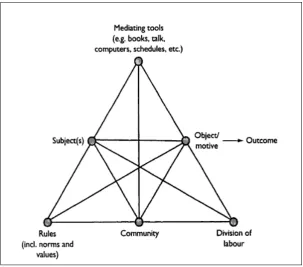
Engeström (1987) developed concepts taken from activity theory in a framework
that can be used to understand a problem-solving process and the means by which
knowledge is mediated by the social context. This extended activity theory thus can
be used to study the effect of the different tools available for PBL, but also as a means
to understand language use, negotiation between students, and the extent to which all
members of a group participate in a PBL session (Roth & Lee, 2007). In addition, it
provides a tool to analyse and categorise group discussions and group dynamics
(Arvaja, Salovaara, Häkkinen, & Järvelä, 2007) and the interaction between personal
learning and group learning. In particular, activity theory allows us to differentiate
between types of interaction in social contexts such as a PBL session, eg. collective
interaction where all the students are interacting and communicating or partial
interaction where sub-group of PBL students are interacting, as well as the way in
which interactions are framed by the social context (such as being at a university).
In consequence, activity theory can play a useful role in studying learning activity
in PBL-based classes. The theoretical model elaborated by Engeström (1987)
provides a valuable framework for breaking down observed actions and exploring the
various constraints and dynamics within a PBL session. Similarly, the structure allows
consideration of how some resources change role as the problem-solving process is
undertaken. In this research, following Jewitt (2006), activity theory and
multi-modality are seen as comprising complementary theoretical and analytical structures.
Both focus on meaning making and how this is mediated by the external environment
(Mutton, Burn, & Hagger, 2010).
1.2.4 Defining Key Terms
and drawing heavily on concepts from PBL as a pedagogic approach clarity in
definition of the key terms is important.
The first aspect is to distinguish between the concepts of Multiliteracies and
Multimodality (Kress et al., 1998, Liu, 2009). Multiliteracy is a concept developed by
the New London Group and has been used to argue that multimedia (ie text, sound,
images) can be combined to create new ways of meaning making (Liu, 2009) and
associated new ways of being literate. More generally, the original manifesto (Kress,
G. et al., 1998) identified six potential metalanguages, all of which have a role in
meaning making. These were described by Kalantsis and Cope (2001, p. 12) as
“Linguistic Design, Visual Design, Audio Design, Gestural Design, Spatial Design
and Multimodal Design”.
Multimodality (Jewitt, 2008), as discussed earlier, is best seen as the
encompassing generic concept of how meaning making is is realised through the use
of different modalities of communication (speech, text, signs, gestures and body
language) influenced by the wider social dynamics. In effect, it is an attempt to draw
together all the potential modes of meaning making and Kress et al (1998) argue that
“a social semiotic theory of multimodality … provides a ‘take’ on meaning … and it provides a view on the characteristics and uses of modes in representation (Kress, 2009, p. 19). From this perspective, Kress argues that multimodality shows that
meaning making uses much more than just speech or writing.
The second key definitional issue is the difference between social constructivism
and social constructionism. In this context, social constructivism is the process of
shared meaning making by a group (Vygotsky, 1962) and social constructionism is
related to the meaning making in the sense of the production of artefacts. However,
this distinction is not always applied consistently in the literature (Cromby. and
Nightingale, 1999) with social constructionism often being used as an encompassing
concept for any process of meaning making that takes account of the importance of
the social setting in which it takes place.
In this thesis, social constructivism is used to indicate the meaning making
process and social constructionism refers to artefacts created in this social
constructivist process (such as the model bridge built by the student group in the
1.3 Research goals
The goal of the research is to contribute to a greater understanding of the process of
students’ meaning making in the course of a PBL session. Due to the complexity of
meaning making within PBL, two different approaches are used to explore how
meaning making occurs. The overall PBL session and its outcome are evaluated using
activity theory as that has the concepts useful for constructing such an overview.
Within the PBL session, seven specific sub-sessions (spread across the five class
sessions that were video-recorded) were evaluated in much more detail, employing
the framework of multimodality, to explore the extent to which a focus on the
semiotic resources employed will extend our knowledge of the process of meaning
making.
The overarching aim of the study is to investigate the role of multimodal
representational, communicative resources in enhancing learning and
meaning-making processes by undergraduate students taking an engineering design course that
adopted PBL as the teaching method. The objectives of the research are to:
1) Understand the role of context in the PBL task, specifically - How far can the actions of both the students and the tutor be understood in terms of external constraints rather than their own preferred problem-solving / meaning-making approach?
2) Understand the role of the students in the meaning-making process, specifically - Do they use different semiotic resources as the task evolves and their understanding shifts?
3) Understand the role of the tutor/facilitator in the meaning-making process, specifically - Does the tutor’s use of semiotic resources vary as the task evolves and, if so, how does this affect his/her interaction with the students and use of scaffolding?; and
4) Evaluate the overall performance of the student group in terms of task performance and the students’ construction of meaning.
The data collected and analysed to address the research questions compromises
the interactions of a group of engineering students who were video-recorded while
they completed a PBL task, which was to design a bridge structure that would
1.4 Rationale for conducting current research
The researcher used to work as a teacher of English-for-science at Taif University in
Saudi Arabia. His profession as an English-for-science teacher encouraged him to
become more qualified to deal with different teaching approaches to deliver his course
adopting a more contemporary professional method, instead of merely assuming the
position of an information deliverer to science students who are often passive. This
desire motivated him to undertake postgraduate studies. He completed his Masters
degree at the University of Adelaide, Australia, including both coursework and
writing a dissertation. The courses he enrolled in during his Masters enhanced his
understanding of how teaching and learning processes are constructed, including
exposure to different teaching methods.
Principally as an outcome of these initial postgraduate studies, the researcher was
influenced to consider teaching as a socially constructed process (Vygotsky, 1978).
This means that learning should always be considered as an interactive process (Le &
Le, 2012) between teacher and students. Students should also be active to learn.
Students should exchange information and experiences and communicate. It is a
matter of searching for a teaching approach in which we can teach the sciences and
English-for-science in a better way in order to help students become more actively
engaged. Therefore, it became clear to him that new approaches should be employed.
One of these approaches is PBL, a teaching pedagogy which mainly depends on
group-based collaborative learning techniques, and which has gained quite wide
acceptance in the tertiary learning environment. PBL gives the students the
opportunity to become actively involved in the learning process, and to work on
addressing their learning needs through collective group engagement. Accordingly,
the researcher proposed to learn and research further about PBL, and selected a PBL
university student team, studying engineering at Victoria University, Melbourne, as a
key focus for his research as part of his in-depth investigation of PBL.
Through the research process the researcher aims to be able to return to his
professional position as teacher of English-for-science and to be able to draw on
insights from his research about PBL as a teaching method to better engage his
students, but taking into consideration what this research has taught him about the
strengths and challenges in implementing PBL from the perspective of student
1.5 Structure of thesis
The literature review in Chapter Two first discusses the existing research on the
application and use of PBL in higher education and develops the analysis briefly
sketched out in the introduction. The chapter then discusses the issue of multimodality
and related research issues, and activity theory. Finally, these are integrated, with the
chapter setting out the theoretical underpinning for the model of student learning that
informs the multimodal coding system used in Chapter Five.
Chapter Three sets out the research methodology adopted. The chapter
commences with a discussion of the underlying epistemology of the research and then
proceeds to discuss the various applied research approaches used in published studies
on PBL, multimodal analysis and activity theory. The chapter then sets out the design
of the research and documents how it was carried out.
Chapter Four presents an overview of the PBL sessions and uses activity theory
to explore the processes of meaning making within the student group and how this
meaning making is influenced by both external and internal information. From this
analysis, a number of sections within the PBL sessions are identified that exemplify
the development of meaning making and group interaction across the PBL sessions.
Chapter Five looks in detail at seven specific sections drawn from the video
recordings of the student PBL classes. Here the focus is on the use of semiotics in the
meaning-making process and how students take account of various semiotic resources
(intersemiotics) and the wider context (resemiotics) as they deal with the set task.
Chapter Six draws together the two analytic strands represented in the research
questions to present an overview of the meaning-making process, and Chapter Seven
evaluates the contribution of the entire thesis and suggests themes for further
Chapter Two
Literature Review
2.1 Introduction
This chapter reviews the three main theoretical concepts at the core of the study. The
chapter draws together how the model of student-led meaning making that is central
to PBL can be explored using the concepts of multimodality and activity theory. In
this research context, meaning making is seen not just as an internal, cognitive,
process, but one that is influenced by the nature of the task, the resources available
and the overall framework within which it takes place, i.e. problem solving, can be
best understood as a process that is social constructivist. This chapter is divided into
three main sections: reviews of PBL, multimodality (in particular in an educational
setting) and activity theory (again with an emphasis on how this is applied in
educational settings).
From the PBL review, it is clear that both the process of student-led meaning
making and of the support provided by the tutor in the form of scaffolding are key to
success. The analysis of multimodality offers one means of examining how different
semiotic resources are used in the meaning-making process and how they might
interact. In turn, activity theory explores similar ground, offering a powerful insight
into the importance of context in framing a problem-solving task. These three strands
are then drawn together in a short section that reviews the model of student learning
that is implicit in the PBL method. That model is then used to evaluate the research
findings reported in Chapters Four and Five.
2.2 Problem-Based Learning (PBL)
2.2.1 Development and controversies
PBL was originally introduced by a group of medical schools (Bereiter &
Scardamalia, 2000; Rideout, 2001; Savin-Baden, 2000) in Europe and North America
in the late 1960s (Barrows & Tamblyn, 1980). PBL was not just a pedagogic tool used
to supplement other models of learning, it was seen as the basis to organise the entire
curriculum. At its core PBL was seen as student-centred and based on philosophies of
constructivist model of adult learning (Hendry et al., 1999). The choice of PBL was a
rejection of the older model of medical education with its emphasis on classroom
instruction with the students positioned as passive learners (Hmelo-Silver, 2004).
McMaster University and Mercer University School of Medicine in Georgia were
among the first to adopt PBL across their entire curriculum, even though there are
claims (Berkson, 1993) that PBL as a pedagogic approach influenced the teaching of
medicine as far back as Ancient Greece. All the institutions that initially pioneered
PBL in the 1960s were relatively new and, were thus open to the idea of finding a new
way to deliver the traditional medicine curriculum (Berkson, 1993). PBL was seen not
just as a different way to deliver the curriculum but was “expected to influence the
whole student, or, at least, many aspects of the students’ learning experience” (Camp,
1996, p. 1).
PBL appeared to offer a means to move beyond the student learning information
simply in order to pass examinations to the student valuing ongoing learning as a
desirable end in itself. In this respect, PBL aligned itself with those theories of adult
learning that stress the importance of the student understanding why information is
important, how it fits with existing knowledge and that, if the student is actively
engaged in the learning process, they are much more likely to retain the knowledge
(Camp, 1996). Generally the view was that learning ‘in context’ (Berkson, 1993)
would improve both the students’ practical clinical performance and their grasp of the
underlying scientific principles.
Subsequently PBL was adopted in other universities and then slowly spread into
other disciplines (Savin-Baden, 2000). The relative isolation of medical education
within the tertiary sector may have delayed this transmission (Perrenet, Bouhuijs, &
Smits, 2000). However, the expectation that PBL was the means to deliver the entire
curriculum, not just specific elements or modules (Pennell & Miles, 2009), also
limited its spread outside medicine.
Outside medicine, PBL has tended to be adopted more piecemeal, for particular
parts of a course. In doing so, the distinction between PBL and other forms of
student-centred learning has been partly lost. For example, many management schools make
world of work. What is not clear is whether or not this is automatically a form of
PBL, or would even be described as such within the discipline (Camp, 1996). Some
medical programmes even are now starting to argue that simulation-based learning is
a superior approach to conventional PBL (Steadman et al., 2006). Most science
subjects have adopted PBL also in a relatively isolated manner. For example, a
chemistry degree (Belta, Evans, McCreedy, Overton, & Summerfield, 2002) makes
use of PBL as a learning tool for situations where there is no single correct answer
and where the core learning outcomes are the process of reasoning by the students,
not the answer proposed. Here again, there is also a degree of conflation between
using a case study model and the ideas of PBL.
Engineering too has adopted PBL in its own way, not least as the engineering
curriculum has had a long tradition of being based on problem solving (Perrenet et al.,
2000; Ribeiro & Mizukami, 2005) and project work. Engineering shares with
medicine the interest in closely linking theoretical underpinnings with practical
applications (Mills & Treagust, 2003; Perrenet et al., 2000). Here again the
controversy is raised as to the meaningful difference between the traditional
project-based model and one structured around PBL (Mills & Treagust, 2003). However, it
has been argued that PBL, as a specific approach, promotes the acquisition of a deeper
understanding that allows students to apply knowledge gained in one domain to
another (Ribeiro & Mizukami, 2005). This is significant as the contemporary engineer
is facing numerous demands on a daily basis and is often asked to solve issues and
concerns amidst limited resources and data. Such demands highlight the importance
of employing problem-based scenarios in engineering education. Polanco et al. (2004)
studied the influence of PBL on engineering students’ educational performance and
concluded that PBL strengthens such performance. It is argued also that adopting PBL
in engineering education will enhance students’ confidence to work with the PBL
engineering task and to be able to learn effectively (Dunlap, 2005). Du’s study (2006)
also showed that PBL in engineering helped increase the reciprocal construction of
engineers’ identities.
A recent nationwide survey conducted in India determined that 64% of graduate
engineers were unemployable (Blom & Saeki, 2010). This highlights that although
understanding to comprehend the work, they may not be trained in how to work in
teams and have the communication skills that are vital for job applications.
Overall, even where PBL has been adopted, the approach has been adapted to the
demands of the academic subject:
In engineering some topics are characterised by an hierarchic knowledge structure and complex problem-solving. These topics cannot be approached without risk in a PBL-setting. Therefore, separate direct instruction and supervised practice are needed: direct instruction of outlines, demonstration of expert problem-solving, teacher-guided discussions, problem-solving tutorials with specially structured group work. (Perrenet et al., 2000, p. 356)
In this respect, PBL in engineering has been identified as an important tool to
allow students to move beyond manipulation of equations to instead “reason
effectively at the qualitative level” (Molyneaux, Setunge, Gravina, & Xie, 2006, p. 2).
This argument has seen the curriculum being designed around the basic principles of
team project work, model building and testing and practical experiments as well as
more conventional lectures and examinations (Molyneaux et al., 2006). Furthermore,
PBL as a pedagogy in engineering has been integrated into an otherwise conventional
curriculum, in contrast to the early approaches in medical science, but in a manner
typical of its application in most other academic fields (Ribeiro & Mizukami, 2005).
Engineering students often report satisfaction with their experience of PBL (Ribeiro
& Mizukami, 2005) although Ribeiro & Mizukami’s (2005) study was again of a
mixed programme (PBL and conventional delivery) and it may be that students
appreciated the blend of PBL and more structured methods of knowledge acquisition
rather than learning in a purely PBL context.
One related issue with PBL in an engineering context, especially in the early
years, is the need to ensure that the students have the grounding in the knowledge
required (Mills & Treagust, 2003). This means that the selection and framing of the
problem is important, too trivial and any learning will be limited, too challenging and
the students will lack the knowledge to make progress without substantive help. As
discussed in Section 3.2.2.2, an early case study in this research looked at a PBL class
in the first semester and, on reflection, the problem was sufficiently simple that there