Upgrading to Functional Encryption
Saikrishna Badrinarayanan ∗ Dakshita Khurana † Amit Sahai ‡ Brent Waters §
Abstract
The notion of Functional Encryption (FE) has recently emerged as a strong primitive with several exciting applications. In this work, we initiate the study of the following question: Can existing public key encryption schemes be “upgraded” to Functional Encryption schemes without changing their public keys or the encryption algorithm? We call a public-key encryption with this property to beFE-compatible.
Indeed, assuming ideal obfuscation, it is easy to see that every CCA-secure public-key en-cryption scheme is FE-compatible. Despite the recent success in using indistinguishability ob-fuscation to replace ideal obob-fuscation for many applications, we show that this phenomenon most likely will not apply here. We show that assuming fully homomorphic encryption and the learning with errors (LWE) assumption, there exists a CCA-secure encryption scheme that is provablynot FE-compatible. We also show that a large class of natural CCA-secure encryption schemes proven secure in the random oracle model are not FE-compatible in the random oracle model.
Nevertheless, we identify a key structure that, if present, is sufficient to provide FE-compatibility. Specifically, we show that assuming sub-exponentially secure iO and sub-exponentially secure one way functions, there exists a class of public key encryption schemes which we call Special-CCAsecure encryption schemes that are in fact, FE-compatible.
In particular, each of the following popular CCA secure encryption schemes (some of which existed even before the notion of FE was introduced) fall into the class of Special-CCAsecure encryption schemes and are thus FE-compatible:
1. [CHK04] when instantiated with the IBE scheme of [BB04]. 2. [CHK04] when instantiated with any Hierarchical IBE scheme. 3. [PW08] when instantiated with any Lossy Trapdoor Function.
∗
UCLA. Email: [email protected] †
UCLA. Email: [email protected] ‡
UCLA. Email: [email protected]. §
Contents
1 Introduction 4
2 Technical Overview 7
2.1 Organization . . . 11
3 Preliminaries 11 4 Defining Functional Encryption Compatibility 11 4.1 Public Key Encryption . . . 11
4.2 Functional Encryption . . . 12
4.2.1 Security . . . 12
4.3 FE-Compatibility . . . 13
5 An Impossibility Result 13 5.1 An Attack . . . 15
5.2 IND-CCA Security . . . 16
5.3 Proof of Claim 1 . . . 19
6 On the Difficulty of Proving Functional Encryption Compatibility for Fujisaki-Okamoto and RSA-OAEP 22 6.1 Construction . . . 22
6.2 Attack . . . 23
7 Building FE-Compatible Encryption Schemes 24 7.1 Puncturable Tag Based Encryption . . . 24
7.2 Special-CCA secure encryption scheme . . . 26
7.3 Instantiating Special-CCA encryption . . . 27
7.4 Building selectively secure FE . . . 27
7.4.1 Security Proof . . . 29
8 Acknowledgements 35 A Security Notions for Public Key Encryption 38 A.1 CCA Security . . . 38
A.2 CPA Security . . . 38
B Further Preliminaries 38 B.1 Indistinguishability Obfuscation. . . 38
B.2 Differing Inputs Obfuscation. . . 39
B.3 Lockable Obfuscation. . . 40
B.3.1 Correctness . . . 40
B.3.2 Security . . . 40
D Examples of Special-CCA Secure Encryption Schemes 43
D.1 Scheme in [CHK04]. . . 43
D.1.1 [CHK04] using IBE scheme in [BB04] . . . 44
D.1.2 [CHK04] using any HIBE scheme . . . 46
D.2 Scheme in [PW08] . . . 47
1
Introduction
Functional Encryption (FE) [SW05,SW08] is a powerful framework that significantly expands the scope of public-key encryption. In an ordinary public-key encryption scheme, a user Alice first chooses a public keyPKand a corresponding secret keySKusing a (master) setup algorithmSetup. Then, any other user Bob can use Alice’s public key to encrypt a messagemto obtain a ciphertext c=Enc(PK, m). Alice can decrypt this ciphertext using her secret key, yielding m=Dec(SK, c).
In a functional encryption scheme, we give Alice key delegation capabilities: Alice can use a new key generation algorithm KeyGen to generate a functional key SKf = FE.KeyGen(SK, f) for a function f that is, say, described by a circuit. Then Alice can hand this functional key SKf to an associate Charlie, and Charlie can use this functional key together with a new decryption algorithm to only learn f(m) =FE.Dec(SKf, c) when given the ciphertext c. Intuitively speaking, nothing1 beyond f(m) should be learned by Charlie when given SKf and c. This notion was fully formalized by [BSW11] in the setting where many functional keys and ciphertexts may be given to an adversary. The first work achieving functional encryption for general functions was [GGH+13], using the power of indistinguishability obfuscation.
The work of [BSW11] gave several compelling applications of functional encryption. For in-stance, Alice may want to store her e-mail in encrypted form, but she wants her cloud provider to be able to execute a phishing-detection circuit C on her email prior to sending it to her for decryption. She could accomplish this goal by providing her cloud provider with a functional key forSKC, and the only thing the cloud provider would learn is whether any email received by Alice satisfies the phishing-detection circuit.
Applications of functional encryption become even more compelling when we think of Alice as representing a large organization or company. In such a scenario, the threat that functional encryption helps to address cryptographically is the insider threat. For example, consider an or-ganization like a government tax authority, that regularly handles extremely sensitive information, but where individuals within the organization should only have access to limited digests or snippets of this sensitive information. For example, an analyst Dave at the tax authority may need only to compute statistical summaries of tax returns filed by a large set of people. Functional encryption would allow Dave to obtain a functional keySKT, whereT is the description of a function that pro-duces statistical summaries of tax returns. The security of functional encryption would guarantee that even if Dave goes rogue, Dave’s functional key would only allow him to learn and exfiltrate statistical summaries, and not any more personal information about individual tax returns beyond what could be deduced from the statistical summary.
Contrast this to the case where only ordinary public-key encryption is used to encrypt tax information. In this case, Dave would need the (master) secret key SK in order to decrypt tax information before processing it to obtain statistical summaries. And therefore a rogue Dave could exfiltrate the personal details of any person’s tax return that was an input to the statistical summary he was supposed to compute. This is just one example, illustrative of many such scenarios where functional encryption could be beneficial for security.
Upgrading to Functional Encryption. Suppose that some time in the future, an organization, upon hearing about the advantages of functional encryption, wishes to “upgrade” to use functional encryption. Such an organization may face many challenges. First, the organization may already have infrastructure in place where partners and clients use an existing public-key encryption scheme
1 Slightly more formally, functional encryption requires that encryptions of two messagesm
0 and m1 should be
to communicate with the organization. As such, the organization may have already amassed large amounts of encrypted data using a legacy public-key encryption system. Second, the organization may face regulatory burdens like HIPAA or other future regulations, that require the organization to use a particular encryption algorithm. Third, it could be that, even in this future time, existing key generation algorithms for general-purpose functional encryption (which typically currently use indistinguishability obfuscation) are too slow, but the organization wants to be ready for the day when such algorithms become practical.
In light of these concerns, what public-key encryption algorithm should the organization use now? While these are mostly societal challenges, security must exist in the context of human societies with traditions, rules, and regulations. And in this case, these concerns give rise to an intriguing theoretical question:
What (existing) public-key encryption algorithms can be “upgraded” to become functional encryption schemes, without changing the encryption algorithm or the public keys?
Our paper initiates the systematic study of this question. To formalize this, we say that a public-key encryption schemeE isFE-compatible if there exist new key generation and decryption algorithms that, when combined with the original setup and encryption algorithms of E, yield a (selectively) secure functional encryption scheme. (See Section 4 for details.)
Necessary Conditions. The technical starting point for our work is the folklore observation that any functional encryption scheme must satisfy a certain level of non-malleability. To see why, consider a functional encryption scheme for encrypting (n+ 1)-bit messagesm, and consider the function f1 that on input m simply outputs the firstn bits of m. Suppose that we obtain a
functional key SKf1 for this function. Then functional encryption guarantees that encryptions of any two messages with identicaln-bit prefixes should still be indistinguishable from each other.
But suppose there was a way for an adversary to modify any encryption FE.Enc(m) to obtain
FE.Enc(m0) where m0 swapped the first and last bits of m. This would, for example, easily be possible if one tried to encrypt the message bit-by-bit. Then, by applying the functional keySKf1 toFE.Enc(m0), the adversary would learn the last bit of m, and break the security that is supposed to be guaranteed by functional encryption.
Indeed, it is not hard to see that the above argument generalizes to guarantee a type of security against chosen-ciphertext attacks. Thus, (a form of) CCA-security is a necessary requirement for an encryption scheme to be FE-compatible.
Universal Functional Encryption? At this point, it might be tempting to consider the possi-bility that CCA-security is also asufficient condition for being FE-compatible. Indeed, this would be true if we had ideal obfuscation2 [Had00] – that is, obfuscation that creates the equivalent of a virtual black box. It is not difficult to see why: To create a functional key SKf, simply obfuscate the function that uses SK as a hardwired constant to decrypt the input ciphertext cto obtain the message m, and then simply output f(m). If the obfuscation is ideal, then this functional key can easily be simulated as a black box just by using the CCA-decryption oracle for decryption. Thus, given ideal obfuscation, every CCA-secure public-key encryption scheme is FE-compatible. In this sense, we could hope to have a kind of universal functional encryption (in the sense of universal deniable encryption [SW14] or universal signature aggregators [HKW15]), where the key generation construction above could be applied to any CCA-secure encryption scheme.
2
Recently our field has had remarkable success in achieving results using indistinguishability obfuscation that were previously known to be possible only using ideal obfuscation, especially using the punctured programming paradigm of [SW14]. Is this just a matter of applying enough “iO gymnastics” to make this work?
Our Results. In our first result, somewhat surprisingly, we show that in this case, the intuition based on ideal obfuscation is wrong. Specifically, we show the following:
Informal Theorem 1. Assuming CCA-secure public-key encryption, fully homomorphic encryp-tion (FHE) and LWE, there exists a CCA-secure public-key encrypencryp-tion scheme that is provably not FE-compatible.
The construction we give in the impossibility result above is quite contrived, like most im-possibility results of this type. Could it be that all “natural” CCA-secure public-key encryption schemes are FE-compatible? Sadly, we do not know how to answer, or even formally define, this question. Nevertheless, one natural setting in which to consider this question is the well-studied random oracle model; this model allows for very simple and intuitive proofs of CCA-security, via the popular Fujisaki-Okamoto [FO99] transformation. In the random oracle model, however, we show an even stronger negative result: Every public-key encryption scheme, when converted into a CCA-secure encryption scheme in the random oracle model via the Fujisaki-Okamoto transfor-mation, is provably not FE-compatible in the random oracle model. Thus, in the random oracle model, we obtain a large family of natural CCA-secure schemes 3 that are not FE-compatible. 4
In light of the impossibility results above, we believe that a systematic study of FE-compatibility will need to proceed in a “bottom-up” manner, by looking at existing classes of CCA-secure en-cryption schemes and seeing if they can indeed be FE-compatible. We initiate this line of study by identifying a key structure that, if present, is sufficient to provide FE-compatibility. Specifically, we show the following:
Informal Theorem 2. Assuming sub-exponentially secure iO and sub-exponentially secure one way functions, there exists a class of public key encryption schemes which we call Special-CCA secure encryption schemes that are FE-compatible.
We then note that several existing CCA-secure encryption schemes fall into the class of Special-CCAsecure encryption schemes. As a result, we get the following theorem:
Informal Theorem 3. Assuming sub-exponentially secure indistinguishability obfuscation and sub-exponentially secure one way functions, each of the following existing CCA-secure encryption schemes are FE-compatible:
• [CHK04]when instantiated with the IBE scheme of [BB04].
• [CHK04]when instantiated with any Hierarchical IBE scheme.
• [PW08]when instantiated with any Lossy Trapdoor Function.
3We believe similarly structured transformation such as RSA-OAEP [BR94] will have the same issues. 4
It is interesting to note that the above CCA-secure encryption schemes are each at least 9 years old, and yet they can be used to build functional encryption schemes without changing the encryption mechanism. Contrast this to existing functional encryption schemes before our work, most of which have specifically designed encryption methods using “iO-friendly” tools.
Finally, we also consider a weaker notion calledkey-only FE-compatibility where we retain only the public key and secret key of the public key encryption scheme and design new encryption, function secret key generation and decryption algorithms to “upgrade” it to a FE scheme. In the common random string model, we show that assuming polynomially hard iO, every public key encryption scheme is key-only FE compatible - that is, it can be upgraded to a selectively secure FE scheme for any function family.
Open problems and future work. It would be interesting to understand if there exists other classes of encryption schemes that are FE-compatible. More generally, an interesting open problem would be to study what is the exact type of CCA-security needed for an encryption scheme to be FE-compatible.
While it is known that general purpose functional encryption implies indistinguishability ob-fuscation, another interesting direction would be to weaken the security requirement of functional encryption (for example, bounded-key secure FE) and understand what class of encryption schemes can be upgraded without the use of indistinguishability obfuscation. A solution in this setting might also be practical in today’s world. Going in the other direction, an interesting feasibility question is whether we can upgrade existing encryption schemes to achieve general purpose multi-input functional encryption [GGG+14,BGJS15].
Finally, we observe that in our positive result, on upgrading the CCA secure encryption schemes into an FE scheme, it may potentially lose the CCA property. It is an interesting open problem to define and achieve FE-CCA compatibility5.
2
Technical Overview
The question at the core of this paper is: what kinds of public-key encryption schemes can be “upgraded” to yield functional encryption schemes? Informally speaking, we say that a public-key encryption scheme PKE is FE-compatible if a functional encryption scheme can be generated where the setup and encryption algorithms of the functional encryption scheme are the same as the public-key encryption scheme. Namely, we have FE.Setup = PKE.Setup and FE.Enc = PKE.Enc. Thus, only the functional encryption key generation and decryption algorithms are allowed to be newly specified.
As already noted, the technical starting point for our work is the folklore observation that any functional encryption scheme must satisfy a certain level of non-malleability. To remind ourselves why, consider a functional encryption scheme for encrypting (n+ 1)-bit messagesm, and consider the function f1 that on input m simply outputs the firstn bits of m. Suppose that we obtain a
functional key SKf1 for this function. Then functional encryption guarantees that encryptions of any two messages with identicaln-bit prefixes should still be indistinguishable from each other.
But suppose there was a way for an adversary to modify any encryption FE.Enc(m) to obtain
FE.Enc(m0) where m0 swapped the first and last bits of m. This would, for example, easily be possible if one tried to encrypt the message bit-by-bit. Then, by applying the functional keySKf1 toFE.Enc(m0), the adversary would learn the last bit of m, and break the security that is supposed to be guaranteed by functional encryption.
5
An impossibility result. The most natural question to ask, then, is whether CCA-security is also a sufficient condition for FE-compatibility. In our first result, we prove that this is indeed not the case: we construct a counterexample public-key encryption scheme that satisfies CCA-security, but provably is not FE-compatible.
Let us build some intuition for how our impossibility result will proceed. The main difference between the CCA security game and the FE security game is that in the CCA security game, there is a decryptionoracle, whereas in the FE security game, the adversary can actually obtain a circuit that will (at least partially) decrypt ciphertexts. This is reminiscent of the situation underlying the impossibility result of Barak et al. [BGI+01] for virtual black-box obfuscation: There, the ideal model gave oracle access to the function to be obfuscated, whereas the real model gave the adversary an actual circuit implementing that function. Indeed, we draw inspiration from [BGI+01] in devising our negative result, although we differ from it in almost every technical respect.
The idea behind our negative result will be to take an arbitrary CCA-secure encryption scheme (SetupCCA,EncCCA,DecCCA) and somehow “damage” it to make it FE-incompatible, without
dis-turbing its CCA security. This “damaged scheme” must somehow make use of the fact that an FE-adversary will be able to ask for and obtain a functional keySKf1, let us say for the same prefix-revealing function f1 that we defined above. This functional keySKf1 enables the FE-adversary to compute a prefix-decryption circuit D that outputs the first n bits of the message corresponding to any ciphertext.
Our first idea (which conceptually dates back to [BGI+01]) is to use fully homomorphic encryp-tion (FHE) to help us take advantage of this situaencryp-tion. We first choose a random n-bit string α, and encrypt itc=EncCCA(α||0) using the CCA-secure encryption scheme. But then we re-encrypt
thisc0 =FHE(c) using the fully homomorphic encryption scheme. We revealc0as part of the public key of the “damaged scheme,” but crucially both α and care kept hidden.
Why does this help? Because now an FE-adversary that obtains the prefix-decryption circuitD can computeFHE.Eval(D, c0) =FHE(α). While it is not yet clear that this is useful for any attack, we observe that, at least intuitively, a CCA-attacker has no obvious way to obtainingFHE(α) from the public key and the decryption oracle (though formally proving this will be the main technical challenge of our impossibility result, as we will discuss shortly). This is because the only information that the CCA-attacker has about α is contained in c0, but c0 is an encryption under FHEand the decryption oracle only decrypts ciphertexts validly encrypted usingEncCCA.
To enable a real attack, then, we also add to the public key an obfuscation of a programP that takes as input an FHEciphertext e, decrypts it, and checks whether this decryption is equal toα. If so, it outputs the secret key needed for executing DecCCA, otherwise it outputs ⊥. Because the
FE-attacker can obtain FHE(α) as noted above, it can then use the obfuscated program to obtain the full secret key for executingDecCCA, breaking the security of the FE scheme.
Why these changes preserve CCA security. The changes above – adding theFHEciphertext c0 and the obfuscated program P to the public key – only provide an impossibility result if CCA security is preserved even after these two objects are added to the public key. While it is not obvious how a CCA-attacker could use these objects to break security, in order to prove CCA security, intuitively we will need to remove the dependence ofc0 onα. Butc0=FHE(EncCCA(α||0)),
and the obfuscated programP contains the secret key forFHE. But in order to remove these secret keys from P, intuitively we need to remove the “trigger” point FHE(α) from the code of P, for which we first need to remove the dependence of c0 on α. This chicken-and-egg situation is the primary technical obstacle that we need to overcome to finish the proof.
Hohenberger, Lewko and Waters [HLW12] that considered the seemingly very different problem of converting any CCA-secure encryption scheme for single-bit messages into a CCA-secure encryption scheme for multi-bit messages. However, to implement our inspiration, we will need to make a technical change to the encryption system. Instead of usingEncCCA to encrypt the entiren+ 1-bit
message, we will use the CCA-secure encryption schemes to encrypt the firstnbits of the message, and use a separate encryption schemeEncCPA to encrypt the last bit of the message. (In fact, we
will use EncCCA to jointly encrypt the first n bits of the message and the ciphertext produced by
EncCPA. But we will ignore this detail for the purpose of this overview.) Finally, we will change
our obfuscated program P to output just the secret key for executing DecCPA to decrypt the last
bit. This way, the secret key for executing DecCCA is independent of the program P. Now, we
will define a Bad Event to be when a CCA-attacker queries its decryption oracle on the ciphertext c=EncCCA(α). Looking ahead, we will first consider the situation when this Bad Event does not
happen. Then, we will show that indeed the Bad Event can only occur with negligible probability. Suppose that we know that the Bad Event cannot happen. Then, the decryption oracle given to the CCA-attacker is equivalent to a decryption oracle that would be given to a CCA-attacker if c = EncCCA(α) was the “challenge” ciphertext on which the attacker is not allowed to query.
Note that in this case, the CCA security of EncCCA already guarantees that c = EncCCA(α) is
indistinguishable fromc=EncCCA(0n), even to an adversary that is given the obfuscated program
P as auxiliary information about α. Thus, we can already remove the dependence ofc0 on α. Now, the only part of the public key that depends onαis the obfuscated programP, and we just need to get rid of it. This could be accomplished viaiOusing the fact thatαis a uniformly random string, but in fact our job is made even easier due to the recent works on “lockable obfuscation” of Goyal et al. [GKW17] and Wichs and Zirdelis [WZ17]. These works consider obfuscating programs C(x) whose structure is exactly such that, for some circuitTest ifTest(x) =α, then some secretβ is revealed, and otherwise the output is⊥. Lockable obfuscation states that ifαis chosen uniformly (and, for our setting, no auxiliary information aboutαis revealed), then such obfuscated programs are indistinguishable from obfuscated programs that always output ⊥and have no secrets within them whatsoever. Furthermore, such lockable obfuscation is possible to construct just assuming LWE for suitable parameters. Thus, applying the security of lockable obfuscation, we are able to replace the obfuscated program P with a program that always outputs ⊥, thereby completely removing any information about the secret keys of any encryption scheme and aboutα. This shows that the new scheme is CCA-secure, under the assumption that the Bad Event does not occur.
All that remains to be done is to prove that the Bad Event does not occur. Counterintuitively, we first observe that the lockable obfuscation argument above already shows that the Bad Event cannot occur if the ciphertextchad beenc=EncCCA(0n) instead ofc=EncCCA(α). In other words,
ifc=EncCCA(0n), then the adversary never queries the decryption oracle withc. Now, suppose for
sake of contradiction, that the adversary does querycwith noticeable probability ifc=EncCCA(α).
Then, we can use this to break CCA-security of EncCCA; take as a challenge ciphertext c that
is either c = EncCCA(α) or c = EncCCA(0n). Then run the adversary until it attempts to query
the oracle on c. If it ever does this, we can conclude that c = EncCCA(α). If it doesn’t, then
we can output a random guess. This will give us an nontrivial advantage in determining whether c=EncCCA(α) or c=EncCCA(0n).
This completes the impossibility proof. Full details can be found inSection 5.
Positive Results for FE-compatibility. Our impossibility result shows that CCA security is not a sufficient condition for an encryption scheme to be FE-compatible. On the other hand, unfor-tunately positive results on FE in the literature (e.g. [GGH+13,Wat14]) typically construct special-purpose encryption methods that are atypical for achieving CCA security. For instance, even though the original general-purpose FE scheme of [GGH+13] follows the Naor-Yung paradigm [NY90,
Sah99], instead of using a simulation-sound NIZK in the encryption, it uses a special object in-troduced in [GGH+13] called a statistically simulation-sound NIZK. Recall that our goal is to find existing CCA-secure encryption schemes that are already FE-compatible, rather than design special-purpose (sometimes called “iO friendly”) primitives that would enable FE.
How can we go about this? Let us try to see if there are encryption mechanisms that were useful in achieving CCA-security that can also be sufficient for achieving FE.
Our key observation is that the notion of apunctured decryption key, which has implicitly been used for building CCA-security for over a decade, since (at least) the work of [CHK04], can also be useful for building FE functional keys. Roughly speaking, we consider the notion of a tag-based encryption, where every ciphertext is associated with a tag. Then, a punctured decryption key
SKtag∗ should allow a user to decrypt every ciphertext with tag 6= tag∗, but messages encrypted
under tag tag∗ should still be semantically secure. Intuitively, such punctured keys have been useful for building CCA-secure encryption because a punctured decryption key would allow the implementation of a decryption oracle that would still not be able to decrypt a challenge message that was encrypted under tag tag∗. In the literature, such schemes are combined with one-time signature schemes, where the tag is set to be the verification key of such a one-time signature scheme, and then the ciphertext is signed in a way that verifies with this key.
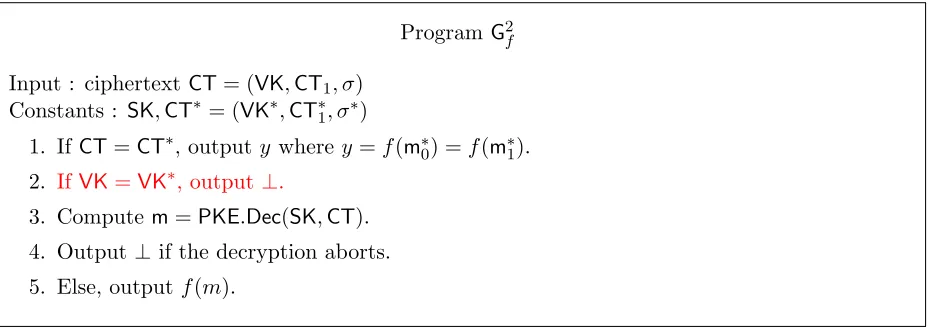
How can we use this idea for building FE functional keys? At a high level, we start with the most basic idea for building a functional key for a functionf. We can simply obfuscate a program that has the decryption key built in, uses this decryption key to decrypt the messagem, and then outputsf(m). Now, we need to argue that the encryption ofm0 and the encryption of m1 should
be indistinguishable as long asf(m0) =f(m1) =y. The first idea is to fix the verification key VK∗
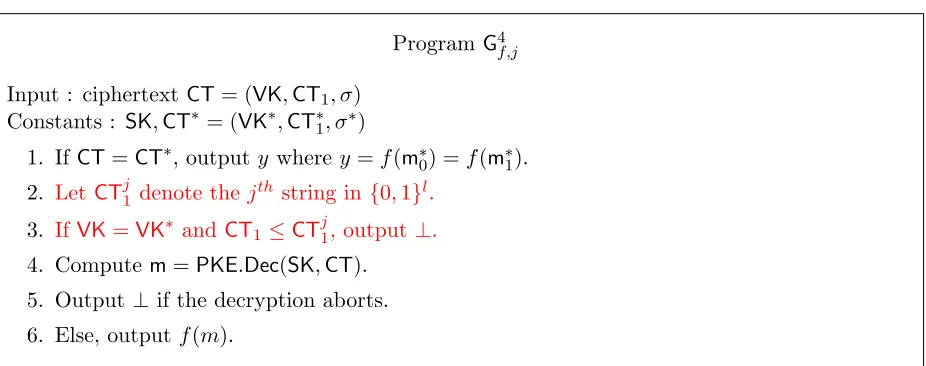
in advance that will be used as the tag for the challenge ciphertext c∗. Now, we can reformulate the obfuscated program to first check whether the input ciphertext is equal to c∗, in which case the program should output y, but otherwise it should just use the decryption key to decrypt the messagem, and then outputf(m) as before. This program is functionally equivalent to the previous one, and therefore indistinguishability of obfuscated programs follows from iO.
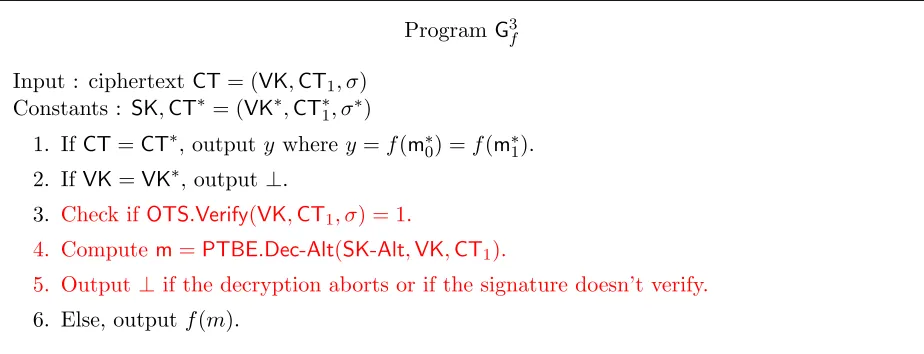
Now, our goal will be to replace the decryption key within the program with the punctured decryption keySKVK∗. However, note that we cannot do that immediately, because there are many
valid ciphertexts for various messagesmthat could be signed under verification keyVK∗, on which the program is supposed to outputf(m). However, we know that it should be hard for the adversary to actually find such valid ciphertexts, because of the security of the one-time signature scheme. Here, we can use sub-exponentially secure iO to complete the argument: Roughly speaking, the work of [BCP14] shows that if an iO scheme is secure against time T ·poly(n) adversaries, then iO(P1) and iO(P2) are indistinguishable as long as: (1) they only differ on at mostT inputs, and
(2) these inputs are hard to find even if given the code of both P1 and P2, even for machines
whose running time far exceed T. By using this, assuming also sub-exponentially secure one-time signatures (which follow from sub-exponentially strong one-way functions), we can replace the program with one that first checks whether the input ciphertext is equal to c∗, in which case the program outputs y, but otherwise it uses the punctured decryption key SKVK∗ to decrypt the
message m, and then output f(m) as before.
Now, since only this punctured decryption keySKVK∗is used, we can argue that an encryption of
to bootstrap punctured decryption keys as an existing method for building CCA-secure encryption, into a method for constructing functional keys without needing to change the underlying encryption scheme. Interestingly, the security of the encryption given a punctured decryption key needs to hold only against polynomial-time adversaries, as in standard proofs of CCA-security.
We observe that at least three different existing CCA-secure schemes from the literature, some dating back over a decade, already follow the punctured key approach to building CCA-secure encryption, and therefore are FE-compatible. Full details can be found inSection 7.
2.1 Organization
In Section 3, we define some preliminaries. This is followed by the definition of FE-compatibility in Section 4. In Section 5 we show the impossibility result. This is followed by the impossibility result in the random oracle model in Section 6. Finally, inSection 7, we show the constructions of FE-compatible CCA secure encryption schemes. In Appendix E, we discuss the weaker notion of Key Only FE-Compatibility.
3
Preliminaries
We define the following primitives inAppendix B: indistinguishability obfuscation, differing inputs obfuscation, lockable obfuscation. We refer the reader to [Gen09, Gen10] for a definition of fully homomorphic encryption.
4
Defining Functional Encryption Compatibility
Throughout, let the security parameter be denoted by n. Let X = {Xn}n∈N and Y = {Yn}n∈N denote ensembles where each Xn and Yn is a finite set. Let F = {Fn}n∈N denote an ensemble where each Fn is a finite collection of functions, and each functionf ∈ Fn takes as input a string x∈ Xn and outputs f(x)∈ Yn.
We first define public key encryption in the next subsection. This is followed by the definition of functional encryption(FE) in the subsequent subsection and then finally, we define what it means for a public key encryption scheme to be FE-Compatible.
4.1 Public Key Encryption
A public key encryption scheme PKE = (PKE.Setup,PKE.Enc,PKE.Dec) for a family of message spaces{Xn} consists of the following algorithms:
• PKE.Setup(1n):
Given the security parameter n, it generates a public keyPKand a secret key SK.
• PKE.Enc(PK,m):
Given a message m∈ Xn and the public key PKas input, the encryption algorithm outputs a ciphertextCT.
• PKE.Dec(MSK,CT):
Correctness: A public key encryption scheme PKEis correct if for all messagesm∈ Xn
Pr
(PK,SK)←PKE.Setup(1n)
PKE.Dec(SK,PKE.Enc(PK,m)) =m
= 1
The probability is over the randomness used in the setup, encryption and decryption algorithms above.
Security Notions: We consider two notions of security namely IND-CPA security and IND-CCA security. We define them formally inAppendix A. It is well known that any IND-CCA secure public key encryption scheme is also IND-CPA secure.
4.2 Functional Encryption
A functional encryption schemeFE= (FE.Setup,FE.Enc,FE.Keygen,FE.Dec) for a family of message spaces{Xn}, a family of output spaces{Yn} and a family of functions F consists of the following polynomial time algorithms:
• FE.Setup(1n). The setup algorithm takes as input the security parameter n and outputs a master public key-secret key pair (MPK,MSK).
• FE.Enc(MPK, x) →CT. The encryption algorithm takes as input a message x∈ Xn and the master public keyMPK. It outputs a ciphertext CT.
• FE.Keygen(MSK, f)→ SKf. The key generation algorithm takes as input a function f ∈ Fn and the master secret key MSK. It outputs a function secret key SKf.
• FE.Dec(SKf,CT) → y. The decryption algorithm takes as input a secret key SKf and a ciphertext CT. It outputs a string y∈ Yn or⊥.
Definition 1. (Correctness) A functional encryption scheme FE for F is correct if for all f ∈ Fn and all x∈ Xn
Pr
(MPK,MSK)←FE.Setup(1n)
SKf ←FE.Keygen(MSK, f)
FE.Dec(SKf,FE.Enc(MPK, x)) =f(x)
= 1
where the probability is over the random coins of FE.Setup,FE.Enc,FE.Keygen and FE.Dec.
4.2.1 Security
We define the security notion for a functional encryption scheme using the following game (Adaptive−IND) between a challenger and an adversary.
Setup Phase: The challenger generates (MPK,MSK)←FE.Setup(1n) and then hands over the master public keyMPK to the adversary.
Key Query Phase 1: The adversary makes function secret key queries by submitting functions
f ∈ Fn. The challenger responds by giving the adversary the corresponding function secret key
SKf ←FE.KeyGen(MSK,f).
Challenge Phase: The adversary chooses two messages (m0,m1) of the same size (each in Xn) such that for all queried functions f in the key query phase, it holds that f(m0) =f(m1). The
adversary.
Key Query Phase 2: The adversary may submit additional key queries f ∈Fn as long as they do not violate the constraint described above. That is, for all queries f, it must hold that
f(m0) =f(m1).
Guess: The adversary submits a guess b0 and wins if b0 = b. The adversary’s advantage in this game is defined to be 2∗ |Pr[b=b0]−1/2|.
We also define the selective security game, which we call (Selective−IND) where the adversary outputs the challenge message pair even before seeing the master public key.
Definition 2. A functional encryption scheme FE is selective/adaptive secure if all PPT adver-saries have at most a negligible advantage in the Selective−IND/Adaptive−IND security game.
We can also parameterize by the number of function secret key queries the adversary can make in the security game.
Compactness[AJ15] : A functional encryption scheme is said to be compact if the size of the ciphertext does not depend on the size of the functions that the scheme can handle. That is, let p(·) be a polynomial. Now, any functional encryption schemeFE for a class of functions F is said to be compact if |FE.Enc(MPK, x)|=p(n,|x|) where nis the security parameter.
4.3 FE-Compatibility
In this section, we define a property called FE-Compatibility for any public key encryption scheme.
Definition 3. A public key encryption schemePKE= (PKE.Setup,PKE.Enc,PKE.Dec) is said to be selective/adaptive FE-Compatible relative to a family of functions F if there exists two algorithms (FE.Keygen,FE.Dec) such that (FE.Setup,FE.Enc,FE.Keygen,FE.Dec) is a selectively/adaptively se-cure functional encryption scheme for the family F where:
• FE.Setup(n) =PKE.Setup(n). In particular, if PKE.Setup(n) outputs(PK,SK), the output of
FE.Setup(n) is (MPK=PK,MSK=SK).
• FE.Enc(MPK,m) =PKE.Enc(PK,m).
Moreover, any such FE scheme is also compact because the size of the ciphertext is determined by the scheme PKEand doesn’t depend on the size of the functions being queried.
5
An Impossibility Result
In this section, we will construct an IND-CCA secure encryption scheme that is not FE-Compatible according toDefinition 11. Consider a functionf1that on any inputxof length (n+1) bits, outputs
the first nbits of x. Formally, we prove the following theorem:
Theorem 1. Assuming the existence of lockable obfuscation, fully homomorphic encryption and IND-CCA secure public key encryption, the scheme PKE = (PKE.Setup,PKE.Enc,PKE.Dec) de-scribed below is an IND-CCA secure public key encryption scheme that is not selective FE-Compatible even for a single function secret key query for any function family F such that f1 ∈ F.
Corollary 2. Assuming LWE, fully homomorphic encryption and the existence of IND-CCA secure public key encryption, the scheme PKE = (PKE.Setup,PKE.Enc,PKE.Dec) described below is an IND-CCA secure public key encryption scheme that is not selective FE-Compatible even for a single function secret key query for any function family F such that f1 ∈ F.
Notation: Let the security parameter be n. Let (SetupCPA,EncCPA,DecCPA) be an IND-CPA
secure encryption scheme that encrypts 1 bit messages and produces ciphertexts of length l1(n),
(SetupCCA,EncCCA,DecCCA) be a CCA secure encryption scheme that encrypts messages of length
(n+1+l1(n)) and produces ciphertexts of sizel2(n). LetFHE= (FHE.Setup,FHE.Enc,FHE.DecFHE.Eval)
be a fully homomorphic encryption scheme that encrypts messages of length (l1(n) +l2(n)) and
can evaluate anyPoly(n)-sized circuit. Let (O,Eval) be a secure lockable obfuscator for allPoly(n )-sized circuits that take inputs of size l2(n) and produce outputs of size n. Our scheme PKE =
(PKE.Setup,PKE.Enc,PKE.Dec) that encrypts messages of length (n+ 1) is as follows:
• PKE.Setup(1n):
1. Compute (PKCPA,SKCPA)←SetupCPA(1n), (PKCCA,SKCCA)←SetupCCA(1n) and (PKFHE,SKFHE)←
FHE.Setup(1n).
2. Choose a random stringα∈ {0,1}n.
3. Compute CT0CPA = EncCPA(PKCPA,0) and CTCCA0 = EncCCA(PKCCA, α||0||CT0CPA). Let
CT0 = (CT0CCA,CT0CPA). (In fact, CT0 is an encryption of (α||0) using the encryption algorithmPKE.Enc described next).
4. Compute CT0FHE =FHE.Enc(PKFHE,CT0).
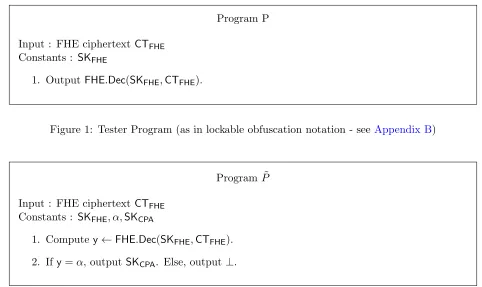
5. Generate ˜P =O(n, P,SKCPA, α) using the tester programP described inFigure 1where
n is the security parameter, P is the program, SKCPA is the message andα is the lock
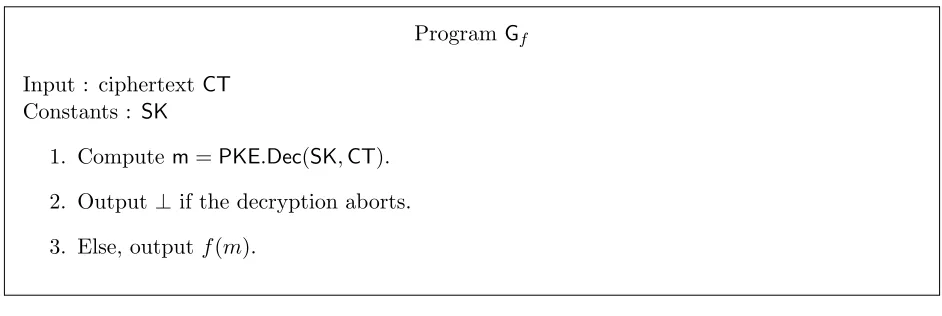
value. In particular, the functionality of the obfuscated program ˜P is described in
Figure 2. Note that Figure 2 is just for intuition and does not correspond to a formal specification.
6. Output the public key asPK= (PKCPA,PKCCA,PKFHE,CT0FHE,P˜). The secret key of the
scheme isSK=SKCCA.
• PKE.Enc(PK,m):
1. Given an (n+ 1) bit message m, letp be the last bit ofm.
2. Compute CTCPA=EncCPA(PKCPA, p).
3. Compute CTCCA=EncCCA(PKCCA,m||CTCPA).
4. Output the ciphertextCT= (CTCCA,CTCPA).
• PKE.Dec(SK,CT):
1. ParseCT= (CTCCA,CTCPA). Recall thatSK=SKCCA.
2. Let (m||y) =DecCCA(SKCCA,CTCCA).
3. If the above decryption outputs⊥ or ify6=CTCPA, output ⊥.
Program P
Input : FHE ciphertextCTFHE
Constants : SKFHE
1. OutputFHE.Dec(SKFHE,CTFHE).
Figure 1: Tester Program (as in lockable obfuscation notation - see Appendix B)
Program ˜P
Input : FHE ciphertextCTFHE
Constants : SKFHE, α,SKCPA
1. Compute y←FHE.Dec(SKFHE,CTFHE).
2. Ify=α, output SKCPA. Else, output ⊥.
Figure 2: Functionality of lockable obfuscated tester program
We now prove Theorem 1.
Correctness: It can be easily observed that if the schemes (SetupCPA,EncCPA,DecCPA) and (SetupCCA,EncCCA,DecCCA)
are correct except with negligible probability, thenPKEis correct except with negligible probability. That is, PKE.Dec(PKE.Enc(PK,m),SK) =m for any messagem∈ {0,1}(n+1).
To prove our theorem we need to show two things. First, we will show that any candidate functional encryption scheme that includes a “all but last bit reveal” functionality which shares the setup and encrypt algorithms with the above public key encryption scheme must be insecure. Second, we show that the schemePKEactually does have IND-CCA security under certain assump-tions. Putting these together will yield our theorem.
5.1 An Attack
In this section, assuming the correctness of the encryption schemes used and correctness of the obfuscator, we show that the above scheme PKE is not FE-Compatible. Suppose it is indeed FE-Compatible. We will arrive at a contradiction. Formally, we prove the following lemma.
Lemma 1. Any schemeFE= (FE.Setup,FE.Enc,FE.Keygen,FE.Dec)whereFE.Setup(.) =PKE.Setup(.) and FE.Enc(.) =PKE.Enc(.) is not selectively secure even for just 1 function secret key query for any function family F such thatf1 ∈ F.
Proof. Consider a FE adversaryAwho interacts with a FE challenger in the selective IND-security game as follows:
2. A asks for a function secret key corresponding to the following function f1: on input x of
length (n+ 1) bits,f1(x) outputs the first nbits of x. Note that since the first nbits of m0
and m1 are equal, this is a valid function secret key query.
3. The challenger runs the setup algorithm and generatesPK,SK. He givesPKto the adversary along with the function secret key SKf1. Also, the challenger picks a bit b at random and sends CT∗ =PKE.Enc(PK,mb).
4. Let the challenge ciphertext be CT∗ = (CT∗CCA,CT∗CPA). The adversary computes a FHE ciphertext CTFHE = FHE.Eval(FE.Dec(SKf,·),CT0FHE) using the ciphertext CT
0
FHE in the
public key and the function secret key SKf. A then runs the obfuscated program ˜P on input CTFHE. That is, run Eval( ˜P ,CTFHE) to receive output SK0CPA. It then computes
b0 =DecCPA(SK0CPA,CT
∗
CPA) and outputs b0 to the challenger.
Analysis: We now show why the adversary’s guess b0 is equal to the challenger’s random bit b except with negligible probability. From the correctness of the FE scheme,SKf1 must be a correct function secret key for the function f1. First, from the correctness of the FHE scheme, observe
that CTFHE =FHE.Eval(SKf,CT0FHE) is an encryption of the random string α using the algorithm
FHE.Enc. Now, notice that when this ciphertext CTFHE is a correct encryption of α. So, when
it is fed as input to the program ˜P, from the correctness of lockable obfuscation, the program outputs the secret key of the IND-CPA secure encryption scheme - SKCPA (which we denoted as
SK0CPA). Therefore, now the adversary’s strategy easily follows. A uses SKCPA to decrypt CT∗CPA
and from the correctness of the IND-CPA secure encryption scheme, this decrypts to give the value bcorrectly, which is the adversary’s output.
Hence, the adversary can break the selective IND-security of the FE scheme which is a contra-diction. Note that the negligible error comes from the fact that the IND-CPA secure encryption scheme, the FE scheme, the lockable obfuscation scheme and the FHE scheme are all correct except with negligible probability.
5.2 IND-CCA Security
We now prove that the scheme is IND-CCA secure. Our proof strategy is organized along the lines around detecting a bad query event which follows the work of Myers and Shelat[MS09] and Hohenberger, Lewko and Waters[HLW12] who proved multibit CCA security from the existence of 1-bit CCA security. Formally, we prove the following lemma:
Lemma 2. Assuming the hardness of learning with errors (LWE),(SetupCPA,EncCPA,DecCPA)is an
IND-CPA secure public key encryption scheme and(SetupCCA,EncCCA,DecCCA)is an IND-CCA
se-cure public key encryption scheme,PKE= (PKE.Setup,PKE.Enc,PKE.Dec) is an IND-CCA secure public key encryption scheme.
Proof. We begin our proof by defining a “Bad-Query” event that is defined within the context of the attacker playing the IND-CCA security game on the encryption schemePKE.
Definition 4. (Bad Query Event): Let PKbe the public key of the scheme PKEthat is given to the adversary. We say that a bad query event has occurred during an execution of the IND-CCA security game between the adversary A and the challenger if A makes a decryption query of the form CT= (CT1,CT2) such that CT1 =CT0CCA, where CT0CCA was created by the setup algorithm
In order to prove IND-CCA security of our scheme, we will rely on the following claim :
Claim 1. A Bad Query Event does not take place except with negligible probability in n, where the probability is taken over the coins of the adversary and the challenger playing the IND-CCA security game.
We defer the proof of this claim to the next section. Here, we show that our scheme is IND-CCA secure assuming the claim holds true. We will prove this via a series of hybrid experiments where we show that every successive pair of hybrids is computationally indistinguishable and the final hybrid is independent of the challenge bit b and hence the attacker’s advantage will be 0 in the final hybrid.
• Hyb1: This is the real world experiment with challenge bitbchosen randomly. The challenge ciphertext isCT∗= (CT∗CCA,CT∗CPA).
• Hyb2: This hybrid is identical to the previous hybrid except that now, the decryption oracle rejects6 for any ciphertext queryCT= (CT1,CT2) ifCT1 =CT0CCA. Note that the oracle also
continues to reject the challenge ciphertext as before.
• Hyb3: This hybrid is identical to the previous hybrid except that during setup,CT0CCAis now computed asCT0CCA=EncCCA(PKCCA,0n+1||CT0CPA).
• Hyb4: This hybrid is identical to the previous hybrid except that in the public key, ˜P is replaced with the simulated obfuscated program - i.e Sim(n,1|P|,1|SKCPA|) where Sim is the simulator of the lockable obfuscation scheme.
• Hyb5: This hybrid is identical to the previous hybrid except that in the challenge ciphertext
CT∗= (CT∗CCA,CT∗CPA),CT∗CPAis now computed independent of the bitbas follows: CT∗CPA=
EncCPA(PKCPA,0).
• Hyb6: This hybrid is identical to the previous hybrid except that now, the decryption oracle also rejects any ciphertext queryCT= (CT1,CT2) if CT1 =CT∗CCA.
• Hyb7: This hybrid is identical to the previous hybrid except that in the challenge ciphertext,
CT∗CCAis now computed independent of the bitbas follows: CT∗CCA=EncCPA(PKCCA,0n+1||CT∗CPA).
Observe that in this last hybrid, the challenge ciphertext is created independent of the bitb. Hence, the attacker’s advantage in this hybrid is negligible.
We will now show the indistinguishability of every successive pair of hybrids.
Claim 2. Assuming Claim 1holds, Hyb1 is computationally indistinguishable fromHyb2.
Proof. The only difference between the two hybrids is that in Hyb2, the decryption oracle rejects queries of the form CT= (CT1,CT2) where CT1 =CT0CCA while such queries are not rejected by
the oracle in Hyb1. However, Claim 1 essentially proves that such queries (which we have defined as the occurrence of a bad query event) are never made by the adversary except with negligible probability. Therefore, ifClaim 1 holds,Hyb1 is computationally indistinguishable fromHyb2.
Claim 3. Assuming that (SetupCCA,EncCCA,DecCCA) is an IND-CCA secure encryption scheme,
Hyb2 is computationally indistinguishable fromHyb3.
6
Proof. The only difference is that in Hyb2, CT0CCA = EncCCA(PKCCA, α||0||CT0CPA) while in Hyb3,
CT0CCA=EncCCA(PKCCA,0n+1||CT0CPA). Suppose there exists an adversaryA that can distinguish
between these two hybrids. We will use this adversary to come up with an adversary B that can break the CCA security of the encryption scheme (SetupCCA,EncCCA,DecCCA). B receives the
public key PKCCAof the CCA secure encryption scheme from its challenger. B runs the algorithm
PKE.Setup (except the SetupCCA algorithm part) to create the public key PK. B sends the pair
(α||0||CT0CPA,0n+1||CT0CPA)) to its challenger and sets CT0CCA as the response.
It then interacts with A acting as the challenger of the scheme PKEand sends the public key
PK to the adversary A. Now, for every decryption oracle query, CT = (CT1,CT2) made by A, B
forwards CT1 to the decryption oracle provided by its challenger and receives a response (m||y) or ⊥. If the response was ⊥ or if y 6=CT2, B responds with ⊥ toA. Else, it sends m as the output
of the decryption. B, on receiving challenge messages m0,m1, picks one of them at random and
encrypts that as the challenge ciphertext.
We can observe that ifBreceived an encryption of (α||0||CT0CPA) from its challenger, that corre-sponds to an execution ofHyb2while if it received an encryption of (0n+1||CT0CPA), that corresponds to an execution ofHyb3. Thus, ifAcan distinguish between the two hybrids,Bcan break the CCA security of the encryption scheme (SetupCCA,EncCCA,DecCCA) which is a contradiction.
Claim 4. Assuming that (O,Eval) is a secure lockable obfuscator, Hyb3 is computationally indis-tinguishable from Hyb4.
Proof. The only difference between the two hybrids is that in Hyb3, the public key contains
O(n, P,SKCPA, α) while in Hyb4, it contains the simulated program - Sim(n,1|P|,1|SKCPA|). Since
α is picked uniformly at random and is used only as the lock value in the obfuscated program and nowhere else, from the security of lockable obfuscation, the two hybrids will be computationally indistinguishable. We now describe the reduction.
Consider an adversaryAthat can distinguish between these two hybrids. We will now design a reductionAlockthat usesAto break the security of the lockable obfuscation scheme. Alockinteracts withAand runs the experiment exactly as inHyb3 except generating the obfuscated program. Alock
interacts with a challenger C for the lockable obfuscation scheme. Alock sends the programP and
the message SKCPA to the challenger C. C sends back either O(n, P,SKCPA, α) where α is picked
uniformly at random or a simulated obfuscated circuitSim(n,1|P|,1|SKCPA|). Alocksets this as the
obfuscated circuit ˜P and continues with the experiment as in Hyb3. Now, it easily follows that if
A can distinguish between the two hybrids, Alock can use the same distinguishing guess to break the security of the lockable obfuscation scheme which is a contradiction.
Claim 5. Assuming that (SetupCPA,EncCPA,DecCPA) is an IND-CPA secure encryption scheme,
Hyb4 is computationally indistinguishable fromHyb5.
Proof. The only difference between the two hybrids is in the challenge ciphertexts. In Hyb4,
CT∗CPA = EncCPA(PKCPA, pb) while in Hyb5, CT∗CPA = EncCCA(PKCPA,0). Here, p is the last bit
of the message mb. Suppose there exists an adversary A that can distinguish between these two hybrids. We will use this adversary to come up with an adversary B that can break the CPA security of the encryption scheme (SetupCPA,EncCPA,DecCPA). B receives the public key PKCPA of
the CCA secure encryption scheme from its challenger. B runs the algorithm PKE.Setup (except theSetupCPA algorithm part) to create the public keyPK. Bsends the public key to the adversary
A and answers all the decryption queries honestly as in Hyb4. B, on receiving challenge messages
and receivesCT∗CPA as an encryption of one of them. It setsCT∗CCA as inHyb4 and continues with the rest of the experiment.
We can observe that if B received an encryption of (pb) from its challenger, that corresponds to an execution of Hyb4 while if it received an encryption of (0), that corresponds to an execution of Hyb5. Thus, if A can distinguish between the two hybrids, B can use that to break the CPA security of the encryption scheme (SetupCPA,EncCPA,DecCPA) which is a contradiction.
Note that here, CPA security of the encryption scheme is enough since the decryption algorithm
PKE.Dec does not use its secret key at all. Also, the only place the secret keySKCPA was used was
inside the obfuscation of programP which is also not the case anymore in the simulated obfuscated program.
Claim 6. Hyb5 is identical to Hyb6.
Proof. The only difference between the two hybrids is that in Hyb6, the decryption oracle rejects any ciphertext query CT= (CT1,CT2) ifCT1 =CT∗CCA. First, observe that if CT2 =CT∗CPA, then
CT is in fact the challenge ciphertext CT∗ itself and hence even Hyb6 would reject the query. On the other hand, if CT2 6= CT∗CPA butCT1 =CT∗CCA, then, DecCCA(SKCCA,CT1) produces (m∗, y∗)
such thaty∗ 6=CT2. This is becausey∗ would in fact be equal to CT∗CPA. Hence, even Hyb5 would
reject these queries and so the two hybrids are identical.
Claim 7. Assuming that (SetupCCA,EncCCA,DecCCA) is an IND-CCA secure encryption scheme,
Hyb6 is computationally indistinguishable fromHyb7.
Proof. The only difference between the two hybrids is in the challenge ciphertextCT∗ = (CT∗CCA,CT∗CPA). InHyb6,CT∗CCA=EncCCA(PKCCA,mb||CT∗CPA) while inHyb7,CT∗CCA=EncCCA(PKCCA,0n+1||CT∗CPA).
Suppose there exists an adversaryA that can distinguish between these two hybrids. We will use this adversary to come up with an adversaryBthat can break the CCA security of the encryption scheme (SetupCCA,EncCCA,DecCCA). B receives the public key PKCCA of the CCA secure
encryp-tion scheme from its challenger. B runs the algorithm PKE.Setup (except theSetupCCA algorithm
part) to create the public key PK. It then interacts with A acting as the challenger of the scheme
PKE and sends the public key PK to the adversary A. Now, for every decryption oracle query,
CT= (CT1,CT2) made bycA, Bforwards CT1 to the decryption oracle provided by its challenger
and receives a response (m||y) or⊥. If the response was⊥or if y6=CT2,Bresponds with ⊥toA.
Else, it sends mas the output of the decryption. B, on receiving challenge messages m0,m1, picks
one of them at random by choosing a bitb. ComputeCT∗CPA=EncCPA(PKCPA,0). Bsends the pair
(mb||CT∗CPA,0n+1||CT∗CPA)) to its challenger and setsCT∗CCA as the response. Bsends the challenge
ciphertext CT∗ = (CT∗CCA,CT∗CPA).
We can observe that if Breceived an encryption of (mb||CT∗CPA) from its challenger, that
corre-sponds to an execution ofHyb6while if it received an encryption of (0n+1||CT∗CPA), that corresponds to an execution of Hyb7. Thus, if A can distinguish between the two hybrids, B can use that to break the CCA security of the encryption scheme (SetupCCA,EncCCA,DecCCA) which is a
contradic-tion.
5.3 Proof of Claim 1
Alternate IND-CCA Game. This is same as the original game except that the Challenger now computes CT0CCA during setup as follows: CT0CCA=EncCCA(PKCCA,0n+1||CT0CPA). That is, α is no
longer part of the message being encrypted. For this alternate IND-CCA game, the Bad Query Event remains the same: i.e, the event occurs if the adversary makes a queryCT= (CT1,CT2) to
the decryption oracle whereCT1 =CT0CCA. Now, via a sequence of hybrids, we show that Claim 1
holds for this alternate IND-CCA game. That is, we show that the Bad Query Event happens with negligible probability.
• Hyb1: This hybrid corresponds to the alternate IND-CCA game as described above.
• Hyb2: This hybrid is identical to the previous hybrid except that in the public key, ˜P is replaced with the simulated obfuscated program - i.e Sim(n,1|P|,1|SKCPA|) where Sim is the simulator of the lockable obfuscation scheme.
• Hyb3: This hybrid is identical to the previous hybrid except that the ciphertextCT0FHEis now computed asCT0FHE=FHE.Enc(PKFHE,0l1(n)+l2(n)).
We now show that every successive pair of hybrids is computationally indistinguishable. This proves that the probability that the Bad Query Event occurs is the same for every pair of successive hybrids. Finally, we show that in the last hybridHyb4, the probability that the Bad Query Event occurs is negligible.
Claim 8. Assuming that (O,Eval) is a secure lockable obfuscator, Hyb1 is computationally indis-tinguishable from Hyb2.
Proof. The proof is same as the proof of Claim 5.
Claim 9. Assuming that(FHE.setup,FHE.enc,FHE.dec)is an IND-CPA secure fully homomorphic encryption scheme, Hyb2 is computationally indistinguishable from Hyb3.
Proof. The proof is same as the proof of Claim 6.
Claim 10. Pr[Bad Query Event occurs inHyb3] = negligible(n).
Proof. This is because the ciphertext CT0CCA does not appear at all in the public key anymore! Even if the adversary knew the value of (CT0CPA), the only information that the adversary has about CT0CCA is that it is an encryption of (0n+1||CT0CPA) using public keyPKCCA.
First, observe that the number of possible ciphertexts for the message (0n+1||CT0CPA) must be at least super-polynomial in n. This follows from the CPA security of the encryption scheme (SetupCCA,EncCCA,DecCCA) because if this wasn’t true, a polynomial time adversary can break
the CPA security by generating all possible ciphertexts for (0n+1||CT0CPA) and testing it with the challenge ciphertext.
Original IND-CCA Game. We show that the Bad Query Event happens only with negligible probability even in the original IND-CCA game. Formally, we prove the following lemma:
Lemma 3. Assuming (SetupCCA,EncCCA,DecCCA) is a CCA secure encryption scheme and that
the Bad Query Event does not occur in the Alternate CCA game described above except with neg-ligible probability, the Bad Query Event does not occur in the original CCA security game for the encryption scheme PKE except with negligible probability.
Proof. Suppose there exists an adversary A that makes the Bad Query Event occur with non-negligible probability. We now construct an algorithm B that breaks the IND-CCA security of (SetupCCA,EncCCA,DecCCA). Bacts as the challenger of the IND-CCA security game for the scheme
PKE in its interaction with A. First, B interacts with its challenger and receives the public key
PKCCA. B then runs the setup algorithm PKE.Setup,(except the SetupCCA part) to compute the
public keys PKCPA,PKFHE. It computes CT0CPA as done by the setup algorithm. B then sends
the pair (α||0||CT0CPA,0n+1||CT0
CPA) as the two challenge messages to the challenger and sets the
response asCT0CCA. Bcontinues with the rest of the game acting as the challenger toA. Whenever
A makes a decryption query (CT1,CT2), if CT1 6= CT0CCA, it queries the decryption oracle of its
challenger with CT1 and uses this to respond to A as done in the original game. Similarly, B also
creates the challenge ciphertext. If B ever receives a query (CT1,CT2) from A to the decryption
oracle such that CT1 =CT0CCA, it immediately halts the game withA and outputs the guess 0 to
its challenger. If such a query never happens, it outputs 1 to the challenger after completing the game withA.
We now analyze why this works. The algorithmBknows that if its challenger gave an encryption of 0n+1, then its interaction withAcorresponds to the alternate IND-CCA game described earlier. Here, we know that the adversaryA can not make the Bad Query Event occur. Therefore, if the adversary A makes the Bad Query Event occur, then it must occur in the case that CT0CCA is an encryption of (α||0||CT0CPA). Hence,Bguesses 0 in that case. On the other hand, if the adversaryA
does not make the Bad Query Event occur, then it must be the case that 0n+1was encrypted. This is because we assumed thatAcan make the Bad Query Event occur with non-negligible probability in the original IND-CCA security game. This completes the proof.
Note that the reduction is actually not interested in completing the game with A in the event that B halts. That is, B does not care whether A wins the IND-CCA game but is rather more interested in whetherA makes a Bad Query Event occur.
Remark: At first glance, there seems to be a circularity issue in trying to prove IND-CCA security of our scheme. That is, in order to prove indistinguishability of the main hybrids, we require to first eraseαwhich depends on no queries being made to the decryption oracle that containCT0CCA. On the other hand, it seems difficult to directly argue that no such queries are made because of the presence ofα inCT0CCA. This causes a circularity. We get around this issue using the alternate IND-CCA game where α is erased. In this game, we show that the bad query event can’t occur and then using a reduction to the underlying encryption scheme’s security, we can eventually show that the bad query event does not occur even in the original CCA security game.
This technique is very similar to [MS09, HLW12]. In these works, they construct CCA secure encryption and in the process, they run into a similar circularity issue. The analog of α was the randomness used for encryption and this randomness is in fact encrypted by an inner encryption scheme.
6
On the Difficulty of Proving Functional Encryption
Compati-bility for Fujisaki-Okamoto and RSA-OAEP
In exploring functional encryption compatibility an important class of schemes to consider is schemes that have proofs of CCA security based on the random oracle heuristic. Examples of these include RSA-OAEP[BR94] and the Fujisaki-Okamoto [FO99] transformation. While stan-dard model proofs might be desirable, studying random oracle-based schemes is important as they largely represent what encryption is deployed and standardized. For example, RSA-OAEP is stan-dardized as PKCS #1 v2.2 [JK03].
In this section we give a negative result and show that any functional encryption system that uses the setup and encryption algorithms from the Fujisaki-Okamoto transformation is insecurein the random oracle model. We believe a very similar analysis will work for the RSA-OAEP scheme, but chose to focus our formal analysis on Fujisaki-Okamoto.
However, this finding must be taken with a grain of salt as it might the case that such a candidate FE system is actually secure when the random oracles are instantiated with a concrete hash function such as SHA-256. The above statement is quite peculiar in that almost all random oracle uninstantiability results [CGH04] are of the flavor that one shows a scheme that is secure in the random oracle model, but insecure when one uses any concrete instantiation of it. Our result is somewhat the opposite where the scheme in question is insecure when using the random oracle, but may or may not be secure for a particular hash function.
Our takeaway interpretation is that if one attempted to derive a functional encryption scheme from the Fujisaki-Okamoto transformation (or a similar scheme) it might be secure, but it would be difficult to arrive at a proof of security. The reason is that any argument for FE compatibility would seem to need to be rooted in the encryption scheme being CCA secure to begin with. However, the only way we currently know how to argue security of such systems is via the random oracle heuristic and this pathway is cutoff by our result.
6.1 Construction
We first describe the Fujisaki-Okamoto transformation that combines any public key encryption scheme and any private key encryption scheme into a CCA secure encryption scheme in the random oracle model. Then, we show why such a CCA secure encryption scheme can not be FE-Compatible.
Notation: Letn be the security parameter. LetPKE= (PKE.Setup,PKE.Enc,PKE.Dec) be any public key encryption scheme with message space {0,1}p(n) and randomness space {0,1}l(n) for
some polynomials p, l. Let (SKE.Enc,SKE.Dec) be a private key encryption scheme with message space{0,1}q(n) and key space{0,1}k(n)for some polynomialsq, k. LetG:{0,1}∗→ {0,1}k(n) and
H:{0,1}∗× {0,1}∗ → {0,1}l(n) be two random oracles.
The CCA secure encryption schemeFO= (FO.Setup,FO.Enc,FO.Dec) on applying the Fujisaki-Okamoto transformation has message space {0,1}q(n). The scheme is as follows:
• FO.Setup(1n):
1. Compute (PK,SK)←PKE.Setup(1n).
2. SetPKas the public key and SK as the secret key of the scheme.
• FO.Enc(PK,m):
2. Compute CT1 =SKE.Enc(a,m).
3. Compute h=H(r,CT1).
4. Compute CT2 =PKE.Enc(PK,r;h) using randomnessh.
5. OutputCT= (CT1,CT2).
• FO.Dec(SK,CT):
1. ParseCT= (CT1,CT2).
2. Compute ˜r=PKE.Dec(SK,CT2).
3. Compute ˜a=G(˜r) and ˜h=H(˜r,CT1).
4. Check thatCT2 =PKE.Enc(PK,˜r; ˜h). Else, Abort.
5. Outputm=SKE.Dec(˜a,CT1).
6.2 Attack
Consider the scheme FO as described above with message space consisting of all strings of length (n+ 1). That is, let q(n) = n+ 1. Assuming the correctness and security of the underlying encryption schemes PKEand SKE, we will show that the above scheme FO is not FE-Compatible in the random oracle model. We will use the same functionf1 as in the last section. That is,f1(m)
outputs the firstnbits of the (n+ 1) bit stringm. Formally, we prove the following lemma.
Lemma 4. In the random oracle model, assuming that the underlying encryption scheme SKE is semantically secure, any scheme FE= (FE.Setup,FE.Enc,FE.Keygen,FE.Dec) where FE.Setup(.) =
FO.Setup(.)andFE.Enc(.) =FO.Enc(.)is not a selectively secure functional encryption scheme even for just 1 function secret key query for any function familyF such thatf1 ∈ F.
Proof. Consider any ciphertextCT=FO.Enc(PK,m;r). That is, the ciphertext was generated using randomnessr. Recall that, given ciphertext CT= (CT1,CT2), the algorithmFO.Dec first decrypts
CT2 to generaterand then queries the two random oraclesGand Hon this randomnessr. We will
now consider two cases and show that the scheme FEis not a secure FE scheme in both.
Case 1: In this case, let’s assume that, given any ciphertextCT=FO.Enc(PK,m;r), theFE.Dec
algorithm, except with negligible probability, either queries the random oracleGon the randomness
ror queries the random oracle Hon (r, c) for some c.
Now, consider a FE adversary Awho interacts with a FE challenger in the selective IND-security game as follows:
1. In the first round,A submits two messagesm∗0 = (0n||0) and m∗1 = (0n||1).
2. Aasks for a function secret key corresponding to the functionf1. Note that since the firstn
bits ofm0 and m1 are equal, this is a valid function secret key query.
4. AcomputesFE.Dec(SKf1,CT∗). Recall that this algorithm, except with negligible probability, would either query G on the randomness r∗ or query H on (r, c) for some c. Let’s say the algorithm makesqqueries to both oracles combined. Aobserves all these queries and for each of them, tries to check whether it was the randomnessr∗. That is, it can re-encrypt bothm∗0
and m∗1 using the algorithm FO.Enc and check if it generates CT∗. Therefore, the adversary can easily determine whetherCT∗ encryptsm∗0 orm∗1 and this would break FE security.
Case 2: Now, we assume that given any ciphertext CT = (CT1,CT2) that is computed as
FO.Enc(PK,m;r), theFE.Decalgorithm, except with negligible probability, neither queries the ran-dom oracle Gon the randomnessr nor queries the random oracleHon (r, c) for some stringc.
We now describe why it is impossible in this case too. In any ciphertextCT= (CT1,CT2) computed
asFO.Enc(PK,m;r), notice thatCT1=SKE.Enc(a,m) where a=G(r). That is, the secret key used
for the private key encryption scheme is the output of the random oracle G on the randomness r
and this is the only component of the ciphertext that uses the underlying message m. However, if the decryption algorithm FE.Dec never queries the random oracle G on r, then by the security of the random oracle, the output G(r) is statistically indistinguishable from random. Therefore, the algorithm FE.Dec has no information about the secret key a. Yet, by the correctness of the FE scheme, we know that FE.Dec is able to partially decrypt the underlying message inside the ciphertext CT1 =SKE.Enc(a,m) and evaluate the function output. Therefore, we can use this to
break the semantic security of the private key encryption scheme which will be a contradiction. Thus, in this case, the resulting functional encryption scheme can not be correct. Note that, in fact, in this case, we don’t even need to use the second oracle H in the proof.
Further, recall that the decryption algorithm for any functional encryption scheme is determin-istic (we are only considering determindetermin-istic functionalities). Hence, these 2 cases are exhaustive because given any ciphertext, the decryption algorithm either queries one of the random oracles or it doesn’t. This completes the proof.
7
Building FE-Compatible Encryption Schemes
We first define a new notion called puncturable tag based encryption7. In the next subsection, we show how to construct a selective IND-CCA secure public key encryption scheme from any punc-turable tag based encryption scheme. We call such a selective IND-CCA secure public key encryp-tion scheme as CCA”. In the following subsecencryp-tion, we show how to instantiate a “Special-CCA” secure encryption scheme with several existing popular encryption schemes in literature. Finally, we show that this “Special-CCA” secure public key encryption scheme is FE-Compatible.
7.1 Puncturable Tag Based Encryption
In this section, we define a new primitive called puncturable tag based encryption (PTBE) that is a modification of tag based encryption schemes [Kil06] but with two more algorithms. We then show how several well known encryption schemes in literature (based on various assumptions) do in fact fit into the framework of puncturable tag based encryption.
Letndenote the security parameter and X ={Xn}n∈N,T ={Tn}n∈N denote ensembles where each Xn and Tn is a finite set. Formally, a puncturable tag based encryption scheme PTBE =
7