The recent development of mechanical browse-seed harvest- ers should make collecting bit- terbrush seed easier. The first harvester3 was built and tested in 1961. The harvester consists of a motor and “vacuum” plant which sucks the seed from the shrubs into a hopper through large flexible tubes (Figure 3). It can be mounted on a pickup truck or trailer. A 3-man crew operating two suction hoses can collect about 160 pounds of bit- terbrush fruit per day. This rate may be stepped-up and costs somewhat reduced by operating the harvester under more favor- able conditions than experienced during the tests.
The method to use in collect- ing bitterbrush seed will depend upon labor conditions, the amount of seed that is to be gathered, and the efficiency of browse seed harvesting equip-
ment. Even though seed crops may be forecast almost a year ahead of the crop by knowing weather and plant growth condi- tions, some scouting is necessary to locate bitterbrush stands of a character that can produce seed, unless the particular area is well known. To prevent any possible conflicts, collectors must obtain permission of the land operator before harvesting the seed and find out if other collectors use the proposed collecting grounds. New and improved mechanical harvesters which are ready for field tests probably will replace hand collecting methods to take care of anticipated needs for bit- terbrush seed wherever this shrub may be used in planting programs.
LITERATURE CITED BLAISDELL, JAMES P. 1958. Seasonal
development and yield of native plants on the upper Snake River
Plains and their relation to cer- tain climatic factors. U.S. Dept. Agr. Tech. Bul. 1190, 68 pp. illus. BROWN, ELLSWORTH R. AND CHARLES
F. MARTINSEN. 1959. Browse plant- ing for big game. Washington Game Dept. Biological Bul. 12, 63 pp., illus.
HOLMGREN, RALPH C. AND JOSEPH V. BASILE. 1959. Improving Southern Idaho deer winter ranges by arti- ficial revegetation. Idaho Fish and Game Wildlife Bul. 3, 61 pp., illus. HOPKINS, A. D. 1918. Periodical
events and natural law as guides to agricultural research and prac- tice. U.S. Monthly Weather Re- view Sup. 9:5-42.
HUBBARD, RICHARD L., EAMOR C. NORD, AND L. L. BROWN. 1959. Bit- terbrush reseeding-a tool for the game range manager. U.S. Forest Service, Pacific Southwest Forest and Range Expt. Sta. Misc. Paper 39, 14 pp., illus.
PLUMMER, A. PERRY, HOMER D. STAP- LEY, AND DONALD R. CHRISTENSEN. 1959. Job completion report for game forage revegetation project W-82-R-4, 25 pp., illus.
Uptake of Available Selenium by
Certain Range Plants1
JOHN W. HAMILTON AND 0. A. BEATH
Associate Professor and Professor Emeritus, Division of Agricultural Biochemistry, Agricultural Experiment Station, University of Wyoming, Laramie, Wyoming.
Plants are variable in their re- sponse to the presence of sele- nium in the soil. A group of plants termed “indicator plants” has never been observed, under natural conditions, growing on soil free of selenium. Their growth in a certain area has been accepted as unmistakable evi- dence of the presence of seleni- um. In contrast to other plants, these “indicator plants” possess the ability to leach or solubilize, for their own use, normally in- soluble selenium occurring in
1 Published with the approval of the Director, W y o m in g Agricultural Experiment Station, as Journal Paper No, 205,
numerous geological formations. When these plants decay the selenium is returned to the soil in a soluble or available form.
There are only a limited num- ber of locations where naturally occurring soil selenium exists in an available form. In most in- stances, where available soil se- lenium occurs, it has been sup- plied by the leaching effect of soil water or by decay of sele- nium-containing vegetation. Many workers have observed that nearly all plants, growing upon soils containing selenium in a water-soluble or available form, will absorb, metabolize, and store in their tissues var-
iable quantities of selenium. This study was carried out to deter- mine the amount and chemical nature of the selenium in cer- tain range plants that were grown in the greenhouse on soils containing different amounts and forms of available selenium. All of these greenhouse plants grew at a satisfactory or near normal rate.
Review of Previous Work
in cattle and sheep by ingestion, variable amounts of soluble se- (Phleum pratense L.) , rabbitfoot over a considerable period of lenium in the organic and se- grass (Polypogon monspeliensis time, of seleniferous weeds con- lenate forms. Small amounts of (L.) Desf.) , alkali prince’s plume taining appreciable quantities of selenite selenium were detected (Stanleya bipinnata (Pursh) selenium. Alkali disease is ob- in some plant extracts. Bnitton) , needle-and-thread served in cattle, hogs, and horses It appears that a number of (Stipa comata Trin. and Rupr.), that have consumed cereal factors affect the selenium ab- common dandelion (Taraxacum grains, forage grasses, and per-
haps certain other plants con- taining appreciable quantities of selenium. The selenium contents of wheat grain, wheat products, barley, corn, oats, and several other crops were extensively studied by Williams et al.
(1941).
Range grasses growing in var- ious seleniferous areas, princi- pally in South Dakota, were studied by Moxon (1937) and by Olson et al. (1942). They found western wheatgrass, (Agropy- ron smithii Ryd.), to be the most efficient absorber of selenium among the grasses studied. Other grasses were reported to contain small amounts of’ selenium. Jones et al. (1937)) Horn and Jones (1941)) and Trelease et al. (1960) reported that selenium partially replaced sulfur in plant metabolism and occurred along with sulphur in the amino acid and protein components of wheat, narrow leaf milkvetch (As- tragalus pectinatus Dougl.) , and two-grooved milkvetch (Astra- galus bisulcatus (Hook) Gray). Plants vary widely in their ability to accumulate selenium from soils containing available selenium. The solubility and chemical nature of the accumu- lated selenium is quite variable according to Beath and Epp- son (1947). These workers re- ported that plants comprising several species of Astragalus, and several species of Stanleya, alfalfa (Medicago sativa L.) , barley, (Hordeum vulgare L.) , corn, (Zea mays L.), oats,
(Avena sativa L.), and sweet- clover (MeZZiZotus alba Desr.) ,
contained organic selenium com- pounds and no inorganic sele- nium. Most of the seleniferous plants they studied contained
sorption of plants since Hurd- Karrer (1935) reported that al- falfa contained 560 ppm and sweetclover 645 ppm when grown in the greenhouse on soil containing five ppm selenate se- lenium. In our study, alfalfa grown on soil containing five ppm selenate selenium con- tained 41 ppm selenium and white blossom sweetclover grown on soil containing 20 ppm of selenate selenium contained 226 ppm selenium. Beath and Eppson (1947) reported values of 202, 98 and 41 ppm selenium in range grown western wheat- grass in contrast to values of 298, 154, and 71 ppm selenium in our greenhouse grown western wheatgrass.
Methods and Procedures In nearly all instances the plants used in this study were started from seed and were grown in the greenhouse. Plants grown and analyzed were: west- ern wheatgrass, slender wheat- grass (Agropyron trachycaulum Link), western aster (Aster oc- cidentalis (Nutt.) T. and G.), common winter fat (Eurotia Zanata (Pursh) Moq.) broom snakeweed (Gutierrexia saroth- rue Pursh) , Fremont golden- weed (Haplopappus fremontii A. Gray) , summer cypress (Kochia scoparia (L.) Schrad) , prickly lettuce (Lactuca serriola L.) , Nuttall goldenweed (Machaer- anthera grindelioides (Nutt.) Shinners) tansy aster (Mach- aeranthera ramosa A. Nels.), al- falfa (Medicago sativa L. var. Grimm), white blossom sweet- clover, Indian ricegrass (Oryzop- sis hymenoides Roem. and Schult.) , common yellow oxalis (Oxalis stricta L.1, timothy
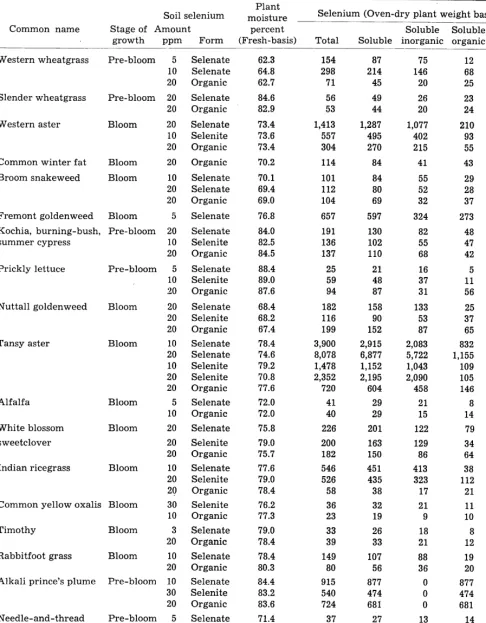
Table 1. Common name, sfage of growth, amount and form of added soil selenium, moisture content of plant, amounts of total, water-soluble, soluble inorganic, soluble organic, and insoluble selenium in various range plants.
Soil selenium moisture Plant Selenium (Oven-dry plant weight basis) ppm
Common name Stage of Amount percent
growth ppm Form (Fresh-basis) Total
Soluble Soluble Insol- Soluble inorganic organic uble Western wheatgrass Pre-bloom
Slender wheatgrass Pre-bloom
Western aster Bloom
Common winter fat Bloom Broom snakeweed Bloom
Fremont goldenweed Bloom Kochia, burning-bush, Pre-bloom summer cypress
Prickly lettuce Pre-bloom
Nuttall goldenweed Bloom
Tansy aster Bloom
Alfalfa
White blossom sweetclover
Bloom
Bloom
Indian ricegrass Bloom
Common yellow oxalis Bloom
Timothy Bloom
Rabbitfoot grass Bloom
Alkali prince’s plume Pre-bloom
Needle-and-thread Pre-bloom
Common dandelion Bloom
Yellow goatsbeard Bloom
5 10 20 20 20 20 10 20 20 10 20 20 5 20 10 20 5 10 20 20 20 20 10 20 10 20 20 5 10 20 20 20 10 20 20 30 10 3 20 10 20 10 30 20 5 10 2 20 20 Selenate Selenate Organic Selenate Organic Selenate Selenite Organic Organic Selenate Selenate Organic Selenate Selenate Selenite Organic Selenate Selenite Organic Selenate Selenite Organic Selenate Selenate Selenite Selenite Organic Selenate Organic Selenate Selenite Organic Selenate Selenite Organic Selenite Organic Selenate Organic Selenate Organic Selenate Selenite Organic Selenate Organic Selenate Organic Organic
62.3 154 87
64.8 298 214
62.7 71 45
84.6 56 49
82.9 53 44
73.4 1,413 1,287
73.6 557 495
73.4 304 270
70.2 114 84
70.1 101 84
69.4 112 80
69.0 104 69
76.8 657 597
84.0 191 130
82.5 136 102
84.5 137 110
88.4 25 21
89.0 59 48
87.6 94 87
68.4 68.2 67.4 78.4 74.6 79.2 70.8 77.6 72.0 72.0 75.8 79.0 75.7 77.6 79.0 78.4 76.2 77.3 79.0 78.4 78.4 80.3 84.4 83.2 83.6 71.4 72.3 79.3 81.7 84.7 182 116 199 3,900 8,078 1,478 2,352 720 41 40 226 200 182 546 526 58 36 23 33 39 158 90 152 2,915 6,877 1,152 2,195 604 29 29 201 163 150 451 435 38 32 19 149 80 915 540 724 37 30 67 89 26 33 107 56 877 474 681 27 22 84 55 69 65 75 146 20 26 20 1,077 402 215 41 55 52 32 324 82 55 68 16 37 31 133 53 87 2,083 5,722 1,043 2,090 458 21 15 122 129 86 413 323 17 21 9 18 21 88 36 0 0 0 13 10 38 41 40
12 67
68 84
25 26
obtained by difference. Amounts of selenium present are ex- pressed as ppm based on oven- dry sample weights. Consider- ing the minimum sample weights used in some instances selenium analyses cannot be considered accurate to less than 0.5 ppm and fractional ppm selenium con- tents are therefore expressed only to the nearest whole num- ber. The water-insoluble frac- tion is assumed to be organic selenium, Beath and Eppson (1947). No attempts were made to determine whether elemental selenium was present in the plant dregs, as has been sug- gested by Peterson and Butler (1962). All inorganic selenium compounds present are consid- ered water-soluble under the extraction conditions.
Discussion of Resulfs The common name of the plant and the amount and’ form of selenium added to the soil along with the results of selenium analyses of the entire plant and certain plant fractions are given in Table 1. Most of the plants were collected at the bloom stage of growth. However, a few species were collected at the pre- bloom stage. The moisture con- tents of the freshly harvested plants varied from 62.3 to 89.0 percent.
The grasses tested varied widely in their ability to absorb, metabolize, and store selenium. Indian ricegrass accumulated by far the highest amount of se- lenium with values of 526 and 546 ppm when grown on soil containing inorganic selenium. Western wheatgrass and rabbit- foot grass samples also contained large amounts. Nearly all grasses grown on soils containing seleni- um, supplied by powdered indi- cator plants, contained a much lower level than similar plants grown on soils containing inor-
ganic selenium. The grasses con- tained from 12.5 to 36.6 percent of the total selenium in an in-
soluble or organic form. The major portion of the water- soluble selenium present in the grasses was inorganic in nature and this amount was not mark- edly influenced by the form of selenium added to the soil.
White blossom sweetclover was an efficient absorber and stored a relatively large amount of selenium whether it was sup- plied as selenate, selenite, or or- ganic selenium. Alfalfa con- tained relatively low levels of 40 and 41 ppm selenium. The second cutting contained nearly the same level of selenium as did the first cutting. Under these ex- perimental conditions both al- falfa and white blossom sweet- clover plants collected at bloom stage, contained from 37.5 to 64.5 percent of the total selenium in the inorganic form. Plants of both species, when grown on soil containing organic selenium, contained 37.5 and 47.2 percent of the total as inorganic sele- nium. These results are not in agreement with those reported by Beath and Eppson (1947) since, they reported that both al- falfa and yellow sweetclover contained only organic selenium. Possible explanations could be variety differences in the alfalfa, variations in selenium metabo- lism between white and yellow species of sweetclover, or differ- ences in selenium metabolism and accumulation by plants grown under natural and those grown under greenhouse condi- tions.
Fremont goldenweed is an ef- ficient selenium absorber since plants grown on soil containing five ppm of selenate selenium contained 657 ppm selenium of which more than 40 percent was in the organic form. Tansy aster is the most efficient absorber of selenium studied and its tissues contained 8,078 ppm selenium when grown on soil containing 20 ppm of selenate. This plant contained 2,352 ppm selenium when grown on selenite contain-
ing soil and 720 ppm when or- ganic selenium was added to the soil. The major portion of the selenium was water soluble and inorganic. Western aster plants contained 1,413 ppm selenium when grown on soil containing 20 ppm selenate as compared with 304 ppm selenium when grown on soil containing a simi- lar level of organic selenium.
Alkali prince’s plume, a seleni- um-indicator plant, accumulated a comparatively high level and absorbed organic selenium more efficiently than selenite but less efficiently than selenate. This plant contains only organic com- pounds of selenium irrespective of the form contained in the soil.
All the plants studied ab- sorbed, metabolized, and stored selenium. It appears that the plants vary widely in their abil- ity to accumulate selenium in their tissues. All species studied are able to absorb inorganic se- lenium and convert some or all of it into organic compounds. The majority of the plants are able to convert organic selenium into inorganic compounds. The ability of plants to absorb, me- tabolize, and store selenium in their tissues is important, poten- tially dangerous, and emphasizes the need to avoid growing food plants on soils containing seleni- um in an available form, since consumption of plants produced on these soils can be directly harmful to humans and live- stock. Livestock consuming se- lenium-containing plants metab- olize the selenium and some of the selenium is incorporated into milk, eggs, and meat products which are consumed by humans and other animals. Precautions should be exercised to limit, in- sofar as possible, the intake of selenium by humans and live- stock.
Summary
and organic form accumulated
selenium in varying amounts in their tissues. Grasses varied widely in selenium-absorption efficiency. Indian ricegrass was the most efficient selenium-ab- sorbing grass, western wheat- grass was somewhat less effi- cient. Common winter fat, broom snakeweed, kochia or burning bush, rabbitfoot grass, common dandelion, and yellow goatsbeard exhibited a some- what lower selenium absorption efficiency. Alkali prince’s plume contained a relatively high level of selenium which was present only in organic compounds. Tansy aster plants grown on soil containing inorganic selenium contained high levels of seleni- um. In general, increasing the level of soil selenium resulted in increased selenium absorption by the plant. Selenate selenium was in most instances, absorbed most efficiently, selenite some- what less efficiently, and organic selenium absorbed to a lesser ex- tent. However, some plants readily absorbed comparatively large amounts of organic seleni- um from the soil. All plants
changed inorganic selenium into the organic form and in most plants the reverse process oper- ated with varying degrees of efficiency. Plants grown on soils containing selenium in an available form should not be used for human consumption. Livestock consuming plants con- taining appreciable quantities of selenium are capable of metabo- lizing the selenium, which is harmful to them. Milk, eggs, and meat obtained from selenium-fed animals will contain selenium.
LITERATURE CITED
BEATH, 0. A., AND H. F. EPPSON. 1947.
The form of selenium in some vegetation. Wyoming Agr. Exp. Sta. Bull. 278, 17 pp.
HITCHCOCK, A. S. (Revised by Agnes Chase) . 1950. Manual of the grasses of the United States, 2nd Ed. U.S. Dept. Agr. Miscellaneous Publication 200, 1051 pp.
HORN, M. J., AND D. B. JONES. 1941. Isolation from Astragalus pectina- tus of a crystalline amino acid complex containing selenium and sulfur. J. Biol. Chem. 139: 649-660. HURD-KARRER, ANNIE M. 1935. Fac- tors affecting the absorption of selenium from soils by plants. J. Agr. Research. 50: 413-427. JONES, D. B., M. J. HORN, AND C. E. F.
GERSDORF. 1937. The selenium and
cystine content of some partial hydrolysis products of gluten from toxic wheat. Cereal Chem. 14: 130- 134.
KELSEY, HARLAN P., AND WILLIAM A. DAYTON. 1942. Standardized plant names. 2nd Ed. J. Horace McFarland Co. 675 pp.
MOXON, A. L. 1937. Alkali disease or selenium poisoning. South Da- kota Agr. Exp. Sta. Bull. 311, 91 PP.
OLSON, 0. E,, D. F. JORNLIN, AND A. L. MOXON. 1942. The seleni- um content of vegetation and the mapping of seleniferous soils. Agron. Jour. 34: 607-615.
PETERSON, P. J., AND G. W. BUTLER. 1962. The uptake and assimilation of selenite by higher plants. Au- stralian J. Biol. Sci. 15: 126-146. TRELEASE, SAM F., AND ORVILLE A.
BEATH. 1949. Selenium, its geolog- ical occurrence and its biological effects in relation to botany, chemistry, agriculture, nutrition, and medicine. Published for the authors by Champlain Printers, 292 pp.
TRELEASE, SAM F., AUGUST A. DI SOMMA, AND ALLEN L. JACOBS. 1960. Seleno-amino acid found in Astragalus bisulcatus. Science, 132: 3427,
WILLIAMS, K. T., H. W. LAKIN, AND H. G. BYERS. 1941. Selenium oc- currence in certain soils in the United States, with a discussion of related topics: Fifth Report. U.S. Dept. Agr. Tech. Bull. 758, 70 pp.
Determining Equitable Grazing Fees
for Washington Department of
Natural Resources Land
GRANT A. HARRIS AND WALLACE R. HOFFMAN
Associate Professor of Range Management, Washington State University; Pullman, Washington, and Supervisor, Division of Lands, Washington Department of Natural Resources, Olympia, Washington.
State Land management. Now the lands are Agencies Reorganized administered impartially, follow- A new concept in the pricing ing principles of sound manage- of range grazing fees has been ment.
put into use on the state lands This was all made possible as of Washington whereby a public the result of an extensive reor- agency is directly sharing in the ganization of land managing income of the livestock industry. agencies by the Washington This “new look” in grazing fees State Legislature. In 1957, six reflects a profound change in the different departments and entire philosophy of state land twelve commissions responsible