MULTI-OBJECTIVE OPTIMIZATION OF PID CONTROLLER PARAMETERS USING GENETIC ALGORITHM
MOHD RAHAIRI BIN RANI
A thesis submitted in fulfilment of the requirements for the award of the degree of
Master of Engineering (Electrical)
Faculty of Electrical Engineering Universiti Teknologi Malaysia
In the name of Allah, Most Gracious, Most Merciful,
All praises and thanks to Allah, whom with His willing giving me the opportunity to complete this thesis. I am heartily thankful to my supervisor, Dr. Hazlina binti Selamat and co-supervisor, Dr. Hairi bin Zamzuri for their support and guidance from the initial to the final stage of my research. Only Allah alone can repay their kindness. Also thanks to the folks at the CAIRO for working together and being fun with. They have kept me in good spirits throughout my study.
I would like to express my deepest thanks and appreciations to my late father, my mother, family and friends for their encouragement, cooperation and
DECLARATION ii
DEDICATION iii
ACKNOWLEDGEMENTS iv
ABSTRACT v
ABSTRAK vi
TABLE OF CONTENTS vii
LIST OF TABLES x
LIST OF FIGURES xi
LIST OF ABBREVIATIONS xiii
LIST OF APPENDICES xv
1 INTRODUCTION 1
1.1 Background of the Problem 1
1.2 Importance of the Work 3
1.3 Research Objectives 3
1.4 Scope of Work 4
1.5 Research Contribution 4
1.6 Thesis Outline 4
2 PID CONTROLLER 6
2.1 Introduction 6
2.2 Conventional Tuning Approaches 7
2.3 Stochastic Tuning Approaches 10
2.4 Multi-objective PID Controller Tuning 13
2.5 Summary 14
3.1 Introduction 15
3.2 Basic Evolutionary Algorithm 15
3.2.1 Initialization 16
3.2.2 Objective Function and Fitness Assignment 18
3.2.3 Selection 18
3.2.4 Crossover 20
3.2.5 Mutation 21
3.2.6 Elitism 22
3.2.7 Termination 22
3.2.8 GA Loop 23
3.3 Studies of Multi-objective Evolutionary Algorithm 24
3.3.1 Weighted Sum Approaches 25
3.3.2 Population Based Approaches 27
3.3.3 Pereto Based Approaches 28
3.3.4 Review of diversity preservation in MOEA 31 3.4 Elitist Non-dominated Sorting Genetic Algorithm
(NSGA-II) 33
3.5 Summary 33
4 METHODOLOGY 35
4.1 Introduction 35
4.2 The Global Criterion Genetic Algorithm (GCGA) 35 4.2.1 Global Ranking Fitness Assignment 36
4.2.2 Binary Tournament Selection 37
4.2.3 Simulated Binary Crossover 39
4.2.4 Polynomial Mutation 40
4.2.5 Elitism through Non-dominated Sorting, Crowding Distance and k-Nearest Neighbour (k-NN) 40
4.2.6 Complete Loop 43
4.3 Rotational Inverted Pendulum (RIP) 44
4.3.1 Mathematical representation of RIP 46 4.3.2 Integration of GCGA in the PID Tuning of RIP 50
4.4 Summary 52
5.1 Introduction ' 53
5.2 Performance Evaluation of GCGA 53
5.2.1 ZDT and DTLZ Test Problems 54
5.2.2 Convergence Metric 56
5.2.3 Diversity Metric 57
5.2.4 Comparison GCGA and NSGA-II in ZDT4 Test
Problem 59
5.3 Procedure of choosing the desired solution from final
pareto front from GCGA optimization 62
5.4 Simulation Results 63
5.5 Real RIP Results 67
5.6 Summary 69
6 CONCLUSION AND FUTURE WORK 70
6.1 Conclusion 70
6.2 Future Works 71
REFERENCES APPENDIX A-D
2.1 PID Parameters Equation for Ziegler and Nichol Tuning 8 2.2 PID Parameters Equation for Cohen and Coon Tuning 9
4.1 Example of the global ranking assignment 36
4.2 The mechanical and electrical parameters of the RIP 57 4.3 Parameters of the PID controller optimization 60
5.1 ZDT and DTLZ test problems 54
5.2 Symbols and description for the test problems 56
5.3 GCGA and NSGA-II user defined parameters 56
5.4 Convergence metric for GCGA and NSGA-II 57
5.5 Neighbouring scheme for the diversity metric 58
5.6 The diversity metric for GCGA and NSGA-II 59
5.7 The transition of solution at K 1 generation for GCGA and
NSGA-II in ZDT4 problem. 60
5.8 PID Parameters and their objective values for the three
1.1 Block diagram of the controller, actuator, plant and sensor 1
2.1 Parallel architecture of PID controller 6
2.2 The structure of stochastic optimization techniques for
PID controller 11
3.1 Structure of a chromosome in real representation 17 3.2 Structure of chromosome in binary representation 17
3.3 Pseudo-code for the binary tournament 19
3.4 One-point crossover 21
3.5 Bitwise mutation 22
3.6 Pseudo-code for GA 23
3.7 HLGA’s selection mechanism 26
3.8 VEGA’s selection mechanism 27
3.9 MOGA’s selection mechanism 28
3.10 NSGA’s selection mechanism 29
3.11 Diversity preservation by grid technique 31
3.12 Niche counting 32
3.13 The crowding distance calculation 32
4.1 The elitism mechanism in GCGA 42
4.2 The proposed flow chart of GCGA 43
4.3 The rotational inverted pendulum at a) downward
equilibrium and b) upward equilibrium. 44 4.4 The configuration of RIP, Microbox, power supply and
driver circuit. 45
4.5 The configuration of RIP, Micro-box and Matlab Simulink 45
4.6 Rotational Inverted Pendulum (RIP) 46
5.1 The final pareto front from GCGA optimization in the
three objective space 63
from GCGA 63 5.3 The pendulum responses for individuals in pareto front
from GCGA 64
5.4 The most minimum ts and OS in the pareto front 65 5.5 The most minimum OS and ITAE in the pareto front 65 5.6 The arm responses of the three individuals with the most
minimum objective. 66
5.7 The pendulum responses of the three individuals with the
most minimum objective 67
5.8 Arm responses for the three extreme solutions from the
final pareto front in GCGA 68
5.9 Pendulum responses for the three extreme solutions from
c1 - Distance to arm centre of mass
c2 - Distance to pendulum centre of mass DTLZ - Deb-Thiele-Laumans-Zitzler
EA - Evolutionary Algorithm
ES - Evolution Strategy
GA - Genetic Algorithm
GCGA - Global Criterion Genetic Algorithm
GP - Genetic Programming
HLGA - Hajela and Lin Genetic Algorithm
J1 _ Inertia of arm
J2 - Inertia of pendulum
Kb - Back EMF constant
Kd - PID derivative gain
K - PID integral gain
Kp - PID proportional gain
Kt - Torque Constant
11 - Length of the arm
12 - Length of the pendulum LQR - Linear Quadratic Regulator
M - No. of objectives
m1 - Mass of the arm
m2 - Mass of the pendulum
MOEA - Multi-objective Evolutionary Algorithm
N - No. of individual in population
NSGA - Non-dominated Sorting Genetic Algorithm
NSGA-II - Elitism Non-dominated Sorting Genetic Algorithm
pc - Crossover probability
pm - Mutation probability
PSO - Particle Swarm Optimization RIP - Rotational Inverted Pendulum
Rm - Armature resistance
APPENDIX TITLE PAGE A Matlab and Simulink code for RIP optimization using
GCGA 77
B The PID Gains and objectives for all points in the pareto
front. 92
C Published paper in International Journal of Innovative
Computing, Information and Control (IJICIC) 95 D Published paper in International Conference on
INTRODUCTION
1.1 Background of the Problem
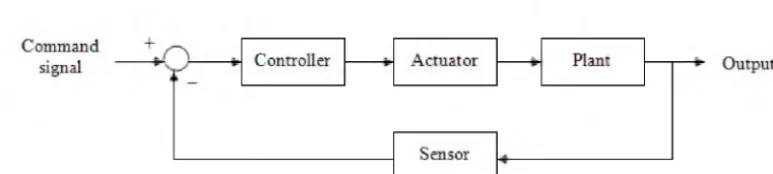
Controller design is an essential aspect in control engineering in order to ensure a controlled plant to perform well. The controller or control law describes the algorithm or the signal processing employed by the control processor to generate the actuator signal from the sensors and command signals it receives (Chen, 1992). Figure 1.1 shows the configuration of the controller, actuator, plant and sensor in a feedback or closed-loop system. The controller receives command signal and after that compares it with the present output measured by the sensor. The controller then send the appropriate signal to the actuator in order to ensure the plant produces the same output as the command signal.
Figure 1.1: Block diagram of the controller, actuator, plant and sensor in a feedback or closed-loop system
controllers like Proportional-Integral-Derivative (PID) controller only requires few parameters to be tuned but complicated controllers like Linear-Quadratic Regulator (LQR) and Linear Quadratic Gaussian (LQG) have more parameters to deal because they considered more states in the designs (Bemporad et al., 2002). These complicated controllers however are developed in such way so it will produce optimum control signal (Polyak and Tempo, 2001). The controller design only has to decide on the value of the weights associated with the various signals in the system. On the other hand, this research aims to find an approach to optimize the performances of the PID controllers.
Despite the simplicity in its structure and being the most popular type of controller employed, the level of difficulty in the PID controller tuning mainly depends on the plant behaviours (Astrom and Hagglund, 2001). Nonlinearity, instable open-loop system, under-actuation and the system’s order are the elements that contribute to the difficulties of tuning process (Zhuang and Atherton, 1993). Therefore this research used a rotational inverted pendulum (RIP) to demonstrate the difficulties in tuning the PID control parameters for a very nonlinear and under actuated system. The under-actuated (two degree of freedoms, one actuator) property of RIP also demonstrates the tuning example of two PID controllers simultaneously. This condition will add to the difficulties in PID tuning.
1.2 Importance of the Works
Despite the popularity of PID controllers as the most practical controller for control engineer, Ender (1993) reports that 30% of the installed PID controllers are operating in manual mode and 65% of the automatic controllers are poorly tuned. Moreover, a study from Van Overschee et al. (1997) shows 80% of PID controllers are badly tuned and 25% of the PID controllers are operating under default factory settings, means the controllers are not tuned at all. Recently, O’Dwyer (2009) states the proposed tuning methods in literature are not having significant impact in the industrial practises. These situations implies the tuning PID controllers are the vexing problems to the tuning operators which maybe the tuning rules available are not well compatible for their tuning problems in industry.
Hence this research tries to provide an alternative approach for tuning PID controllers. The developed algorithm in this research will automatically provide the designers with the optimized PID parameters with less rules of tuning.
1.3 Research Objectives
The main objectives of this research are
i. To develop a multi-objective optimization algorithm based on evolutionary techniques for tuning PID controller parameters.
ii. To compare the proposed algorithm with the well known multi-objective GA. iii. To apply the optimized PID controller to an under-actuated plant, rotational
1.4 Scope of Work
This research consists of a few focus works in order to achieve its objectives. i. Developing a multi-objective optimization algorithm to optimally tune the
PID controller performances like settling time, steady state errors and overshoot using multi-objective genetic algorithms (MOGAs) approach. ii. Analysing the optimization algorithm using several test problems borrowed
from literature and comparing to a well-known algorithm.
iii. Applying the results of optimized PID controller simulation to the real plant in order to validate the algorithm in the real implementation.
1.5 Research Contribution
The main contributions of this research are
i. Introduction of a variant of MOGAs called Global Criterion Genetic Algorithm (GCGA).
ii. Optimization of PID controller tuning using GCGA.
iii. Simulation and experimental validation of optimized PID controller tuning.
1.6 Thesis Outline
This thesis consists of six chapters. Chapter 2 provides a discussion of the fundamentals of PID controller and a number of popular tuning methods for PID controller. Both conventional and alternative approaches are covered in this chapter.
Chapter 4 presents the detailed methodology of the proposed algorithm called Global Criterion Genetic Algorithm (GCGA). Moreover, the modelling of the rotational inverted pendulum through derivation from the equations of motion is presented.
Chapter 5 analyzes the GCGA through several popular test problems and compares its performances with the well known Non-dominated Sorting Genetic Algorithm II (NSGA-II). This chapter also shows the optimization work of the PID controller using GCGA in the simulation and real RIP.
R EFEREN CES
Acosta, J. (2010). Furuta’s Pendulum: A Conservative Nonlinear Model for Theory
and Practise. M athem atical P roblem s in Engineering, 29.
Astrom, K. J. and Hagglund, T. (1988). Automatic tuning of PID controllers.
Instrument Society of A m erica, 7-8.
Astrom, K. J. and Hagglund, T. (2001). The future of PID control. Control
Engineering Practice, 9, 1163-1175.
Bemporad, A., Morari, M., Dua, V. and Pistikopoulos, E. N. (2002). The explicit
linear quadratic regulator for constrained systems. Automatica, 38, 3-20. Chen, G. 1992. Linear Controller Design: Limits of Performance. JSTOR.
Coello, C. A. C. and Lamont, G. B. (2004). A pplications o f multi-objective
evolutionary algorithms, World Scientific Pub Co Inc.
Coello, C. A. C., Lamont, G. B. and Van Veldhuizen, D. A. (2007). Evolutionary
algorithms f o r solving multi-objective problem s, Springer-Verlag New York Inc.
Coello C. and Toscano Pulido, G. (2001). A micro-genetic algorithm for
multiobjective optimization. In, 2001. Springer, 126-140.
Cohen, G. H. and Coon, G. (1953). Theoretical consideration of retarded control.
Trans. Asme, 75, 827-834.
Cominos, P. and Munro, N. (2002). PID controllers: recent tuning methods and
design to specification. In, 2002. IET, 46-53.
Deb, K. (2000). An efficient constraint handling method for genetic algorithms.
Com puter m ethods in app lied mechanics an d engineering, 186, 311-338. Deb, K. (2001). Multi-objective optimization using evolutionary algorithms, Wiley.
Deb, K. and Agrawal, R. B. (1995). Simulated binary crossover for continuous
search space. Complex systems, 9, 115-148.
Deb, K., Pratap, A., Agarwal, S. and Meyarivan, T. (2002). A fast and elitist
multiobjective genetic algorithm: NSGA-II. Evolutionary Computation, IEEE
Transactions on, 6, 182-197.
Deb, K., Thiele, L., Laumanns, M. and Zitzler, E. (2005). Scalable test problems for
evolutionary multiobjective optimization. Evolutionary Multiobjective
Di Pierro, F., Khu, S. T. and Savic, D. A. (2007). An investigation on preference
order ranking scheme for multiobjective evolutionary optimization.
Evolutionary Computation, IEEE Transactions on, 11, 17-45.
Duan, H., Wang, D. and Yu, X. (2006). Novel approach to nonlinear PID parameter
optimization using ant colony optimization algorithm. Journal of Bionic
Engineering, 3, 73-78.
Ender, D. B. (1993). Process control performance: Not as good as you think. Control
Engineering, 40, 180-190.
Fogel, L. J., Owens, A. J. and Walsh, M. J. (1966). Artificial intelligence through
simulated evolution.
Fonseca, C. M. and Fleming, P. J. (1993). Multiobjective genetic algorithms. In,
1993. IET, 6/1-6/5.
Gaing, Z. L. (2004). A particle swarm optimization approach for optimum design of
PID controller in AVR system. Energy Conversion, IEEE Transactions on,
19, 384-391.
Goldberg, D. E. and Holland, J. H. (1988). Genetic algorithms and machine learning.
Machine Learning, 3, 95-99.
Guliashki, V., Toshev, H. and Korsemov, C. (2009). Survey of evolutionary
algorithms used in multiobjective optimization. P roblem s o f Engineering
Cybernetics and Robotics, Bulgarian A cadem y o f Sciences.
Hajela, P. and Lin, C. Y. (1992). Genetic search strategies in multicriterion optimal
design. Structural and Multidisciplinary Optimization, 4, 99-107.
Ho, S. J., Shu, L. S. and Ho, S. Y. (2006). Optimizing fuzzy neural networks for
tuning PID controllers using an orthogonal simulated annealing algorithm
OSA. Fuzzy Systems, IEEE Transactions on, 14, 421-434.
Holand, J. (1975). Adaptation in natural and artificial systems. Ann A rb o r Mich:
University Michigan Press.
Hu, H., Hu, Q., Lu, Z. and Xu, D. (2005). Optimal pid controller design in pmsm
servo system via particle swarm optimization. In, 2005. Ieee, 5 pp.
Huang, W. and Lam, H. (1997). Using genetic algorithms to optimize controller
parameters for HVAC systems. Energy and Buildings, 26, 277-282.
Igel, C., Hansen, N. and Roth, S. (2007). Covariance matrix adaptation for multi
Johnson, M. A., Moradi, M. H. and Crowe, J. (2005). PID control: new identification
an d design m ethods, Springer Verlag.
Kim, D. H. and Cho, J. H. (2005). Adaptive tuning of PID controller for
multivariable system using bacterial foraging based optimization. A dvan ces
in W eb Intelligence, 231-235.
Koza, J. R. (1992). Genetic programming: On the programming of computers by
natural selection. MIT Press, Cambridge, MA, USA.
Kukkonen, S. and Deb, K. (2006). Improved pruning of non-dominated solutions
based on crowding distance for bi-objective optimization problems. In, 2006. Proceedings of the World Congress on Computational Intelligence (WCCI-
2006)(IEEE Press). Vancouver, Canada, 1179-1186.
Kursawe, F. (1991). A variant of evolution strategies for vector optimization.
P a ra llel P roblem Solving fro m N ature, 193-197.
Mcmillan, G. K. (1983). Tuning and control loop performance. Instrum ent S ociety o f
A m erica, R esearch Triangle P ark, N C.
Murata, T. and Ishibuchi, H. (1995). MOGA: Multi-objective genetic algorithms. In,
1995. IEEE, 289.
O'dwyer, A. (2009). H andbook o f P I an d PID con tro ller tuning rules, Imperial College Pr.
Osyczka, A. (1985). Multicriteria optimization for engineering design. D esign
optim ization , 1, 193-227.
Pedersen, G. K. M. and Yang, Z. (2006). Multi-objective PID-controller tuning for a
magnetic levitation system using NSGA-II. In: Proceedings of the 8th annual conference on Genetic and evolutionary computation, 2006. ACM, 1737
1744.
Polyak, B. and Tempo, R. (2001). Probabilistic robust design with linear quadratic
regulators. System s & C ontrol Letters, 43, 343-353.
Popov, A., Farag, A. and Werner, H. (2005). Tuning of a PID controller using a
multi-objective optimization technique applied to a neutralization plant. In:
Decision and Control, 2005 and 2005 European Control Conference. CDC-
ECC'05. 44th IEEE Conference on, 2005. IEEE, 7139-7143.
Porter, B. and Jones, A. (1992). Genetic tuning of digital PID controllers. E lectron ics
Letters, 28, 843-844.
Sadasivarao, M. and Chidambaram, M. (2006). PID controller tuning of cascade
control systems using genetic algorithm. Journal o f Indian Institute o f
Science, 86, 343-354.
Schaffer, J. D. (1985). Some experiments in machine learning using vector evaluated
genetic algorithms. Vanderbilt Univ., Nashville, TN (USA).
Schwefel, H. P. (1965). Kybernetische Evolution als Strategie der experimentellen
Forschung in der Stromungstechnik. M aster's thesis, Technical U n iversity o f
B erlin.
Scott, D. A., Karr, C. L. and Schinstock, D. E. (1999). Genetic algorithm frequency-
domain optimization of an anti-resonant electromechanical controller.
E ngineering A pplication s o f A rtificia l Intelligence, 12, 201-211.
Spears, W. M. (2000). E volu tion ary algorith m s: the role o f m utation and
recom bin ation, Springer-Verlag New York Inc.
Srinivas, N. and Deb, K. (1994). Muiltiobjective optimization using nondominated
sorting in genetic algorithms. E volu tion ary com putation, 2, 221-248.
Van Overschee, P., Moons, C., Van Brempt, W., Vanvuchelen, P. and De Moor, B.
(1997). RAPID: the end of heuristic PID tuning. JOURNAL A, 38, 6-10. Wang, X., Li, S., Chen, H. and Mei, Y. (2006). Multi-objective and Multi-district
Transmission Planning Based on NSGA-II and Cooperative Co-evolutionary
Algorithm. In: Zhongguo Dianji Gongcheng Xuebao(Proceedings of the
Chinese Society of Electrical Engineering), 2006. 11-15.
Zhao, J., Li, T. and Qian, J. (2005). Application of particle swarm optimization
algorithm on robust PID controller tuning. A dva n ces in N atu ral C om putation, 444-444.
Zhuang, M. and Atherton, D. (1993). Automatic tuning of optimum PID controllers.
In: Control Theory and Applications, IEE Proceedings D, 1993. IET, 216 224.
Ziegler, J. and Nichols, N. (1942). Optimum settings for automatic controllers.
Transactions o f the, 5, 759-768.
Zitzler, E. and Thiele, L. (1999). Multiobjective evolutionary algorithms: A
comparative case study and the strength pareto approach. E volutionary