Students today... educators tomorrow 1
2
Keri Moore1,2
3
Brett Vaughan2
4 5
1 School of Health and Human Sciences, Southern Cross University, Bilinga, 6
Queensland, Australia
7
2 College of Health & Biomedicine, Victoria University, Melbourne, Australia 8
9 10
Keri Moore, Clinical Education Specialist and Consultant, School of Health and
11
Human Sciences, Southern Cross University, Gold Coast Highway, Bilinga,
12
Queensland 4225, Australia. E-mail: [email protected]
Students today... educators tomorrow 17
SUMMARY 20
21
Background:
22
The article describes the use of the mini clinical examination (mini-CEX) in a pilot
23
study to introduce peer assessment in one allied health programme to explore
24
students’ capacity as clinical educators. Preparing today’s pre-professional health
25
students to be clinical educators by engaging them in peer teaching, learning and
26
assessment may encourage them to become tomorrow’s clinical educators.
27 28
Context:
29
Peer assessment is common among many undergraduate medical and allied health
30
programmes, and is typically used as a means of providing students with feedback
31
on their clinical skill development. We argue that peer assessment ought to be
32
focused not only on the development of learners’ clinical skills and knowledge, but
33
also on preparing learners for their responsibilities as clinical educators.
34 35
Innovation:
36
Final-year Australian osteopathy students in our on-campus university clinic
37
undertook, without training, peer assessment and provision of feedback related to
38
clinical performance using a discipline-specific adaptation
39
of the mini-CEX. The current study suggests that students are able to judge
40
another’s consultation skills and case management in that they identify what we
41
know are common learning issues for students at this level.
42 43
Implication:
Students may be willing to engage in peer assessment if they see the exercise as a
45
way to improve patient care and to develop their skills as educators – potentially
46
encouraging them to become clinical educators in the future.
INTRODUCTION 50
51
The process by which learners at the same stage of their training are asked to make
52
judgement on the work of one of their peers is termed peer assessment. From that
53
activity, among other outcomes, the peer assessor learns to make judgements and
54
to provide feedback for their peers. In the peer assessor’s future role as a health
55
care professional, teaching and assessing peers is an expected competency (1).
56
Learning to be a peer assessor in the work- place arguably helps health care
57
students to develop skills that contribute to patient care, and possibly motivates them
58
to consider becoming engaged in clinical education, becoming a member of
59
tomorrow’s academic faculty staff (2).
60 61
Peer assessment has educational value, yet we know that in many instances
62
students are reluctant to be assessed by a peer (3), particularly in summative
63
assessments. Peer assessors also don’t like to think that they affect another
64
student’s progress in a negative way (4). Furthermore, peer assessors feel
65
uncomfortable reporting observed clinical weaknesses or unprofessional behaviour
66
to a peer, and would rather present such information to a third party to pass on (4).
67
Only one study demonstrated that students can assess peers dispassionately (5).
68
The aim of the current study was to ascertain whether students, who were not
69
specifically trained to use the mini-clinical examination (mini-CEX) as peer
70
assessors, could engage in peer assessment, make performance judgements and
71
provide useful feedback. The mini-CEX tool was used as it provides a snapshot of a
72
student’s clinical performance and has previously been used in osteopathy clinical
73
education.
METHODS 75
76
The osteopathy programme at Victoria University (VU, Melbourne, Australia) is a
5-77
year pre-professional programme with clinical education undertaken in on-campus
78
clinics. In this environment it is expected that students in years 4 and 5 will develop
79
and consolidate their clinical and professional skills, and knowledge, prior to
80
registration. The student is expected to take a clinical history, undertake an
81
examination, and develop/implement a management plan for patients, all under the
82
supervision of registered osteopaths (6). Students manage members of
83
the general public with a range of acute and chronic musculoskeletal complaints. As
84
part of a workplace-based assessment programme, the mini-CEX is used to assess
85
a student’s progress (7).
86 87
The mini-CEX is an assessment tool that can be used to provide a snapshot of
88
student performance whilst managing a patient in a workplace setting. The tool
89
captures performance across six domains: information gathering; clinical
90
examination; communication & counselling skills; clinical judgement; organisation &
91
efficiency; and professionalism. The students’ overall performance managing the
92
patient during the consultation is also assessed. The domains and overall
93
performance are assessed on a scale from 1 (well below expectation) to 6 (well
94
above expectation). Not all domains may be observed during a patient consultation
95
and the examiner can mark ‘not observed’ for particular domain(s). Multiple
mini-96
CEX assessments with different examiners and different patients are required to
97
make a reliable judgement about competency. The present study explored aspects
98
of the utility of the mini-CEX as a peer assessment tool with a view to: (1) providing
students with peer feedback on their clinical work; and (2) exploring whether student
100
peer assessors were able to make judgements and provide useful feedback.
101 102
The study was approved by the VU Human Research Ethics Committee. All 52
103
students enrolled in year 5 (final year) of the osteopathy programme at VU were
104
required to complete a minimum of two mini-CEX assessments on a year-5 peer as
105
a hurdle requirement. The assessment was not summative and did not contribute to
106
the grade for their clinical subjects. These students had already undertaken
107
approximately 500 hours of clinical training prior to this point, including the
108
management of approximately 100 patients under supervision. The peer assessor
109
selected the aspect of the consultation to be assessed, as we wanted to provide an
110
opportunity for the peer assessor to select an area that they felt comfortable
111
assessing. Students were able to choose their peer assessor. The assessment was
112
completed during allocated clinical time.
113 114
Quantitative results from each mini-CEX were extracted and analysed. Qualitative
115
comments were independently classified by the authors using an adaptation of a
tier-116
feedback taxonomy (Box 1) (8). The authors met several times to discuss
117
interpretations, differences and to form a consensus.
Box 1. Modified four-tier feedback taxonomy. 121
122
Tier 1 - No comment
Tier 2 - Vague comment: global statement (e.g. overall good performance)
Tier 3 - Descriptive comment: a clear point or issue for the student to act upon
(e.g. excellent rapport with patients)
Tier 4 - A clear point or issue for the student to act upon, with qualifiers as to what
the consequences would be
RESULTS 125
126
One hundred and eighteen assessments were completed during semesters 1 and 2
127
in 2014. Fourteen students had three assessments completed on them. The
128
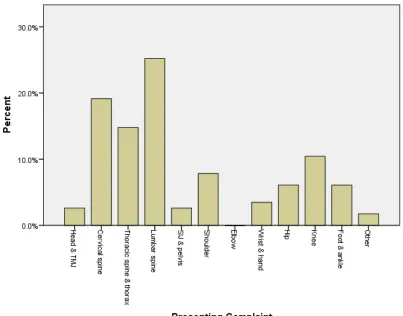
presenting complaints are provided in Figure 1. Peer assessors conducted
129
assessments across three aspects of the osteopathy consultation: Clinical History
130
(31.4%), Examination (35.6%) and Management (33.1%).
131 132
Figure 1. Regions of presenting complaints assessed.
133 134
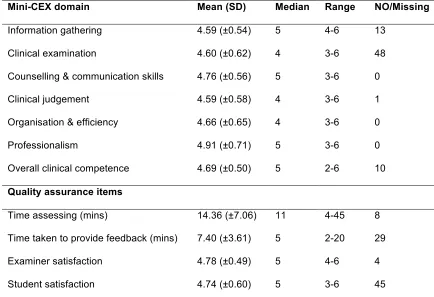
Descriptive statistics for the mini-CEX are presented in Table 1. The high number of
135
‘NO/Missing’ entries is related to the aspect of the consultation observed, as some
136
domains were not relevant in every instance (i.e. the clinical examination domain is
137
not relevant when assessing history taking). The time taken with the assessment and
138
to provide feedback was acceptable to both parties. Anecdotal reports indicate that
139
both students and peer assessors felt the process had some educational value and
140
were keen to participate in similar activities again.
141 142
Table 1. Descriptive statistics for the mini-CEX domains and quality assurance
143
items.
144 145
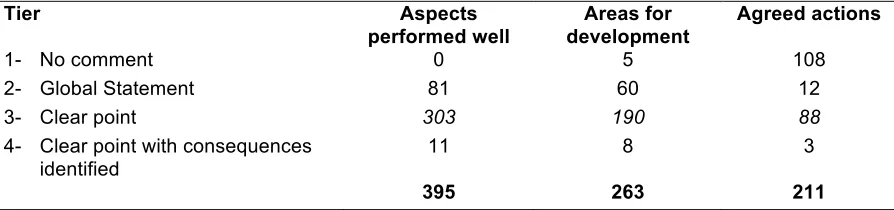
Peer assessors were asked to provide students with written comments on the
146
aspects of the consultation that: (1) performed well; (2) needed development and
147
improvement; and (3) were agreed as items to action. Qualitative comments from the
118 assessments fell into the two central tiers: global statements and clear
149
comments (Table 2).
150 151
Table 2. Classification of qualitative comments provided by peer assessors on the
152
mini-CEX form.
153 154
Written comments included the following examples:
155 156
• An example of a global statement, on an area per- formed well, was ‘Very
157
friendly and relaxed’ (student no. 7).
158
• An example of a clear point, an area for improvement, was ‘[seek] more
159
patient feedback on comfort/pain levels’ (student no. 6).
160
• An example of a clear point with consequences, an area for improvement,
161
was ‘Address fears of running due to previous injury – relationship to
162
presenting complaint’ (student no. 5).
163 164
The comments suggested peer assessors were able to identify:
165
• the questioning techniques used during patient interviews;
166
• whether rapport had been established and when
167
• communication had gone astray;
168
• which clinical tests and techniques were omitted or not performed properly;
169
• postural errors that could cause the student to suffer an injury – an important
170
consideration in manual therapy; and
171
• the thoroughness of the consultation relative to the patient’s health concern.
174
DISCUSSION 175
176
From the snapshot presented here, it appears that the peer assessors had a clear
177
model of what constitutes an appropriate osteopathy consultation for a given health
178
concern, and were able to make judgements about a peer’s performance and
179
provide feedback (9). The median mini-CEX domain values were in the mid-range:
180
no student ‘failed’ a mini-CEX and, taken on face value, it seems that peer assessors
181
were reluctant to use the full scale range on each domain. This may possibly be
182
because of student/peer assessor familiarity or reluctance to find fault (4,5).
183 184
Ostensibly it appears that this cohort have the baseline skills to be peer assessors
185
and perhaps clinical educators in the future: that is, to complete assessments and
186
provide feed- back. The ability to provide feedback to peers is encouraged by patient
187
safety and quality of care agendas, engenders collabo- ration,9 and creates an
188
environment that has sense of a community of practice. The feedback – short written
189
statements – did not suggest the
190 191
Peer assessors conducted assessments across three aspects of the osteopathy
192
consultation possible consequences of the omissions or errors observed for the
193
patient personally or the patient’s health concern. We also think the brevity of the
194
written feedback was linked to time constraints, or it may reflect a misunderstanding
195
of the value of providing meaningful, constructive feedback in written form for
196
accountability and audit purposes. The peer assessors in the present study did
197
identify learning issues for students at this level of their pre- professional
programme. Anecdotally, these are consistent with those identified by clinical
199
educators in the VU programme.
200 201
Students probably require training in how to give useful feedback (3,10). The present
202
study was opportunistic given the previous successful implementation of the
mini-203
CEX, and therefore it was not possible to provide training for peer assessors. Future
204
studies will provide training for students in the peer assessment process and will
205
provide feedback, as this has the potential to help students learn to think as clinical
206
educators in the hope of moving beyond the notion of a peer appraising the work of a
207
classmate.
208 209
Beyond the training issues, there are a number of limitations in the present study.
210
There was no way to confirm the accuracy of the student peer assessor’s
211
observations and comments. This would only be possible if the consultation was
212
videotaped or if both a clinical educator and peer assessor were present at the same
213
time. Students could select who assessed them, therefore leniency could have
214
played a part in the results. Allocating the student a peer assessor may help to
215
resolve this to some extent, but given the small cohort size it is unlikely to have a
216
significant influence. Peer assessors were untrained but had experience being
217
assessed by a clinical educator using the mini-CEX during their clinical training.
CONCLUSION 221
222
Our snapshot exploration of the peer assessment skills of pre- professional
223
osteopathy students who received no training as educators or assessors suggests
224
that they have some capability to judge the work of others and provide written
225
feedback. Embedding peer assessment activities in the pre-professional clinical
226
curriculum is potentially a way to motivate today’s students to become tomorrow’s
227
clinical educators, thereby developing the future health workforce. This is critical
228
given that all health professions struggle to find willing practitioners to become
229
clinical educators. Future studies need to explore the perceived educational value of
230
the peer assessment process in this context, the actual practice of pre-professional
231
peer assessors in relation to other assessments and the legal aspects of peer
232
assessment in clinical education.
REFERENCES 235
236
1. Gusic M, Hageman H, Zenni E. Peer review: a tool to enhance clinical teaching.
237
Clin Teach 2013;10(5):287–290.
238
2. Mileder L. Are medical schools hesitant to teach undergraduate students teaching
239
skills? A medical student’s critical view. Med Educ Online 2013;18:1–2.
240
3. Burgess AW, Roberts C, Black KI, Mellis C. Senior medical student perceived
241
ability and experience in giving peer feedback in formative long case examinations.
242
BMC Med Educ 2013;13:79.
243
4. Shue CK, Arnold L, Stern DT. Maximizing participation in peer assessment of
244
professionalism: the students speak. Acad Med 2005;80:S1–S5.
245
5. McGarr O, Clifford AM. ‘Just enough to make you take it seriously’: ex- ploring
246
students’ attitudes towards peer assessment. Higher Education 2013;65:677–693.
247
6. Vaughan B, MacFarlane C, Florentine P. Clinical education in the osteopathy
248
program at Victoria University. Int J Osteopath Med 2014;17:199–205.
249
7. Vaughan B, Moore K. The mini Clinical Evaluation Exercise (mini- CEX) in a
pre-250
registration osteopathy program: Exploring aspects of its validity. Int J Osteopath
251
Med 2015;19:61–72.
252
8. Burnand H, Fysh T, Wheelar J, Allum W. Feedback and performance scores for
253
direct observation of procedural skills. Bulletin of The Royal College of Surgeons of
254
England 2014;96:e5–e8.
255
9. Kearney S, Perkins T, Kennedy-Clark S. Using self-and peer-assessment for
256
summative purposes: analysing the relative validity of the AASL (Authentic
257
Assessment & Sustainable Learning) model. Assessment and Evaluation in Higher
258
Education 2015;1–14.
10. Finn GM, Garner J. Twelve tips for implementing a successful peer assessment.
260
Med Teach 2011;33:443–446.
Table 1. Descriptive statistics for the mini-CEX domains and quality assurance items.
Mini-CEX domain Mean (SD) Median Range NO/Missing
Information gathering 4.59 (±0.54) 5 4-6 13
Clinical examination 4.60 (±0.62) 4 3-6 48
Counselling & communication skills 4.76 (±0.56) 5 3-6 0
Clinical judgement 4.59 (±0.58) 4 3-6 1
Organisation & efficiency 4.66 (±0.65) 4 3-6 0
Professionalism 4.91 (±0.71) 5 3-6 0
Overall clinical competence 4.69 (±0.50) 5 2-6 10
Quality assurance items
Time assessing (mins) 14.36 (±7.06) 11 4-45 8
Time taken to provide feedback (mins) 7.40 (±3.61) 5 2-20 29
Examiner satisfaction 4.78 (±0.49) 5 4-6 4
Student satisfaction 4.74 (±0.60) 5 3-6 45
Table 2. Classification of qualitative comments provided by peer assessors on the mini-CEX form.
Tier Aspects
performed well
Areas for development
Agreed actions
1- No comment 0 5 108
2- Global Statement 81 60 12
3- Clear point 303 190 88
4- Clear point with consequences identified
11 8 3