Fast and Secure Linear Regression and Biometric Authentication
with Security Update
?Yoshinori Aono Takuya Hayashi Le Trieu Phong?? Lihua Wang National Institute of Information and Communications Technology (NICT), Japan
{aono, takuya.hayashi, phong, wlh}@nict.go.jp
Abstract. We explicitly present a homomorphic encryption scheme with a flexible encoding of plain-texts. We prove its security under the LWE assumption, and innovatively show how the scheme can be used to handle computations over both binary strings and real numbers. In addition, using the scheme and its features, we build fast and secure systems of
• linear regression using gradient descent, namely finding a reasonable linear relation between data items which remain encrypted. Compared to the best previous work over a simulated dataset of 108 records each with 20 features, our system dramatically reduces the server running time from about 8.75 hours (of the previous work) to only about 10 minutes.
• biometric authentication, in which we show how to reduce ciphertext sizes by half and to do the computation at the server veryfast, compared with the state-of-the-art.
Moreover, as key rotation is a vital task in practice and is recommended by many authorized organi-zations for key management,
• we show how to do key rotation over encrypted data, without any decryption involved, and yet homomorphic properties of ciphertexts remain unchanged. In addition, our method of doing key rotation handles keys of different security levels (e.g., 80- and 128-bit securities), so that the security of ciphertexts and keys in our scheme can be “updated”, namely can be changed into a higher security level.
Keywords:Homomorphic encryption, LWE assumption, privacy preservation, linear regression, bio-metric authentication.
1 Introduction
1.1 Background
Imaginatively, the storage and computation on the cloud can be seen as storing data and performing computations on a huge and globally available “machine”. Formally, a definition of cloud computing is given by NIST in [29] saying that it is a “model for enabling ubiquitous, convenient, on-demand network access to a shared pool of configurable computing resources that can be rapidly provisioned and released with minimal management effort or service provider interaction.”
The benefits of cloud computing come with threats, typically one of which is that plain data stored in the cloud may be accessed unwillingly. Promisingly, homomorphic encryption can balance the situation, as it enables the computations over the data even in encrypted form, on which the discussion can go back far to Rivest et al. [36] in 1978. Specifically, a client can store encrypted data on the cloud to enjoy the service, but at the same time can ensure that no useful information is leaked to the storage.
?This paper is an abridged version of [8, 9]. ??
1.2 Our contributions
We explicitly explore features of an LWE-based homomorphic encryption scheme, and exploit those features in designing extremely efficient and secure systems in cloud computing. Details are given below.
1. A homomorphic encryption scheme: we make explicit and analyze a homomorphic public key encryption scheme secure under the LWE assumption. By making the scheme explicit, we newly discover that it has a veryflexibleencoding of plaintexts. By “flexible”, we mean two things: (a) the scheme natively handles binary strings, real numbers, and the computations (additions, multiplication) over them; and (b) in the scheme, the message length can properly vary with applications.
See Section 3 for the scheme and Section 4 for the encoding. The novel encoding of plaintexts is exploited in depth in following secure systems.
2. Fast and secure linear regression: we show in Section 5 that secure linear regression using gradient descent can be accomplished extremely fast in time and modest in communication. In particular, in the scenario of outsourced computation with an honest-but-curious server and a client, our system processes a simulated dataset of 108 records each with 20 features in 10 minutes at the server (Xeon E5-2660 v3, 2.60GHz, 20 threads) and 0.38 second (1 thread) at the client, with only 280 kilobytes of communication from the server to the client. These are extremely fast compared with the best previous work using Paillier encryption equipped with garbled circuits (8.75 hours at the server, [32]). Moreover, on real UCI datasets [1], our system is dramatically faster than [32] with significant improvements on the communication costs as shown in Table 7.
As a warm-up for Section 5, we show how to handle real numbers with fixed precision (usually set to 64-bit) in Section 4, and demonstrate the secure computation of standard statistics including the mean, variance, and weighted sum (which is used in secure prediction in Section 5).
3. Fast and secure biometric system: we show that binary strings are processed extremely efficiently by our scheme in biometric authentication, in which two binary templates are compared by XORing. The computation can be done in a secure way where the templates are encrypted, so that it can be performed by an honest-but-curious server. Our ciphertext size is at least a half smaller than previous results by [38, 39], and the computation at the server is dramatically (more than 1000x) improved. See Section 6.
4. Key rotation and security update: this is very unique to our homomorphic encryption scheme, where we show that encrypted data (stored in the server in above systems) can be key-rotated, and generally security-updated in a non-naive way. The task of key rotation, recalled at length in Section 3.3, is recommended by NIST [31], PCI DSS [2], and OWASP [3]. We design algorithms allowing key rotation and security update over encrypted data without any plain data recovery, and hence help to prevent any data breach (on the cloud servers) specifically in above systems. See Section 3.3.
as transforming ciphertexts from current to higher dimensions, together with a re-randomization in the high dimension.
However, the ring-LWE assumption generally helps saving the public key size, and improving the speed of the scheme basing on it thanks to careful manipulations over polynomial rings. Therefore, many works choose ring-LWE-based schemes in implementations [21, 24, 30, 38, 39], to list just a few.
When building secure systems, we will highlight that the usage of primitives, either LWE-based or ring-LWE-LWE-based, plays a key role for overall efficiency. Perhaps surprisingly, via above applications, we demonstrate that properusages of an LWE-based scheme can still yield sufficient efficiency. Having said that, we discuss how to use ring-LWE in Appendix A, pointing out that the ciphertext size increases (compared to the use of LWE) when using in our systems.
1.3 More related works
Graepel et al. [21] mention using homomorphic encryption for regression, using schemes supporting additions and r multiplications where r is the number of steps in gradient descent. On a small dataset of 100 records each with 2 features, the system in [21] needs about 1 minute even when r = 1 (at which the result may be not tuned sufficiently). We are different from that work by showing in Section 5 that secure linear regression can be done with only additive homomorphism (and multiplicative one is not needed at all), regardless of the numberr.
Regarding secure linear regression, the work [32] (compared with ours above) itself improves [22], whose running time is 2 days over a dataset of 51K records each with 22 features.
Differential privacy [18] aims to show that the change in any single data item will not much affect the output. Our system for secure linear regression can be combined with the functional mechanism of [40] so that the output can be publicly released with the same assurance from differential privacy. We will discuss details later.
Ignoring the key rotation and security update properties, the pairing-based BGN encryption scheme [12, 19] can also be used in our systems. In Appendix B we will show how it can be used in our systems, and approximately compare the efficiencies with the LWE-based ones.
2 Preliminaries
LetZs be the discrete Gaussian distribution over the integersZ, with mean 0 and deviations >0.
The mark ←g is for “sampling from a discrete Gaussian” set, so that x←g Zs means x appears
with probability proportional to exp(−πx2/s2). Below, $
← means “sampling randomly”; and ≈c stands for “computationally indistinguishable”. Abusing notation a little, Zq ⊂(−q/2, q/2] is the
set of integers centered modulus q. (In this manuscript, q is always for modulus, and s is always for Gaussian deviation.)
2.1 Learning with Errors
Related to the decision LWE assumption LWE(n, s, q), where n, s, q depends on security param-eter, consider matrix A←$ Zmq×n, vectors r
$
←Zmq×1, x
g
←Zns×1, e
g
computed over Zq. Define the following advantage of a poly-time probabilistic algorithm D:
AdvLWE(D n,s,q)(λ) =
Pr[D(A, Ax+e)→1]−Pr[D(A, r)→1] .
The LWE assumption asserts that AdvLWE(D n,s,q)(λ) is negligible as a functions of λ.
2.2 Homomorphic encryption, key rotation, and security update
Definition 1. Public key homomorphic encryption (PHE) schemes consist of the following (possi-bly probabilistic) poly-time algorithms.
• ParamGen(1λ, h)→pp:λis the security parameter, whileh is the maximum number of security updates of one ciphertext.
The public parameter pp is implicitly fed in following algorithms.
• KeyGen(1λ)→(pk, sk): pk is the public key, whilesk is the secret key.
• Enc(pk, m)→c: probabilistic encryption algorithm produces c, the ciphertext of messagem.
• Dec(sk, c)→m: decryption algorithm returns message m encrypted inc.
• Add(c, c0),AddM(c, c0): InAdd, for ciphertextscandc0, the output is the encryption of plaintext addition cadd. Similarly, AddM adds two ciphertexts each was obtained by one multiplication
(using Mul below).
• Mul(pp, c, c0): for ciphertexts c and c0, the output is the encryption of plaintext multiplication
cmul.
• DecA(sk, cadd): decryptingcadd to obtain an addition of plaintexts.
• DecM(sk, cmul): decrypting cmul to obtain a multiplication of plaintexts.
Definition 2. With respect to a PHE scheme as in Definition 1, consider the following game between an adversary A and a challenger:
• Setup. The challenger createspp and key pairs (pk, sk). Thenpp andpk are given to A.
• Challenge.A chooses two plaintextsm0, m1 of the same length, then submits them to the
chal-lenger, who in turn takes b∈ {0,1} randomly and computes C∗ =Enc(pk, mb). The challenge ciphertext C∗ is returned to A, who then produces a bitb0.
A PHE scheme is CPA-secure if the advantage AdvcpaA (λ) =Pr[b0 =b]−12
is negligible in λ.
Definition 3. A PHE scheme as in Definition 1 has the property of key rotation and security update if there are algorithms:
• UKGen(pp, pk1, sk1, pk2, sk2): generating an update key uk1→2 from the public/secret key pairs
(pk1, sk1) (old) and (pk2, sk2) (new).
• Update(pp, c, uk1→2, pk2): outputting a new ciphertext cnew from an old c.
with the following four requirements:
a) Pseudorandom update key: the update key uk1→2 is pseudorandom, even given public pk1,
b) Pseudorandom updated ciphertexts:the ciphertextcnewis secure as those encrypted directly
under pk2, even given uk1→2, pk1, pk2 and any poly-number of ciphertexts under these keys.
c) Correctness of updated ciphertexts: Succinctly,
Dec(sk2, cnew) =Dec(sk1, c)
with overwhelming probability, namely the correctness is not affected by key rotation and security update.
d) Homomorphisms: are preserved as long as the ciphertexts in operations are under the same public key (either pk1 or pk2), regardless of whether they are (1) directly formed by Enc, or (2)
indirectly formed by Update.
2.3 Our vision: secure cloud computing with key rotation and security update
Using a PHE scheme with properties as in Definition 3, a client can store encrypted data on cloud server for computations using homomorphic properties. Moreover, the client can do key rotation for all ciphertexts, namely replacing an old key pair (pk1, sk1) by a new one (pk2, sk2) by:
1. The client holding (pk1, sk1) generates the new key pair (pk2, sk2), and then createsuk1→2 via
executingUKGen(pp, pk1, sk1, pk2, sk2). The client sendsuk1→2to the cloud server. Noteuk1→2
is pseudorandom, and hence reveals no information to the cloud server.
2. The cloud server receives uk1→2 and runs the algorithm Update(pp, c, uk1→2, pk2) to rotate the
key pk1 encrypting c to pk2. The output iscnew. The cloud server is trusted in deleting c and
storing cnew properly. This step is repeated for all old ciphertexts cunder pk1 in the storage.
Plain data is never recovered in the above steps, which helps preventing any data breach. The discussion of why key rotation is important appears in [2, 3, 31] and Section 3.3.
3 Proposed scheme
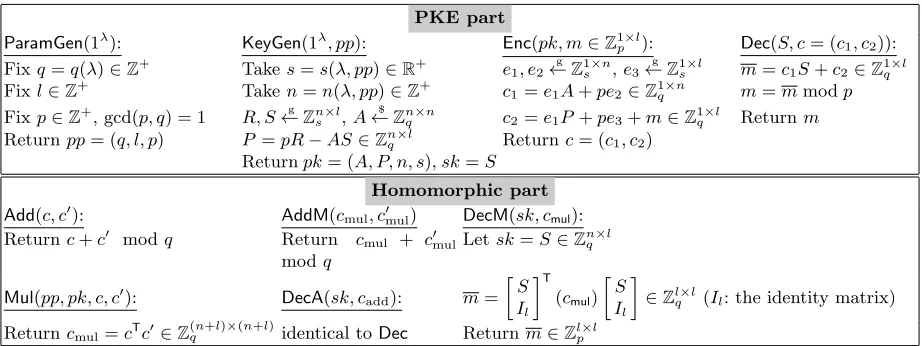
Our proposed homomorphic encryption scheme is depicted in Figure 1. It naturally supports mul-tiple additions and one multiplication. While relying on the idea of [25] for reducing the public key size, its full description is not explicitly appeared in the literature to the best of our knowledge, not to mention its power in application. In particular,
• there are rooms for choosing parameters l and p in the message space Zlp to fit each specific
application, as they are not tightly related to parameters deciding security (q, n, s).
For example, as l (message length) and n (security level) can be different, we can set (l, n) = (64,3530) for the secure computation of mean in Section 4.2, or (l, n) = (16128,3530) for linear regression as in Section 5.
When p = 2 and l is arbitrary (e.g., l = 2048), the scheme can handle bit vectors in Z12×l as
shown in Section 6 on biometrics. (Whenp= 2 andl= 1, we essentially obtain a variant of the Regev encryption scheme [35].)
• the addition and outer product of plaintexts inZ1p×lgives rise to the addition and multiplication
PKE part
ParamGen(1λ): KeyGen(1λ, pp): Enc(pk, m∈Zp1×l): Dec(S, c= (c1, c2)):
Fixq=q(λ)∈Z+ Takes=s(λ, pp)∈R+ e1, e2
g
←Z1s×n,e3
g
←Z1s×l m=c1S+c2∈Z1q×l Fixl∈Z+ Taken=n(λ, pp)∈Z+ c1=e1A+pe2∈Z1q×n m=mmodp Fixp∈Z+, gcd(p, q) = 1 R, S←g Zns×l,A
$
←Znq×n c2=e1P+pe3+m∈Z1q×l Returnm Returnpp= (q, l, p) P =pR−AS∈Zqn×l Returnc= (c1, c2)
Returnpk= (A, P, n, s),sk=S
Homomorphic part Add(c, c0): AddM(cmul, c0mul) DecM(sk, cmul):
Returnc+c0 modq Return cmul + c0mul
modq
Letsk=S∈Znq×l
Mul(pp, pk, c, c0): DecA(sk, cadd): m=
S Il
T
(cmul)
S Il
∈Zlq×l(Il: the identity matrix)
Returncmul=cTc0∈Zq(n+l)×(n+l) identical toDec Returnm∈Zlp×l
Fig. 1.Our PHE scheme. Above,Z+and
R+are correspondingly the sets of positive integers and real numbers, ←$
means “sampling randomly” while ←g is for “sampling from the discrete Gaussian” set.
3.1 Correctness and homomorphic property
Correctness.We check that directly-formed ciphertexts can be decrypted correctly. Indeed, in the decryptionDec algorithm,
c1S+c2= (e1A+pe2)S+e1P +pe3+m
=e1(AS+P) +pe2S+pe3+m
=p(e1R+e2S+e3) +m∈Z1q×l (1)
will yield correctmin decryption if the noise p(e1R+e2S+e3) is small enough. The decryption of
added ciphertexts via algorithm DecA can be checked similarly.
For ciphertextsc∈Zq1×(n+l)and c0 ∈Zq1×(n+l), considercmul=cTc0 ∈Z(qn+l)×(n+l), where theT
stands for matrix transpose. The decryption of this product works as follows. First, over Zq, and
Il is the identity matrix of sizel,
S Il
T
(cTc0)
S Il
=
c
S Il
T
c0
S Il
(2)
= (m+pu)T(m0+pu0)∈Zlq×l (3)
so that the result becomes (m+pu)T(m0+pu0) over the integersZifqis sufficiently larger than the
incurred noise, which grows quadratically in each component. Then taking component-wise modulo p will yieldmTm0 ∈Zl×l
p , which is the outer product of two message vectors.
Quadratically homomorphic property. Succinctly, the scheme in Figure 1 can evaluate the following formulas on ciphertexts
CT1+· · ·+CTNadd∈Z 1×(n+l)
q (4)
in which (4) is a special case of (5) and yet the noise added is smaller. The decryption of (4) and (5) uses the algorithmsDecA and DecMrespectively, yielding
m1+· · ·+mNadd ∈Z 1×l p
mT1 ·m01+· · ·+mTN
add·m
0
Nadd ∈Z
l×l p
wheremi and m0i are the plaintext vectors inCTi and CTi0.
3.2 Security analysis
We prove security of the proposed scheme according to Definition 2.
Theorem 1. The scheme in Figure 1 is CPA-secure under the LWE assumption. Specifically, for any poly-time adversary A, there is an algorithm Dof essentially the same running time such that
AdvcpaA (λ)≤(l+ 1)·AdvLWE(D n,s,q)(λ).
Proof. The proof is standard and follows [25] closely. First, we modify the original game in Definition 2 by providing A with a random P←$ Znq×l. Namely P =pR−AS ∈ Znq×l is turned to random.
This is indistinguishable to A thanks to the LWE assumption with secret vectors as l columns of S. More precisely, we need the condition gcd(p, q) = 1 to reduceP =pR−AS ∈Zn×l
q to the LWE
form. Indeed,p−1P =R+ (−p−1A)S∈
Znq×l. AsAis random,A0 =−p−1A∈Znq×nis also random.
Therefore, P0 = p−1P ∈ Zn×l
q is random under the LWE assumption which in turn means P is
random as claimed.
Second, the challenge ciphertextc∗ =e1[A|P] +p[e2|e3] + [0|mb] is turned to random. This relies
on the LWE assumption with secret vector e1. Here, the condition gcd(p, q) = 1 is also necessary
as above. Thus b is perfectly hidden after this change. The factor l+ 1 is due tol uses of LWE in
changing P and 1 use in changingc∗. ut
3.3 Key rotation and security update
Suppose encryption under (pk1, sk1) has security of level n1, while that under (pk2, sk2) has level
n21. The question is how to turn oldciphertexts of security level n1 intonewones having level n2
while keeping the underlying plaintext the same. Moreover, homomorphic operations can be still performed after the transformation.
Two possibly interesting cases are as follows:
• (Key rotation) Whenn1 =n2, the above is the well-knownkey rotation problem (applied to
public-key homomorphic encryption), which is often raised in practice as the process of re-keying encrypted data from an old key to a new one.
• (Security update) Whenn1 < n2, the problem can be described succinctly as turning
security-weakened ciphertexts and the related secret key into ones with higher security assurance.
1Concretely, in our scheme, n
1 and n2 correspond to LWE dimensions, which are related to dimensions in lattice
Indeed, on the federal side, it is recommended by NIST [31] via the concept of cryptoperiods of keys, namely the time spans during which they are used. As suggested in [31, Table 1], cryptoperiods are in the order of 1-2 years depending on the considered primitives. On the industrial side, it is required by the Payment Card Industry Data Security Standard [2, Requirement 3.6.4], and is recommended by the Open Web Application Security Project [3], specifying that “key rotation is a must as all good keys do come to an end either through expiration or revocation. So a developer will have to deal with rotating keys at some point – better to have a system in place now rather than scrambling later.” The same arguments apply to the case n1 < n2 as attacks advance.
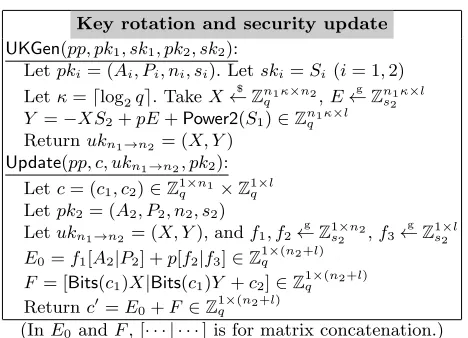
How to do key rotation and security update. For these purposes, we define two additional algorithms UKGen (generating the update key) and Update (doing the key rotation, or security update over ciphertexts). The algorithmUKGentakes two pairs (pk1, sk1) and (pk2, sk2) and returns
a key ukn1→n2. The algorithm Update uses that ukn1→n2 to turn a ciphertext c under pk1 to a
ciphertext c0 decryptable under sk2. The details are depicted in Figure 2 in which we need the
functions Power2(·) and Bits(·) explained as follows. Let v ∈ Zn
q and κ =dlog2qe, then there are
bit vectorsvi ∈ {0,1}n such thatv=Piκ=0−12ivi. Define
Bits(v) = [v0| · · · |vκ−1]∈ {0,1}1×nκ.
LetX = [X1| · · · |Xl]∈Znq×l where Xi are columns. Then
Power2(X) =
X1 · · · Xl
2X1 · · · 2Xl
..
. ...
2κ−1X1· · · 2κ−1Xl
∈Znκq ×l.
It is easy to check that
Bits(v)Power2(X) =vX ∈Z1q×l.
Intuitively, Bits(·) is used inUpdateto limit the noise increase, whilePower2(·) is put inUKGen
to ensure correctness of updated ciphertexts using above equation.
New use of a known technique.The functionsBits(·) andPower2(·) are originated in [13, 15] as part of the dimension switching technique. Historically, the paper [15] only considered
dimension-reduction, namelyn2< n1 in our notation, for efficiency issues in FHE. Then subsequent paper [13],
while notified that the technique works for arbitrary dimensionsn1andn2, only made use of the case
n2 < n1 as in [15]. In this paper, we use n1 =n2 for key rotation andn1 < n2 for security update
in homomorphic encryption. Therefore, the specific usages of the dimension switching technique for key rotation and security update are new to this work, as summarized in Table 1.
Table 1.Usages of the dimension switching technique.
Dimension switching Exploited in Main purpose
(high→low)n2< n1 [13, 15] efficiency improvement in FHE
(equal)n2=n1 [7, 17] PRE, obfuscation
Key rotation and security update UKGen(pp, pk1, sk1, pk2, sk2):
Letpki= (Ai, Pi, ni, si). Letski=Si (i= 1,2) Letκ=dlog2qe. TakeX
$
←Znq1κ×n2,E
g
←Zns21κ×l
Y =−XS2+pE+Power2(S1)∈Znq1κ×l Returnukn1→n2= (X, Y)
Update(pp, c, ukn1→n2, pk2):
Letc= (c1, c2)∈Zq1×n1×Z1q×l Letpk2= (A2, P2, n2, s2)
Letukn1→n2= (X, Y), andf1, f2 g
←Z1s2×n2,f3 g
←Z1s×2l
E0=f1[A2|P2] +p[f2|f3]∈Z1q×(n2+l) F= [Bits(c1)X|Bits(c1)Y +c2]∈Z1q×(n2+l) Returnc0=E0+F∈Zq1×(n2+l)
(InE0 andF, [· · · | · · ·] is for matrix concatenation.)
Fig. 2.Algorithms for key rotation and security update.
Theorem 2 (Pseudorandom update key). Given pp, pk1, pk2, and even secret sk1, the
up-date key ukn1→n2 generated as in Figure 2 is computationally random under the LWE(n2, s2, q)
assumption.
Proof. Since ukn1→n2 = (X, Y) where X is truly random, it suffices to show that Y is
computa-tionally random, which is straightforward since −XS2+pE ∈Zn1κ×l
q is computationally random
under the LWE(n2, s2, q) assumption.
The argument extends even given pk1, sk1, pk2 and any poly-number of ciphertexts under pk2.
First, the matrix −XS2+pE∈Zqn1κ×l is independent of pk1. Second, the related part inpk2 is
P2 =pR2−A2S2 ∈Znq2×l
so that both P2 and Y are computationally random under the LWE(n2, s2, q) assumption. Third,
conditioned random P2, any ciphertext under pk2 contains the part e1[A2|P2] +p·[e2|e3] which is
also pseudorandom under LWE(n2, s2, q) since the secret e1∈Zq1×n2 of Gaussian deviations2. ut
Theorem 3 (Pseudorandom updated ciphertext). The updated ciphertext c0 generated as in Figure 2 is computationally random under theLWE(n2, s2, q) assumption.
Proof. We havec0=E0+F ∈Zq1×(n2+l). Note thatE0is an encryption underpk2of lengthlvector
(0, . . . ,0), and hence is computationally random under the LWE(n2, s2, q) assumption by Theorem
1. Thereforec0 is computationally random under the LWE(n2, s2, q) assumption.
The argument extends even givenukn1→n2,pk1,pk2 and any poly-number of ciphertexts under
these keys. More precisely,pk2andukn1→n2 are first changed to random using the LWE(n2, s2, q)
as-sumption. Conditioned on that,E0=Enc(pk2,01×l) is turned to random also under the LWE(n2, s2, q)
assumption as in the proof of Theorem 1. Other ciphertexts and pk1 are unrelated to E0, ending
the proof. ut
Proof. We have c0 = E0+F ∈ Zq1×(n2+l). As E0 is an encryption under pk2 of length l vector
(0, . . . ,0), its decryption undersk2 gives the zero vector. The decryption ofF under sk2 =S2 is
m=Bits(c1)XS2+Bits(c1)Y +c2
=Bits(c1)(pE+Power2(S1)) +c2
=pBits(c1)E+c1S1+c2∈Z1q×l (6)
which is equal to the decryption ofc= (c1, c2) under sk1=S1 as long as the added noiseBits(c1)E
is small, which holds with high probability as matrix E containing small, Gaussian-distributed
elements. ut
Homomorphisms held even after key rotation or security update.Succinctly, formulas (4) and (5) holds even ifCTi,CTi0 (1≤i≤Nadd) are altogether encrypted under the same public key,
regardless of whether they are directly formed by the Enc algorithm (Figure 1) or are indirectly transformed by Update (Figure 2) from old ciphertexts. Intuitively, this is because (a) the zero encryptionE0 part in updated ciphertexts does not interfere with homomorphisms, and (b) theF
part can be correctly decrypted as in (6).
More precisely, consider following cases, where “old” stands for a ciphertext under pk1 and
“new” for a ciphertext under pk2, and Update(old) for an updated ciphertext from pk1 topk2:
• (old + old) or (new + new): this should be easily seen, as vector addition of two ciphertexts in the same form e1[A|P] +p[e2|e3] + [0n|m] and e10[A|P] +p[e02|e03] + [0n|m0] under identical public
key [A|P] (either old or new) gives us a ciphertext whose decryption will yield (m+m0) modp. •Update(old) + new: letcudandcnwbe the updated-from-old and under-new public-key ciphertexts
correspondingly. The decryption under the new secret key S2 is
Dec(S2, cud+cnw) =Dec(S2, cud) +Dec(S2, cnw) (mod p)
as the noise increases linearly when doing cud+cnw. The decryption Dec(S2, cud) works as in (6)
and Dec(S2, cnw) as in (1), yielding corresponding messages mud and mnw as expected.
Like the above, one can do the multiplication of (old ×old), (new×new), and (Update(old)× new) where ×is the outer product of vectors, justifying that formulas (4) and (5) hold even after key rotation or security update.
3.4 Parameters for homomorphisms
In this subsection we establish the relation between the modulus q and the number of additions (after multiplication or key rotation or update) Nadd. Results in this subsection are in Theorem 5
(theoretical) and Figure 3 (experimental).
Theorem 5. Let parametersp, q, sbe as in the scheme in Figure 1, andn1,. . .,nh (h≥1) are the dimensions in key rotation or security updates, and Nadd the number of additions over multiplied
ciphertexts as in (5) where all ciphertexts are with the same ni, then the correctness of (5) holds with overwhelming probability if q = Nadd·O
p2s4Ph
i=1ni +p2s2(log2q)
Ph
i=2ni
in which the
Proof. Given in Appendix C. ut Figure 3 complements Theorem 5 by showing the experimental Nadd that one can actually
obtain. The straight line is the theoretical values of q and Nadd in Theorem 5, while the dots are
experimental results. As seen in the figure, given a fixedq, the experimental Nadd is always bigger
than the theoretical one, which is as expected since the proof of Theorem 5 makes loose bounds for some worst cases. Setting h = 1,2,3 in Theorem 5 corresponds to 80-, 128-, 256-bit securities in Figure 3, and one can see thatNadd is reduced after each “jump” from one security level to another
as expected. Certainly, one can also do key rotation between keys of the same security levels (e.g., 128-bit), in which case Nadd will decrease less.
Fig. 3.Number of additions and modulusq. (In the figure,p= 230+ 1 so that gcd(p, q) = 1 and (n, s) is set to obtain 80-, 128-, 256-bit securities with a given modulusq.)
3.5 Basic timings
Parameter selection. We rely on recent attacks on LWE in [7, 25, 26]. Specifically, we use the following formula to decide the bit security of LWE(n, s, q)
bit security= 4.22n−96.8
lnq−1.26 lns−65.7 (7)
which is extrapolated from the recent cryptanalysis on LWE in [7] employing the RC5-72 testing benchmark2 published in distributed.net. Concretely for q = 2114, p= 230+ 1, s= 8.0, l = 64,
using (7) we need n= 2661,3530,5847 respectively for 80-, 128-, 256-bit securities. The message length l= 64 is sufficient to handle real numbers of 64-bit precision in computing basic statistics in Section 4.
Gaussian sampling. To generate discrete Gaussian noises, we employ the Knuth-Yao algorithm [23]. For reference, when s = 10, our standard desktop computer (having Intel Core i7-950 @
2
As stated in [7], the relation with time/advantage 2kof attacking LWE isbit security= log2(2
3.07GHz) can generate more than 4.1·104 Gaussian samples in one millisecond in one thread with 256-bit precision, using only 1.65 megabytes to store a binary tree.
Timings of algorithms in Figure 1. The running times are reported in Table 2. One can see that additive homomorphism Add is extremely fast when compared with the others. This fact is innovatively exploited in applications in Sections 5 and 6.
Table 2.Timings of algorithms in Figure 1.
bit-secKeyGen Enc Dec Add Mul AddM DecM
80 1428 63.2 0.92 0.003 35.1 29.3 1313 128 2513 94.7 1.22 0.004 60.8 50.1 2296 256 7249 313 2.05 0.010 164 136 6643
(All times, averaged over 1000 executions, are in milliseconds using 1 thread of a Xeon E5-2660 v3, 2.60GHz machine. Parametersq= 2114, p= 230+ 1, s= 8.0, l= 64, andn= 2661,3530,5847 respectively for 80-, 128-, 256-bit securities
using (7).)
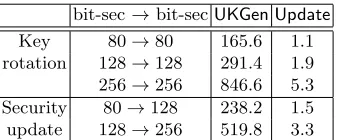
Timings of algorithms in Figure 2.The running times are reported in Table 3. As seen in the table, generating an update key requires a few minutes, while updating a ciphertext needs a few seconds. The update task can be fully parallelized on the cloud server.
Table 3.Timings of algorithms in Figure 2.
bit-sec→bit-secUKGen Update
Key 80→80 165.6 1.1 rotation 128→128 291.4 1.9 256→256 846.6 5.3 Security 80→128 238.2 1.5 update 128→256 519.8 3.3
(All times are in seconds using the same machine and parameters as in Table 2.)
4 Warming up: encoding real numbers and secure mean and variance
In this section, we show basic techniques to handle real numbers in our proposed scheme in Figure 1, and demonstrate the secure computation of mean, variance, as well as weighted sum.
Previously, many works including [21, 30, 32] encode a real number by two steps: (a) encoding an integer and then (b) using the integer to approximate the real number with a fixed precision. Succinctly, a real number a∈Ris represented via an integerba·2ηc ∈Zwhereη is the precision.
4.1 Encode, add, multiply, and encrypt real numbers
Encoding. Real numbers of prec = (L+`+ 1) bits are encoded via signed bit vectors, namely a, b∈Rare expressed as
a=
`
X
k=−L
ak2k, and b= `
X
k=−L
bk2k
in which all ak ∈ {0,1}ifa≥0 andak∈ {0,−1} ifa <0, and likewise forbk.
Define vector Pow(2, L, `) = [2−L · · · 20· · · 2`] ∈ Zprec and Bits(a) = [a−
L· · ·a0· · ·a`] ∈
{−1,0,1}prec the signed bit vector in the above representation ofa∈
R. Addition of real numbers. We have
a+b=
`
X
k=−L
(ak+bk)2k=Pow(2, L, `)
Bits(a) +Bits(b)T
and generally for manya(i)∈R, N
X
i=1
a(i)=Pow(2, L, `)
N
X
i=1
Bits(a(i))
!T
(8)
Multiplication of real numbers.Real number multiplication can be expressed by outer product of bit vectors as follows
ab=
[2
−L · · · 2`]
a−L .. . a`
[b−L · · · b`]
2−L .. . 2`
= [2−L · · · 2`]
a−L .. . a`
[b−L · · · b`]
2−L .. . 2` or succinctly
ab=Pow(2, L, `)Bits(a)TBits(b)
| {z }
outer product
Pow(2, L, `)T (9)
where Pow(2, L, `) = [2−L · · · 2`] and Bits(a) is the bit vector in binary representation of a∈ R. More generally, for many real numbers a(i)∈Rand b(i)∈R,
N
X
i=1
a(i)b(i)
=Pow N
X
i=1
Bits(a(i))TBits(b(i))
| {z }
sum of outer product
holds over R, wherePow=Pow(2, L, `).
Encryption of real numbers. For two real number a and b of precision prec, naturally define their encryptions as
Ea=Enc
Bits(a), Eb =Enc
Bits(b)∈Z1q×(n+prec) (11)
whereEnc is the encryption algorithm in Figure 1. These give rise to vector operations
Ea+Eb ∈Z1q×(n+prec) and EaTEb ∈Z(qn+prec)×(n+prec)
whose decryption using the DecAand DecMalgorithms yields
Bits(a) +Bits(b)∈Z1×prec
p and Bits(a)TBits(b)∈Zprec×precp
and then the modulo p is canceled
Bits(a) +Bits(b)∈Z1×prec and Bits(a)TBits(b)∈Zprec×prec
ifp≥3. These integer vectors, equipped with (9) and (10), give us the resultsa+b∈Randab∈R. In general, to handle (8) and (10) when all N real numbers a(i) and b(i) are encrypted as in
(11), the condition on p becomes
N < p
2 (12)
to remove the plaintext-related modulop.
4.2 Secure computation of mean, variance, and weighted sum
Mean.To securely compute the mean ofa(1), . . . , a(N) ∈Rusing their encryptionsEa(1), . . . , Ea(N)
as in (11), just do
Ea(1)+· · ·+Ea(N) ∈Z1q×(n+prec)
and then use (8) to obtain the sum P1 =
PN
i=1a(i) over R. The mean is obtained by dividing the
sum byN.
When setting the precision prec= 64 and N = 1001, in 128-bit security, one can see that the secure mean computation requires (N−1)×TAdd= 1000×0.004 = 4 (ms) whereTAddis the time for one addition given in Table 2.
Variance.Compute
EaT(1)Ea(1)+· · ·+EaT(N)Ea(N) ∈Zq(n+prec)×(n+prec)
whose decryption, equipped with (10), yields the sum of squaresP2 =PNi=1(a(i))2 ∈R. The variance
is computed asP2/N−(P1/N)2 whereP1 is computed as above.
Mean and variance in one shot. We need to change the encryption format from (11) a little, namely for a(i) ∈ R, let Ea(i) = (Enc(Bits(a(i))),Enc(Bits((a(i))2))) ∈ Z
1×2(n+prec)
q , and compute
PN
i=1Ea(i) ∈Z
1×2(n+prec)
Again, when setting the precisionprec= 64 andN = 1001, in 128-bit security, one can see that the secure computation of the mean and variance requires at most 2(N−1)×TAdd= 2000×0.004 = 8 (ms) where TAddis the time for one addition given in Table 2.
Weighted sum.For real numbersθ(i)∈R, compute Eθ(i) using (11), and
EθT(1)Ea(1)+· · ·+EθT(N)Ea(N) ∈Zq(n+prec)×(n+prec)
whose decryption, equipped with (10), yields the weighted sumPN
i=1θ(i)a(i) ∈R. This is later used
for secure prediction in linear regression in Section 5.6.
5 Application 1: secure linear regression
5.1 The model of secure outsourced computation
We work in the scenario of outsourced computation using homomorphic encryption: a client out-sources its data to a cloud server for computation and storage, but does not want to leak any information to the cloud server. This model is standard to show applications of homomorphic encryption, as in [20, 36]. In the following we recap the details.
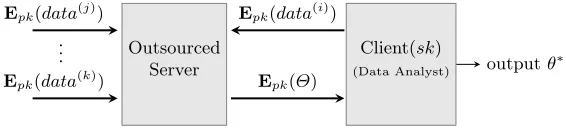
Model outline.The general picture of the protocol is in Figure 4. We use Epk(data(i)) to
repre-sent the encryption of the data under a public key pk from the client, and possibly Epk(data(j)),
Epk(data(k)) from various geographically-distributed data contributors. After receiving the
en-crypted data, using homomorphic property ofEpk, the computing server does necessary
computa-tions and sends the output Epk(Θ) to the data analyst, from which Θ is recovered by decryption, and the final resultθ∗ is obtained (fromΘ). Note that, naivelyΘ =θ∗ but it is not a must; indeed, what requires is thatθ∗ can be efficiently derived from Θ.
Outsourced Server
Client(sk)
(Data Analyst) outputθ ∗
Epk(data(i))
Epk(Θ)
Epk(data(j))
Epk(data(k)) . . .
Fig. 4.Basic model of secure outsourced computation.
Key generation. The client generates the public and secret key pair (pk, sk) and publicly dis-tributespk.
Data encryption. Data from the client or many contributors is encrypted and sent to the out-sourced server. We assume that these encryption and uploading processes are always correctly executed.
This honest-but-curious assumption is reasonable to model an economically motivated cloud service provider: it wants to provide excellent service for a successful business, but would be in-terested in any extra available information. On the order hand, a malicious cloud service provider can mishandle calculations, delete data, refuse to return results, collude with other parties etc. Nevertheless, it is likely to be caught in most of these malicious behaviors, and hence harms its reputation in business. Therefore, we will stick to the assumption of honest-but-curious server.
Non-threat.The client can see all data via decryption, and this is inherent in using homomorphic encryption for outsourced computation [20], as the client holds the secret key. This makes sense, e.g., in medical research, as the client can be a research institute having it own responsibility on handling the data.
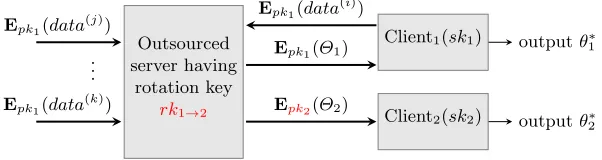
5.2 Supporting multiple clients via key rotation
In previous Sections 2.3 and 3.3, we show how to use the key rotation property regarding security. In this section, again making use of that property, we show the model in Figure 4 can be extended to support many clients. The extension is in Figure 5, illustrating the case of two clients utilizing encrypted data in a cloud server.
Outsourced server having
rotation key
rk1→2
Client1(sk1) outputθ∗ 1
Epk1(data
(i))
Epk1(Θ1)
Client2(sk2)
Epk2(Θ2)
outputθ∗2
Epk1(data
(j))
Epk1(data
(k)
) . . .
Fig. 5.Extended model with multiple clients.
In Figure 5, all data items from geographically-distributed contributors are encrypted un-der pk1 and sent to the cloud server. The cloud server has a rotation key rk1→2 generated via
UKGen(pp, pk1, sk1, pk2, sk2) as in Figure 2. While the UKGenalgorithm uses both the secret keys,
it is unnecessary that Client1 and Client2 do the generation off-line. Instead, by examining the
UKGenalgorithm, it suffices to have Client2 generate and send matrices (X,−XS2+pE) to Client1
via a secure channel. Then Client1 can generate rk1→2 = (X, Y) as in UKGenand sends it to the
cloud server.
Client1 can use the encrypted data and the cloud server as in the basic model in Figure 4.
Client2, with the help ofrk1→2, can do the same. Namely, it can have the cloud server to transform
all or parts of the encrypted data underpk1intopk2and stores them on the cloud; it can outsource
the computation over the ciphertexts under its key pk2 just like Client1 does.
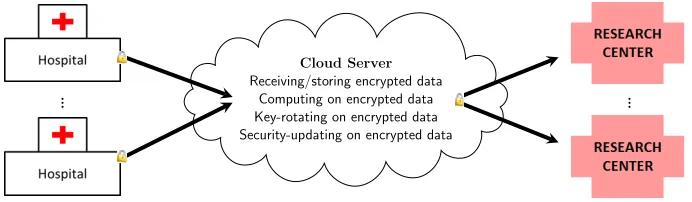
5.3 An application example
Cloud Server Receiving/storing encrypted data
Computing on encrypted data Key-rotating on encrypted data Security-updating on encrypted data
... ...
Fig. 6.Application example in medical research
clients are several medical research centers. The cloud server is always available to receive and store incoming encrypted data; it computes on encrypted data as requested; it does key-rotation to share the data among many medical research centers; and it updates the security of encryption whenever necessary. The data for encryption and sharing comes from patients; and indeed it is reported that many patients are willing to share their data for research if the data access is properly controlled [28].
5.4 Linear regression and some tweaks
Background. Data dimension, namely the number of features, is denoted by d. The number of data items, namely the training set size, is denoted byNdata. Each training data item is denoted as
(x(i), y(i)) for 1≤i≤Ndata in which x(i) ∈Rd and y(i) ∈ R. As x(i) ∈ Rd, we can explicitly write
it as x(i)= (x(1i), . . . , xd(i)). Linear hypothesis is a linear function hθ :Rd→ R; namely for variable
X= (X1, . . . , Xd)∈Rd,
hθ(X) = d
X
j=1
θjXj+θ0.
The cost function over training data is usually defined as
Jcost(θ) =
1 2Ndata
Ndata X
i=1
hθ(x(i))−y(i)
2
. (13)
Tweaking the cost function. For 0≤k, j ≤d, let
Ak,j= Ndata
X
i=1
x(ki)x(ji) (14)
Bk= Ndata
X
i=1
y(i)x(ki) (15)
C=
Ndata X
i=1
y(i)
2
(16)
the cost function in (13) can be expressed as
Jcost(θ) =
1 2Ndata
d
X
k,j=0
(θkθj)Ak,j−2 d
X
k=0
θkBk+C
and the task of linear regression is to produceθ∗= argminθJcost(θ), using for example gradient
de-scent, or any optimization methods in numerical computing (conjugate gradient, BFGS, L-BFGS).
Extension to ridge regression. The above backgrounds and tweaks can be straightforwardly applied to ridge regression, where the cost function is defined as Jcost(θ) +µ||θ||22 for a parameter
µ∈R. Whenµ= 0, ridge regression is exactly linear regression. Whenµ >0, a solutionθwith small
norm is preferable. As the added termµ||θ||2
2does not vary with data items, the following subsections
remain almost unchanged even with ridge regression. The only change for ridge regression is in the client side, and we will note that in place later.
5.5 Secure linear regression
We present our system of securely outsourced linear regression under the model outlined in Figure 4. Overall, in the following, the workload of the parties characterized by dataset size Ndata and
dimensiond(Ndata) is in Table 4.
Table 4.Costs of parties in dataset sizeNdata and dimensiond.
Storage Computation Server O(Ndata) O(Ndata)
Client N/A O(d2)
Data sources N/A O(d2)
Communication Each data source→ server O(d2)
Server→ client O(d2)
The details are as follows.
(0) Data format.Each data item i(1≤i≤Ndata) is represented as
data(i)= (x(1i), . . . , xd(i), y(i))∈Rd+1.
Via normalization, without loss of generality, we assume that −1≤x(1i), . . . , xd(i), y(i) ≤1 which is standard to improve the convergence speed of the gradient descent.
(1) Encryption at client (or any data sources).The encryption Epk(data(i)) from the client
or any data source is done as follows
1. Compute u(k,ji) = x(ki)x(ji), v(ji) = y(i)x(ji), w(i) = (y(i))2 ∈ R for all 1 ≤ k, j ≤ d, which is of ld=d(d+ 1)/2 +d+ 1 real numbers.
2. Consider prec bit representations of real numbers in data(i), and all uk,j(i) and vj(i), concatenate them as one vector in {−1,0,1}(d+1+ld)·prec, and do the encryption
E(i) =Enc Bits(x
(i)
1 ), . . . ,Bits(x (i)
d ),Bits(y(i)), . . . , Bits(u(k,ji)), . . . ,Bits(vj(i)), . . . ,Bits(w(i))
!
whereEncis the encryption algorithm in Figure 1. The ciphertext result is a vector inZq1×(n+(d+1+ld)·prec),
(2) Outsourced server.Having all ciphertexts E(i), the cloud server computes the sum
E =
Ndata X
i=1
E(i)∈Z1×(n+(d+1+ld)·prec)
q (18)
and sends the result to the client.
(3) Client (data analyst). The client decrypts E using algorithm DecA in Figure 1 to obtains the following sums
Ndata X
i=1
Bits(x(1i)), . . . ,
Ndata X
i=1
Bits(x(di)),
Ndata X
i=1
Bits(y(i))∈Z1×prec
p
and
Ndata X
i=1
Bits(u(k,ji)),
Ndata X
i=1
Bits(vj(i)),
Ndata X
i=1
Bits(w(i))∈Z1p×prec
from which the client obtains the following real numbers
Ndata X
i=1
x(1i), . . . ,
Ndata X
i=1
y(i)∈R
Ndata X
i=1
u(k,ji),
Ndata X
i=1
vj(i)∈R,
Ndata X
i=1
w(i)∈R
for all 1 ≤ k, j ≤ d via (8) if Ndata < p/2. These are exactly Ak,j, Bj, C for all 0 ≤ k, j ≤ d
in (14), (15), and (16). Having these O(d2) coefficients of Jcost(θ) at (17), the client then finds
θ∗ = argminθJcost(θ). One concrete and simple way is to proceed with gradient descent (recalled in
Appendix D) and outputs the result of that algorithm. For ridge regression,θ∗ = argminθ(Jcost(θ) +
µ||θ||2
2) at the client side. More advanced methods (e.g., conjugate gradient, BFGS, L-BFGS) can
also be used at the client using the coefficients ofJcost(θ).
Communication cost between server and client.The cost of sending the computed result is only the size of E at (18), which is in bits
n+ (d+ 1 +ld)prec
log2q=
n+O(d2)prec
log2q. (19)
Moreover, in the store phase, as E(i) has the same size of E at (18), the cost of each store is also (19).
5.6 Secure prediction
Section 5.5 showed how to computeθ∗ = argminθJcost(θ) using encrypted data. Here we show how
to use those coefficients for secure prediction in the sense that
– θ∗= (θ∗0, . . . , θd∗) can be made public, and
– data used in prediction (x1, . . . , xd) is encrypted,
and yet the outputhθ∗(x) =Pd
i=1θi∗xi+θ∗0can be computed. This is exactly the secure computation
5.7 Outputs with differential privacy
Outputs with differential privacy intuitively ensure that the change in any single data item will not much affect the output.
First, it is worth noting that directly adding Laplace noise to the output θ∗, namely directly using the Laplace mechanism [18], may work heuristically. Nevertheless, it seems hard to determine parameters for the noise due to complexity of the gradient descent algorithm.
Instead, we prefer to make use of the functional mechanism [40]. Namely, it suffices to add noises with Laplace distribution into the coefficients Ak,k0,Bk, and C of the cost function at (17).
In that way, differential privacy of the output can be obtained, as shown in [40].
Below gives the details. Recall that, a noisex∈Rhas Lap(σ) distribution if its probability den-sity function is 21σ exp(−|x|/σ). To obtain-differential privacy, the only change we need is the com-putation of the server given at (18). Namely, the server generates Laplace noisese1, . . . , ed+1+ld ∈R from the Lap(nd/) distribution, where nd=O(d2), and does the following computation in the
re-placement of (18)
E=Enc
Bits(e1), . . . ,Bits(ed+1+ld)
∈Z1×(n+(d+1+ld)·prec)
q
E=E+ Ndata
X
i=1
E(i)∈Zq1×(n+(d+1+ld)·prec).
The effect of the change is that the client obtains real values
Ak,j =Ak,j+ Lap(nd/)∈R
Bj =Bj+ Lap(nd/)∈R
C=C+ Lap(nd/)∈R
for all 0≤k, j≤din (17) and (16). Having them, the client again proceeds as in Section 5.5.
5.8 Experiments and comparisons
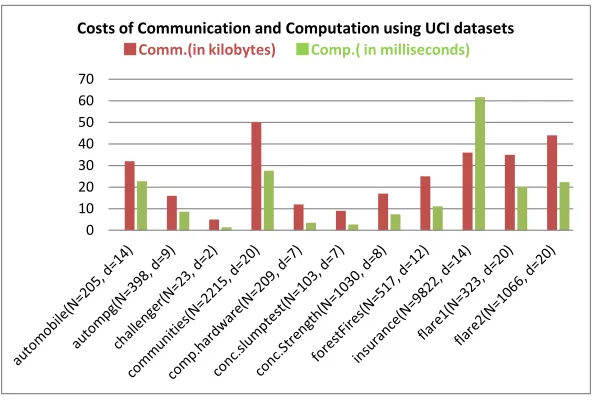
Our basic and extended models of computation in Sections 5.1 and 5.2 are different from the model in [32]. Namely, while sharing the goal of hiding data from the outsourced server, we do not employ any garbled circuit provider interactively communicating with the server as in [32]. In that respect, it is hard to fairly compare costs of computation and communication. Nonetheless, as [32] does compare with [22] in yet another model (of multi-party computation), we decide to make some comparisons and try to interpret the differences, especially with [32]. For that purpose, we make Table 5 (with synthetic datasets in [32] and ours) and Figure 7 (with real UCI datasets).
As seen in Table 5 with big Ndata, we are able to reduce the server running time to only about
10 minutes, with 280 KBytes of communication from the server to the client. Additionally in Figure 7 with relatively small datasets, megabytes (resp., seconds) in [32] are reduced to kilobytes (resp., milliseconds) by our system. For example, with theflare2dataset of Ndata= 1066 and d= 20, 200
megabytes in [32] become 44 kilobytes (0.044 megabytes) in our system; while 115 seconds in [32] become 22.3 milliseconds (0.0223 seconds) in our system.
Table 5.Comparisons using datasets with big sizeNdata.
Ref. Approach Server running time Communication cost
[22] Paillier enc. + secret shar. 2 days (Ndata= 51016, d= 22) not found
[32] Paillier enc. + garbled cir. 8.75 hours (Ndata= 108, d= 20) 270 MegaBytes (d= 20,frac= 25)
Ours LWE-based homm. enc. 10 minutes (Ndata= 108, d= 20) 280 KiloBytes (d= 20,frac= 54)
Servers: in [22] (not found); [32] (1.9GHz, 64GB RAM); ours (2.60GHz x 2 CPU, 128GB RAM). Also, fracis the number of bits in the fractional part of number representation.
0 10 20 30 40 50 60 70
Costs of Communication and Computation using UCI datasets
■Comm.(in kilobytes) ■Comp.( in milliseconds)
Fig. 7.Experiments using the UCI [1] datasets. Our reported time counts both of the server and the decryption at the client.
• we use the standard model of secure outsourced computation using homomorphic encryption, while [32] combines homomorphic encryption with Yao’s garbled circuits [37]. The use of garbled circuits causes several rounds of interactions and megabytes of communication in [32].
• in turn, the server in [32] needs to do O(Ndata) ciphertext additions and solve a garbled linear
equation system with d equations and variables. Namely [32] takes the approach of inverting the d×d matrix of the normal equations, whose computational complexity is O(d3), with a potential improvement toO(d2.37) [34], plus the execution time of a garbled circuit (which is at least 40 seconds whend= 14 [32, Figure 7]).
In contrast, in our system, the server does O(Ndata) ciphertext additions; the client decrypts
O(d2) times to obtain the coefficients of the cost function at (17), so that our approach scales better with d in both computation and communication. For example, even with dimension d = 40, the communication cost between the server and the client is only about 873 Kbytes computed via (19) using parameters for 128-bit security in Section 3.5.
no-collusion is assumed to ensure the security of their system. In ours, we assume that the client is honest (as typically in using homomorphic encryption) and can decrypt the encrypted data, and pay all security attention to the semi-honest outsourced server. These different preconditions on the systems, besides computation and communication costs, should be fully realized before any deployment in practice.
6 Application 2: secure biometric authentication
For binary vectors R, A, A0 ∈Z1×l
2 (={0,1}l), consider the encryption using theEnc algorithm in
Figure 1 with p= 2 and gcd(2, q) = 1,
c(1) =Enc(R+A)∈Zqn+l, c(2)=Enc(A
0
)∈Znq+l
and define
cadd =c(1)+c(2) ∈Znq+l (20)
so that by the additive homomorphism
Decsk
cadd
=R+A+A0 ∈Zl2 (21)
which gives us binary vectorR ∈Zl
2 ifA=A0.
The computations at (20) and (21) can be readily applied to biometric authentication, as follows. The following passively secure protocol has been known in [16].
Biometric authentication protocol [16].There are three parties in the protocol: users, a server, and a key manager.
• Key generation:The key manager runs algorithmsParamGen(1λ) and KeyGen(1λ, pp) in
Fig-ure 1 to obtain pp and (pk, sk) respectively. The key manager keeps sk secret and makes pp= (q, l, p= 2), and pk= (A, P, n, s) public. As p= 2 we haveZp =Z2 ={0,1}.
• Enrollment phase:a user with identityidand biometric representationA∈Zl
2takes a random
binary linear code R∈Zl2 (with error correcting functionality), computes and sends the tuple
id, H(R),Enc(R+A)
to the server, in which H is a hash function, andEnc(·) is the encryption algorithm Enc(pk,·) in Figure 1, and the addition R+A is done over Zlp=Zl2. The server stores the above tuple.
• Verification phase: this consists of following two steps.
Computation at server:A user sendsid,Enc(A0) to the server. The server, using the identity id, restoresH(R) andEnc(R+A) and then computes as in (20)
CT =Enc(R+A) +Enc(A0)∈Znq+l
which is Enc(R+A+A0) by additive homomorphism. The server then sendsid,H(R), and the added ciphertext CT to the key manager.
Checking at key manager:The key manager, owning secret keysk, computes the decryption
Decsk(CT) as in (21) to obtain
R0=R+A+A0∈Zl
p (=Zl2)
Correctness.As seen above, if A=A0, then the verification will pass asA+A0 becomes the zero vector inZl2. Moreover, even if a few bits inA0 are flipped, the verification will still pass due to the
error correcting code, which captures the situation that some errors may occur in the representation of biometric information.
Passive security. On the security side, an honest-but-curious server will not obtain any infor-mation on the biometric representation, as all are stored encryptedly and the hash value H(R) is random computationally. The information recovered at the key managerR0(and henceR=EC(R0)) is independent of any biometric templates and is deleted after the check. (We assume that the key manager is honest.)
An interesting feature of the protocol is as follows. Assuming the key manager is honest, yetsk is unfortunately leaked to an adversary who controls the database. Even in that case, no biometric template can be recovered. The reason is that the adversary can only seeH(R) andR+A∈Zl
2. As
both H(R) and R are independently random if the hash functionH is “ideal”, A is still perfectly hidden.
Table 6.Timing of computations and sizes in biometric authentication (128-bit security).
q= 232−1,n= 921,s= 8,p= 2,l= 2048 Computation of (20) Computation of (21)
(Addition) (Decryption) 4.56 (µs) 2.15 (ms) Enc. Ciphertext pk sk 3.05 (msec) 12 Kbytes 11 Mbytes 1.18 Mbytes
Timings are averaged over 1000 executions using 1 thread on a Xeon E5-2660 v3, 2.60GHz machine. The sizes of ciphertexts andpkandskare computed as (n+l) log2q andn(n+l) log2qandnllog2(4s) in bits.
Comparisons.In Table 6, (q, n, s) decides the bit security of LWE, whilelis the message length in bits. Since these values can be independent, and in particular nis smaller thanl, the modulus q is also smaller compared to [38,39] (in whichq≈261). Therefore, our size of ciphertexts, while relying on the LWE assumption, is half smaller than [38, 39] (31 Kbytes, under the ring-LWE assumption). It is also worth noting that if Paillier encryption [33] is used to encrypt 2048 bits in a bit-by-bit manner, then the ciphertext size can be even worse as shown in [38].
The computation at the server, in our case is 4.56 (µs). In contrast, it is 5.31 (ms) in [38] so that we are more than 1000x faster. The reason is the protocol we use above do not require ciphertext multiplication at the server. The difference in speed shows that the usageof a primitive is as important as the primitive itself.
References
1. UCI Machine Learning Repository,http://archive.ics.uci.edu/ml.
2. https://www.pcisecuritystandards.org/documents/Prioritized_Approach_V2.0.pdf. 3. https://www.owasp.org/index.php/Cryptographic_Storage_Cheat_Sheet.
4. International Warfarin Pharmacogenetics Consortium,https://www.pharmgkb.org/page/iwpc. 5. The Global Alliance for Genomics and Health,http://genomicsandhealth.org/.
7. Y. Aono, X. Boyen, L. T. Phong, and L. Wang. Key-private proxy re-encryption under LWE. In G. Paul and S. Vaudenay, editors,INDOCRYPT, volume 8250 ofLecture Notes in Computer Science, pages 1–18. Springer, 2013.
8. Y. Aono, T. Hayashi, L. T. Phong, and L. Wang. Input and output privacy-preserving linear regression. IEICE Transactions, 100-D(10):2339–2347, 2017.
9. Y. Aono, T. Hayashi, L. T. Phong, and L. Wang. Efficient homomorphic encryption with key rotation and security update. IEICE Transactions, 101-A(1):39–50, 2018.
10. W. Banaszczyk. New bounds in some transference theorems in the geometry of numbers.Mathematische Annalen, 296(1):625–635, 1993.
11. W. Banaszczyk. Inequalities for convex bodies and polar reciprocal lattices inRn. Discrete & Computational
Geometry, 13(1):217–231, 1995.
12. D. Boneh, E. Goh, and K. Nissim. Evaluating 2-DNF formulas on ciphertexts. In J. Kilian, editor,Theory of Cryptography, Second Theory of Cryptography Conference, TCC 2005, Cambridge, MA, USA, February 10-12, 2005, Proceedings, volume 3378 ofLecture Notes in Computer Science, pages 325–341. Springer, 2005.
13. Z. Brakerski, C. Gentry, and V. Vaikuntanathan. (Leveled) fully homomorphic encryption without bootstrapping. In S. Goldwasser, editor,ITCS, pages 309–325. ACM, 2012. Available athttps://eprint.iacr.org/2011/277. pdf.
14. Z. Brakerski, A. Langlois, C. Peikert, O. Regev, and D. Stehl´e. Classical hardness of learning with errors. In D. Boneh, T. Roughgarden, and J. Feigenbaum, editors,STOC, pages 575–584. ACM, 2013.
15. Z. Brakerski and V. Vaikuntanathan. Efficient fully homomorphic encryption from (standard) LWE. In R. Os-trovsky, editor,FOCS, pages 97–106. IEEE, 2011.
16. J. Bringer and H. Chabanne. An authentication protocol with encrypted biometric data. In S. Vaudenay, editor,Progress in Cryptology - AFRICACRYPT 2008, First International Conference on Cryptology in Africa, Casablanca, Morocco, June 11-14, 2008. Proceedings, volume 5023 ofLecture Notes in Computer Science, pages 109–124. Springer, 2008.
17. N. Chandran, M. Chase, F. Liu, R. Nishimaki, and K. Xagawa. Re-encryption, functional re-encryption, and multi-hop re-encryption: A framework for achieving obfuscation-based security and instantiations from lattices. In H. Krawczyk, editor,Public-Key Cryptography - PKC 2014 - 17th International Conference on Practice and Theory in Public-Key Cryptography, Buenos Aires, Argentina, March 26-28, 2014. Proceedings, volume 8383 of
Lecture Notes in Computer Science, pages 95–112. Springer, 2014.
18. C. Dwork and A. Roth. The algorithmic foundations of differential privacy.Foundations and Trends in Theoretical Computer Science, 9(3-4):211–407, 2014.
19. D. M. Freeman. Converting pairing-based cryptosystems from composite-order groups to prime-order groups. In H. Gilbert, editor,Advances in Cryptology - EUROCRYPT 2010, 29th Annual International Conference on the Theory and Applications of Cryptographic Techniques, French Riviera, May 30 - June 3, 2010. Proceedings, volume 6110 ofLecture Notes in Computer Science, pages 44–61. Springer, 2010.
20. C. Gentry. A fully homomorphic encryption scheme. PhD thesis, Stanford University, 2009. crypto.stanford. edu/craig.
21. T. Graepel, K. E. Lauter, and M. Naehrig. ML confidential: Machine learning on encrypted data. In T. Kwon, M. Lee, and D. Kwon, editors,Information Security and Cryptology - ICISC 2012 - 15th International Conference, Seoul, Korea, November 28-30, 2012, Revised Selected Papers, volume 7839 ofLecture Notes in Computer Science, pages 1–21. Springer, 2012.
22. R. Hall, S. E. Fienberg, and Y. Nardi. Secure multiple linear regression based on homomorphic encryption.
Journal of Official Statistics, 27(4):669, 2011.
23. D. E. Knuth and A. C. Yao. The complexity of non-uniform random number generation. Algorithms and Complexity, Academic Press, New York, pages 357–428, 1976.
24. K. E. Lauter, A. L´opez-Alt, and M. Naehrig. Private computation on encrypted genomic data. In D. F. Aranha and A. Menezes, editors, Progress in Cryptology - LATINCRYPT 2014 - Third International Conference on Cryptology and Information Security in Latin America, Florian´opolis, Brazil, September 17-19, 2014, Revised Selected Papers, volume 8895 ofLecture Notes in Computer Science, pages 3–27. Springer, 2014.
25. R. Lindner and C. Peikert. Better key sizes (and attacks) for LWE-based encryption. In A. Kiayias, editor,
CT-RSA, volume 6558 ofLecture Notes in Computer Science, pages 319–339. Springer, 2011.
26. M. Liu and P. Q. Nguyen. Solving BDD by enumeration: An update. In E. Dawson, editor,CT-RSA, volume 7779 ofLecture Notes in Computer Science, pages 293–309. Springer, 2013.
28. A. L. McGuire, J. M. Oliver, M. J. Slashinski, J. L. Graves, T. Wang, P. A. Kelly, W. Fisher, C. C. Lau, J. Goss, M. Okcu, et al. To share or not to share: a randomized trial of consent for data sharing in genome research.
Genetics in Medicine, 13(11):948–955, 2011.
29. P. Mell and T. Grance. The NIST definition of cloud computing. http://csrc.nist.gov/publications/ nistpubs/800-145/SP800-145.pdf.
30. M. Naehrig, K. E. Lauter, and V. Vaikuntanathan. Can homomorphic encryption be practical? In C. Cachin and T. Ristenpart, editors,Proceedings of the 3rd ACM Cloud Computing Security Workshop, CCSW 2011, Chicago, IL, USA, October 21, 2011, pages 113–124. ACM, 2011.
31. National Institute of Standards and Technology (NIST). Recommendation for Key Management: Part 1: General (Revision 3). http://csrc.nist.gov/publications/nistpubs/800-57/sp800-57_part1_rev3_general.pdf. Accessed: 2014, January 16.
32. V. Nikolaenko, U. Weinsberg, S. Ioannidis, M. Joye, D. Boneh, and N. Taft. Privacy-preserving ridge regression on hundreds of millions of records. In2013 IEEE Symposium on Security and Privacy, SP 2013, Berkeley, CA, USA, May 19-22, 2013, pages 334–348. IEEE Computer Society, 2013.
33. P. Paillier. Public-key cryptosystems based on composite degree residuosity classes. In J. Stern, editor,Advances in Cryptology - EUROCRYPT ’99, International Conference on the Theory and Application of Cryptographic Techniques, Prague, Czech Republic, May 2-6, 1999, Proceeding, volume 1592 of Lecture Notes in Computer Science, pages 223–238. Springer, 1999.
34. W. H. Press, S. A. Teukolsky, W. T. Vetterling, and B. P. Flannery. Numerical Recipes 3rd Edition: The Art of Scientific Computing. Cambridge University Press, New York, NY, USA, 3 edition, 2007.
35. O. Regev. On lattices, learning with errors, random linear codes, and cryptography. In H. N. Gabow and R. Fagin, editors,STOC, pages 84–93. ACM, 2005.
36. R. L. Rivest, L. Adleman, and M. L. Dertouzos. On data banks and privacy homomorphisms. Foundations of secure computation, 4(11):169–180, 1978.
37. A. C.-C. Yao. How to generate and exchange secrets. InProceedings of the 27th Annual Symposium on Founda-tions of Computer Science, SFCS ’86, pages 162–167, Washington, DC, USA, 1986. IEEE Computer Society. 38. M. Yasuda, T. Shimoyama, J. Kogure, K. Yokoyama, and T. Koshiba. Practical packing method in somewhat
homomorphic encryption. In J. Garc´ıa-Alfaro, G. V. Lioudakis, N. Cuppens-Boulahia, S. N. Foley, and W. M. Fitzgerald, editors,Data Privacy Management and Autonomous Spontaneous Security - 8th International Work-shop, DPM 2013, and 6th International WorkWork-shop, SETOP 2013, Egham, UK, September 12-13, 2013, Revised Selected Papers, volume 8247 ofLecture Notes in Computer Science, pages 34–50. Springer, 2013.
39. M. Yasuda, T. Shimoyama, J. Kogure, K. Yokoyama, and T. Koshiba. Secure pattern matching using somewhat homomorphic encryption. In A. Juels and B. Parno, editors, CCSW’13, Proceedings of the 2013 ACM Cloud Computing Security Workshop, Co-located with CCS 2013, Berlin, Germany, November 4, 2013, pages 65–76. ACM, 2013.
40. J. Zhang, Z. Zhang, X. Xiao, Y. Yang, and M. Winslett. Functional mechanism: Regression analysis under differential privacy. PVLDB, 5(11):1364–1375, 2012.
A Use of a ring-LWE-based scheme and some comparisons
We recall the known ring-LWE-based homomorphic encryption scheme (described in [21]) in Figure 8. The addition of ciphertexts can be done naturally asc+c0∈R2q. The multiplication is the tensor (aka, outer) productc⊗c0∈Zn
2 rlwe
q in which c and c0 are seen as vectors in Znrlwe
q .
Differing from our scheme in Figure 1, the plaintext space is Rp = Zp[x]/(xnrlwe + 1) so that
plaintexts are vectors of lengthnrlwe. In other words, the parameternrlwe decides both the security
and the plaintext size in the ring-LWE-based scheme. Therefore,
•(Secure linear regression) If using the above ring-LWE-based scheme in secure linear regression in Section 5.5, it is necessary to set the dimensionnrlwe to handle plaintexts in{−1,0,1}(d+1+ld)·prec
where ld = d(d+ 1)/2 +d+ 1 and prec = 64. If the data dimension d= 20, the plaintext space
becomes{−1,0,1}16128. Naively settingn
rlwe≈16128 will yield big modulusqto ensure correctness,
ParamGen(1λ): KeyGen(1λ, pp):
Take: Takes=s(λ, pp)∈R+
q=q(λ)∈Z+ r,s
g ←Rs,a
$ ←Rq
nrlwe=nrlwe(λ)∈Z+ p=r−as∈Rq
p∈Z+ Returnpk= (a,p, s) Returnpp= (q, nrlwe, p) sk=s
Enc(pk,m∈Rp): Dec(s,c= (c1,c2)):
e1,e2
g ←Rs,e3
g
←Rs m=c1s+c2∈Rq
c1=e1a+e2∈Rq m=b(p/q)·memodp
c2=e1p+e3+bq/pcm∈RqReturnm∈Rp
Returnc= (c1,c2)∈R2q
Fig. 8.The ring-LWE-based PKE in [21]. RingR =Z[x]/f(x),f(x) =xnrlwe+ 1, andRq =R/q,Rp=R/p. The notionRs stands for polynomials inR with small Gaussian coefficients.
A way to reduce the modulus q is to split the message length 16128 to k (e.g., = 4) pieces of size ≈ 16128/k bits. In this way, nrlwe ≈ 16128/k which helps reducing q. However, as each
piece of message is encrypted independently, we have k ciphertexts, each of which is of length 2(16128/k) log2q, so that the total length is 2k(16128/k) log2q = 2·16128 log2q. In contrast, in Section 5, the ciphertext size is (n+l) log2q wherel= 16128 andnlso our LWE-based scheme gets a gain in size here.
Table 7.Our parameters vs. [38]’s.
Message Dimension log2q length (bits) nrlwe nlwe
[38] 2048 2048 ≈61 Sect.6 2048 950 ≈32
• (Secure biometric authentication) If using the ring-LWE-based scheme in the protocol of biometric authentication in Section 6 with biometric templates of size 2048 bits,nrlwe must be set
to 2048 as in [38]. In turn, [38] took log2q ≈61 to ensure about 128-bit security. Each ciphertext is of 2nrlwelog2q bits, which is about 31 Kbytes as computed in [38]. In contrast, as in Table 7, we
can take smaller dimensionnlwe = 950 thanks to the independence between the LWE’s dimension
and the message length in our scheme. These yield shorter ciphertexts as claimed in Section 6.
B Use of the Boneh-Goh-Nissim scheme and some comparisons
The BGN scheme originates in [12] using composite-order pairing groups. Its conversion to prime-order pairing group is in [19]. BGN has shorter public key than our scheme. Nonetheless, when using in our systems, it decreases the speeds of the server and the client and increases the ciphertext sizes, argued below. The discussions apply to both versions of BGN.
The message space in BGN encryption can be expressed as Zp for some smallp(to ensure that
the discrete logarithm problem is easy). To encrypt m = (m1, . . . , ml) ∈Zlp using BGN, we need
to encrypt element-wise, so that the ciphertext is
where G is an elliptic curve over finite field Fq. Therefore, ciphertext addition is done by l point
additions over the elliptic curve, which is usually more than 10 multiplications in Fq (see e.g. https://hyperelliptic.org/EFD/). Assume that each multiplication is as fast as 3 additions over Fq, we estimate that each ciphertext addition takes more than 3·10·l = 30l additions over Fq.
In contrast, in our scheme, as each ciphertext is a vector inZnq+l, each ciphertext addition needs
n+l additions over Zq. At 128-bit security level, n = 3530 in our scheme, and as n+l 30l if
l= 2048 (biometric authentication) or 16128 (linear regression over high-dimensional data), we will not vote for the use of BGN in our systems for speed.
Let us consider ciphertext sizes. At 128-bit security level, encrypting one message inZp
produc-ing 3072 bits in the original BGN [12] and 1536 bits in the prime-order version [19]. As a result, CT above is of at least 1536lbits, which is 1536l/213 kilobytes. Whenl= 2048 and 16128, the size of CT becomes 384 kilobytes and 3024 kilobytes respectively, which are much longer than ours (of 12 and 280 kilobytes respectively). Therefore, we will not vote for the use of BGN in the systems regarding ciphertext sizes.
C Proof of Theorem 5
We will use following lemmas, whose proofs can be derived from [10,11]. Belowh·,·istands for inner product. Writing||Zn
s||is a short hand for taking a vector from the discrete Gaussian distribution
of deviationsand computing its Euclidean norm.
Lemma 1. Let c ≥1 and C =c·exp(1−2c2). Then for any real s >0 and any integer n≥1, we have
Pr
||Zns|| ≥ c·s √
n √
2π
≤Cn.
Lemma 2. For any real s >0 and T >0, and any x∈Rn, we have
Pr [||hx,Znsi|| ≥T s||x||]<2 exp(−πT2).
Proof (of Theorem 5).For now supposeh= 2, we check the decryption by secret keyS2in dimension
n2 of updated ciphertexts. Using the notations as in Figure 2, let E0 = [E1|E2] and F = [F1|F2]
forE1, F1 ∈Zq1×n2, andE2, F2 ∈Zq1×l, so c0 =E0+F = [E1+F1|E2+F2], and the decryption of
c0 byS2 becomes
(E1+F1)S2+E2+F2
= f1A2+pf2+Bits(c1)X
S2+f1P2+pf3
+Bits(c1)Y +c2
=f1A2S2+pf2S2+Bits(c1)XS2+f1(pR2−A2S2)
+pf3+Bits(c1)Y +c2
=pf2S2+Bits(c1)XS2+pf1R2+pf3
+Bits(c1) −XS2+pE+Power2(S1)
+c2
=pf2S2+pf1R2+pf3
+pBits(c1)E+Bits(c1)Power2(S1) +c2
=p(f2S2+f1R2+f3+Bits(c1)E)
| {z }
noise incurred after one Update