Abstract
Hallå Norden is a web site with information regarding mobility between the Nordic coun-tries in five different languages; Swedish, Danish, Norwegian, Icelandic and Finnish. We wanted to create a Nordic cross-language dictionary for the use in a cross-language search engine for Hallå Norden. The entire set of texts on the web site was treated as one multilingual parallel corpus. From this we extracted parallel corpora for each language pair. The corpora were very sparse, contain-ing on average less than 80 000 words per language pair. We have used the Uplug word alignment system (Tiedemann 2003a), for the creation of the dictionaries. The results gave on average 213 new dictionary words (fre-quency > 3) per language pair. The average error rate was 16 percent. Different combina-tions with Finnish had a higher error rate, 33 percent, whereas the error rate for the re-maining language pairs only yielded on aver-age 9 percent errors. The high error rate for Finnish is possibly due to the fact that the Finnish language belongs to a different lan-guage family. Although the corpora were very sparse the word alignment results for the combinations of Swedish, Danish, Norwe-gian and Icelandic were surprisingly good compared to other experiments with larger corpora.
© 2008. Licensed under the Creative Commons Attri-bution-Noncommercial-Share Alike 3.0 Unported
license (http://creativecommons.org/licenses/by-nc-sa/3.0/). Some rights reserved.
1
Introduction
Hallå Norden (Hello Scandinavia) is a web site with information regarding mobility between the Nordic countries and is maintained by the Nordic Council. Mobility information concerns issues such as how employment services, social ser-vices, educational systems etc. work in the dif-ferent countries. The web site has information in five different languages; Swedish, Danish, Nor-wegian, Icelandic and Finnish. In this paper Nordic languages are defined as Swedish, Danish, Norwegian, Icelandic and Finnish. Scandinavian languages are defined as the Nordic languages excluding Finnish.
The texts on the web site were almost parallel and there were also ten minimal dictionaries with on average 165 words available for the different languages. The dictionaries consisted of domain-specific words regarding mobility information in the Nordic countries. The Nordic Council wanted to extend the dictionaries so they would cover a larger part of the specific vocabulary, in order to help the people in the Nordic countries to find and learn the concepts in their neighboring coun-tries.
The entire set of texts on the web site was treated as one multilingual parallel corpus. From this we extracted parallel corpora for each lan-guage pair. We discovered, as expected, that the corpora were very sparse, containing on average less than 80 000 words per language pair. We needed to construct 10 different dictionaries and therefore we processed 10 pairs of parallel text sets. We have used the Uplug word alignment system (Tiedemann 2003a), for the creation of the dictionaries. The system and motivation for the choice of system is further discussed in Sec-tion 2.1.
Automatic Construction of Domain-specific Dictionaries on
Sparse Parallel Corpora in the Nordic Languages
Sumithra Velupillai
DSV/KTH-Stockholm University
SE-164 40 Kista
Sweden
[email protected]
Hercules Dalianis
1, 21)
DSV/KTH-Stockholm University
SE-164 40 Kista
Sweden
2)
Euroling AB
Igeldammsgatan 22c
112 49 Stockholm, Sweden
[email protected]
We also discovered that the texts were not completely parallel. Therefore, we made a small experiment on attempting to enhance the results by deleting texts that were not parallel. Multilin-gual parallel corpora covering all Nordic lan-guages are very rare. Although the corpora cre-ated in this work are domain-specific, they are an important contribution for further research on Nordic multilingual issues. Moreover, many large governmental, industrial or similar web sites that contain information in several lan-guages may profit from compiling multilingual dictionaries automatically in order to enhance their search engines and search results.
In this project, our two main goals were to compile parallel corpora covering the Nordic languages, and to evaluate the results of auto-matically creating dictionaries using an existing tool with basic settings, in order to find out where more work would need to be done and where performance is actually acceptable. We have limited the work by only testing one system (Uplug) with basic settings. Our experiments and results are described in further detail in the fol-lowing sections. Conclusions and future work are discussed in the final section.
2
Related Work
Word alignment systems have been used in pre-vious research projects for automatically creating dictionaries. In Charitakis (2007) Uplug was used for aligning words in a Greek-English paral-lel corpus. The corpus was relatively sparse, con-taining around 200 000 words for each language, downloaded from two different bilingual web sites. A sample of 498 word pairs from Uplug were evaluated by expert evaluators and the re-sult was 51 percent correctly translated words (frequency > 3). When studying high frequent word pairs (>11), there were 67 percent correctly translated words. In Megyesi & Dahlqvist (2007) an experiment is described where they had 150 000 words in Swedish and 126 000 words in Turkish that gave 69 percent correct translations (Uplug being one of the main tools used). In this work the need for parallel corpora in different language combinations is also discussed.
The ITools’ suite for word alignment that was used in Nyström et al (2006) on a medical paral-lel corpus, containing 174 000 Swedish words and 153 000 English words, created 31 000 word pairs with 76 percent precision and 77 percent recall. In this work the word alignment was pro-duced interactively.
A shared task on languages with sparse re-sources is described in Martin et al (2005). The language pairs processed were English-Inuktitut, Romanian-English and English-Hindi, where the English-Inuktitut parallel corpus contained around 4 million words for English and 2 mil-lions words for Inuktitut. English-Hindi had less words, 60 000 words and 70 000 words respec-tively. The languages with the largest corpora obtained best word alignment results, for Eng-lish-Inuktitut over 90 percent precision and recall and for English-Hindi 77 percent precision and 68 percent recall. One conclusion from the shared task was that it is worth using additional resources for languages with very sparse corpora improving results with up to 20 percent but not for the languages with more abundant corpora such as for instance English-Inuktitut.
2.1 Word Alignment: Uplug
We have chosen to use the Uplug word align-ment system since it is a non-commercial system which does not need a pre-trained model and is easy to use. It is also updated continuously and incorporates other alignment models, such as GIZA++ (Och & Ney 2003). We did not want to evaluate the performance of different systems in the work presented here, but rather evaluate the performance of only one system applied on dif-ferent language combinations and on sparse cor-pora. Evaluating the performance of different systems is an important and interesting research problem, but is left for future work. An evalua-tion of two word alignment systems Plug (Uplug) and Arcade is described in Ahrenberg et al (2000).
The Uplug system implements a word align-ment process that combines different statistical measures for finding word alignment candidates and is fully automatic. It is also possible to com-bine statistical measures with linguistic informa-tion, such as part-of-speech tags. In the preproc-essing steps the corpora are converted to an xml-format and they are also sentence aligned.
We have chosen to use basic settings for all corpora in the different language pairs, in order to evaluate the effect of this. The default word alignment settings in Uplug works in the follow-ing way:
• create basic clues (Dice and LCSR)
• run GIZA++ with standard settings
• learn clues from GIZA's Viterbi align-ments
• "radical stemming" (take only the 3 initial characters of each token) and run GIZA++ again
• align words with existing clues • learn clues from previous alignment • align words again with all existing clues1
This approach is called the clue alignment ap-proach and is described further in Tiedemann (2003b). In the work presented here, we have not included any linguistic information, as we wanted to evaluate the performance of applying the system on sparse, raw, unprocessed corpora for different (Nordic) language pairs, using de-fault settings.
3
Experiments and Results
For the project presented in this paper we wanted to see if it was possible to create domain-specific dictionaries on even smaller corpora. (compared to the ones described in Section 2) for all the Nordic language pairs. We did not have the pos-sibility to evaluate the results for Icelandic-Finnish, since we did not find any evaluator hav-ing knowledge in both Icelandic and Finnish. Therefore we present the results for the remain-ing nine language pairs. In total we had four evaluators for the other language combinations. Each evaluator evaluated those language pairs
1
Steps taken from the Quickstart guidelines for the Uplug system, which can be downloaded here:
http://uplug.sourceforge.net/
she or he had fluent or near-fluent knowledge in. The domain was very restricted containing only words about mobility between the Nordic coun-tries.
The Scandinavian languages are closely re-lated. Swedish, Danish, and Norwegian are com-prehensible for Scandinavians. A typical Swede will for instance understand written and to a cer-tain degree spoken Danish, but is not able to speak Danish. Typical Swedes will, for instance, have a passive understanding of Danish (and vice versa for the other languages). Finnish on the other hand belongs to the Finno-Ugric group of the Uralic languages, while the Scandinavian languages are North-Germanic Indo-European languages. We wanted to investigate if, and how, these differences affect the word alignment re-sults. We also wanted to experiment with differ-ent frequency thresholds, in order to see if this would influence the results.
The first step was to extract the web pages from the web site and obtain the web pages in plain text format. We obtained help for that work from Euroling AB,2 our contractor.
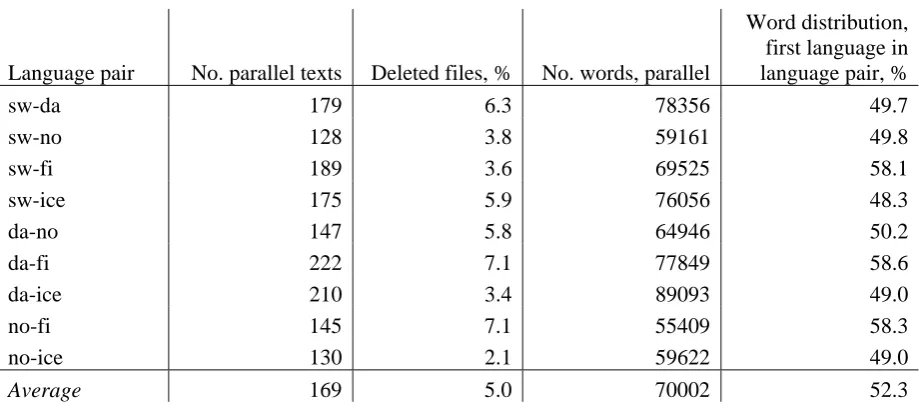
In Table 1 we show general information about the corpora. We see that the distribution of words is even for the Scandinavian languages, but not for the combinations with Finnish. It is interest-ing to observe that Finnish has fewer word to-kens than the Scandinavian languages.
All Nordic languages, both Scandinavian and Finnish, have very productive word compound-ing. In Finnish word length is longer, on average,
2
See: http://www.euroling.se/
Language pair No. texts No. words Word distribution, first language in language pair, %
sw-da 191 83871 49.2
sw-no 133 62554 49.7
sw-fi 196 73933 57.6
sw-ice 187 82711 48.5
da-no 156 68777 50.2
da-fi 239 84194 58.4
da-ice 232 97411 49.5
no-fi 156 58901 58.2
no-ice 145 64931 49.6
Average 182 75254 52.3
and the number of words per clause lower, on average, due to its extensive morphology.
In Dalianis et al (2007) lemmatizing the text set before the alignment process did not improve results. In the work presented here, we have also made some experiments on lemmatizing the cor-pora before the alignment process. We have used the CST lemmatizer3 for the Scandinavian lan- guages and Fintwol4 for Finnish. Unfortunately, the results were not improved. The main reason for the decrease in performance is probably due to the loss of sentence formatting during the lemmatization process. The sentence alignment is a crucial preprocessing step for the word alignment process, and a lot of the sentence
boundaries were lost in the lemmatization proc-ess. However, the resulting word lists from Uplug have been lemmatized using the same lemmatizers, in order to obtain normalized dic-tionaries.
The corpora were to some extent non-parallel containing some extra non-parallel paragraphs. We found that around five percent of the corpora were non-parallel. In order to detect non-parallel sections we have used a simpler algorithm than in for instance Munteanu & Marcu (2006). The total number of paragraphs and sentences in each
3
See: http://cst.dk/download/cstlemma/current/doc/ 4
See: http://www2.lingsoft.fi/cgi-bin/fintwol
parallel text pair were counted. If the total num-ber for each language in some language pair dif-fered more than 20 percent these files were de-leted. The refined corpora have been re-aligned with Uplug and evaluated. In Table 2 we show the general information for the refined corpora.
3.1 Evaluation
Our initial plan was to use the manually con-structed dictionaries from the web site as an evaluation resource, but the words in these dic-tionaries were rare in the corpus. Therefore we used human evaluators to evaluate the results from Uplug.
The results from the Uplug execution gave on
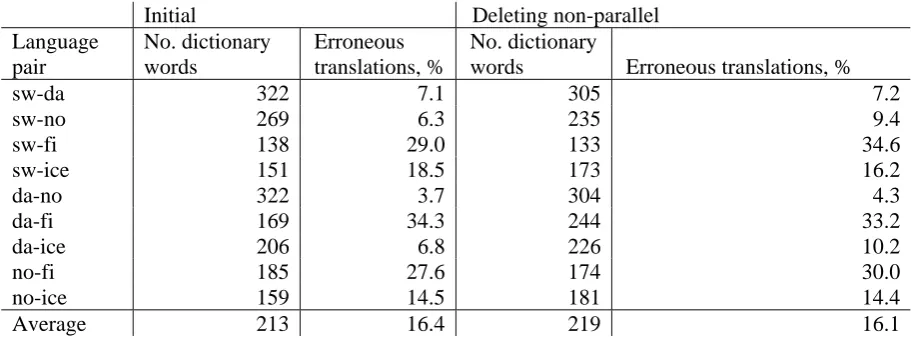
average 213 new dictionary words (frequency > 3) per language, see Table 3. The average error rate5 was 16 percent. We delimited the word amount by removing words shorter than six char-acters, and also multiword expressions6 from the resulting word lists. The six character strategy is efficient for the Scandinavian languages as an alternative to stop word removal (Dalianis et al 2003) since the Scandinavian languages, as well
5
The error rate is in this paper defined as the percentage of wrongly generated entries compared to the total number of generated entries.
6
A multiword expression is in this paper defined as words (sequences of characters, letters or digits) separated by a blank or a hyphen.
Language pair No. parallel texts Deleted files, % No. words, parallel
Word distribution, first language in language pair, %
sw-da 179 6.3 78356 49.7
sw-no 128 3.8 59161 49.8
sw-fi 189 3.6 69525 58.1
sw-ice 175 5.9 76056 48.3
da-no 147 5.8 64946 50.2
da-fi 222 7.1 77849 58.6
da-ice 210 3.4 89093 49.0
no-fi 145 7.1 55409 58.3
no-ice 130 2.1 59622 49.0
Average 169 5.0 70002 52.3
as Finnish, mostly produce compounds that are formed into one word (i.e. without blanks or hy-phens). In Tiedemann (2008), a similar strategy
of removing words with a word length shorter than five characters was carried out but in that case for English, Dutch and German.
Different combinations with Finnish had a higher error rate, 30 percent, whereas the error rate for the combinations of the Scandinavian languages only yielded on average 9 percent errors.
The high error rate for Finnish is possibly due to the fact that the Finnish language belongs to a different language family. We can see the same phenomena for Greek (Charitakis, 2007) and Turkish (Megyesi & Dahlqvist, 2007) combined with English and Swedish respectively, with 33 and 31 percent erroneously translated words.
However, one might expect even higher error rates due to the differences in the different lan-guage pairs (and the sparseness of the data). Fin-nish has free word order and is typologically very different from the Scandinavian languages, and the use of form words differs between the languages. On the other hand, both Finnish and the Scandinavian languages produce long, com-plex compounds somewhat similarly, and the word order in Finnish share many features with the word order in the Scandinavian languages. One important aspect is the cultural similarities that the languages share.
The main errors that were produced for the combinations of Finnish and the Scandinavian languages consisted of either errors with particles
or compounds where the head word or attribute were missing in the Finnish alignment. For in-stance, the Swedish word invånare (inhabitant)
was aligned with the Finnish word asukasluku (number of inhabitants). Another error which was produced for all combinations with Finnish was lisätieto (more information) which was aligned with ytterligere (additional, more) in Norwegian (and equivalent words in Swedish and Danish), an example of an error where the head word is missing. Many texts had sentences pointing to further information, which might ex-plain this type of error.
The lemmatizers produced some erroneous word forms. In Dalianis & Jongejan (2006) the CST lemmatizer was evaluated and reported an average error rate of nine percent. Moreover, since the lemmatization process is performed on the resulting word lists, and not within the origi-nal context in which the words occur, the auto-matic lemmatization is more difficult for the two lemmatizers used in this project. These errors have not been included in our evaluation since they are not produced by the Uplug alignment procedure.
We can also see in Table 3 that deleting non-parallel texts using our simple algorithm did not improve the overall results significantly. Perhaps our simple algorithm was too coarse for these corpora. The texts were in general very short and simple frequency information on paragraph and sentence amounts might not have captured non-parallel fragments on such texts.
Initial Deleting non-parallel
Language pair
No. dictionary words
Erroneous translations, %
No. dictionary
words Erroneous translations, %
sw-da 322 7.1 305 7.2
sw-no 269 6.3 235 9.4
sw-fi 138 29.0 133 34.6
sw-ice 151 18.5 173 16.2
da-no 322 3.7 304 4.3
da-fi 169 34.3 244 33.2
da-ice 206 6.8 226 10.2
no-fi 185 27.6 174 30.0
no-ice 159 14.5 181 14.4
Average 213 16.4 219 16.1
The produced dictionary words were of high domain-specific quality. The majority of the cor-rect and erroneous word pairs were covered by both the initial and the refined corpus. Deleting non-parallel texts produced some new, valuable words that were not included in the initial results. However, since these dictionaries were generally smaller, this did not improve the overall results, and the error rate was somewhat higher for most language pairs. Improved dictionary in this work means as many word pairs as possible with do-main-specific significance.
Since the texts were about different country-specific issues they could contain sections in an-other language (names of ministries, offices etc). This produced some errors in the alignment re-sults. These errors might have been avoided by applying a language checker while processing the texts.
The errors for the Scandinavian languages were also mainly of the same type, and mostly due to the fact that the texts were not completely parallel, or due to form words or compounds. For instance, the Swedish word exempelvis (for ex-ample) was aligned with the Norwegian word eksempel (example), which was counted as an error, but which, in its context, is not completely erroneous.
Even at a relatively low frequency threshold the results were very good for the Scandinavian languages. We tried to increase the frequency threshold in order to see if this would improve the results for Finnish, which it unfortunately did not. However, as stated above, the errors were mainly of the same type, and probably constant over different frequencies. We also see that for Icelandic, unlike the other languages, deleting non-parallel fragments yielded larger dictionar-ies. Uplug produced more multiword units for the initial corpora containing Icelandic, single word pairs were more frequent in the refined corpus. However, the overall results were not improved.
4
Conclusions and Future Work
Although the corpora were very sparse the word alignment results for Danish, Swedish-Norwegian and Danish-Swedish-Norwegian were surpris-ingly good with on average 93.1 percent correct results. The results for Finnish were worse with on average only 67.4 percent correct results.
However, as discussed above, the main errors were of the same type. Creating dictionaries for non-related languages might need more elaborate
alignment approaches. In the special case of Fin-nish combined with one (or several) of the Scan-dinavian languages, simple preprocessing steps might improve the results. For instance, remov-ing stop words before runnremov-ing the corpora through a word alignment system might handle the errors where particles and form words are included. Also, tagging the corpora with part-of-speech tags and lemmatizing as a preprocessing step might improve results.
An important aspect of automatically creating multilingual dictionaries is the need for preproc-essing tools covering all languages. This is often difficult to obtain, and different tools use differ-ent formatting and tagging schemes. Moreover, they might differ in robustness, which also af-fects the end results. In this project, we encoun-tered such problems during the lemmatization process for instance, but we did not have the op-portunity to explore and evaluate alternative tools. In the future, evaluating the performance of the preprocessing steps might be desirable.
Evaluating translated words is not easy. Many words may be related without being direct trans-lations. Manual evaluation has the advantage of taking such issues into account, but this also means that the results might differ depending on the evaluator. Furthermore, evaluating transla-tions without contextual information is problem-atic. Also, the criteria for judging a translation as correct or not depend on the goal for the use of the word lists. For instance, the errors for the combinations with Finnish might not be prob-lematic in a real-world search engine setting, de-pending on which demands there are on the search results. The errors produced in the work presented here would probably yield acceptable search results. Such user and search engine result aspects have not been evaluated here, but are interesting research questions for future work.
detect non-parallel fragments should be investi-gated.
Finding the boundary for the minimum size of parallel corpora in order to obtain acceptable dic-tionaries is also an interesting research issue which should be explored.
Automatically creating multilingual dictionar-ies is not trivial. Many aspects need to be consid-ered. Especially, the final use of the produced results influences both the preprocessing steps required and the evaluation of the results. Also, the languages in consideration affect the steps that need to be made. However, in this paper we have shown that using state-of-the-art tools on sparse, raw, unprocessed domain-specific cor-pora in both related and non-related languages yield acceptable and even commendable results. Depending on the purposes for the use of the dic-tionaries, simple adjustments would probably yield even better results.
In a real-world setting, parallel (or near-parallel) corpora covering several (small) lan-guages are difficult to obtain and compile. Most resources are found on the Internet, and the qual-ity of the corpora may vary depending on many aspects. Formatting, translations, text length and style may differ considerably depending on the type of texts. Freely available text sets for small languages are often sparse. Despite this, we have shown that it is possible to compile valuable re-sources from available data.
There are very few sources of dictionaries covering the Nordic language pairs. The created corpora will be made publicly available for fur-ther research and evaluation.
References
Ahrenberg, L., M. Merkel, A. Sågvall Hein and J. Tiedemann 2000. Evaluation of word alignment systems. Lars Ahrenberg, Magnus Merkel, Anna Sågvall Hein and Jörg Tiedemann. Proceedings of the Second International Conference on Linguistic Resources and Evaluation (LREC-2000), Athens, Greece, 31 May - 2 June, 2000, Volume III: 1255-1261.
Charitakis, K. 2007. Using parallel corpora to create a Greek-English dictionary with Uplug, in Proc. 16th Nordic Conference on Computational Linguistics - NODALIDA ‘07.
Dalianis, H. and B. Jongejan 2006. Hand-crafted ver-sus Machine-learned Inflectional Rules: the Eurol-ing-SiteSeeker Stemmer and CST's Lemmatiser, in Proc. of the International Conference on Language Resources and Evaluation, LREC 2006.
Dalianis, H., M. Rimka and V. Kann 2007. Using Uplug and SiteSeeker to construct a cross language search engine for Scandinavian. Workshop: The Automatic Treatment of Multilinguality in Re-trieval, Search and Lexicography, Copenhagen, April 2007.
Dalianis, H., M. Hassel, J. Wedekind, D. Haltrup, K. de Smedt and T.C. Lech. 2003. Automatic text summarization for the Scandinavian languages. In Holmboe, H. (ed.) Nordisk Sprogteknologi 2002: Årbog for Nordisk Språkteknologisk Forsknings-program 2000-2004, pp. 153-163. Museum Tuscu-lanums Forlag.
Martin, J and R. Mihalcea and T. Pedersen. 2005. Word Alignment for Languages with Scarce Re-sources. Proceedings of the ACL 2005 Workshop on Building and Using Parallel Texts: Data Driven Machine Translation and Beyond, Ann Arbor, MI, June 2005.
Megyesi, B. and B. Dahlqvist, 2007. The Swedish-Turkish Parallel Corpus and Tools for its Creation, in Proc. 16th Nordic Conference on Computational Linguistics - NODALIDA ‘07.
Munteanu, D.S. and D. Marcu 2006. Extracting Paral-lel Sub-sentential Fragments from Non-paralParal-lel Corpora. ACL ’06: Proceedings of the 21st Interna-tional Conference on ComputaInterna-tional Linguistics, pp. 81-88, Sydney, Australia.
Nyström, M., M. Merkel, L. Ahrenberg, P. Zweigen-baum, H. Petersson and H. Åhlfeldt. 2006. Creat-ing a Medical English-Swedish Dictionary usCreat-ing Interactive Word Alignment, in BMC medical in-formatics and decision making, 6:35.
Franz Josef Och, Hermann Ney. A Systematic Com-parison of Various Statistical Alignment Models, Computational Linguistics, volume 29, number 1, pp. 19-51 March 2003.
Tiedemann, J. 2003a. Recycling Translations: Extrac-tion of Lexical Data from Parallel Corpora and their Application in Natural Language Processing. Acta Universitatis Upsaliensis: Studia linguistica upsaliensia, ISSN 1652-1366, ISBN 91-554-5815-7.
Tiedemann, J. 2003b. Combining clues for word alignment. In Proceedings of the Tenth Conference on European Chapter of the Association For Com-putational Linguistics - Volume 1 (Budapest, Hun-gary, April 12 - 17, 2003). European Chapter Meet-ing of the ACL. Association for Computational Linguistics, Morristown, NJ, 339-346. DOI= http://dx.doi.org/10.3115/1067807.1067852.