International Journal of Advanced Research in Computer Science RESEARCH PAPER
Available Online at www.ijarcs.info
Recognizing Deformed Fingerprint Images Using SVM Classifier
Arushi Aggarwal
Research Scholar(M.Tech)Department of Computer Science and Applications Kurukshetra University, Kurukshetra, INDIA
Dr. Chander Kant
Assistant ProfessorDepartment of Computer Science and Applications Kurukshetra University, Kurukshetra, INDIA
Abstract: Biometric arrangements works on behavioral and physiological biometric data to recognize a person. The behavioral biometric parameters are signature, speech, gait and keystroke, these parameters may change with time period. Though physiological characteristics such as face, fingerprint, palm print and iris stays unchanged with the existence period of person. Automatic fingerprint recognition systems (AFRS), as well-known biometric methods, are nowadays extensively utilized in assorted requests such as forensics and admission control. Fingerprints have been utilized as a reliable biometric feature for confidential identification. All Fingerprint-authentication system are based on various matching techniques, that can be generally categorized as minutiae based and correlation based. In Pattern recognition various modalities being used are fingerprint, palm print, footprint. But these pattern recognition methods cannot identify the persons with deformed finger. The problem of deformed fingerprint is extremely disparate from that of fingerprint spoofing. The objective of this paper is to propose an algorithm for recognizing deformed fingerprint. The Proposed method SVM-classifier is effective searching technique over the huge clustered fingerprint database. This Paper also presents a Feature and SVM established fingerprint trooping of the methods transpiring in the scrutiny area for adjusted fingerprints.
Keywords: Finger Print Recognition, Automated fingerprint recognition systems (AFRSs), Pattern Recognition, Deformed fingerprint, Support vector machines(SVM).
I. INTRODUCTION
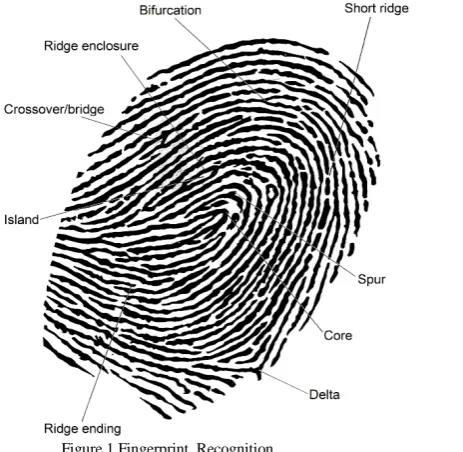
Biometrics [1][2] is the recognition that is automatic of predicated on their biological and behavioral characteristics such as for instance fingerprints, face, iris, gait and voice. Making use of fingerprints as a characteristic that is biometric been extensively conversed concerning in the systematic works, and countless disparate methods have truly been industrialized for giving fingerprint recognition [3]. Immutability mentions to the perpetual and character that is unchanging of outline on every single finger, from beforehand transport till decomposition afterward death. Individuality mentions to the uniqueness of ridge features across individuals. No two persons, even identical twins, are discovered to own identical fingerprints, even though constituents of similarity. Fingerprint recognition arrangements have truly been encompassed into lots of forensic, civilian and requests that are commercial.as shown in
Fig. 1 below: Figure 1 Fingerprint Recognition
meaning scanners. Instituted on their locale on the ridges, pores can be looked at closed or available. A pore that is closed completely encircled by a ridge as an open pore intersects the valley. Both automated and fingerprint that is manual schemes use the purpose points ambitious by singularities in the hand ridge pattern. Unlike the form that is finished subject, in fingerprint matching the singularities in the ridge outline denoted to as minutiae proposal an all-natural option for feature points. These features, that encompass of points whereas a ridge whichever ends or splits into two ridges, form the basis of fingerprint matching requests that are most. Fingerprint addresses that are matching finished classes of issues. The early involves situations for that it is needed to confirm or authenticate an individual’s identity. Such matching that is one-to-one are of attention right here chiefly as a conceptual basis for one-to-many matching.
The subsequent, extra challenging sequence of setbacks occurs after a database that is particular a solitary entry for each endowed individual. For example, a services that are communal, wherein people have to be stopped from making use of countless aliases, and identification card issuance. This recognition setback necessitates a database that is colossal of people to notice whether an individual is by now in the database
II. FEATURE EXTRACTION AND MATCHING
Features removed from a fingerprint picture are usually categorized into three levels:-
• the Level 1 features [6] arrest macro features such as for instance friction ridge flow, outline kind, and points that are singular,
• the Level 2 features denote to minutiae such as ridge bifurcations and ending,
•
the Level 3 features contain all dimensional qualities of the ridge such as for instance ridge trail deviation, width, form, pores, supremacy contour, and supplementary features, encompassing ridges that are incipient creases, and scars.
A fingerprint module that is matching a match score amid two fingerprints, that is elevated for fingerprints from equivalent hand and low for all those from disparate fingers. Fingerprint matching is a pattern-recognition that is tough due to large intraclass variations (variations in fingerprint pictures of the precise alike slight finger) and colossal interclass similarity (similarity amid fingerprint pictures from assorted hands). Intraclass variants are held on by hand placement— rotation and pressure, translation, and link area—with respect towards the sensor and condition of the hand such as skin dryness and cuts. Meanwhile, interclass similarity can be large because there are merely three kinds of main fingerprint outlines (arch, series, and whorl).
A scope that is expansive of matching algorithms transpire, employing lots of disparate techniques. Nearly all pursue the long-established forensic procedures of minutia-matching. Minutia recognition that is matching pursue to find recurrences of outlines of minutiae. Minutiae are related alongside adjacent geometric or features that are topological a minutia from one creation matches one an supplementary print if the associated features are sufficiently similar. Next the prints are deemed to b from the alike finger if the minutiae of two fingerprints match well sufficient. Fingerprint pictures are
normally high-contrast and clean alongside distinctive features; below good conditions matches is made alongside a elevated accuracy. Though, lots of results add to the deterioration of the match made amid prints from the hand that is precise same. These encounters scope from the after: distortion due to deformation that is flexible of finger; cuts and abrasions on the hand; dust, oil or moisture on the finger or scanner; partial imaging of the fingertip; prints imaged alongside disparate rotations. Assorted methods transpire to compensate for these nagging setbacks, but this paper will wage attention to correcting for flexible distortion of the finger surface.
III. DETECTION OF ALTERED FINGEPRINT
In this we deal with the setback of automatic detection of alterations that consequence in distorted (unnatural) fingerprints. In fact, the distorted and imitated fingerprints are very hard to detect for any fingerprint image quality assessment algorithm that is based on analyzing local image quality. In this section, we consider the problem of automatic detection of alterations based on analyzing ridge orientation field and minutiae distribution. Original and altered versions of fingerprint are shown below in Fig.2.
Figure2. An original fingerprint and its altered versions: ‘Z’ cut, full rotation, and central rotation.
Here changing a fingerprint leads to wreck in matching to its real mate. The procedure of fingerprint mutilation destroys the ridge construction itself so that minutiae extraction is not probable in this area.
Also, harsh ridge distortion, such as ridge construction makeover or ridge deformation due to scars, adjustments the spatial allocation of the minutiae. There is no promise that fingerprint alteration will always be prosperous in evading AFIS.
IV. TYPES OF ALTERED FINGERPRINTS
We classify altered fingerprints into three categories based on the changes in ridge pattern due to alteration. This categorization will assist us in following manner:
1. Getting a better understanding of the nature of alterations that can be encountered,
3. Developing methods for altered fingerprint restoration.
Note that this classification is not based on the method of alteration, which is not known to us.The number of minutiae points can be limiting factor for security of the algorithm. Results can also be confused by false minutiae points (areas of obfuscation that appear due to low-quality enrollment or fingerprint ridge detail).So fingerprint deformations are those factors that can affect/reduce system performance.
Various fingerprint alterations are given below. [7] • Cold finger
Friction ridge outlines on fingertips can be obliterated by abrading cutting blazing requesting forceful chemicals, and transplanting flat skin. More factors such as skin illness (such as leprosy) and side results of a cancer drug can additionally obliterate fingerprints. Friction ridge construction is hardly visible inside the obliterated region.
Obliteration appears to be the most accepted form of alteration. This could be because obliteration, that completely destroys ridge constructions, is far simpler to present than distortion/imitation that needs a surgical procedure. Furthermore, noticing distorted or copied fingerprints is far extra tough for human examiners than obliterated fingerprints.
Obliterated fingerprints can evade fingerprint quality manipulation multimedia, reliant on the span of the damage. If the altered finger span is tiny, the continuing fingerprint quality assessment software’s could flounderto notice it as a modified fingerprint.
B. Distortion
Friction ridge outlines on fingertips can be coiled into abnormal ridge outlines by removing servings of skin from a fingertip and whichever grafting them back in disparate locations or substituting them alongside friction ridge skin from the palm or sole. Distorted fingerprints have infrequent ridge outlines that are not discovered in usual fingerprints.
V. RELATED WORK
Yi Wang et al. [8] Knowing incomplete or partial fingerprints from a large fingerprint database stays a tough examination today. Tolerating studies on partial fingerprints focus on one-to-one matching retaining innate ridge details.
In this paper, we scrutinize the setback of reclaiming candidate catalogs for matching partial fingerprints by exploiting globe topological features.
David Zhang et al. [9] In this scrutiny paper High-resolution automated fingerprint trust arrangements (AFRSs) proposition higher protection because they are able to make use of level-3 features, such as pores, that are not obtainable in lower resolution (< 500-dpi) images. One of the main parameters altering the quality of a digital fingerprint picture and subjects such as price, interoperability, and presentation of an AFRS is the choice of picture resolution.
Rakesh Verma et al. [10] In this research paper Fingerprint verification is one of the most reliable confidential
identification methods and it plays a extremely vital act in forensic requests like convict investigations, extreme identification and Nationwide protection issues.
Soweon Yoon et al. [11] The comprehensive arrangement of Automated Fingerprint Identification Arrangements (AFIS) in regulation implementation and frontier manipulation demands has heightened the demand for safeguarding that these arrangements are not compromising.
The main contributions of this paper are:
• amassing case studies of events whereas people were discovered to have modified their fingerprints for circumventing AFIS,
• investigating the encounter of fingerprint alteration on the accuracy of a business fingerprint matcher,
•
categorizing the alterations into three main groupsand counselling probable countermeasures
,
Alessandra A Paulino, et al. [12] We have provided a
fingerprint matching algorithm projected for matching latent’s to rolled/plain fingerprints that is instituted on a descriptor-based Hough Change alignment. An analogy amid the alignment presentation of the counseled algorithm and the well-known Generalized Hough Change displays the superior presentation of the counseled method
Ajita Rattani, et al. [13] A fingerprint liveness detector is an outline classifier that is utilized to discriminate a live finger from a fake (spoof) one in the context of an automated fingerprint recognition system. Most liveness detectors are learning-based and rely on a set of training images. Consequently, the presentation of a liveness detector considerably degrades on encountering spoofs fabricated employing new materials not utilized across the training stage
Carsten Gottschlich, et al. [14] Aftermath display that counseled method achieves a comparable average accuracy alongside the best algorithms on LivDet 2013 employing the alike evaluation protocol
.
We will spread examinations by assessing alongside disparate materials to embody the spoof class and to clarify interoperability of the counseled liveness detector.VI. PROPOSED WORK
The abovementioned setback including modified fingerprints falls below a broader group of aggressions recognized as biometric obfuscation. Obfuscation can be described as a deliberate endeavor by an individual to mask his individuality from a biometric arrangement by changing the biometric trait prior to its buy by the system.
Examples contain mutilating the ridges of one’s fingerprint by employing crude physical, or changing facial qualities such as nose and lips via surgical procedures. In this discovery, we will concern ourselves alongside the setback of fingerprint obfuscation for the pursuing reasons:
• Fingerprint-based biometric systems are much more widespread for large scale identification than any other biometric modality;
• Mutilated fingerprints are being routinely encountered by law enforcement and immigration officials in several countries, thereby underscoring the urgency of finding a solution to this problem. Developing an automatic solution to detect altered fingerprints is the first step in defeating fingerprint alteration.
In this paper, we have endeavored to counseled a extremely robust method for detection and rectification of distorted fingerprints.
Distortion detection is perceived as a two class association setback, whereas the registered ridge orientation chart and the era chart of a particular fingerprint are utilized as the feature vector and an SVM classifier is utilized to generally present the association task.
Distortion correction is a regression setback, the input is always a distorted fingerprint and the output is the distortion field. A database of countless distorted reference fingerprints and convoying distortion fields is made in the offline period, and next in online period, the closest acquaintance of all the input fingerprint is discovered in the database of distorted reference fingerprints and their corresponding distortion earth is utilized to rectify the input fingerprint.
A. Flow Chart Of Proposed Approach
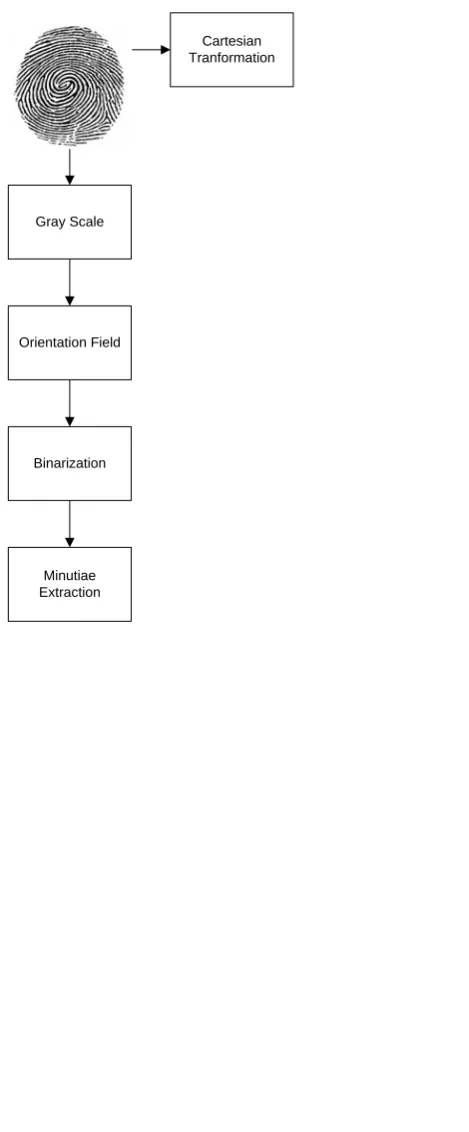
The basic flow chart or graphical representation of the proposed approach is given in Fig 3 as shown:
Gray Scale
Orientation Field
Binarization
Minutiae Extraction
Cartesian Tranformation
Surface Folding Transformation
Gray Scale
Orientation Field
Binarization
Minutiae Extraction
Storage Normal
Features
Deformed Features
Predictor Trained Model
Training
Classifier Test Data
Results
Figure 3. Flow Chart of Proposed Approach
B. Proposed Algorithm for Recognizing Deformed Fingerprint
1) Enrollment
1. FingerPrint = read Finger Print image from scanner
2.FingerPrint p=Preprocess image to remove any abnormalities, noise and Gray scale conversion, binarization and orientation field is performed here
4. FingerPrintm = Minutiae Feature extraction of input image,
FingerPrintm is normal fingerprint
5. Let us assume there can be N transformations achievable on the fingerprint FingerPrint m
For T = 1 to N
FingerPrintti= Transform(FingerPrint m, Ti)
6. End
7.Store FingerPrint m and N transformation with class as
subject in feature Vector.
2) Classification
1.For all Subjects do
2. X=[FingerPrintm,FingerPrintt1,FingerPrintt2…..FingerPrinttn]
3.Y = Subject identity
4.SVM_Model = SVMClassify(X,Y) 5.End
3) Authentication
1.FingerPrint = read Finger Print image from scanner
2.FingerPrint p= Preprocess image to remove any abnormalities,
noise and perform color correction, Gray scale conversion, binarization and orientation field estimation is performed here 3. FingerPrint r = FingerPrint region of interest extraction of Ip
4.FingerPrint m = Minutiae extraction of Ir and Minutiae
Feature extraction, this fingerprint can be Abnormal or Altered, this is not known at this point, we have to match it. 5.Try MATCH FingerPrintm with Classified SVM Model using
SVM Predict
6.If (Match Successful) 7. Validate User 8.End
C. Fingerprint identification
Fingerprints are made of a sequence of ridges and furrows on external of the finger and it have a core concerning it that outlines like swirls, loops, or arches are arced to safeguard that every single print is unique. An arch is a outline whereas the ridges go in from one side of the finger, development in the center growing an arc, and exit the supplementary side of the finger. The loop is a outline whereas the ridges go in from one of the side of a finger, form a arc, and incline to exit from the alike side. In the whorl, ridges form circularly concerning the central point on the finger.
The ridges and furrows are described by irregularities recognized as minutiae, the distinctive feature on that finger scanning technologies are based. Minutiae points are innate ridge characteristics that transpire at whichever a ridge bifurcation or a ridge ending.
• The ridge concluding is the point at that a ridge terminates.
•
Bifurcations are points at that a solitary ridge splits into two ridges.•
Minutiae and outlines are extremely vital in the scrutiny of fingerprints as no two fingers have been shown to be identical.
The main fingerprint enhancement algorithm that uses Gabor filters and band-pass filters to remove the sound and uphold real ridge/valley constructions is encompassed in the minutiae extraction module to safeguard that the presentation of arrangement is not altered by variations quality of fingerprint images.
D. Feature extraction of fingerprint
The most Feature extraction algorithms purpose on the pursuing four steps. In the early step, determine the reference point for the fingerprint image. Subsequent pace, tessellate the span concerning the reference point, already determined. Third pace, filter the span of attention in disparate orders, and in the end, delineate the feature vector clearly. The seized picture can have a varied scope of specifications. The pixels are 8-bit benefits, and intensity scope from 0 to 255.
E. Binary matrix formation
Feature extraction is the tough period of modified finger print identification. For feature extraction, afterward seizing finger print picture we desire to compute the length and breadth of finger print picture, next store every single pixel of finger print picture in matrix format. By employing this matrix format we can facilely change the finger print data.
F.Analysis of Minutiae Distribution
The ridge characteristic in the picture is indicated by minutiae technique. In most of the finger print ways minutia is utilized the matching process. In supplement the orientation earth abnormalities of modified finger prints have contrasts in the minutia too.
G. Smoothing
In the feature level extraction, smoothing plays a very vital role. For making smoothed finger print image K means algorithm is always used.
H. Fingerprint matching
Fingerprint matching mentions to discovering the similarity amid two given fingerprint images. Due to sound and distortion gave across fingerprint arrest and the inexact nature of feature extraction, the fingerprint representation frequently has missing, spurious, or loud features. Therefore, the matching algorithm ought to be immune to these errors. The matching algorithm outputs a similarity worth that indicates its assurance in the decision that the two pictures come from the alike finger. The continuing accepted fingerprint matching methods can be mainly categorized into three groups reliant on the kinds of features utilized are minutiae-based, correlation-based and euclidean distance-based.
I. Detection of altered fingerprints
The input fingerprint picture is normalized by employing a tiny rectangular span from the centre of the fingerprint. This removed features are invariant to translation and rotation. The fingerprint orientation earth is to be computed by employing the gradient established method. The early earth ought to be obtained by the flattened average filter, pursued by this averaging the orientations in the form of pixel blocks.
A foreground mask is crafted for the filling of the innate blocks and for morphological procedure is performed. The orientation earth is approximated by a polynomial model. The error chart is computed employing the definite difference and is utilized to craft the feature vector.
VII. CONCLUSION & FUTURE SCOPE
deformed fingerprints. The advantage of using this approach is that, SVM-classifier is effective search method over the large clustered database. Fingerprint association remarks to the setback of allocating fingerprints to one of countless pre-specified classes. Automatic association can be utilized as a pre-processing pace for fingerprint matching, cutting matching era and intricacy by restricting the find space to a subset of a normally huge database.
Automatic fingerprint identification is one of the most vital biometric technologies. In order to effectually match fingerprints in a large database, an indexing scheme is necessary. Fingerprint association that remarks to allocating a fingerprint picture into a number of pre-specified classes provides a feasible indexing mechanism. In exercise, nevertheless large intra-class and puny interclass variations in globe chart configuration and poor quality of fingerprint pictures make the association setback tremendously difficult. A fingerprint association algorithm needs a robust feature extractor that must to be able to reliable remove salient features from input images. A lot work is demanded to apply wavelet established outline recognition method for finger print recognition so as to evolve generalized methods autonomous of specific necessities and to rise the fingerprint recognition rate. In upcoming, we will work on the alike employing convolution transforms.
VIII. REFERENCES
[1]. Bolle, Ruud M., Jonathan Connell, Sharath Pankanti, Nalini K. Ratha, and Andrew W. Senior. Guide to biometrics. Springer Science & Business Media, 2013.
[2]. Ashbourn, Julian. Biometrics: Advanced identity verification: the complete guide. Springer, 2014.
[3]. Hasan, Haitham, and S. Abdul-Kareem. "Fingerprint image enhancement and recognition algorithms: a survey." Neural Computing and Applications 23, no. 6 (2013): 1605-1610. [4]. Singh, Paramvir, and Lakhwinder Kaur. "Fingerprint
feature extraction using morphological operations." In Computer Engineering and Applications (ICACEA), 2015 International Conference on Advances in, pp. 764-767. IEEE, 2015.
[5]. Crow, James F. "Francis Galton: Count and measure, measure and count." Genetics 135, no. 1 (1993): 1.
[6]. Paulino, Alessandra A., Eryun Liu, Kai Cao, and Anubhav K. Jain. "Latent fingerprint indexing: Fusion of level 1 and level 2 features." In Biometrics: Theory, Applications and Systems (BTAS), 2013 IEEE Sixth International Conference on, pp. 1-8. IEEE, 2013.
[7]. ArunKumar Yadav, Sanjiv Kumar Grewal, “A Comparitive Study of different Biometric Techonoligies.”IJCSC, vol. 5, no. 1, March-September2014, pp-37-42,ISSN -0973-7391.
[8]. Yi Wang, and Jiankun Hu. "Global ridge orientation modeling for partial fingerprint identification." Pattern Analysis and Machine Intelligence, IEEE Transactions on 33, no. 1 (2011): 72-87.
[9]. David Zhang, Feng Liu, Qijun Zhao, Guangming Lu, and Nan Luo. "Selecting a reference high resolution for fingerprint recognition using minutiae and pores." Instrumentation and Measurement, IEEE Transactions on 60, no. 3 (2011): 863-871.
[10]. Rakesh Verma, and Anuj Goel. "Wavelet application in fingerprint recognition." International Journal of Soft Computing and Engineering (IJSCE) ISSN (2011): 2231-2307.
[11]. Soweon Yoon, Jianjiang Feng, and Anil K. Jain. "Altered fingerprints: Analysis and detection." Pattern Analysis and Machine Intelligence, IEEE Transactions on 34, no. 3 (2012): 451-464.
[12]. Alessandra A. Paulino, Jianjiang Feng, and Anil K. Jain. "Latent fingerprint matching using descriptor-based Hough transform." Information Forensics and Security, IEEE Transactions on 8, no. 1 (2013): 31-45.
[13]. Ajita Rattani, and Arun Ross. "Automatic adaptation of fingerprint liveness detector to new spoof materials." In Proceedings of the IEEE International Conference on Biometrics (IJCB'14). 2014.