Volume 2010, Article ID 169597,11pages doi:10.1155/2010/169597
Research Article
Orthogonal DF Cooperative Relay Networks with Multiple-SNR
Thresholds and Multiple Hard-Decision Detections
Dian-Wu Yue
1, 2and Ha H. Nguyen
31College of Information Science & Technology, Dalian Maritime University, Dalian, Liaoning 116026, China 2National Mobile Communications Research Laboratory, Southeast University, Nanjing, Jiangsue 210096, China 3Department of Electrical & Computer Engineering, University of Saskatchewan, Saskatoon, SK, Canada S7N 5A9 Correspondence should be addressed to Ha H. Nguyen,[email protected]
Received 17 October 2009; Revised 28 March 2010; Accepted 17 June 2010
Academic Editor: Mischa Dohler
Copyright © 2010 D.-W. Yue and H. H. Nguyen. This is an open access article distributed under the Creative Commons Attribution License, which permits unrestricted use, distribution, and reproduction in any medium, provided the original work is properly cited.
This paper investigates a wireless cooperative relay network with multiple relays communicating with the destination over orthogonal channels. Proposed is a cooperative transmission scheme that employs two signal-to-noise ratio (SNR) thresholds and multiple hard-decision detections (HDD) at the destination. One SNR threshold is used to select transmitting relays, and the other threshold is used at the destination for detection. Then the destination simply combines all the hard-decision results and makes the final binary decision based on majority voting. Focusing on the decode-and-forward (DF) relaying protocol, the average bit error probability is derived and diversity analysis is carried out. It is shown that the full diversity order can be achieved by setting appropriate thresholds even when the destination does not know the exact or average SNRs of the source-relay links. The performance analysis is further extended to multi-hop cooperation and/or with the presence of a direct link where multiple thresholds are needed. By combining the multiple-SNR threshold method with a selection of the best relaying link, a high spectral-efficiency cooperative transmission scheme is further presented. Simulation results verify the theoretical analysis and demonstrate performance advantage of our proposed schemes over the existing ones.
1. Introduction
In most existing wireless communication networks, cable-powered base stations can be easily equipped with spatially separated multiple antennas. On the other hand, mounting multiple antennas in portable mobile terminals is not so practical because of their small-size and limited processing power. Hence, how to fully exploit the diversity benefit of multiple-antenna systems in distributed wireless communi-cation networks has become an important issue. Recently, the concept of cooperation in wireless communications has drawn much research attention due to its potential in improving the efficiency of wireless networks [1–3]. In cooperative communications, users can cooperate to relay each other’s information signals, creating a virtual array of transmit antennas, and hence achieving spatial diversity. Therefore cooperative diversity techniques can dramatically improve the reliability of signal transmission from each user.
In general, relaying transmission strategies can be divided into two main categories: amplify-and-forward (AF) and decode-and-forward (DF). In AF protocol, a relay just amplifies the signal received from the source and retransmits it to the destination or the next node. On the other hand, with the DF protocol, the a relay decodes the signal and remodulates the decoded information before transmitting to the next node. For these two protocols, outage and error performance have been extensively investigated [4–6]. In addition, the DF protocol can be combined with coding techniques and thus forming the so-called coded cooperation [7], which has been further developed in [8].
erroneous information, and with a conventional combining scheme such as the maximal-ratio combining (MRC), the error propagation degrades the end-to-end (e2e) detection performance. Recently, some works have been done to mitigate error propagation, which can be classified into two main approaches as follows.
The first approach includes selective and adaptive relay-ing techniques, for example, link adaptive relayrelay-ing [9] and threshold digital relaying (TDR) [10–13]. Both techniques use the source-relay link SNR to evaluate the reliability of the data received by the relay. In TDR, a relay forwards the received data only when its received SNR is above a threshold value. It has been shown that TDR can achieve the full-diversity order. Different from other full-diversity protocols in the literature, the TDR with relay selection proposed in [12,13] does not require that the exact or average SNRs of the source-relay links be known at the destination.
In order to mitigate error propagation, the second approach is to develop efficient combining schemes used at the destination [14–17]. In [14], the authors assume that the destination knows the exact source-relay SNR and present the so-called cooperative MRC (C-MRC) scheme that can approximate the maximum likelihood (ML) detec-tion scheme. This scheme is shown to achieve the full-diversity order at the expense of increased signaling overhead to convey the first hop (source-relay link) SNR information to the destination. In [16], in order to reduce the signaling overhead in C-MRC with relay selection, the authors pro-pose a modified combining scheme, called product MRC, which can achieve the same diversity order as the C-MRC. Reference [15] proposes a piecewise linear detector that approximates the ML detector and only requires knowledge of the average SNRs of the first hop. Although transmitting the average link SNRs is less costly than transmitting the instantaneous SNR, the scheme in [15] can only achieve about half of the full-diversity order for networks with more than one relay. In [17], the authors present a simple combining scheme based on hard-decision detection (HDD) with a much lower implementation complexity. However, similar to the scheme in [15], it does not achieve the full-diversity order. All of these abovementioned schemes require the relays to send the instantaneous or average SNRs of source-relay links to the destination. This requirement involves significant signalling overhead and is therefore difficult to fulfill for certain applications such as sensor networks.
This paper is concerned with wireless relay networks that deploy multiple parallel relays communicating with the destination over orthogonal channels in the second phase. We propose and analyze a protocol for relay selection and HDD at the destination based on double SNR thresholds. One SNR threshold is used to select retransmitting relays: a relay retransmits if its received SNR is larger than a threshold; otherwise it remains silent. The other threshold is used at the destination so that the destination makes an HDD for each received signal if its SNR is higher than the threshold, and does nothing (or declares an erasure) otherwise. Finally, the binary decision is made with the simple majority voting rule of the hard decisions. We focus on the exact BER
and diversity analysis for the uncoded DF protocol and in the case that the destination does not know the exact or average SNRs of the source-relay links. The performance analysis is also generalized for the multihop cooperative scenario. Our analysis shows that the full-diversity order can be achieved for the multihop cooperative networks with the proposed cooperative transmission scheme. Numerical results are provided to verify the theoretical results and demonstrate the performance advantage of our proposed scheme over those existing schemes that also achieve the full-diversity order. In order to improve spectral efficiency, we also propose to combine the multiple-SNR threshold method with a selection of the best relaying link.
2. System Model
Consider a wireless cooperative relay network with R+ 2 nodes, including one source node, one destination node, and R relay nodes. Each node is equipped with only one antenna and works in a half-duplex mode (i.e., it cannot receive and transmit signals simultaneously). For simplicity, we first assume that there is no direct link from the source to destination. All channel links are assumed to be quasistatic and mutually independent, which means that the channels are constant within one transmission duration, but vary independently over different transmission durations. Furthermore, it is assumed that the destination knows the channel state information (CSI) of every relay-destination link and each relay knows the CSI of its source-relay link.
Information transmission over a wireless relay network is accomplished in two phases. In the first phase, signals are broadcasted by the source to the relays. In the second phase, each relay decides independently whether its detection is reliable by comparing its received SNR to a threshold value. If the detection is considered to be reliable; the relay retransmits by the DF protocol. Otherwise, it remains silent. It is also assumed that the destination knows whether a relay retransmits in the second phase, for example, by looking for a flag bit. For each received signal from the reliable relays, the destination only makes a binary decision detection when the relay-destination link is considered to be reliable, that is, the received SNR of the link is higher than a second threshold value. Otherwise, the destination does nothing (erasure mode). The destination then makes a final binary decision by a simple majority voting on multiple HDDs.
In the first phase, source broadcasts a modulated signal
sto all of the relays. The received signal at the ith relay is expressed as
ri=
√
Esfis+vi, i=1,. . .,R. (1)
In the above expression, s has unit power (thus, Es is the
transmit power), fi is the channel gain between the source
and theith relay, modeled as a circularly symmetric complex Gaussian variable with varianceNi(1)(the magnitude offihas
a Rayleigh distribution), andviis the complex additive white
signal ri, and then forwards the detected result si to the
destination. Therefore the received signal at the destination from theith relay can be written as
yi=
√
Eigisi+wi, (2)
where Ei is the transmit power of the ith relay, gi is the
channel gain between theith relay and destination, which is modeled as a circularly symmetric complex Gaussian variable with varianceNi(2), andwidenotes the AWGN at the
destination with zero mean and unit variance. Moreover,si
also has unit average energy.
It is assumed that all of the random variables {fi}Ri=1, {gi}Ri=1,{vi}
R
i=1, and{wi}Ri=1are independent of each other. Furthermore, for simplicity of analysis (Extension of our analysis to the more general case is quite straightforward.), we assume that
whereETdenotes the total power consumed by the network.
3. BER Performance Analysis
3.1. Performance for the ith-Relay Link. We first focus on the performance of the ith-relay linkwhich is a cascade of the source-to-ith-relay link andith-relay-to-destination link. Denote the instantaneous SNRs of these two individual links byγ(1)i andγ
general modulation scheme, it can be approximated as [18]
pb Now let Θ1 and Θ2 denote the two SNR thresholds used at the relays and destination, respectively. Let Fj(·)
and fj(·), respectively, denote the cumulative distribution
function (cdf) and the probability density function (pdf) of the random SNRγ(ij),j=1, 2. Then the probability that the ith-relay link is unreliable can be expressed as
Pu=1−[1−F1(Θ1)][1−F2(Θ2)]. (6)
With Rayleigh fading channels,γi(1)andγ
(2)
The conditional average BER at the destination for the
ith-relay link under the reliable condition, that is,γ(1)i >Θ1 andγ(2)i >Θ2, is written as
i ) represents the BER ofith-relay link as a
function of the SNRsγ(1)i andγ
Thus the conditional BER can be calculated as
Pb=Pb Θj,N(j)
Appendix Aprovides detailed derivations of the above result.
3.2. Overall Average Bit Error Probability. Consider binary modulation and letPb(m,k) denote the conditional BER that
resulted from the majority voting on the HDDs under the conditions that (i), among all R relays, there are m relays making binary decisions andR−mrelays making erasure decisions and (ii), amongmrelays making binary decisions, there arekrelays making correct decisions (i.e.,m−krelays making error decisions). Obviously, ifk > m−k, the final binary decision is correct and thus Pb(m,k) = 0. On the
other hand, ifk < m−k, the final binary decision is wrong and thus Pb(m,k) = 1. If it happens that k = m−k,
the destination makes the final binary decision by chance and hencePb(m,k) = 1/2. Therefore, the conditional BER
When nonbinary modulation such as PSK or QAM is used, for all the signals from the received reliable links, the destination first detects the information bits independently and then combines all of the detection results, bit by bit, with a majority voting. Therefore, for any bit in one modulation symbol the conditional BER is the same as that in the case of binary modulation and thus can still be determined by
Pb(m,k).
Now let PB denote the overall average BER for the
proposed cooperative relay scheme. Then it can be written as
Note that the above exact BER calculation ofPB requires to
use (6) and (10).
3.3. Near Optimality of the Proposed Combing Scheme. This section shows that, when BPSK modulation is employed, the BER performance at high SNR obtained with the proposed signal combining scheme based on HDDs and majority voting can be close to the BER performance of the optimal combining scheme, that is, the maximum likelihood (ML) combining.
Among all R relays, it is assumed that m relays make binary decisions (reliable relays) and R−m relays make erasure decisions. Without loss of generality, assume that themreliable relays are relays 1, 2,. . .,m. If the destination can know all of the conditional BERs (conditioned on the instantaneous SNR γi(1)) {pb(γ(1)i )}
m
i=1 at these m reliable relays, then the log-likelihood ratio (LLR) for the transmitted signalscan be computed as (see [19,20])
If the destination only knows all of theaverageBERs, that is,E(pb(γi(1)))=G(Θ1,N(1)E)=P(1),i=1, 2,. . .,m, at these
mreliable relays, then the LLR of the signalsis given by
Λ(s)=
Furthermore, suppose that among themreliable relays there arekrelays that make “+1” decisions. WhenE → ∞, one has
Λ(s)−→
The above LLR metric implies that at high SNR the ML combining scheme is equivalent to the proposed combining scheme based on HDD and majority voting. It should also be noted that the proposed combining scheme does not require that either exact or average SNRs of the source-relay links be known at the destination. Furthermore, when
P(1) = 0, it can be readily shown that the ML combining scheme coincides with the conventional MRC scheme. It has also been pointed out in [20] that the performance of the MRC scheme is severely degraded in practical scenario when
P(1)>0, especially when the number of relays increases.
4. Diversity Analysis
4.1. Asymptotic Performance of the ith-Relay Link. In order to present the asymptotic analysis for Pu and Pb, let us
introduce the following two common notations. For two positive functionsa(x) andb(x), a(x) ∼ b(x) means that limx→ ∞a(x)/b(x) =1, whereasa(x)=O(b(x)) means that lim supx→ ∞a(x)/b(x)<∞. Furthermore, similar to [11,13], we will define the two SNR thresholds as follows:
Θ1=c1N(1)logE,
Θ2=c2N(2)logE,
(20)
wherec1andc2are two positive constants, whose values are discussed at the end of this subsection.
With the above definitions of the two SNR thresholds and as the SNRE → ∞, one has
must decay at least asO(1/E2) so that each term in the sum in (13) can be expressed asymptotically byO((logE/E)R).
Now define
Θmin=min{Θ1,Θ2}. (22)
Then fromAppendix Athe conditional BER has the follow-ing upper bound:
Pbαe−βΘmin/2. (23)
It follows from (10) thatΘminneeds to satisfy
βΘmin
2 ≥2 logE, (24)
which in turn requirescj(j=1, 2) to satisfy
cj≥
4
β·
1
N(j), j=1, 2. (25)
With the definitions ofΘ1 andΘ2 in (20), (10) can be further simplified to
Pb≤αe−2 logE=α·
1
E2, (26)
which confirms the second diversity order of Pb, namely, Pb ∼ O(1/E2). Note that, if there is no threshold, or only
one threshold, the diversity order of Pb is only 1; that is, Pb∼O(1/E).
4.2. Diversity Analysis of the Overall Average BER,PB. Recall that the diversity order is defined as
d= −lim
E→ ∞ logPB
logE . (27)
In the following, it is shown that an upper bound on the BER yieldsd=R, which implies that the relay network can achieve the full-diversity.
Since (1−Pu)m≤1 and (1−Pb)k≤1,PBcan be upper
bounded as follows:
PB≤ R
m=0
m/2
k=0
R m
m k
PRu−mPbm−k. (28)
Herem/2 =m/2 ifmis even, andm/2 =(m−1)/2 ifm
is odd. It follows from (21) and (26) that
PB≤ R
m=0
m/2
k=0
R m
m k
clogE E
R−m α E2
m−k
. (29)
Sincek≤ m/2, one has
R≤R−m+ 2(m−k)=R+m−2k. (30)
Therefore,
PB≤
logE E
R R
m=0
m/2
k=0
R m
m k
cR−mαm−k≤q logE E
R
,
(31)
whereqis a positive constant equal to
q=
R
m=0
m/2
k=0
R m
m k
cR−m(α)m−k≤
(c+ 1 +α)R. (32)
From the above two inequalities, it is obvious that the diversity order ofPBisR.
Remark 1. If there is no threshold or only one threshold, due to the fact thatPb∼O(1/E), it can be shown similarly that
d= −lim
E→ ∞ logPB
logE = R+ 1
2 !
. (33)
This means that only about half of the full-diversity order can be achieved.
Since there is no the direct link from the source to the destination, it is possible that an outage event occurs for the network when no information is actually sent to the destination. Based on (21), the outage probability is equal to
Pout=PuR∼ c·
logE E
R
. (34)
Obviously, whenE → ∞,Pout → 0. Therefore, at high SNR region, the outage event has a negligible influence on the BER performance.
5. General Cooperation Scenarios
This section first generalizes the results of Section 3 to the following scenarios: (i) multihop cooperation and (ii) cooperation including the direct link. Then a link selection protocol for the general cooperative network including the direct link is also proposed.
5.1. Multihop Cooperation. Consider a general cooperative relay network consisting of R parallel links with each link having M −1 relays. This means that there are M hops from the source to destination. Assume that, for each relay link composing of M −1 relays from the source to the destination, a given relay knows the instantaneous SNR of the channel connected to itself. There areMSNR thresholds to determine the operation of theseM −1 relays and the destination on a given relay link. If each relay link has at least one out ofMhops whose instantaneous SNR is lower than the corresponding threshold, the whole relay link is called
unreliable.
whether its channel is reliable by comparing its received SNR to the first threshold value, and informs the second relay by sending a single-bit message indicating whether the first section of the relay link is reliable. Then the second relay sends a single-bit message informing that the first two sections of the relay link are unreliable if it receives the single-bit message from the first relay saying that the first section of the link is unreliable. Otherwise, the second relay first decides independently whether the second channel is reliable by comparing its received SNR to the second threshold value, and informs the third relay by sending a single-bit message. The same procedure repeats for other relays on the link. For any relay link, if the whole link is reliable, then each relay on the link is allowed to retransmit by the DF protocol. Otherwise, each relay, due to the link unreliability, remains silent. For each of the received signals from the last relays of reliable links, similar to the case of two-hop networks, the destination makes binary hard-decision detections, whereas for the unreliable relay links it makes erasure decisions.
For the jth hop of theith-relay link, denote its instanta-neous SNR byγ(ij), whose second moment isN
(j)
i . Similar to
the two-hop case, theMSNR thresholdsΘj, j = 1,. . .,M,
introduced for the multihop network are defined as
Θj=cjN(j)logE. (35)
In order to achieve the full-diversity order, the coefficientscj
should satisfycj ≥(4/β)·(1/N(j)), which is the same as in
the two-hop case.
Extending the analysis in the previous section, the unreliable probability for each relay link is expressed as
Pu=1−
Furthermore, with the definition of{Θj}, it is easily shown
that
Pu∼c·logE
E , (37)
wherec="M j=1cj.
The exact conditional BER at the destination for the
ith-relay link under the reliable condition can be calculated iteratively based on (10), (11) and the following formula:
Pb=Pb Θj,N(j)
Furthermore, it can be shown by induction that the
conditional BER for each relay link as a function of{γ(ij)} M
j=1
has the following upper bound (see Appendix B for the derivations):
case, one can verify that the diversity order is alsoRsince the expression of the overall average BERPBis the same as that in
the two-hop networks, and so is the expression of the outage probability.
5.2. Cooperation Including the Direct Link. First consider separately the performance of the direct link. Assume that the channel gain of the link ish, whose magnitude follows a Rayleigh distribution with a second momentN. For the direct link, we also set an SNR threshold at the destination node and define it similarly as follows:
Θ=cNlogE, (40)
wherecis a constant satisfyingc≥(4/β)·(1/N). Then the probability that the direct link is unreliable can be expressed as
Pu=1−e−c
logE/E
∼c·logE
E . (41)
On the other hand, under the reliable condition, the conditional BER of the direct link is Pb = G(Θ,NE) ∼ O(1/E2). Furthermore, whenE → ∞, it follows thatP
u = O(logE/E). This implies that the individual contribution of the direct link on the diversity order is the same as the contribution of single-relay link on the diversity order. Since the direct link can be viewed equivalently as a relay link, the cooperative network with the inclusion of the direct link must have a maximum (or full-) diversity order ofR+ 1. Below we will show that this full-diversity order can indeed be achieved with our proposed method.
The overall system average BER can expressed as
PB=
the case that the direct link is reliable. The latter probability can be computed as
To proceed further, the following observations are made.
(1) When the destination makes a correct binary decision for the direct link,R−m+2(m−k)=R+m−2k≥R+1 for (m+ 1)−(k+ 1)≥k+ 1.
(2) When the destination makes an error binary decision for the direct link, 2 +R−m+ 2(m−k)=2 +R+m− 2k≥R+ 1 for (m+ 1)−k≥k.
Based on the above observations and similar to the deriva-tions inSection 3, it can be shown that
PB=O
logE E
R+1 ,
PuPB=O
logE E
R+1
.
(45)
Thus the diversity order can finally be computed as
d= −lim
E→ ∞ logPB
logE =R+ 1. (46)
5.3. Combining Multiple-SNR Threshold Method with a Selec-tion of the Best Relaying Link. In general, any cooperative scheme that involves all the relaying links suffers from a loss in spectral efficiency since multiple time slots or frequency bands (equal to the number of relaying links plus one) are required to retransmit one information symbol. In the two-hop scenario, the best relay selection scheme with high spectrum efficiency is very attractive [21]. In [16,22], Yi and Kim gave a cooperative scheme by combing C-MRC [14] with the best relay selection and showed that such a combined scheme can also achieve the full-diversity order. In [13], Onat et al. presented a threshold-based relay selection protocol, which can also achieve the full-diversity order. The basic idea in Onat’s protocol is that the destination selects only one link with the best SNR from all of the reliable relay links and the direct link, and performs detection based on the single selected link only. We now extend the link selection ideas to the multihop scenario with multiple-SNR thresholds employed for each indirect link and give a novel cooperative relaying protocol in the following.
Consider a multihop cooperation network withRparallel relay links. In the first phase, the source broadcasts signals, and the relays and destination receive. In the second phase, the destination first selects only one relay link among all of the reliable relay links. When there exits a reliable relay link among all of the relay links, the relays in the selected link detect the received signal and transmit it to the destination, while all of the other relay links keep silent. Finally the destination performs the MRC with the received signals from the best relay link and the received signal from the direct link. If there is no reliable relay link, all of the relay links remain silent and the destination detects only the received signal from the direct link.
Similar to [13], we also set the SNR threshold as
Θ=logE2R/β. (47)
Following similar derivations in [13], it is not difficult to show that the proposed link selection protocol can achieve the full-diversity order. The main results are as follows.
Case 1. When there exits a reliable relay link among all of the relay links, the average BER can be expressed as
PB−(a)=O
RlogE2R/β ER+1
. (48)
Case 2. When there is no reliable relay link, due to the fact that the MRC combining has the same diversity order as the selection combing [23], the proposed scheme has the same diversity order as Onat’s scheme. The average BER in this case is also given as in Case1; namely,
PB−(b)=O
RlogE2R/β ER+1
. (49)
Therefore, the overall system average BER is
PB=PB−(a)+PB−(b)=O
RlogE2R/β ER+1
, (50)
which shows the full-diversity order ofd=R+ 1.
6. Numerical Results and Comparison
This section provides simulation results to illustrate the performance of the proposed method with multiple-SNR thresholds and multiple hard-decision detections. In all of the simulation curves, SNR denotes the total power,ET, since
the variance of AWGN is set to one. For simplicity only BPSK modulation is employed in all simulations. We will observe the BER performance of networks with two hops whenN(1) =N(2)=N =1, and we set all the of thresholds to be the same; namely,Θ1 = Θ2 =Θ. In Figures1–3, we setΘ=cTlog(1 +ET/(R+ 1)), which can satisfy the positive
property of SNR thresholds for all values ofET.
First, we observe the diversity performance for different numbers of relays.Figure 1plots the BER performance with and without SNR thresholds forR=2, 4, 6. Here we setcT =
(4/β)·(1/N) = 2, which meets the inequality in (25). As can be seen, the diversity order with SNR thresholds is higher than the one without thresholds for the sameR. It can be also seen that the diversity order with or without SNR thresholds becomes higher asRincreases. These simulation results verify our diversity analysis.
Second, we consider the influence of SNR thresholds on the network average BER performance. Figure 2 plots the BER for different thresholds under the case where there is the direct link. In particular, we considerR = 3 relays and set the constant coefficient to be cT = K ·2, with K =
0 10 20 30 40 50 60 70 80 10−35
10−30
10−25
10−20
10−15
10−10
10−5
100
BER
SNR (dB)
Without thresholds With thresholds
R=2
R=4
R=6
Figure1: Diversity performance comparison with and without the SNR thresholds for different numbers of the relays.
0 10 20 30 40 50
10−15
10−10
10−5
100
BER
SNR (dB)
K=3 K=2
K=1
K=0
K=1/2
K=1/4
K=1/8
Figure2: BER performance comparison for different SNR thresh-olds whenR=3: with the direct link.
better than the ones without SNR thresholds only at very high-SNR region. On the other hand, the BER curves with smaller SNR thresholds whenK =1/4, 1/8 are better than the one without SNR-thresholds in low-to-high-SNR region. In particular, in all of the SNR region from 0 dB to 50 dB, the curve with K = 1/4 is always better than any other curves. Similar results can be observed in Figure 3for the network without the direct link (hereR=8). Based on the above observations, in the simulations forFigure 4the best threshold value (1/2) log(1 +ET/(R+ 1)) whenK = 1/4 is
selected.
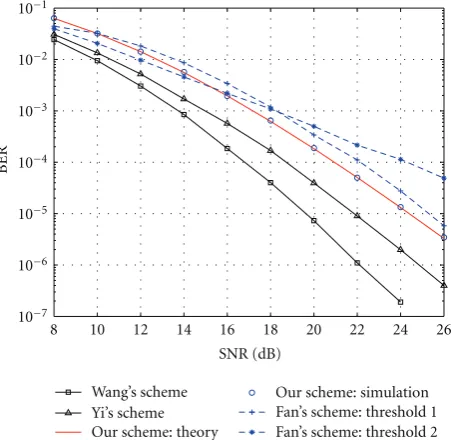
Third, Figure 4 compares the BER performances achieved by the proposed HDD scheme and three MRC schemes for the cooperative network including the direct link
0 5 10 15 20 25 30 35 40
10−20
10−15
10−10
10−5
100
BER
SNR (dB)
K=3
K=2
K=1
K=0
K=1/2
K=1/4
K=1/8
Figure3: BER performance comparison for different SNR thresh-olds whenR=8: without the direct link.
8 10 12 14 16 18 20 22 24 26 10−7
10−6
10−5
10−4
10−3
10−2
10−1
BER
SNR (dB)
Wang’s scheme Yi’s scheme Our scheme: theory
Our scheme: simulation Fan’s scheme: threshold 1 Fan’s scheme: threshold 2
Figure4: BER performance comparison between the HDD scheme and several MRC schemes whenR=3.
and withR = 3. For the proposed HDD scheme, we make use of the best SNR threshold of (1/2) log(1 +ET/(R+ 1)).
For Fan’s MRC scheme [12], we use two thresholds: (i) an SNR threshold of 3 log(ET/(R+ 1)) (referred to asThreshold 1in the figure) as suggested in [12] and (ii) the same SNR threshold of (1/2) log(1 +ET/(R+ 1)) (calledThreshold 2in
the figure) as applied in our HDD scheme. From Figure 4
be known at the destination. The product MRC scheme by Yi et al. requires that the relays transmit the amplified signals with the gain determined by the corresponding resource-relay channels. This is not a simple DF transmission. At the practical SNR region, our HDD scheme is better than that of Fan’s. Furthermore, since both our HDD and Fan’s schemes are based on the SNR thresholds, at each SNR value ofET,
the average total consumed powers in the threshold-based schemes are in fact smaller than the consumed powers in Wang’s and Yi’s MRC schemes. This is a consequence of the fact that there often exists one or more unreliable links. Specifically, the average power saving of our HDD scheme is equal toRETPu/(R+ 1). The perfect agreement between
simulation and theoretical results of our proposed HDD scheme is also illustrated inFigure 4.
Finally, we simulate the proposed link selection scheme (Section 5.3) forR=3. In particular,Figure 5plots the BER curves for different thresholds by settingΘ=KRlog(ET/2)
withK=1, 1/2, 1/3, 1/6, 1/12. Note that only whenK=1 the resulting threshold value meets the equation given in (47). The best performance curve is achieved withK =1/3 and this curve is also plotted inFigure 6to compare our link selection scheme with existing two relay selection schemes in [13, 22]. For Onat’s scheme [13], the two BER curves correspond to the two SNR thresholds ofΘ=K·R·logET/2,
with K = 1, 1/3. The first threshold (calledThreshold 1) with K = 1 comes from [13], and the second threshold (calledThreshold 2) withK =1/3 is the same as that used in our scheme. Obviously, the BER performance with Yi’s selection scheme [22] is the best among all of the three selection schemes under comparison. However, it requires that the exact SNRs of the source-relay links be known at the destination. At low-medium SNR region, our scheme is better than Onat’s scheme withThreshold 1, and close to Onat’s scheme withThreshold 2. On the other hand, at high-SNR region, our scheme is better than Onat’s scheme with
Threshold 2, and close to Onat’s scheme withThreshold 1. As discussed before, since both our scheme and Onat’s scheme are based on the SNR thresholds, there is a saving in the total consumed power whenever all of the relay links are unreliable. Precisely, the average power saving for our scheme can be determined to beET(Pu)R/2.
7. Conclusions
In this paper we have proposed and investigated a cooper-ative transmission scheme for a wireless coopercooper-ative relay network with multiple relays. The proposed scheme employs two signal-to-noise ratio (SNR) thresholds and multiple hard-decision detections (HDDs) at the destination. One SNR threshold is used to select transmitting relays, while the other threshold is used at the destination for detection. We derived the exact average bit error probability of the proposed scheme and showed that it can achieve the full-diversity order by setting appropriate thresholds. The diversity result is significant since our proposed scheme does not require the destination to know the exact or average SNRs of the source-relay links. Performance analysis was
K=1
K=1/2
K=1/6
K=1/3
K=1/2
8 10 12 14 16 18 20 22 24 26 10−7
10−6
10−5
10−4
10−3
10−2
10−1
BER
SNR (dB)
Figure5: BER performance comparison for different SNR thresh-olds whenR=3: with relaying link selection.
8 10 12 14 16 18 20 22 24 26 10−7
10−6
10−5
10−4
10−3
10−2
10−1
BER
SNR (dB)
Yi selection scheme Onat scheme with Threshold 1 Onat scheme with Threshold 2 Our selection scheme
Figure 6: BER performance comparison between our selection scheme and two other selection schemes whenR=3.
further extended to multihop cooperation and cooperation with the presence of a direct link. A high spectral-efficiency cooperative transmission scheme was also presented by combining the multiple-SNR threshold method with a selection of the best relaying link. Simulation results were provided to verify the theoretical analysis and demonstrate performance advantage of our proposed schemes over the previously proposed schemes that have a similar complexity.
Appendices
A. Proofs of
(
10
)
,
(
11
)
, and
(
23
)
signal if its SNR is higher than the SNR thresholdΘ. With the Rayleigh fading model, the channel gain magnitude squared,
γ, has an exponential distribution with mean valueΦ, pdf
f(γ), and cdfF(·). The conditional pdf ofγ, conditioned on
Then for a general modulation scheme with parameters
αandβas given in (5), the average BER at the destination
To prove (23), first observe that
pb
The proof of (39) will be carried out by induction. Consider theith-relay link withMhops. WhenM=2, the conclusion is obvious due to (A.5). Suppose that the conclusion also holds forM=K; that is,
Then we need to prove that the conclusion holds whenM=
pb({γi(j)} K
j=1), the BER with (K+ 1)-hop link is expressed as
pb γi(j)
K+1
j=1
= #
1−pb γi(j)
K j=1
$
pb
γ(iK+1)
+1−pb
γ(iK+1)
pb γi(j)
K j=1
≈ #
1−pb γi(j)
K j=1
$
αQ βγ(iK+1)
+ #
1−αQ βγ(iK+1)
$
pb γi(j)
K j=1
≤pb γi(j)
K j=1
+αQ βγ(iK+1)
≤
K
j=1
αQβΘj
+αQ βγi(K+1)
≤
K+1
j=1
αQβΘj
≤(K+ 1)αQβΘmin
.
(B.2)
Acknowledgments
This work was supported by an NSERC Discovery Grant, by the Research Fund for the Doctoral Program of Higher Education, China Ministry of Education, under Grant no. 20092125110006, and by the open research fund of National Mobile Communications Research Laboratory, Southeast University, under Grant no. W200810.
References
[1] A. Sendonaris, E. Erkip, and B. Aazhang, “User cooperation diversity—part I: system description,”IEEE Transactions on Communications, vol. 51, no. 11, pp. 1927–1938, 2003. [2] J. N. Laneman, D. N. C. Tse, and G. W. Wornell, “Cooperative
diversity in wireless networks: efficient protocols and outage behavior,”IEEE Transactions on Information Theory, vol. 50, no. 12, pp. 3062–3080, 2004.
[3] J. N. Laneman and G. W. Wornell, “Distributed space-time-coded protocols for exploiting cooperative diversity in wireless networks,”IEEE Transactions on Information Theory, vol. 49, no. 10, pp. 2415–2425, 2003.
[4] P. A. Anghel and M. Kaveh, “Exact symbol error probability of a cooperative network in a rayleigh-fading environment,” IEEE Transactions on Wireless Communications, vol. 3, no. 5, pp. 1416–1421, 2004.
[5] I.-H. Lee and D. Kim, “BER analysis for decode-and-forward relaying in dissimilar Rayleigh fading channels,”IEEE Com-munications Letters, vol. 11, no. 1, pp. 52–54, 2007.
[6] W. Su, A. K. Sadek, and K. J. Ray Liu, “Cooperative communication protocols in wireless networks: performance analysis and optimum power allocation,” Wireless Personal Communications, vol. 44, no. 2, pp. 181–217, 2008.
[7] A. Nosratinia, T. E. Hunter, and A. Hedayat, “Cooperative communication in wireless networks,”IEEE Communications Magazine, vol. 42, no. 10, pp. 74–80, 2004.
[8] A. W. Eckford, J. P. K. Chu, and R. S. Adve, “Low complexity and fractional coded cooperation for wireless networks,”IEEE
Transactions on Wireless Communications, vol. 7, no. 5, pp. 1917–1929, 2008.
[9] T. Wang, R. Wang, and G. B. Giannakis, “Smart regenerative relays for link-adaptive cooperative communications,” in Proceedings of the IEEE Conference on Information Sciences and Systems (CISS ’06), pp. 1038–1043, Princeton, NJ, USA, March 2007.
[10] F. A. Onat, A. Adinoyi, Y. Fan, H. Yanikomeroglu, J. S. Thompson, and I. D. Marsland, “Threshold selection for SNR-based selective digital relaying in cooperative wireless networks,” IEEE Transactions on Wireless Communications, vol. 7, no. 11, pp. 4226–4237, 2008.
[11] F. Onat, Y. Fan, H. Yanikomeroglu, and J. Thompson, “Asymptotic BER analysis of threshold digital relaying schemes in cooperative wireless systems,”IEEE Transactions on Wireless Communications, vol. 7, no. 12, pp. 4938–4947, 2008. [12] Y. Fan, F. A. Onat, H. Yanikomerpglu, and H. V. Poor, “Threshold based distributed detection that achieves full diversity inwireless sensor networks,” in Proceedings of the Asilomar Conference on Signals, Systems, and Computerse, Pacific Grove, Calif, USA, October 2008.
[13] F. A. Onat, Y. Fan, H. Yanikomeroglu, and H. V. Poor, “Threshold based relay selection in cooperative wireless networks,” in Proceedings of the IEEE Global Telecommunications Conference (GLOBECOM ’08), pp. 4810–4814, New Orleans, La, USA, November 2008.
[14] T. Wang, A. Cano, G. B. Giannakis, and J. N. Laneman, “High-performance cooperative demodulation with decode-and-forward relays,” IEEE Transactions on Communications, vol. 55, no. 7, pp. 1427–1438, 2007.
[15] D. Chen and J. N. Laneman, “Modulation and demodulation for cooperative diversity in wireless systems,” IEEE Transactions on Wireless Communications, vol. 5, no. 7, pp. 1785–1794, 2006.
[16] Z. Yi and I.-M. Kim, “Decode-and-forward cooperative networks with relay selection,” inProceedings of the IEEE 66th Vehicular Technology Conference (VTC ’07), pp. 1167–1171, Baltimore, Md, USA, October 2007.
[17] Z. Yi and I.-M. Kim, “Decode-and-forward cooperative net-works with multiuser diversity,” inProceedings of the Military Communications Conference (MILCOM ’06), October 2006. [18] A. Goldsmith,Wireless Communications, chapter 6, Cambrige
University Press, Cambrige, UK, 2005.
[19] J. N. Laneman and G. W. Wornell, “Energy-efficient antenna sharing and relaying for wireless networks,” inProceedings of the IEEE Wireless Communications and Networking Conference (WCNC ’00), pp. 7–12, Chicago, Ill, USA, September 2000. [20] B. Djeumou, S. Lasaulce, and A. G. Klein, “Combinning
decoded-and-forward signals in Gaussian cooperative channels,” in Proceedings of the 6th IEEE International Symposium on Signal Processing and Information Technology, pp. 622–627, Vancouver, Canada, August 2006.
[21] A. Bletsas, A. Khisti, D. P. Reed, and A. Lippman, “A simple cooperative diversity method based on network path selection,”IEEE Journal on Selected Areas in Communications, vol. 24, no. 3, pp. 659–672, 2006.
[22] Z. Yi and I.-M. Kim, “Diversity order analysis of the decode-and-forward cooperative networks with relay selection,”IEEE Transactions on Wireless Communications, vol. 7, no. 5, pp. 1792–1799, 2008.