Volume 2008, Article ID 852397,9pages doi:10.1155/2008/852397
Research Article
Distributed Generalized Low-Density Codes for
Multiple Relay Cooperative Communications
Changcai Han and Weiling Wu
Key Laboratory of Information Processing and Intelligent Technology, Beijing University of Posts and Telecommunications, Beijing 100876, China
Correspondence should be addressed to Changcai Han,[email protected]
Received 1 November 2007; Revised 17 March 2008; Accepted 9 July 2008
Recommended by Yonghui Li
As a class of pseudorandom error correcting codes, generalized low-density (GLD) codes exhibit excellent performance over both additive white Gaussian noise (AWGN) and Rayleigh fading channels. In this paper, distributed GLD codes are proposed for multiple relay cooperative communications. Specifically, using the partial error detecting and error correcting capabilities of the GLD code, each relay node decodes and forwards some of the constituent codes of the GLD code to cooperatively form a distributed GLD code, which can work effectively and keep a fixed overall code rate when the number of relay nodes varies. Also, at relay nodes, a progressive processing procedure is proposed to reduce the complexity and adapt to the source-relay channel variations. At the destination, the soft information from different paths is combined for the GLD decoder thus diversity gain and coding gain are achieved simultaneously. Simulation results verify that distributed GLD codes with various number of relay nodes can obtain significant performance gains in quasistatic fading channels compared with the strategy without relays and the performance is further improved when more relays are employed.
Copyright © 2008 C. Han and W. Wu. This is an open access article distributed under the Creative Commons Attribution License, which permits unrestricted use, distribution, and reproduction in any medium, provided the original work is properly cited.
1. INTRODUCTION
Cooperative communications can increase achievable rates and decrease susceptibility to channel variations [1–3] and have potential practical applications in cellular systems, wireless ad hoc, and sensor networks. In cooperative com-munications, several relay protocols, such as amplify-and-forward (AF) [4], decode-and-forward (DF) [1], and coded cooperation [5,6], have been proposed.
Based on relay protocols, various coding strategies can be devised using rate-compatible punctured convolutional (RCPC) codes, product codes, or concatenation codes and the coding scheme design has become a hot topic in the literature [7–12]. Specifically, low-density parity-check (LDPC) codes [13] are employed for relay networks in [7– 9] and distributed turbo codes are presented in [10–12].
Most of the cooperative strategies above are devised for the classical three-node relay channel model, that is, the network with only one relay. However, it has been theoretically revealed that the diversity gain increases when more relays participate in cooperation [14]. Moreover, in
wireless relay networks, the number of relays participating in cooperation may vary from time to time due to the random mobility of nodes [15]. Therefore, the coding schemes should be easily adjusted when the relay number varies. Although distributed turbo codes can be extended to networks with different number of relays using multiple turbo codes [16], the overall code rate decreases with the increase of relay number [11]. In this paper, based on the DF relay protocol, a novel coding scheme is proposed for cooperative relay networks using generalized low-density (GLD) codes [17– 19], which has a fixed overall code rate.
GLD codes were first introduced by Tanner in [17] and then were further investigated in [18–20]. GLD codes which make the generalization of Gallager’s LDPC codes are constructed by replacing the parity-check constraints in LDPC codes with block code constraints. Similar to LDPC codes, GLD codes can also be iteratively decoded and exhibit excellent performance over both additive white Gaussian noise (AWGN) [18,19] and Rayleigh fading channels [20].
s
d
Phase 1 Phase 2
Figure1: Cooperative communication scenario.
codes according to the number of available relays using the partial error detecting and error correcting capabilities of GLD codes. Unlike distributed turbo codes in [11], the overall code rate of distributed GLD codes is fixed when the relay number varies. Moreover, a progressive processing strategy is proposed for relay nodes, which allows partial decoding of the received codeword to reduce the complexity in good source-relay channel conditions and guarantees the robustness of the system in bad conditions. At the destination, a combiner is added to collect the soft information from different nodes for the GLD decoder and a little complexity is added to the destination node. The significant performance of distributed GLD codes over quasistatic fading channels is further verified by simulations. The remainder of this paper is organized as follows. Section 2 briefly describes the system model of coopera-tive communications with multiple relays in a cluster. In Section 3, distributed GLD codes are proposed and the processing algorithms at relays and the destination are pre-sented.Section 4gives the simulation results of distributed GLD codes. The conclusions are drawn inSection 5.
2. SYSTEM MODEL
In this paper, we investigate the scenario that the source node transmits data to the distant destination aided by some nearby nodes as depicted inFigure 1. We may further assume that the source and relay nodes locate geographically in a small region forming a transmit cluster, and thus the quality of the channels from the source to relays is usually good. This is approximately equivalent to the cooperative network with multiple relays as presented in [15].
In this scenario, the cooperative relay group can be assigned by some central nodes or via some other distributed protocols. For example, the source node may send a “hello” message to the surrounding nodes and those nodes which respond properly verified according to some criteria form a transmit cluster as introduced in [15]. Once a cluster is formed, the relay setR is given. LetLdenote the number of available relays in the setR, whereLequals the cardinality of the setRdenoted as|R|. Note that the cluster needs to be reformed after some time due to the random mobility of nodes. That is, the relay numberLmay vary from time to time in cooperative relay networks accordingly.
All the channels from nodes in the cluster to the distant destination are usually modeled as independent quasistatic Rayleigh fading channels. All the internode channels, that is, the channels between nodes in the same cluster, may be modeled as independent AWGN channels due to strong line of sight components [21], although this is not a critical element of the scheme. We assume that all the nodes transmit signals on orthogonal channels (e.g., CDMA, FDMA, or TDMA) and are constrained to the half-duplex mode.
We assume the sourcestransmits signals to the destina-tion d aided by relay nodes in the set R. The cooperative relay protocol in this scenario is usually consisted of two phases as illustrated in Figure 1. At the source node s, let
c=[c1,c2,. . .,cN] denote the encoded bit vector, whereNis the code length. Then it is modulated with the binary phase shift keying (BPSK) constellation to getx=[x1,x2,. . .,xN].
In the first phase, the sourcesbroadcasts its dataxi, 1≤
i≤N and the received signal at the distant destinationdis given by
ysd
i =
√
Pshsd
i xi+ηsdi , (1)
wherePsis the power of each symbol from the source,hsd i is the Rayleigh fading coefficient of the channel from the source to the destination and ηsdi denotes the AWGN with the varianceσ2.
Simultaneously, the broadcast data from the source can also be received by relay nodes in the setRand the received signal of the relaylis denoted as
ysr
i,l=
√
Pshsr
i,lxi+ηsri,l, (2)
where hsri,l represents the fading gain of the path from the source node to the relay nodelandηsri,lis the AWGN. In the scenario of this paper, the internode channels are modeled as AWGN channels, that is, for the pair of nodes belong to the same cluster,hsr
i,l=1. Relay nodes decode the data and some error detecting codes such as cyclic redundancy check (CRC) or other linear block codes are used to verify the decoding results.
In the second phase, those relay nodes which decode the data correctly aid the source to forward data to the destination. Letxildenote the signal transmitted by the relay l, which is received at the destination given by
yird,l =
Prdl hrdi,lxli+ηird,l, (3)
wherePrd
l is the power of each symbol from the relayl,hrdi,l is the Rayleigh fading coefficient of the channel from the relay lto the destination, and ηrdi,l denotes the AWGN with the varianceσl2.
H0
Figure2: Structure of the parity-check matrixHof a GLD code.
nodes. For fair comparison of different strategies, the total transmit power of each bitciis usually fixed as
P=Ps+
l∈R
Prd
l . (4)
3. DISTRIBUTED GLD CODES FOR COOPERATIVE COMMUNICATIONS
3.1. GLD codes and distributed GLD codes
In this part, generalized low-density codes are introduced and distributed GLD codes are proposed for the cooperative networks with multiple relays. Following the construction in [17–19], GLD codes are defined using a sparse matrixH
constructed by replacing each row in a sparse parity-check matrix, which indeed defines an LDPC code, with n−k rows including one copy of the parity-check matrixH0of the constituent codeC0(n,k).Here,C0(n,k) is usually a block code of code lengthnand information bit lengthk, such as BCH code and Reed-Solomon (RS) code.
For an (N,J,n) GLD code with code lengthN,the matrix
Hconsists ofJsubmatricesH1,. . .,HJ, whereHj+1=π
j(H1)
and πj, j = 1,. . .,J −1 denote pseudorandom column permutations, that is, bit-level interleavers [19] as illustrated in Figure 2. Therefore, an (N,J,n) GLD code C can be constituent codeC0.
The parity-check matrix H of GLD code is rearranged using Gaussian elimination method to get the systematic form, and then the generator matrix Gis achieved. Using the generator matrixG, information bits are encoded. GLD codes can be iteratively decoded based on the soft-input soft-output (SISO) decoders of constituent codes [22,23]. Specifically, the first supercode C1 is decoded using N/n SISO decoders executed in parallel, for it is composed of N/nconstituent codes. Then the extrinsic messages of coded bits are interleaved and fed to the decoder of the second supercode C2 as the priori information. Thus, excellent
performance is obtained by iterating the process above for each supercode [19], that is,C1→C2→ · · · →CJ→C1→ · · ·.
In the following, distributed GLD codes are devised for cooperative relay networks using (N, 2,n) GLD codes, for the performance of GLD codes withJ =2 is asymptotically good as shown in [19]. In order to make the description more general, we still employ (N,J,n) to denote the GLD code in the following.
In the proposed scheme, the source node encodes the data using an (N,J,n) GLD encoder and then broadcasts modulated symbols to the sink and simultaneously to all the relay nodes in the first phase. Then, the GLD code is decoded and forwarded in a distributed manner by relay nodes using its partial error detecting and error correcting capabilities. Specifically, the protocol assigns nl, 1 ≤ l ≤ L, different constituent codes of the GLD code to the relayl, according to the relay numberLin the cluster. Since an (N,J,n) GLD code consists ofJ·N/nconstituent codes, we configurenlto satisfy
L
l=1
nl=J·N
n . (5)
In order to efficiently use the transmit power, we assume L ≤ J·N/n and one constituent code is only allocated to one relay in this scheme. Then each relay decodes the constituent codes for which it is responsible. The decoding results of constituent codes which are decoded correctly are forwarded to the destination by the associated relays in the second phase. Note that relay nodes do not reencode the data, which reduces the complexity of relay nodes compared with distributed turbo codes in [11].
In this way, all the constituent codes forwarded by the relays construct a distributed GLD code. If all the constituent codes are forwarded successfully, each code symbolxi, 1 ≤
i ≤ N, is indeed forwarded J times by J relays which constitute a relay setR(ci)⊆ Rfor the associated code bit
ci, where|R(ci)| = J. Therefore,Jcopies of the bitci from relays in theR(ci) can be combined with the copy from the source to achieve diversity gain at the destination.
One advantage of the proposed scheme is that it can be adaptive to the variation of the relay numberL by simply adjustingnl. Note that, for each code bitci, the total power consumed by the source and the associated relays in R(ci) is fixed as P when the relay number L varies. Moreover, contrary to distributed turbo codes [11], the overall code rate Rof the system is independent of the relay number Land given as follows:
R=1−J(1−r)
1 +J . (6)
Therefore, the scheme is quite suitable for the cooperative networks where the number of active relay nodes may vary from time to time. In contrast, the distributed turbo codes may increase the traffic of the network when more relays are employed to improve the performance.
Input Hard decision decoding forC0
H0·C0=0 i=i+ 1
MAP decoding forC0
Theith iterative decoding for GLD
Figure3: Flow chart of progressive decoding for relay nodes.
several constituent codes to the destination according to the assignment of the protocol. In this way, each relay only consumes a little energy to relay data and significant diversity gain can be achieved at the destination, for the fading at different locations may vary. In general, the constituent codes are uniformly allocated to the available relay nodes in the set R so as to balance the power consumption and data payload of each relay node. Also, the same quality of each bit is achieved in this way. This also gives us a hint to improve the system performance by allowing the relays, which are lucky to experience good channel conditions to the destination, to forward more constituent codes than others with some adaptive protocols. This adaptive strategy will not be included in this paper. The other design aspects and advantages of distributed GLD codes will be addressed in the following parts.
3.2. Progressive decoding for relay nodes
Generally speaking, the internode channels in the same cluster can be modeled as AWGN channels and are usually of high quality. For example, the channels between different receiving nodes in the same cluster are modeled as error-free channels in [24]. In order to reduce the decoding complexity and adapt well to the channel variations, a progressive decoding strategy is proposed for relay nodes as illustrated inFigure 3using the partial error detecting and correcting capabilities of the GLD code.
Let us take the scenario in which one relay node forwards one constituent code C0 as an example and the process can be summarized as follows. First, decode the constituent code C0(n,k) using a hard decision algorithm
based on the receivednsymbols and obtain the hard decision
C0 of the codeword. Then, use the parity check matrix
H0 to verify whether the codeword is correct or not. If
H0·C0 = 0, the decoder stops and C0 is forwarded to the destination. Otherwise, this codeword will be decoded utilizing a maximum a posteriori (MAP) decoder, that is, BCJR algorithm [22, 23]. Similarly, the check criterion is employed to check the decoding results after MAP decoding. If H0·C0 = 0, the relay stops decoding and forwards C0 to the destination. Otherwise, the relay will execute iterative decoding for the whole GLD code based on all theNsymbols from the source. During the iterative decoding, the same check criterion is executed after each iteration. Once the check result is correct or the iteration reaches the maximum timesImax, the decoding process stops.
Theoretically, undetected errors will be incurred by the checking criterion, but this is ignored in this paper due to the good internode channels in a cluster and the good error detecting capability of the constituent code. In addition, the probability of decoding failure at relays may be very low attributed to the significant performance of GLD codes.
3.3. Processing at the destination
In the proposed scheme, several independent copies asso-ciated with one symbol are obtained from the source and relay nodes, and then the signals from different paths are combined before they are inputted into the GLD decoder at the destination. With the scheme, the coding gain and diversity gain are achieved with a little additional complexity compared with strategies without relays.
For each bitciin a GLD codeword, its log-likelihood ratio (LLR) can be denoted as
L(ci)=logP
In the receiver, fading factors and the parameters of Gaussian noise of each channel to the destination need to be estimated before the combination of soft information. If BPSK modulation is adopted in the system as described above, the LLR from the source to the destination can be given as follows:
Lsd(c
i)=
2√Pshsd
i ysdi
σ2 , (11)
and the LLR from the relayl, l∈R(ci), to the destination is
Lrd
l (ci)=
2
Plrdhrdi,lyrdi,l
σ2
l
. (12)
Then, the combined LLRs are sent to the GLD decoder for iterative decoding. In this way, the diversity and coding gain are achieved using distributed GLD codes with low complexity at the destination. Specifically, the trellis-based MAP algorithm [22, 23] can be employed to decode the constituent codes in parallel for the GLD code. Compared with multiple turbo codes [16], the decoding latency of GLD codes is shorter due to the parallel decoding of N/n constituent codes in each supercode. Moreover, in the proposed scheme, the destination node always needs to decode the (N,J,n) GLD code even when the relay numberLvaries. However, in distributed turbo codes, the receiver needs to decode the multiple turbo code withL+ 1 constituent RSC codes. Here, the code length of the multiple turbo code also increases with the relay number L, which is usually much longer than the (N,J,n) GLD code length
N. Therefore, the complexity and decoding latency of the proposed scheme can be greatly reduced compared with distributed turbo codes especially whenLis large.
In conclusion,Section 3presents a novel strategy using distributed GLD codes for multiple relay cooperative com-munications. Firstly, it is a flexible scheme which can adapt well to cooperative networks with different number of relays. Secondly, the complexity of relay nodes is low, for the progressive decoding algorithm allows partial decoding of the GLD code and no reencoding process is needed. When there are many relays, the power consumption can be approximately balanced for each relay node, which is quite essential for relays especially in wireless sensor networks. At last, the diversity gain and coding gain are achieved with a little additional complexity compared with the strategy without relay.
4. SIMULATION RESULTS
In this section, the performance of the proposed scheme is simulated and compared with other cooperative coding schemes. In the simulations, the (420, 2, 15) GLD code is employed, which takes (15, 11) BCH codes as constituent codes and has a code rate ofR=7/15.
Firstly, we evaluate the progressive processing at relay nodes. InFigure 5, the bit error rate (BER) performance of the (15, 11) BCH code with hard decision decoding, MAP decoding and the (420, 2, 15) GLD code under different
Lrd
1 (ci) LrdJ (ci) Lsd(ci) · · ·
Combiner GLD decoder
L(ci)
Figure4: The receiver structure at the destination.
10 8 6 4 2 0
−2
Es/N0(dB)
10−6
10−5
10−4
10−3
10−2
10−1
BER
BCH HD BCH MAP GLD, iter.=1
GLD, iter.=2 GLD, iter.=4 GLD, iter.=10
Figure5: Performance of the progressive decoding at relays over AWGN channel.
iterations over AWGN channel is compared, for internode channels in a cluster are usually modeled as AWGN channels. Here, the horizontal axisEs/N0 denotes the signal-to-noise ratio (SNR) of symbols after encoding and modulation. It is illustrated that proper decoding schemes in the progressive processing may be chosen according to source-relay channel conditions.
45 40 35 30 25 20 15 10 5 0
Eb/N0(dB)
10−6
10−5
10−4
10−3
10−2
10−1
BER
L=0
L=56
L=28
L=14
L=8
L=4
L=2
Figure6: Performance of distributed GLD codes without source-destination path.
When the source-destination path does not exist, the BER performance of distributed GLD codes with different number of relays is illustrated in Figure 6. The horizontal axis inFigure 6is Eb/N0 denoting the SNR of information bits and horizontal axes in performance figures below are the same. Seen from Figure 6, distributed GLD codes can significantly improve the system performance and the BER performance can be further improved as the relay number increases. Especially, when L = 56, the distributed GLD code can achieve about 35 dB gain at a BER of 10−5 over the scheme without relay. In the scheme with 56 relays, each relay only needs to forward a single (15, 11) BCH codeword, that is, 15 symbols. Therefore, a little latency, complexity, and power consumption are incurred for each relay node.
When the source-destination path is included,Figure 7 shows the BER performance under different number of relay nodes. The performance can also be improved as the relay number increases. Take the scheme with two relays as an example, in which each relay indeed forwards one supercode of the GLD code, and it can achieve about 25 dB gain over the scheme without relay node at a BER of 10−5.
The performance of distributed GLD codes with and without the source-destination path is further compared in Figure 8. It is shown that the source-destination path can improve the performance for the system with the same number of relay nodes, especially whenLis small, such as L = 2, 4. However, as the relay number increases, the gap decreases. This may be because that when Lis small, the diversity from the source-destination path is prominent in the overall performance.
Thirdly, the performance of the proposed scheme is fur-ther compared with ofur-ther two cooperative coding schemes when the source-destination path exists. First, Figure 9
45 40 35 30 25 20 15 10 5 0
Eb/N0(dB)
10−6
10−5
10−4
10−3
10−2
10−1
BER
L=0
L=56
L=28
L=14
L=8
L=4
L=2
Figure 7: Performance of distributed GLD codes with source-destination path.
25 20
15 10
5
Eb/N0(dB)
10−6
10−5
10−4
10−3
10−2
10−1
BER
No SD,L=56 No SD,L=14 No SD,L=4 No SD,L=2
SD,L=56 SD,L=14 SD,L=4 SD,L=2
Figure8: Performance comparison of distributed GLD codes with source-destination path (SD) and without source-destination path (No SD).
30 25 20 15 10 5
0
Eb/N0(dB)
10−6
10−5
10−4
10−3
10−2
10−1
BER
Distributed turbo code,L=4 Distributed GLD code,L=56 Distributed GLD code,L=4 Distributed GLD code,L=2
Figure9: Performance comparison of distributed GLD codes (R=
7/45) and distributed turbo codes (R=1/6).
length of GLD code at the source and each relay node only transmits the parity-check bits of its own RSC code. For fair comparison, four relay nodes are used to construct the distributed turbo code with the overall rateR= 1/6 which is approximately equal to 7/45 in the distributed GLD code. The transmit power is allocated to the source and relay nodes according to the same rule as in the distributed GLD code. Considering the complexity of the receiver, we choose the soft-output Viterbi algorithm (SOVA) to decode each RSC code for the multiple turbo code at the destination.
InFigure 9, it is illustrated that distributed GLD codes outperform the distributed turbo code. Here, the destination node in distributed GLD codes always needs to decode the (420, 2, 15) GLD code for different relay numberL. However, in distributed turbo codes, the receiver needs to decode the multiple turbo code of the code length 420×(1 +L/2) bits, which consists ofL+ 1 constituent (7, 5)8 RSC codes. The complexity and decoding latency of the proposed scheme can be greatly reduced compared with distributed turbo codes especially whenLis large. In addition, distributed GLD codes may be used to provide different quality of service (QoS) by employing different number of relays while the network traffic is constant, for they can easily adapt to the variation of the relay number and keep a fixed overall code rate.
Then, Figure 10 compares the proposed scheme with another relaying coding scheme using turbo codes working in the similar manner as GLD codes, which is called turbo multiple relay (TMR) scheme in this paper. In TMR scheme, the source node broadcasts a rate 1/2 turbo code using the rate 1/2(7, 5)8 RSC codes as constituent codes. The turbo code length is 420 bits and the codeword is also forwarded twice by relay nodes to achieve the overall rate R = 1/6. It is observed that TMR scheme exhibits a little better
15 10
5 0
Eb/N0(dB)
10−6
10−5
10−4
10−3
10−2
10−1
BER
TMR,L=56 TMR,L=14
Distributed GLD code,L=56 Distributed GLD code,L=14
Figure10: Performance comparison of distributed GLD codes (R=
7/45) and turbo multiple relay scheme (TMR,R=1/6).
performance in the waterfall region while it is worse in the error floor region. In fact, TMR scheme has some flaws. For example, the relay is difficult to just decode and detect part of the codeword while the proposed scheme can ingeniously use the intrinsic partial error detecting and error correcting capabilities of the GLD code.
At last, different power allocation strategies on dis-tributed GLD codes are investigated. In the simulations above, the powers allocated to the source and the two associated relays is P/3 and 2P/3, respectively, thus each symbol from either the source or each relay has the same power level. In practical situations, the destination node is usually located far from the source while the relay nodes surround the source in a cluster. When the large-scale path loss is considered, the power levels at relay nodes may be much higher than at the destination. Thus, the unequal power allocation (UPA) may be considered to further improve the performance of distributed GLD codes.
s d
50 m
250 m
Figure11: Topology example of the cooperative network.
30 25
20 15
10 5
Eb/N0(dB)
10−6
10−5
10−4
10−3
10−2
10−1
BER
L=0 No SD,L=56 No SD,L=14 No SD,L=8 No SD,L=2
SD,L=56 SD,L=14 SD,L=8 SD,L=2
Figure12: Performance of distributed GLD codes of UPA scheme with and without source-destination path.
Figure 12 shows the BER performance of distributed GLD codes with UPA. It is obvious that the source-destination path still improves the performance for the system with the same number of relay nodes, especially when
Lis small, such asL=2. However, compared withFigure 8, the improvement gap of the source-destination path in the UPA scheme is narrower especially whenLis large, such as L =14, 56.For the systems with many relays, the diversity of the source-destination path can be almost ignored.
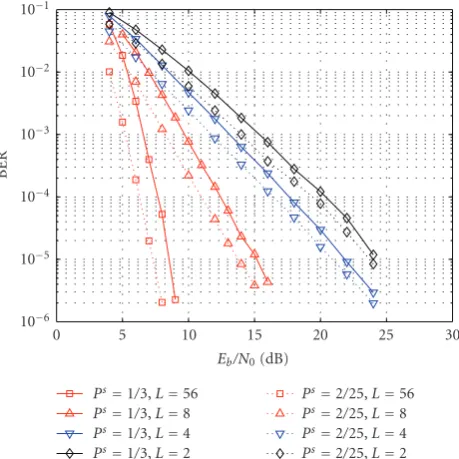
When the source-destination path does not exist, the performance of distributed GLD codes with two power allocation schemes is compared in Figure 13. It is seen that the UPA strategy with Ps = 2P/25 can improve the performance over the scheme withPs=P/3 when the system has the same number of relays. Furthermore, for different relay numberL, the improvement gaps of the UPA strategy are all about 1.3 dB at a BER of 10−5.
When the source-destination path is included, the BER performance of distributed GLD codes with two different power allocation strategies is compared in Figure 14. It is very interesting that when Lis small, such as 2 and 4, the UPA scheme suffers performance loss compared with the scheme with Ps = P/3. However, when L is large, such
30 25 20 15 10 5
0
Eb/N0(dB)
10−6
10−5
10−4
10−3
10−2
10−1
BER
Ps=1/3,L=56
Ps=1/3,L=8
Ps=1/3,L=4
Ps=1/3,L=2
Ps=2/25,L=56
Ps=2/25,L=8
Ps=2/25,L=4
Ps=2/25,L=2
Figure 13: Performance comparison between the two power
allocation schemes without source-destination path.
30 25
20 15
10 5
Eb/N0(dB)
10−6
10−5
10−4
10−3
10−2
10−1
BER
Ps=1/3,L=56
Ps=1/3,L=14
Ps=1/3,L=8
Ps=1/3,L=4
Ps=1/3,L=2
Ps=2/25,L=56
Ps=2/25,L=14
Ps=2/25,L=8
Ps=2/25,L=4
Ps=2/25,L=2
Figure 14: Performance comparison between the two power
allocation schemes with source-destination path.
as 14 and 56, the UPA scheme contrarily exhibits better performance compared with the scheme withPs=P/3. This may be because whenLis small, the UPA scheme lowers the effectiveness of the diversity due to the source-destination path while it enforces the effectiveness of relays for large L
5. CONCLUSION
Distributed generalized low-density codes are constructed for multiple relay cooperative communications. The pro-posed scheme can adapt well to the variation of the relay number in the wireless relay network while the overall code rate of the system is fixed. In the scheme, each relay is responsible for forwarding one or several constituent codes of the GLD code, thus the complexity and power consumption of each relay node are quite limited. Moreover, a progressive decoding strategy is proposed for relay nodes to further reduce the complexity and adapt to the source-relay channel variations. At the destination, the soft information is first combined and then iterative decoding is performed for GLD codes to achieve the coding gain and diversity gain. The significant performance improvements have also been verified by simulations over quasistatic fading channels.
In the future, the performance can still be further improved by allocating constituent codes and transmit power elaborately to different relay nodes considering their distance to the destination and channel variations.
ACKNOWLEDGMENTS
The authors thank the editors and reviewers for their valu-able comments and suggestions. This work was supported by National Basic Research Program of China (2007CB310604) and NSFC (60772108).
REFERENCES
[1] A. Sendonaris, E. Erkip, and B. Aazhang, “Increasing uplink capacity via user cooperation diversity,” inProceedings of IEEE International Symposium on Information Theory (ISIT ’98), p. 156, Cambridge, Mass, USA, August 1998.
[2] A. Sendonaris, E. Erkip, and B. Aazhang, “User cooperation diversity—part I: system description,”IEEE Transactions on Communications, vol. 51, no. 11, pp. 1927–1938, 2003. [3] A. Sendonaris, E. Erkip, and B. Aazhang, “User cooperation
diversity—part II: implementation aspects and performance analysis,”IEEE Transactions on Communications, vol. 51, no. 11, pp. 1939–1948, 2003.
[4] J. N. Laneman, G. W. Wornell, and D. N. C. Tse, “An efficient protocol for realizing cooperative diversity in wireless networks,” inProceedings of IEEE International Symposium on Information Theory (ISIT ’01), p. 294, Washington, DC, USA, June 2001.
[5] T. E. Hunter and A. Nosratinia, “Cooperation diversity through coding,” in Proceedings of IEEE International Sym-posium on Information Theory (ISIT ’02), p. 220, Lausanne, Switzerland, June-July 2002.
[6] T. E. Hunter and A. Nosratinia, “Diversity through coded cooperation,”IEEE Transactions on Wireless Communications, vol. 5, no. 2, pp. 283–289, 2006.
[7] J. Ezri and M. Gastpar, “On the performance of independently designed LDPC codes for the relay channel,” inProceedings of IEEE International Symposium on Information Theory (ISIT ’06), pp. 977–981, Seattle, Wash, USA, July 2006. [8] P. Razaghi and W. Yu, “Bilayer low-density parity-check codes
for decode-and-forward in relay channels,”IEEE Transactions on Information Theory, vol. 53, no. 10, pp. 3723–3739, 2007.
[9] A. Chakrabarti, A. de Baynast, A. Sabharwal, and B. Aazhang, “Low density parity check codes for the relay channel,”IEEE Journal on Selected Areas in Communications, vol. 25, no. 2, pp. 280–291, 2007.
[10] B. Zhao and M. C. Valenti, “Distributed turbo coded diversity for relay channel,”Electronics Letters, vol. 39, no. 10, pp. 786– 787, 2003.
[11] M. C. Valenti and B. Zhao, “Distributed turbo codes: towards the capacity of the relay channel,” inProceedings of the 58th IEEE Vehicular Technology Conference (VTC ’03), vol. 1, pp. 322–326, Orlando, Fla, USA, October 2003.
[12] Y. Li, B. Vucetic, T. F. Wong, and M. Dohler, “Distributed turbo coding with soft information relaying in multihop relay networks,”IEEE Journal on Selected Areas in Communications, vol. 24, no. 11, pp. 2040–2050, 2006.
[13] R. G. Gallager,Low-Density Parity-Check Codes, MIT Press, Cambridge, Mass, USA, 1963.
[14] K. Azarian, H. El Gamal, and P. Schniter, “On the achievable diversity-multiplexing tradeoff in half-duplex cooperative channels,”IEEE Transactions on Information Theory, vol. 51, no. 12, pp. 4152–4172, 2005.
[15] A. K. Sadek, W. Su, and K. J. R. Liu, “Clustered cooperative communications in wireless networks,” inProceedings of IEEE Global Telecommunications Conference (GLOBECOM ’05), vol. 3, pp. 1–5, St. Louis, Mo, USA, November-December 2005. [16] D. Divsalar and F. Pollara, “Multiple turbo codes,” in
Proceedings of IEEE Military Communications Conference (MILCOM ’95), vol. 1, pp. 279–285, San Diego, Calif, USA, November 1995.
[17] R. M. Tanner, “A recursive approach to low complexity codes,”
IEEE Transactions on Information Theory, vol. 27, no. 5, pp. 533–547, 1981.
[18] M. Lentmaier and K. S. Ziganfirov, “Iterative decoding of generalized low-density parity-check codes,” in Proceedings of IEEE International Symposium on Information Theory (ISIT ’98), p. 149, Cambridge, Mass, USA, August 1998. [19] J. Boutros, O. Pothier, and G. Zemor, “Generalized low
density (Tanner) codes,” inProceedimgs of IEEE International Conference on Communications (ICC ’99), vol. 1, pp. 441–445, Vancouver, Canada, June 1999.
[20] O. Pothier, L. Brunel, and J. Boutros, “A low complexity FEC scheme based on the intersection of interleaved block codes,” inProceedings of the 49th IEEE Vehicular Technology Conference (VTC ’99), vol. 1, pp. 274–278, Houston, Tex, USA, May 1999. [21] M. Yuksel and E. Erkip, “Diversity-multiplexing tradeoffin cooperative wireless systems,” inProceedings of the 40th Annual Conference on Information Sciences and Systems (CISS ’06), pp. 1062–1067, Princeton, NJ, USA, March 2007.
[22] L. Bahl, J. Cocke, F. Jelinek, and J. Raviv, “Optimal decoding
of linear codes for minimizing symbol error rate,” IEEE
Transactions on Information Theory, vol. 20, no. 2, pp. 284– 287, 1974.
[23] T. Matsumoto, “Decoding performance of linear block codes using a trellis in digital mobile radio,”IEEE Transactions on Vehicular Technology, vol. 39, no. 1, pp. 68–74, 1990.
[24] X. Li, T. F. Wong, and J. M. Shea, “Performance analysis for collaborative decoding with least-reliable-bits exchange on AWGN channels,”IEEE Transactions on Communications, vol. 56, no. 1, pp. 58–69, 2008.