R E S E A R C H
Open Access
Stability of numerical solution for partial
differential equations with piecewise
constant arguments
Qi Wang
**Correspondence:
School of Applied Mathematics, Guangdong University of Technology, Guangzhou, China
Abstract
In this paper, the numerical stability of a partial differential equation with piecewise constant arguments is considered. Firstly, the
θ
-methods are applied to approximate the original equation. Secondly, the numerical asymptotic stability conditions are given when the mesh ratio and the corresponding parameter satisfy certain conditions. Thirdly, the conditions under which the numerical stability region contains the analytic stability region are also established. Finally, some numerical examples are given to demonstrate the theoretical results.MSC: 65L07; 65L20
Keywords: Partial differential equation; Piecewise constant arguments;
θ
-methods; Stability1 Introduction
Recently, differential equations with piecewise constant arguments (EPCA) have received much attention from a number of investigators [1–5] in such various fields as population dynamics, physics, mechanical systems, control science and economics. The theory of EPCA was initiated in 1983 and 1984 with the contributions of Cooke and Wiener [6], Shah and Wiener [7], Wiener [8], and it has been developed by many authors [9–13]. In 1993, Wiener, pioneer of EPCAs, recollects in the book [14] the investigation of EPCA until that moment. Later, continuous efforts have been made devoted to considering various properties of EPCA [15–18].
Generally speaking, in many cases analytic solutions of EPCA are hard to achieve and we are forced to use numerical methods to approximate them. Nevertheless, compared with the qualitative investigation of EPCA, the numerical study of EPCA is very late and rare. The original work for this field should be attributed to Liu et al. [19]. We think that it is the key step toward solving EPCA by numerical methods. Next, several results about the convergence, the stability and the dissipativity of numerical solutions for EPCA have been reported [20–24]. However, all of them are based on ordinary differential equations (ODEs). To the best of the author’s knowledge, only few results were presented in the case of numerical treatment of partial differential equations with piecewise constant arguments (PEPCA) [25, 26]. In these two articles, the authors investigated the numerical stability of
θ-methods and Galerkin methods for a simple PEPCA, respectively. In contrast to [25,
26], in the present paper we study a more complicated model and analyze the numerical stability.
In this paper, we consider the following initial boundary value problem (IBVP): ⎧
For the sake of the coming discussion, we derive the following stability conditions of (1) by using the similar method in [27, 28].
Lemma 1 If the following conditions are satisfied: ⎧
then the zero solution of the equation in(1)is asymptotically stable.
2 The stability of the numerical solution
In this section, we consider the numerical asymptotic stability ofθ-methods for (1).
2.1 The difference equation
Lett> 0 andx> 0 be time and spatial stepsizes, respectively. We also assume thatt satisfiest= 1/m, wherem≥1 is an integer, andxsatisfiesx= 1/pforp∈N. Define the mesh points
tn=nt, n= 0, 1, 2, . . . ,
and
xi=ix, i= 0, 1, 2, . . . ,p.
whereuni,uh(x
Basically, in each interval [n,n+ 1), the equation in (1) can be seen as an original PDE, so theθ-methods for (1) are convergent ofO(t+x2) ifθ= 1/2, ofO(t2+x2) ifθ= 1/2. A more detailed analysis on the convergence of theθ-methods can be found in [30, 31].
whenkis even, and ⎧
⎨ ⎩
(I +a2θrF)ukm+l+1= (I –a2(1 –θ)rF)ukm+l–brFukm–crFu(k+1)m,
u0= v(x), (9)
whenkis odd.
2.2 Stability analysis From (8), we obtain
ukm+l+1= Rukm+l+ Sukm, (10)
where
R=I+a2θrF –1I–a2(1 –θ)rF ,
S= –(b+c)rI+a2θrF –1F.
By (9), we also obtain
ukm+l+1= Rukm+l+ S1ukm+ S2u(k+1)m, (11)
where
R=I+a2θrF –1I–a2(1 –θ)rF ,
S1= –br
I+a2θrF –1F,
S2= –cr
I+a2θrF –1F.
Iteration of (10) gives
ukm+l+1=Rl+1+Rl+1– I (R – I)–1S ukm, (12)
in the same way, from (11) we have
ukm+l+1=Rl+1+Rl+1– I (R – I)–1S1 ukm+
Rl+1– I (R – I)–1S2u(k+1)m. (13)
Thus we get
un= ⎧ ⎪ ⎪ ⎨ ⎪ ⎪ ⎩
(Rl+ (Rl– I)(R – I)–1S)ukm, kis even,
(Rl+ (Rl– I)(R – I)–1S 1)ukm
+ (Rl– I)(R – I)–1S
2u(k+1)m, kis odd.
(14)
So
un= ⎧ ⎪ ⎪ ⎨ ⎪ ⎪ ⎩
(Rl+ (Rl– I)(R – I)–1S)u2jm, n= 2jm+l,
(Rl+ (Rl– I)(R – I)–1S
1)u(2j–1)m
+ (Rl– I)(R – I)–1S2u2jm, n= (2j– 1)m+l.
Letl=m– 1 in (15) gives ⎧
⎨ ⎩
u(2j+1)m= (Rm+ (Rm– I)(R – I)–1S)u2jm, j= 0, 1, . . . ,
u2jm= (I – (Rm– I)(R – I)–1S
2)–1(Rm+ (Rm– I)(R – I)–1S1)u(2j–1)m, j= 1, 2, . . . .
Hence we have u(2j+1)m= Mu(2j–1)m, where
M=Rm+Rm– I (R – I)–1S Rm+Rm– I (R – I)–1S1 I–
Rm– I (R – I)–1S2 –1.
Therefore
un= ⎧ ⎪ ⎪ ⎨ ⎪ ⎪ ⎩
(Rl+ (Rl– I)(R – I)–1S)Mju0, n= 2jm+l,j= 0, 1, . . . ,
(Rl+ (Rl– I)(R – I)–1S1)Mj–1u1
+ (Rl– I)(R – I)–1S
2NMju0, n= (2j– 1)m+l,j= 1, 2, . . . ,
(16)
where u1= Nu0, N = Rm+ (Rm– I)(R – I)–1Sandl= 0, 1, . . . ,m– 1.
Lemma 2 If the coefficients a,b and c satisfy
βm+ab2(βm– 1) 1 –ac2(βm– 1)
< 1 (17)
and
βm+b+c a2
βm– 1 < 1, (18)
then the zero solution of the equation in(3)is asymptotically stable,where
β=1 –a
2(1 –θ)rλ F
1 +a2θrλ F
. (19)
Proof From (16) and [25], we know that the largest eigenvalue (in modulus) of the matrix
Mis
λM=
(βm+ b
a2(βm– 1))(βm+ba+2c(βm– 1)) 1 –ac2(βm– 1)
,
whereβis defined in (19). The zero solution of the equation in (3) is asymptotically stable if and only if|λM|< 1. So (17) and (18) are got.
Theorem 1 Under the conditions of Lemma2,if the conditions
a2+b+c βm– 1 a2+b–c βm–b–a2–c < 0 (20)
and
are satisfied,where c=a2/(βm– 1),a= 0,then the zero solution of the equation in(3)is
asymptotically stable.
Proof Ifa= 0, (17) and (18) are equivalent to
βm+ b
a2(βm– 1) 1 –ac2(βm– 1)
+ 1
βm+ b
a2(βm– 1) 1 –ac2(βm– 1)
– 1
< 0
and
βm+b+c a2
βm– 1 + 1
βm+b+c a2
βm– 1 – 1
< 0.
After some derivations we can get (20) and (21). The proof is completed.
Definition 1 The set of all points (a,b,c) which satisfies (2) is called an asymptotic stabil-ity region denoted byH.
Definition 2 The set of all points (a,b,c) at which theθ-methods for (1) which satisfies (20) is asymptotically stable is called an asymptotic stability region denoted byS.
For convenience, we divide the regionHinto three parts:
H0=
(a,b,c)∈H:a2+b+c a2+b–c = 0,
H1=
(a,b,c)∈H:a2+b+c a2+b–c > 0,
H2=
(a,b,c)∈H:a2+b+c a2+b–c < 0.
In the similar way, we denote
S0=
(a,b,c)∈S:a2+b+c a2+b–c = 0,
S1=
(a,b,c)∈S:a2+b+c a2+b–c > 0,
S2=
(a,b,c)∈S:a2+b+c a2+b–c < 0.
It is easy to see thatH=H0∪H1∪H2,S=S0∪S1∪S2,Hi∩Hj=,Si∩Sj=and
Hi∩Sj=,i=j,i,j= 0, 1, 2.
Theorem 2 Under the constraints
b–a2–c
b+a2–c≤0 (22)
and
b–a2+c
b+a2+c≤0, (23)
r= 1/(a2λ
F(1 –θ))and
⎧ ⎨ ⎩
r<min 2
a2λ
F(1–2θ), 0≤θ< 1/2, r> 0, 1/2≤θ≤1,
(24)
for m is even,and
r<min 1
a2λF(1 –θ), (25)
for m odd,then H1⊆S1.
Proof By the definition ofH1we know that (2) is satisfied when (22) and (23) hold. In the
same way, according to the definition ofS1we know that (20) is satisfied when (22) and
(23) hold and 0 <βm< 1, whereβis defined in (19), then we can getH1⊆S1. Therefore,
(24) and (25) can be obtained from 0 <βm< 1. The proof is completed.
Theorem 3 Under the constraints
b–a2–c
b+a2–c≥1 (26)
and
b–a2+c
b+a2+c≤0, (27)
if the following conditions are satisfied: r= 1/(a2λ
F(1 –θ))and
⎧ ⎨ ⎩
r<min 2
a2λ
F(1–2θ), 0≤θ< 1/2, r> 0, 1/2≤θ≤1,
for m even,and
r<min 1
a2λ F(1 –θ)
,
for m odd,then H2⊆S2.
Proof Similar to the proof of Theorem 2, we can omit it.
Theorem 4 Under the constraints
b+a2–c
b+a2+c= 0, (28)
b–a2–c
and
b–a2+c
b+a2+c≤0, (30)
if the following conditions are satisfied: r= 1/(a2λ
F(1 –θ))and
⎧ ⎨ ⎩
r<min 2
a2λ
F(1–2θ), 0≤θ< 1/2, r> 0, 1/2≤θ≤1,
for m even,and
r<min 1
a2λF(1 –θ),
for m odd,then H0⊆S0.
Proof Follows directly from the proof of Theorem 2.
Remark 1 Ifθ= 1, then the corresponding fully implicit finite difference scheme is
asymp-totically stable unconditionally.
3 Numerical experiments
To demonstrate our theoretical result, some numerical examples are adopted in this sec-tion. Consider the following two problems:
⎧ ⎪ ⎪ ⎨ ⎪ ⎪ ⎩
ut(x,t) =uxx(x,t) +12uxx(x, [t]) +14uxx(x, 2[t+12 ]), t> 0,
u(0,t) =u(1,t) = 0,
u(x, 0) =sin(πx),
(31)
⎧ ⎪ ⎪ ⎨ ⎪ ⎪ ⎩
ut(x,t) =uxx(x,t) – 2uxx(x, [t]) + 2uxx(x, 2[t+12 ]), t> 0,
u(0,t) =u(1,t) = 0,
u(x, 0) =sin(πx).
(32)
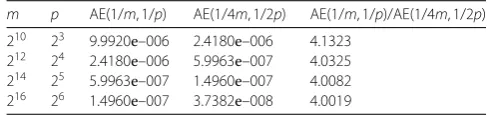
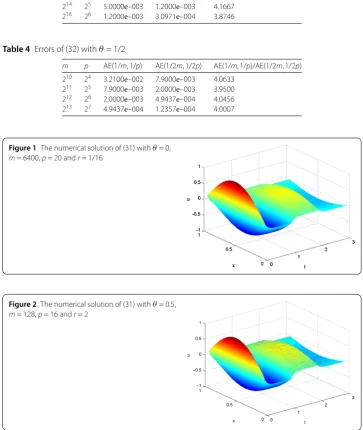
In Tables 1–4 we list the absolute errorsAE(1/m, 1/p),AE(1/4m, 1/2p) andAE(1/2m, 1/2p) atx= 1/2,t= 1 of theθ-methods for (31) and (32), the ratio ofAE(1/m, 1/p) over AE(1/4m, 1/2p) in Tables 1, 3 and the ratio ofAE(1/m, 1/p) overAE(1/2m, 1/2p) in Ta-bles 2, 4. We can see from these taTa-bles that the numerical methods conserve their orders of convergence.
Table 1 Errors of (31) withθ= 0
m p AE(1/m, 1/p) AE(1/4m, 1/2p) AE(1/m, 1/p)/AE(1/4m, 1/2p) 210 23 9.9920e–006 2.4180e–006 4.1323
Table 2 Errors of (31) withθ= 1/2
m p AE(1/m, 1/p) AE(1/2m, 1/2p) AE(1/m, 1/p)/AE(1/2m, 1/2p) 210 24 3.8741e–006 9.5800e–007 4.0439
211 25 9.5800e–007 2.3885e–007 4.0109 212 26 2.3885e–007 5.9671e–008 4.0028 213 27 5.9671e–008 1.4915e–008 4.0007
Table 3 Errors of (32) withθ= 0
m p AE(1/m, 1/p) AE(1/4m, 1/2p) AE(1/m, 1/p)/AE(1/4m, 1/2p) 210 23 8.2800e–002 2.0000e–002 4.1400
212 24 2.0000e–002 5.0000e–003 4.0000 214 25 5.0000e–003 1.2000e–003 4.1667 216 26 1.2000e–003 3.0971e–004 3.8746
Table 4 Errors of (32) withθ= 1/2
m p AE(1/m, 1/p) AE(1/2m, 1/2p) AE(1/m, 1/p)/AE(1/2m, 1/2p) 210 24 3.2100e–002 7.9000e–003 4.0633
211 25 7.9000e–003 2.0000e–003 3.9500 212 26 2.0000e–003 4.9437e–004 4.0456 213 27 4.9437e–004 1.2357e–004 4.0007
Figure 1The numerical solution of (31) withθ= 0,
m= 6400,p= 20 andr= 1/16
Figure 2The numerical solution of (31) withθ= 0.5,
m= 128,p= 16 andr= 2
Figure 3The numerical solution of (32) withθ= 0,
m= 6400,p= 20 andr= 1/16
Figure 4The numerical solution of (32) with
θ= 0.5,m= 128,p= 16 andr= 2
Figure 5Errors of (31) withθ= 1,m= 1024,p= 32 andr= 1
Acknowledgements
The author is grateful to the reviewers for their careful reading and useful comments. This work is supported by the National Natural Science Foundation of China (No. 11201084) and Natural Science Foundation of Guangdong Province (No. 2017A030313031).
Competing interests
The author declares that he has no competing interests.
Authors’ contributions
The author read and approved the final manuscript.
Publisher’s Note
Springer Nature remains neutral with regard to jurisdictional claims in published maps and institutional affiliations. Received: 4 October 2017 Accepted: 2 February 2018
References
1. Cavalli, F., Naimzada, A.: A multiscale time model with piecewise constant argument for a boundedly rational monopolist. J. Differ. Equ. Appl.22, 1480–1489 (2016)
2. Dai, L., Fan, L.: Analytical and numerical approaches to characteristics of linear and nonlinear vibratory systems under piecewise discontinuous disturbances. Commun. Nonlinear Sci. Numer. Simul.9, 417–429 (2004)
3. Dai, L., Singh, M.C.: On oscillatory motion of spring-mass systems subjected to piecewise constant forces. J. Sound Vib.173, 217–232 (1994)
4. Gurcan, F., Bozkurt, F.: Global stability in a population model with piecewise constant arguments. J. Math. Anal. Appl. 360, 334–342 (2009)
5. Wiener, J., Lakshmikantham, V.: A damped oscillator with piecewise constant time delay. Nonlinear Stud.1, 78–84 (2000)
6. Cooke, K.L., Wiener, J.: Retarded differential equations with piecewise constant delays. J. Math. Anal. Appl.99, 265–297 (1984)
7. Shah, S.M., Wiener, J.: Advanced differential equations with piecewise constant argument deviations. Int. J. Math. Math. Sci.6, 671–703 (1983)
8. Wiener, J.: Differential equations with piecewise constant delays. In: Lakshmikantham, V. (ed.) Trends in the Theory and Practice of Nonlinear Differential Equations, pp. 547–580. Dekker, New York (1983)
9. Akhmet, M.U., Arugˇaslan, D., Yılmaz, E.: Stability in cellular neural networks with a piecewise constant argument. J. Comput. Appl. Math.233, 2365–2373 (2010)
10. Bereketoglu, H., Seyhan, G., Ogun, A.: Advanced impulsive differential equations with piecewise constant arguments. Math. Model. Anal.15, 175–187 (2010)
11. Karakoc, F.: Asymptotic behaviour of a population model with piecewise constant argument. Appl. Math. Lett.70, 7–13 (2017)
12. Muroya, Y.: New contractivity condition in a population model with piecewise constant arguments. J. Math. Anal. Appl.346, 65–81 (2008)
13. Pinto, M.: Asymptotic equivalence of nonlinear and quasi linear differential equations with piecewise constant arguments. Math. Comput. Model.49, 1750–1758 (2009)
14. Wiener, J.: Generalized Solutions of Functional Differential Equations. World Scientific, Singapore (1993)
15. Berezansky, L., Braverman, E.: Stability conditions for scalar delay differential equations with a non-delay term. Appl. Math. Comput.250, 157–164 (2015)
16. Dimbour, W.: Almost automorphic solutions for differential equations with piecewise constant argument in a Banach space. Nonlinear Anal.74, 2351–2357 (2011)
17. El Raheem, Z.F., Salman, S.M.: On a discretization process of fractional-order logistic differential equation. J. Egypt. Math. Soc.22, 407–412 (2014)
18. Muminov, M.I.: On the method of finding periodic solutions of second-order neutral differential equations with piecewise constant arguments. Adv. Differ. Equ.2017, 336 (2017)
19. Liu, M.Z., Song, M.H., Yang, Z.W.: Stability of Runge–Kutta methods in the numerical solution of equation
u(t) =au(t) +a0u([t]). J. Comput. Appl. Math.166, 361–370 (2004)
20. Li, C., Zhang, C.J.: Block boundary value methods applied to functional differential equations with piecewise continuous arguments. Appl. Numer. Math.115, 214–224 (2017)
21. Milosevic, M.: The Euler–Maruyama approximation of solutions to stochastic differential equations with piecewise constant arguments. J. Comput. Appl. Math.298, 1–12 (2016)
22. Song, M.H., Liu, X.: The improved linear multistep methods for differential equations with piecewise continuous arguments. Appl. Math. Comput.217, 4002–4009 (2010)
23. Wang, W.S., Li, S.F.: Dissipativity of Runge–Kutta methods for neutral delay differential equations with piecewise constant delay. Appl. Math. Lett.21, 983–991 (2008)
24. Zhang, G.L.: Stability of Runge–Kutta methods for linear impulsive delay differential equations with piecewise constant arguments. J. Comput. Appl. Math.297, 41–50 (2016)
25. Liang, H., Liu, M.Z., Lv, W.J.: Stability ofθ-schemes in the numerical solution of a partial differential equation with piecewise continuous arguments. Appl. Math. Lett.23, 198–206 (2010)
26. Liang, H., Shi, D.Y., Lv, W.J.: Convergence and asymptotic stability of Galerkin methods for a partial differential equation with piecewise constant argument. Appl. Math. Comput.217, 854–860 (2010)
27. Wang, Q., Wen, J.C.: Analytical and numerical stability of partial differential equations with piecewise constant arguments. Numer. Methods Partial Differ. Equ.30, 1–16 (2014)
29. Song, M.H., Liu, M.Z.: Numerical stability and oscillations of the Runge–Kutta methods for the differential equations with piecewise continuous arguments of alternately retarded and advanced type. J. Inequal. Appl.2012, 290 (2012) 30. Blanco-Cocom, L., Àvila-Vales, E.: Convergence and stability analysis of theθ-method for delayed diffusion
mathematical models. Appl. Math. Comput.231, 16–25 (2014)