1
T
HEL
ONDONS
CHOOL OFE
CONOMICS ANDP
OLITICALS
CIENCEThe Public Value Notion in UK Public Service
Broadcasting
–
An Analysis of the Ideological Justification of Public
Service Broadcasting in the Context of Evolving Media
Policy Paradigms
Eva Marie Knoll
A thesis submitted to the Department of Media and Communications of the London School of Economics for the degree of Doctor of Philosophy,
2
Declaration
I certify that the thesis I have presented for examination for the MPhil/PhD degree of the London School of Economics and Political Science is solely my own work other than where I have clearly indicated that it is the work of others (in which case the extent of any work carried out jointly by me and any other person is clearly identified in it).
The copyright of this thesis rests with the author. Quotation from it is permitted, provided that full acknowledgement is made. This thesis may not be reproduced without the prior written consent of the author.
I warrant that this authorization does not, to the best of my belief, infringe the rights of any third party.
3
Abstract
The thesis investigates the application of the public value notion in UK public service broadcasting (PSB). In the context of technological change from analogue to digital broadcasting and the reduction of applicable market failures, the notion has been used to describe the remit and assess the performance of PSB, thus providing sustained justification of PSB in the digital age.
The overall research interest is to investigate the public value notion in the context of evolving media policy paradigms to examine whether its institutionalisation represents a paradigm shift in the ideological justification of PSB. The ideological justification is investigated in the form of economic and non-economic regulatory rationales as different academic approaches to market intervention and public service provision.
As a fundamental type of policy change, the paradigm shift concept is operationalised by devising an analytical framework that consists of two analytical strands; an ideological shift and a policy process analysis.
Based on a case study approach of the notion’s application at the BBC and Channel 4, the research design employs interpretative textual analysis of documents and expert interviews to investigate the ideological composition of the public value notion and its wider policy process.
The research finds that no paradigm shift has taken place in the justification of PSB as the public value notion continues the overall more economic than non-economic focus of the incumbent media policy paradigm.
These findings contribute to media and public policy studies with regard to the understanding and classification of (media policy) paradigm shifts as a fundamental type of policy change and the use of economic and non-economic rationales as different ideologies in informing policy ideas and decisions-making in media policy.
4
Acknowledgements
5
Table of Contents
Declaration ... 2
Abstract ... 3
Acknowledgements ... 4
Table of Contents ... 5
List of Acronyms and Abbreviations ... 10
List of Tables and Figures ... 11
1. Introduction ... 12
1.1 The Public Value Notion and the Justification of Public Service Broadcasting: A Fundamental Shift in Ideology? ... 12
1.2 Public Value Management in Public Administration Theory ... 16
1.3 Ideological Shifts and Media Policy Paradigms ... 20
1.4 Paradigm Shifts as Fundamental Changes in Policy ... 24
1.5 Definition of Key Concepts, the Analytical Framework and the Research Questions ... 34
1.6 Chapter Outline ... 41
2. Regulatory Rationales Part I: Economic Approaches ... 43
2.1 The Role and Relevance of Economic and Non-Economic Rationales .... 43
2.2 Economic and Non-Economic Rationales: Introduction... 49
2.3 Regulatory Rationales in Economic Theory ... 52
2.3.1 Microeconomic Theory and Market Failure Rationales ... 52
Monopolies ... 53
Asymmetric Information ... 55
Public Goods ... 56
Externalities ... 57
Summary: Market Failures ... 59
2.3.2 Merit Goods and Behavioural Economics ... 61
6
3. Regulatory Theory Part II: Non-Economic Approaches and
Comparison ... 67
3.1 Non-Economic Rationales: Social, Cultural, Legal, and Political Approaches ... 67
3.1.1 Regulatory Rationales from Social and Cultural Studies ... 70
3.1.2 Regulatory Rationales from the Field of Law ... 70
3.1.3 Regulatory Rationales from Political Science... 72
3.1.4 Non-Economic Rationales and PSB Justification ... 74
3.2 Comparison of Economic and Non-Economic Rationales: Substantive and Procedural Characteristics ... 75
3.3 Conclusion: Economic and Non-Economic Rationales ... 85
4. Theories on Influence Factors and Influence Taking in Policy-Making ... 87
4.1 Influence Factors in Policy-Making: Interest Theories and Neo- Institutional Approaches ... 89
4.1.1 Public and Private Interest Theories ... 90
4.1.1.1 Public Interest Theories ... 90
4.1.1.2 Private and Group Interest Theories ... 91
4.1.2 Neo-Institutional Approaches ... 93
4.1.2.1 Rational Choice Neo-Institutionalism ... 96
4.1.2.2 Historical Neo-Institutionalism ... 97
4.1.2.3 Sociological Neo-Institutionalism ... 98
4.2 Non-market Strategy: Policy Ideas and Policy Environments ... 103
4.3 The Conceptual Framework ... 107
5. The UK Broadcasting Ecology: The Public Value Notion and the History of Evolving Media Policy Paradigms... 111
5.1 The First Media Policy Paradigm: Early 20th Century until 1940s ... 111
5.2 The Second Media Policy Paradigm: 1945 until 1980s ... 113
5.3 The Third Media Policy Paradigm: 1980s until 2000 ... 117
5.4 The Contemporary Context and the Research Interest: Emergence of a New PSB Policy Paradigm? ... 128
7
6. Research Design ... 134
6.1 A Comparative Case Study Approach: Interpretative Policy Analysis and Epistemological Considerations ... 134
6.2 Component Analysis: Ideological Classification of the Public Value Notion ... 137
6.2.1 Document Analysis ... 138
6.2.2 Analytical Steps: Sampling, Data Collection and Analysis ... 139
6.2.2.1 Sampling ... 140
6.2.2.2 Data Collection and Analysis ... 143
First Analytical Step: Data collection and reduction ... 144
Second Analytical Step: Data analysis, classification, and interpretation ... 146
6.3 Contextual Analysis: The Public Value Notion and the wider Policy Change Process ... 147
6.3.1 Expert Interviews ... 149
6.3.2 Data Collection: Selecting Interviewees, Preparing the Questionnaire, and Conducting Interviews ... 150
Identifying and Contacting Interviewees ... 150
The Questionnaire ... 152
Conducting the Interviews ... 153
6.3.3 Data Analysis: Thematic Content Analysis ... 153
Step 1: Interview Transcription ... 153
Step 2: Thematic Analysis ... 153
Step 3: Interpretation and Presentation of Findings ... 155
6.4 Integration of Findings ... 157
7. Comparative Component Analysis of the Public Value Notion – Part 1: BBC Case Study ... 158
7.1 Performance Assessments in Broadcasting ... 159
7.2 BBC Case Study: Public Value Component Analysis ... 162
7.2.1 The Regulatory Framework ... 162
7.2.2 Ideological Classification of Public Value Assessment Components ... 166
8
Cost & Value for Money ... 171
Quality & Distinctiveness ... 174
Impact ... 176
Fit with public purposes ... 185
7.2.3 Discussion and Conclusion: Ideological Composition and Regulatory Justification ... 187
8. Comparative Component Analysis of the Public Value Notion – Part 2: C4 Case Study ... 194
8.1 C4 Case Study: Public Value Component Analysis ... 194
8.1.1 Contextual Review: History and Recent Developments ... 194
8.1.2 Ideological Composition: Public Impact Assessments ... 200
Four Public Purposes: Nurture, Challenge, Champion, and Inspire ... 201
Impact & Scale: Viewer Impact, Output & Spend, Creative Economy Impact ... 207
8.1.3 Discussion and Conclusion ... 210
8.2 Comparison and Conclusion: Ideological Composition of the Public Value Notion ... 217
9. Public Value Process Analysis: Influence Factors and Process Characteristics ... 222
9.1 Phase One – Prior to the Institutionalisation of the Public Value Concept at the BBC ... 222
9.1.1 Nodal Point: The 1990s and the 1999 Davies Report ... 222
9.1.2 Nodal Point: The 2003 Communications Act ... 227
9.1.3 Parallel development: Assessment of Wider Societal Benefits ... 228
9.2 Phase Two – The Institutionalisation of Public Value at the BBC ... 230
9.2.1 Motivational Aspects: Adoption of the Public Value Notion at the BBC in 2004 ... 230
9.2.2 Parallel Development: Dissemination of the Public Value Notion and Existing Procedures and Methods ... 246
9.2.3 Parallel Development: Ofcom’s 2004 Public Service Television Broadcasting Review ... 249
9 9.3 Phase Three – After the Institutionalisation of the Public Value Notion
at the BBC ... 254
9.3.1 Motivational Aspects: Public Value Take-up at C4 ... 254
9.3.2 Parallel Development: The Diminishing Role of Public Value ... 259
9.4 Summary and Conclusion ... 260
10. Conclusion and Contribution ... 264
10.1 The Public Value Notion in UK PSB Justification – A Paradigm Shift? ... 266
10.2 Contribution and Outlook ... 271
Bibliography ... 277
Legislation and Policy Documents... 277
Monographs and Articles ... 288
Appendix A: The Public Value Test Process ... 310
Appendix B: Piloting and Methodological Reflexions ... 312
Appendix C: BBC Case Study – Aggregate Tables ... 314
Appendix D: C4 Case Study – Aggregate Tables ... 325
Appendix E: List of Interviewees ... 333
Appendix F: Interview Questionnaire ... 336
Appendix G: Interview Transcript ... 343
Appendix H: Analysed Documents (for chapter 9) ... 355
10
List of Acronyms and Abbreviations
BBC British Broadcasting Corporation CBA
CPUH
Cost-benefit analysis Cost Per User Hour C4
DCMS
Channel 4
Department for Culture, Media and Sport DNH Department for National Heritage
DTI Department of Trade and Industry DTT Digital Terrestrial Television GDS Gaelic Digital Service HDTV High Definition Television
HH Households
IBA Independent Broadcasting Authority ITA Independent Television Authority ITC Independent Television Commission ITV Independent Television
LV Local Video
MIA NPM
Market Impact Assessment New Public Management
OD On-Demand
OPA Old Public Administration PSB Public Service Broadcasting PIA Public Impact Assessment PVA Public Value Assessment PVM Public Value Management PVT Public Value Test
TWF The Work Foundation
UK United Kingdom
VfM Value for money
11
List of Tables and Figures
Table 1.1: Comparison of Public Management Approaches ... 19
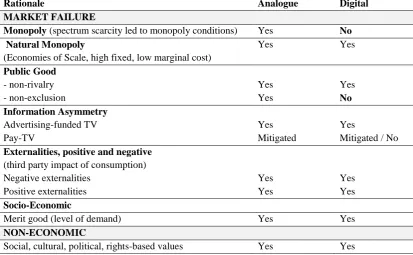
Table 3.1: Regulatory Rationales in Analogue and Digital Broadcasting ... 78
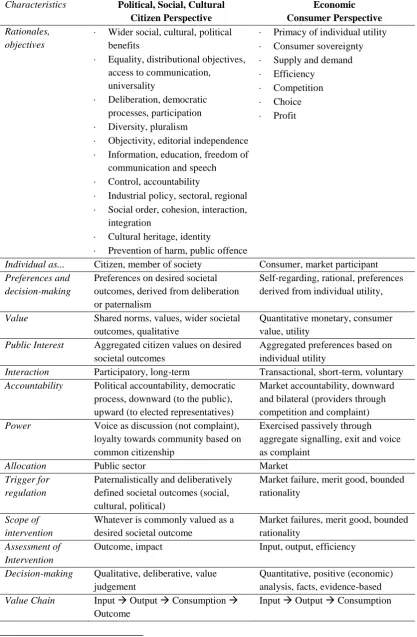
Table 3.2: Characteristics of Economic and Non-Economic Rationales ... 82
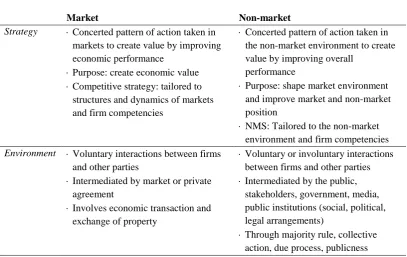
Table 4.1: Non-market and Market Strategy... 105
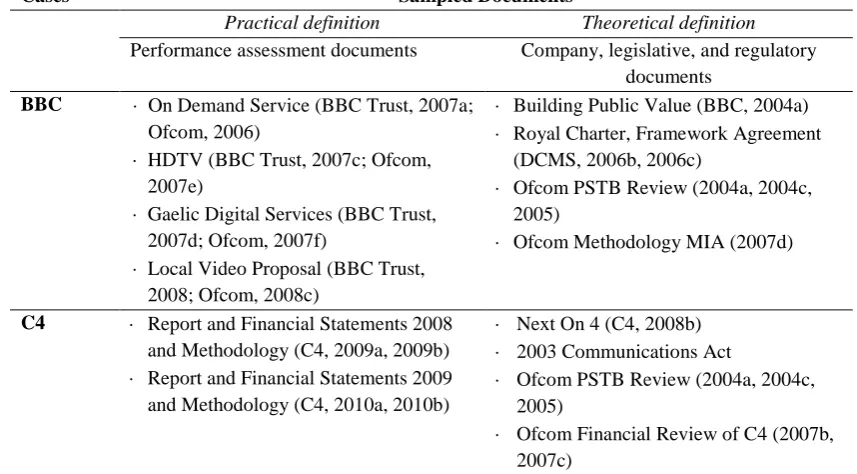
Table 6.1: Sampled Case Study Documents ... 142
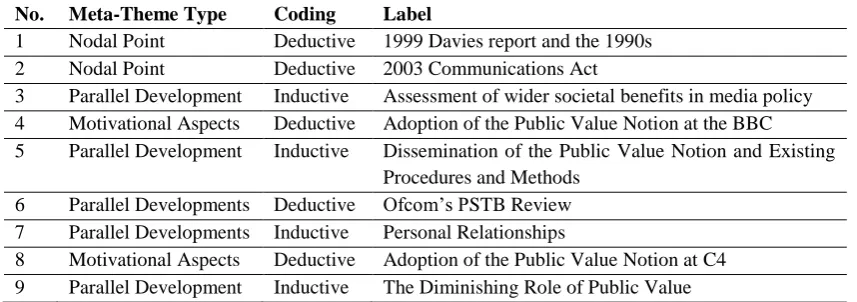
Table 6.2: Meta-Themes in Chronological Order ... 155
Table 7.1: MIA Standard Approach ... 165
Table 7.2: Public Value Tests ... 167
Table 7.3: BBC’s Six Public Purposes ... 178
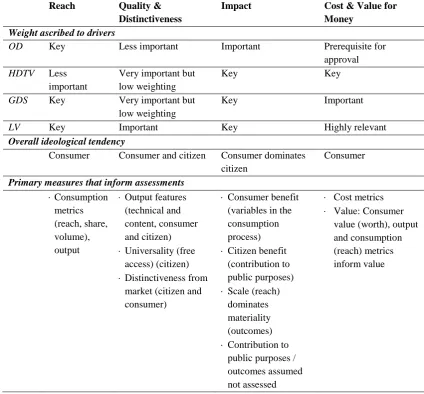
Table 7.4: Weighting and Ideological Classification of Public Value Drivers ... 189
Table 8.1: Generalized Classification of PIA Components ... 211
Table 8.2: Full Aggregate Table of the Assessment Component... 214
12
1.
I
NTRODUCTION1.1
The Public Value Notion and the Justification of Public Service
Broadcasting: A Fundamental Shift in Ideology?
Shortly after the commencement of the BBC’s Charter review in 2004, the corporation published a strategic document (BBC, 2004a) that set out its role for the digital age. The title ‘Building Public Value: Renewing the BBC for a digital world’ expressed the BBC’s future vision and declared objective of ‘public value creation’. The document further stated that the “BBC exists solely to create public value” (ibid., p. 28) and that “public value should be the goal for everything the BBC does” (ibid., p. 10). The public value notion therewith entered PSB policy discourse and the BBC’s Charter review, during which it was used heavily.
While the notion – at first sight – does not appear to be very different from the familiar concept of the public interest, it however seems to have another dimension to it, which is that of justifying public service broadcasting (PSB) provision. The concept was not only used discursively, it was also presented as a performance assessment and accountability tool that would inform decisions on the provision of new and significantly changed services. This tool, called the public value test (PVT), proposed to compare the public value a BBC service creates with the negative impact it has on the market. Only when the positive public value created outweighed the negative impact on the market should the service be provided. The test thus proposed the rationale of net public value to justify PSB service provision, which due to the corporation’s public funding represents an intervention into broadcasting markets.
13 lofty ambition, “Building Public Value” is at best a detour and at worst an obstacle on the journey to understanding how PSB might make sense in the digital age” (2004, p. 15).
Others, such as Collins, focus less on the notion’s instrumental use and more on its origin in public management theory (Moore, 1995). He states that even though the BBC’s application represents the first explicit UK engagement of public value doctrine, the concept is applied as a ‘quasi-regulatory’ principle while the term is used in its loose and literal sense of something valued by the public, rather than according to its public management origins (2006a, pp. 13, 56, 2007a, pp. 171-184, 2007b, p. 67).
The thesis builds on these considerations of the notion’s instrumental use and its public value management origin but goes beyond them by focussing on its role in regulation and the ideological justification of PSB.
The public value development seems to indicate that the concept’s application was more than a mere discursive public relations strategy devised for Charter review. Rather, it seems to be a deliberately and strategically crafted guiding or legitimising rationale for PSB provision that was intended to inform the justification of PSB in the new Charter – as it eventually did. The concept entered the regulatory practice of PSB provision with the inclusion in the BBC’s Royal Charter (DCMS, 2006b) and Framework Agreement (DCMS, 2006). Subsequently, it spread more widely in the PSB context. Channel 4 (C4) used it in its strategy review ‘Next on 4’ (2008b) and in the following years applied it as a public impact assessment (PIA) (C4, 2009a, 2010a) which had originally been called public value assessment.
Further, the notion spread outside of the UK to the European Commission. A so-called ex-ante test, which is based on the BBC’s PVT, was included in the revised Communication on State Aid for PSB (European Commission, 2009). Something similar to the PVT now has to be applied by all European member states for certain decisions on PSB service provision. While it is important to point to this wider diffusion of the notion, the study however only concerns the notion’s introduction and institutionalisation in the UK, thus excluding the later adoption of the concept in the EU.
14 importantly its inclusion in the Royal Charter indicate that some type or form of policy change has taken place. The interesting question which arises from this is why this change has taken place and what kind of change it was. Was the change fundamental or was it in the end only a well crafted publicity strategy that seemed to change much but in the end did not provide anything new?
The research assumption is that some kind of change took place that goes beyond a mere PR strategy. This view is based not only on the notion becoming a statutory concept through its inclusion in the BBC’s Royal Charter. Most importantly, the relevance of this development becomes evident when the concept is considered in the context of regulatory PSB justification and the use of different economic and non-economic ideological rationales.
The term ideology1 is here used to refer to different academic disciplines such as economic and non-economic approaches that provide rationales to justify regulatory intervention. Regulation2, as a type of public policy, here concerns the intervention into markets by providing the provision of public services in the form of PSB. Different academic disciplines and corresponding rationales provide different approaches to regulation that justify public service provision and market intervention.
The concept of market failure is for example an economic rationale that applied widely for analogue PSB provision (see chapter 2 for a detailed analysis). In the switch from analogue to digital service provision, changes however occurred to the applicability of market failure rationales, which were reduced considerably (see chapter 2). These technologically induced changes to market failure justification of PSB can be seen as a threat to the scale and scope of traditional PSB, as the justification derived from the remaining market failures can be used to argue for a reduced scope of PSB. The few remaining applicable market failures made it difficult to justify not only the sustained provision of the traditional scale of PSB but also the expansion of PSB provision into new digital services.
When the emergence of the public value notion is considered in this light, it seems as if the concept functioned as a policy idea and rationale to respond to
1 See Thomson, 1990; van Dijk, 1998 on a history of ideology and its diverse uses and understandings
from Carson et al., 2009, p. 15.
2
15 market failure turning from a legitimising to a de-legitimising rationale in the technological shift from analogue to digital broadcasting. This development resembles an externally induced crisis which created the need and the opportunity to devise a new, alternative rationale.
A central question which arises from this is whether the concept was indeed devised and introduced as a strategic policy idea to challenge market failure as the dominant ideology in PSB justification. This consequentially raises a further question of how exactly the concepts of market failure and public value differ from each other.
Central to these questions is the dichotomy of economic and non-economic ideologies as two key theoretical and empirical concepts that run through this study and define its research interest. Here, academic disciplines are grouped into these two categories of economic and non-economic approaches, with the latter comprising disciplines such as politics, sociology, cultural studies, and law. This binary grouping is done deliberately to reflect commonalities and differences between these disciplines.
In general and from a theoretical idealised point of view, it can be said that economic regulatory rationales, such as market failure, focus on markets and individuals as consumers while non-economic regulatory rationales, such as public value, focus on benefits to society and individuals as citizens. Similarly, these two approaches differ regarding the scale and scope of PSB intervention they justify. As rationales, they serve as normative and ideological frameworks or frames politicians, public officials, and institutions adopt to inform decision-making, perceive of policy problems, and devise solutions (Radaelli, 1995, p. 168; Surel, 2009, pp. 30, 33, 39).
This rather clear cut, simplistic and idealised distinction between economic and non-economic ideologies is made here to introduce them as two opposing ends on a spectrum of theoretical approaches to regulation and as the central research perspective from which the public value notion is approached. A more critical and nuanced perspective is given in chapters 2 and 3, which qualifies this simplistic view by showing that bridging concepts exist between these two approaches and that they are used much more loosely and incoherently in policy practice than in theory.
16 as understandings of individuals as consumers and citizens in theory and applied regulation. Market failure, as a theoretical concept from economic regulatory theory, focuses on the efficiency of markets and consumer benefits, while non-economic rationales, such a public value or public interest, focus on the wider benefit to society and citizens.
The central research interest of the thesis concerns the investigation of the public value development in this wider context of ideological PSB justification.
This is of particular interest as the notion was introduced at a time when (media) policy-making and regulation tended to be ideologically more favourable of or biased towards economic neo-liberal rationales than non-economic approaches (Born, 2008, 2004; Freedman, 2005, 2008a; Leys, 2001). While non-economic considerations have always had a prominent standing in PSB policy, in the 1980s and 1990s they seem to come secondary to economic considerations in informing regulation. This raises the question why and how the policy idea of the public value notion found wider acceptance in PSB policy.
In this context, the emergence of the public value notion is an interesting ideological development that raises the question whether it represents a change in the dominant ideology that informs PSB policy, from a more economic, market- and consumer-focused perspective of the 1990s towards wider societal and citizen considerations in the early 2000s.
In order to better understand the ideological background of the public value notion, the next section briefly reviews the notion’s origin in public management theory before a more direct connection is established between ideological shifts in media policy3 and policy paradigms.
1.2
Public Value Management in Public Administration Theory
Public value management (PVM) was introduced by US scholar Moore in his seminal book ‘Creating Public Value - Strategic Management in Government’ (1995). The approach postulates that public value creation should be the main objective of public managers, analogue to shareholder value maximization in the
17 private sector (Moore, 1995, p. 28). PVM was developed as a critique of and reaction to the previous public service approach New Public Management (NPM), which dominated since the 1980s and had in turn emerged as a response to shortcomings of its predecessor Old Public Administration (OPA).
OPA was characterised through a bureaucratic and paternalistic model of top-down service provision in the form of command and control (Stoker, 2006, pp. 43-45), executed by public officials supposed to act in the public interest. In reality, public organisations however tended to be dominated by the interests of public servants and providers (Stoker, 2006, p. 45).
As a post-bureaucratic approach, NPM critiqued the inefficiencies of OPA by taking a market-orientated approach that argued for increased consumer choice and the application of private sector management to operational targets like efficiency and cost reduction (Stocker, 2006, pp. 42, 45; Denhardt & Denhardt, 2000, pp. 549-551; O’Flynn, 2007, pp. 354-356; Talbot, 2009, p. 168; Bozeman, 2007, p. 69; Alford & Hughes, 2008, p. 134).
This in turn lead to NPM being criticized for pursuing economic targets at the expense of democratic processes and broader notions of public value with adverse effects on increased bureaucracy, accountability, and institutional complexity (Blaug et al., 2006a, pp. 6, 16; O‘Flynn, 2007, pp. 358, 363; Stewart, 2004, p. 16). Viewing individuals as customers rather than citizens raised concerns that market transaction-like conditions imposed on this relationship could cause depolitisation and consumerisation (Needham, 2003; Dunleavy et al., 2006, p. 467).
PVM therefore emerged as an alternative to incumbent NPM approaches. PVM focuses on public value creation for and together with the public through processes of deliberation and co-production. The determination, authorization, and evaluation of collective or public values through public deliberation and co-production creates accountability and legitimacy which is responsive to social changes and reduces hierarchical top down decision-making of previous approaches (Stoker, 2006, pp. 41, 47; O’Flynn, 2007, p. 361; Hills & Sullivan, 2006, pp. 9, 11, 21; Davis & West, 2009, p. 604 and van der Wal & van Hout, 2009 on public values).
18 2009, pp. 235, 238-240) for which the public values defined through deliberation and co-production differ according to policy and industry. Deliberative processes also function as means of judging outcome-based performance, which represents a shift away from input and output measures, processes and aggregation scores that were typical of NPM regimes (Stoker, 2006, pp. 47, 52; Needham, 2003, pp. 36, 38, 39; Hills & Sullivan, 2006, pp. 13, 11).
These operational elements are summarised in a “strategic triangle” which includes 1) public value as the overall mission, 2) support and legitimacy, and 3) operational capabilities (Moore, 1995, pp. 70-71; Moore & Khagram, 2004, pp. 2-3; Alford & O’Flynn, 2009, p. 173).
While not dismissing either but rather integrating both, a central characteristic of PVM is the re-emphasis of citizen representation over consumer and NPM objectives. This stands in contrast to the strong consumer focus of the previous NPM approach. Based on the pursuit of the twin goals of democracy and efficiency, Collins states that “a hard characterization of public value theory might describe it as NPM plus co-production” (2007b, pp. 7-8).
As a post-bureaucratic and post-competitive approach, PVM critiques the narrow utilitarian microeconomic assumptions of NPM and its lack of adequately addressing collective preferences (Stoker, 2006, p. 42; O’Flynn, 2007, p. 360). In contrast to its predecessors OPA and NPM, PVM provides a more holistic way of addressing public service goals as well as qualitative and quantitative performance.
19
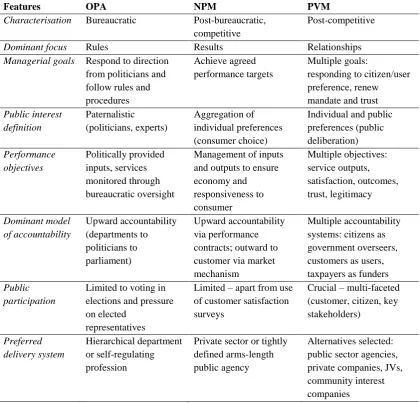
Table 1.1: Comparison of Public Management Approaches4
Features OPA NPM PVM
Characterisation Bureaucratic Post-bureaucratic,
competitive
Post-competitive
Dominant focus Rules Results Relationships
Managerial goals Respond to direction
from politicians and follow rules and procedures
Achieve agreed performance targets
Multiple goals:
responding to citizen/user preference, renew mandate and trust Public interest definition Paternalistic (politicians, experts) Aggregation of individual preferences (consumer choice)
Individual and public preferences (public deliberation) Performance objectives Politically provided inputs, services monitored through bureaucratic oversight
Management of inputs and outputs to ensure economy and responsiveness to consumer Multiple objectives: service outputs, satisfaction, outcomes, trust, legitimacy Dominant model of accountability Upward accountability (departments to politicians to parliament) Upward accountability via performance contracts; outward to customer via market mechanism
Multiple accountability systems: citizens as government overseers, customers as users, taxpayers as funders Public
participation
Limited to voting in elections and pressure on elected
representatives
Limited – apart from use of customer satisfaction surveys
Crucial – multi-faceted (customer, citizen, key stakeholders) Preferred delivery system Hierarchical department or self-regulating profession
Private sector or tightly defined arms-length public agency
Alternatives selected: public sector agencies, private companies, JVs, community interest companies
Regarding the research interest of the thesis, the notion’s original conceptualisation in public management theory indicates that the application of the public value concept in PSB policy – while representing both economic and non-economic rationales – puts more emphasis on citizen objectives, setting them above (or at par with) consumer representations.
This focus on non-economic rationales would stand in contrast to previous economic consumer- and market-focused approaches of the 1980s/90s. This raises the research question of whether the public value development represents a shift in the dominance from economic to non-economic rationales in PSB justification.
20 The policy change that has taken place with the institutionalisation of the public value notion in the BBC’s Charter and wider PSB practice therefore needs to be investigated with regard to the use of different economic and non-economic rationales in the justification of PSB provision. Broadly, this change can be described as a shift from correcting market failures to providing public value as an alternative rationale for PSB intervention.
In investigations of policy change, processes of ideological shifts are addressed by concepts such as policy paradigms and paradigm shifts. The next section therefore takes a closer look at studies of paradigm shifts in media (1.3) and public policy (1.4).
1.3
Ideological Shifts and Media Policy Paradigms
In policy studies, fundamental shifts in ideologies that inform policy-making are addressed through the concept of a paradigm shift. As the review in the next section shows, a paradigm shift is defined as a specific type of policy change that concerns the ideological level of policy-making – or more precisely, the underlying ideologies that inform policy-making in the form of policy goals, the perceived policy problems, and corresponding solutions.
As addressed before, the term ideology is defined and used to represent different academic disciplines which are grouped into two categories of economic and non-economic approaches. The analysis focuses on the different regulatory rationales of these disciplines that are used to justify regulatory intervention. Generally, it can be said that market failure represents an economic rationale, while public value is seen as a non-economic rationale for intervention.
The concepts of policy paradigms and paradigm shifts have also been used in studies of ideological changes in media policy by Van Cuilenburg and McQuail (2003), Jakubowicz (2011), and Pickard (2010).
21 Parliamentary Assembly of the Council of Europe: A debate about public service broadcasting (PSB) is in reality a debate about the philosophical, ideological and cultural underpinnings of society and about the role of the State and the public sector in meeting the needs of individuals and society as a whole (Parliamentary Assembly 2004: 10)5. This is well illustrated by the evolution of media policy paradigms (from the phase of emerging communication industry policy, to that of public service media policy, and, finally, to a new communication policy approach), prompted by shifts in the balance of component political, social, and economic values that shape the definition of the public interest that the media are normatively expected to serve (van Cuilenburg and McQuail 2003)” (Jakubowicz, 2011, p. 210).
Similarly, Pickard (2010) investigates the origins, ideological shifts and implications of media policy paradigms in the post war period in the United States by focussing on paradigmatic clashes and struggles between “social-democratic” and “libertarian” approaches to media regulation (pp. 174, 177). This ideological distinction corresponds to the one made here between economic and non-economic ideologies.
Of most interest and relevance for this study is the work of van Cuilenburg and McQuail (2003), who investigate different media policy paradigms of the 20th century for Western Europe and the US. They distinguish between three phases of media policy paradigms according to the importance ascribed to different ideologies in informing policy-making. With regard to ideologies, they develop a tripartite division of the public interest into political, social, and economic welfare (ibid., p. 184). These underlying ideologies are represented as component values that inform policy paradigms (ibid., p. 201). Those values which are more dominant in informing policy making (than other values) inform the overall paradigm.
Van Cuilenburg and McQuail’s (2003) first identified paradigm of an emerging communications industry lasted until 1945 and was informed through national strategic and technological interests. It was succeeded by the post-war paradigm of public service media policy which lasted until the 1970s and was ideologically informed by socio-political objectives, with PSB being at its height. The third and emerging paradigm commenced in the 1980s and is characterised
5
22 through the primacy of economic and technological rationales, supplemented by socio-cultural and communications values.
While van Cuilenburg and McQuail defined these three phases to reflect wider meta-developments in the EU, this succession of phases is also evident in UK media policy (see chapter 5). In the UK, the rather protective approach of the dual public-private broadcasting model that dominated until the late 1970s has in the 1980s been succeeded by a neo-liberal focus on market competition and deregulation under the Thatcher government, which continued throughout the 1990s. The deregulatory approach under Thatcher coincided with new technologies such as cable and satellite distribution that allowed increased channels and consumer choice. With this service proliferation, the consumer and market perspective was favoured over more traditional socio-political and societal objectives that had dominated until the end of the 1970s. This change in dominant ideology from the 1960s/70s to the 1980s/90s resembles the change from the second to the third phase described by van Cuilenburg and McQuail.
In this context of the third, predominantly economic paradigm informed by consumer objectives, market failure rationales and NPM approaches, the emergence of the public value notion seems to indicate a shift to non-economic citizen and wider societal objectives. The question then arises, whether the policy change that has take place with the institutionalisation of the public value notion, represents a fundamental paradigmatic shift in ideology.
As paradigm shifts indicate a fundamental or high degree of policy change, it is of general and specific interest for the policy area concerned to investigate such processes in detail. The central objective of such studies is to better understand these processes and in particular the distinction between policy changes and paradigm shifts, as the higher degree of change of the latter has a fundamental impact on policy outcomes and thus overall society.
The concept of a paradigm shift describes these changes in the relative importance of different ideologies in policy-making, i.e. economic, political, social, cultural approaches. In the context of media policy, these phases represent media policy paradigms.
23 exists. Rather, the classification given to a paradigm describes the type of values which are dominant in the overall hierarchy of values that inform policy-making over a certain period of time. Based on this understanding, paradigm shifts are consequentially shifts in the hierarchy of component values. As will be shown in the next section 1.4, this is also the general understanding of paradigms and paradigm shifts in public policy studies.
Another aspect which should briefly be addressed is that the understanding of paradigms represents policy practice or more precisely policy decision-making which has a direct impact on policy outcomes. Purely discursive changes in policy debate that do not translate into policy outcomes are not defined as paradigm shifts.
It can be summarised that the concept of media policy paradigms is a particularly suitable analytical framework to investigate the apparent ideological shift associated with the public value notion in UK PSB policy. Before taking a closer look at studies of paradigm shifts in policy analysis, some limitations of existing media policy paradigm studies should be addressed briefly.
While the three studies reviewed above consistently define media policy paradigms as being composed of different ideologies in the form of ideological component values, they do provide only little clarification on when exactly a paradigm shift has taken place. No definition is given of how a paradigm shift can be identified aside from the rather general statement that paradigm shifts are shifts in ideology. Van Cuilenburg and McQuail provide some further information as they address changes in the hierarchy of component values.
Beyond these views, the development of media policy paradigms as an analytical concept however remains rather limited. These shortcomings provide the opportunity to develop a clearer understanding of paradigms and paradigm shifts, their composition and how they come about for the specific context of media policy. These are central objectives of this research.
24 represents a central challenge of such investigations (Capano & Howlett, 2009, p. 4; Capano, 2009, p. 14).
In van Cuilenburg and McQuail’s (2003) case, another point of critique and also possible reason for a high degree of abstraction is their rather broad approach to study paradigm shifts for both Western Europe and the US. As media systems, they are considerably different which raises further questions about whether the three phases are indeed accurate and applicable across different countries and media types. Care therefore needs to be taken when the classification is applied to a specific media context. For the UK, these three phases do generally reflect the overall developments in PSB and media policy (see chapter 5). In addition, the previous review of public administration approaches also supports the ideological phases outlined by van Cuilenburg and McQuail. In this context, the application of the public value notion in contemporary PSB policy – given its origin as a successor of NPM approaches in public administration theory – supports the indication of an ideological shift. The evolution of media policy paradigms is addressed in more detail in chapter 5.
Despite these shortcomings, it can be summarised that the paradigm notion as well as van Cuilenburg and McQuail’s (2003) phases of media policy paradigms provide useful conceptual tools to study the policy change process associated with the public value notion in UK PSB. A central objective of this study is to address existing shortcoming by improving the understanding and analysis of media policy paradigms.
The next section reviews paradigm shift studies in public policy analysis to gain insights on the use of the paradigm concept as an analytical framework. The thesis is theoretically positioned in the context of both media policy and policy analysis, thus taking an industry-focused approach to policy and paradigm shift analysis.
1.4
Paradigm Shifts as Fundamental Changes in Policy
25 addresses the wider field of policy process analysis. Here, it concentrates on the use of policy ideas and ideologies in policy change and paradigm shift process, in particular how they take place and how they can be classified or identified.
The latter aspect of classifying policy change addresses paradigm shifts as a specific type of fundamental policy change. The public value notion is viewed as a policy idea that was introduced to facilitate such a policy change. The interest of the study focuses in particular on the use of different economic and non-economic ideologies in policy change and paradigm shift processes to investigate whether a paradigm shift has taken place.
The focus of the thesis and the review below are limited to the use of the paradigm notion in policy-making and in investigations of paradigm shifts as a specific type of fundamental policy change. Kuhn’s seminal work on paradigm shifts in the history of science (1962, 1970) is thus addressed only indirectly regarding its influence on policy studies.
To date, the central work is that of Hall (1993) who devised a three-tiered classification framework of policy change and paradigm shifts. As later shown in section 1.5, Hall’s classification provides the core of the analytical framework developed for this study.
Central studies on policy paradigm shifts, which are reviewed below, include those of Jenson (1989), Hall (1993), Coleman et al. (1996) and Carson (2008, et al. 2009). While focussing on slightly different aspects of the change process, it can generally be said that all studies share the view of paradigm shifts being defined as fundamental changes in the overarching ideologythat informs policy-making. The studies differ however regarding the attention they devote to the classification of paradigm shifts.
As one of the earlier studies of policy paradigms, Jenson (1989) investigates state policies regulating women’s behaviour in France and the US before 1914 and how particular identities were embedded in societal paradigms that followed from the institutionalisation of new social relations.
26 emerging conditions and a period of crisis, competing identities, which make better sense of the new situation, may be adopted as a new paradigm (ibid.). Central to this view is that paradigms, as meaning systems around which actors constitute collective identities, are “a crucial analytic focus for understanding stability and change” (ibid., p. 237) in policy processes.
Jenson thus addresses change and stability between paradigms; why hegemonic paradigms may not offer guidance anymore in periods of crises and may consequentially be replaced by emerging new paradigms. One aspect the study does however not clarify is how a paradigm shift can be identified in the context of policy change, i.e. at what point exactly policy change represents a paradigm shift.
As this question of the fundamentality of policy change is central to this research, the seminal study of Hall (1993) is of particular interest for understanding and classifying processes of policy change and paradigm shifts.
Hall investigates social learning and the role of policy ideas in policy change on the empirical setting of the ideological shift in British macroeconomic policy-making from Keynsianism to Monetarism between 1970 and 1989. With regard to investigating and understanding different degrees of policy change, he develops a tripartite classification of first, second and third order change as “three distinct kinds of change” to distinguish between normal processes of policy change and paradigm shifts (ibid., p. 278).
Hall views policy-making as a process which involves three central variables – instrument settings, instruments themselves and overarching ideas/ideologies/goals (ibid., p. 278). First order change in the levels or settings of instruments and second order change in the instruments themselves are described as “normal policymaking” or processes that adjusts policy without challenging the overall hierarchy of goals behind a given policy paradigm. Third order change in the form of a radical or wholesale change in overarching ideology and hierarchy of goals is classified as a paradigm shift (ibid., pp. 278, 281-283). Third order change, which occurs relatively rarely, entails simultaneous change in all three components (ibid., p. 279).
27 policy prescriptions based on fundamentally different conceptions of how the economy worked. When one replaced the other, Hall found, there was a radical shift in the hierarchy of goals guiding policy, the instruments relied on to effect policy, and the settings of those instruments. This was accompanied by substantial changes in the discourse and analysis employed by policy-makers (ibid., pp. 284, 279).
Without denying the impact of material interests in the policy process (ibid., p. 292), Hall emphasises the role of ideas in policy-making, stating that policy-makers customarily work within a framework of ideas that specifies the nature of the problem, the policy goals, instruments and terminology. He calls this interpretive framework a policy paradigm (ibid., p. 279).
Regarding the movement or process between the different orders of change, Hall describes first order change as incremental and second order change as strategic action (ibid., pp. 279-280). These do however not automatically lead to third order change in form of a paradigm shift, which is much more political and complex in nature (ibid.).
According to Hall, a third order policy change process leading to a paradigm shift is initiated by a series of new economic developments that proved anomalous with the terms of the prevailing paradigm. These anomalies threaten and discredit the existing paradigm which neither fully anticipates nor explains them. This leads to policy failures and incoherencies which prompts a search for alternatives along with experimentation and modification of policy. Such conditions create the opportunity for an alternative paradigm to be introduced and supported in the policy arena to become the new paradigm once it is institutionalised (ibid., pp. 284-287, 291).
By disaggregating the process of policy change into three sub-types and invoking the concept of policy paradigms, Hall has shown that then dominant state-centric theories that associated social learning with the autonomy of the state needed to be extended to reflect that policy changed not only as a result of autonomous action by the state and civil servants or policy experts but also through politicians, the media and wider societal public debate (ibid., pp. 287-288).
28 specific argument about the way in which ideas condition policymaking and how they change, organized around the concept of "policy paradigms"” (ibid., p. 290).
The paradigm shift process described by Hall is similar to that of Jenson, regarding the occurrence of anomalies that challenge and eventually lead to the replacement of the existing paradigm. With its three orders of change, Hall however provides a more sophisticated classification that can be applied as an analytical framework to investigate the fundamentality of policy change processes.
Most of the studies published after Hall have applied or built on his approach by modifying, adding to or criticising it. None of these studies has however provided a more useful approach than Hall’s three orders of change to classify paradigm shifts. Carson et al. (2009, p. 18) for example state that relatively little has been done to elaborate the paradigm concept beyond Hall‘s adaptation. In general it can be said that most studies analyse the complex policy change processes, often focussing on different variables, while not paying much attention to the question of when exactly a policy change process becomes a paradigm shift. Hall’s three-partite classification has persisted over the years as the dominant framework, or “the current orthodoxy”, as Howlett and Cashore (2009, p. 36) put it.
More recent studies, like those of Oliver and Pemberton (2004) and Coleman et al. (1996) for example, address the temporal nature of the policy change process. They question whether paradigm shifts are revolutionary, as described by Hall and Kuhn, or rather evolutionary and incremental in nature (also Schmidt, 2011, p. 108). Oliver and Pemberton (2004) find that Hall’s case study is more
evolutionary than its revolutionary typology of change allows (p. 435).
29 While Coleman et al. assume a similar accumulation of first and second order change as Hall, they view the transition as much more gradual and without the requirement that significant institutional change precedes policy change (ibid., p. 274). They conclude that the pattern of change, revolutionary/radical or evolutionary/incremental, depends on the type of policy and whether it is dominated by a pressure pluralist, state-directed (Hall) or corporatist policy network (ibid., p. 288).
In another study, Lida (2004) proposes paradigm theory as a think tool for policy-making (p., 17). A policy paradigm is referred to as the paradigm prevailing in the policy space in which policy-makers contemplate choices of policy instruments required to achieve certain policy objectives (ibid., p. 18).
Lida distinguishes between major and minor paradigm change. A major change is a shift from one paradigm to another that takes place through change in the determinants of the paradigm, such as values, market forces, political events, technological innovations (ibid., p. 20). In contrast, a minor paradigm only changes with the passage of time. It is a historic stage of the paradigm change in the form of a transformation of important content of the major paradigm (ibid., p. 21).
Further relevant studies are those of Carson (2008) and Carson et al. (2009). Carson (2008) defines a policy paradigm as „a cognitive-normative concept that permits the analysis of distinctly different, sometimes incommensurable ways of conceptualising the issues, problems, interests, goals, and remedies involved in policymaking” (p. 171).
As a conceptual model shared by a particular community of actors, Carson views a policy paradigm as a socially constructed, idealized, relatively coherent complex of assumptions and principles upon which (institutional) rules are built, while the institutional rule system represents a compromised and often not fully implemented version of the idealized paradigm (ibid., pp. 173, 176).
In his understanding of paradigms, he stresses the social context in which policy-making is embedded and in turn influenced by. The important point here is that cognitive-ideational factors such as those embodied in policy paradigms are a type of cultural phenomena (ibid., pp. 172, 180).
30 (ibid., pp. 176, 179-180), policy paradigms are expressed in discourses “that rely on conceptual categories such as ‘public problems’, distribution of ‘expert authority’, distribution of ‘policy authority and responsibility’, and ‘appropriate solutions’. Taken as a whole, they constitute the conceptual framework of a given policy paradigm. When institutionalized, the discourses translate into laws and written rules and other materials that define the location and other aspects of formal rule making authority, and set(s) of institutional practice or strategies for dealing with specific types of problems” (ibid., p. 178).
Regarding the emergence of a new policy paradigm, Carson identifies three types of processes that often combined contribute to paradigm shifts: (1) crisis and reaction, where problems develop into crisis; (2) conversion and consolidation, where policy-making elites bring about incremental conversion of guiding principles and assumptions over time; and (3) persuasion, where a new paradigm is established through lobbying and framing issues in normative terms and as relevant and important (ibid., pp. 184-185). Replacement of an old with a new paradigm may also come as governing elites embrace a new paradigm or elites and paradigms are replaced at the same time (ibid., p. 186 refers to Burns & Carson, 2002).
He concludes that, as a complex process, paradigm change is the result of an “untold number of incremental decisions” of which some are clearly path breaking and may have large consequences (ibid., p. 186). This “frequently-incremental nature of paradigm shifts contributes to the difficulty of assessing just when it is possible to determine that an established paradigm has been replaced by its challenger“ (ibid.).
In a later study, Carson et al. (2009) investigate public policy paradigms, within which policy ideas are embedded and on the basis of which policies are framed, articulated, and implemented. They view ideology as a very general level of a belief system while policy paradigms are the analytical level of policy-making (ibid., pp. 15-16).
31 which actors manage or fail to exercise their influence. The “policy paradigm concept has emerged over the past decade and a half as a useful tool for analyzing and comprehending the interactions between ideas, institutions, and organized actors engaged in political and administrative processes” (ibid., pp. 11-12).
Carson et al. view policy paradigms as conceptual structures which frame and constrain public issues and problems that policy-makers are likely to consider and select (ibid., p. 6). As paradigms are idealized rule systems, models or blueprints for institutional design as well as compromised operative paradigms of these idealized models when they are translated into practice, Carson et al. suggest that paradigms should be investigated as ideas and as concrete practices (ibid., pp. 380-381, 142). Shifts in the paradigm blueprint and the operational paradigm are seen to be analytically and sometime also empirically distinct as they can happen at separate points in time (ibid., p. 401).
The paradigm shift itself is defined in the reconfiguration of core constitutional principles that guide policy, such as goals (problems, solutions), organisational arrangements, actors, or values (ibid., pp. 148, 167-168, 25, 378). In their study of EU food, chemicals, asbestos, and gender equality policy they found a reprioritisation from economic to social values in the form of a shift from an economic free market to a social, health, and environmental paradigm (ibid., pp. 359, 375). According to their view, a reordering of core dimensions defines a paradigm shift, while changes in the periphery do not (ibid., p. 142). Paradigm shifts are described as new hierarchical rankings of already existing elements rather than the replacement of one paradigm by another. “Neither does a dominant paradigm destroy previously legitimate frames, rather it comes to constitute the reference point in relation to which these older structures must adapt” (Surel, 2009/ibid., pp. 42, 359).
With regard to the question if a paradigm shift occurred, they investigate whether significant changes have taken place in one or more dimensions that make up a policy paradigm, while conclusions are more secure when several or significant changes have occurred (ibid., pp. 170, 379).
32 170). Incremental change makes it difficult to assess when exactly an established paradigm has been replaced (ibid., p. 400).
Analytically, Carson et al. trace the process of fundamental policy change as it evolves from ideas and through action to become institutionalised (ibid., p. 21). In their study of EU policy, they operationalise the paradigm by analysing the key elements that constitute the paradigm which was done by “identifying how the different paradigms assign priority to market versus social goals, how they define who should participate in the processes related to policymaking, and how they define where, or at what level of governance the issues associated with competing goals should be decided” (p. 129). In a second step, they outline the “process of paradigm construction with consideration for the categories of actors involved, the kinds of problem solutions that are conceivable, and the concrete goals that are developed from those” (ibid.).
They state that multiple methods are essential for analyzing paradigms and paradigm shifts, such as analysing discourse or statements in documents to investigate the architecture of paradigms as well as analysing the political process in which paradigm transformation takes place (ibid., p. 155).
In comparison to the previously reviewed studies, Carson et. al’s approach takes a more comprehensive perspective on public policy paradigms. Studies have become more nuanced over the years, they generally take a more contextual view and agree that both radical revolutionary or incremental evolutionary change can lead to paradigm shifts and that a change in ideology lies at the core of a paradigm shift.
33 While the different studies discuss variables in their analyses of paradigm shifts, they however do not directly link them to the classification of paradigm shifts. Those studies which address the classification of paradigm shifts refer to Hall’s approach, as do Howlett and Cashore (2009), who extend Hall’s classification by distinguishing between six instead of Hall’s three orders of policy change. Their six orders do however not include new variables, rather they take a more detailed look at Hall’s three orders of instrument settings, instruments, and goals/ideologies by distinguishing them into six (goals, objectives, settings, instrument logic, mechanisms, and calibrations) (ibid., pp. 38-39). While this study modifies Hall’s approach, it does not take a broader range of variables into account.
Regarding the review of paradigm shift studies and the thesis’ focus on the classification of paradigm shifts, it can be summarised that while the analysis of paradigm shifts has continuously developed by adopting more nuanced and contextual perspectives, little progress has been made on adapting Hall’s classification. As addressed by different authors, it remains unclear when exactly the “tipping” (Carson et al., 2009, p. 407) or “switching points” (Schmidt, 2011, p. 110) are reached. This means that more work needs to be done on paradigm shift classification, which remains underdeveloped.
This study certainly does not attempt to devise such a one-size-fits-all framework. It does however try to provide a step in this direction by extending Hall’s framework through including further variables as paradigm shift indicators. As such, the devised framework represents one possible approach to further the development of the classification of paradigm shifts.
34 It is therefore desirable to adapt Hall’s classification framework by introducing further secondary variables into the classification that can be used to support or undermine findings of an ideological shift. This is particularly useful where findings are ambiguous. A broader evidence base reduces subjectivity and improves the overall assessment.
A central objective of the thesis is therefore to develop an analytical framework that extends Hall’s classification in order to analyse the policy change process associated with the public value development in UK PSB to see whether it represents a paradigm shift. In the framework, the central or primary indicator of a paradigm shift remains that of a fundamental change in ideology in the form of a change in the hierarchy of component values. This finding is however qualified by secondary evidence or indicators in the form of typical paradigm shift characteristics and factors that influenced the policy change process.
In the next section, key terminologies are defined before the analytical classification framework is developed and the research questions are introduced.
1.5
Definition of Key Concepts, the Analytical Framework and the
Research Questions
As Stuart states, “Understanding why, when, and how policy does (or does not) change is one of the key problems of the policy sciences” (2006, p. 184). The public value development in UK PSB is such an instance of policy change and it is the objective of this study to describe, analyse and explain this policy change process to understand its meaning and significance of change.
35 fundamental change in ideology for PSB justification that would represent a paradigm shift.
This is of relevance as the public value development represents a very interesting contemporary development in PSB justification in the shift from analogue to digital service provision that is embedded in a wider historical context of evolving media policy paradigms. As the ideological justification is directly related to the scope and type of PSB provision, the study is – beyond its theoretical interest – of wider societal and empirical relevance.
This section briefly defines the key concepts of this study, which guide the analysis. These terminologies are policy idea, policy change, policy paradigm and paradigm shift. The concepts link the empirical object of study with the theoretical context of policy change analysis. The public value notion is viewed as a policy idea that was introduced to achieve policy change by informing policy statutes and practices. The investigation concerns the question of whether the policy change has taken the form of a paradigm shift with the public value notion representing a new paradigm for PSB justification.
The literature review has shown that policy ideas and ideologies are central to the processes of policy change and paradigm shifts. The term policy idea is here used as an umbrella term to describe policy concepts or instruments which are introduced in policy debates but have not been institutionalised or implemented. Policy ideas can carry different ideologies (such as economic and non-economic rationales) that represent the interests and objectives of the party who introduced the idea. The term further suggests that the concepts proposed are not identical to those currently used in policy and thus have some degree of novelty. The public value notion is viewed as such a policy idea that was devised and introduced to convey certain ideological and strategic interests of the BBC as a corporate policy actor. The role of a policy idea as an influence factor in policy-making is addressed in more detail in chapter 4.
36 form – strictly speaking any form of policy-making can be described as policy change. Based on this view, the inclusion of the public value notion into the BBC’s Charter, subsequent to its discursive introduction as a policy idea by the BBC, represents a policy change. Due to its institutionalisation it became a rationale authorised by government to make decisions on the scope of PSB provision and thus justification.
In contrast to policy change, which describes an act of modification, a policy paradigm describes a much more static, overarching or underlying approach to policy-making. A policy paradigm is defined as the dominant ideology adopted to inform policy decision-making. More precisely, policy paradigms consist of different component values representing different ideologies. These component values are subject to an interchangeable, hierarchical order, of which those values that are dominant inform the paradigm’s overall ideological classification.
In the empirical context of the public value development, the policy paradigm refers to the dominant ideology that informs the justification of PSB regarding different economic or non-economic rationales. It is investigated whether PSB justification based on the public value notion prioritises non-economic over economic rationales. In the wider context of media policy paradigms such a development could represent a paradigm shift from a primarily economic to a primarily non-economic paradigm. This is the central research interest of this study.
Corresponding to this definition of a policy paradigm, a paradigm shift is defined as a fundamental change in the underlying ideology that informs policy-making. This fundamental policy change is further defined as a reordering of the hierarchy of component values of a policy paradigm. This definition represents the generally shared definition of a paradigm shift in public policy studies, as reviewed above. This understanding also forms the core of the analytical framework which is devised for this study to classify a paradigm shift.
The analytical framework consists of primary and secondary indicators for a paradigm shift classification.
37 shift. According to the previous definition of policy change taking place in the form of the institutionalisation and implementation of policy ideas, the investigation of whether a policy change represents a paradigm shift has to be conducted by analysing applied policy concepts in practice such as the implemented public value notion at the BBC and C4. This provides insights on the concept’s actual operationalisation and impact on policy outcomes.
These findings can then be compared with the discursive definition of such a concept to see whether discrepancies exist between the discursive and the implemented form of a policy idea. This is of interest as internal contradictions or disconnects between words and actions (Schmidt & Radaelli, 2004, p. 202) can negatively impact the credibility, validity, and thus wider acceptance of a policy idea. This is again relevant in the investigation of paradigm shifts.
As paradigm shifts are however complicated, multilevel processes that can hardly be explained or classified by just drawing on one variable such as ideology, the analytical framework is extended to include secondary indicators in the form of paradigm shift process characteristics and influence factors. This wider contextual and procedural perspective reflects the ontological view that ideas and ideologies are a central but only one factor in policy change processes that should not be considered in isolation (see chapter 4; Schmidt & Radaelli, 2004, p. 206).
The here adopted analytical framework therefore extends Hall’s approach by integrating secondary indicators to reduce subjectivity and broaden the evidence base for a paradigm shift classification. Secondary indicators serve to refine the findings of the ideological analysis.
The secondary indicators concerns the policy change process in that they are typical characteristics of paradigm shift processes or influence factors that provide insights on explaining why this development has taken place.
38 by some seen to take both forms (see Schmidt, 2011, p. 10; Capano, 2009, pp. 14-15). Other characteristics are the duration of change, i.e. the longevity or perseverance after a policy change has taken place.
As it is impossible to deductively define an exhaustive list of possible paradigm shift characteristics, the approach is taken to analyse the empirical policy process with regard to both deductive and inductive characteristics that arise out of the data.
The second type of secondary indicators concerns influence factors. These are generally all possible factors that influence the development of the policy change process. As it is again impossible to define a deductive set of influence factors, the same combined deductive and inductive approach is adopted as before. Influence factors in policy-making are reviewed in detail in chapter 4. At this point they can roughly be distinguished into two categories; interest factors concerning the motivation of policy actors, and contextual factors which are wider institutional, cultural, and political factors that inform or constrain the interests of policy actors.
By investigating the change process with regard to its procedural characteristics and influence factors, it is possible to develop a better understanding and explanation of the overall development. These findings are used to supplement the primary ideological analysis of the paradigm shift classification.
The consideration of the historical context (Rayner, 2009, pp. 86-87), both short- and long-term, is of particular relevance in policy studies. The long-term historical context is considered by positioning the study in the wider context of media policy paradigms, while the short-term context is represented by this secondary policy process analysis.
39 addresses the post-implementation phase, which is for example of interest with regard to the longevity of change. The analytical framework and the corresponding theory are developed in more detail throughout the thesis (see chapter outline 1.6).
It can be summarised that the analytical framework represents a more nuanced approach to paradigm shift classification which integrates primary ideological and secondary