R E S E A R C H
Open Access
Enhanced belief propagation decoding of
polar codes by adapting the parity-check
matrix
Guiping Li
1*†, Jianjun Mu
1,2†, Xiaopeng Jiao
1†, Junjun Guo
3and Xiaohang Liu
4Abstract
Though the performance of belief propagation (BP) decoder for polar codes is comparable with the successive cancellation (SC) decoder, it has significant performance gap when compared with the improved SC decoders, such as SC list (SCL) decoding. In this paper, we propose an improved BP decoding for polar codes with good performance by adapting their parity-check matrices. The decoding process is iterative and consists of two parts. Firstly, the parity-check matrix of polar codes is adjusted such that one of its submatrices corresponding to less reliable bits is in a sparse nature. Secondly, the BP decoding is applied to the adjusted parity-check matrix. Simulation results show that the proposed decoder, when accompanied with the early termination scheme, provides significant performance gains over the original polar BP decoder under a relatively low decoding complexity and even competes with the cyclic redundancy check (CRC)-aided SCL (CRC-SCL) decoder only by increasing a tolerate complexity.
Keywords: Polar codes, Belief propagation, Parity-check matrix adaptation, early termination
1 Introduction
Polar codes are shown to be capacity-achieving for binary input discrete memoryless channel (B-DMC) with explicit construction and decoding methods [1]. In the regime of finite block lengths with practical considerations, the per-formance of polar codes is not very appealing. One of the reasons is that the successive cancellation (SC) decoding for polar codes is suboptimal and it may cause error prop-agation due to the serial decoding architecture. Although there are some improved SC decoders [2, 3], the through-put of these decoders is low and the decoding latency is relatively high. Another interesting decoding method for polar codes is belief propagation (BP) decoding [4–11]. One advantage of BP decoder is its fully parallel architecture which is important for possible applications. However, the performance of BP decoders reported in the literatures is inferior to the improved SC decoders.
Since the parity-check matrix of polar codes is not sparse in general [12], running BP decoding directly on
*Correspondence: [email protected]
†Equal contributors
1The School of Computer Science and Technology, Xidian University, TaiBai Road, Xi’an, China
Full list of author information is available at the end of the article
it does not obtain good frame error rate (FER) perfor-mances. Thus, the proposed BP decoders in [4, 5] are based on the factor graph representation of the generator matrix. In this paper, based on the idea of iterative soft-input-soft-output decoding of Reed-Solomon (RS) codes [13], we propose an improved BP decoder for polar codes by adapting their parity-check matrices. In particular, we first adapt the parity-check matrix according to the bit reliability so that the unreliable bits correspond to a sparse submatrix. Then, the BP decoding algorithm is applied to the adapted parity-check matrix. The above process is iteratively performed until the predefined maximum number of iterations is reached or the stopping criterion is satisfied.
2 Preliminaries
2.1 Polar codes
Let W denote a B-DMC with input u ∈ {0, 1}, output y ∈ Y, and transition probabilities W(y|u). By recur-sively applying channel combining and splitting opera-tions on N (N = 2n, n ≥ 1) independent copies ofW, we can get a set ofN polarized subchannels, denoted by WN(i)
yN1,ui1−1|ui
, wherei = 1, 2,· · ·,N. The construc-tion of an (N,K) polar code is completed by choosing
the K best polarized subchannels which carry informa-tion bits and freezing the remaining subchannels to zero or some fixed values. According to the encoding rule of polar codes, the encoder can first generate the source block uN1. Then, polar coding is performed on the con-straintxN1 =uN1GN, whereGNis the generator matrix and the vectorxN1 is the codeword. The matrixGNis obtained by the formulaBNF⊗n, whereF⊗nis thenth Kronecker
andBN is the bit-reversal
permu-tation matrix. The popular decoding algorithms of polar codes are SC algorithm and BP algorithm.
2.2 Successive cancellation decoding of polar codes
In [1], SC decoding is proposed as a baseline algorithm which has a very low complexityNlogN, whereN is the codeblock length. Based on the recursive structure of the polar encoder, the SC decoder performs a series of inter-laced step-by-step decisions in which a decision in each step heavily depends on the decisions in the previous steps and the received sequenceyN1 from channel. We define the log-likelihood ratio (LLR) of theith bit as
L(Ni)yN1,uˆi1−1=log
Decisions are taken according to
ˆ
where the vectorI denotes the index set of information subchannels and Ic is the complementary of the set I, and the decision LLR L(Ni)y1N,uˆi1−1 can be straightly calculated using the following recursive formulas according to [1, 14] sist of elements ofuˆN1 with even and odd indices, respec-tively, and the symbol⊕denotes modulo-2 addition. From
the above decoding process, we can see that the com-plexity is determined essentially by the comcom-plexity of computing the LLRs.
2.3 Belief propagation decoding of polar codes
To perform BP decoding of polar codes, the authors in [4] show that the factor graph of polar codes can be obtained by adding N check nodes to each column of the first n (n = logN) columns from left to right in the encod-ing graph. Durencod-ing the whole BP iteration process, soft messages are updated and propagated among adjacent nodes from the rightmost column to the leftmost col-umn. Then, the decoder reverses the course and updates schedule toward the rightmost column. This procedure makes one round of BP iteration. After reaching prede-fined number of BP iterationMBP, the decision sequence
ˆ
uN1 is determined based on the hard decision of messages from the nodes in the leftmost column. However, the per-formance gains of BP decoder are not significant over the binary-input additive white Gaussian noise (BAWGN) channel [12].
3 Enhanced belief propagation decoding of polar codes by adapting the parity-check matrix
3.1 Enhanced belief propagation decoding of polar codes
Generally, the BP decoder for polar codes is based on the factor graph representation obtained by the encod-ing graph of polar codes [4]. In [12], the authors proved that the parity-check matrixH of polar codes is formed by the columns ofGN with indices inIc, whereIcis the index set of frozen channels. However, no one considers to use H for the polar BP decoder since the density of H is relatively high. In general, BP decoder is not suit-able for linear block codes with high-density parity-check (HDPC) matrix. However, in [13], Jiang and Narayanan proposed an iterative decoding scheme that performs well for RS code with HDPC matrix by adapting its parity-check matrix when BP decoding fails to converge. In this paper, we investigate whether the idea of parity-check matrix adaptation also performs well for polar codes or not.
Suppose a codeword x is transmitted over a B-DMC and y is received. The LLR of the ith coded bit is defined as γ (xi) = log the LLRs ofNcoded bits. The improved polar BP decoder is described as follows.
Stage 1 matrix adaptation. Firstly, all absolute values |γ (xi)|(i=1, 2,· · ·,N) for γ are sorted by ascending order. This yields a permutation sequence
introduce a new vector B = j1,j2,· · ·,jN−K
which denotes the indices of theN−K least reliable bits inγ. LetHBdenotes the columns ofHwith the indices chosen fromB. Finally, the Gauss elimination (GE) is applied to HB to reduce this submatrix to be an identity matrix. If
HB is singular, we replace some elements of Bwith the indices of less reliable information bits untilHBbecomes invertible. Then, a new matrixH ofH is obtained. The process can makeHB as sparse as possible. We choose to use GE toHBbased on the fact that the LLR value for a bit reflects its reliability. Therefore, the columns ofH corresponding to the most unreliable bits are reduced to a sparse matrix. This will help BP to correct these unreliable bits.
Stage 2 BP decoding. The BP algorithm is performed on the new obtained matrixH. During one round of BP iteration, the LLR value of theith bit is updated as:
γ(xi)=γ (xi)+ηγext(xi), (5)
where 0< η≤1 is the damping factor [13]. The extrinsic information ofith bitγext(xi)is calculated as follows [13]:
γext(xi)= made. After a fixed number of BP iterations, sayMBP, the
decoder goes to stage 1 and continues to the next round of outer iteration. It should be noted that the matrix adapta-tion should use the latest updated LLRsγobtained by the inner BP decoder. The advantages of matrix adaptation are as follows: (1) It reduces the density of the original parity-check matrixH and eliminates part of short cycles. (2) It takes LLR values of reliable bits into account when updat-ing unreliable bits. Therefore, the decodupdat-ing performance can be improved [13].
3.2 Early termination
It is well-known that the stopping criterion for the BP
decoder is to determine if the constraintxˆ
H
T
= 0 is sat-isfied. However, according to the analysis in [15] and sim-ulation results, the BP decoder does not provide a good
error-correction performance if we only use xˆHT= 0 as the stopping criterion for polar codes. Hence, we consider the following simple but efficient stopping cri-terion for the proposed decoder based on the cricri-terion described in [15], which also can reduce the number of matrix adaption.
minLLR-based stopping criterion: Let Min|LLR|denotes the minimum absolute value of LLRs forγ andβ be a
positive real number. If Min|LLR|> β, then the decoder calculatesuˆ according to xˆ and stops decoding. Other-wise, the decoder continues to perform the next round of matrix adaptation.
The above criterion is based on the stopping criterion described in [15], though it is proposed for BP decoder with factor graph representation of generator matrix. To illustrate the validity of this criterion, the proposed
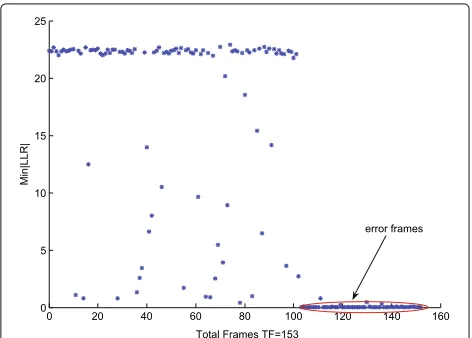
decoder only withxˆHT= 0 as the stopping criterion is used to decode the (256, 128) polar code at SNR = 2.5 dB. In order to avoid getting trapped for the decoder when BP iterations could not converge to a valid estimated
sequence (i.e.,xˆ
H
T
=0 ), the total number of BP iter-ations should be limited to a predefined valueMBP. We
generate 153 frames, and 50 frames among them cannot be decoded by the proposed decoder. It means that for 103
frames, the conditionxˆ
H
T
= 0 is met before the total number of iterations is achieved and that for 50 frames,
the conditionxˆ
H
T
= 0 is still not met when the total number of iterations is achieved. Figure 1 shows the values of Min|LLR|sforγwhich are gathered during the decod-ing of these 153 frames. In order to examine the results, Min|LLR|sfor the 50 error frames are plotted on the right side of Fig. 1. We can see that the Min|LLR|of a correct frame is much larger than zero in general, while that of incorrect frames approach zero. The parameterβcan be chosen according to simulations which are shown in the next section.
3.3 Algorithm description
Based on the above analysis, the proposed scheme is described in Algorithm 1, where MAP denotes the
pre-defined number of matrix adaptation. The function
AdaptiveMatrix() performs matrix adaptation which reduces H to H. The function BP() performs BP algo-rithm based onH and stores its returned value into the boolean variable BPresult. If BPresult = false, it means the
constraintxˆHT =0 is still not satisfied when the num-ber of iterations that BP used is increased toMBP. Thus,
the algorithm goes back to perform the matrix
adapta-tion again. Otherwise, it means the constraintxˆ
H
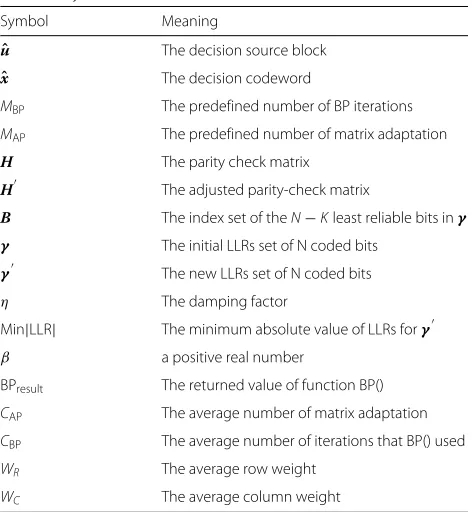
T = 0 is satisfied. Then, we compare Min|LLR| with β, and the matrix adaptation will be performed again when Min|LLR| < β. It should be noted that we can use the cyclic redundancy check (CRC) to detect the output sequence of the BP algorithm when Min|LLR| ≥βto fur-ther improve the performance of the proposed algorithm. Accordingly, it needs to set the lastrunfrozen bits to hold ther-bit CRC when encoding, whereris a small constant. In addition, considering that there are lots of variables in Section 3, we first provide a variable list as shown in Table 1 to make the used variables more clearly. Specifi-cally, the last four variables in Table 1 will be used in the following subsection.
3.4 Computational complexity
The computational complexity of Algorithm 1 is deter-mined by three parts: (1) sorting in AdaptiveMartix(), (2) GE in AdaptiveMartix(), and (3) BP decoding. Since different parts are involved in different operations, we analyze the complexity by counting the number of binary operations (BOs), floating point comparisons (FPCs), and
Table 1Symbol definition
Symbol Meaning
ˆ
u The decision source block
ˆ
x The decision codeword
MBP The predefined number of BP iterations
MAP The predefined number of matrix adaptation
H The parity check matrix
H The adjusted parity-check matrix
B The index set of theN−Kleast reliable bits inγ
γ The initial LLRs set of N coded bits
γ The new LLRs set of N coded bits
η The damping factor
Min|LLR| The minimum absolute value of LLRs forγ
β a positive real number
BPresult The returned value of function BP()
CAP The average number of matrix adaptation
CBP The average number of iterations that BP() used
WR The average row weight
WC The average column weight
Algorithm 1 Enhanced Belief Propagation Decoding Algorithm of Polar Codes
Input: the original LLR vector γ,the parity check matrixH;
Output:the encoding estimated sequenceuˆ;
1: i=1 ;
2: whilei≤MAPdo 3: AdaptiveMatrix(); 4: BPresult=BP(); 5: ifBPresult =falsethen 6: incrementiby one;
7: performAdaptiveMatrix()onH;
8: else
9: Min|LLR| =minNk=1|γ(xk)|;
10: ifMin|LLR|< βthen 11: incrementiby one;
12: performAdaptiveMatrix()onH;
13: else
14: ifCRC(xˆ)=Successthen
15: computeuˆaccording toxˆand break;
16: else
17: incrementiby one;
18: performAdaptiveMatrix()onH;
19: end if
20: end if
21: end if 22: end while
23: ifi>MAPthen
24: declare a decoding failure; 25: end if
Algorithm 2The functionAdaptiveMatrix()
Input:the latest updated LLRsγ, the original check matrixH;
Output:the new adapted matrixH;
1: perform the sorting operation on the latest updated LLRsγ;
2: perform matrix adaptation onH;
floating point operations (FPOs), respectively. For part (1), the sorting step needs OCAPNlogN
FPCs, where CAP denotes the average number of matrix adaptation.
The GE in part (2) needs OCAPN3
Algorithm 3The functionBP()
Input:the latest adapted matrixH; Output:a boolean variableBPresult;
1: j=1;
2: BPresult=false; 3: whilej≤MBPdo
4: update the message of the check nodes ; 5: update the message of the variable nodes;
6: ifxˆ(H)T=0then
7: BPresult=true ; 8: break ;
9: else
10: incrementjby one ; 11: end if
12: end while
13: ifj>MBPthen
14: BPresult=false ; 15: end if
not count the number of FPOs for tanh()function when analyzing the complexity of different decoders. This is reasonable since all the involved decoders need tanh() function. According to Eq. (2), theN-Kcheck nodes need O(CAPCBP(N−K) (WR−2))multiplication operations, whereWRis the average row weight andCBPis the average number of iterations thatBP()used. TheNvariable nodes needO(CAPCBPN(WC−2))additive operations, where WC is the average column weight. Table 2 summarizes the complexity analysis of Algorithm 1 and SC decoder. It should be noted that the complexity of the proposed algorithm decreases rapidly as SNR increases sinceCAP
andCBPare very small. Actually, from Table 3, we can see
thatWCandWRafterAdaptiveMatrix()are much smaller thanK. Hence, the average complexity of BP decoding is relatively low.
3.5 Variations to the Proposed Algorithms
In this subsection, we give several variations of the pro-posed algorithm to further improve the performance or reduce the decoding complexity.
1. Improving the performance
The first variation inspired by [13] can further improve the performance by running the proposed algorithm several times each time with the same
initial LLRs from the channel but a different grouping of the less reliable bits. This is based on the fact that some bits with their|LLR|sclose to those in the unreliable setBare also of the wrong sign and vice versa. Each time the proposed algorithm is run, a different estimate of codeword may be obtained due to the different parity-check matrix. The decoder keeps all the returned codewords in a list and chooses the one that minimizes Euclidean distance from the received vector of the channel. This variation can significantly improve the asymptotic performance of polar codes.
2. Reducing the complexity
(a) Partial reliable bit updating
The complexity of the proposed algorithm mostly depends on the complexity of the FPCs. The main FPCs complexity comes from two ways: the computation of the extrinsic information in the reliable part and the adaptation of the parity-check matrix. Since only some bits in the boundary will be switched from the reliable part to the unreliable part in the adaptation of the parity-check matrix, we can use the rule of partial reliable bit updating proposed in [13] to reduce the complexity in the bit reliabilities update part.
(b) Sophisticated update schemes
Using sophisticated update schemes reduces the complexity of matrix adaptation, such as the scheme that adapting the parity-check matrix from the previous ones proposed by EI-Khamy and McEliece [16], which reduces the overall complexityby 75%.
4 Simulation results
In this section, we consider three polar codes: a (256, 128) rate-1/2 polar codeC1, a (1024, 512) rate-1/2 polar code
C2, and a (2048, 1536) rate-3/4 polar codeC3. We setMAP
= 10 andMBP= 20/50. According to the selection principle
ofηin [13], we set first the observed performances of the proposed decoder whenη= 0.5. And a CRC-8 code forC1
with generator polynomialg(D) = D8+D7+D6+D4+ D2+1 is used. While for forC2andC3, we use a
CRC-24 code with generator polynomialg(D) = D24+D23+
D6+D5+D+1. Since the length of CRC sequences is
Table 2Complexity comparisons with different decoders
BOs FPCs FPOs
×/÷ +/−
SC / / O(NlogN) O(NlogN)
proposed OCAPN3
Table 3The average row and column weight ofHfor a (1024, 512) polar code
SNR Avg. weight of column(WC) Avg. weight of row(WR)
2.0 dB 26.08 52.67
2.5 dB 26.12 52.72
3.0 dB 26.10 52.73
3.5 dB 26.14 52.77
4.0 dB 26.16 52.79
very short when compared to that of information bits in a polar code, the rate loss caused by using CRC is almost negligible. All simulations are performed over an additive white Gaussian noise (AWGN) channel with binary phase shift keying (BPSK).
4.1 Choice ofβ
Figure 2 presents the FER performance as a function of β at different signal-to-noise ratios (SNRs) forC1. It can
be seen that for SNR <3.5 dB, the FER performances are almost the same as β increases. For SNR ≥3.5 dB, the FER decreases gradually as β increases. Although the value of β has little influence on the FER perfor-mance of the proposed scheme for small SNRs, it is shown from the simulations that for the larger value ofβ, the decoder needs to perform a larger number of BP iterations. For example, if the value of β is 0.5, the average number of BP iterations for C1 is about 49 at
SNR = 2.0 dB. However, if the value of β is 7.5, the average number of BP iterations for C1 is about 63 at
the same SNR. Therefore, as in [15], to make a trade-off between the FER performance and decoding com-plexity, we choose β = 0.5 when SNR <3.5 dB and β = 7.5 when SNR≥3.5 dB for C1. ForC2 andC3,
Fig. 2Performances of the proposed decoder forC1with differentβ
we choose β = 0.5 when SNR <3.5 dB and β = 15.5 when SNR≥3.5 dB.
4.2 Comparison of the FER performance
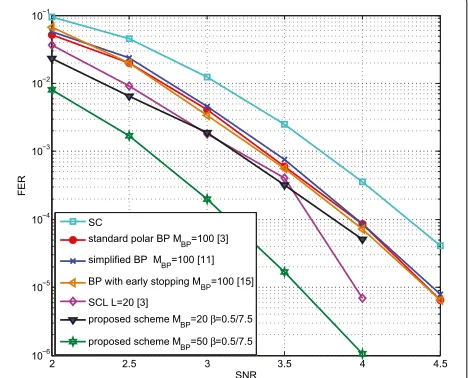
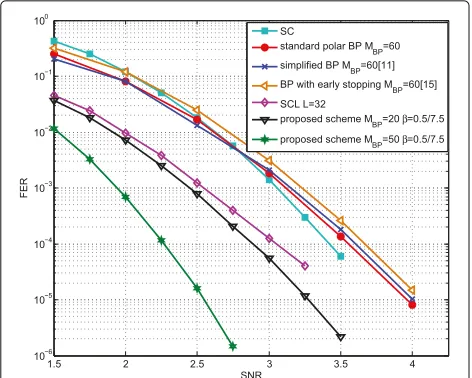
Figures 3 and 4 show the FER performances forC1and
C2with different polar decoders, respectively. We can see
that the proposed decoder with MBP = 50 performs
sig-nificantly better than the SC decoder and the original BP decoder. Particularly, for C2, at FER = 10−4, the
perfor-mance gains for the proposed decoder withMBP = 50 is
about 1.2 dB when compared to the original BP decoder with MBP = 60 and the improved BP decoders
pro-posed in [11] and [15]. And also, compared to the SC list (SCL) decoder with the list sizeL = 32, the polar codes using the proposed decoder can obtain almost 0.7 dB per-formance gains. Figure 5 presents the FER perper-formances forC3using different polar decoders. Although the code
rate becomes large, the proposed decoder still can obtain about 0.5 dB performance gains at FER = 10−4compared to the original polar BP decoder. It shows that the pro-posed decoder can improve the FER performance of the original polar BP decoder significantly on the AWGN channel with short and moderate blocklength at different code rates. Another side, we notice that the algorithm pro-posed in [10] which the readers are referred to for more details also can improve the performance of the original polar BP decoder with an improvement in SNR of 0.3 dB. However, both Figs. 4 and 5 show the performance gains using the proposed decoder can be increased to 0.5 dB at least, such as 0.5 dB at a rate = 0.75 and 1.2 dB at a rate = 0.5.
We make a performance comparison between the pro-posed decoder with variations and CRC-aided SCL (CRC-SCL) decoder as shown in Fig. 6. Specifically, the notion proposed(MAP, MBP, q1) refers to the proposed scheme
β β
β β
Fig. 4Performance comparisons of different decoders forC2
with variations which are presented in Section 3.5. The parameter q1 refers to the number of decoding rounds
with different groupings of the unreliable bits. The damping factorηis also specified on the plots. From Fig. 6, we can see that the performance of the proposed decoder using the different grouping method can be improved sig-nificantly. Compared with the CRC-SCL (L= 32) [17, 18], the proposed decoder with the parameters (10, 50, 3) pro-vides about 0.2 dB performance gains at an FER = 10−4. Additionally, the damping coefficients of the proposed algorithm must be carefully chosen to control the updat-ing step width. In general, if theηis set to be larger, the performance of the proposed decoder has a flat slope(as shown in Fig. 6) which is mainly due to the overshooting
Fig. 5Performance comparisons of different decoders forC3
Fig. 6Performance comparisons between the proposed decoder with variations and CRC-SCL forC2
of the update scheduling such that the decoder tends to a wrong codeword, quickly.
4.3 Average iterative number and decoding complexity
Figure 7 shows the average number of total BP iter-ations (=CAPCBP) per frame for C2 using the
origi-nal BP decoder, BP decoder with G-matrix-based early stopping scheme [15], BP decoder with the freezing of connected sub-factor-graphs (CSFGs) [19], and the pro-posed decoder. From simulations, we can see that as SNR increases, the average number of BP iterations for the pro-posed decoder decreases faster than other decoders. It shows that the proposed algorithm can tend to a correct codeword with a faster convergence rate. To show the FPO
β
β η
Fig. 7Comparison of average number of BP iterations forC2using
Table 4The numbers of FPOs of different decoders (×103) forC2
Proposed(10, 50, 3) 214 204 136 130 98 93 58 55
complexity of the proposed decoder clearly, we use the complexity of SCL decoder as reference. Table 4 shows the numbers of FPOs using the original SC decoder, SCL decoder (L= 32) and the proposed decoder (MBP= 50) for
a (1024, 512) polar code. Since the average number of total BP iterationsCAPCBPbecomes smaller as SNR increases,
such asCAPCBP= 5.01 at SNR = 3.5 dB, the average
num-bers of FPOs of the proposed decoder decrease with SNR increasing. When SNR≥3.5 dB, the proposed decoder has the lower complexity of FPOs than SCL decoder. It should be noted that all the numbers in Table 4 are rounding numbers. From the table, it shows that the FPO com-plexity of the proposed decoder decreases rapidly as SNR increases. And also, we can see that the complexity of the proposed decoder when using the variations mentioned in Section 3.5 is reduced quickly. However, compared with the reduced-complexity SCL [18], the proposed decoder with the variations still has a higher complexity. Consid-ering the better performance and parallel architecture of the proposed decoder, if a larger complexity is tolerated, it will be a promising decoder to reduce the decoding latency of CRC-SCL decoder for polar codes and provide a good performance.
5 Conclusions
In this paper, we have proposed an improved BP decoder for polar codes by adapting their parity-check matri-ces. Though the idea of the proposed decoder is not new, it has never been used for polar codes before. More importantly, simulation results show that the pro-posed decoder can provide significant performance gains compared to the polar BP decoder and also can com-pete with CRC-SCL decoder when using the variations of the proposed algorithm described in Section 3.5. Although the proposed decoder still has a little larger complexity than that of those reduced-complexity CRC-SCL, the proposed decoder is a promising decoder as a fully parallel architecture to reduce the decoding latency of CRC-SCL decoder for polar codes with a tolerated complexity.
Acknowledgements
The authors would like to thank the editor and anonymous reviewers for their constructive comments which helped improve the quality of this paper. This
work is supported by the National Nature Science Foundation of China (no. 61471286, no. 61271004), the Fundamental Research Funds for the Central Universities, and the open research fund of Key Laboratory of Information Coding and Transmission, Southwest Jiaotong University (no. 2010-03).
Competing interests
The authors declare that they have no competing interests.
Author details
1The School of Computer Science and Technology, Xidian University, TaiBai
Road, Xi’an, China.2The Key Laboratory of Information Coding and
Transmission, Southwest Jiaotong University, ErHuan Road, Chengdu, China.
3The School of Computer Science and Technology, Xi’an Technological
University, JinHua Road, Xi’an, China.4Border Defence Academy, HuanShan
Road, Xi’an, China.
Received: 5 April 2016 Accepted: 15 February 2017
References
1. E Arikan, Channel polarization: a method for constructing capacity achieving codes for symmetric binary-input memoryless channels. IEEE Trans. Inform. Theory.55(7), 3051–3073 (2009)
2. I Tal, A Vardy, List decoding of polar codes. IEEE Trans Inf Theory.61(5), 2213–2226 (2015)
3. K Niu, K Chen, Stack decoding of polar codes. Electron. Lett.48(12), 695–697 (2012)
4. E Arikan, A performance comparison of polar codes and Reed-Muller codes. IEEE Commun. Lett.12(6), 447–449 (2008)
5. A Eslami, H Pishro-Nik, On finite-length performance of polar codes: stopping sets, error floor, concatenated design. IEEE Trans. Commun. 61(3), 919–929 (2013)
6. N Hussami, R Urbanke, SB Korada, inProceedings of the IEEE International Symposium on Information Theory (ISIT). Performance of polar codes for channel and source coding (IEEE, Seoul, 2009), pp. 1488–1492
7. A Eslami, H Pishro-Nik, inProceedings of the 48th Annual Allerton Conference on Communication, Control, and Computing. On bit error rate performance of polar codes in finite regime (AACCCC, Allerton, 2010), pp. 188–194 8. Y Zhang, A Liu, X Pan, Z Ye, C Gong, A modified belief propagation polar
decoder. IEEE Commun. Lett.18(7), 1091–1094 (2014)
9. B Yuan, KK Parhi, inProceedings of the IEEE International Conference Acoustics, Speech and Signal Processing. Architecture optimizations for BP polar decoders (ICASSP, Vancouver, British Columbia, 2013),
pp. 2654–2658
10. J Guo, M Qin, A Guillén i Fàbregas, PH Siegel, inProceedings of the IEEE International Symposium on Information Theory. Enhanced belief propagation decoding of polar codes through concatenation (ISIT, Honolulu, 2014), pp. 2987–2991
11. Y Zhang, Q Zhang, X Pan, Z Ye, C Gong, inProceedings of the IEEE International Wireless Symposium. A simplified belief propagation decoder for polar codes (IWS, Xi’an, 2014), pp. 1–4
12. N Goela, SB Korada, M Gastpar, inProceedings of the IEEE Information Theory Workshop. On LP decoding of polar codes (ITW, Dublin, 2010), pp. 1–5 13. J Jiang, K Narayanan, Iterative soft-input-soft-output decoding of
14. R Mori, T Tanaka, Performance of polar codes with the construction using density evoluation. IEEE Commun. Lett.13(7), 519–521 (2009)
15. B Yuan, KK Parhi, Early stopping criteria for energy-efficient low-latency belief-propagation code decoders. IEEE Trans. Signal Proc.62(24), 6496–6506 (2014)
16. M El-Khamy, RJ McEliece, J Harel, inProceedings of the IEEE International Symposium on Information Theory. Performance enhancements for algebraic soft-decision decoding of Reed-Solomon codes (ISIT, Chicago, 2004), p. 419
17. K Chen, K Niu, J Lin, Improved successive cancellation decoding of polar codes. IEEE Trans. Commun.61(8), 3100–3107 (2013)
18. K Chen, K Niu, J Lin, inProceedings of the IEEE Vehicular Technology Conference. A reduced-complexity successive cancellation list decoding of polar codes (VTC Spring, Dresden, 2013), pp. 1–5
19. S Mohsin Abbas, Y Fan, J Chen, C Tsui, Low complexity belief propagation polar code decoders [Online] (2015). Available, http://arxiv.org/abs/1505. 04979
Submit your manuscript to a
journal and benefi t from:
7Convenient online submission
7Rigorous peer review
7Immediate publication on acceptance
7Open access: articles freely available online
7High visibility within the fi eld
7Retaining the copyright to your article