https://doi.org/10.5194/nhess-19-2295-2019 © Author(s) 2019. This work is distributed under the Creative Commons Attribution 4.0 License.
Ensemble models from machine learning: an example
of wave runup and coastal dune erosion
Tomas Beuzen1, Evan B. Goldstein2, and Kristen D. Splinter1
1Water Research Laboratory, School of Civil and Environmental Engineering, UNSW Sydney, Sydney, NSW, Australia 2Department of Geography, Environment, and Sustainability, University of North Carolina at Greensboro,
Greensboro, NC, USA
Correspondence:Tomas Beuzen ([email protected]) Received: 14 March 2019 – Discussion started: 2 April 2019
Revised: 7 September 2019 – Accepted: 11 September 2019 – Published: 22 October 2019
Abstract. After decades of study and significant data col-lection of time-varying swash on sandy beaches, there is no single deterministic prediction scheme for wave runup that eliminates prediction error – even bespoke, locally tuned pre-dictors present scatter when compared to observations. Scat-ter in runup prediction is meaningful and can be used to cre-ate probabilistic predictions of runup for a given wave cli-mate and beach slope. This contribution demonstrates this using a data-driven Gaussian process predictor; a probabilis-tic machine-learning technique. The runup predictor is devel-oped using 1 year of hourly wave runup data (8328 observa-tions) collected by a fixed lidar at Narrabeen Beach, Sydney, Australia. The Gaussian process predictor accurately predicts hourly wave runup elevation when tested on unseen data with a root-mean-squared error of 0.18 m and bias of 0.02 m. The uncertainty estimates output from the probabilistic GP pre-dictor are then used practically in a deterministic numerical model of coastal dune erosion, which relies on a parame-terization of wave runup, to generate ensemble predictions. When applied to a dataset of dune erosion caused by a storm event that impacted Narrabeen Beach in 2011, the ensem-ble approach reproduced ∼85 % of the observed variability in dune erosion along the 3.5 km beach and provided clear uncertainty estimates around these predictions. This work demonstrates how data-driven methods can be used with tra-ditional deterministic models to develop ensemble predic-tions that provide more information and greater forecasting skill when compared to a single model using a deterministic parameterization – an idea that could be applied more gener-ally to other numerical models of geomorphic systems.
1 Introduction
with only reduced, easily obtainable inputs (i.e., wave height, wave period, and beach slope), is improbable.
The resulting inadequacies of a single deterministic pa-rameterization of wave runup can cascade up through the scales to cause error in any larger model that uses a runup parameterization. It therefore makes sense to clearly incor-porate prediction uncertainty into wave runup predictions. In disciplines such as hydrology and meteorology, with a more established tradition of forecasting, model uncertainty is of-ten captured by using ensembles (e.g., Bauer et al., 2015; Cloke and Pappenberger, 2009). The benefits of ensemble modelling are typically superior skill and the explicit inclu-sion of uncertainty in predictions by outputting a range of possible model outcomes. Commonly used methods of gen-erating ensembles include combining different models (Lim-ber et al., 2018) or perturbing model parameters, initial con-ditions, and/or input data (e.g., via Monte Carlo simulations; e.g., Callaghan et al., 2013).
An alternative approach to quantify prediction uncertainty is to incorporate scatter about a mean prediction into model parameterizations. For example, wave runup predictions at every time step could be modelled with a deterministic pa-rameterization plus a noise component that captures the scatter about the deterministic prediction caused by unre-solved processes. If parameterizations are stochastic, or have a stochastic component, repeated model runs (given identical initial and forcing conditions) produce different model out-puts – an ensemble – that represent a range of possible val-ues the process could take. This is broadly analogous to the method of stochastic parameterization used in the weather forecasting community for sub-grid-scale processes and pa-rameterizations (Berner et al., 2017). In these applications, stochastic parameterization has been shown to produce bet-ter predictions than traditional ensemble methods and is now routinely used by many operational weather forecasting cen-tres (Berner et al., 2017; Buchanan, 2018).
Stochastically varying a deterministic wave runup param-eterization to form an ensemble still requires defining the stochastic term – i.e., the stochastic element that should be added to the predicted runup at each model time step. An al-ternative to specifying a predefined distribution or a noise term added to a parameterization is to learn and parame-terize the variability in wave runup from observational data using machine-learning techniques. Machine learning has had a wide range of applications in coastal morphodynam-ics research (Goldstein et al., 2019) and has shown specific utility in understanding swash processes (Passarella et al., 2018b; Power et al., 2019) as well as storm-driven erosion (Beuzen et al., 2017, 2018; den Heijer et al., 2012; Goldstein and Moore, 2016; Palmsten et al., 2014; Plant and Stock-don, 2012). While many machine-learning algorithms and applications are often used to optimize deterministic predic-tions, a Gaussian process is a probabilistic machine-learning technique that directly captures model uncertainty from data (Rasmussen and Williams, 2006). Recent work has
specif-ically used Gaussian processes to model coastal processes such as large-scale coastline erosion (Kupilik et al., 2018) and estuarine hydrodynamics (Parker et al., 2019).
The work presented here is focused on using a Gaussian process to build a data-driven probabilistic predictor of wave runup that includes estimates of uncertainty. While quanti-fying uncertainty in runup predictions from data is useful in itself, the benefit of this methodology is in explicitly includ-ing the uncertainty with the runup predictor in a larger model that uses a runup parameterization, such as a coastal dune erosion model. Dunes on sandy coastlines provide a natu-ral barrier to storm erosion by absorbing the impact of inci-dent waves and storm surge and helping to prevent or delay flooding of coastal hinterland and infrastructure (Mull and Ruggiero, 2014; Sallenger, 2000; Stockdon et al., 2007). The accurate prediction of coastal dune erosion is therefore crit-ical for characterizing the vulnerability of dune and beach systems and coastal infrastructure to storm events. A vari-ety of methods are available for modelling dune erosion, including simple conceptual models relating hydrodynamic forcing, antecedent morphology, and dune response (Sal-lenger, 2000); empirical dune-impact models that relate time-dependent dune erosion to the force of wave impact at the dune (Erikson et al., 2007; Larson et al., 2004; Palmsten and Holman, 2012); data-driven machine-learning models (Plant and Stockdon, 2012); and more complex physics-based mod-els (Roelvink et al., 2009). In this study, we focus on dune-impact models, which are simple, commonly used models that typically rely on a parameterization of wave runup to model time-dependent dune erosion. As inadequacies in the runup parameterization can jeopardize the success of model results (Overbeck et al., 2017; Palmsten and Holman, 2012; Splinter et al., 2018), it makes sense to use a runup predictor that includes prediction uncertainty.
2 Gaussian processes 2.1 Gaussian process theory
Gaussian processes (GPs) are data-driven, non-parametric models. A brief introduction to GPs is given here; for a more detailed introduction the reader is referred to Rasmussen and Williams (2006). There are two main approaches to deter-mine a function that best parameterizes a process over an in-put space: (1) select a class of functions to consider, e.g., polynomial functions, and best fit the functions to the data (a parametric approach); or (2) consider all possible functions that could fit the data, and assign higher weight to functions that are more likely (a non-parametric approach) (Rasmussen and Williams, 2006). In the first approach it is necessary to decide on a class of functions to fit to the data – if all or parts of the data are not well modelled by the selected functions, then the predictions may be poor. In the second approach there is an infinite set of possible functions that could fit a dataset (imagine the number of paths that could be drawn be-tween two points on a graph). A GP addresses the problem of infinite possible functions by specifying a probability dis-tribution over the space of possible functions that fit a given dataset. Based on this distribution, the GP quantifies what function most likely fits the underlying process generating the data and gives confidence intervals for this estimate. Ad-ditionally, random samples can also be drawn from the dis-tribution to provide examples of what different functions that fit the dataset might look like.
A GP is defined as a collection of random variables, any finite set of which has a multivariate Gaussian distribution. The random variables in a GP represent the value of the un-derlying function that describes the data,f (x), at locationx. The typical workflow for a GP is to define a prior distribution over the space of possible functions that fit the data, form a posterior distribution by conditioning the prior on observed input/output data pairs (“training data”), and to then use this posterior distribution to predict unknown outputs at other in-put values (“testing data”). The key to GP modelling is the use of the multivariate Gaussian distribution, which has sim-ple closed form solutions to the aforementioned conditioning process, as described below.
Whereas a univariate Gaussian distribution is defined by a mean and variance (i.e., (µ, σ2)), a GP (a multivariate Gaussian distribution) is completely defined by a mean func-tionm(x)and covariance functionk(x,x0) (also known as a “kernel”), and it is typically denoted as
f (x)∼N (m(x), k(x,x0)), (1)
where x is an input vector of dimension D (x∈RD), and f is the unknown function describing the data. Note that for the remainder of this paper, a variable denoted in bold text represents a vector. The mean function,m(x), describes the expected mean value of the function describing the data at
locationx, while the covariance function encodes the corre-lation between the function values at locations inx.
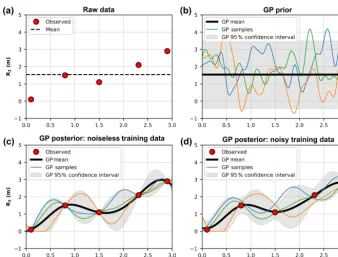
These concepts of GP development are further described using a hypothetical dataset of significant wave height (Hs) versus wave runup (R2) shown in Fig. 1a. The first step of GP modelling is to constrain the infinite set of functions that could fit a dataset by defining a prior distribution over the space of functions. This prior distribution encodes be-lief about what the underlying function is expected to look like (e.g., smooth/erratic, cyclic/random) before constrain-ing the model with any observed trainconstrain-ing data. Typically it is assumed that the mean function of the GP prior, m(x), is 0 everywhere, to simplify notation and computation of the model (Rasmussen and Williams, 2006). Note that this does not limit the GP posterior to be a constant mean process. The covariance function, k(x,x0), ultimately encodes what the
underlying functions look like because it controls how sim-ilar the function value at one input point is to the function value at other input points.
There are many different types of covariance functions or kernels. One of the most common, and the one used in this study, is the squared exponential covariance function:
k xi, xj=σf2exp
"
− D
X
d=1 1
2ld2 xd,i−xd,j 2
#
, (2)
whereσf is the signal variance andlis known as the length
scale, both of which are hyperparameters in the model that can be estimated from data (discussed further in Sect. 2.2). Together the mean function and covariance function specify a multivariate Gaussian distribution:
f (x)∼N (0,K), (3)
where f is the output of the prior distribution, the mean function is assumed to be 0, andKis the covariance matrix made by evaluating the covariance function at arbitrary input points that lie within the domain being modelled (i.e.,K(x, x)i,j=k(xi,xj)). Random sample functions can be drawn
from this prior distribution as demonstrated in Fig. 1b. The goal is to determine which of these functions actu-ally fit the observed data points (training data) in Fig. 1a. This can be achieved by forming a posterior distribution on the function space by conditioning the prior with the train-ing data. Roughly speaktrain-ing, this operation is mathematically equivalent to drawing an infinite number of random func-tions from the multivariate Gaussian prior (Eq. 3) and then rejecting those that do not agree with the training data. As mentioned above, the multivariate Gaussian offers a simple, closed form solution to this conditioning. Assuming that our observed training data are noiseless (i.e.,yexactly represents the value of the underlying functionf) then we can condition the prior distribution with the training data samples (x,y) to define a posterior distribution of the function value (f∗) at
arbitrary test inputs (x∗):
f∗|y∼NK∗K−1y,K∗∗−K∗K−1KT∗
Figure 1. (a)Five hypothetical random observations of significant wave height (Hs) and 2 % wave runup elevation (R2).(b)The Gaussian process (GP) prior distribution.(c)The GP posterior distribution, formed by conditioning the prior distribution in(b)with the observed data points in(a), assuming the observations are noise-free.(d)The GP posterior distribution conditioned on the observations with a noise component.
wheref∗is the output of the posterior distribution at the
de-sired test pointsx∗,yis the training data outputs at inputsx,
K∗ is the covariance matrix made by evaluating the
covari-ance function (Eq. 2) between the test inputsx∗and training
inputs x (i.e., k(x∗, x)),K is the covariance matrix made
by evaluating the covariance function between training data pointsx, and K∗∗ is the covariance matrix made by
evalu-ating the covariance function between test pointsx∗.
Func-tion values can be sampled from the posterior distribuFunc-tion as shown in Fig. 1c. These samples represent random realiza-tions of what the underlying function describing the training data could look like.
As stated earlier, in Eq. (4) and Fig. 1c there is an assump-tion that the training data are noiseless and represent the ex-act value of the function at the specific point in input space. In reality, there is error associated with observations of phys-ical systems, such that
y=f (x)+ε, (5)
whereεis assumed to be independent identically distributed Gaussian noise with varianceσn2. This noise can be incorpo-rated into the GP modelling framework through the use of a white noise kernel that adds an element of Gaussian white noise into the model:
k xi, xj
=σn2δij, (6)
whereσn2is the variance of the noise andδij is a Kronecker
delta which is 1 ifi=j and 0 otherwise. The squared expo-nential kernel and white noise kernel are closed under addi-tion and product (Rasmussen and Williams, 2006), such that they can simply be combined to form a custom kernel for use in the GP:
k xi, xj
=σf2exp (
− D
X
d=1 1 2ld2 xd,i
−xd,j
2 )
+σn2δij. (7)
The combination of kernels to model different signals in a dataset (that vary over different spatial or temporal timescales) is common in applications of GPs (Rasmussen and Williams, 2006; Reggente et al., 2014; Roberts et al., 2013). Samples drawn from the resultant noisy posterior dis-tribution are shown in Fig. 1d, in which the GP can now be seen to not fit the observed training data precisely.
2.2 Gaussian process kernel optimization
In Eq. (7) there are three hyperparameters: the signal vari-ance (σf), the length scale (l), and the noise variance (σn).
These hyperparameters are typically unknown but can be es-timated and optimized based on the particular dataset. Here, this optimization is performed by using the typical method-ology of maximizing the log marginal likelihood of the ob-served dataygiven the hyperparameters:
logp y|x, σf, l, σn
The Python toolkit scikit-learn (Pedregosa et al., 2011) was used to develop the GP described in this study. For the Reader unfamiliar with the Python programming language, alter-native programs for developing Gaussian processes include Matlab (Rasmussen and Nickisch, 2010) and R (Dancik and Dorman, 2008; MacDonald et al., 2015).
2.3 Training a Gaussian process model
It is standard practice in the development of data-driven machine-learning models to divide the available dataset into training, validation, and testing subsets. The training data are used to fit model parameters. The validation data are used to evaluate model performance, and the model hyperparameters are usually varied until performance on the validation data is optimized. Once the model is optimized, the remaining test dataset is used to objectively evaluate its performance and generalizability. A decision must be made about how to split a dataset into training, validation, and testing subsets. There are many different approaches to handle this splitting pro-cess; for example, random selection, cross validation, strat-ified sampling, or a number of other deterministic sampling techniques (Camus et al., 2011). The exact technique used to generate the data subsets often depends on the problem at hand. Here, there were two constraints to be considered: first, the computational expense of GPs scales by O(n3) (Ras-mussen and Williams, 2006), so it is desirable to keep the training set as small as possible without deteriorating model performance; and, secondly, machine-learning models typi-cally perform poorly with out-of-sample predictions (i.e., ex-trapolation), so it is desirable to include in the training set the data samples that capture the full range of variability in the data. Based on these constraints, we used a maximum dis-similarity algorithm (MDA) to divide the available data into training, validation, and testing sets.
The MDA is a deterministic routine that iteratively adds a data point to the training set based on how dissimilar it is to the data already included in the training set. Camus et al. (2011) provide a comprehensive introduction to the MDA selection routine, and it has been previously used in machine-learning studies (e.g., Goldstein et al., 2013). Briefly, to ini-tialize the MDA routine, the data point with the maximum sum of dissimilarity (defined by Euclidean distance) to all other data points is selected as the first data point to be added to the training dataset. Additional data points are included in the training set through an iterative process whereby the next data point added is the one with maximum dissimilarity to those already in the training set – this process continues un-til a user-defined training set size is reached. In this way the MDA routine produces a set of training data that captures the range of variability present in the full dataset. The data not selected for the training set are equally and randomly split to form the validation dataset and test dataset. While alternative data-splitting routines are available, including simple random sampling, stratified random sampling, self-organizing maps,
andk-means clustering (Camus et al., 2011), the MDA rou-tine used in this study was found in preliminary testing (not presented) to produce the best GP performance with the least computational expense.
3 Development of a Gaussian process runup model 3.1 Runup data
In 2014, an extended-range lidar (light detection and rang-ing) device (SICK LD-LRS 2110) was permanently installed on the rooftop of a beachside building (44 m a.m.s.l. – above mean sea level) at Narrabeen–Collaroy Beach (hereafter re-ferred to simply as Narrabeen) on the southeast coast of Australia (Fig. 2). Since 2014, this lidar has continuously scanned a single cross-shore profile transect extending from the base of the beachside building to a range of 130 m, captur-ing the surface of the beach profile and incident wave swash at a frequency of 5 Hz in both daylight and non-daylight hours. Specific details of the lidar setup and functioning can be found in Phillips et al. (2019).
Narrabeen Beach is a 3.6 km long embayed beach bounded by rocky headlands. It is composed of fine to medium quartz sand (D50≈0.3 mm), with a∼30 % carbonate fraction. Off-shore, the coastline has a steep and narrow (20–70 km) con-tinental shelf (Short and Trenaman, 1992). The region is mi-crotidal and semidiurnal with a mean spring tidal range of 1.6 m and has a moderate to high energy deep water wave cli-mate characterized by persistent long-period south-southeast swell waves that is interrupted by storm events (significant wave height>3 m) typically 10–20 times per year (Short and Trenaman, 1992). In the present study, approximately 1 year of the high-resolution wave runup lidar dataset avail-able at Narrabeen is used to develop a data-driven parame-terization of the 2 % exceedance of wave runup (R2). Data used to develop this parameterization were at hourly resolu-tion and includeR2, the beach slope (β), offshore significant wave height (Hs), and peak wave period (Tp). These data are described below and have been commonly used to parame-terizeR2in other empirical models of wave runup (e.g., Hol-man, 1986; Hunt, 1959; Stockdon et al., 2006).
Figure 2. (a)Narrabeen Beach, located on the southeast coast of Australia.(b)Conceptual figure of the fixed lidar setup.(c)A 5 min extract of runup elevation extracted from the lidar data; individual runup maxima are marked with red circles.
coastline and generalize the parameterization ofR2presented in this study, offshore wave data were first transformed to a nearshore equivalent (10 m water depth) using a precalcu-lated lookup table generated with the SWAN spectral wave model based on a 10 m resolution grid (Booij et al., 1999) and then reverse shoaled back to deep water wave data. A total of 8328 hourly samples ofR2,β,Hs, andTpwere extracted to develop a parameterization ofR2in this study. Histograms of these data are shown in Fig. 3.
3.2 Training data for the GP runup predictor
To determine the optimum training set size, kernel, and model hyperparameters, a number of different user-defined training set sizes were trialled using the MDA selection rou-tine discussed in Sect. 2.3. The GP was trained using dif-ferent amounts of data and hyperparameters were optimized on the validation dataset only. It was found that a training set size of only 5 % of the available dataset (training dataset: 416 of 8328 available samples; validation dataset: 3956 sam-ples; testing dataset: 3956 samples) was required to develop an optimum GP model. Training data sizes beyond this value produced negligible changes in GP performance but consid-erable increases in computational demand, similar to findings of previous work (Goldstein and Coco, 2014; Tinoco et al., 2015). Results presented below discuss the performance of
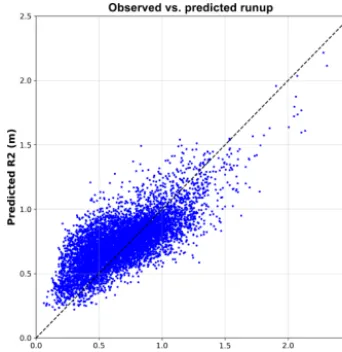
Figure 4. Observed 2 % wave runup (R2) versus the R2 pre-dicted by the Gaussian process model. The root-mean-squared er-ror (RMSE) is 0.36 m, bias (B) is 0.02 m, and squared correla-tion (r2) is 0.54.
the GP on the testing dataset which was not used in GP train-ing or validation.
3.3 Runup predictor results
Results of the GPR2predictor on the 3956 test samples are shown in Fig. 4. This figure plots the mean GP predictions against corresponding observations ofR2. The mean GP pre-diction performs well on the test data, with a root-mean-squared error (RMSE) of 0.18 m and bias (B) of 0.02 m. For comparison, the commonly usedR2parameterization of Stockdon et al. (2006) tested on the same data has a RMSE of 0.36 m and B of 0.21 m. Despite the relatively accurate performance of the GP on this dataset, there remains signif-icant scatter in the observed versus predicted R2 in Fig. 4. This is consistent with recent work by Atkinson et al. (2017) showing that commonly used predictors ofR2always result in scatter.
As discussed in Sect. 1 scatter in runup predictions is likely a result of unresolved processes in the model such as wave dispersion, wave spectrum, nearshore morphology, or a range of other possible processes. Regardless of the ori-gin, here this scatter (uncertainty) is used to form ensemble predictions. The GP developed here not only gives a mean prediction as used in Fig. 4, but it specifies a multivariate Gaussian distribution from which different random functions that describe the data can be sampled. Random samples of wave runup from the GP can capture uncertainty around the mean runup prediction (as was demonstrated in the hypothet-ical example in Fig. 1d). To assess how well the GP model captures uncertainty, random samples are successively drawn from the GP, and the number ofR2measurements captured with each new draw are determined. Only 10 random sam-ples drawn from the GP are required to capture 95 % of the
Figure 5. (a) Percent of observed runup values captured within the range of ensemble predictions made by randomly sampling dif-ferent runup values from the Gaussian process. Only 10 randomly drawn models can form an ensemble that captures 95 % of the scat-ter in observedR2values.(b)An experiment showing how much arbitrary error would need to be added to the mean GP runup pre-diction in order to capture scatter inR2observations. The mean GP prediction would have to vary by 51 % in order to capture 95 % of scatter inR2observations.
scatter inR2(Fig. 5a). This process of drawing random sam-ples from the GP was repeated 100 times with results show-ing that the above is true for any 10 random samples, with an average capture percentage of 95.7 % and range of 94.9 % to 96.1 % for 10 samples across the 100 trials. As a point of contrast, Fig. 5b shows how much arbitrary error would need to be added to the meanR2prediction to capture scat-ter about the mean to emulate the uncertainty captured by the GP. It can be seen that the mean R2 prediction would need to vary by±51 % to capture 95 % of the scatter present in the runup data. This demonstrates how random models of runup drawn from the GP effectively capture uncertainty in R2 predictions. These randomly drawn R2 models can be used within a larger dune-impact model to produce an en-semble of dune erosion predictions that includes uncertainty in runup predictions, as demonstrated in Sect. 4.
4 Application of a Gaussian process runup predictor in a coastal dune erosion model
4.1 Dune erosion model
We use the dune erosion model of Larson et al. (2004) as an example of how the GP runup predictor can be used to create an ensemble of dune erosion predictions, and we thus pro-vide probabilistic outcomes with uncertainty bands needed in coastal management. The dune erosion model is subse-quently referred to as LEH04 and is defined as follows:
dV=4Cs(R2−zb)2
t
T
, (9)
where dV (m3m−1) is the volumetric dune erosion per unit width alongshore for a given time stept,zb(m) is the
time step,R2(m) is the 2 % runup exceedance for that time step, andCsis the transport coefficient. Note that the original equation used a best-fit relationship to define the runup term, R (see Eq. 36 in Larson et al., 2004), rather thanR2. Subse-quent modifications of the LEH04 model have been made to adjust the collision frequency (i.e. thet /T term; e.g., Palm-sten and Holman, 2012, and Splinter and PalmPalm-sten, 2012); however, we retain the model presented in Eq. (9) for the purpose of providing a simple illustrative example. At each time step, dune volume is eroded in bulk, and the dune toe is adjusted along a predefined slope (defined here as the lin-ear slope between the pre- and post-storm dune toe) so that erosion causes the dune toe to increase in elevation and re-cede landward. Dune erosion and dune toe recession only occurs when wave runup (R2) exceeds the dune toe (i.e., R2−zb>0) and cannot progress vertically beyond the
max-imum runup elevation. WhenR2does not exceedzb, dV=0.
The GPR2predictor described in Sect. 3 is used to stochasti-cally parameterize wave runup in the LEH04 model and form ensembles of dune erosion predictions. The model is applied to new data not used to train the GPR2predictor, using de-tailed observations of dune erosion caused by a large coastal storm event at Narrabeen Beach, southeast Australia in 2011. 4.2 June 2011 storm data
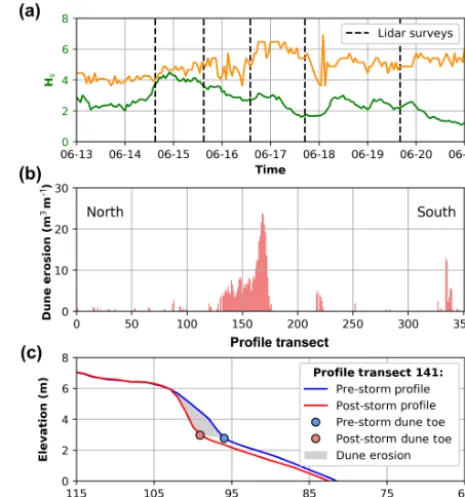
In June 2011 a large coastal storm event impacted the south-east coast of Australia. This event resulted in variable along-shore dune erosion at Narrabeen Beach, which was pre-cisely captured by airborne lidar immediately pre-, during, and post-storm by five surveys conducted approximately 24 h apart. Cross-shore profiles were extracted from the lidar data at 10 m alongshore intervals as described in detail in Splin-ter et al. (2018), resulting in 351 individual profiles (Fig. 6). The June 2011 storm lasted 120 h. Hourly wave data were recorded by the Sydney Waverider buoy located in ∼80 m water depth directly to the southeast of Narrabeen Beach. As with the hourly wave data used to develop the GP model ofR2(Sect. 3.1), hourly wave data for each of the 351 pro-files for the June 2011 storm were obtained by first trans-forming offshore wave data to the nearshore equivalent at 10 m water depth directly offshore of each profile using the SWAN spectral wave model (Booij et al., 1999) and then reverse shoaling back to equivalent deep water wave data, to account for the effects of wave refraction and attenuation caused by the distinctly curved Narrabeen embayment. The tidal range during the storm event was measured in situ at the Fort Denison tide gauge (located within Sydney Harbour approximately 16 km south of Narrabeen) as 1.58 m (mean spring tidal range at Narrabeen is 1.6 m). As can be seen in Fig. 6 the wave conditions for the June 2011 storm lie within the range of the training dataset used to develop the GP runup predictor. The hydrodynamic time series and airborne lidar observations of dune change are used to demonstrate how the LEH04 model can be used with the GP predictor of runup to
Figure 6.June 2011 storm data.(a)OffshoreHsandTpwith ver-tical dashed lines indicating the time of the lidar surveys,(b) mea-sured (pre- vs. post-storm) dune erosion volumes for the 351 profile transects extracted from lidar data, and(c)example pre- (blue) and post-storm (red) profile cross sections showing dune toes (coloured circles) and dune erosion volume (grey shading).
generate stochastic parameterizations and create probabilis-tic model ensembles (Eq. 9).
For each of the 351 available profiles, the pre-, during, and post-storm dune toe positions were defined as the lo-cal maxima of curvature of the beach profile following the method of Stockdon et al. (2007). Dune erosion at each pro-file was then defined as the difference in subaerial beach vol-ume landward of the pre-storm dune toe, as shown in Fig. 6c. Of the 351 profiles, only 117 had storm-driven dune ero-sion (Fig. 6b). For the example demonstration presented here, only profiles for which the post-storm dune toe elevation was at the same or higher elevation than the pre-storm dune toe are considered, which is a basic assumption of the LEH04 model. Of the 117 profiles with storm erosion, 40 profiles met these criteria. For each of these profiles, the linear slope between the pre- and post-storm dune toe was used to project the dune erosion calculated using the LEH04 model.
LEH04 to model dune erosion observed in a large wave tank experiment conducted at the O. H. Hinsdale Wave Re-search Laboratory at Oregon State University. The model was shown to accurately reproduce dune erosion when ap-plied in hourly time steps using aCs of 1.34×10⁻³, based on the empirical equation determined by Larson et al. (2004). Mull and Ruggiero (2014) used values of 1.7×10⁻⁴ and 1.34×10⁻³as lower and upper bounds ofCsto model dune erosion caused by a large storm event on the Pacific North-west Coast of the USA and the laboratory experiment used by Palmsten and Holman (2012). For the dune erosion exper-iment, the value of 1.7×10⁻⁴was found to predict dune ero-sion volumes closest to the observed eroero-sion when applied in a single time step, with an optimum value of 2.98×10⁻⁴. Splinter and Palmsten (2012) found a best-fitCsof 4×10⁻⁵ in an application to modelling dune erosion caused by a large storm event that occurred on the Gold Coast, Australia. Ranasinghe et al. (2012) found aCs value of 1.5×10⁻³in an application at Narrabeen Beach, Australia. It is noted that Cs values in these studies are influenced by the time step used in the model and the exact definition of wave runup,R, used (Larson et al., 2004; Mull and Ruggiero, 2014; Palmsten and Holman, 2012; Splinter and Palmsten, 2012). In practice, Cscould be optimized to fit any particular dataset. However,
for predictive applications the optimumCsvalue may not be known in advance, since it is unclear if subsequent storms at a given location will be well predicted using previously op-timizedCs values. A key goal of this work is to determine if using stochastic parameterizations to generate ensembles that predict a range of dune erosion (based on uncertainty in the runup parameterization) can still capture observed dune erosion even if the optimum Cs value is not known in ad-vance. As such, aCsvalue of 1.5×10⁻³is used in this exam-ple application based on previous work at Narrabeen Beach by Ranasinghe et al. (2012). Sensitivity of model results to the choice ofCsis further discussed in Sect. 4.3.
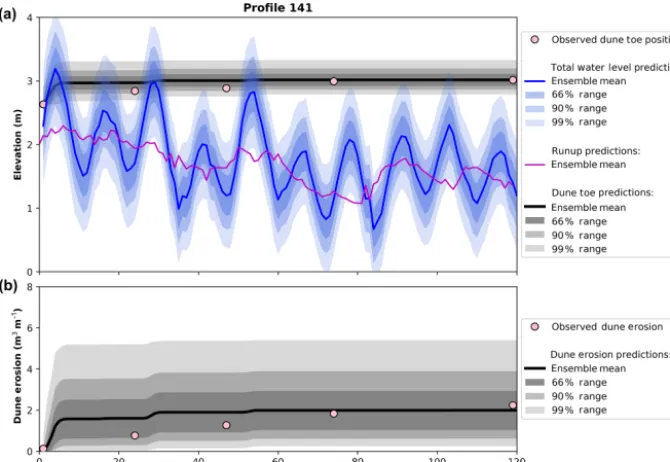
An example at a single profile (profile 141, located approx-imately half-way up the Narrabeen embayment as shown in Fig. 6b) of time-varying ensemble dune erosion predictions is provided in Fig. 7. It was previously shown in Fig. 5 that only 10 random samples drawn from the GP R2 predictor were required to capture 95 % of the scatter in the R2data used to develop and test the GP. However, it is trivial to draw many more samples than this from the GP – for ex-ample, drawing 10 000 samples takes less than 1 s on a stan-dard desktop computer. Therefore, to explore a large range of possible runup scenarios during the 120 h storm event, 10 000 different runup time series are drawn from the GP and used to run LEH04 at hourly intervals, thus producing 10 000 model results of dune erosion. The effect of using different ensemble sizes is explored in Sect. 4.3. Figure 7a shows the time-varying distribution of the runup models (blue) used to force LEH04 along with the time-varying pre-diction distribution of dune toe elevations (grey) throughout the 120 h storm event. To interpret model output
probabilis-tically, the mean of the ensemble is plotted, along with inter-vals capturing 66 %, 90 %, and 99 % of the ensemble output. These intervals are consistent with those used in IPCC for climate change predictions (Mastrandrea et al., 2010), and, in the context of the model results presented here, they repre-sent varying levels of confidence in the model output. For ex-ample, there is high confidence that the real dune erosion will fall within the 66 % ensemble prediction range. Figure 7b shows the time-varying predicted distribution of dune ero-sion volumes from the 10 000 LEH04 runs. It can be seen that while the mean value of the ensemble predictions de-viates slightly from the observed dune erosion, the observed erosion is still captured well within the 66 % envelope of pre-dictions.
Pre- and post-storm dune erosion results for the 40 profiles using 10 000 ensemble members andCs of 1.5×10⁻³ are shown in Fig. 8. The squared correlation (r2) for the observed and predicted dune erosion volumes is 0.85. Many of the pro-files experienced only minor dune erosion (<2.5 m3m−1) and can be seen to be well predicted by the mean of the en-semble predictions. In contrast, the enen-semble mean can be seen to under-predict dune erosion at profiles where high ero-sion volumes were observed (profiles 29–34 in Fig. 8), with some profiles not even captured by the uncertainty of the en-semble. However, the ensemble range of predictions for these particular profiles also has a large spread, indicative of high uncertainty in predictions and the potential for high erosion to occur. It should be noted that the results presented in Fig. 8 are based on an assumed (i.e., non-optimized)Cs value of 1.5×10⁻³. Better prediction of large erosion events could potentially be achieved by increasingCs or giving greater weighting to these events during calibration, but at the cost of over-predicting the smaller events. The exact effect of vary-ingCs is quantified in Sect. 4.3. Importantly, Fig. 8 demon-strates that, even with a non-optimizedCs, uncertainty in the GP predictions can provide useful information about the po-tential for dune erosion, even if the mean dune erosion pre-diction deviates from the observation – a key advantage of the GP approach over a deterministic approach.
Figure 7.Example of LEH04 used with the Gaussian processR2 predictor to form an ensemble of dune erosion predictions. A total of 10 000 runup models are drawn from the Gaussian process and used to force the LEH04 model. (a)Total water level (measured water level+R2; blue) and dune toe elevation (grey) for the 120 h storm event. The bold coloured line is the mean of the ensemble, and shaded areas represent the regions captured by 66 %, 90 %, and 99 % of the ensemble predictions. An example of just theR2prediction (no measured water level) from the Gaussian process is shown in the magenta line. Pink dots denote the observed dune toe elevation throughout the storm event.(b)The corresponding ensemble of dune erosion predictions.
Figure 8.Observed (pink dots) and predicted (black dots) dune ero-sion volumes for the 40 modelled profiles, using 10 000 runup mod-els drawn from the Gaussian process and used to force the LEH04 model. Note that the 40 profiles shown are not uniformly spaced along the 3.5 km Narrabeen embayment. The black dots represent the ensemble mean prediction for each profile, while the shaded ar-eas represent the regions captured by 66 %, 90 %, and 99 % of the ensemble predictions.
the number of ensemble members does not have a significant impact on the resultant mean prediction. The lowest MAE for the different ensemble sizes corresponds toCsvalues be-tween 2.8×10⁻³(10 000 ensemble members) and 4.1×10⁻³ (5 ensemble members), which is reasonably consistent with
the value of 1.5×10⁻³ previously reported by Ranasinghe et al. (2012) for Narrabeen Beach and within the range of Csvalues presented in Larson et al. (2004).
The key utility to using a data-driven GP predictor to pro-duce ensembles is that a range of predictions at every lo-cation is provided as opposed to a single erosion volume. The ensemble range provides an indication of uncertainty in predictions, which can be highly useful for coastal engineers and managers taking a risk-based approach to coastal hazard management. Figure 9b–d displays the percentage of dune erosion observations from the 40 profiles captured within en-semble predictions forCsvalues ranging from 10−5to 10−1. It can be seen that a high proportion of dune erosion obser-vations are captured within the 66 %, 90 %, and 99 % ensem-ble envelope across several orders of magnitudeCs. While the main purpose of using ensemble runup predictions within LEH04 is to incorporate uncertainty in the runup prediction, this result demonstrates that the ensemble approach is less sensitive to the choice ofCsthan a deterministic model and so can be useful for forecasting with non-optimized model parameters.
Figure 9. Results of the stochastic parameterization methodology forR2ensembles of 5, 10, 20, 100, 1000, and 10 000 members and Csvalues ranging from 10−5to 10−1.(a)The mean absolute er-ror (MAE) between the median ensemble dune erosion predictions and the observed dune erosion averaged across all 40 profiles.(b– d)show the percentage of dune erosion observations that fall within the 99 %, 90 %, and 66 % ensemble prediction ranges respectively.
used to develop and test the GP. This suggests that the GP approach efficiently captures scatter (uncertainty) in runup predictions and subsequently dune erosion predictions, re-quiring on the order of 10 samples, which is significantly less than the 103–106runs typically used in Monte Carlo simula-tions to develop probabilistic predicsimula-tions (e.g., Callaghan et al., 2008; Li et al., 2013; Ranasinghe et al., 2012).
5 Discussion
5.1 Runup predictors
Studies of commonly used deterministic runup parameteriza-tions such as those proposed by Hunt (1959), Holman (1986), and Stockdon et al. (2006), amongst others, show that these parameterizations are not universally applicable and there remains no perfect predictor of wave runup on beaches (Atkinson et al., 2017; Passarella et al., 2018a; Power et al., 2019). This suggests that the available parameterizations do not fully capture all the relevant processes controlling wave runup on beaches (Power et al., 2019). Recent work has used ensemble and data-driven methods to account for unre-solved factors and complexity in runup processes. For exam-ple, Atkinson et al. (2017) developed a model of models by fitting a least-squares line to the predictions of several runup parameterizations. Power et al. (2019) used a data-driven, de-terministic, gene-expression programming model to predict wave runup against a large dataset of runup observations. Both of these approaches led to improved predictions, when compared to conventional runup parameterizations, of wave runup on the datasets tested in these studies.
Table 1.Quantitative summary of Fig. 9, showing the optimumCsvalue for differing ensemble sizes, along with the associated mean absolute error (MAE) and percent of the 40 dune erosion observations captured by the 66 %, 90 %, and 99 % ensemble prediction range.
Ensemble Optimum MAE r2 Percent Percent Percent members Cs (m3m−1) captured captured captured in the 66 % in the 90 % in the 99 % ensemble ensemble ensemble range (%) range (%) range (%)
5 4.1×10⁻³ 1.59 0.86 45 57 65
10 3.4×10⁻³ 1.50 0.87 55 75 78
20 3.4×10⁻³ 1.54 0.86 62 78 88
100 3.3×10⁻³ 1.61 0.86 68 88 100 1000 2.8×10⁻³ 1.64 0.86 65 88 100 10 000 2.8×10⁻³ 1.64 0.86 65 88 100
5.2 Including uncertainty in dune erosion models
Uncertainty in wave runup predictions within dune-impact models can result in significantly varied predictions of dune erosion. For example, the model of Larson et al. (2004) used in this study only predicts dune erosion if runup elevation exceeds the dune toe elevation and predicts a non-linear lationship between runup that exceeds the dune toe and re-sultant dune erosion. Hence, if wave runup predictions are biased too low then no dune erosion will be predicted, and if wave runup is predicted too high then dune erosion may be significantly over predicted. Ensemble modelling has be-come standard practice in many areas of weather and cli-mate modelling (Bauer et al., 2015), as well as hydrologi-cal modelling (Cloke and Pappenberger, 2009), and more re-cently has been applied to coastal problems such as the pre-diction of cliff retreat (Limber et al., 2018) as a method of handling prediction uncertainty. While using a single deter-ministic model is computationally simple and provides one solution for a given set of input conditions, model ensembles provide a range of predictions that can better capture the vari-ety of mechanisms and stochasticity within a coastal system. The result is typically improved skill over deterministic mod-els (Atkinson et al., 2017; Limber et al., 2018) and a natural method of providing uncertainty with predictions.
As a quantitative comparison, Splinter et al. (2018) ap-plied a modified version of the LEH04 model to the same June 2011 storm dataset used in the work presented here with a modified expression for the collision frequency (i.e. the t /T term in Eq. 9) based on work by Palmsten and Hol-man (2012). The parameterization of Stockdon et al. (2006) was used to estimateR2in the model. The model was forced hourly over the course of the storm, updating the dune toe, recession slope, and profiles based on each daily lidar sur-vey. Based on only the 40 profiles used in the present study, results from Splinter et al. (2018) showed that the deter-ministic LEH04 approach reproduced 68 % (r2=0.68) of the observed variability in dune erosion. As shown in
Ta-ble 1, the simple LEH04 model (Eq. 9) applied here using the GP runup predictor to generate ensemble prediction repro-duced∼85 % (based on the ensemble mean) of the observed variability in dune erosion for the 40 profiles. While there are some discrepancies in the two modelling approaches, the ensemble approach clearly has an appreciable increase in skill over the deterministic approach – attributed here to us-ing a runup predictor trained on local runup data – and the ensemble modelling approach. However, a major advantage of the ensemble approach over the deterministic approach is the provision of prediction uncertainty (e.g., Fig. 8). While the mean ensemble prediction is not 100 % accurate, Table 1 shows that using just 100 samples can capture all the ob-served variability in dune erosion within the ensemble out-put.
The GP approach is a novel approach to building model ensembles to capture uncertainty. Previous work modelling beach and dune erosion has successfully used Monte Carlo methods, which randomly vary model inputs within many thousands of model iterations, to produce ensembles and probabilistic erosion predictions (e.g., Callaghan et al., 2008; Li et al., 2013; Ranasinghe et al., 2012). As discussed ear-lier in Sect. 4.3, the GP approach differs from Monte Carlo in that it explicitly quantifies uncertainty directly from data, does not use deterministic equations, and can be computa-tionally efficient.
6 Conclusion
obser-vations was used to develop a probabilistic parameterization of wave runup that quantifies uncertainty in runup predic-tions. The mean GP prediction performed well on unseen data, with a RMSE of 0.18 m, which is a significant improve-ment over the commonly usedR2parameterization of Stock-don et al. (2006) (RMSE of 0.36 m) used on the same data. Further, only 10 randomly drawn models from the probabilis-tic GP distribution were needed to form an ensemble that captured 95 % of the scatter in the test data.
Coastal dune-impact models offer a method of predicting dune erosion deterministically. As an example application of how the GP runup predictor can be used in geomorphic sys-tems, the uncertainty in the runup parameterization was prop-agated through a deterministic dune erosion model to gener-ate ensemble model predictions and provide prediction un-certainty. The hybrid dune erosion model performed well on the test data, with a squared correlation (r2) between the ob-served and predicted dune erosion volumes of 0.85. Impor-tantly, the probabilistic output provided uncertainty bands of the expected erosion volumes, which is a key advantage over deterministic approaches. Compared to traditional methods of producing probabilistic predictions such as Monte Carlo, the GP approach has the advantage of learning uncertainty di-rectly from observed data, it requires no deterministic equa-tions, and is computationally efficient.
This work is an example of how a machine-learning model such as a GP can profitably be integrated into coastal mor-phodynamic models (Goldstein and Coco, 2015) to provide probabilistic predictions for nonlinear, multidimensional processes, and drive ensemble forecasts. Approaches com-bining machine-learning methods with traditional coastal science and management models present a promising area for furthering coastal morphodynamic research. Future work is focused on using more data and additional inputs, such as offshore bar morphology and wave spectra, to improve the GP runup predictor developed here, testing it at different lo-cations and integrating it into a real-time coastal erosion fore-casting system.
Code and data availability. The data and code used to develop the Gaussian process runup predictor in this paper are publicly available at https://doi.org/10.5281/zenodo.3401739 (Beuzen and Goldstein, 2019).
Author contributions. The order of the authors’ names reflects the size of their contribution to the writing of this paper.
Competing interests. The authors declare that they have no conflict of interest.
Special issue statement. This article is part of the special issue “Ad-vances in computational modelling of natural hazards and geohaz-ards”.
Acknowledgements. Wave and tide data were kindly provided by the Manly Hydraulics Laboratory under the NSW Coastal Data Net-work Program managed by OEH. The lead author is funded under the Australian Postgraduate Research Training Program.
Financial support. This research has been supported by the Aus-tralian Research Council (grant nos. LP04555157, LP100200348, and DP150101339), the NSW Environmental Trust Environmental Research Program (grant no. RD 2015/0128), and the DOD DARPA (grant no. R0011836623/HR001118200064).
Review statement. This paper was edited by Randall LeVeque and reviewed by two anonymous referees.
References
Atkinson, A. L., Power, H. E., Moura, T., Hammond, T., Callaghan, D. P., and Baldock, T. E.: Assessment of runup predictions by empirical models on non-truncated beaches on the south-east Australian coast, Coast. Eng., 119, 15–31, 2017.
Bauer, P., Thorpe, A., and Brunet, G.: The quiet revolution of nu-merical weather prediction, Nature, 525, 47–55, 2015.
Berner, J., Achatz, U., Batté, L., Bengtsson, L., Cámara, A. D. L., Christensen, H. M., Colangeli, M., Coleman, D. R., Crommelin, D., Dolaptchiev, S. I., and Franzke, C. L.: Stochastic parameter-ization: Toward a new view of weather and climate models, B. Am. Meteorol. Soc., 98, 565–588, 2017.
Beuzen, T. and Goldstein, E. B.: Tomas-Beuzen/BeuzenEtAl_2019_NHESS_GP_runup_model: First release of repo (Version 0.1), Zenodo, https://doi.org/10.5281/zenodo.3401739, 2019.
Beuzen, T., Splinter, K. D., Turner, I. L., Harley, M. D., and Marshall, L.: Predicting storm erosion on sandy coastlines using a Bayesian network, in: Proceedings of Australasian Coasts & Ports: Working with Nature, 21–23 June 2017, Cairns, Australia, 102–108, 2017.
Beuzen, T., Splinter, K., Marshall, L., Turner, I., Harley, M., and Palmsten, M.: Bayesian Networks in coastal engineering: Dis-tinguishing descriptive and predictive applications, Coast. Eng., 135, 16–30, 2018.
Birkemeier, W. A., Savage, R. J., and Leffler, M. W.: A collection of storm erosion field data, Coastal Engineering Research Center, Vicksburg, MS, 1988.
Booij, N., Ris, R. C., and Holthuijsen, L. H.: A third-generation wave model for coastal regions: 1. Model descrip-tion and validadescrip-tion, J. Geophys. Res.-Oceans, 104, 7649–7666, https://doi.org/10.1029/98jc02622, 1999.
Buchanan, M.: Ignorance as strength, Nat. Phys., 14, 428, https://doi.org/10.1038/s41567-018-0133-9, 2018.
extreme beach erosion, Coast. Eng., 55, 375–390, https://doi.org/10.1016/j.coastaleng.2007.12.003, 2008. Callaghan, D. P., Ranasinghe, R., and Roelvink, D.: Probabilistic
estimation of storm erosion using analytical, semi-empirical, and process based storm erosion models, Coast. Eng., 82, 64–75, 2013.
Camus, P., Mendez, F. J., Medina, R., and Cofiño, A. S.: Analysis of clustering and selection algorithms for the study of multivariate wave climate, Coast. Eng., 58, 453–462, 2011.
Cloke, H. and Pappenberger, F.: Ensemble flood forecasting: A re-view, J. Hydrol., 375, 613–626, 2009.
Cohn, N. and Ruggiero, P.: The influence of seasonal to interan-nual nearshore profile variability on extreme water levels: Mod-eling wave runup on dissipative beaches, Coast. Eng., 115, 79– 92, 2006.
Dancik, G. M. and Dorman, K. S.: mlegp: statistical analysis for computer models of biological systems using R, Bioinformatics, 24, 1966–1967, 2008.
den Heijer, C., Knipping, D. T. J. A., Plant, N. G., van Thiel de Vries, J. S. M., Baart, F., and van Gelder, P. H. A. J. M.: Impact Assessment of Extreme Storm Events Using a Bayesian Network, Paper presented at the Coastal Engineering (No. 33), Santander, Spain, 2012.
Erikson, L. H., Larson, M., and Hanson, H.: Laboratory investiga-tion of beach scarp and dune recession due to notching and sub-sequent failure, Mar. Geol., 245, 1–19, 2007.
García-Medina, G., Özkan-Haller, H. T., Holman, R. A., and Rug-giero, P.: Large runup controls on a gently sloping dissipative beach, J. Geophys. Res.-Oceans, 122, 5998–6010, 2017. Goldstein, E. B. and Coco, G.: A machine learning approach for
the prediction of settling velocity, Water Resour. Res., 50, 3595– 3601, 2014.
Goldstein, E. B. and Coco, G.: Machine learning components in deterministic models: hybrid synergy in the age of data, Front. Environ. Sci., 33, 1–4, 2015.
Goldstein, E. B. and Moore, L. J.: Stability and bistability in a one-dimensional model of coastal foredune height, J. Geophys. Res.-Earth Surf., 121, 964–977, 2016.
Goldstein, E. B., Coco, G., and Murray, A. B.: Prediction of wave ripple characteristics using genetic programming, Cont. Shelf Res., 71, 1–15, 2013.
Goldstein, E. B., Coco, G., and Plant, N. G.: A Review of Machine Learning Applications to Coastal Sediment Trans-port and Morphodynamics, Earth Sci. Rev., 194, 97–108, https://doi.org/10.1016/j.earscirev.2019.04.022, 2019.
Guedes, R., Bryan, K. R., and Coco, G.: Observations of wave energy fluxes and swash motions on a low-sloping, dissipative beach, J. Geophys. Res.-Oceans, 118, 3651–3669, 2013. Guza, R. and Feddersen, F.: Effect of wave frequency and
direc-tional spread on shoreline runup, Geophys. Res. Lett., 39, 1–5, https://doi.org/10.1029/2012GL051959, 2012.
Holman, D., Sridharan, M., Gowda, P., Porter, D., Marek, T., How-ell, T., and Moorhead, J.: Gaussian process models for reference ET estimation from alternative meteorological data sources, J. Hydrol., 517, 28–35, 2014.
Holman, R.: Extreme value statistics for wave run-up on a natural beach, Coast. Eng., 9, 527–544, 1986.
Hunt, I. A.: Design of sea-walls and breakwaters, T. Am. Soc. Civ. Eng., 126, 542–570, 1959.
Krasnopolsky, V. M. and Fox-Rabinovitz, M. S.: Complex hybrid models combining deterministic and machine learning compo-nents for numerical climate modeling and weather prediction, Neural Networks, 19, 122–134, 2006.
Kupilik, M., Witmer, F. D., MacLeod, E.-A., Wang, C., and Ravens, T.: Gaussian Process Regression for Arctic Coastal Erosion Fore-casting, IEEE T. Geosci. Remote, 99, 1–9, 2018.
Larson, M., Erikson, L., and Hanson, H.: An analytical model to predict dune erosion due to wave impact, Coast. Eng., 51, 675– 696, 2004.
Li, F., Van Gelder, P., Callaghan, D., Jongejan, R., Heijer, C. D., and Ranasinghe, R.: Probabilistic modeling of wave climate and predicting dune erosion, J. Coast. Res., 65, 760–765, 2013. Limber, P. W., Barnard, P. L., Vitousek, S., and Erikson, L. H.: A
model ensemble for projecting multidecadal coastal cliff retreat during the 21st century, J. Geophys. Res.-Ea. Surf., 123, 1566– 1589, 2018.
MacDonald, B., Ranjan, P., and Chipman, H.: GPfit: An R package for fitting a Gaussian process model to deterministic simulator outputs, J. Stat. Softw., 64, 1–23, 2015.
Mastrandrea, M. D., Field, C. B., Stocker, T. F., Edenhofer, O., Ebi, K. L., Frame, D. J., Held, H., Kriegler, E., Mach, K. J., Matschoss, P. R., and Plattner, G. K.: Guidance note for lead authors of the IPCC fifth assessment report on consistent treatment of uncertainties, Intergovernmental Panel on Climate Change (IPCC), 2010.
Mull, J. and Ruggiero, P.: Estimating storm-induced dune erosion and overtopping along US West Coast beaches, J. Coast. Res., 30, 1173–1187, 2014.
Overbeck, J. R., Long, J. W., and Stockdon, H. F.: Testing model pa-rameters for wave-induced dune erosion using observations from Hurricane Sandy, Geophys. Res. Lett., 44, 937–945, 2017. Palmsten, M. L. and Holman, R. A.: Laboratory investigation of
dune erosion using stereo video, Coast. Eng., 60, 123–135, 2012. Palmsten, M. L., Splinter, K. D., Plant, N. G., and Stockdon, H. F.: Probabilistic estimation of dune retreat on the Gold Coast, Australia, Shore Beach, 82, 35–43, 2014.
Parker, K., Ruggiero, P., Serafin, K. A., and Hill, D. F.: Emulation as an approach for rapid estuarine modeling, Coast. Eng., 150, 79–93, 2019.
Passarella, M., De Muro, S., Ruju, A., and Coco, G.: An assessment of swash excursion predictors using field observations, J. Coast. Res., 85, 1036–1040, 2018a.
Passarella, M., Goldstein, E. B., De Muro, S., and Coco, G.: The use of genetic programming to develop a predictor of swash excur-sion on sandy beaches, Nat. Hazards Earth Syst. Sci., 18, 599– 611, https://doi.org/10.5194/nhess-18-599-2018, 2018b. Pedregosa, F., Varoquaux, G., Gramfort, A., Michel, V., Thirion, B.,
Grisel, O., Blondel, M., Prettenhofer, P., Weiss, R., Dubourg, V., and Vanderplas, J.: Scikit-learn: Machine learning in Python, J. Mach. Learn. Res., 12, 2825–2830, 2011.
Phillips, M. S., Blenkinsopp, C. E., Splinter, K. D., Harley, M. D., and Turner, I. L.: Modes of berm and beachface recovery follow-ing storm reset: observations usfollow-ing a continuously scannfollow-ing lidar, J. Geophys. Res.-Ea. Surf., 124, 720–736, 2019.
Power, H. E., Gharabaghi, B., Bonakdari, H., Robertson, B., Atkin-son, A. L., and Baldock, T. E.: Prediction of wave runup on beaches using Gene-Expression Programming and empirical re-lationships, Coast. Eng., 144, 47–61, 2019.
Ranasinghe, R., Callaghan, D., and Stive, M. J.: Estimating coastal recession due to sea level rise: beyond the Bruun rule, Climatic Change, 110, 561–574, 2012.
Rasmussen, C. E. and Nickisch, H.: Gaussian processes for machine learning (GPML) toolbox, J. Mach. Learn. Res., 11, 3011–3015, 2010.
Rasmussen, C. E. and Williams, C. K.: Gaussian Processes for Machine Learning, The MIT Press, Cambridge, Massachusetts, 2006.
Reggente, M., Peters, J., Theunis, J., Van Poppel, M., Rademaker, M., Kumar, P., and De Baets, B.: Prediction of ultrafine parti-cle number concentrations in urban environments by means of Gaussian process regression based on measurements of oxides of nitrogen, Environ. Model. Softw., 61, 135–150, 2014. Roberts, S., Osborne, M., Ebden, M., Reece, S.,
Gib-son, N., and Aigrain, S.: Gaussian processes for time-series modelling, Philos. T. Roy. Soc. A, 371, 20110550, https://doi.org/10.1098/rsta.2011.0550, 2013.
Roelvink, D., Reniers, A., van Dongeren, A., van Thiel de Vries, J., McCall, R., and Lescinski, J.: Modelling storm impacts on beaches, dunes and barrier islands, Coast. Eng., 56, 1133–1152, https://doi.org/10.1016/j.coastaleng.2009.08.006, 2009. Ruggiero, P., Komar, P. D., McDougal, W. G., Marra, J. J., and
Beach, R. A.: Wave runup, extreme water levels and the erosion of properties backing beaches, J. Coast. Res., 17, 407–419, 2001. Sallenger, A. H.: Storm impact scale for barrier islands, J. Coast.
Res., 16, 890–895, 2000.
Semedo, A., Weisse, R., Behrens, A., Sterl, A., Bengtsson, L., and Günther, H.: Projection of global wave climate change toward the end of the twenty-first century, J. Climate, 26, 8269–8288, 2012. Short, A. D. and Trenaman, N.: Wave climate of the Sydney region, an energetic and highly variable ocean wave regime, Mar. Fresh-water Res., 43, 765–791, 1992.
Simmons, J. A., Splinter, K. D., Phillips, M. S., and Leaman, C. K.: Wave runup detection from Lidar using machine learning tech-niques, Environ. Model. Softw., in preparation, 2019.
Splinter, K. D. and Palmsten, M. L.: Modeling dune response to an East Coast Low, Mar. Geol., 329, 46–57, 2012.
Splinter, K. D., Kearney, E. T., and Turner, I. L.: Drivers of along-shore variable dune erosion during a storm event: Observations and modelling, Coast. Eng., 131, 31–41, 2018.
Stockdon, H. F., Holman, R. A., Howd, P. A., and Sallenger, A. H.: Empirical parameterization of setup, swash, and runup, Coast. Eng., 53, 573–588, https://doi.org/10.1016/j.coastaleng.2005.12.005, 2006. Stockdon, H. F., Sallenger Jr., A. H., Holman, R. A., and Howd, P.
A.: A simple model for the spatially-variable coastal response to hurricanes, Mar. Geol., 238, 1–20, 2007.
Tinoco, R., Goldstein, E., and Coco, G.: A data-driven approach to develop physically sound predictors: Application to depth-averaged velocities on flows through submerged arrays of rigid cylinders, Water Resour. Res., 51, 1247–1263, 2015.