ABSTRACT
SHORES, LUCY R. The Role of Cognitive and Metacognitive Tool Use in Narrative-Centered Learning Environments. (Under the direction of James C. Lester).
Inquiry-based learning has shown to afford several opportunities for domain knowledge acquisition while also developing inquiry and self-regulatory skills obligatory for lifelong learning. However, several challenges create an impasse for the execution of such
instruction including creating self-sustaining, engaging environments and providing requisite individualized guidance and support as students often lack the necessary skills for successful inquiry-based learning. Advancements in intelligent technologies provide a platform for investigating the potential for computer-based learning environments as a means for creating inquiry-based learning environments equipped with cognitive and metacognitive tools that automatically generate personalized guidance.
This thesis presents a specific cognitive and metacognitive tool for assisting students during inquiry-based learning within a narrative-centered learning environment. A 137-subject experiment revealed the tool, an organized virtual space designed to assist students with organizing and reasoning about collected information, if used correctly, is indicative of significant domain learning gains. Domain learning gains were especially prevalent for students coming into the experiment with relatively low levels of prior knowledge.
The Role of Cognitive and Metacognitive Tool Use in Narrative-Centered Learning Environments
by Lucy R. Shores
A thesis submitted to the Graduate Faculty of North Carolina State University
in partial fulfillment of the requirements for the degree of
Master of Science
Computer Science
Raleigh, North Carolina 2010
APPROVED BY:
_______________________________ ______________________________
Dr. James C. Lester Dr. Heather Davis
Committee Chair
DEDICATION
BIOGRAPHY
ACKNOWLEDGMENTS
I would first like to extend my gratitude to the members of my committee Dr. Heather Davis and Dr. R. Michael Young for their constructive comments and support.
I also would like to acknowledge my academic advisor, Dr. James C. Lester, for his continuous commitment to my academic career. His unwavering guidance and support has provided me with numerous significant opportunities during my tenure as a graduate student.
I am also greatly appreciative of my research supervisor, Dr. John L. Nietfeld, whose dedication to my research often went above and beyond the outlined responsibilities. His advice and guidance has been highly influential on my academic pursuits for which I am extremely grateful.
This research would not have been possible without the support of my colleagues Jonathan Rowe, Jennifer Robison and the other members of the IntelliMedia Center for Intelligent Systems. Special appreciation is extended to my research partner, Kristin Hoffman, for always helping to keep things in perspective. Their constructive discussions, assistance, and amicable support are the reason this research was possible and successful. Their generosity is truly unmatched.
My graduate career would not have been possible without the emotional support of Tyler Lake, whose understanding and patience I am extremely thankful for.
TABLE OF CONTENTS
LIST OF TABLES...viii
LIST OF FIGURES ... x
CHAPTER ONE: INTRODUCTION...1
Overview of Research ... 5
Thesis Organization... 6
CHAPTER TWO: RELATED WORK...8
Inquiry-based learning... 8
Theoretical framework ... 10
Challenges ... 15
Execution factors... 16
Student factors... 18
The role of self-regulated learning ... 21
Winne & Hadwin’s (1998) model of self-regulated learning ... 21
Implications for inquiry-based learning ... 25
Technology mediations ... 30
Adaptively scaffolding inquiry... 31
Cognitive and metacognitive tools ... 39
Narrative-centered learning environments ... 44
CHAPTER THREE: EMPIRICAL INVESTIGATION...47
Experimental design ... 47
The CRYSTAL ISLAND: OUTBREAK environment ... 47
Participants ... 50
Materials and apparatus... 51
Participant procedure... 56
Results ... 56
What is the role of the diagnosis worksheet as a compensatory tool for inquiry-based learning in a narrative-centered learning environment? ... 57
Diagnosis worksheet as a scaffold... 61
Impact of diagnosis worksheet performance and learning... 59
What individual differences account for effective diagnosis worksheet usage? ... 63
Detailed worksheet usage... 67
What behavioral patterns are indicative of the use of the diagnosis worksheet?... 76
Discussion ... 80
Results ... 86
Modeling students’ diagnosis worksheet performance ... 86
Modeling students’ diagnosis worksheet performance with prior knowledge ... 88
Discussion ... 89
CHAPTER FIVE: OVERALL DISCUSSION...93
Implications ... 93
Limitations and Future Work ... 95
CHAPTER SIX: CONCLUSIONS... 101
Summary ... 101
Concluding Remarks ... 103
LIST OF TABLES
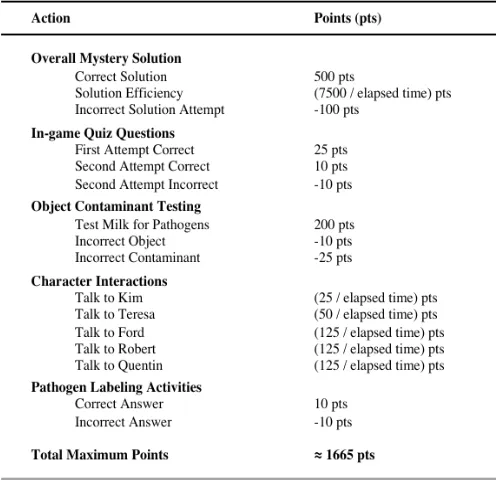
Table 3.1 Calculation scheme for in-game score ... 53
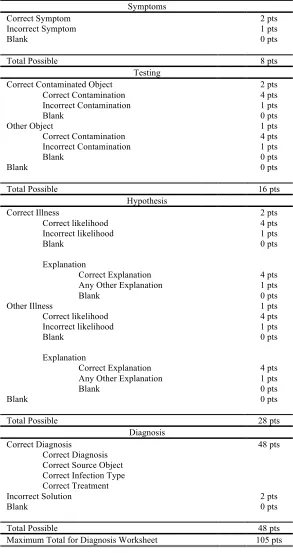
Table 3.2 Calculation scheme for scoring the diagnosis worksheet... 55
Table 3.3 Hierarchical multiple regression table predicting content learning... 59
Table 3.4 Hierarchical multiple regression table predicting content learning... 59
Table 3.5 Hierarchical multiple regression table predicting final in-game score... 60
Table 3.6 Final in-game score separated by prior knowledge and diagnosis worksheet score... 61
Table 3.7 Differences in learning gains divided by prior knowledge and diagnosis worksheet performance... 65
Table 3.8 Differences in learning gains divided by diagnosis worksheet performance and prior knowledge... 65
Table 3.9 Prior knowledge by diagnosis worksheet learning level differences ... 66
Table 3.10 Means for select pre-, in-, and post-interaction variables by prior knowledge and worksheet score ... 68
Table 3.11 Average overall diagnosis worksheet scores separated by prior knowledge .. 70
Table 3.12 Symptoms section averages over time by prior knowledge... 71
Table 3.13 Testing section averages over time by prior knowledge ... 73
Table 3.14 Hypothesis section averages over time by prior knowledge ... 74
of gameplay divided by diagnosis worksheet use ... 79 Table 4.1 Accuracy percentages for classification models predicting diagnosis worksheet
performance with regard to time ... 87 Table 4.2 Areas under the ROC curve for diagnosis worksheet critical time models... 88 Table 4.3 Accuracy percentages for classification models predicting diagnosis worksheet
performance + prior knowledge with regard to time... 88 Table 4.4 Areas under the ROC curve for diagnosis worksheet performance + prior
LIST OF FIGURES
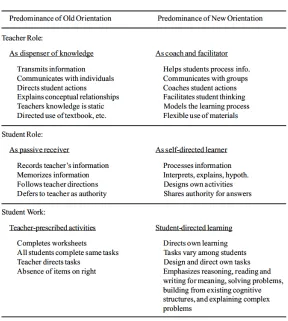
Figure 2.1 A comparison of the orientation of old curriculum versus inquiry-based
curriculum ... 9
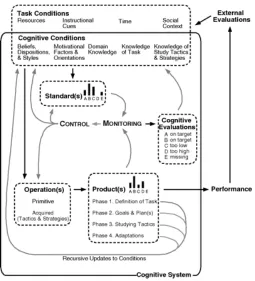
Figure 2.2 Winne and Hadwin’s (1998) model of self-regulated learning ... 25
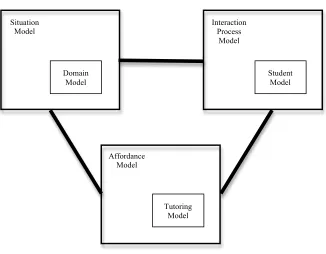
Figure 2.3 Akhras & Self (2000) architecture for modeling the process of inquiry learning... 35
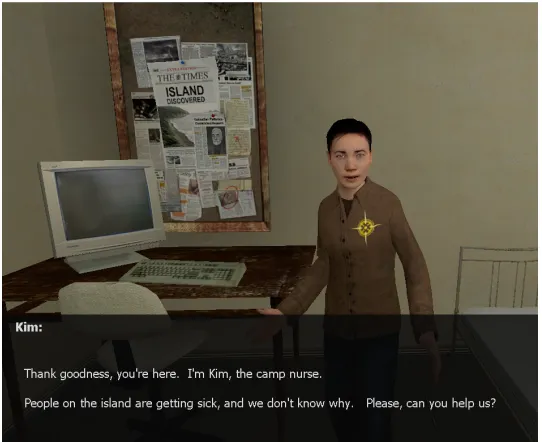
Figure 3.1 The CRYSTAL ISLAND: OUTBREAK learning environment... 48
Figure 3.2 The diagnosis worksheet space... 50
Figure 3.3 Diagnosis Worksheet Use Overtime Separated by Prior Knowledge... 69
Figure 3.4 Symptoms section scores over time by prior knowledge... 71
Figure 3.5 Testing section scores over time by prior knowledge... 72
Figure 3.6 Hypothesis section scores over time by prior knowledge... 74
Figure 3.7 Diagnosis section scores over time by prior knowledge... 75
CHAPTER ONE
Introduction
Inquiry-based learning consists of instruction intended to mimic the inquiry process conducted by scientists and thus requires the active participation of the student. The student, not the instructor, guides learning by asking his own questions, identifying his own learning goals, systematically investigating potential solutions, drawing plausible conclusions, and reflecting on the process (Anderson, 2002). Inquiry experiences develop both domain-knowledge achievements and practical skills mandatory for lifelong learning (Anderson, 2002; Marx et al., 2004). For this reason, several federally funded research agencies have started to significantly support efforts geared towards supplementing current curriculum with inquiry-based activities (Bransford, Brown, & Cocking, 1999; American Association for the Advancement of Science, 1994).
know about the subject (Anderson, 2002). The learning is then tailored to the individual student as opposed to the one-size-fits-all mentality of traditional instruction. Moreover, these experiences provide ample opportunity for students to practice general inquiry skills such as asking good questions and forming reasonable conclusions, which can be transferred to other learning environments.
Inquiry-based learning does pose several execution challenges. The constructive nature of inquiry learning takes a significant amount of time, which is often inconsistent with curriculum demands (Driver, 1995). Also, students often lack the skills necessary for inquiry learning (de Jong & Njoo, 1992) thus resulting in inadequate experiences often leaving the student no better off than they were before (Kirschner, Sweller, & Clark, 2006). Moreover, given the deficit in inquiry skills, students often experience cognitive overload during inquiry learning and find it extremely difficult to even completely understand the problem at hand (Kirschner, Sweller, & Clark, 2006).
Inquiry skills are analogous to self-regulatory skills (Kuhn, Black, Keselman, & Kaplan, 2000). Self-regulated learning involves learners taking an active role in the learning process by setting their own goals, monitoring the progression towards these goals,
skills are developed through external modeling and facilitation, which, in turn, students internalize, practice, and automate overtime. Therefore, factors from a learning environment can be designed or leveraged to aid students’ development of self-regulatory skills (Schunk, 2001; Zimmerman, 2001b).
Moreover, inquiry-based learning environments provide an excellent platform for self-regulated learning instruction given their dependence upon self-regulatory behaviors for success (Azevedo, 2002). Self-regulatory behaviors must first be modeled for students in order for them to emulate these behaviors (Schunk, 2001; Zimmerman, 1990). Then, after practice, students implement the presented behaviors during their own learning and finally integrate the skills as part of their own repertoire for learning for use during other learning tasks (Schunk, 2001). Thus, through careful guidance during inquiry-learning, students are afforded the opportunity to acquire domain-related knowledge while also practicing skills for lifelong learning.
Providing the necessary guidance for self-regulatory support can be difficult,
of reach and progressively fade the support as the student develops cognitively (Hogan & Pressley, 1997). Students receiving unnecessary guidance or guidance beyond their zone of proximal development perceive scaffolding as obsolete, and scaffolding in this context often negatively interferes with cognitive processes currently occurring (Hogan & Pressley, 1997). Therefore, careful assessment of a student’s cognitive and metacognitive abilities is
obligatory for providing effective scaffolding (Azevedo & Hadwin, 2005; Pintrich & Zasho, 2002).
Advancements in computer-based learning environments and artificial intelligence techniques provide optimism for creating productive inquiry-learning environments. Virtual representations of inquiry resources such as references (e.g., textbooks, experts, tools) can be embedded within real-world settings (e.g., a well-equipped laboratory) to provide students with out-of-the-classroom experiences. Furthermore, cognitive and metacognitive resources can be introduced to help scaffold inquiry behaviors such as hypothesis generation and experimental design (Liu, Horton, Corliss, Svinicki, Bogard, & Kim, 2009; Azevedo et al., 2009; Veermans, de Jong, & van Joolingen, 2000). Also, by capitalizing on student modeling techniques, the entire inquiry experience can be supplemented through prompting or
modifications to the environment that subtly encourage students to engage in activities particularly advantageous for the inquiry experience without disrupting the experience (Rowe, Shores, Mott, & Lester, 2010c; McQuiggan, Goth, Ha, Rowe, & Lester, 2008; Veermans, de Jong, & van Joolingen, 2000; Akhras & Self, 2000).
environments situate learning within engaging, story-centric problem-solving scenarios that provide students with several opportunities for autonomy and utilization of self-regulatory behaviors. Azevedo et al. (2009) suggests metacognitive tools be embedded within the learning context; therefore, narrative-centered learning environments provide multiple means for providing cognitive and metacognitive tools through use of the narrative (for full
discussion see Shores, Robison, Rowe, Hoffmann, & Lester, 2009). Further, advancements in intelligent narrative technologies offer techniques for tailoring the narrative experience to the user without disrupting the learning experience (Rowe et al., 2010c). The environment adapts to the student creating subtle, yet favorable, modifications to the inquiry process. By
juxtaposing learning situations proven to be profitable for learning with complex computational modeling techniques, learners can engage in inquiry experiences without suffering from extraneous cognitive load due to inadequacies in inquiry and self-regulatory skills.
Overview of the research
student must use resources scattered around the island to investigate, diagnose, and treat the mystery illness.
Specifically, among other resources, students are equipped with a diagnosis worksheet, a narrative-centered metacognitive tool for organizing information, forming hypotheses, and diagnosing the illness. Students are told to complete the worksheet as means for communicating to the camp nurse about the intricacies of the illness. The diagnosis worksheet is designed to be a compensatory resource for students lacking sufficient domain-knowledge as well as inquiry skills.
The present research is designed to investigate the utility of the diagnosis worksheet as a compensatory resource for students interacting with the CRYSTAL ISLAND: OUTBREAK environment. Furthermore, modeling techniques informed by student actions during their interaction are applied to investigate the possibility of identifying the type of students who find the diagnosis worksheet useful, as well as, students who could potentially benefit from a more effective use of the space.
Thesis organization
CHAPTER TWO
Related Work
Inquiry-based learning
Inquiry-based learning involves inverting our general concepts of traditional instruction where the learner is a passive recipient of transmitted information from an instructor. Instead, with inquiry learning, learners are simply supplied with the necessary inquiry resources and charged with constructing, testing, and revising their own hypotheses by collecting and analyzing information, consulting supplemental material, seeking expert advice, and engaging in beneficial discussions with others (See Figure 2.1; Bransford, Brown, & Cocking, 1999; Anderson, 2002). In such environments, the instructor and instructional texts shift from being the single source of information to merely ancillary aids by providing assistance on student-generated and guided tasks (Alvarado & Herr, 2003). Inquiry-based learning techniques complement domain knowledge acquisition with
developing functional skills that “will enable them to construct new knowledge” regardless of domain thereafter (Kuhn et al., 2000, p. 496). For example, science inquiry learning provides students with the opportunity for attaining general inquiry skills, specific
investigation skills such as controlled experimentation, modeling, and data analysis, and an improved understanding of science concepts (Edelson, Gordin, & Pea, 2000).
learning. A longitudinal assessment of inquiry-based learning in urban, public schools
revealed promising implications for its use in the classroom (Marx et al., 2004). Several other investigations revealed when constructed with careful attention to individual student needs, the success of inquiry-based learning is truly undeniable (Hmelo-Silver, Duncan, & Chinn, 2006; Anderson, 2002). Therefore, the construction of archetype inquiry-based learning environments should be informed by social constructivism, the theory in which it is grounded.
Theoretical framework
Inquiry-based learning is motivated by Piagetian and Vygotskian theories of constructivist cognitive development. Fundamentally, constructivist cognitive development suggests
knowledge acquisition is an active and ongoing process of thoughtful, internal perception and elaboration of incoming information with prior knowledge (Piaget, 1983). Individuals
personally create meaning from information presented by the current environment based upon environmental factors and what is already known; thus, no two knowledge bases are identical. Knowledge is therefore not truth, but rather, viable, functional information−be it procedural or episodic−incrementally constructed from independent experiences (von Glasersfeld, 1995).
As with any scientific theory, subsequent hypotheses have given rise to numerous tangential propositions−predominantly concerning the internally versus externally directed construction (Shotter, 1995). From a Piagetian, individual constructivist point of view,
knowledge is a conceptual network comprised of individually created schemata that represent personal abstractions of the world (Piaget, 1983). Abstractly, knowledge acquisition occurs either when novel information is incorporated into an existing schema, known as
suggests that through guidance, learners can achieve greater, more cognitively profitable behaviors that would otherwise be unattainable. In other words, our knowledge and cognitive development is highly conditional upon, among other things, the guidance we receive, and personal and situational factors; therefore, typically, no two learners hold identical
representations for an identical concept (Akhras & Self, 2000)
The success of social constructivist instruction requires that “learning occurs within a context that is itself part of what is learned, knowing and doing [are not] separated, and learning is [understood to be] a process that is extended over time” (Akhras & Self, 2000, p. 6). Edelson (2001) explains students in a constructivist environment are motivated to learn by recognizing the need to attain new knowledge. During their acquisition of knowledge, these students understand the first step to learning is defined by building new or modifying existing knowledge structures for the incoming information. Students understand the importance of generating meaningful and plentiful connections between the new and pre-existing
knowledge structures. Finally, external factors provide compensatory aid, a factor often obligatory for success in such environments (Mayer, 2004). These assumptions are further discussed below.
abilities to acquire information. Finally, quick learning refers to the time and effort necessary for learning. Because the crux of constructivism is the notion of subjective, not absolute, truths developed continuously overtime (von Glasersfeld, 1995), social constructivist environments assume learners view information as incremental, relative, and subject to change, and perceive its acquisition requires active effort. Epistemological beliefs can be indicative of cognitive strategy use (Schommer, 1993). For example, Dweck and Leggett (1988) found students who believe in a dynamic ability to learn are more likely to take on more cognitively challenging tasks and implement various study strategies to achieve the task. On the other hand, students with low beliefs about the fluidity of knowledge acquisition ability are more likely to simply give up when presented with difficult problems. These findings further necessitate the requirement of sophisticated epistemological beliefs for eliciting profitable learning from such environments. A student with constructivist awareness recognizes learning as a goal, or a personal responsibility, perceives problems in terms of personal knowledge representations, and derives implicit motivation for solving the problem by viewing it as an obstacle to that goal; however, representing a problem in personal terms is not always achievable without assistance (von Glasersfeld, 1995).
“learning occurs within a context that is itself part of what is learned”, learning environments should consist of multiple authentic, self-sustaining activities that broaden the range of learning activities by supporting various forms of self-guided and self-generated thought, inquiry, application of material, and reasoning as a means for achieving a learning goal (Veermans, de Jong & Njoo, 2000; Shotter, 1995). Such activities should also be adequately complex to ensure that multiple potential solutions exist, indicative of problems common to the real world (Woolfolk, 2005; Schunk, 2001). Furthermore, providing multiple
representations of a particular concept illustrates various perspectives and is essential for developing cognitive flexibility, where cognitive flexibility refers to sufficiently mastering a learning goal allowing for efficient transfer (Spiro, Feldovich, Jacobson, & Coulson, 1995). Cognitive flexibility is grounded in the assumption that the actual application of previous knowledge will vary depending on the current problem parameters; thus, an efficient
representation consisting of understandings for multiple implementations is vital (Spiro et al., 1995). For transfer to occur, the learner must first recognize the plurality of an existing concept by noticing overlap with a current experience (von Glasersfeld, 1995). Lastly, it is important to note the inclusion of the environment’s self-sustaining parameter. Ill-structured, complex activities can be daunting or overwhelming at first glance and also result in
practical skills transferrable to several domains as ill-structured problem-solving is common during everyday life (Resnick, 1987; Shotter, 1995).
Finally, social constructivist learning emphasizes the importance of external resources and social interactions. First, collaborative problem solving provides opportunities for the development of cognitive flexibility (Spiro et al., 1995). Throughout the problem-solving process, students develop their personal perspective through suggestions for progression, which provides exposure to multiple forms of problem representation, strategies for goal attainment, various applications of transferrable knowledge, justifications for success or failure, and critical thinking during reflection (Spiro et al., 1995). Second, social interactions and external resources also provide circumstances for facilitating learning within a student’s zone of proximal development (Vygotsky, 1978). It is this type of guidance, or scaffolding, that fulfills the self-sustaining parameter described above by breaking down problems in order to help the student to personally represent the problem, avoid misconceptions, ensure comprehensive coverage of the material, and maintain motivation without extinguishing constructivist activities (von Glasersfeld, 1995). Scaffolding within a student’s zone of proximal development is an intricate and fragile process requiring significant attention to attributes of both the problem and the internal state of the learner (Pintrich & Zasho, 2002; Roehler & Cantlon, 1997). Initially scaffolding involves creating a structure for high-level, out-of-reach concepts allowing for student perceptions of control. As the interaction
knowledge and performance demonstrates the necessity for experience.
Proponents of social constructivist theory posit knowledge is not the product of learning but rather the process (Akhras & Self, 2000). The accumulation of perceptions from experiences that construct conceptions is the essence of knowing, as this information is applicable and functional. Therefore, the fundamental paradigm shift differentiating traditional-learning and social constructivist-learning environments, such as inquiry-based learning, involves transferring the locus of control from the instructor to the student (Anderson, 2002). It is the student, not the instructor that actually appends meaning to incoming information. Inquiry-based learning entails providing an open-ended context sufficient for inducing and supporting student-generated inquiry while carefully
accommodating for minimal, yet adequate, guidance through environmental factors, peers, or the instructor (Hmelo-Silver, Duncan, & Chinn, 2007; Anderson, 2002). Consequently, as students believe knowledge and knowledge acquisition is a incremental and personal process, they self-construct the meaning of incoming information in terms of existing prior
knowledge, a process associated with deeper reasoning and processing (Schommer, 1990), while also developing practical problem-solving and inquiry skills.
Challenges
Creating social constructivist learning or minimally guided inquiry environments is a daunting task, which has provoked substantial resistance to the feasibility of this instructional technique. Generally, attempts at inquiry-based learning result in a vast amount of
2000; Hogan & Pressley, 1997; Anderson, 2002), logistically providing adequate scaffolding (Hogan & Pressley, 1997; Mayer, 2004; Kirschner, Sweller, & Clark, 2006), unrefined student beliefs and capabilities (Veermans, de Jong & Njoo, 2001; Driver, 1995; Schommer, 1990), and incongruence with cognitive architecture (Kirschner, Sweller, and Clark, 2006). It should be noted that the challenges presented below often could be accommodated with compensatory forms of scaffolding (Hmelo-Silver, Duncan, & Chinn, 2007); however, effective scaffolding techniques are more easily conceived than executed.
Execution factors
As previously stated, effectively scaffolding a student within his zone of proximal development has undisputed benefits for enhancing cognitive development (Roehler & Cantlon, 1997; Hogan & Pressley, 1997; Vygotsky, 1978). Individual scaffolding can compensate for students’ difficulties experienced during each step of inquiry learning: motivation, knowledge construction, and knowledge integration or refinement (Edelson, 2001). However, providing the necessary cognitive compensation is highly subjective with respect to the current state of the student and the task (Azevedo & Hadwin, 2005; Pintrich & Zasho, 2002); therefore, several factors restrict the execution of persistent one-on-one
attention, which in turn quickly diminishes the advantages of scaffolding (Hogan & Pressley, 1997). Scaffolding’s practicality is inhibited by large class sizes, reasonable teacher training, accurate student assessment, diverse communication styles, and curriculum and time
constraints (Hogan & Pressley, 1997). Support provided by scaffolding a broad ranges from simple motivational feedback to a detailed dissection of concepts, and it can be difficult to properly distinguish between a student struggling with the material and a high-knowledge, yet unmotivated student; thus, appropriate student assessment and teacher training are imperative for proper implementation (Hogan & Pressley, 1997).
performance on post-inquiry-based-intervention assessments (Kirschner, Sweller, & Clark, 2006). The advancement of inquiry instruction demands feasible and adaptive environmental solutions.
Student factors
The design and supplemental requirements are not the only issues impeding the use of inquiry-based learning environments; cognitive skills and incongruence with existing
theories of cognitive architecture are also theorized obstructions (de Jong & Njoo, 1992; Kirchner, Sweller, & Clark, 2006). Social constructivist learning seems to favor sophisticated learners, and its success seems to hinge on having students with the skill set required for inquiry learning success. van Joolingen (1999) defines hypothesis generation, experiment design, prediction, data analysis, planning, and monitoring as the necessary discovery skills. de Jong and Njoo’s (1992) review of inquiry learning revealed students often lack adequate ability to generate robust hypotheses, design systematic experiments, interpret data
efficiently, and form justified conclusions. For example, after being prompted to form a distinct hypothesis, students rarely develop experimental designs for testing said hypothesis (de Jong & Njoo, 1992). Moreover, low-aptitude students are especially susceptible to forming implausible conclusions with negligent support (de Jong & Njoo, 1992). Although an important goal for inquiry-based learning environments is the development of these skills, if students are not guided during this development, it is easy to postulate how misconceptions for both procedural and domain knowledge could occur.
authors base their critique on cognitive load theory (Sweller, 2005), an instructional theory grounded in the limitations of human working memory capacity. Sweller (2005) describes cognitive load theory in the following manner. First, cognitive load theory assumes long-term memory is structured as a seemingly infinite interconnected network of dynamic schemata, structured representations of knowledge. Initially, schemata require conscious retrieval, however, through practice overtime, their retrieval can become unconscious, or automatic. Secondly, cognitive load theory borrows Miller’s (1956) classic theory for working memory capacity: 7 plus or minus 2 chunks, in which a chunk an ambiguous unit of related
information. Reasoning about information through manipulation and integration, the processes involved given novel information, decreases this capacity to roughly 2-4 chunks, and without rehearsal, information held in working memory fades after approximately 20 seconds. Working memory limitations for familiar information, or that previously stored in long-term memory, generally do not apply because these structures already exist allowing for vast amounts of information to be easily chunked, or this information has been automated requiring unconscious effort demanding no working memory capacity. Novel information is responsible for and susceptible to working memory limitations; in other words, novel information in working memory activates the retrieval of related schemata, which is then chunked, and the structure of existing schemata guide manipulation and integration of the novel information resulting in learning.
information being held in working memory simply because of inappropriate instructional design. Principles such as the worked example, split-attention, modality, redundancy, and expertise-reversal effect have all been shown to increase cognitive load (for further
information, see Mayer, 2005). Extraneous cognitive load is just that, useless for learning, and easily reduced through careful examination of the instructional design. The natural complexity of the problem or presented information induces intrinsic cognitive load. Complex problems requiring the integration of multiple concepts inevitably produce higher intrinsic cognitive load than a simple, straightforward problems. Finally, germane cognitive load is beneficial cognitive load yielded during active schema construction. Schema
construction requires active attention to relative prior knowledge and devising ways in which novel information can be integrating. Deep integration occurs when maximum connections are made, a process that requires additional working memory capacity (Valcke, 2001); therefore, greater amounts of space for germane cognitive load provide the more optimal conditions for deep learning. It should also be noted, schema construction mandates
metacognitive monitoring, which also produce demands on working memory (Valcke, 2001). Cognitive maximization can be educationally rewarding; however, only when the extraneous load is minimized to allow for the highest amounts of germane load relative to the mandatory intrinsic load levels.
remains for germane load once problem-related information is perceived. Second, low-aptitude students are particularly disadvantaged (Tuovinen & Sweller, 1999). High-low-aptitude students generally possess existing problem-relevant schemata such as structures containing prior domain knowledge. These schemata can liberate working memory capacity to allow for germane load and also be utilized as a guide for problem-solving and novel information schema construction and integration, better known as learning. Low-aptitude students suffer from a summative effect of minimal external guidance from the problem space and internal guidance because of insufficient prior knowledge. For these reasons, research has shown high prior knowledge students can thrive in inquiry-based settings; however, low prior knowledge students require more guidance (Park, Lee, & Kim, 2009; Tuovinen & Sweller, 1999). The cognitive overload produced for low prior knowledge students during inquiry-based learning commonly leads to frustration and resignation (Sweller, 2005).
The role of self-regulated learning
Cognitive deficiencies deemed responsible for working memory overload are theoretically problematic for self-regulated learning. Self-regulated learning refers to a student’s ability to moderate all internal and external provisions of learning and traditionally consists of three interdependent components: motivation, strategy use, and metacognition (Zimmerman, 1990; Brunning, Schraw, Norby, & Ronning, 2004). Motivation is a student’s regulation of ambition for learning and is often mediated by individual differences such as attributions, self-efficacy, and goal orientation. Strategy use encompasses a learner’s
offloading cognitive processes (e.g., note taking) and help seeking. Metacognition can be loosely defined as “thinking about thinking”, and metacognitive processes are used to monitor and control cognitions and cognitive effort during learning activities. Metacognitive awareness includes thoughts such as judgments of learning and feelings of knowing, which can activate the necessity for employing strategies. Conceptually, inquiry-based learning is quite dependent upon self-regulated learning because inquiry activity is a personal endeavor guided by the student’s curiosity and motivation for acquiring knowledge and achieved by the student’s application of inquiry skills (Graesser, McNamara, & Van Lehn, 2005). Zimmerman (2001a) posits self-regulated learners generally engender motivation for a task and efficiently monitor the process by eliciting necessary amounts of cognitive effort and engaging in effective strategy use and use of one’s environment to ensure sufficient learning occurs. These learners can accurately calibrate feelings of knowing with actual knowing and fluidly manipulate their cognitions to account for deficits in knowledge until the task is deemed accomplished. Although several models exist (Pintrich, 2000; Zimmerman, 1990), the following section further details the intricacies of self-regulated learning processes through use of Winne and Hadwin’s (1998) model.
Winne and Hadwin’s (1998) model of self-regulated learning
self-regulation. Specifically, the authors prescribe five distinct processes, conditions, operations, products, evaluations, and standards, commonly abbreviated as COPES (see Figure 2.2). Winne (2001) explains conditions as either cognitive, information processing resources available for use during a given task (e.g., prior knowledge) or task, external resources available to the learner (e.g., time, scaffolding). Operation is an umbrella term encompassing methods for constructing new knowledge including searching, monitoring, assembling, rehearsing, and translated (SMARTs). Products are schema modifications or creations following a series of operations. Standards are qualifications or specifications for a given product. Finally, evaluations refer to the production of reflective thought regarding the congruence of a product with its corresponding standards.
the task in terms of standards. From this definition an individual then devises a plan for accomplishing the goal. Plans include procedural information as well as related and effective strategies that can be used that will lead to goal attainment with manageable cognitive effort. Often, experts can activate plans previously successful for certain standards and integrate those strategies for achieving the intended goal. The third phase occurs when an individual enacts tactics. This phase involves actively pursuing the determined goal by engaging in the plan as outlined during phase two. Related prior knowledge is stored in working memory as other tactics use this information to construct new knowledge, or products, which entail their own set of corresponding standards. Finally, phase four, or adapting metacognition, serves more of a “lessons learned” role, and its existence is dependent upon the execution of the task. During this phase, an individual makes modifications to existing self-regulated learning schemata−through accreting, tuning, or restructuring conditions−as a result of failed or successful experiences during the execution of the task. The existence of phase four yields verification for self-regulated learning as a learned skill developed overtime. Students must be explicitly instructed and guided to use self-regulatory skills, which increases awareness of their utility, and in turn, developing and enhancing related self-regulated learning schemata which can be applied across problem-solving tasks.
of a task and products elicited during phase three based upon plans set during phase two can be evaluated by comparing products against the generated standards for the task. The
corresponding information produced during these evaluations can then be metacognitively utilized to refine the current problem-solving process. This may involve making revisions to phase two, which then induces an additional cycle of phase three using newly defined strategies. The evaluations can be used to inform schema modifications during phase four.
Figure 2.2. Winne and Hadwin’s (1998) model of self-regulated learning.
Implications for inquiry-based learning
the necessary skills, generally, self-regulatory skills. Unfortunately, younger students, even high-achieving students, are notoriously inadequate at employing self-regulatory
mechanisms, especially in inquiry learning settings (Veermans, de Jong & Njoo, 2000). Boekaerts and Niemvirta (2000) note that teachers are expected to convey information and procedures, monitor student performance, provide feedback, and motivate students to be engaged learners—all processes that hinder the development of self-regulation by making learning the responsibility of the teacher rather than the learner. Research has shown that although most teachers agree that one of the primary goals of education is to develop
intrinsically motivated, self-regulated learners (Paris, Lipson, & Wixson, 1994), few students receive instruction in self-regulated learning in school and few have opportunities to regulate their own learning (Randi & Corno, 2000).
Again, de Jong and Njoo’s (1992) review of inquiry learning revealed students often lack adequate ability to generate robust hypotheses, design systematic experiments, interpret data efficiently, and form justified conclusions. Each of these inquiry inadequacies can be explained through improper use of self-regulatory processes. Insufficient hypothesis
generation is an indication that the student does not completely understand the task at hand; phase one of Winne and Hadwin’s (1998) model. The inability to design systematic
experiments evidences problems with effective planning. Finally, forming justified
scarcity of inquiry-based learning gains is commonly attributed to self-regulation deficiencies (Azevedo, 2005).
Fortunately, self-regulation is a learned skill that can be automated through proper instruction, scaffolding, practice and refinement overtime (Azevedo & Cromley, 2004; Winne, 2001; Schunk, 2001; Kuhn et al., 2000). According to Schunk (2001), self-regulatory competence develops through a four-phase process where learners begin by observing self-regulatory behaviors from factors within a given environment and then emulating them. Learners then engage in self-controlled learning where the observed behaviors are transferred into novel settings. Finally, self-regulation is attained when the learner can not only transfer the observed skills, but also adapt them making them their own to accommodate the current situation (Schunk, 2001; Zimmerman, 2001b).
During the development of self-regulatory skills, students rely heavily on external factors designed to explicitly target the refinement of related behaviors and internal processes. Winne and Hadwin’s (1998) model for self-regulated learning represents these external factors as “task conditions”, or resources and cues that can facilitate the learner’s self-regulatory activities during learning. Self-regulatory instruction can take many forms (e.g. instructor cues, organized workspaces) and are typically mandatory to accommodate for young students’ limitations in self-regulatory development (Zimmerman, 2001b).
Unsurprisingly then, when students are made explicitly aware of self-regulatory processes and providing proper instruction or tools to guide the appropriate use of the processes, they are more likely to implement them into their learning (Azevedo & Cromley, 2004).
self-regulation techniques and also provide a space for presenting novel strategies and metacognitive methods that can be subsequently reflected upon and integrated within existing schemata. Through an instructor’s conscious attention to a student’s individual self-regulatory abilities, existing skills can be strengthened while new skills can be developed. Moreover, inquiry-based learning environments provide several opportunities for integrating self-regulatory resources that can also enhance the development of such skills through structured and organized facilities designed to externally represent the related processes. Both instructional guidance and cognitive or metacognitive tools (to be defined later) can be used during inquiry-based learning to provide support during the modeling and emulation phase of self-regulatory development (Schunk, 2001; Zimmerman, 2001b).
Evidence for this claim is provided by research by Tuovinen and Sweller (1999) in which students received either minimally-guided, inquiry-based instruction or instruction using worked examples. High prior knowledge students benefited from the minimally-guided instruction whereas how prior knowledge students struggled. On the other hand, low prior knowledge students thrived in the worked examples conditions, which proved to be too elementary for the high prior knowledge students (Tuovinen & Sweller, 1999). Therefore, adaptive self-regulated learning scaffolds, scaffolds of the inquiry process, are necessary for creating ideal inquiry experiences regardless of individual differences.
resignation from the task (Kirschner, Sweller, & Clark, 2006). Fortunately, technological support has been investigated as means for mitigating these challenges (Edelson, Gordin, & Pea, 1999).
Technology mediations
Over the past two decades, researchers have begun to capitalize on advances in computing and technology as a means for mitigating the impediments of constructivist-learning environments. As reported by Edelson, Gordin and Pea (1999), Blumenfield, Soloway, Marx, Krajcik, Guzdial, and Palinscsar (1991) suggest technology affords opportunities for “enhancing interest and motivation, providing access to information, allowing active, manipulable representations, structuring the process with tactical and strategic support, diagnosing and correcting errors, and managing complexity and aiding production” (p. 395). Hypermedia (Azevedo et al., 2009), simulations (Veermans, de Jong, & van Joolingen, 2000), intelligent tutoring systems (Biswas, Jeong, Roscoe, & Sulcer, 2009; Muldner & Conati, 2005; Aleven, Roll, & Koedinger, 2004; Litman & Forbes-Riley, 2009), and immersive 3D environments (Barab, Scott, Siyahhan, Goldstone, Ingram-Goble, Zuiker, & Warren, 2009; McQuiggan et al., 2008; Johnson & Valente, 2008; Ketelhut, Dede, Clarke, Nelson, & Bowman, 1997) constitute a subset of computer-based learning environments currently implemented or beginning to emerge in classrooms today that are capitalizing on Blumenfield et al.’s (1991) ideas. While each class of computer-based learning environments entails unique pedagogical implications, their commonality lies in the potential for
immerse students in rich, naturalistic settings that engender the capacity to practice professional skills and reasoning.
More importantly, computer-based learning environments afford spaces for successful inquiry-based learning by mitigating challenges with student self-regulatory behaviors presented above. Computer-based learning environments address several issues concerning the feasibility of constructivist-learning environments by providing
individualized, compensatory scaffolding techniques to accommodate diverse student populations. These resources include cognitive tools, minimal guidance without teacher intervention, and maintaining student motivation and engagement all while developing inquiry skills by allowing manipulation of virtual vocational tools, demanding practical procedural skills, and exposing students to foreign settings otherwise logistically impossible. Advancements in artificial intelligence techniques offer the ability to provide the
individualized instruction necessary for inquiry learning success. The following sections discuss the exploitation of computing as a self-regulatory and inquiry supplement.
Adaptively scaffolding inquiry
The developmental and complex nature of self-regulated learning yields great variability in the level and type of support required for each learner. Expert tutoring, an instructional one-on-one technique shown to elicit significant learning gains (Bloom, 1984), utilizes trained instructors who are able to specifically identify and control problem elements beyond the cognitive reach of the student so the student can continue working at a pace that might generate abilities at the seemingly unattainable level (Lepper, Drake, O’Donnell-Johnson, 1997). The space of “out-of-cognitive-reach” objectives, however, depends on the student and problem attributes, and as noted above, it is not feasible for the instructor of a large class to provide individual attention to these elements. Moreover, significant individual differences in students, the complexity of inquiry-based learning environments, and dynamic shifts in student knowledge during inquiry-based learning, render impossible the
predetermination of when, what, how, and why a student will require support (Akhras & Self, 2000). Lastly, the amount of scaffolding necessary should be considered. Too much support can lead to increased extraneous cognitive load, an effect known as the expertise-reversal effect (Sweller, 2006). Therefore, artificial intelligence techniques such as student and expert modeling are introduced into computer-based learning environments to provide the necessary level of adaptive, individualized support (Wenger, 1987; Van Lehn, 1988).
Conceptually, a student model is computational representations of the learner’s beliefs, misunderstandings, and desires (Akhras & Self, 2000). In other words, student
models attempt to provide an assessment of internal states of the student, which are otherwise unable to be reliably measured. Such models use observable information to make
probabilities given other student behaviors. In principle, if the system can accurately diagnose what the student knows or misunderstands, dynamic adaptations can be made to correct deficits. Adaptations can be direct instruction, hinting, prompting, or pumping.
From a technical perspective, statistical model approaches are often implemented. For instance, Bayesian networks are commonly used to represent dependencies of variables in order to make statistical inferences about a hypothesis given some amount of evidence (Russell & Norvig, 2003). Russell & Norvig (2003) describe Bayesian networks as a directed acyclic graph whose nodes correspond to variables and directed links indicated the parent-child relationship. Each node has an associated conditional probability. Using Bayesian networks, a student model that is given a set of actions the student has already performed can draw probabilistic inferences about the student’s current beliefs and knowledge, which can be used to a computer-based learning environment about optimal progressions.
1994).
To reiterate, the objective of the student modeling enterprise is to construct an objective or quantitative assessment of a student’s current state of conceptual knowledge as means for producing optimal levels of domain understanding (Akhras & Self, 2000; Corbett & Anderson, 1994). Student modeling contributes to scaffolding for a product rather than a process (Akhras & Self, 2000). However, from a social constructivist viewpoint, objective perceptions of knowledge are unobtainable as knowledge is posited as an individual’s cumulative, situation model of experiences (de Jong & van Joolingen, 1998). It is then
impossible to normatively or relatively assess the current or optimal state of knowledge, thus, making a complete representation of the student’s knowledge, a goal in early student
modeling research, unobtainable. Instead, it is important to develop student models that advise and support the student to participate in inquiry actions that sustain engagement in the learning environment, or scaffolds for self-regulated learning behaviors, which is predictive of knowledge construction in inquiry-based environments (Graesser, McNamara, &
Figure 2.3: Akhras & Self (2000) student model for inquiry learning.
Akhras and Self (2000) suggest student modeling for inquiry-based learning should shift from constructing robust models of student knowledge to models informed by both user characteristics and prior actions that predict the most profitable learning situation at that time. As seen in Figure 2.3, high-level estimations of current domain knowledge are useful, but simply one component of a broader anthology of characteristics. The situation model
represents all characteristics of the learning environment provided to the student for learning, including a conceptualization of the desired model of domain knowledge. The interaction process model represents actions occurring within the environment. Again, this includes estimations of the student’s current domain knowledge, but also details from all of the events that have occurred during the interaction. Finally, the affordance model represents the most profitable learning space as informed by both the situation and interaction process model.
Domain Model
Student Model
Tutoring Model Situation
Model Interaction Process
Model
Curriculum planning is a component of this sub-model; however, also included is information about further actions and affordances that could come about as a product of current affordances (Akhras & Self, 2000).
Akhras and Self (2000) incorporate intelligent inquiry-based support in their system, INCENSE, a computer-based learning environment for software engineering. INCENSE uses an intelligent learner model to reason about the educational affordances of potential events rather than to construct instructional support. Given a situation, s, potential events, {e1, e2, e3,
… , en}, each with certain properties, {p1, p2, p3, … , pn} arise. Properties are defined as
characteristics thought to be beneficial for learning. The utility of the corresponding
properties of an event are weighed and the environment is then tailored to encourage events deemed optimal for the inquiry process. The completion of an event by the learner, also known as an interaction, is defined by the time taken to complete the interaction and the entities involved or produced. Entities can include physical objects such as cognitive tools, but also generated material such as a note, hypothesis, or subgoal. The completed interaction informs the model and gives rise to a completely new set of potential situations, {s1, s2, s3, …
, sn}. The cumulative use of certain entities can inform progression (e.g., student has
successfully completed a necessary subgoal for supporting the current hypothesis), the student’s awareness of entity flexibility, and also preference for certain cognitive tools. Entity flexibility in this case means the student’s awareness of an entities relationship, or transfer, to various components of the environment. Information regarding the student’s preferences can be used to inform elicited advice from the model. In sum, the goal of
actions with optimal affordances for a given student.
Similarly, Veermans, de Jong, and van Joolingen (2000) incorporated discovery-learning support in a simulation-based intelligent environment, SimQuest. The researchers apply induction and deduction reasoning techniques based upon a student-generated hypothesis to provide tailored feedback about beneficial inquiry actions. Specifically, the system uses accomplished actions to reason forward about candidate hypotheses currently under investigation, or the system uses a student-generated hypothesis to define necessary actions for thoroughly investigated the hypothesis. Therefore, if a student submits a set of conclusions, the system is able to provide explanation for why the conclusions are incorrect, and suggests ways in which the learner can correct their misconceptions based upon a
comparison of required actions and actions already accomplished. An empirical evaluation of their process model elicited significant domain-related learning gains for students receiving the discovery learning support as compared with students receiving fixed, predefined feedback. However, no evaluation of acquired inquiry skills was conducted.
guide the user to experience certain actions. Interactive narrative technologies have emerged as a resource for developing resources for K-12 education (McQuiggan, Rowe, Lee, & Lester, 2008; Johnson & Valente, 2008; Ketelhut, Dede, Clarke, Nelson, & Bowman, 2007; Aylett, Louchart, Dias, Paiva, & Vala, 2005; Marsella et al., 2003; Si, Marsella, & Pynadath, 2005; Machado, Brna, & Paiva, 2001; Riedl & Stern, 2006; Traum et al., 2008; Barab et al., 2009). With regard to inquiry-process modeling, narrative adaptations can be used in numerous ways to guide a student’s inquiry process (for detailed discussion, see Rowe, Shores, Mott, & Lester, 2010c). Informed by student ability, direct plot adaptations can control the complexity of the problem by requiring more or less action, social scaffolding techniques can be used to inform the degree of guidance elicited through character
interactions, users can be restricted to using certain cognitive tools, and setting characteristics such as lighting can be used to highlight or hide elements. Therefore, similar to techniques used to adapt the amount of presented information in hypermedia environments (Brusilovsky, 2001; De Bra, Brusilovsky, & Houben, 1999), computational models of narrative can be used to minimize or expand the problem space to account for cognitive load issues. Further
implications of using computation models of narrative in educational environments will be discussed later.
Student modeling during inquiry learning involves modeling the process of inquiry rather than the cognitive product of the experience as seen during intelligent tutoring system instruction. Students can be provided with adaptive instruction pertaining to actions
provide adaptive situations with the maximum level of affordances for student benefit. To achieve this, developers of such environments must consider more than merely the current level of student conceptual knowledge, the technique commonly used for intelligent tutoring systems. One such factor is the resources available to the student at that time (Akhras & Self, 2000). Students should be presented with inquiry spaces equipped with cognitive tools tailored to their individual needs and completed actions. Cognitive tools represent a broad range of supportive entities necessary for creating situation models with optimal affordances. These are the entities used by students to actually engage in and inquiry activities and will be discussed in the following section.
Cognitive and metacognitive tools
Coined by Lajoie (1993), cognitive tools encompass an expansive set of external compensatory resources for problem solving. In inquiry-based learning environments, these tools are utilized to mitigate student ability deficits and to maximize the effects of the
experience. Specifically, Liu, Horton, Corliss, Svinicki, Bogard, Kim, and colleagues (2009) define Lajoie’s (1993) four cognitive tool classifications as resources that:
• “support cognitive and metacognitive processes;
• share cognitive load by providing support for lower level cognitive skills so that resources are left for higher order thinking skills;
• allow learners to engage in cognitive activities that would be out of their reach otherwise; and
Cognitive tools are integral because for inquiry learning to be successful, students must search the environment for problem-related attributes that form the infrastructure of the problem, which they must consider through inquiry processes to achieve the ultimate learning goal. Unfortunately, such a task is extremely cognitively taxing for most students (Kirschner, Sweller, & Clark, 2006). In particular, novices who lack mental models for creating internal problem representations find this step especially difficult (Liu et al., 2009). External representations of problems, especially complex problems, have been shown to enhance problem-solving efficiency by offloading information in an organized structure, thereby enabling quick access and progression monitoring (Zhang, 1997). External problem representation spaces extend working memory to an area more equipped for integrating multiple elements simultaneously without the limitations of working memory (Jonassen, 2003); they also aid the development of cognitive structures for creating rich internal representations, a skill indicative of problem-solving transfer (Jonassen, 2003). Therefore, cognitive tools are implemented to assist external representation construction to avoid the detrimental effects of cognitive overload. It should be noted, “external representation” has a connotation of a physical entity; however, prompts for reflective conversations or self-explanations are also considered to be cognitive tools. Several current computer-based learning systems have integrated cognitive tools within their environments to assist with cognitive and metacognitive processes to further enhance the learning experience.
Cognitive tools for supporting inquiry in 3-D environments include entities for
Corliss, Svinicki, & Beth, 2004). The Betty’s Brain environment designed under a learning-by-teaching paradigm for science learning provides the student with ecosystems reference materials as well as instructional support facilities for assisting the student in teaching the agent (Biswas, Jeong, Roscoe, & Sulcer, 2009; Biswas, Leelawong, Belynne, Viswanath, Vye, Schwartz, & Davis, 2004). Finally, several computer-based environments provide a general, free-form space for cognitive offloading in the form of note-taking (Liu et al., 2009; Biswas et al., 2004; Azevedo et al., 2009; Aleven & Koedinger, 2002).
Metacognitive tools for supporting inquiry involve mechanisms for supporting the inquiry process. In terms of Winne and Hadwin’s (1998) model, metacognitive tools are categorized as a component of the task conditions and need support the four phases of self-regulation and the associated processes (COPES) in order for inquiry learning to be
More importantly, when the self-regulated learning instruction was removed, students who had previously received self-regulatory guidance demonstrated more productive behaviors than students who had not previously received guidance (Biswas et al., 2009). During
engagement with MetaTutor, students are modeled certain self-regulatory behaviors, asked to discriminate between good and poor examples of regulatory behaviors, identify self-regulatory behaviors during a learning task, and finally provided the opportunity to
implement such behaviors in their own learning (Azevedo et al., 2009). As a result, students who received this instruction successfully implemented self-regulatory strategies in their own learning more so than those who did not (Azevedo et al., 2009).
Metacognitive tools can also take the form of physical entities in the world.
SimQuest, a simulation-based environment for science learning, provides students with an interactive, hypothesis generation sketchpad. They hypothesis generation sketchpad is an interactive space that guides students in developing robust, justified hypotheses about the effects of the simulation given certain modifications to the input (Veermans, de Jong, & van Joolingen, 2000). The Alien Rescue environment provides students with a solution form that provides an organized space in which the students are guided while providing their
hypothesis and justification (Liu et al., 2009). CoNoteS2, an interactive reading environment, provides students with several means for enhancing their expository reading comprehension by providing metacognitive tools for systematic organization of important information (Hadwin & Winne, 2001). This space can then be used to review the most important
Reading and Thinking), a reading comprehension tool for high school students, explicitly embeds prompts and spaces for comprehension monitoring, paraphrasing, predicting, elaborating and bridging (McNamara, O'Reilly, Rowe, Boonthum, & Levinstein, 2007).
Effective self-regulated learning scaffolding is a complex process, and sketching how it can be achieved is the first step in a more comprehensive research program. Detailed investigations of the types of cognitive tool scaffolding particularly effective must also be conducted. For instance, what cognitive tools are especially useful and how are they
environment
Adaptive scaffolding of the inquiry process and effective cognitive and metacognitive tools have proven to be a source for successful mitigation of frustrations and challenges posed by developing inquiry learning experiences (Azevedo et al., 2009; Aleven & Koedinger, 2002; Liu et al., 2009). However, Zimmerman and Tsikalas (2005) claim self-regulatory support implemented in current computer-based learning environments does not encompass each phase of self-regulation, and more rigorous efforts for the implementation of all forms of meta-level guidance are needed. Investigations to establish what are the most effective cognitive and metacognitive tools for inquiry learning need to be conducted, and this research should consider the implications of tool use within specific learning contexts, as well as individual differences.
Narrative-centered learning environments
Computational models of narrative can be introduced into learning environments. Narrative-centered learning environments situate components of computer-based learning environments in story-centric problem solving scenarios. Fantasy contexts in educational games have been shown to provide motivational benefits for learning (Parker & Lepper, 1992). Narrative features such as pacing and tension can introduce additional challenge to learning tasks and contribute to student motivation. Establishing concrete connections between narrative context and pedagogical subject matter has also been said to support the assimilation of new ideas in young learners (Wells, 1986). Although it is important to remain mindful of potential disadvantages such as seductive details (Harp & Mayer, 1998), a
In narrative-centered learning, students are often provided with details of a backstory and presented with a particular problem, the desired resolution of the narrative. Students then use problem-solving techniques with which they are most comfortable, as well as resources within the narrative environment, to arrive at the desired resolution. Narrative-centered learning environments have been created for teaching social-related skills (Marsella et al., 2003; Aylett et al., 2005), language skills (Si, Marsella, & Pynadath, 2005; Machado, Brna, & Paiva, 2001), and leadership experience (Riedl & Stern, 2006; Traum et al., 2008). Multi-user systems such as Quest Atlantis (Barab et al., 2009) and River City (Ketelhut et al., 2007) utilize 3D immersive environments to provide spaces for science inquiry-based learning. Often these environments employ adaptive techniques developed for tailoring the narrative to user’s actions and preferences using computational models of narrative as presented in earlier sections.
Narrative-centered learning environments have shown great promise for providing an engaging space while also achieving significant content learning gains (Rowe, Shores, Mott, & Lester, 2010a). Preliminary investigations of individual differences during narrative-centered learning game play have revealed significant behavioral differences in student cognitive tool use as a function of aptitude (Rowe, Shores, Mott & Lester, 2010c). However, similar to investigations by Azevedo and his colleagues (2005), attempts to explicitly
minimally and subtly guiding the user, in essence scaffolding inquiry behavior (Rowe, Shores, Mott & Lester, 2010b).
CHAPTER 3
Empirical Investigation
Experimental design
An experiment involving human participants was conducted with the entire eighth grade population of a North Carolina middle school. The primary goal of the experiment was to investigate the impact of different scaffolding techniques on learning and engagement in the CRYSTAL ISLAND: OUTBREAK, a narrative-centered learning environment for eighth grade microbiology. However, no condition effects were observed for either learning or
engagement. Therefore, considering the experiment’s conditions as a whole, secondary analyses were conducted to investigate the following research questions:
RQ 1. What is the role of the diagnosis worksheet as a compensatory tool for inquiry-based learning in a narrative-centered learning environment? RQ 2. What individual differences account for effective diagnosis worksheet
usage?
RQ 3. What behavioral patterns are indicative of the use of the diagnosis worksheet?
The results of this investigation can be used to inform the behaviors of computations models of narrative for providing effective, natural self-regulate learning scaffolding.
The CRYSTAL ISLAND:OUTBREAK environment
mystery narrative is derived from the North Carolina state standard course of study for eighth-grade microbiology. Students play the role of the protagonist, Alyx, who is attempting to discover the identity and source of an infectious disease plaguing a newly established research station. Several of the team’s members have fallen gravely ill, and it is the student’s task to discover the nature and cause of the outbreak.
Figure 3.1: The CRYSTAL ISLAND: OUTBREAK narrative-centered learning environment CRYSTAL ISLAND: OUTBREAK’s narrative takes place in a small research camp situated on a recently discovered tropical island. As students explore the camp, they investigate the island’s spreading illness by forming questions, generating hypotheses, collecting data, and testing hypotheses. To support the inquiry process, students are provided with several cognitive tools: virtual textbooks, informative posters, virtual characters, a personal digital assistant (PDA), a simulation for testing objects for pathogens, and a
interaction. Their potential use is further explained below.
Throughout their investigations, students interact with virtual characters offering clues and relevant microbiology facts via multimodal “dialogues” delivered by characters through student menu choices and characters’ spoken language. Cognitive tools including virtual books and posters supplement the dialogues’ content and other resources encountered in several of the camp’s locations. As students gather useful information, they have access a PDA to take and review notes via a traditional notepad, consult a microbiology field manual, communicate with characters, and report progress in solving the mystery. To test hypotheses, the CRYSTAL ISLAND: OUTBREAK laboratory is equipped with a simulation for testing
potentially contaminated objects for pathogens. The simulation requires students to enter why and what they believe the object is contaminated, and the simulation reveals if their
hypothesis is correct.
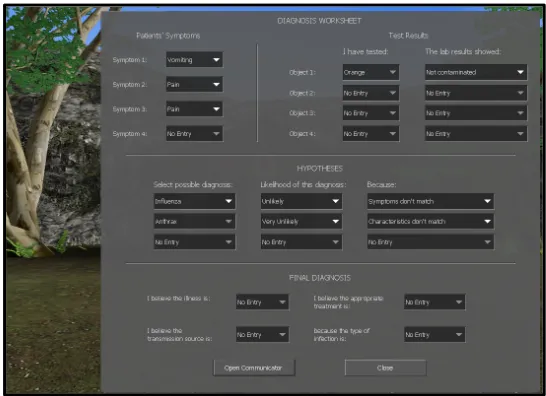
Students are also provided with a diagnosis worksheet to manage their working hypotheses and record findings about patients’ symptoms and medical history, as well as any findings from tests conducted in the camp’s laboratory. The diagnosis worksheet is a
structured note-taking scaffold designed as a metacognitive tools in which the students record information by selecting information via drop-down boxes rather than taking free form notes (see Figure 3.2). This space encompasses a broad range of cognitive and metacognitive tool characteristics to help students break down the problem and guide self-regulatory behaviors by assisting with hypothesis generation, cognitive offloading, and support cognitive