Vol. 3, Issue 3, March 2015
Survey on Feature Subset Selection Algorithm
in Brain Interaction Patterns
K.Vidhyadevia
1, M.Beema Mehraj
2, Dr.K.P.Kaliyamurthie
3Dept of CSE, Bharath University, 173, Agaram Road, Selaiyur, Chennai, India1,2,3.
ABSTRACT: Functional magnetic resonance imaging (FMRI) patterns provides the prospective to study brain function in a non-invasive way. The FMRI data are time series of 3-dimensional volume images of the brain. The data is traditionally analyzed within a mass-univariate framework essentially relying on classical inferential statistics. Handling of feature selection and clustering is a complicated process in interaction patterns of brain datasets. To understand the complex interaction patterns among brain regions system proposes a novel clustering technique. System models each subject as multivariate time series, where the single dimensions characterize the FMRI signal at different anatomical regions. In this survey paper, compares various research parameters for detection of clusters of objects with similar interaction patterns classification and clustering techniques used in it. The study papers was effective to understand the techniques and gives idea to propose select the key features in the preprocessed dataset based on the threshold values and Dimension Ranking algorithm was used to select the best cluster for assuring best result.
KEYWORDS: Data mining, Clustering, Interaction K-means Algorithm, Feature Subset Selection, Dimension Ranking, FMRI.
I. INTRODUCTION
Feature selection for interaction based clustering in interaction patterns among brain images by using feature subset selection algorithm. Feature selection for interaction based clustering in interaction patterns among brain images by using feature subset selection algorithm to provide efficient selection process. The project is to analyze the brain interaction patterns for identifying the state of the brain. Functional magnetic resonance imaging (FMRI) opens up the opportunity to study human brain function in a noninvasive way. The basic signal of FMRI relies on the blood-oxygen-level-dependent (BOLD) effect, which allows indirectly imaging brain activity by changes in the blood flow related to the energy consumption of brain cells. Recently, resting-state FMRI has attracted considerable attention in the neuroscience community. In resting state FMRI, subjects are instructed to just close their eyes and relax while in the scanner. FMRI data are time series of 3-dimensional volume images of the brain. FMRI produce images at higher resolution than other scanning techniques. Data from FMRI experiments are massive in volume with more than hundred thousands of voxels and hundreds of time points. Since these data represent complex brain activity, also the information content can be expected to be highly complex.
Vol. 3, Issue 3, March 2015
among their brain regions. A cluster analysis of motion stream data potentially identifies clusters with similar movements, usually performed by different persons. Time series data are frequently large and may contain outliers.
In addition, time series are a special type of data set where elements have a temporal ordering. Therefore clustering of such data stream is an important issue in the data mining process. Numerous techniques and clustering algorithms have been proposed earlier to assist clustering of time series data streams. The clustering algorithms and its effectiveness on various applications are compared to develop a new method to solve the existing problem. After standard pre-processing including parcellation into anatomical regions, each subject is modeled as a data object which is represented by a multivariate time series. The nature of the considered images and the objective of the segmentation being multiple, there is no unique technique for image segmentation and segmenting an image into meaningful regions remains a real challenge The algorithm is used to evaluate the values within a regional time and group them together based on the merging criteria, resulting in a smaller list and more number of information is collected and compared with the database and finally abnormality can be detected.
The layout of the paper is as follows. In section II, address the above mentioned techniques and also give a brief on the literature being reviewed for the same. Section III, presents a comparative study of the various research works explored in the previous section. Section IV, describes about future work. Section V gives the conclusion in and lastly provides references.
II. RELATED WORK
In this paper [1] IKM achieves good results on synthetic data and on real world data. It is scalable and robust against noise. Ranking Algorithm improves the efficiency of clustering result there is no separate algorithm for feature selection process Complexity is high. Auto class technique is not applicable if the number of time points varies among the objects, a case frequently occurring in FMRI data. There is no separate mechanism for feature selection
In this paper [2] The k-means method is in fact a perfect candidate for smoothed analysis: it is extremely widely used, it runs very fast in practice, and yet the worst-case running time is exponential. It did not make a huge effort to optimize the exponents as the arguments are intricate enough even without trying to optimize constants. The smoothed analyses so far are unsatisfactory as the bounds are still super-polynomial in the number n of data points
In this paper [3] Classification decisions are supported by class-specific interaction patterns within the time series of a data object. It would be also interesting to design model-based classifiers for FMRI data and combined FMRI-EEG data sets which are very challenging because of the large number of time series in FMRI data kind of object representation is very natural and straightforward in many applications, not much research on data mining methods for objects of this particular type.
In this paper [4] This leads to a new view about the neural basis of human perceptual decision-making processes. It is also tempting to speculate that the general principles derived from the studies of simple perceptual decision processes reviewed here extend to other settings. Seen in this light, it is not surprising that motor structures seem to have a role in decision formation. It is not yet clear how these structures contribute to decisions that are not linked to particular actions.
Vol. 3, Issue 3, March 2015
In this paper [7] By applying Support Vector Machines (SVM) to the feature vectors, we can efficiently classify and recognize real world multi-attribute motion data using only a single motion pattern in the database to recognize similar motions allows for less variations in similar motion real time recognition of individual isolated motions accurately and efficiently.
In [8] author has monitored the shape deformation patterns in Anatomical structures show up evidently. Shrinkage of the hippocampus and Cortical and sub-cortical gray matter along the directions. Increasing adas-cog and cdr.sb (measures of increasing cognitive degeneration) and decreasing AVLT and Logical scores (measures of audio verbal learning and logical memory.
In this paper [9]Provide a systematic approach to learn the nature of such time warps while simultaneously allowing for the variations in descriptors for actions. Activity recognition is not very robust to intra- and inter-personal changes of the same action, and are extremely sensitive to warping of the temporal axis due to variations in speed profile activity recognition are not very robust to intra- and inter-personal changes.
In this paper [10] This should provide enough information to allow anyone to reproduce Auto Class, or to use the same evaluation functions in other contexts where these models might be relevant. We will only deal with real and discrete attributes the task of supervised classification: A related problem is unsupervised classification, where preparation cases are also unlabeled
III. COMPARATIVE STUDY
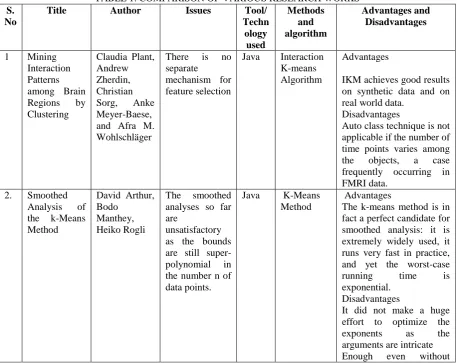
In this section analyzed the various research works on several parameters and presented their comparison in the table below.
TABLE 1.COMPARISON OF VARIOUS RESEARCH WORKS
S. No
Title Author Issues Tool/ Techn ology used
Methods and algorithm
Advantages and Disadvantages
1 Mining
Interaction Patterns among Brain
Regions by
Clustering
Claudia Plant, Andrew Zherdin, Christian
Sorg, Anke
Meyer-Baese, and Afra M. Wohlschläger
There is no
separate mechanism for feature selection
Java Interaction K-means Algorithm
Advantages
IKM achieves good results on synthetic data and on real world data.
Disadvantages
Auto class technique is not applicable if the number of time points varies among
the objects, a case
frequently occurring in FMRI data.
2. Smoothed
Analysis of the k-Means Method
David Arthur, Bodo
Manthey, Heiko Rogli
The smoothed
analyses so far are
unsatisfactory as the bounds are still super-polynomial in the number n of data points.
Java K-Means
Method
Advantages
The k-means method is in fact a perfect candidate for smoothed analysis: it is extremely widely used, it runs very fast in practice, and yet the worst-case
running time is
exponential. Disadvantages
It did not make a huge effort to optimize the
exponents as the
arguments are intricate
Vol. 3, Issue 3, March 2015
trying to optimize
constants.
3 Model-based
Classification of Data with Time Series-valued Attributes
Christian Bohm, Leonhard Laer, Claudia Plant, Andrew Zherdin
Kind of object representation is very natural and straightforward
in many
applications, there has not
been much
research on data mining methods for objects of
this special
type.
Java
Model-based classifier, iterative stepwise algorithm Advantages
Classification decisions are supported by
class-specific interaction
patterns within the time series of a data object.
Disadvantages
It would be also
interesting to design model-based classifiers for FMRI data and combined
FMRI-EEG data sets
which are very
challenging because of the large number of time series in FMRI data.
4 The neural
systems that mediatehuma n perceptual decision making
Hauke R.
Heekeren, Sean Marrett and Leslie G. Ungerleider
Seen in this light, it is not surprising that motor structures seem to have a role in decision formation. It is not yet clear
how these
structures contribute to decisions that are not linked to particular actions
Java
machine-learning algorithms
Advantages
This leads to a new view about the neural basis of
human perceptual
decision-making processes.
Disadvantages
It is also tempting to speculate that the general principles derived from the studies of simple
perceptual decision
processes reviewed here extend to other settings.
5 Clustering of
time series
data—a survey T.Warren Liao Clustering seasonality patterns of retail
data, Cluster
analysis of
country’s energy consumption, Discovering consumer power consumption patterns for the segmentation of markets
Java Relocation
clustering, Relocation clustering, k-Means and fuzzy c-means
Advantages
The goal of clustering is to identify structure in an unlabeled data set by objectively organizing data into homogeneous groups where the within-group-object similarity is
minimized and the
between-group-object dissimilarity is Maximized.
Disadvantages
Vol. 3, Issue 3, March 2015
time series data with different length for each variable.
6 Approximate
Clustering of Time Series Using
Compact Model-based Descriptions
Hans-Peter Kriegel, Peer Kroger, Alexey Pryakhin, Matthias Renz, and Andrew Zherdin
The key issue for approximate clustering is of
course to
generate accurate results
Java Mathematic
al Model,
Efficient Approximat ive Clustering Advantages The great
benefit is that the size of
our approximation
depends only on the
number of Coefficients of the model (i.e. the number of reference time series).
Disadvantages
The distance computation
requires rather high
runtimes and, if the time series are indexed by a standard spatial indexing method such as the R-Tree [1] or one of its variants, this index will perform rather bad due to the
well-known curse of
dimensionality.
7 Feature
Selection for Classification of Variable length Multi-attribute Motions
Chuanjun Li, Latifur Khan, and
Balakrishnan Prabhakaran
Real time
recog-nition of individual isolated motions accurately and efficiently.
Java Support
Vector Machines (SVM)
Advantages
By applying Support
Vector Machines (SVM) to the feature vectors, we can efficiently classify and
recognize real world
multi-attribute motion data.
Disadvantages
Using only a single motion pattern in the database to recognize similar motions allows for less variation in similar motion.
8 Multivariate Statistical Analysis of Deformation Momenta Relating Anatomical Shape to Neuropsychol ogical Measures
Nikhil Singh,
P. Thomas
Fletcher, J. Samuel Preston, Linh Ha, Richard
King, J.
Stephen Marron, Michael Wiener, and Sarang Joshi
Increasing adas-cog and cdr.sb
(measures of
increasing cognitive degeneration) and decreasing
AVLT and
Logical scores
(measures of
audio verbal
learning and
logical memory.
Java Partial Least Squares (PLS) method
Advantages
The shape deformation patterns in Anatomical
structures show up
evidently shrinkage of the hippocampus and Cortical and sub-cortical gray
matter along the
directions. Disadvantages
Shrinkage of the
hippocampus and Cortical and sub-cortical gray
Vol. 3, Issue 3, March 2015
directions.
9 The Function
Space of an Activity
Ashok Veeraraghava
n, Rama
Chellappa, Amit K. Roy-Chowdhury
Activity recognition are not very robust to intra- and inter-personal changes of the same activity,
and are
extremely
sensitive to
warping of the temporal axis
due to
variations in speed profile
Java Nominal
activity trajectory
and a
function space
Advantages
Provide a systematic
approach to learn the nature of such time warps
while simultaneously
allowing for the variations in descriptors for actions. Disadvantages
We will only deal with real and discrete attributes
10 Bayesian Classification Theory
Robin
Hanson, John Stutz, Peter Cheeseman
The task of
supervised classification: A related problem is unsupervised classification, where training cases are also unlabeled.
Java Bayesian
approach
Advantages
This should provide
enough information to allow anyone to reproduce Auto Class, or to use the same evaluation functions
in other contexts
Disadvantages
We will only deal with real and discrete attributes
IV. FUTURE WORK
The case study was very useful to understand the techniques. It is well understood that how the techniques are used to feature Subset Selection Algorithm for Handling Brain Interaction Patterns
Our future work is to design an efficient technique for image segmentation and segmenting an image into meaningful regions in brain image processing.
V.CONCLUSION
The research, a new approach for the feature selection before clustering mechanism has been presented. Feature Subset Selection method used to choose a subset of the original features to be used for the subsequent processes. In this algorithm, initially collect the preprocessed dataset then find out the ranges of the respected dataset. After that, select the key features in the preprocessed dataset based on the threshold values. Interaction K-means (IKM), a partitioning clustering algorithm used to detect clusters of objects with similar interaction patterns classification and clustering. Interaction K-means (IKM), a partitioning clustering algorithm suitable to detect clusters of objects with similar interaction patterns classification and clustering. Finally, Best Ranking algorithm used to select the best cluster for assuring best result.
REFERENCES
[1] D. Arthur, B. Manthey, and H. Röglin, ―Smoothed analysis of the k-means method,‖ J. ACM, vol. 58, no. 5, pp. 19:1–19:31, Oct. 2011.
Vol. 3, Issue 3, March 2015
[3] C. Böhm, L. Läer, C. Plant, and A. Zherdin, ―Model-based classification of data with time series-valued attributes,‖ in Proc. BTW, 2009, pp. 287–296.
[4] H. Heekeren, S. Marrett, and L. Ungerleider, ―The neural systems that mediate human perceptual decision making,‖ Nat. Rev. Neurosci., vol. 9, no. 6, pp. 467–79, Jun. 2008.
[5] H.-P. Kriegel, P. Kröger, A. Pryakhin, M. Renz, and A. Zherdin, ―Approximate clustering of time series using compact modelbased descriptions,‖ in Proc. DASFAA, New Delhi, India, 2008, pp. 364–379.
[6] I. Strigo, A. Simmons, S. Matthews, A. Craig, and M. Paulus, ―Association of major depressive disorder with altered functional brain response during anticipation and processing of heat pain.‖ Arch. Gen. Psychiatry, vol. 65, no. 11, pp. 1275–84, Nov. 2008.
[7] C. Li, L. Khan, and B. Prabhakaran, ―Feature selection for classification of variable length multiattribute motions,‖ in Multimedia Data Mining and Knowledge Discovery, V. A. Petrushin and L. Khan, Eds. London, U.K.: Springer, 2007
[8] A. Veeraraghavan and A. K. R. Chowdhury, ―The function space of an activity,‖ in Proc. CVPR,New York, NY, USA, 2006, pp. 959–968. [9] T. W. Liao, ―Clustering of time series data – A survey,‖ Pattern Recognit., vol. 38, no. 11, pp. 1857–1874, 2005.
[10] P. Cheeseman and J. Stutz, ―Bayesian classification (autoclass): Theory and results,‖ in Proc. Adv. Knowl. Discov. Data Min., Menlo Park, CA, USA, 1996, pp. 153–180.
BIOGRAPHY
K. Vidhyadevi received the B.E degree in Computer Science and Engineering from Arunai Engineering College, Tirunavanamalai in 1998. She Worked as Lecturer for 3 Years at Polytechnic College and Worked as MIS Co- Ordinator for 2 Years at Govt. SSA Chennai. Pursing M.Tech Computer Science and Engineering from Bharath University. Participated in workshops on Android PHP .Net C# programming language.
M. Beema Mehraj received M.Tech in Bharath university Now She is working as an Assistant professor at Bharath University for a years.