An ERP-client benefit-oriented maintenance taxonomy
Celeste See Pui Ng
*, Guy G. Gable, Taizan Chan
Information Systems Management Research Group (ISMRG), Queensland University of Technology, GPOBox 2434, Brisbane, QLD 4001, Australia
Received 17 August 2001; accepted 28 August 2001
Abstract
The worldwide installed base of enterprise resource planning (ERP) systems has increased rapidly over the past 10 years now comprising tens of thousands of installations in large- and medium-sized organizations and millions of licensed users. Similar to traditional information systems (IS), ERP systems must be maintained and upgraded. It is therefore not surprising that ERP maintenance activities have become the largest budget provision in the IS departments of many ERP-using organizations. Yet, there has been limited study of ERP maintenance activities. Are they simply instances of traditional software maintenance activities to which traditional software maintenance research findings can be generalized? Or are they fundamentally different, such that new research, specific to ERP maintenance, is required to help alleviate the ERP maintenance burden? This paper reports a case study of a large organization that implemented ERP (an SAP system) more than three years ago. From the case study and data collected, we observe the following distinctions of ERP maintenance: (1) the ERP-using organization, in addition to addressing internally originated change-requests, also implements maintenance introduced by the vendor; (2) requests for user-support concerning the ERP system behavior, function and training constitute a main part of ERP maintenance activity; and (3) similar to the in-house software environment, enhancement is the major maintenance activity in the ERP environment, encompassing almost 64% of the total change-request effort. In light of these and other findings, we ultimately: (1) propose a clear and precise definition of ERP maintenance; (2) conclude that ERP maintenance cannot be sufficiently described by existing software maintenance taxonomies; and (3) propose a benefits-oriented taxonomy, that better represents ERP maintenance activities. Three salient dimensions (for char-acterizing requests) incorporated in the proposed ERP maintenance taxonomy are: (1)whois the maintenance source? (2)whyis it important to service the request? and (3)what––whether there is any impact of implementing the request on the installed module(s)?
2002 Elsevier Science Inc. All rights reserved.
Keywords:Case study; ERP characteristics; Maintenance taxonomy; Business benefit; Patch maintenance; Upgrade; User-support; ERP maintenance definition
1. Introduction
An enterprise resource planning (ERP) system is en-terprise-wide packaged application software with fully integrated business processes for enterprise manage-ment. ERP sales saw dramatic growth in the nineties. Today ERP has become a basic business information-processing requirement for many organizations. Over the last decade, organizations worldwide have spent
around $300 billion on ERP implementations (James and Wolf, 2000). Despite their huge price tag, many organizations introduced ERP systems seeking best business practices, tightly coupled system integration, economies-of-scale for maintenance support, competi-tive advantage, and globalization potential. The ERP installed base now comprises tens of thousands of or-ganizations worldwide and millions of licensed users (Girard, 2000).
Similar to in-house software, it has been observed that costs of maintaining ERP can exceed those of initial software implementation, with average annual ERP maintenance costs estimated at 25% of original imple-mentation costs (Glass and Vessey, 1999). This obser-vation is akin to that made in the early seventies, when it was realized that the rapid adoption of IS had led to an
*
Corresponding author. Tel.: 3864-1971/9478; fax: +617-3864-1969/9390.
E-mail addresses: [email protected], [email protected] (C. See Pui Ng), [email protected] (G.G. Gable), taizan@fit.qut. edu.au (T. Chan).
0164-1212/02/$ - see front matter2002 Elsevier Science Inc. All rights reserved. PII: S 0 1 6 4 - 1 2 1 2 ( 0 2 ) 0 0 0 2 9 - 8
‘‘iceberg’’ of software maintenance costs, most of which were hidden below the surface. Organizations often fo-cus on the initial IS investment, paying relatively little attention to total cost of ownership and lifecycle costs of maintenance and upgrades. Glass and Vessey suggest that these post-implementation costs can be 70% of the total software cost (Glass and Vessey, 1999). Further-more, the large ERP installed-base, together with a potentially large number of future ERP adoptions by small- and medium-sized enterprises (SME), is expected to result in a growing ‘‘iceberg’’ of costs associated with ERP maintenance and upgrade.
Despite costly lessons learned from paying insuffi-cient attention to maintenance issues related to in-house developed software, little is known of the nature of maintenance performed on ERP. This paper reviews literature on in-house and ERP software to identify differences between ERP and in-house software main-tenance activities and issues (ÔIs ERP maintenance sim-ply an instance of traditional software maintenance?Õ); describes an exploratory, descriptive case study aimed at better understanding the ERP maintenance environment (ÔWhat are the maintenance activities involved in an ERP environment?Õ); examines the dimensions for char-acterizing ERP maintenance requests; and investigates the sufficiency and suitability for ERP of existing in-house software maintenance typologies (ÔIs there a need for a new ERP maintenance taxonomy?Õ).
Discussion of ERP maintenance activities in this paper is from the client or ERP-using organizationÕs perspective, where maintenance activities pertain to the clientÕs installed version. ERP maintenance activities from the vendorÕs perspective deserve separate discus-sion. It is important to note that prior literature has focused on the two extreme examples illustrated in Table 1 (though little on the left-hand side). In reality, these extremes are rare. ERP are implemented to integrate with many existing in-house systems. Further, in-house development often extensively employs consultants and contractors, and facilities management and maintenance of in-house systems can be outsourced. Maintenance issues associated with integrated ERP and existing leg-acy systems, too is worthy of separate discussion.
IEEE standard for software maintenance defines software maintenance as the ‘‘modification of a software product after delivery to correct faults, to improve performance or other attributes, or to adapt the product to a modified environment’’ (IEEE, 1998). In this study,
we define ERP maintenance as ‘‘post-implementation activities related to the packaged application software undertaken by the client-organization from the time the system goes live (i.e. successfully implemented and transported to the production environment) until it is retired from an organizationÕs production system. A clear and precise definition of ERP maintenance is given by the end of this paper.
We define customization (or configuration) as effort to configure the ERP system using switches/tables pro-vided by the vendor, in order to adapt part of the system to support an organizationÕs preferred business pro-cesses, practices and requirements. (Note that the typical ERP contains 800–1000 business processes, and 8000 or more configuration tables (Glass, 1998). Customization is done by choosing among these business processes and setting the configuration-table values.) On the other hand, the term ‘‘modification’’ refers to changes made to the existing ERP standard code, software properties and functionality.
The paper is organized as follows. In Section 2 we re-view the literature, highlighting differences between the characteristics of ERP and typical in-house software. In light of these differences, suitability of traditional soft-ware maintenance taxonomies for describing ERP maintenance activities is also discussed. In Section 3, the case study is presented, and data collection and analysis are described. In Section 4, maintenance activities in the case organization are identified, and differences and sim-ilarities with in-house software maintenance are exam-ined. A clear and precise definition of ERP maintenance is presented and the salient dimensions for characteriz-ing ERP maintenance requests are determined. ERP maintenance activities of the case organization are then mapped onto existing in-house software maintenance classifications. Based on findings from the literature and the case study, Section 5 describes a new taxonomy of ERP maintenance activities based on client-benefits. The paper concludes with brief discussion of contributions from this study and possible future research directions.
2. Literature review
With the objectives of identifying differences between ERP and in-house software characteristics, and assess-ing the sufficiency for ERP of existassess-ing in-house software maintenance typologies, two main streams of literature are reviewed––i.e. literature on the characteristics and nature of ERP, and literature on in-house software maintenance.
2.1. ERP and in-house software characteristics
It is useful to contrast ERP and in-house software along the software lifecycle phases, i.e. from selection
Table 1
Comparison of two extremes
ERP In-house
ERP-only 100% Custom-built
Fully integrated Loosely coupled with other systems Wall-to-wall, cross function Single function
through replacement. Selection of an ERP system is found to involve not only choosing the software system (i.e. software functionality, and its technological envi-ronment) that fits an organizationÕs business practices or requirements, but also selecting a vendor who is reliable and stable with a reasonable installed base of custom-ers and a good record of customer service and ongo-ing maintenance support (Wilson, 1999; Jakovljevic, 2000a,b,c). Conversely, no such effort (or system selec-tion stage) is required for in-house software. Indeed, custom development involves system specification and physical design. At the acquisition stage, ERP is con-sidered relatively easier to acquire (i.e. bought off-the-shelf) than in-house software (i.e. involves software development). For vanilla (as-is) implementations of ERP (and packaged software generally), little if any system analysis, design or coding are required (Davis, 1988). However, like packaged software in general, ERP is a generic enterprise solution, often requiring custom-ization and (some) unavoidable modifications. Alterna-tively, organizations will accept some degree of misfit (Soh et al., 2000; Stedman, 2000; Martin et al., 2002), and adapt their business processes or operations to the software (Greenbaum, 1996; Hecht, 1997; Bingi et al., 1999; Davenport, 1999; Glover et al., 1999). In-house software, on the other hand, is tailor-made and devel-oped based on the organization-specific structures, cul-ture and business processes (Brehm et al., 2001).
Five main benefits sought from ERP implementation are competitive advantage (Weston and Stedman, 1998; Deloitte Touche Tohmatsu, 1999a,b; Heald and Kelly, 1999; Travis, 1999; Shang and Seddon, 2000; Irani and Love, 2001), globalization (Vernadat, 1996; Gable, 1998; Holland et al., 1998; Freedman, 1999), integrated system (Davenport, 1999; Jakovljevic, 2000a,b,c; Mar-kus, 2001), best practice/business processes (Bingi et al., 1999; Carlino and Kelly, 1999a,b; Deloitte Touche Tohmatsu, 1999a,b; Sieber et al., 1999; Jakovljevic, 2000a,b,c; Markus, 2000), and cost effectiveness or re-ductions (Hicks and Stecke, 1995; Butler, 1999; Carlino and Kelly, 1999a,b; Stein 1999a,b; Norris et al., 2000; Shanks et al., 2000; Markus, 2001). These have been key motivations for the rapid deployment of ERP over the past ten years (Jakovljevic, 2000a,b,c); and, are based on the business perspective (Markus and Tanis, 1999).
ERP provides the opportunity, infrastructure and advanced technologies that allow organization to (1) gain competitive business advantage by preparing the organization for future challenges (Heald and Kelly, 1999; Travis, 1999) and the need to remain competitive, according to Advanced Manufacturing Research, Inc., Boston in (Weston and Stedman, 1998), (2) dynamically adapt, grow and extend businesses (Irani and Love, 2001) and adopt new business strategies or develop new partnerships (Deloitte Touche Tohmatsu, 1999a,b) by having an open system and the capacity to operate
worldwide, (3) increase customer responsiveness, data access and satisfaction by reducing customer service time and facilitating worldwide access and distribution of information about company, product and sales (Ja-kovljevic, 2000a,b,c) by using the customer relationship management (CRM) application, and (4) build cost leadership by achieving economies-of-scale through streamlined processes or shared services (Shang and Seddon, 2000).
The functionality in ERP allows organizations to do business in multiple-currencies and languages, and the uniform interface of ERP-product across national bor-ders have helped facilitate progress towards globaliza-tion and global market development (Gable, 1998; Holland et al., 1998; Freedman, 1999). Globalization enables organizations to operate in the worldwide market (see Vernadat, 1996), provide equivalent levels of service to customers worldwide (Jakovljevic, 2000a,b,c), overcome the problem of information fragmentation, and improve information flow to and from customers, suppliers and business partners. Once achieved, e-com-merce and e-business become possible through second-wave applications such as supply-chain management (SCM), online procurement, and CRM (Jakovljevic, 2000a,b,c).
ERP brings the benefit of full business processes integration and standardization (Deloitte Touche Tohmatsu, 1999a,b; Stein 1999a,b; Whearly, 1999; Ja-kovljevic, 2000a,b,c; Markus, 2000; Markus, 2001). The availability of a wide range of applications and modules in ERP packages has meant that user-organizations can satisfy most of their application needs with the single ERP. This has eliminated integration complexities as-sociated with applications from multiple-vendors and has enhanced information flow among internal cesses. An integrated and centralized system has pro-vided support for complete data visibility for all levels of organizational management, thereby facilitating corpo-rate and stcorpo-rategic decision-making (Hicks and Stecke, 1995; King, 2000; Ross and Vitale, 2000).
According to Davenport and Short (1990), business process is defined as ‘‘a set of logically related tasks performed to achieve a defined business outcome’’ (p. 12). ERP serves as a more controlled and more coherent contact point among the internal business units, re-gardless of geographical separation, and has improved the overall business processes and practices (see Ham-mer and Champy, 1996; Barnes, 1999; Bingi et al., 1999; Davenport, 1999; Sieber et al., 1999). This has also fa-cilitated improved business performance (Deloitte Touche Tohmatsu, 1999a,b) and shortened product cy-cle times (Minahan, 1998).
The characteristics of real-time, single and centralized database, and the availability of maintenance support from the vendor have allowed: (1) operational cost reduction, for example reduction in time and cost
associated with order re-entry errors, data entry, wrong shipment and administrative burden for the sales force (SAP, 2002), (2) savings in integration expenses for different applications from different vendors (Stein 1999a,b), (3) shortened cycle times and reduced invento-ries (Minahan, 1998), and (4) lower maintenance cost, as the cost is spread over many other users (Hicks and Ste-cke, 1995; Butler, 1999; Whearly, 1999; Markus, 2001).
In contrast, in the past, traditional in-house software development focused more on technical aspects such as programming and advanced software engineering tech-niques (Gibson et al., 1999). Although benefits are considered in the feasibility study during the in-house software development, they are primarily meant to get expenditure approval. Once the expenditure is ap-proved, little further attention is paid to benefits, and most effort is expended on technical implementation (Ward et al., 1999). In some cases, technology was uti-lized to speed up existing processes but performance deficiencies of these processes were not addressed (Hammer and Champy, 1996). Some organizations use technology (i.e. the system) as administratorsÕ tool to establish control (Dhillon, 2000) as opposed to deliver-ing benefits. Most of these in-house applications are designed to support an individual operational or tactical area. Hence, integration among these individual appli-cations and business processes is not only loosely cou-pled but also prohibits and complicates centralized decision making processes.
Implementation of a large ERP system requires not only substantial time and effort, but also a wide range of expertise and knowledge (besides knowledge of existing business processes) on the functional aspects of the package, system configuration and system integration, technical knowledge of the related hardware and soft-ware, project management and change management, managing knowledge transfer, and organizing system usersÕ training. ERP-adopting organizations typically lack this expertise and usually outsource these activities to the ERP vendor, hardware vendor, and consulting firms (Simon, 1997; Holland et al., 1998; Sumner, 1999). Implementing in-house software may not demand such a wide range of expertise, as the software is usually con-strained to the expertise and knowledge of the in-house system developers and system users. Also, while having a balanced project team with both internal business people and IT staff is crucial for ERP implementation projects (Shanks et al., 2000), traditional in-house soft-ware has been largely IT driven.
In addition to commonly understood critical success factors (CSFs) such as obtaining and maintaining top management support (Bingi et al., 1999; Sumner, 1999), well-defined implementation scope, and project goal management (Clemons, 1998), two of the most impor-tant CSFs in ERP implementation are: (1) choosing the right business processes (Ross and Vitale, 2000), and (2)
ensuring minimal customization and system modifica-tion (Davis, 1998; Martin et al., 2002). In contrast, the latter two factors are less pivotal for in-house software. In the maintenance phase, there are several obvious differences between ERP and in-house applications. While ERP change-requests may come from either the software vendor or system users and IT-staff (these are discussed in detail in Section 4), in-house software maintenance requests generally originate internally (i.e. system users and IT-staff) only (except as regards other packaged system software e.g. the operating system and database management system). With ERP, maintenance support for bug fixes (Songini, 2000) and regular func-tionality enhancements (Gray, 1998; Stein 1999a,b) are available from the ERP vendor. Though this support may not cover all (internal) user maintenance requests, it distinguishes ERP from in-house software that must be fully supported internally. Traditionally, the process of in-house software maintenance involves maintenance problem area analysis (including identification of the causes, solutions, and trade-offs among different solu-tions), designing the modifications, writing and imple-menting modifications, system and user acceptance testing, and final delivery of the changes into production (IEEE, 1998). With ERP, neither system design nor coding is required if the maintenance originates from the vendor. However, extensive impact analysis may be re-quired for implementing patches introduced by the vendor, in order to determine whether re-application of prior modifications are needed. These must be re-tested and re-verified to ensure that the system is working properly following the patches. Finally, the changes are transported to the production environment (Collins, 1999). The primary motivations for ERP enhancement maintenance among others are to realize more busi-ness benefits. In contrast, in-house software system enhancement has mainly focused on: (1) cost effective-ness of the programs (see Swanson, 1976), for instance improving software code quality, maintainability and enhancing software performance, (2) providing new re-ports and adding data to existing rere-ports (Lientzand Swanson, 1980), and (3) improving quality of docu-mentation (Lientzet al., 1978). (This is not surprising, as the implementation of traditional in-house software is more technical-focused (as discussed earlier) and there-fore organizations tend to forget about benefits in maintenance phase!)
ERP is comprised of tightly integrated application modules. Given its breadth and integration, it is argued that each change to ERP can cause more extensive rip-ple effects and impacts on its existing code (or other integrated application modules) than typical standalone in-house application software. On the other hand, if maintenance patches supplied by the vendor have been thoroughly tested prior to release to clients, user orga-nizations should be largely shielded from these ripple
effects (our experience on the case study suggests that this is not always the case; this is an interesting area of further research). The complexity of in-house software maintenance is reported to be a function of the system size (Banker et al., 1993; Kemerer and Slaughter, 1997; Banker et al., 1998), system age (Lientzand Swanson, 1980; Martin and McClure, 1983; Banker et al., 1989), quality of the original system (Krogstie and Solvberg, 1994), the amount of maintenance done previously (Swanson and Beath, 1989; Gode et al., 1990), and software development practices (such as the use of a code generator and structured techniques) (Slaughter and Banker, 1996). While these may also be the drivers of ERP maintenance complexity for the vendor, the complexity of ERP maintenance for the client organi-zation (when implementing the vendorÕs patches) is largely dependent on the amount of modification done during initial implementation (400-Group, 1998) and post-implementation. This is because the application of patches may cause previous modifications or changes done to the standard code to be overwritten or to no longer function correctly. As a result, each modification may cause extra effort in impact analysis, re-applying previous code, and re-testing the whole system.
Software replacement is one of the major activities involved in software maintenance. In-house software replacement is driven by increasing deterioration of the code structure resulting from cumulative maintenance over time (Lehman and Belady, 1980; Lyons, 1981; Swanson and Beath, 1989). As the code structure dete-riorates over time, it becomes increasingly difficult and requires more effort, to maintain. Thus, maintenance becomes more costly over time. In light of this, it is ar-gued in the existing literature that over time it becomes increasingly more economic to replace the old code by rewriting1the software from scratch (Gupta and Rag-hunathan, 1988; Gode et al., 1990; Chan et al., 1996); that is, when the projected lifecycle costs of maintaining the old system are greater than the costs of rewriting and maintaining a new system. In contrast, the decision to upgrade ERP is usually not driven by code deterioration or anticipated reduction in maintenance costs alone, but by the desire to: (1) realize business benefits of a new version (Deloitte Touche Tohmatsu, 1999a,b; Davenport 2000a,b), and (2) avoid vendor support2 termination
(Craig, 1999; Stedman, 1999). The ERP-adopting orga-nization does not have to develop and re-write the ERP system itself but rather it replaces (or upgrades) the old version with a readily available new version from the ERP vendor. A summary of differences between ERP and in-house software is given in Table 2.
2.2. ERP and in-house software maintenance classifica-tions
In light of differences discussed in the previous sec-tion, here we explore the suitability of traditional soft-ware maintenance taxonomies for describing ERP maintenance activities. A widely accepted and applied classification of software maintenance differentiates corrective, adaptive, and perfective maintenance activi-ties (Swanson, 1976). The main criterion that differen-tiates these three categories is the intention of the maintenance request (which is usually to remedy the cause of the request). The corrective and adaptive maintenance categories are respectively meant to keep the system up and functioning correctly, and to be able to operate well in a new environment. Perfective main-tenance seeks to improve the cost effectiveness of the program, and to better serve the system usersÕ needs. Detailed descriptions of each of these three categories are shown in Table 3.
It is noted that SwansonÕs classical maintenance classification does not consider user-support mainte-nance requests, which are later found, in a study by Abran and Nguyenkim (1991) (on in-house developed application), to account for 22% of the total software maintenance effort. User-support requests are associated with consulting with, and supporting (user) requests relating to the systemÕs behavior, rules and functions. Taking into consideration that ERP is an enterprise-wide system entailing fully integrated application mod-ules and business processes, we believe that responding to user-support requests may constitute a significant ERP maintenance activity, possibly even more signifi-cant for ERP than in-house software. (This proposition is supported in Section 4.2.1.)
Burch and Grupe (1993) propose an extension to SwansonÕs classical maintenance categorization a new dimension called ‘‘preventive’’, which is defined as ‘‘proactive maintenance––[which] consists of a periodic inspection and review of the system to uncover and anticipate problems’’ (p. 25). Preventive maintenance is believed to be less substantial in the ERP maintenance environment. Firstly, the nature of maintenance in an ERP environment is relatively more reactive than typi-cal in-house software. While in-house maintainers are familiar enough with homegrown software systems (which are relatively smaller in size) to do periodic in-spections, familiarizing and gaining full understanding of an ERP system represents a daunting challenge (if not
1This is an extreme case. In practice, this option assumes that all the
relevant documentation and people, who are familiar with the system (in relation to what and how the software system functions), are available in an organization (Glass, 1991).
2Vendors withdraw support for older versions in order to contain
and minimize their own maintenance costs, and to guarantee availability of human resources, skills and services support for their clients. Hence, they must focus their maintenance support resources on one or few version(s). While this is of interest, this paper focuses on maintenance of ERP from the client perspective.
Table 2
Summary of differences between ERP and in-house software
Phase Issue ERP In-house
Selection, acquisition, and implementation
System selection Require detailed selection process for the right ERP system from the right vendor
System is developed internally and therefore no vendor or software selection is required Acquisition
method
Bought off-the-shelf; there is some misfit; and most of the time customization and/or modification are required
100% Tailor-made with no misfit
Deployment purpose
Gain competitive advantage; achieve globalization; adopt best business practices; benefit from an inte-grated system; outsource maintenance support
Speed up business processes; utilize ad-vanced software engineering techniques; and facilitate management support in each individual functional area (loose integration among business processes)
Level of decision support
Facilitate top management/executive corporate and strategic decision-making
Mainly to support lower- and middle-level management to carry out operational and tactical planning and tasks
Implementation staff
Involve outsourcing to the ERP vendor, hardware vendor, and consulting firms; and require a balanced project team of business and IT staff
Involve mainly internal (both IT and system users) staff
Implementation success factors
Choosing the right business processes; ensuring minimal system modification
Relatively lesser effort is required to choose business processes or to conduct system modifications; system modifications are not an issue
Maintenance Maintenance originator
Vendor, and system users and IT-staff System users and IT-staff Maintenance
activities
No coding or system design is required if the request is from the vendor; may involve extensive impact analysis, reconfiguration, re-applying the previous modifications, and re-testing the whole system
System design, program design, coding, unit-testing
Maintenance motivation
Realize more business benefits: competitive advan-tage, globalization, best business practices, improved system integration, cost reduction
Focused on the technical aspects––program maintainability and performance, docu-mentation quality
Impact on other application modules
Ripple effects across tightly integrated modules can be extensive and complex; however, for patches these are usually borne by the vendor in advance of release of the patch
Each maintenance task has relatively lesser impact on the other application modules
Drivers of maintenance complexity
Amount of previous modifications or changes made to the software––including add-ons/extensions done during the initial implementation, and post-imple-mentation
SystemÕs age, size, amount of maintenance done previously, and the original software quality, development practice
Replacement Drivers of software replacement
Driven by benefit realization, and vendor support termination
Driven by increasing code structure deteri-oration, and maintenance and rewrite costs Disposal method Upgrade to readily available new version from the
market
Rewrite the software from scratch with fresh code
Table 3
SwansonÕs categories of maintenance activities (Swanson, 1976, pp. 492–493) Maintenance category Objective
Corrective Correct errors in a program (i.e. processing failure); fix program that does not perform satisfactorily (i.e. perfor-mance failure); and repair violations (if any) of the predetermined programming-standards (i.e. implementation failure)
Adaptive Adapt a program to a changed environment (data and/or processing environment)––for example logical
restructuring of a database, installation of a new hardware or operating system version, recoding existing program Perfective Eliminate program processing inefficiency such as inferior computational algorithm, inappropriate language features or poor use of computer operator time; enhance program performance; reformat report to improve the readability; add new data element in a report; add new functionality, insert comments in a program; rewrite program documentation; improve program maintainability––to make the program to be more easily modified (when it must be modified)
impossibility) to ERP maintainers because of the sys-temÕs size, and complicated application logic. Secondly, this type of system inspection is more likely to be initi-ated and monitored by the vendor rather than the ERP-using organization partly because of limited access to the system code and the availability of maintenance-support from the software vendor, and because of ap-prehensions about the ripple effects that may result should this maintenance be implemented by the client organization. Brehm et al. (2001) too suggest that pre-ventive maintenance is a task for the vendor, not clients. A more recent maintenance classification proposed by Chapin (2000) differentiates 12 types of software maintenance based on evidence of: (1) activities involved in interface support, (2) usage and changes to the doc-umentation, (3) changes to the software properties, and (4) changes to the software functionality. The 12 types are training, consultive, evaluative, reformative, upda-tive, groomaupda-tive, prevenupda-tive, performance, adapupda-tive, reductive, corrective, and enhancive. Table 4 provides characteristics of these classes of maintenance activities. ChapinÕs maintenance classification, while valuable, is believed to be deficient in an ERP context because it does not consider the benefit of doing maintenance, particularly business benefits. ERP software
implemen-tation is a business-project (or business-driven, not simply an IT initiative) (Davenport 2000a,b), having huge impact on an organizationÕs processes and strate-gies (Bingi et al., 1999; Davenport, 1999; Deloitte Tou-che Tohmatsu, 1999a,b). ERP implementation is led by the business people with the IT people playing a much smaller role than in traditional in-house software pro-jects. Both Swanson and ChapinÕs maintenance taxo-nomies place much emphasis on the technical aspects of doing maintenance. As a consequence, the Swanson and Chapin taxonomies are not intuitive to business people who are interested in business benefits (if any) of a re-quest. Most organizations implementing ERP systems aim to derive benefits from the systems, and this factor is undoubtedly the driver for continual maintenance of these systems. However, the traditional taxonomies do not facilitate cost and benefit justification of doing ERP maintenance. The strengths and weaknesses of these two classifications are summarized in Table 5.
Thus far the literature review indicates that ERP is not simply an instance of traditional (in-house) soft-ware. ERP and in-house software differ in fundamental ways. This suggests that it is important to further in-vestigate the activities involved in the ERP maintenance environment, and to collect empirical data to reveal
Table 4
ChapinÕs evidence of maintenance activities (Chapin, 2000, pp. 249–251) Maintenance category Evidence of activities
Support interface Training Providing training to stakeholders about the system implemented
Consultive Making time and cost estimates for proposed maintenance work, serving on a help desk, assisting a customer in preparing a maintenance work request, and making specialized knowledge about the software resources available
Evaluative Studying the source code and other documentation, tracing how a proposed change might ripple, preparing and running tests, examining the interactions between operating system features and the software to be maintained, searching for needed data, and debugging
Documentation Reformative Improving the readability of the documentation, modifying the documentation to incorporate the effects of changes in the local standards manual, preparing training materials, and adding entries to a data dictionary
Updative Replacing obsolete documentation with accurate current documentation, preparing Unified Modeling Language (UML) models to document existing source code, and incorporating test plans into the documentation
Software properties
Groomative Replacing algorithms or components with more elegant ones, changing data naming conventions, doing backups, modifying access authorizations, and recompiling source code
Preventive Restructuring the code to improve maintainability and put in place a base for making a future change to some new technology
Performance Activities that affect the user (but not the functionality) such as improving system up time, replacing algorithms or components with faster ones
Adaptive Porting/adapting the custom-built software to a new platform, increasing Commercial off-the-shelf (COTS) utilization, and moving to object-oriented technologies
Business rules (software functionality)
Reductive Eliminating data from output received by the customer, reducing data flows into or out of the software, and reflecting a customerÕs narrowed business plan
Corrective Fixing detected bugs, adding more defensive programming, and changing the handling of exceptions
Enhancive (concerning the use of the software to get the userÕs work done)
Adding or replacing business rules to extend or expand the systemÕs functionality accessible to the customer, and adding data flows into or out of the software
deficiencies of existing software maintenance taxono-mies.
3. The case study
Given the literature reviewed in the previous section revealed no guiding theory on ERP maintenance, yet there is an urgent need to understand the phenomenon, this study employs the case study research method (Benbasat et al., 1987; Gable, 1994; Yin, 1994). The case study method is also chosen because it offers opportu-nity for the researchers to develop a holistic view (Gummesson, 1988) of ERP maintenance activities.
3.1. Background
We studied a State Government Agency (GA) in Australia. GA was created in 1996 to provide corporate services (such as ERP services) to other government departments. This agency had several years of experi-ence in maintaining its ERP system, a SAP R/3 system. GA is a recognized SAP service provider. The agency was selected for several reasons: (1) GAÕs comprehensive ERP maintenance records; (2) the Information Systems Management Research GroupÕs (ISMRG) strong rela-tionship and involvement with State Government in collaborative research; and (3) the ISMRGÕs ongoing, existing collaborative projects with GA. GA currently runs and maintains two fundamental SAP modules: Finance (FI) and Human Resources (HR). The FI module has been in operation since November 1998 and HR since April 1999. The initial motivation for GAÕs move from its previous finance and human resources management systems to SAP was Year 2000 (Y2K) compliance. At the time of this writing, GA has suc-cessfully upgraded its SAP version 3.1H to the latest SAP version 4.6C.
In managing and maintaining the SAP system, GA runs three SAP environments for development, testing, and production. This is a common arrangement in ERP-using organizations (Parkinson et al., 1999). All main-tenance is done on the development environment first, and then tested in testing environment for system cor-rectness and user acceptance, before being transferred into the production environment. In some cases, the development and testing environments must be iterated through several times before the change reaches the production system.
3.2. Data collection
In addition to various supporting documents, there were three main sources of case evidence. A total of six 1-h interviews were conducted and tape-recorded. In-terviews were conducted with the General Manager, Systems Development Manager, and Systems Opera-tions Manager to obtain background information on GA and to understand their ERP maintenance activities (including reasons for doing the maintenance). These people were invited to participate in this study because of their high level of involvement and responsibility in relation to this research problem. The General Manager holds the seniormost position in the GA organization and is in-charge of executive matters. The main re-sponsibility of the Systems Development Manager is the maintenance and enhancement of the SAP system. The Systems Operations Manager is responsible for ensuring the continuing operation of the SAP system, system administration, and liaising with the service bureau that provides facilities management support (hardware op-erations and maintenance).
A second source of evidence in the case study was the change-request database. At the time of the study, the change-request database contained 1616 data points or change-requests, which were documented from 2
Table 5
Strengths and weaknesses of existing maintenance classifications Existing maintenance
classification
Strengths Weaknesses (in the context of ERP)
Classical (Swanson, 1976)
Based on the objective of the maintenance activity Does not include maintenance activities that are intended to (see Section 4.1 for details):
Provides fundamental classes of maintenance activities: corrective, adaptive, and perfective
Provide user-support to system users
Keep the installed system up to the vendorÕs standard version
Maximize business-benefit of doing the maintenance
Modern (Chapin, 2000)
Based on evidence of activities on interface support, documentation, software properties, and/or software functionality
Does not consider (see Section 4.1 for details) the evidence of:
Provides comprehensive classification of maintenance activities: enhancive, corrective, consultive, training, groomative, evaluative, reformative, updative, preventive, performance, adaptive, and reductive
Maximizing the business-benefit of doing the maintenance activities
November 1998 to 27 June 2000. The database contains information about the types of maintenance requests, maintenance description (i.e. what was modified and activities involved to resolve the problem), time spent on each request and other details for both completed and in-progress maintenance requests.
The third source of evidence was the user-support database containing only requests pertaining to user-support of the SAP system; it captures information on the types of support-request, support-problem descrip-tions (i.e. activities undertaken to solve the problem), and details of the requestors and maintainers involved.
3.3. Data analysis
Tape-recorded interviews were transcribed following the interviews. The transcripts were referenced to pro-vide a reliable description of the GA maintenance en-vironment, including the objectives of doing each maintenance activity (or request type) and benefits of maintaining the ERP system. The transcripts were re-examined throughout the process of data analysis to ensure valid data interpretation. The change-request database and user-support database were analyzed in detailed for evidence of activities involved in each maintenance request type, and to obtain the frequency and effort distributions across GAÕs maintenance activ-ities.
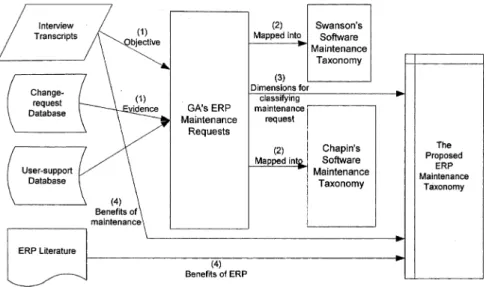
From these observations and our better understand-ing of GAÕs ERP maintenance objectives and activities: we next defined ERP maintenance, then identified sa-lient dimensions for characterizing maintenance re-quests, and mapped the maintenance activities onto the Swanson (1976) and Chapin (2000) in-house software maintenance classifications (see Fig. 1). The objective here is to investigate whether existing maintenance
taxonomies are sufficient and appropriate to classify all ERP maintenance activities.
4. Findings and interpretation
4.1. GA’s ERP maintenance requests: description
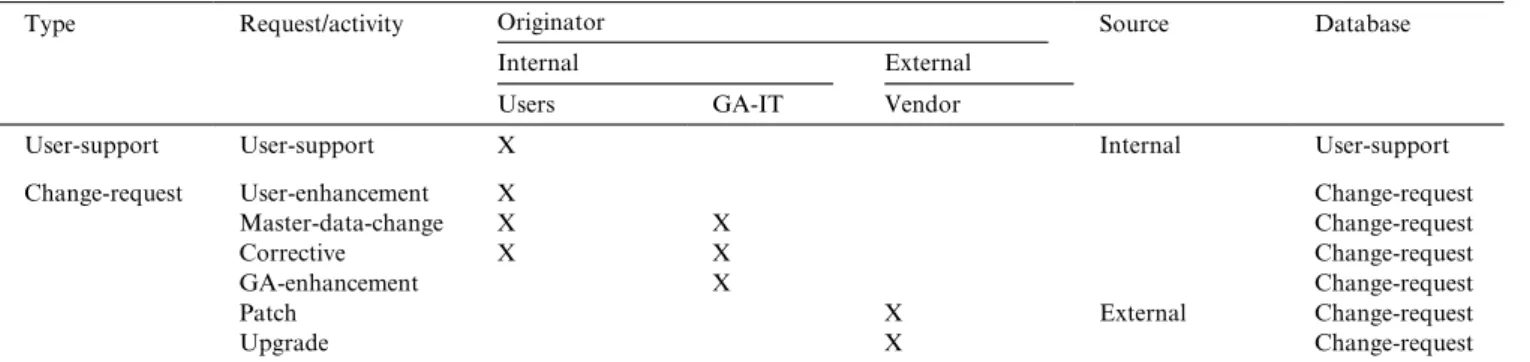
GA differentiates ERP maintenance activities into seven categories: GA-enhancement, user-enhancement, corrective, master-data-change, user-support, patch, and upgrade. GA-enhancement, user-enhancement, correc-tive, master-data change, and user-support are the in-ternally originated maintenance activities. Inin-ternally originated maintenance requests are introduced by two groups: GAÕs IT-staff, and the Government Depart-ments (i.e. GAÕs clients, including GA itself) that out-source SAP to GA. These Government Departments are referred to as the system users. GA-enhancements are initiated by GA IT-staff only, whereas user-enhance-ments and user-support requests are introduced by the system users only. Corrective and master-data-change can be initiated by either group.
Patch and upgrade activities are introduced by the software vendor. While system users incur no incre-mental cost (from GA) for maintenance requests related to master-data-change, corrective, GA-enhancement, user-support, patch or upgrade, costs associated with user-enhancement does flow back to the system users. A change-request in this study refers to either master-data-change, corrective, GA-enhancement, patch or upgrade. GA maintenance activities are summarized in Table 6.
The SAP patches, implemented by GA, are known as legal-change-patches (LCPs) or simply patches (see Section 4.2.4 for more details). According to GAÕs se-nior manager, in version 3.1H LCPs contain not only
corrections and adjustments for legal changes in the Human Resources module, but also for the Finance module.
[. . .] These bug fixes and enhancements could be meant for any module in SAP. Hence, an LCP may comprise some fixes and enhancements for manufacturing, some for accounting, others for payroll, etc. Systems Development Manager, March 2001.
Though the vendor distributes patches on a regular basis, it is the responsibility of the client organization to implement them into their ERP system. Interviews with GA senior managers found that GA implements these patches for three main reasons:
ii(i) Fix bugs in the existing system,
i(ii) Adapt to external environmental changes such as changed Government regulations, and
(iii) Keep the installed system up to the standard re-quired by the vendor.
As regards point (iii), patches are sometimes imple-mented even though they may not be relevant, useful or have impact on the functionality, programs or sub-modules (or the module installed) used by the client-organization.
Some of these LCPs cover modules that are not used [in GA]. Overall, the patches have impact on 30% of our [GA] implementation. However, for LCPs that cover the modules used [by GA], in par-ticular modules such as HR where extensive changes to the system have been made, then exten-sive impact analysis has to be done. Any overwrit-ten custom code will be carefully evaluated and tested. Irrespective of the extent of impact an LCP introduced, only a small fraction (1–5% (max)) of the LCP is deemed really useful [to GA]. Despite the cost associated with incorporating LCP, [GA] has to incorporate all the LCPs to en-sure that their implementation remain a ‘‘standard SAP’’––Systems Development Manager, June 2000.
Keeping an existing system up to the vendorÕs re-quirements by applying the patches is important. One of the senior managers notes:
‘‘This is because of two main reasons: (1) a later LCP works only if earlier LCPs have been incorpo-rated. Thus, to ensure that [GA] is able to exploit an LCP that may be useful, it must also incorporate those that are not; and (2) upgrade cannot be done unless all the LCPs prior to the new version have been incorporated’’––Systems Development Man-ager, May 2000.
On the other hand, GA upgrades to a new version for two main reasons3:
(i) Keep the system a supported-version––i.e. technical upgrade, and
(ii) Obtain new software functionality and more busi-ness improvement––i.e. functional upgrade.
For point (i), GAÕs Systems Development Manager notes:
Given the huge cost associated with upgrade [. . .], GA would not have decided to upgrade if not for the fact that the vendor is withdrawing support for the version we are currently using–– Systems Development Manager, June 2000.
Table 7 includes detailed descriptions of the objec-tives and sample of activities of each GAÕs maintenance request category. (The objectives and evidences of GAÕs ERP maintenance activities are studied in detail here because they are the fundamental characteristics ad-dressed in Swanson and ChapinÕs maintenance classifi-cations. The objectives of these maintenance activities/ requests (i.e. in the second-column of Table 7) have been gathered from interviews with GAÕs senior managers, whereas the evidence of maintenance activities (i.e. in
Table 6
GAÕs maintenance activity classification
Type Request/activity Originator Source Database
Internal External
Users GA-IT Vendor
User-support User-support X Internal User-support
Change-request User-enhancement X Change-request
Master-data-change X X Change-request
Corrective X X Change-request
GA-enhancement X Change-request
Patch X External Change-request
Upgrade X Change-request
3
Note that no data analysis on upgrade requests is possible in this paper because GA was just considering its first upgrade decision during the initial data collection for this research project.
the third-column) are from data captured in the change-request and user-support databases. The activities listed in Table 7 may not be comprehensive, but they represent the majority of activities involved in each maintenance request category undertaken by GA. GA patch-main-tenance is divided in this study into three sub-categories based on distinct maintenance objectives. Similarly, upgrade activity is usefully divided into two sub-cate-gories of activities that are different in nature and meant for different purposes. This table will be intensively ref-erenced in: (1) Section 4.4 where we identifying the di-mensions for characterizing ERP maintenance requests, and (2) Section 4.5 where we map GAÕs maintenance
requests into Swanson and ChapinÕs maintenance taxo-nomies.
4.2. GA’s ERP maintenance requests: basic descriptive statistics
This section presents the basic descriptive statistics, i.e. frequency and effort distributions, of GAÕs ERP maintenance requests derived from the user-support and change-request databases. We first focus on GAÕs internally originated user-support requests, and change-requests. This is followed by discussion on ERP vendor-initiated maintenance activities. Note that GA batches
Table 7
Objectives and activity-evidence of GAÕs ERP maintenance requests GA maintenance
re-quest category
Objective(s) (obtained from interviews with GAÕs senior managers)
Sample activities from change-request and user-support databases
(1) GA-enhancement (initiated by GA IT-staff only)
Aimed at obtaining benefit (e.g. best business practice, integrated system) from the SAP system; reducing the costs of managing and operating the system; and adapting the system to a changed environment
Create report and error-message; change interface and printing format; add program; simplify reconciliation report; additional functionality; update process flow; check the accuracy of a program; audit review; test efficiency of program; prepare documentation; migrate database; and restructure the new SAP Unix environment (2)
User-enhance-ment
Meant to improve the requesting system userÕs business process, including modifying the SAP system to satisfy unique user-departmentÕs pro-cesses; and adapt the system to the userÕs operat-ing environment
Develop new report and new feature in a report; generate interface; create new program or software functionality; improve existing program functionality; and make enhancement and change to existing report
(3) Corrective Aimed at fixing bugs in the SAP system (However, whenever possible for bugs in standard code, only the relevant code in a patch is applied not the whole patch)
Correct duplicate records, incorrect information and missing field in a report; and fix computation error, rounding error, page format, program error and interface error
(4) Master-data-change
Deal with updates to the master data file; docu-mentation to record the changes involved in the system; and adapt to changed environment
Improve data accuracy and consistency; update the system config-uration database; and add access to report tree, table, functional area, transactions processing and program functions
(5) User-support Meant to provide consultation and assistance to the system users regarding the system functions, behaviors and any difficulties associated with human-computer interaction; and provide educa-tion to the system users on the software func-tionality
Provide training details for the ERP module; explain how the system is functioning, operating and behaving; describe how to interact with the system, how to find and enter information into the system, how to complete a transaction using the system and how to get something (report, receipt, printout) out of the system; clarify details on the system error-message; and confirm that a transaction is done correctly
(6) Patch (i) Fix bugs that are found in the (vendorÕs) standard code by applying the whole patch
Implement patches supplied by the vendor; and re-apply previous modifications (if required) (The patch may have very low or high impact on the clientÕs ERP system)
(ii) Adapt the ERP system to conform to a changed environment, such as Government regu-lations
Implement patches supplied by the vendor; and re-apply previous modifications (if required) (The patch may have very low or high impact on the clientÕs ERP system)
(iii) Keep the existing system up to the vendorÕs standard version
Implement patches supplied by the vendor; and re-apply previous modifications (if required) (The patch may have very low or high impact on the clientÕs ERP system)
(7) Upgrade (i) Technical upgrade, ‘‘like to like functionality replacement,’’––to keep the existing system ven-dor-supported
Replace existing system with a new version (supported by the vendor) with the same functionality (but a better technical platform and performance); and re-apply previous modifications (may result) (The upgrade version has high impact on the clientÕs ERP system) (ii) Functional upgrade––providing major
busi-ness improvements and enhancement benefits
Add new functionality and enhanced functionality
* The activities evidence listed here may not be comprehensive but they represent good or dominant examples of the activities involved in that maintenance request category.
patch-maintenance and therefore substantially reducing their frequency (counts) making comparison (of fre-quency counts) with the other maintenance categories questionable. Basic descriptive statistics for GAÕs ERP upgrade is not discussed here since there is only one upgrade project done so far.
4.2.1. Internally originated maintenance requests: user-support
User-support requests are introduced by GAÕs SAP system users. These requests are for consultation or as-sistance with the system functionality and usage, or training in the SAP system. They are recorded in the user-support database. The data analyzed in this section is based upon the maintenance data recorded by GA from 2 November 1998 to 27 June 2000. The number of completed requests and effort spent on this category of requests are shown in Table 8.
A study by Abran and Nguyenkim of in-house soft-ware maintenance showed that user-support requests accounted for 22% of annual total maintenance effort (Abran and Nguyenkim, 1991). In the current study, user-support requests constitute 32% of total mainte-nance effort, over the study period of 20 months. (Note that this percentage is the most conservative, as the total maintenance time for 1438 change-requests is computed using the mean value (¼15.5) from 593 completed maintenance projects––more details is given later. If the
median statistic (¼5.24) is used, user-support requests will constitute 59% of total maintenance effort. On the other hand, if the mode statistic (¼1) is used, user-support requests will account for 88% of total mainte-nance time.) It is noted that the external validity of this finding is limited because both cases compared here are based on a single organization.
In general, this finding supports the earlier suggestion that user-support in an ERP environment may be more important than for in-house software. This can be ex-plained that for in-house software, the system users participate in the software development process (such as prototyping system development), and the system is built based on their business processing requirements and in a way akin to how they always do business. Consequently, the system users do not require as much user-support from the IT-staff as is required in an ERP (packaged
software) environment. Nevertheless, longitudinal study of the distribution of ERP user-support requests would be valuable to further validate the findings in this section.
4.2.2. Internally originated maintenance requests: change-requests
Analysis of GAÕs internally originated change-re-quests (total of 1616 rechange-re-quests) shows that 64%
ðn¼1031Þ are GA-enhancement and 5% ðn¼81Þ are user-enhancement requests (see Table 9). Reasons for the relatively smaller amount of system user-enhance-ments are: first, a desire by requesting users to minimize incremental costs of GA services; and second, GA tends to restrict user-enhancements, which usually involve writing custom code or making changes to SAP code. Though the users pay for their enhancement work, GA absorbs future, ongoing costs of maintaining these en-hancements. Corrective maintenance requests account for 21% ðn¼347Þ of total requests, whereas master-data-change constitutes about 10% of the total. (Of note is that the corrective requests, collected from GA, comprise bugs found in both customized code and in the standard ERP/SAP code.)
Although there are 1616 maintenance requests in the GA change-request database, only 1438 of these have been completed. From that figure, only 593 requests have recorded the effort/time spent in completing the requests. Table 10 shows the effort distribution among GA-enhancement, user-enhancement, corrective and master-data-change maintenance requests for the 593 completed and valid maintenance requests.
It is observed that 64% of GAÕs total maintenance effort on internally originated change-requests is spent on enhancement requests (Table 10); this is inclusive of both GA-enhancements and user-enhancements.
Cor-Table 9
Frequency of internally originated change-requests Internal change-requests Frequency count
# (%) GA-enhancement 1031 64 User-enhancement 81 5 Corrective 347 21 Master-data-change 157 10 Total 1616 100 Table 8
Distribution of maintenance effort: in-house software vs. ERP Maintenance request In-house software (Abran and Nguyenkim, 1991) ERP (Ng et al., 2002)
% of total effort % of total effort Sum of effort (h) % of total # of requests # of completed requests
User-support 22 32 10920 59 2048
Change-request 78 68 22232a 41 1438
rective requests command only 22% of the total effort, whereas master-data-change requests take 8% of the total effort. In general, this study confirms the findings by Glass and Vessey (1999), that enhancement mainte-nance is a major ERP maintemainte-nance activity.
4.2.3. Distribution of change-requests versus user-support requests
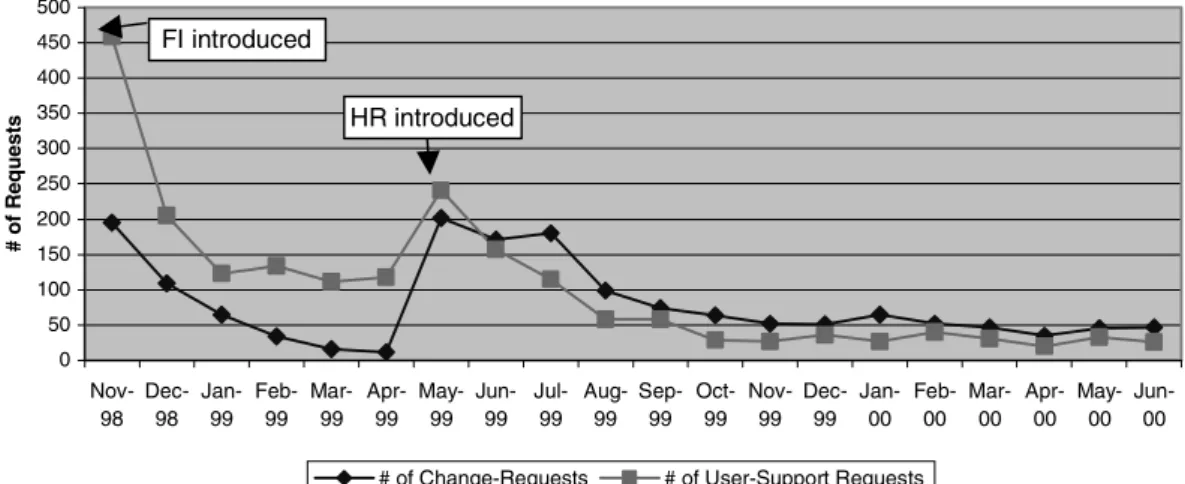
A time series is plotted in Fig. 2; it shows the number of change-requests and user-support requests arriving over the period from November 1998 to June 2000. (The readers need to be careful, since frequency count here is not representative of the amount of maintenance effort.) Fig. 2 shows that the number of user-support requests is relatively larger than change-requests during the first 6– 7 months after the SAP system was introduced at GA. This is because the ERP system is: (1) a new system with which the users are not familiar, and (2) a large system with substantially different interfaces from their earlier system. As a result, they tend to seek advice, training and assistance during the first few months of using and interacting with the system. It is further noted that during the first six months both the change-requests and user-support requests are continually decreasing.
In the seventh month (May 1999), both change-requests and user-support change-requests are found to spike suddenly over 1580% and 100% respectively. This sharp increase in demand for maintenance coincides with the
introduction of SAP Human Resources module (in late April 1999). (The first peak occurred in November 1998 is in conjunction with introduction of the SAP Finance module.)
After the first seven months––i.e. when the users have become more familiar and confident with the ERP sys-tem, the frequency of change-requests and user-support requests begins to decrease slowly over the subsequent 13-month period (Fig. 2). In fact, after using the ERP system for (the first) seven months, user-support re-quests become relatively fewer than change-rere-quests.
Alternatively, from the installation per module per-spective, it is observed that (from Fig. 2) the number of user-support requests will stabilize after 2–3 months of a successful module implementation. It takes two months for the demand for user-support for Finance module to settle down and three months for both the Finance (FI) and Human Resources (HR) modules. In general, it makes sense to expect large a number of user-support requests during the first month after a new module is implemented (e.g. in November 1998 and May 1999). These drop dramatically in the second (in December 1998 and June 1999) and third months (of July 1999), and eventually the number of requests becomes more or less the same thereafter. This finding provides some insights into human resources requirements for helpdesk and other maintenance support, to management. As for change-request, consistent pattern between the FI and HR module, in terms of changes in demand, is also ob-served. However, the demand for change-request seems to become stable five months after both FI and HR go live.
4.2.4. Externally originated ERP maintenance requests: patches
There are only three patch-maintenance records for version 3.1H––in the change-request database: two were completed, and one was still in progress during our first data collection period. GA batches the patches for maintenance purposes (refer to Table 11).
Table 10
Effort distribution among the internally originated change-requests Internal change-requests Efforta
(h) (%) GA-enhancement 3857 42 User-enhancement 2031 22 Corrective 2585 28 Master-data-change 695 8 Total 9168 100 a
The statistics is based on 593 valid data of the requests.
0 50 100 150 200 250 300 350 400 450 500 Nov-98 Dec-98 Jan-99 Feb-99 Mar-99 Apr-99 May-99 Jun-99 Jul-99 Aug-99 Sep-99 Oct-99 Nov-99 Dec-99 Jan-00 Feb-00 Mar-00 Apr-00 May-00 Jun-00 # o f R equests
# of Change-Requests # of User-Support Requests
HR introduced FI introduced
We have chosen to batch LCPs and apply the LCP based on business need, this becomes a problem when there is an LCP addressing a legislative require-ment that we require urgently as we then have to ap-ply a backlog of LCP. SAP seems to assume that you are up to date––General Manager, May 2001.
For example, the first patch-maintenance consists of 34 LCPs numbered 29–62. Note that the implementation of LCPs numbered 1–28 was not recorded in the change-request database as they were done during the initial SAP system implementation. The second patch-maintenance consists of a batch of ten LCPs, numbered 63–72, and the third is a batch of eight LCPs, numbered 73–80. Essen-tially GA batches LCPs in this way to achieve econo-mies-of-scale. GAÕs General Manager suggests:
½. . . Implementing each patch individually would require several times the substantial effort already expended here, and would take up 80% of GAÕs maintenance resources. ½. . . How one manages LCPs can have a huge impact on the costs of main-tenance, and, that oneÕs management strategy is to batch these periodically, and to monitor patches for cumulative benefits and wait until the perceived benefits justify the effort––General Manager, May 2001.
It is found that the first patch-maintenance request was primarily meant to keep the system up to the standard SAP, in order that the second patch-mainte-nance could be implemented. The second patch-main-tenance was stimulated by the need to become fully Y2K compliant, whereas the third patch-maintenance is mo-tivated by the need to deal with new tax regulations (i.e. Goods and Services Taxation––GST) in Australia.
To summarize findings so far, the empirical data analysis on GAÕs ERP maintenance activities sup-ports the earlier suggestion that requests for user-support (concerning the ERP system behavior, function and training) constitute a main part of GAÕs ERP maintenance activities. It is observed that the number of user-support requests will increase dramatically in the first 2–3 months of a successful module implementation and become stable thereafter. Similar to in-house soft-ware environment, enhancement is the major mainte-nance activity in GAÕs ERP environment, encompassing almost 64% of total change-requests effort.
4.3. ERP maintenance definition
Based on the empirical data, discussed in Sections 4.1 and 4.2, this study defines ERP maintenance as:
Post-implementation activities related to the pack-aged application software undertaken by the client-organization from the time the system goes live (i.e. successfully implemented and transported to the pro-duction system) until it is retired from an organizationÕs production system:
• To keep the system running,
• To adapt to a changed environment in order to oper-ate well,
• To provide help to the system users in using the sys-tem,
• To realize benefits from the system (best business pro-cesses or practices, improved system integration, op-erational cost effectiveness), and
• To keep the system a supported-version and meet the vendorÕs requirements for standard code.
These activities include:
• Implementing internal change-requests (initiated by an ERP-using organizationÕs system users and IT-staff),
• Responding or handling user-support requests (initi-ated by an ERP-using organizationÕs system users),
• Upgrading to new versions/releases (introduced by the vendor), and
• Performing patches (support provided by the vendor).
The first two objectives of ERP maintenance are similar to the objectives of in-house software mainte-nance given by Swanson (1976).
Both internal and external change-requests would entail changes to the system properties such as data dictionary, programs, screens, user interfaces, and/or documentation. These comprise bug fixes, adaptation to the external environment, enhancement to existing functionality, additional functionality, and maintaining the system up to the vendorÕs requirements (patches and new releases or upgrade versions). User-support is usu-ally related to software system training, and consulta-tion on the system usage and funcconsulta-tionality.
Table 11
Patch-maintenance
Maintenance Number of LCPs (version 3.1H) Main objective
Request-1 34 Keep the system up to the standard SAP
Request-2 10 Keep the system fully Y2K compliant (for adaptation) Request-3a 8 Adapt the system to the new taxation regulation––GST
Total 52b
a
This was not completed at the point of our initial data collection.
b
4.4. Salient dimensions for characterizing ERP mainte-nance requests
Having gone through the analysis and discussions in previous sections, we observe that ERP maintenance requests can be usefully characterized along three salient dimensions: (1) source of the maintenance request, (2) the existence of any business-benefit, and (3) the exis-tence of any impact of the maintenance on the clientÕs installed ERP module(s).
4.4.1. Maintenance source
As demonstrated from GAÕs maintenance activities, both internally originated and vendor originated main-tenance are substantial. Thus, this dimension ‘‘main-tenance source’’ comprises the two main players: ERP-client and ERP-vendor.
4.4.2. Business-benefit
An observation from Table 7 is that, some of the maintenance requests (such as GA-enhancements and user-enhancements) are meant for realizing more busi-ness-benefits from the system. Some of the GA-enhancements are meant for obtaining benefits for example best practice/business processes, integrated system and cost reduction from the SAP system, and some of the user-enhancements are to improve the re-questing system userÕs business processes. GAÕs Systems Operations Manager states:
½. . .In addition to cost reduction, a main driver of ERP maintenance and upgrade is to maximize busi-ness benefit realization––Systems Operations Man-ager, June 2001.
This dimension ‘‘business benefit’’ distinguishes maintenance requests, which bring business-benefits from those not. The classic maintenance-intentions for keeping an installed version up and running correctly and adapting the software to a changed environment, as well as user-support, are subsumed to be the manda-tory and basic requirements before an organization is considering about business benefit. A maintenance re-quest can contribute to one or more of the business benefits such as best practice or business processes, integrated system and operational cost reduction. A request is perceived to bring business benefit if it:
(1) Improves or enhances the way an organization does business––to streamline best practice or business processes and enhance system integration;
(2) Improves or enhances the existing ERP functional-ity; and/or
(3) Could keep an existing version away from vendor-support termination––cost effective.
4.4.3. Impact on installed module(s)
Based on the earlier discussion in Section 4.1 on the reasons, given by GAÕs senior manager, for doing the patch-maintenance and upgrade, it is found that while some of the maintenance (support) introduced by the vendor are useful, some are not. A maintenance support is perceived to be useful if it is related to and has impact on the module(s) installed on GAÕs ERP system. Patches incorporating bug fixes (or improved functionality) for module, which is not used by GA, are perceived as having no impact on GAÕs ERP system. Besides external requests, internal maintenance requests such as user-support requests also do not affect the installed ERP module(s), when they are serviced or handled. Therefore, they have no impact on the installed ERP module(s).
This dimension ‘‘impact on installed module(s)’’ in-dicates whether a maintenance request has any impact of:
(1) Repairing, improving or enhancing, adding and/or deleting the functionality in the clientÕs ERP mod-ule(s); and/or
(2) Making changes to the ERP software properties, such as configuration files, reports, table, screen, in-terfaces, program documentation, documentation and so forth in the clientÕs ERP module(s) installed. A request is said to have no impact if its implemen-tation does not result in any changes at all to the clientÕs ERP systemÕs functionality and/or ERP software prop-erties.
4.4.4. An illustration using GA as an example
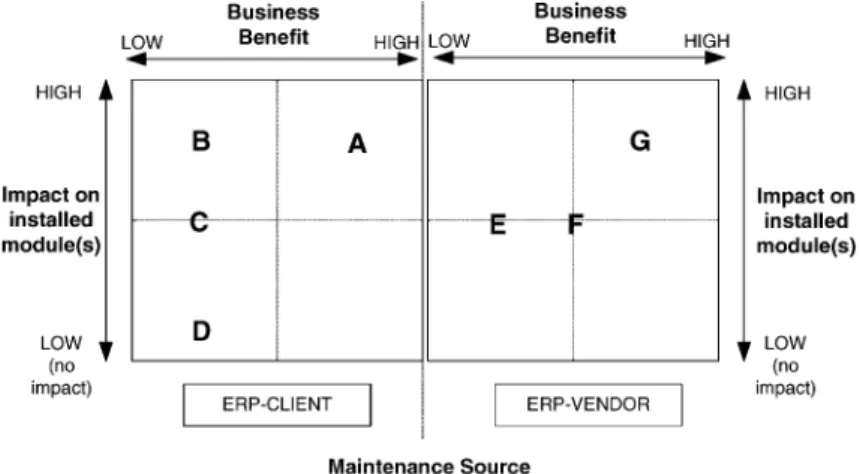
Fig. 3 illustrates how different categories of GAÕs maintenance requests (presented in Table 7) appear on a 3-D illustration of the mentioned three dimensions.
Area-A in Fig. 3: Maintenance categories (1) GA-enhancement and (2) user-GA-enhancement (refer to Table 7) are more likely located around Area-A, in Table 7 because:
• They are initiated by an ERP-client, i.e. GAÕs system users and IT-staff.
• Some of them, which enhance business processes/ practices, system integration and existing functional-ity, or add new functionality to the system, will bring business-benefit(s) to GA and system users.
• These activities (obviously) have impact on GAÕs (the clientÕs) ERP module(s), since they are requested to make changes to the system.
Area-B in Fig. 3: On the other hand, category (3) corrective (from Table 7) is more likely to be found in Area-B, in Table 7 because it is an internal originated request. It does not bring any additional business benefit but has impact on GAÕs ERP system installed module(s).
Area-C in Fig. 3: Maintenance category (4) master-data-change (from Table 7)––pertinent to updating the master data file and documentation falls into Area-C of Fig. 3 as it is introduced internally. This activity is mandatory for adapting to a changed environment; however, it is unlikely to increase any business benefit to GA. This category has impact on the installed module(s) as it involves making changes the software properties such as tables, data fields and data definition.
Area-D in Fig. 3: Category (5) user-support––asso-ciated with the system training, behavior, operating, and functioning (refer to Table 7) is likely to fall in Area-D, in Fig. 3 since it is internally originated, but does not bring any business benefit since they do not improve or change the installed module(s). Therefore, it also does not have any impact on GA installed ERP module(s).
Area-E in Fig. 3: Categories (6(i)) patch-maintenance (for bug fixes) and (6(ii)) patch-maintenance (for adap-tation to the clientÕs changing environment, refer to Table 7) are likely to fall in Area-E, in Fig. 3.
• They are introduced by the vendor.
• These requests are for correcting bugs, and/or adapt-ing the system to a changed environment, where GA is operating. However, they would not contribute to any business-benefit (although if there are not imple-mented, result in barriers to business benefits).
• They are perceived to have high impact on GAÕs in-stalled module(s) if the patches are relevant to its module(s).
Area-F in Fig. 3: The maintenance categories (6(iii)) patch-maintenance (for standard code, and (7(i))
tech-nical upgrade (from Table 7) are more likely to fall in Area-F, in Fig. 3.
• They are vendor initiated.
• They are likely to bring some business-benefit to GA because they keep an existing version a standard ver-sion and avoid vendor-support termination.
• They have impacts on GAÕs installed ERP module(s) as they would replace some (or all) of the custom code in the clientÕs installed version with the vendorÕs standard code. In this case, reapplying previous en-hancements may result, depending on GAÕs system usersÕrequirements.
Area-G in Fig. 3: Maintenance category (7(ii)) func-tional upgrade (refer to Table 7) is likely located Area-G, in Fig. 3. This is because
• It is a vendor-introduced maintenance activity.
• A functional upgrade (involving substantially im-proved and new functionality) would allow GA to realize significant business benefits from the new sys-tem.
• It is perceived highly relevant to an ERP-clientÕs sys-tem functionality as it provides new and improved functionality required by the client.
4.5. Mapping GA’s ERP maintenance requests onto existing maintenance classifications
With further observations made in the previous section (precisely, the three salient dimensions for char-acterizing ERP maintenance request) and better