Department of ECE, Adhiyamaan College of Engineering, Hosur, Tamilnadu, India.
Detection and Prevention of the Malicious
Packet Dropping using Blow fish Algorithm
in Wireless Ad-hoc Network
Ramesh.P 1, Tajammul.J 2, Ragul.M 3 and Mr.Vigna Vinod Kumar.N 4
U.G. Student, Department of ECE, Adhiyamaan College of Engineering, Hosur, Tamilnadu, India1 2 3
Assistant Professor, Department of ECE, Adhiyamaan College of Engineering, Hosur, Tamilnadu, India4
ABSTRACT: The wireless mobile ad-hoc networks is emerging technology has been protected by various systems such as firewall’s, Antivirus, and so on. The MANET is not having any infrastructure or any centralized server to control entire networks. Since every node should rely on other nodes intended for support into routing as well as forwarding packets to the destination. The intermediate nodes might be in agreement to forward the packets although really crash or change them since they are misbehaving. This work provides a solution to identify malicious nodes in wireless ad hoc networks through detection of malicious message transmissions in a network. Additionally to prevents the network from the malicious nodes by using the blow fish algorithm, in order to provide the security to the network by data encryption mechanism. In the proposed method, the detection of malicious node is performed by link error rate and malicious pack drop and then security is provided through blow fish algorithm. Finally, by evaluating the detection rate and the efficiency of proposed method along with the parameters like throughput, packet delivery ratio and delay. The expected results proves to be the best suitable method for detecting as well as preventing the malicious packet drop in the data transmission.
KEYWORDS:MANET, Packet Drop , Blowfish Security , Detection , Prevention
I. INTRODUCTION
MANETs are a type of wireless networks which are rapidly growing because there is no such requirement for setting up an infrastructure for their operational purposes. In such networks, the topology is dynamic, and the nodes are mobile in nature. It must be able to continue their traffic even if the wireless transmission medium is out of range. This effectiveness and flexibility makes these types of networks attractive for many applications. Two node scan communicate or send data packets to each other when they come within the radio range to each other, if they are not in the radio range neighbouring nodes forwards the packet to them. MANETs supports the multi hop communication between thenodes. While performing such operations, it may take into concern that the data cannot be dropped by malicious nodes or misbehaved links. It is still a challenging security concern.
Department of ECE, Adhiyamaan College of Engineering, Hosur, Tamilnadu, India.
collisions can trip the threshold creating false alarms. Basic features of MANETs such as communication via wireless links, resource constraints cooperativeness between the nodes and dynamic topology make it easier to attack. Specifically in MANETs, one of very common attack is dropping data packets through malicious node. In dropping data packet attack and routing packet attack malicious node prevents packets to forward to other mobile nodes and then drop these packets. One of the basic assumptions for the design of routing protocols in MANETs is that every node is equally important and cooperative. That means, if a node claims it can reach another node by a certain path or distance, then protocol takes the claim as real and similarly, when a node reports a link break, the link will not be used for next transmission.
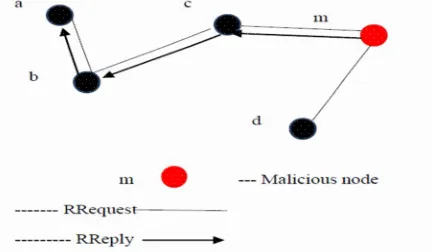
In dropping data packet attack and routing packet attack malicious node prevents packets to forward to other mobile nodes and then drop these packets. One of the basic assumptions for the design of routing protocols in MANETs is that every node is equally important and cooperative. That means, if a node claims it can reach another node by a certain path or distance, then protocol takes the claim as real and similarly, when a node reports a link break, the link will not be used for next transmission. AODV is the commonly used reactive routing protocol in MANET. It is an on-demand protocol, which initiate route request only when needed. AODV is also affected by packet dropping attack. AODV performs better comparing to another protocol like dynamic source routing protocol (DSR). The proposed work adds security features to AODV and has introduced protocol named SAODV. Here it basically deals with packet dropping in network layer. The first level of acknowledgment, such as Transmission Control Protocol Acknowledgment can detect end-to-end communication break, it is unable to identify accurately the malicious node which contributes that attack. Such mechanism is unavailable for connectionless transport layer protocols like User Datagram Protocol. Therefore, securing the basic operation of the MANET becomes one of the primary concerns in mobile environments in the presence of packets droppers. The challenge lies in securing communication with the maintenance of connectivity between nodes under the crucial attacking situations and the frequently changing topology. Detecting selective packet-dropping attacks is more challenging in a highly mobile wireless environment. The main difficulty is the requirement that need not to only detect the node where the packet is dropped, but also identify whether the drop is intentional or unintentional. In order to precede a black hole attack, malicious node exploits the vulnerabilities of the AODV protocols which are generally designed with strong assumption of trustworthiness of all the nodes present in the network. Any node can easily misbehave and can make a severe harm to the network by targeting both data and control packets. For making black hole attack malicious node should be in the routing path. Attack procedure can be explained as follows, as shown in Fig. 1, “m” is a malicious node whereas “a” and “d” are the source and destination nodes respectively.
Fig. 1.Black hole attack in AODV
Department of ECE, Adhiyamaan College of Engineering, Hosur, Tamilnadu, India.
packets or selected packets. Dropping of routing packets causes failure for source node to identify path to destination. Source may conclude destination as unreachable. Dropping of data packets leads to communication failure between nodes. Dropping of routing packets and data packets is an equivalent complex issue, so initial detection of malicious nodes are important for proper delivery of packets to destination.
Fig.2. Link failure
Link failures also have big part in packet dropping. In mobile wireless environment, link errors are quite significant, and shall not significantly smaller than the packet dropping rate of the malicious nodes. Link failure is represented in Fig.2, here link between “m” and “e” is broken.
AODV protocol has option to inform neighboring nodes about the link failure. In the given figure node “e” informs malicious node “m‟ about link failure between them via sending Route Error (RERR) message. Normal
case node “m” should inform neighboring nodes about link failure and it will be forwarded to source node “a”. Link error Fig.2. Link failure Here “m” is malicious and there is a chance for not forwarding the link failure information. Due to this situation source node continue the packet sending thought he same path a-c-m-e. Malicious node will drop all the packets coming through this path.
Most of previous works only proposed the dropping due to link failure or due to malicious drops separately. In this paper, we propose a new routing mechanism to combat the common selective packet dropping attack. Associations between nodes are used to identify and isolate the malicious nodes which can handle these kinds of attacks and should take preventive actions against attacks that consider malicious nodes as the main cause of packet dropping but link failure also have equal part in packet dropping. Main focusing of existing works is to identify data packet dropping. This work deals with both routing and data packets dropping and also gives equal importance to identify link failures. The proposed system can take preventive actions too using trust estimators. This eliminates the overhead of invoking the trust estimator between companions. If it is a known or unknown, transfer is done based on the ratings. This protocol will converge to the DSR protocol if all the nodes in the ad hoc network are companions. Further the overheads due to the calculations of trust relationship are minimal compared to the CONFIDANT protocol. It will be slightly more than the normal DSR due to the invocation of the trust estimator whenever a data transfer is to be done through known or unknown.
II. RELATEDWORK
Department of ECE, Adhiyamaan College of Engineering, Hosur, Tamilnadu, India.
information to serve as the consistency check. In the paper the feasibility and effectiveness of jamming attacks and detection schemes using the MICA2 Mote platform.
In the year 2007 Jakob Erikson, Michalis Faloutsos, Srikanth V, Krishnamurthy proposed a paper titled “Routing amid Colluding Attackers “with the first practical solution to the long-standing problem of secure wireless routing in the presence of colluding attackers. The secure routing protocol, Sprout1, continuously tries new routes to the destination. Routes are generated probabilistically, with complete disregard for performance metrics. This nature makes Sprout uniquely resilient to attack. it cannot be tempted by any kinds of shortcuts. To avoid compromised routes, and to ensure good overall performance, the quality of each active route is monitored by means of signed end-to-end acknowledgments. Based on this end-to-end acknowledgments amount of traffic sent on each route is adjusted accordingly. The vast majority of known routing layer attacks is mitigated by Sprout effectively, even when under assault from a large number of colluding attackers. . Sprout consistently delivers high, reliable performance in benign as well as hostile environments.
In the year 2009 William Kozma Jr, Loukas Lazos proposed a paper titled “REAct: Resource-
Efficient Accountability for Node Misbehavior in Ad Hoc Network based on Random Audits” the paper investigate the problem of uniquely identifying the set of misbehaving nodes who refuse to forward packets. The resource-efficient account- ability for node misbehavior is identified by the new misbehavior identification scheme called REAct. The identification of misbehaving nodes based on a series of random audits triggered upon a performance drop is done in REAct. The source-destination pair using REAct can identify any number of independently misbehaving nodes based on behavioral proofs provided by nodes. Proofs are constructed using Bloom filters which are storage efficient membership structures, thus significantly reducing the communication overhead for misbehavior detection. REAct has three phases (a) the audit phase (b) the search phase (c) the identification phase.
In the year 2010 Divya Ann Luke, Dr. Jayasundha. J .s proposed a paper titled “Selective Jamming Attack Prevention Based on Packet Hiding Methods and Wormholes” contain a new method to prevent the selective jamming attack in a internal thread model. The wormhole is which will generate an alarm to
Department of ECE, Adhiyamaan College of Engineering, Hosur, Tamilnadu, India.
collision occurred. If a packet with a correct header is received but the data part is corrupted, the receiver can recognize the sender and reply with a NAK frame. Here, the sender will assume that the packet was lost due to channel error.
CONFIDANT [7] protocol as proposed by Buchegger et alextends the concepts of watchdog and path rater. In this mechanism, misbehaving nodes are not only excluded from forwarding route replies, but also from sending their own route request. The scheme includes a trust manager to evaluate the level of trust of alert reports and a reputation system to rate each node. The reports from trusted sources are only processed by the nodes. However, it is not clear how fast the trust level can be adjusted for a compromised node especially if it has a high trust level initially. Buttyan et al [13] have advocated the use of tamper-resistant hardware on each node of a MANET to encourage cooperation. Nodes are assumed to be unwilling to forward packets unless they are stimulated to do so. In this approach, a protected credit counter runs on the tamper-resistant device. It increments by one when a packet is forwarded. It refuses to send its own packets if the counter is smaller than a threshold. Public key cryptography is used to exchange credit counter information among the neighbours and verify if forwarding is really successful. However, the availability of tamper-resistant hardware is a very vital assumption for the successful working of the scheme that involves complexity in hardware design.
III.SYSTEMARCHITECTURE
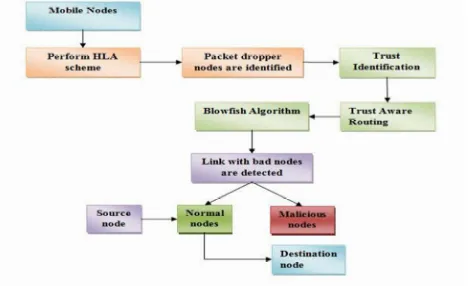
The initially the network is configured with calling the Node configure function with number of nodes. And then Link create will create link, while creating link we need to specify the levels with which the node is associated. Once the network is configured we take up server as the destination and any of the nodes as the sender. Once the network is set we browse for the file we need to send. In the source we split the entire file in to number of packets these packets will be encrypted and Add bit function will help in adding bits to identify the change in number of packets and packet will be forwarded further.
Fig. 3 System architecture
Department of ECE, Adhiyamaan College of Engineering, Hosur, Tamilnadu, India.
The main challenge in mechanism lies in how to guarantee that the packet-loss bitmaps reported by individual nodes along the route are truthful, i.e., reflects the actual status of each packet transmission. Such truthfulness is essential for correct calculation of the correlation between lost packets; this can be achieved by some auditing. Considering that a typical wireless device is resource-constrained, we also require that a user should be able to delegate the burden of auditing and detection to some public server to save its own resources. Public-auditing problem is constructed based on the homomorphism linear authenticator (HLA) cryptographic primitive, which is basically a signature scheme widely used in cloud computing and storage server systems to provide a proof of storage from the server to entrusting clients. For identifying the entrusted nodes, we use trust aware routing for detecting the known and unknown nodes. By using trust classification, the nodes are identified as the known and unknown, the data transmission has been done through trust nodes which has higher trust value.
SYSTEM MODULES
The proposed system contains five modules 1.Network modelling
2.Independent auditing 3.Setup phase
4.Packet dropping detection 5.Trust management
Fig.4. Intermediate nodes with source and destination.
A. NETWORK MODELLING
The wireless channel is modelled of each hop along PSD (Path to Source and Destination) as a random process
that alternates between good and bad states. Packets transmitted during the good state are successful, and packets transmitted during the bad state are lost. It is assumed quasi-static networks, whereby the path PSD
remains unchanged for a relatively long time. Detecting malicious packet drops may not be a concern for highly mobile networks, because the fast-changing topology of such networks makes route disruption the dominant cause for packet losses. In this case, maintaining stable connectivity between nodes is a greater concern than detecting malicious nodes. A sequence of M packets is transmitted consecutively over the channel.
B. INDEPENDENT AUDITOR
There is an independent auditor Ad in the network. Ad is independent in the sense that it is not associated with any node in PSD. The auditor is responsible for detecting malicious nodes on demand. Specifically, it is assumed
S receives feedback from D when D suspects that the route is under attack. Once the destination click on verify, the action takes places to identify the packet loss. To facilitate its investigation, Ad needs to collect certain information from the nodes on route PSD.
C. SETUP PHASE
This phase takes place right after route PSD is established, but before any data packets are transmitted over the
route. In this phase, S decides encrypt the packets and sent through the route to destination. Destination after receiving packets can verify the packet and after verification it can decrypt the packets.
D. PACKET DROP DETECTION
Department of ECE, Adhiyamaan College of Engineering, Hosur, Tamilnadu, India.
and 1 (no loss).Specifically, consider that a sequence of M packets that are transmitted consecutively over a wireless channel. Under different packet dropping conditions, packet loss is identified..
IV.SIMULATIONRESULTS
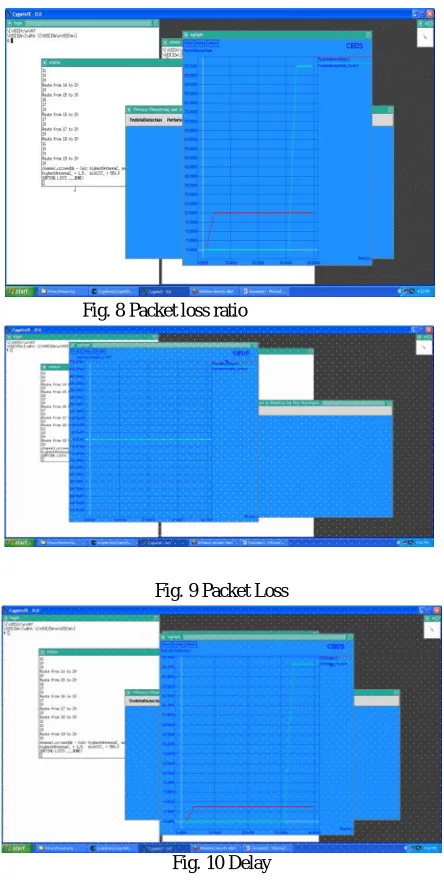
We used the performance metrics to validate the proposed algorithm with results obtained in this papers are shown in Figure 6 and figure 7.
Fig. 9 Packet Loss
Fig. 10 Delay
Fig. 8 Packet loss ratio
Department of ECE, Adhiyamaan College of Engineering, Hosur, Tamilnadu, India.
Fig. 11 Routing head
Thus the proposed scheme is very significant and effective when comparing with existing methods.
V. CONCLUSION
Mobile Ad hoc Network (MANET) is a type of Ad-hoc Network which changes its location dynamically and configures itself. MANET does not have a fixed topology which causes priorities to different kind of attacks. In this work, it deals with detection and prevention of packet dropping attack. Link error and malicious packet dropping are two sources for packet losses in wireless ad hoc network. In this paper, we propose a new routing mechanism to combat the common selective packet dropping attack based on associations between nodes are used to identify and isolate the malicious nodes through trust estimator. Simulation results show the effectiveness of our scheme compared with conventional scheme. This eliminates the overhead of invoking the trust estimator between companions. Further the overheads due to the calculations of trust relationship are minimal compared to the CONFIDANT protocol. In the experiment, proposed method is compared with HLA based auditing and experimental results show that enhanced trust based HLA outperforms existing method, which balances the packet delivery ratio, end to end delay, packet loss and routing overhead prolongs the function lifetime, and guarantees high QoS of MANET. In future work, we concentrate to prevent more attackers in MANET.
REFERENCES
[1] J. N. Arauz, “802.11 Markov channel modeling,” Ph.D. dissertation, School Inform. Sci., Univ. Pittsburgh, Pittsburgh, PA, USA, 2004.
[2] C. Ateniese, R. Burns, R. Curtmola, J. Herring, L. Kissner, Z. Peterson, and D. Song, “Provable data possession at untrusted stores,” in Proc. ACM Conf. Comput. andCommun. Secur., Oct. 2007, pp. 598–610.
[3] G. Ateniese, S. Kamara, and J. Katz, “Proofs of storage from homomorphic identification protocols,” in Proc. Int. Conf. Theory Appl. Cryptol. Inf. Security, 2009, pp. 319–333.
[4] B. Awerbuch, R. Curtmola, D. Holmer, C. Nita-Rotaru, and H. Rubens, “ODSBR: An on-demand secure byzantine resilient routing protocol for wireless ad hoc networks,” ACM Trans. Inform. Syst. Security, vol. 10, no. 4, pp. 1–35, 2008.
[5] B. Awerbuch, R. Curtmola, D. Holmer, C. Nita-Rotaru, and H. Rubens, “ODSBR: An on-demand secure byzantine resilient routing protocol for wireless ad hoc networks,” ACM Trans. Inf. Syst. Secur., vol. 10, no. 4, pp. 11–35, 2008.
[6] K. Balakrishnan, J. Deng, and P. K. Varshney, “TWOACK: Preventing selfishness in mobile ad hoc networks,” in Proc. IEEE Wireless Commun. Netw. Conf., 2005, pp. 2137–2142.
[7] D. Boneh, B. Lynn, and H. Shacham, “Short signatures from the weil pairing,” J. Cryptol., vol. 17, no. 4, pp. 297–319, Sep. 2004. [8] S. Buchegger and J. Y. L. Boudec, “Performance analysis of the confidant protocol (cooperation of nodes: Fairness in dynamic adhoc
networks),” in Proc. 3rd ACM Int. Symp. Mobile Ad Hoc Netw.Comput. Conf., 2002, pp. 226–236.
[9] L. Buttyan and J. P. Hubaux, “Stimulating cooperation in selforganizing mobile ad hoc networks,” ACM/Kluwer Mobile Netw. Appl., vol. 8, no. 5, pp. 579–592, Oct. 2003.
[10] J. Crowcroft, R. Gibbens, F. Kelly, and S. Ostring, “Modelling incentives for collaboration in mobile ad hoc networks,” presented at the First Workshop Modeling Optimization Mobile, Ad Hoc Wireless Netw., Sophia Antipolis, France, 2003.
[11] J. Eriksson, M. Faloutsos, and S. Krishnamurthy, “Routing amid colluding attackers,” in Proc. IEEE Int. Conf. Netw. Protocols, 2007, pp. 184–193.
Department of ECE, Adhiyamaan College of Engineering, Hosur, Tamilnadu, India.
[13] T. Hayajneh, P. Krishnamurthy, D. Tipper, and T. Kim, “Detecting malicious packet dropping in the presence of collisions and channel errors in wireless ad hoc networks,” in Proc. IEEE Int. Conf. Commun., 2009, pp. 1062– 1067.
[14] Q. He, D. Wu, and P. Khosla, “Sori: A secure and objective reputationbased incentive scheme for ad hoc networks,” in Proc. IEEE Wireless Commun. Netw. Conf., 2004, pp. 825–830.
[15] D. B. Johnson, D. A. Maltz, and J. Broch, “DSR: The dynamic source routing protocol for multi-hop wireless ad hoc networks,” in Ad Hoc Networking. Reading, MA, USA: Addison-Wesley, 2001, ch. 5, pp. 139–172. International Journal of Emerging Technology in Computer Science & Electronics (IJETCSE) ISSN: 0976-1353 Volume 21 Issue 3 – APRIL 2016 270