of Writing Effectiveness in an Adult Accelerated Degree Completion Program. (Under the direction of Chris M. Anson.)
Most modern theories of responding to student writing typically advocate a meaning-centered, whole text holistic approach (as opposed to an analytic mode of response, which allows for the separate evaluation of different criteria). In a holistic assessment, certain criteria may be considered together on one descriptive scale, which renders a final assessment that allows for broader judgments on the quality of particular writing products. As a result, a holistic assessment is usually not quite as rigid as an analytic assessment. This study examined a non-traditional writing program that was highly traditional in its emphasis on stressing the rules of writing mechanics (an analytic method). It specifically focused on instructor familiarity with the program’s required citation format. My research questions: how well would instructors score if given the task of finding deliberately inserted errors? What is instructor perception of format in writing evaluation? And, what, if any, influence does instructor training and experience have on the ability to apply citation format? In addition to being asked to detect 33 deliberately inserted errors in documentation format in a typical student paper, ten instructors at the program, an adult accelerated degree completion program, were also asked to complete a demographic survey. As predicted, except for two notable exceptions, average instructor scores were low (68%). In the follow-up survey, most indicated that they were satisfied with the program’s required APA citation format, and finally, neither length of experience nor discipline-specific training proved to be
COMPLETION PROGRAM
by
TANYA RENEE TILLETT
A thesis submitted to the Graduate Faculty of North Carolina State University
in partial fulfillment of the requirements for the Degree of
Master of Arts
ENGLISH
Raleigh 2003
APPROVED BY:
______________________________ ______________________________
BIOGRAPHY
Tanya Tillett was born and raised in Anniston, Alabama. She was born on January 5, 1972 (a cold day, indeed) and lived in Anniston until her eighteenth year, when, after graduating from Anniston High School, she left to attend the University of Alabama in Tuscaloosa. While at college, she studied advertising and minored in French. In college, she began to develop an affinity for the English discipline, but being heavily invested in an advertising major, she trudged ahead because she wanted to secure a “real” job upon graduation. After four glorious years of semi-adulthood, she emerged into the real world with a Bachelor of Arts degree in communication in 1994. She then moved to Hickory, located in the great state of North Carolina, to pursue a career in retail
ACKNOWLEDGMENTS
I would like to thank Dr. Anthony Grady and all the instructors of the Gateway Program, who were all very cooperative as I worked on this project. I would also like to express my extreme gratitude to all three members of my thesis committee (Drs. Anson, Penrose, and Morillo). They bravely beared with me through two and a half years of work on my thesis, offering feedback and invaluable insight as I attempted to develop a fledgling idea into this complete piece of written work.
TABLE OF CONTENTS
List of Tables……….…….vi
Chapter 1 The Problem Definition...1
Introduction...1
Research Questions...3
Background and Interests……….3
The Adult Learner………4
Assessing the Adult Learner………. ..6
Definition of Terms...8
Limitations ...9
Organization of the Study...9
Chapter 2 Review of the Literature...11
Introduction: The Individual and the Writing Process ...11
Beyond the Basics: Instructor Response to Student Writing ...13
Instructor Expectations...13
Analytic versus Holistic...19
General versus Task-Specific...21
Chapter Summary ...22
Chapter 3 Methodology...23
Survey Instrument...23
Procedures...25
Administration ...25
Scoring...25
Chapter 4 Results...26
Demographics of the Sample...26
Analysis of Responses...30
Chapter 5 Discussion, Implications, and Conclusions...36
Works Cited ...44
List of Tables
The Problem Definition
Introduction
In today’s academic environment, there are some who might choose a
product-centered approach in which emphasis is placed on mechanics and form (ensuring that a
student understands how to connect sentences together to form a paragraph, for example).
In some ways, this choice is understandable, maybe because mechanics and form are often
the most visible and easily recognizable features of writing. But experienced instructors
argue that there has to be an allowance for the generation and feedback of ideas without an
immediate judgment on the mechanics of a student’s written product. This
student-centered approach, unlike the product-student-centered approach mentioned above, allows for the
expression of unique arguments that might otherwise be lost if the student feels pressure
only to meet specific mechanics goals.
In the traditional academic environment (a two-year associate or four-year
baccalaureate program), the presentation of a final written product for a course—an
end-of-semester paper, or a final research paper for example—is usually stressed by
instructors as a task that adequately gauges how well a student has learned and
internalized specific subject matter. How well the student can present the necessary
refer to the many course syllabi collected by a student over the course of his or her
academic career to acknowledge the truth of this assertion. It should also be noted that in
some cases, there is not only the requirement of a final paper for the student, but also a
mid-term or mid-semester writing requirement as well.
Because the term paper requirement is one that an instructor will usually apply to
relevant issues in his or her course, it is understandable that content might be seen as an
especially important ingredient in a student’s formal paper. Perhaps less obvious is the
question, how does documentation style fit into an instructor’s evaluation of a student’s
paper? Is the degree of emphasis on documentation based on the instructor’s comfort or
skill in applying citation format rules, or is it based on the importance of the presentation
of subject matter? To help find answers to these questions, instructors who teach in the
Gateway Program, an adult accelerated degree completion program located in Raleigh,
North Carolina, agreed to participate in a study designed to measure their ability to
recognize and apply the program’s required citation format in the grading of a given
student’s term paper. Because emphasis in the composition literature over the last three
decades has been on holistic and process-oriented teaching and assessment, it seemed
likely that instructors would have difficulty scoring high when asked to focus on only
finding errors in APA citation format when evaluating a piece of student writing. My
Research Questions
Three questions are posed by the investigation, and the research study is
designed specifically to answer these questions:
1. How well would instructors score if given the task of finding deliberately
inserted formatting errors in a student’s paper?
2. What are instructors’ perceptions of the importance of a formatting style in
evaluating a student’s writing assignment when weighed against the content of
the assignment?
3. Do weaknesses or strengths in an instructor’s ability to apply the specific citation format to a grading exercise reflect a certain amount of instruction
experience or are they influenced by training in particular disciplines?
Background and Interests
In May 2000 I approached Anthony Grady, the director of the Gateway Program
at St. Augustine’s College, Raleigh, North Carolina, regarding the possibility of
conducting a study of how instructors assess student writing. He particularly wanted to
keep the evaluation grounded solely in the application of the APA citation format. In one
of the discussions of how best to design the assessment project, he stated that the adult
format to refer to, and a large amount of the responsibility for ensuring the students
became familiar and comfortable with the APA citation format rested in the hands of the
program instructors. The students were not simply taking courses that allowed them to
act as passive learners moving easily through a course of study. They were active
learners who were engaging in academic conversation. Although their demographics might
be considered “non-traditional,” their ultimate goal was undoubtedly traditional: obtaining
an undergraduate degree from a fully accredited institution of higher learning. Keeping
this important consideration in mind, he felt that it was only logical that emphasis should
be placed on instructor familiarity with the program’s required citation format. Although I
would have preferred to conduct a more in-depth study of instructor response to student
writing, my project therefore centered on an assessment of the instructors’ familiarity
with the APA citation format.
The Adult Learner
Who is today’s adult learner? According to Darkenwald and Merriam, an adult
learner is “a person married, head of household, or over 21 years of age” (qtd. in Blum).
Other sources use the age of 25 as the definitive beginning age of an adult learner.
Although there is room for debate over what constitutes the appropriate beginning age of
an adult learner, most sources define an adult learner as someone who “returns to study,
on a full-time or part-time basis, after a period of time spent in other life activities or
pursuits” (Neeley, Niemi and Ehrhard). This return to the pursuit of an education could
advancement in current job, industry downsizing, or desire for change in career. The U.S.
Department of Education’s National Center for Education Statistics reported in its 1999
survey that adult learners are the “fastest-growing segment of today’s college
population,” and account for approximately 46% of the U.S. adult population (U.S.
Dept. of Educ.).
Located within this burgeoning non-traditional area of the education spectrum are
different kinds of adult learners: those who seek to acquire basic literacy; those who wish
to complete a basic education requirement, such as the GED (General Equivalency
Diploma); those who take credit-only courses for pleasure or to fulfill job requirements;
those who take courses to complete undergraduate degrees begun earlier in life and
abandoned; and those seeking to earn post-baccalaureate degrees. The adult learner of
interest to this project is the one who would be enrolled in an accelerated degree program
like the Gateway Program at St. Augustine’s College, and who has at least two solid years
of undergraduate courses to their credit, but for a variety of reasons, did not complete his
or her undergraduate education.
According to the program’s director, the adult learners enrolled in his program
reflect the diversity of those individuals who are active members of our country’s
workforce. The adult learner is usually employed full-time, and in addition to managing a
career, also contends with family and community demands on his or her time. All the
elements combined create a multi-dimensional student who faces arguably more challenges
than the younger, traditional student would face. They also emphasize the necessity of
upon in a “real world” setting.
Assessing the Adult Learner
Given the challenges facing both the adult learner and the instructor in a learning
environment like an accelerated degree program, prioritization of assignments becomes a
necessity. Because the curriculum is designed to provide an education that leads to degree
completion at an accelerated speed, the instructor course outline and follow-through is
usually expected to be well-defined and highly specific in nature (Grady). Generally
speaking, all courses offered by the Gateway Program are taught in a seminar setting, with
the students and instructors engaging in active conversation, instead of merely
participating in a lecture-driven format. Small class sizes facilitate the seminar format; the
average class size usually ranges from a minimum of about eight or nine students, to a
maximum of about fifteen. At the time of this study, there were about 135 students
enrolled in the program. With 13 instructors on the roster, the instructor/student ratio is
about one to ten, which supports the ideal seminar setting. In terms of assignments, each
course is designed much along the same lines that a traditional undergraduate course would
be, with a final End of Module paper weighted 40% of the course grade.
If the average Gateway Program student is “non-traditional” by definition, then
who is the instructor guiding or evaluating him? All instructors in the Gateway Program
who participated in this research project had a grounding in a traditional academic
environment, and provided instruction in their individual disciplines of training. In fact, at
undergraduate curriculum at St. Augustine’s College. In assessing the writing of his or her
student, the Gateway Program instructor is charged with one of the same basic
responsibilities that the instructor of a typical undergraduate course would be charged
with: teach the students to converse successfully in an academic environment. Most
instructors would acknowledge that teaching students to converse in this manner is a
multi-pronged task and that there should be a certain amount of flexibility if the student is
to feel comfortable in expressing himself. In other words, using a developmental,
process-driven approach to writing instruction would more than likely yield a better
student written product than using a mechanics-driven approach. However, this
approach to writing instruction and evaluation is somewhat at odds with the writing
assignment guidelines for the Gateway Program’s End of Module paper. The instructors
are provided with a sample paper and instructions on grading all papers using the APA
(American Psychological Association) format. They are also required to weight the paper
a full 40% of the student’s final course grade. There is no argument that the ability to
converse in a scholarly written voice is ideal. Most literature suggests that it is reasonable
to expect the student to converse on an academic level in a final written product.
However, even so, it seems as if there should also be some amount of flexibility in
formatting, perhaps having formatting issues be dependent upon the discipline in which
the course is housed. In reference to the guidelines for the final research project paper
required in all Gateway Program courses, it would seem logical to expect the papers in
each course to follow the recommended documentation styles of their respective fields,
matter of the program requirement for an end-of-term paper for each course, the APA
method of style usage is required for all student End of Module papers; course titles vary
from English to Managerial Marketing to Biblical Perspectives, but all require the End of
Module research paper to be formatted in APA citation style.
This combination of diverse discipline representation and the requirement for only
one formal style usage for formal papers provides an intriguing sample to assess
instructor skill in evaluating student papers based on APA documentation style. What are
the average Gateway Program instructor’s thoughts on what constitutes effective writing?
What do instructors in this program look for when evaluating student writing? Is there
significant weighting of content over formatting and style or vice versa?
Definition of Terms
Several terms and designations will be unique to the study. These are defined
generally and operationally as follows:
Documentation Style: In the case of this research project, the terms
“documentation style” or “citation format” are used interchangeably to describe specific
formatting based on a published citation guide, such as Modern Language Association
(MLA). In the case of this study, however, the term refers specifically to the use of
American Psychological Association (APA) format.
Instructors’ Perceptions: In general, this designation refers to the viewpoints of
teachers and professors with respect to assessing writing skills and abilities of students.
survey instrument that is used to assess instructors’ views and knowledge of APA
format. This instrument is comprised of two sections and is described in more detail in
the methodology chapter.
Limitations
The study is limited to instructors teaching in an adult accelerated degree
completion program. The sample population of the proposed study was limited to ten of
13 instructors in the program.
The study conclusions are limited by the amount of information and data
discovered in the documents, reports, studies, and other related materials comprising the
literature review and the data collected from administration of survey questionnaires. It is
important to note that inherent limitations also exist in the utilization of a small
population to provide evidence. But this is true regardless of the type of study or the
methodology employed (Babbie, 1998; Rea & Parker, 1997).
Organization of the Study
Chapter 1 introduces the present study. It discusses the topic of concern, and the
background and significance of the problem. It also provides research questions,
limitations, and definitions of terms unique to the study.
Chapter 2 reviews the literature relevant to the theoretical foundation. The review
Chapter 3 details the methodology of the research. Included is an explanation of
the approach and method, sample population, data collection procedures, survey
instrument, and procedures.
Chapter 4 analyzes the data that derives from administration of the questionnaire
instrument and compares results to the findings from the literature review. Tables are
provided and results noted, followed by answers to research questions.
Chapter 5 concludes the study. It includes a discussion of findings, followed by
Chapter 2
Review of the Literature
Because my research project only focused on instructor application of APA citation
format, instructors were not given the option of grading the sample student paper in a
global, holistic manner that would have allowed for feedback and response. It would seem
in any instance that a narrow evaluation process like the one used in the study would not
allow for the successful exchange of ideas between teacher and student, and as the
following review of the literature reveals, adequate teacher response is integral to the
development of a student’s writing voice.
Introduction: The Individual and the Writing Process
In the 1970s, the idea that all individuals had a written voice that could be heard
seemed to be shared by many who were leaders in the field of composition theory. In her
important and influential essay “Writing as a Mode of Learning” published in 1977, Janet
Emig discussed the idea of accessibility of strong writing skills for all by presenting the
argument that “because writing is often our representation of the world made visible,
embodying both process and product, writing is more readily a form and source of
learning than talking” (91). If the process of writing could be seen as an even more
effective teaching tool than talking, one could reasonably conclude that since we all
could also learn to write better by engaging in writing exercises. Using Emig’s
interpretation, the writing “knack” became de-mystified, and the idea of any person,
regardless of any believed natural talent, successfully completing a given written
assignment became highly possible, if not a foregone conclusion.
This idea that any individual can become a skilled writer if given a chance was also
shared by others in composition theory. In his classic book Writing Without Teachers,
Peter Elbow pointed out that “most people’s relationship to the process of writing is one
of helplessness” (12). In his argument that the idea of understanding writing ability is
something that is regarded as “mysterious” by most people, even those considered to be
accomplished writers, he seemed to argue that writing ability is something that can be
learned, and is not a random gift of nature. This underlying message in his book, which
was published in 1973, still seems a valid one when applied to today’s diverse world of
writing assignments. By presenting the writing task as a process that can be navigated by
most, if not all, both Emig and Elbow present an idea that is still useful today as a model
for approaching writing assignments, both academic and professional. These ideas were
influential in my choice of instructors in the Gateway Program as study subjects. These
instructors are charged with the task of encouraging the development of writing skills in a
non-traditional undergraduate population (adult learners) which might possess a writing
voice that is distinct and different from the traditional undergraduate’s.
In addition to the acknowledgement that each individual writer had a voice, there
was also the need for fair and reasonable assessment of his work. In Teaching and
grading student writing on a holistic basis. Although he admitted that there is a line of
leniency that should not be crossed – ignoring the repeated stylistic or structural mistakes
of a particular student’s writing over time for example – he also stated that integrating
holistic scoring into your methods of instruction is “important for reasons beyond
measurement, for reasons that return us to the nature of writing itself.” He went on to
argue that we see our thoughts in our writing, and therefore ask our students to write “so
that they can think more clearly” (Teaching and Assessing Writing 32) In this statement,
White seems to argue that it would certainly benefit the student’s long-term writing
development if the writing teacher focused on a broader instruction process that did not
over-emphasize specific writing mechanics rules. In other words, there will be plenty of
time to focus on mechanics and stylistic issues once the student has completely captured
his thoughts on paper. If a student writer is guaranteed a “brainstorming” or “freewrite”
stage, his confidence in his writing at later stages might be greater.
Beyond the Basics: Instructor Response to Student Writing
Instructor Expectations
Responding to student writing is probably the most challenging part of teaching
writing. It not only takes a tremendous amount of time and demands a great deal of
intellectual activity, it also affects to a large extent how students feel about their ability to
write. It becomes increasingly obvious that teachers may become less pressured and more
an examiner who must spend enormous amounts of time grading every paper to that of a
facilitator who helps students recognize and work on their own strengths and weaknesses
(Grant-Davie and Shapiro).
In his essay “The Student, the Text, and the Classroom Context: a Case Study of
Teacher Response,” Richard Straub discusses the influence of teacher response on student
writing. In particular, he presents a case study of one instructor’s response (his own) to
one student’s writing over the course of several writing assignments. In his
recommendations to would-be instructors to leave control of the writing in the hands of
the students, and to evaluate in a more global, holistic manner, he presents a clear,
well-defined argument for weighting content over style in grading of student papers. In
addition, he discusses his own motivation of being “less interested in the overall quality
of . . . individual essays as written products, than . . . in the development of [the
students’] writing, and in turn, in their development as writers” (Part 1).
It can be argued that a teacher who marks only grammar, sentence structure,
punctuation, citation format, and spelling errors does not prompt better student writing.
Rather, comments on the logic and structure of an argument may be more helpful. This
may be more easily said than done, however; as Anson has noted, “For many teachers,
the domain of error remains untheorized and without . . . reflection. Response to
error—how much to identify, what to say about it, where it fits in the larger cycles of
instruction and production of text—comes from inherited practices, local conditions . . .
Sometimes, we inadvertently give students conflicting messages. In "Responding
to Student Writing", Nancy Sommers reviews the purposes and effects of teachers'
comments on papers. She provides examples of actual instructor comments. In each
instance, the instructors have taken a lot of time and effort to show their students how to
edit sentences with interlinear comments, but then the instructors also make marginal
comments that ask students to expand paragraphs to make them more interesting to a
reader. The interlinear comments and the marginal comments represent two different
tasks. The interlinear comments focus on the text as a finished piece in need of editing.
The marginal notes suggest that this text is a work in progress and that the student may
need to do some further research to develop the meaning. The student is being asked, in
other words, to edit and develop at the same time--a task that most writers would find
difficult to do simultaneously. These two sets of comments (interlinear and marginal)
make it hard for the student to sort out whether content or style deserves priority for
revision and may create the impression that stylistic details need to be attended to before
the meaning. These two sets of comments seem to confuse product and process: the
student is forced to consider all elements of the paper in one draft. A more successful,
student-centered approach would probably entail at least two separate drafts in which the
instructor could focus on ideas and content first, and mechanics issues next.
Indeed, Sommers notes that correcting details such as grammar gives students the
mistaken idea that early drafts should be as correct as the final product.
To emphasize that writing is a process, Erika Lindemann has a chapter on
advises instructors to identify a priority for each draft and to correct that draft only for
that priority. For example, the priority for the first draft would be to establish
organization and specific examples, and the instructor’s responses to the draft should be
to those two aspects of the writing only. She observes that as students master the tasks
established for each draft, details such as proper vocabulary and spelling take care of
themselves. In general, she argues that for students to learn to write, they must correct
their own writing many times and that instructor response should focus on what students
are doing well and help them build on that.
Noting that research has shown teacher comment has little effect on the quality of
student writing, Grant-Davie and Shapiro suggest teachers should view comments as
rhetorical acts, think about their purpose for writing them, and teach students to become
their own best readers. To achieve this goal, teachers should respond to student drafts
with fewer judgments and directives and more questions and suggestions. In focusing
heavily on the required citation format, the program in my research study seems to limit
the instructors’ ability to respond to students’ writing in this manner. The focus on
ensuring that use of the required citation format is ingrained in the students seems too
narrow to allow for a broader interpretation of the curriculum by individual instructors.
In Assigning, Responding, Evaluating, White encourages instructors to look for
opportunities to give meaningful praise when responding to student work. Generic, vague
compliments can have a negative effect, however, since they are viewed as being passed
out freely to all. White (Assigning) encourages instructors to mark the clearest and most
questions often work better than statements since the latter can be interpreted as
authoritative dictates. Questions are more apt to inspire students to think about what
they know and are learning about writing. Instructor responses should also encourage
risk-taking in early drafts. Trying out an idea or an argument that is new, different, or
unusual can be exciting for beginning writers. The position statement developed by the
CCCC Committee on Assessment stresses the importance of instructors realizing that
student language is a result of their individual social context. As difficult as it may be,
instructors must fairly interpret and assess student writing within a framework of
knowledge about that social community. It is not appropriate to judge student writing
strictly on a basis of comparison to other student writers, but, instead, teachers of
composition must see the value of student writing as related to the social structures and
cultural boundaries of each student author.
These instruments all support the main idea that fuels this study, that an
assessment which focuses solely on formatting and mechanical issues does not allow for a
completely accurate assessment of writing skill, because content is de-emphasized. In
addition to these instruments, various teacher/writers in the field share the following
strategies they have developed for measuring writing quality.
Krest provides helpful techniques of a general nature to show teachers how to give
students credit for all their work and how to spend less time doing it. These techniques
involve using holistic scoring, using a somewhat similar technique of general comments,
students' progress until a suitable period of time has elapsed which allows for measurable
growth, and then measure the quality of selected pieces of writing at periodic intervals.
Cooper and Odell suggest that teachers can eliminate much of the uncertainty and
frustration of measuring the quality of these samples if they will identify limited types of
discourse and create exercises which stimulate writing in the appropriate range but not
beyond it. In their model, they present explanatory, persuasive, and expressive extremes
as represented by the angles of the triangle. Each point is associated with a characteristic
of language related to a goal of writing, with assignments and the resulting measure of
quality focused on that particular goal. Writing teachers are moving increasingly toward
this type of assessment of writing quality.
Krest also presents an interesting modification of the writing response process by
measuring the quality of students' papers with the following levels of concerns in mind:
(HOCs) high order concerns: focus, details, and organization; (MOCs) middle order
concerns: style and sentence order; and (LOCs) lower order concerns: mechanics and
spelling. In considering my study of the Gateway Program, I think that APA format
could probably be classified as all three (although mostly as LOCs). It seems to qualify as
an LOC in the sense that improperly formatted citations would not change the meaning or
focus of an argument. However, incorrect citation style could possibly weaken an
argument if it is untraceable, or it could slow down reader comprehension of an argument
Just as we discover and determine what to do in the classroom to respond to
student writing, it is equally important that writing instructors consider what not to do. A
habit White (Assigning) encourages the writing instructor to break is marking every error.
Students often view this saturation of ink as justification for the grade that is assigned and
not really as a way to help them improve the quality of their writing. Because of this
perception, students feel frustration and inadequacy and may eventually give up trying to
improve their writing at all. White also encourages instructors to avoid responding with
puzzling abbreviations which, although familiar to the teacher, might as well represent
another language to the student who only sees the uninterpretable message, “you made a
mistake.”
However much writing may be conceptualized as a process, the time eventually
comes for the process to come to an end and for the final product to be submitted for
assessment. At that point, instructors can choose among several methods of arriving at a
final score or grade for a paper. In general, the approaches include analytic versus holistic
scoring methods and between task-specific and general scoring methods. Based on my
observation of the Gateway Program, the emphasis seems to be placed on an analytic
method of evaluation. Because of the program’s emphasis on an analytical method of
evaluation, it seems especially relevant to discuss it in relation to the more flexible holistic
method of evaluation.
Analytic versus Holistic
In the initial phases of developing a scoring method, the instructor determines the
piece of writing are whether appropriate grammar is used and the extent to which the
given argument is persuasive. An analytic scoring method allows for the separate
evaluation of each factor. Each criterion is scored on a different descriptive scale
(Brookhart).
The method can be extended to include a separate set of criteria for assessing the
persuasiveness of the argument. This would result in an analytic scoring system with two
factors, quality of written expression and persuasiveness of the argument, each of which
would receive a separate score. Numerical weights can be assigned to the evaluation of
each criterion. The benefit of using a scoring system rather than weighted scores is that
scoring systems provide a description of what is expected at each score level. Students
may use this information to improve their future performance.
It may not be possible to separate an evaluation into independent factors. When
there is an overlap between the criteria set for the evaluation of the different factors, a
holistic scoring approach may be preferable to an analytic one. In a holistic scoring
approach, the criteria are considered together on a single descriptive scale (Brookhart).
Holistic scoring approaches support broader judgments concerning the quality of the
process or product than do analytic approaches.
However, using an analytic scoring approach does not eliminate the possibility of
a holistic factor. A holistic assessment may be built into an analytic scoring system as one
of the score categories. One difficulty with this approach is that overlap between the
criteria set for the holistic judgment and the other evaluated factors cannot be avoided.
other words, the instructor needs to be careful that the student is not unintentionally
penalized severely for a given mistake. Although there is this danger involved in a
combination of both methods, I feel the Gateway Program does need to move towards a
more holistic approach, if not at the program curriculum level, then at the individual
instructor level.
General versus Task-Specific
A variation of analytical versus holistic scoring is general versus task specific.
Scoring methods may be designed to evaluate a specific task or to evaluate a broader
category of tasks. If the purpose of a given course is to develop a student's ability to use
a given documentation style, for example, a general scoring method may be developed and
used to evaluate each of the references given by that student in a preliminary draft. This
approach would allow the students to use the feedback they acquired from the draft to
improve their performance on the final essay.
Scoring systems may also be designed to contain both general and task specific
components. If the purpose of a paper is to evaluate the students' documentation skills
and their ability to develop and present their research, then an analytic method could be
used that contains both a general component and a task-specific component. In such a
case, the documentation component of the method may consist of a general set of criteria
developed for the evaluation of references and in-text citations. The task-specific
component of the system, on the other hand, may contain a set of criteria developed with
specific structural and argumentative skills in mind, such as proper paragraph
Chapter Summary
As can be seen from this review, recent theory about writing instruction has
tended to emphasize process in the service of product. That is, instructors have been
encouraged to teach writing as a process of revision that leads, ultimately, to an
acceptable product, one that is both mechanically correct, well organized and content-rich.
Once a writing product has gone through a multi-draft process and is considered ready for
evaluation, instructors can choose to either focus on mechanics and style issues only, or
can choose to evaluate more generally and holistically (which would include mechanics,
Chapter 3
Methodology
Previous chapters have introduced the focus of the study and have reviewed the
literature pertinent to the topic of instructor response to student writing. The purpose of
the present chapter is to describe the methodology used to conduct the quantitative
portion of the study.
Sample Population
The sample used in the investigation consisted of ten of the 13 instructors then
currently teaching in the Gateway Program. The three who did not participate were not
available at the time of the study.
Survey Instrument
The survey instrument used to assess instructors’ knowledge of APA format
requires approximately 15 minutes or less to complete, and is comprised of two sections
(Appendix A). The first portion solicits demographic data relating to years of teaching
experience, age, gender, and educational level. It also provides data on how the instructors
weigh documentation concerns when grading, and their perceptions of whether they
evaluate APA format consistently. The second section consists of a student paper of
average length and subject matter for the program requirement containing 33 deliberately
The evaluation assignment was followed by a structured interview of two of the
instructors and consisted of the following seven questions:
1. Is APA format the best format for the course(s) you teach, or is there another?
2. Do you consider yourself to be more of a global, holistic evaluator of student
writing projects, or is correct formatting and style more important to you?
3. Do you have different expectations for your adult learners in comparison to
younger, traditional undergraduate students that you have taught, or are presently
teaching?
4. In your experience, are there any marked differences in the way adult learners and
traditional undergraduate students present their final written products?
5. Since the students in the program are classified as “adult learners,” are there any
particular characteristics that they possess that would influence the way you
evaluate their writing products? For example, more leniently or more stringently
than traditional undergraduates? Would they be evaluated exactly the same? If so,
why? If not, why not?
6. Did the paper seem like the average student paper that you would encounter in
terms of quality and/or content?
7. Do you think your score on this evaluation project accurately reflects your view
Procedures
Administration
Each instructor was required to evaluate the paper at one sitting, in the offices of
the Gateway Program. Each instructor was assigned a number to maintain confidentiality.
A follow-up survey was given to the instructors to obtain demographic data and gather
their opinions on how writing fits into their own and the program’s general curriculum. In
addition, interviews were conducted with two of the instructors after their “assignment”
was evaluated.
Scoring
In the evaluation of each instructor’s graded paper, more errors than those that
were deliberately inserted became apparent. To maintain the integrity of the project’s
evaluation goals, instructors were given credit for those formatting errors that they found,
but were still evaluated with 33 errors as the target number to be found. Errors that were
Chapter 4
Results
Previous chapters of the research introduced the problem of concern and reviewed
the literature pertinent to the important variables of the present study. The purpose of
this chapter is to present and analyze the data collected through administration of a
survey questionnaire.
Demographics of the Sample
· All of the instructors who participated in this project taught courses that
were housed within their given disciplines of training (see Table 1).
· Half of those who participated were trained in and also currently
instructing in business or business-related courses.
· 40% of those who participated had been teaching 20 years or more.
· 40% had been teaching 0-4 years.
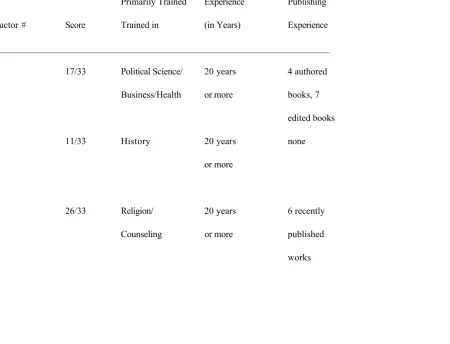
Table 1. Demographics of the Sample
Discipline(s) Teaching
Primarily Trained Experience Publishing
Instructor # Score Trained in (in Years) Experience
___________________________________________________________________________
1 17/33 Political Science/ 20 years 4 authored
Business/Health or more books, 7
edited books
2 11/33 History 20 years none
or more
3 26/33 Religion/ 20 years 6 recently
Counseling or more published
(Table 1 continued)
4 23/33 English/Linguistics 20 years several
or more works
published
5 30/33 Accounting/Business 0-4 years 1 work
6 26/33 Nursing/Health 0-4 years none
Administration
7 26/33 Business Admin./ 5-9 years none
Management/ Marketing
8 18/33 Business 0-4 years none
9 36/33 Education/English 0-4 years 2 works
(Table 1 continued)
10 14/33 Political Science/ 5-9 years 2 works
published
· 3 of the 4 who stated that they had been teaching for 20+ years had work
published an average of 5 different times (Instructor #1 raised this average
considerably, with a total of 11 times published).
· The highest scorer (Instructor #9) had been teaching 0-4 years, while the
second highest scorer (Instructor #5) had also been teaching 0-4 years.
· The lowest scorer (Instructor #2) had been teaching 20+ years.
Analysis of Responses
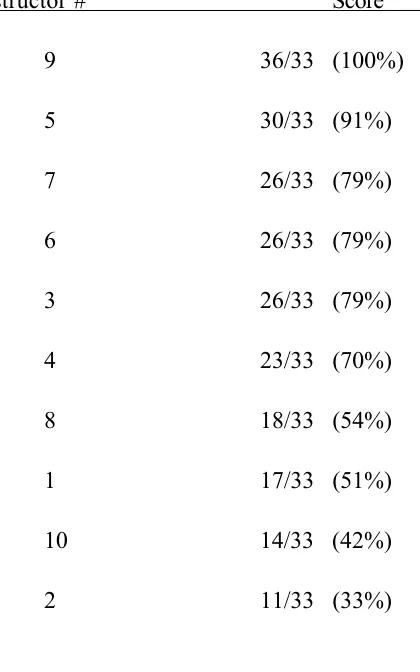
Table 2 summarizes scores for each instructor. The following provides a summary
of responses to the survey instrument:
∑ 8 of the 10 instructors found half or more of the stated 33 errors.
∑ The average score for all instructors was 22.6 of 33 correct, or 68.%.
∑ Instructors 5 and 9 scored the highest.
∑ Instructors 2 and 10 scored the lowest and had been teaching for 20+ years
and 5 – 9 years, respectively
∑ Instructor 3 was particularly perceptive in noticing the error pattern
(pagination errors in particular)
∑ Instructor 7 provided responses that addressed content (even though all
instructors were told not to consider content)
∑ Instructor 10 scored low in the formatting area (what she was assessing) but
Table 2. Instructor Scores (Ranked)
Instructor # Score
9 36/33 (100%)
5 30/33 (91%)
7 26/33 (79%)
6 26/33 (79%)
3 26/33 (79%)
4 23/33 (70%)
8 18/33 (54%)
1 17/33 (51%)
10 14/33 (42%)
2 11/33 (33%)
The median score for the sample was 23, or 69%. This corresponds closely to the
mean score for the sample (22.6 or 68%). These findings confirmed the primary
hypothesis, that instructors would score at or below the “C” level on a test of ability to
detect errors in APA format. However, two of the ten instructors scored exceptionally
well (an “A” average or better).
In the follow-up survey to the evaluation assignment, 50% of the instructors
stated that APA style usage in student research papers was equally important in
comparison to content, and 50% also felt that consistently incorrect formatting
throughout a content-rich paper would very much affect the paper’s grade. In addition,
all the instructors felt that they had been grading student papers in accordance with
citation guidelines set forth in their program guide. Most also stated that they were
satisfied with the APA citation format requirement. At the end of the survey, an
open-ended question asked for their views on APA citation format, and on the program’s
requirements, but most of the instructors left the answer field for this question blank.
Although instructors had not been expected to score especially high in the
evaluation project, there were two notable exceptions, Instructor #5 and Instructor #9.
Instructor #5 noted 30 of 33 errors, while Instructor #9 also found a large number of
errors (36 of 33). In the general survey questions, both instructors stated that they had
been instructing between 0-4 years. In fact, they both scored noticeably higher than those
instructors who stated that they had been instructing for as many as 20 years or more. It
necessarily lead to higher scores. Neither did publishing experience, with Instructor #5
only having one work published, and Instructor #9 only having two works published.
Also, given the two instructors’ markedly different areas of academic training
(Accounting/Finance and Education/English), I thought it would be helpful to interview
them to discover if they had differing or similar philosophies on student writing
instruction and assessment. I asked the following questions of each instructor:
1. Is APA format the best format for the course(s) you teach, or if there another?
Although Instructor #9 (Education/English) seemed to feel that APA was the best
possible format to evaluate student research papers, Instructor #5 (Accounting) did not.
She felt that there should be an allowance for other kinds of evaluation tools, although she
admitted to adhering faithfully to the APA citation guidelines when evaluating student
papers.
2. Do you consider yourself to be more of a global, holistic evaluator of student writing
projects, or is correct formatting and style more important to you?
Both instructors stated that they considered themselves to be more holistic than
format-specific in their grading process.
3. Do you have different expectations for your adult learners in comparison to younger,
traditional undergraduate students that you have taught, or are presently teaching?
Instructor #9 stated that his expectations were exactly the same for both
traditional undergraduates and adult learners. Instructor #5 stated that she had initially
instructing in the Gateway Program, but has often found that as much as about 40% of
the time, adult learners provide just as much difficulty in the areas of attitude and
determination or desire to succeed than do their traditional counterparts who have less
responsibilities in their daily lives.
4. In your experience, are there any marked differences in the way adult learners and
traditional undergraduate students present their final written products?
Both instructors agreed that the adult learners seem to follow directions better
than their more traditional undergraduate counterparts in reference to citation format and
in overall final written products. However, overall writing savvy of the average adult
learner seems to be no better than the traditional undergraduate.
5. Since the students in the program are classified as “adult learners,” are there any
particular characteristics that they possess that would influence the way you evaluate
their writing products? For example, more leniently or more stringently than
traditional undergraduates? Would they be evaluated exactly the same? If so, why?
If not, why not?
Instructor #9 stated that he evaluates all students the same, regardless of
demographics. Instructor #5 stated that she also applies the same grading guidelines to all
students, but the adult learners seem to demand more leniency in consideration of the
extra responsibilities in their lives (family, community, career, etc.).
6. Did the paper seem like the average student paper that you would encounter in terms
Instructor #9 felt that the paper was average in terms of the number of formatting
errors, while Instructor #5 felt that the error pattern was too high and did not accurately
reflect the average student’s paper. Both agreed to seeing this type of paper from at least
two students per term in every class they teach (the average class size from the program
ranges from about nine to about 15 students).
7. Do you think your score on this evaluation project accurately reflects your view of
the importance of applying the correct citation format? Why or why not?
Instructor #9 felt that his score on the project did accurately reflect his views on
the importance of citation format, while Instructor #5 felt that since she does have
misgivings about the format, her score could be somewhat misleading.
Contrary to the intuitive notion that the English professor would have more
insightful views about the writing effectiveness of the adult students, the Accounting
instructor proved to be much more expressive. Although both instructors scored high on
the evaluation project, their answers provide somewhat differing views on assessing the
adult learner’s writing effectiveness. Even though both appear to assess the adult learner
the same as the traditional undergraduate, Instructor #5 seemed to present a greater
awareness of the need to incorporate instructor techniques that better encompass the
unique needs of the adult learner. Her comments seemed to allow for the idea that there
has to be a smoother blending of the “real world” experience that each adult learner
inherently brings into the classroom, and the necessarily structured academic environment
Chapter 5
Discussion, Implications, and Conclusions
Discussion
A superficial interpretation of the opinions expressed by all ten instructors who
participated in the project would perhaps lead one to believe that most of them would
have scored fairly high in the measurement of their ability to recognize and apply the
APA citation format. As noted in the results section, at least half of the instructors felt
that format and style were equally as important as content in the evaluation of student
writing. When specifically asked in the survey if they were satisfied with the use of APA
as the citation format for their students’ papers, most said that they were. However,
most did not score very high in finding citation errors. In fact, the average score for
error-detection was determined as a ratio of 22.6/33, which represents a 68% score. Also noted
in the results section, weaknesses or strengths in an instructor’s ability to apply the APA
format to the grading exercise did not reflect a longer amount of experience or training in
any particular discipline.
An interesting side effect in the instructors’ assessment of the instrument
appeared to occur. Most of the early comments were strictly format-driven (wrong
margin settings and faulty page numbering for example). However, by the end of the
paper, the average instructor had begun to provide more insightful and constructive
example, one instructor began his evaluation by pointing out proper margin settings for
the paper, yet notes near the end the need for the student author to ensure that he
concludes the paper by emphasizing the points presented in the introduction and body of
the paper.
Interestingly, most of the margin comments of the instructors did argue for the
instructors’ familiarity with the citation format, although their final scores might not have
adequately reflected it. In other words, there might have been several key comments
made, for example – “all paragraphs must be indented,” “no extra spaces needed,” “cite
page number” -- but not enough to meet the error goal. (This could perhaps be used as a
somewhat unique argument for the need to grade holistically as well as stylistically).
Finally, although the average score of the instructors in this evaluation project
seems to suggest that they are not familiar enough with the APA citation format to
adequately assess student writing effectiveness in that area, a closer look at the grading
patterns on some of the papers indicates that they are aware of how well an individual
student might be expressing himself. For example, while pointing out the necessity to
include a publication date in a particular citation, one instructor also prompted the
student writer to ensure that the meaning of the thesis statement be “complete.” In
another instance, in addition to pointing out to the student writer the correct format for
the paper outline, one instructor also asked that a particular section heading in the paper
This finding demonstrates that they are able to offer guidance in better written
self-expression. An underlying lesson that might be gained from these observations is
that simply applying a specific, one-dimensional method of analyzing student writing
does not allow for the rewards that could be reaped if a more global, holistic method of
evaluation was utilized. This thus becomes one of the recommendations of the present
investigative study.
Also of interest was that even though a variety of disciplines were represented by
the instructors (as evidenced by the demographic data collected in the survey), when
given the opportunity to recommend a citation format that might be considered more
appropriate for their respective fields, most did not recommend one. It was difficult to
determine from the information gathered whether or not the instructors genuinely did not
have a more appropriate format in mind, or if they were simply withholding comment. As
a result, another recommendation of this study is to ensure that there is always adequate
instructor feedback in the design of course content and requirements (this might allow for
the implementation of heuristics and assignments that address issues specific to a
particular course).
The main argument drawn from the study – and the literature – is that writing
should be taught as a process, not product, and should be assessed in a global, holistic
manner in which mechanics issues are important, but are not as important as content and
Implications and Conclusions
It has been the purpose of this thesis to examine the ways in which instructors
respond to student errors, in this case, errors in documentation format. A review of the
research literature shows how theories of writing pedagogy have developed over the
years. This includes an emphasis on the accessibility of a competent written voice and the
teacher’s need to find a fair and reasonable means of assessing the student’s work. The
main dilemma that arose from the latter was the question of how both the assessment of
surface errors and the assessment of higher-level content issues should each be weighted.
The literature suggests that instructors tend to de-emphasize error detection in the
assessment process in favor of holistic scoring that takes into account organization and
logic as well as the mechanics of writing.
Modern researchers seem to advocate the teaching of writing as a process instead
of as a product with the assumption that a suitable process will lead to a suitable product.
Nevertheless, student writing is ultimately assessed as a product, often in the form of a
final paper. To gain an understanding of instructors’ perceptions of what constitutes
writing effectiveness, I studied an adult accelerated degree completion program. The
program seemed to offer an intriguing blend of the traditional and non-traditional. It
seemed traditional in the sense that all students enrolled were actively pursuing an
accredited undergraduate degree; non-traditional in the sense that most of the students
enrolled were usually older adults (at least 25 years old) who had other commitments
the program offered courses in a diverse array of disciplines, only one citation format for
all research papers (regardless of course content) was used. Because of emphasis over the
last three decades on holistic and process-oriented teaching and assessment, it seemed
likely that instructors would have difficulty scoring high when asked to focus on only
finding errors in APA citation format when evaluating a piece of student writing. Not
surprisingly, aside from two exceptions, the instructors’ average score was 22.6/33
(68%).
Based on this study, there are a number of problems with such a narrow method
of writing evaluation (focusing only on citation format errors). As the literature suggests,
a mechanics-driven approach to writing evaluation could cause students to believe that
mechanics should take precedence over proper content focus. Of course, mechanics do
have a rightful place in the writing process, but the literature seems to support the idea
that it should be given attention only after the writer has adequately formulated his main
argument in a particular writing assignment, which would suggest that multiple drafts
should be written.
Another problem with APA citation format specific to the Gateway Program is
the fact that it is the only format used in a program that offers courses in a number of
different disciplines. Would APA format be the best choice for a science paper or an
English paper? (As opposed to a psychology or sociology paper, whose style would lend
itself to the APA format)? A scientist or an English scholar might not think so. Although
grounding that all of the students enrolled in the program can refer to, it must also be
noted that only stressing this one particular citation style does not allow for the students
in the Gateway Program to easily converse on an academic level in various disciplines
outside of the program.
Finally, would a heavily mechanics-driven or format-driven evaluation allow for a
particular student’s entire argument to be distinctively heard, and would it take into
account the student’s personal writing style or subject matter environment? Hopefully,
this study has demonstrated that the answer is more than likely, no. As evidenced by the
literature, error perception is socially constructed. Anson states the following:
we must begin to see teacher response to error in the context of what is – and
what is thought to be – the existing “code” of language rules and norms of
correctness. . . an uninformed and unreflective stance in the classroom ignores
[the] often fascinating indeterminacy [of mechanical correctness] in favor of
teaching “correctness” as if it has a basis in the essence of a language and not in a
shifting, constantly modified and revised code of language conventions (3).
The instructor who allows himself to be weighed down in the evaluation of
mechanics is likely to miss new and engaging ideas and arguments that might be offered by
his students. The literature therefore seems to argue for the need of instructors to
encourage student writer self-expression by engaging in a written conversation in their
format errors does not allow for a truly accurate view of what a writer might be
expressing.
If it were possible to return to the beginning of this project, one of the main
actions I would take would be to design the study so that actual instructor response to
unmanipulated student writing could be evaluated. As I mentioned earlier, the main appeal
of the Gateway Program to me was its unique student population: adult learners who
brought with them into the classroom experiences from outside influences (family, career,
community), that might have shaped their writing in unknown ways. In that context, it
would have been interesting to see how the instructors responded to the adult learners’
writing in comparison to the writing of more traditional undergraduates. Would there be
no difference in response (as Instructors #5 and #9 suggest), or would response be harsher
or more lenient? I believe that this is a legitimate question that could be researched further.
Another important component to consider is the program director’s motivation to assess
instructor skill specifically in APA citation format. Why was this in particular so
important to him? Beyond his justification that the adult learners in the program needed
the parameters of a scholarly format to refer to, were there other more intangible issues at
stake, like the desire to present the best possible public image of the program, or the need
to comply with the rules of college administrators? Issues such as these could serve as
background in a study that evaluated how they affect curriculum design, and the
This also leads to the area of instructor feedback on the survey that was included
with the student paper in my study. Because I feel that that there was some reticence in
their responses to the survey questions regarding APA format, especially the open-ended
question at the end of the survey, in hindsight, I think it would have helped to truly
impress upon the instructors that all feedback provided in their surveys would remain
strictly confidential. Although the director was aware of the instructors’ final scores, he
was never shown the follow-up surveys. I feel as if there were valuable opinions and
suggestions that were not given because the instructors might not have wanted to appear
to be stating opinions that were in opposition to the current curriculum design.
Most of all, it is hoped that this study adequately demonstrates a need for more
research to be conducted in the area of instructor response to student writing in
non-traditional academic environments (“English as a Second Language” courses for example).
Like my study of the Gateway Program, it is possible that studies in these other
non-traditional environments would show the same parallels in teacher-student feedback that
seem to emerge in traditional academic environments, namely, that students deliver a
better written product when they are guided through a multiple draft and response
process by the instructor. This could strengthen the argument even more for a
de-emphasis on the evaluation of mechanics use, and an de-emphasis on a process-driven,
Works Cited
Anson, Chris M. “Response and the Social Construction of Error.” Assessing Writing 7.1
(2000): 5-21.
Babbie, Earl. The Practice of Social Research. 8th ed. New York: Wadsworth Publishing
Company. 1998.
Bean, John C. Engaging Ideas. The Professor’s Guide to Integrating Writing, Critical
Thinking, and Active Learning in the Classroom. San Francisco: Jossey-Bass
Publishers, 1996.
Blum, Kimberly Dawn. “Providing Equitable Adult Learning for Higher Education
Students in Asynchronous and Synchronous CMC-based Distance Education
(Part One).” Feminista 2.8 (Dec.1998). Online. Internet.
http://www.feminista.com/v2n8/blum.html >.8 July 2001.
Brookhart, S. M. The Art and Science of Classroom Assessment: The Missing Part of
Pedagogy. ASHE-ERIC Higher Education Report (Vol. 27, No.1). Washington,
DC: The George Washington University, Graduate School of Education and
Human Development, 1999.
CCCC Committee on Assessment. “Writing Assessment: A Position Statement.” College
Composition and Communication 47.4. (1996): 549-565.
Cooper, Charles R., and Lee Odell. “Evaluating Writing: Describing, Measuring, Judging.”
Urbana: National Council of Teachers of English, 1977. 37-39. [ERIC document
Dunn, Patricia A. “Forgotten Elements in Writing across the Curriculum:
Speaking-to-Learn and Collaborative Interdisciplinary Research.” Issues in Writing 9.1 (1998):
19-42.
Elbow, Peter. Writing without Teachers. New York: Oxford UP, 1978.
Emig, Janet. “Writing as a Mode of Learning.” Landmark Essays on Writing across the
Curriculum. Ed. Charles Bazerman and David Russell. Davis, CA: Hermagoras
Press, 1994. 89-96.
Grady, Anthony. Personal communication.
Grant-Davie, Keith and Nancy Shapiro. "Curing the Nervous Tick: Reader-Based
Response to Student Writing." Paper presented at the Annual Meeting of the
Conference on College Composition and Communication, March 1987. [ERIC
document no. ED 282 196]
Harmon, John. "The Myth of Measurable Improvement." English Journal 77.5
(September 1988): 79-80. [ERIC document no. EJ 376 076]
Krest, Margie. "Time on My Hands: Handling the Paper Load." English Journal 76.8
(December 1987): 37-42. [ERIC document no. EJ 367 295]
Lindemann, Erika. A Rhetoric for Writing Teachers. 3rd ed. Oxford: Oxford UP, 1995.
Neely, Lynn, John A. Niemi, and Barbara J. Ehrhard. “Classes Going the Distance So
People Don’t Have To: Instructional Opportunities for Adult Learners.” T.H.E.
Journal 26.4 (Nov. 1998). Online. Internet. <http://www.thejournal.
Rea, Louis M., & Parker, Richard A. Designing and Conducting Survey Research: A
Comprehensive Guide. (2nd ed.). San Francisco, CA: Jossey-Bass, 1997.
Russell, David R. “American Origins of the Writing-across-the-Curriculum Movement.”
Landmark Essays on Writing across the Curriculum. Ed. Charles Bazerman and
David R. Russell. Davis, CA: Hermagoras Press, 1994. 3-22.
Sommers, Nancy. “Responding to Student Writing.” College Composition and
Communication 33.2. (1982): 148-156.
Straub, Richard. “The Student, the Text, and the Classroom Context: A Case Study of
Teacher Response.” Assessing Writing 7.1 (Feb. 2000): 23-55. Online. Internet.
<http://www.lib.ncsu.edu:2083/science?_ob=ArticleURL&_udi=B6VT8-
42VVW3T-3&_user=290868&_ooverDate=02%2F29%F2000&rdoc3&_fmt=full&orig=brow
se&_srch=>. 25 May 2001.
United States Department of Education. National Center for Education Statistics.
National Household Education Survey, November 1999. (qtd. on
classesUSA.com).
<http://www.classesusa.com/mediakit/affiliatekit/research.html>.
White, E. Assigning, Responding, Evaluating. New York: St. Martin's Press, 1994.
White, Edward M. “Teaching and Assessing Writing.” Recent Advances in
Understanding, Evaluating, and Improving Student Performance. San Francisco:
Note to Faculty:
This exercise is composed of two parts: (1) a general survey/questionnaire,
and (2) a student paper that should be graded using APA citation format
criteria.
Please note that on the survey there is an area that allows for general
comments, in particular comments that address any concerns/issues
regarding the APA citation format in relation to your current course
Instructor Survey/Questionnaire
1. Gender
a. Male b. Female
2. Ethnicity
a. African American
b. American Indian/Alaska Native c. Asian-American/Pacific Islander d. Caucasian
e. Hispanic f. Other
3. Age
a. 29 years or less b. 30-39 years c. 40-49 years d. 50-59 years e. 60 or more years
4. Highest level of education
a. Doctoral degree b. Master’s degree c. Bachelor’s degree d. Associate’s degree e. High school diploma f. Other
5. How long have you worked at this institution?