ABSTRACT
MINOGUE, JAMES. The Impact of Haptic Feedback on Students’ Conceptions of the Cell. (Under the direction of Dr. M.G. Jones)
The purpose of this study was to investigate the efficacy of adding haptic (sense of touch) feedback to computer generated visualizations for use in middle school science instruction. Current technology allows for the simulation of tactile and kinesthetic sensations via haptic devices and a computer interface. This study, conducted with middle school students (n = 80), explored the cognitive and affective impacts of this innovative technology on students’ conceptions of the cell and the process of passive transport.
A pretest-posttest control group design was used and participants were randomly assigned to one of two treatment groups (n = 40 for each). Both groups experienced the same core computer-mediated instructional program. This Cell Exploration program engaged students in a 3-D immersive environment that allowed them to actively investigate the form and function of a typical animal cell including its major organelles. The program also engaged students in a study of the structure and function of the cell membrane as it pertains to the process of passive transport and the mechanisms behind the membrane's selective permeability.
students’ learning was assessed using a post-experience semi-structured interview and an attitudinal survey.
Results showed that students from both conditions (Visual-Only and Visual + Haptic) found the instructional program interesting and engaging. Additionally, the vast majority of the students reported that they learned a lot about and were more interested in the topic due to their participation. Moreover, students who received the bi-modal (Visual + Haptic) feedback indicated that they experienced lower levels of frustration and spatial disorientation as they conducted their investigations when compared to individuals that relied solely on vision. There were no significant differences measured across the treatment groups on the cognitive assessment items. Despite this finding, the study provided valuable insight into the theoretical and practical considerations involved in the development of multimodal
THE IMPACT OF HAPTIC FEEDBACK ON STUDENTS’ CONCEPTIONS OF THE CELL
by
JAMES MINOGUE
A dissertation submitted to the Graduate Faculty of North Carolina State University
in partial fulfillment of the requirements for the Degree of
Doctor of Philosophy
SCIENCE EDUCATION
Raleigh
2004
APPROVED BY:
_____________________________________
Dr. M. Gail Jones Chair of Advisory Committee
_____________________________ ____________________________
Dr. Glenda Carter Dr. John Park
_____________________________ ____________________________
Dr. Eric Wiebe Dr. John Meyer
_____________________________
DEDICATION
To my wife, Stacie, who has provided the much needed solace, guidance, and support
that has made this journey possible and enjoyable; to my parents who have always
encouraged me to continue my education and who have taught me, by example, the value of
BIOGRAPHY
James Minogue was born to James E. Minogue and Theresa A. Minogue in 1972. He
was raised, along with his two older sisters Patti and Theresea, in Staten Island, New York.
He attended a Catholic grade school, where he received the comprehensive and structured
instruction he needed before entering high school. James went to Tottenville High School, a
large public school that allowed him to explore several areas of interest such as literature and
mechanical drafting. While here James was active in numerous school sponsored clubs
including their ski club and was a member of the National Honor Society.
Upon graduation in 1990 James attended East Stroudsburg University (ESU) of
Pennsylvania where he met his future wife. While at ESU he remained active in intramural
sports and joined a fraternity while pursuing a dual degree in biology and marine science. His
studies engaged him in numerous summer sessions at Wallops Island, Virginia where he
gained hands-on experiences in oceanography, marine biology, and coastal ecology. After
earning his B.S. in 1994 James decided to explore a career in education and remained at ESU
to start this work. He began taking education courses that summer and student taught the
following spring; receiving his PA secondary education science certification in May of 1995.
James’ first teaching position was at Leonardtown High School in St. Mary’s
Country, Maryland. Here he taught 9th and 10th grade biology and chemistry and benefited
greatly from a group of passionate and effective teachers in the department who served as
unofficial mentors. Attracted in part to the three major universities, James accepted a position
teaching middle school science at Carrington M.S. in Durham, North Carolina for the next
science here from 1996 until 2000. During which time he completed his M.Ed. in secondary
education from East Stroudsburg University (1997) and soon after (1999) enrolled at North
Carolina State University (NCSU) to begin work on his Ph.D. in science education. In 2000,
James and his team of teachers moved to Lowe’s Grove M.S. in Durham where he taught 7th
grade science for three more years before returning to NCSU to complete his degree
full-time. In June of 2001 James married his love from freshman year at ESU and they purchased
a home together in Raleigh, North Carolina.
Since joining Dr. Gail Jones in the fall of 2003 James has been immersed in the
thriving research and innovating teaching culture at NCSU. His work has involved him in the
writing of large grant proposals, new teacher preparation and supervision, as well as cutting
edge research and dissemination of results. James is excited about his future as a science
educator and even more excited about the baby that he and his wife, Stacie, are expecting this
summer.
ACKNOWLEDGEMENTS
The author would like to express his gratitude to a number of individuals that have
provided the necessary support and guidance during his studies and culminating research
project. First and foremost his advisor and committee chair, Dr. Gail Jones. I feel that one of
the keys to a person’s success in any endeavor is the ability to identify, value, and lean from
a mentor; I am very fortunate to have had the opportunity to benefit from the insight,
wisdom, drive, and passion that Dr. Jones possesses. She has provided me with a multitude
of opportunities to grow professionally and instilled in me a confidence and desire that I am
truly grateful for.
I would also like to acknowledge the other members of my advisory committee
including Dr. Carter, Dr. Park, and Dr. Meyer who, by example, helped me to better
understand what it means to model effective instruction at the university level. To Dr. Wiebe,
who pushed me to explore areas of the research that I was reluctant to on my own and helped
me to untangle, understand and organize this material effectively. To Dr. Annetta, who as a
new faculty member, through his work ethic and kind manner, has become a model for me as
I embark on my new career.
I would also like to thank Dr. Oppewal and Mrs. Broadwell who were instrumental in
the planning of this research and more importantly perhaps, willing to help me in the data
collection and initial analysis. To the faculty and staff at Lowe’s Grove middle school for
allowing me to return and conduct my study with their students; in particular Ms. Everett and
Mrs. Sosna who were willing to deal with disruptions to their normal classroom routines so
Additionally, I would like to acknowledge the technical expertise that was provided
by Dr. Bokinsky, who did the programming for our computer-mediated instructional program
and Dr. Taylor whose knowledge of haptics was indispensable.
A special thank you to my former team members with whom I taught for seven years.
The guidance, care, support, and insight that Mrs. May, Mrs. Wilson, and Mrs. Kempf gave
TABLE OF CONTENTS
Page
LIST OF TABLES ………...
ix
LIST OF FIGURES ……… x
CHAPTER ONE: INTRODUCTION ………... 1
Purpose and Significance of the Study ………... 1
Research Questions ………... 4
Definitions of Terms ………... 5
CHAPTER TWO: REVIEW OF THE RELATED LITERATURE ………... 8
Overview ………... 8
Students’ Understandings of the Cell ………... 9
Students’ Understandings of Diffusion ………... 10
Multimedia Computer-based Learning ………... 14
Haptic Perception and Selecting Information ………... 17
Haptic Perception and Organizing Information ……….. 21
Haptic Perception and Integrating Information ………... 26
CHAPTER THREE: METHODS ………... 33
Overview ……….... 33
Research Design ………... 34
Study Site and Participants ………... 34
Instructional Program ………... 35
Instrumentation ………... 38
Procedural Details ……….. 42
The Cognitive Domain of Students’ Learning ………... 43
Research Hypotheses and Assessments ………. 43
Analyses ………. 52
The Affective Domain of Students’ Learning ……… 54
Research Hypothesis, Assessment, and Analysis ………... 54
Differential Impact of the Instructional Program ……… 55
Additional Sources of Data ………. 55
CHAPTER FOUR: RESULTS ………... 57
Overview ……… 57
The Cognitive Domain of Students’ Learning ……… 57
Establishing Normality ……… 57
Students’ Initial Knowledge ……… 59
Did Learning Occur? ………... 60
Page
Cognitive Results by Hypothesis ……… 62
Summary of Cognitive Assessment Results ………... 68
The Affective Domain of Students’ Learning ……… 69
Differential Impact of the Instructional Program ………... 73
Gender ………. 74
Computer Use ……….. 75
Additional Sources of Data ………. 75
Haptic Assessment ……….. 75
Interviews ……… 77
CHAPTER FIVE: DISCUSSION ……….. 80
Overview ……… 80
The Affective Impact on Students’ Learning ………. 80
The Cognitive Impact on Students’ Learning ………. 83
Assessment Tasks ………... 84
Cognitive Architecture ……… 86
The Students’ Cognitive Load ……… 87
Intrinsic Load ……….. 88
Extraneous Load ………. 89
Haptics and the Perception of Object Properties ……… 90
Haptic Exploration in the Presence of Vision ………. 91
Sensory Integration ………. 93
Point-probe Exploration in a Virtual Environment ………. 95
Future Work and Implications on Science Instruction ……….... 96
REFERENCES ……….... 99
APPENDICES ………... 112
Appendix A: Cell Exploration Guide ……….. 112
Appendix B: Cognitive Assessment Instruments ……… 116
Appendix C: Affective Assessment Instrument ……….. 129
Appendix D: Differential Impact Instruments ……….... 132
LIST OF TABLES
Page
CHAPTER TWO: REVIEW OF THE RELATED LITERATURE
2.1 Availability of EPs during exploration with a point-probe ………. 20
CHAPTER THREE: METHODS
3.1 Summary of the connections among learning domains, research
questions, and data sources ……… 39
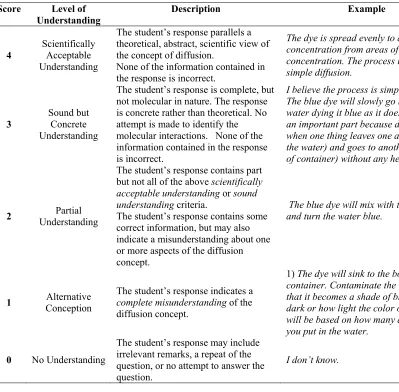
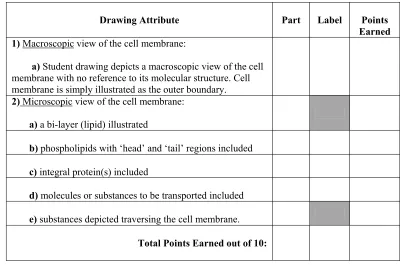
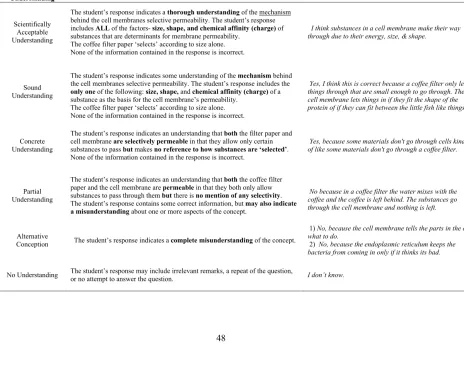
3.2 Evaluation rubric for the diffusion CES ……….. 45 3.3 Scoring scheme for students’ drawings of the cell membrane …………. 46 3.4 Scoring rubric for the cell membrane-filter paper analogy ……….. 48 3.5 Scoring rubric for student explanations of ‘selective permeability’ …… 49 3.6 Content boundaries used to assess student responses to ‘Tell me
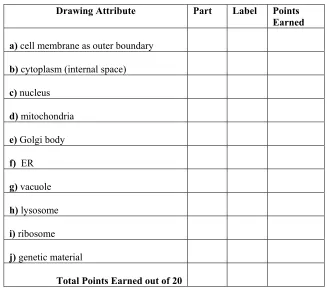
everything that you know about cells’ ………... 51 3.7 Scoring scheme for ‘draw a cell’ task ……….. 52
CHAPTER FOUR: RESULTS
4.1 Results of the Shapiro-Wilks W test of normality
for cognitive items ………. 59 4.2 Analysis of variance of pretest scores on the cognitive
assessment items ……… 60 4.3 Comparison of pretest and posttest scores for entire sample …………... 61 4.4 Comparison of mean gain scores across treatment groups ……….. 62 4.5 Significant difference across treatment groups for ‘low level’
students ……….. 68 4.6 Comparison of student responses to AIM interest items ………. 70 4.7 Comparison of student responses to AIM usability items ………... 72 4.8 Results of the General Linear Model for the cognitive assessment ……. 73 4.9 Description of object choices from the Haptic Assessment ………. 76 4.10 Results of the crosstabulation and Pearson Chi-squared
analysis of the Haptic Assessment ………... 77
LIST OF FIGURES
Page
CHAPTER TWO: REVIEW OF THE RELATED LITERATURE
2.1 A cognitive model of multimedia learning ……….. 16 2.2 A depiction of the exploratory procedures (EPs) ………. 18
CHAPTER THREE: METHODS
3.1 A screenshot of the Cell Exploration instructional program …………... 35 3.2 A view of the last section of the Cell Exploration
instructional program ………... 36 3.3 The PHANToM desktop device ………... 37 3.4 Sequence of events from the perspective of an individual student …….. 42
CHAPTER FOUR: RESULTS
4.1 Representative examples of score histograms
used to visually assess normality ………... 58 4.2 Comparison of mean pretest, posttest, and gain scores
on objective items ……….. 63 4.3 Comparison of mean pretest, posttest, and gain scores
on the Diffusion CES ………... 64 4.4 Mean pretest, posttest, and gain scores on the Draw
a Cell Membrane task ……… 65 4.5 Comparison of mean scores on the cell membrane’s
mechanism items ……… 66 4.6 Mean pretest, posttest, and gain scores on the Tell me
everything that you know about cells free-response item ………... 67 4.7 Comparison of mean scores on the Draw and label a cell task ………… 67 4.8 Frequency of student choices on the Haptic Assessment
across the treatment groups ……… 76
CHAPTER FIVE: DISCUSSION
5.1 Example of one student’s depiction of the cell ………... 85 5.2 Example of a student’s pretest and posttest
drawings of the cell membrane ……….. 85 5.3 Klatzky, Lederman, and Matula’s models representing
Chapter One Introduction
Purpose and Significance of the Study
Computer-mediated instructional technologies hold great promise for use in educational settings in that they can increase students’ access to knowledge and act as vehicles that may promote learning. Many science education researchers assert that simulations and computer-based models are an extremely powerful resource for the
advancement and application of science (e.g., Linn, 1997; 2003). The progression from static 2-D images in an inert medium to dynamic 3-D models in an interactive environment has the potential to profoundly change the nature of inquiry in science and science teaching. Students immersed in interactive computer ‘microworlds’ may acquire hands-on and minds-on
experiences that allow them to develop a deeper understanding of science concepts (White, 1992; Bransford, Brown & Cocking, 1999).
Of the five sensory channels-sight, sound, taste, smell, and touch, it is only our sense of touch that enables us to modify and manipulate the world around us. Our sense of touch is an active, informative, and useful perceptual system (Klatzky & Lederman, 2002). From our earliest days we use information gained through touch to learn about our environment and build the foundations for a wide range of concepts and understandings. Taylor, Lederman and Gibson (1973) suggested that something touched is more real than something seen. But despite its perceptual power and the wealth of information it affords us, the sense of touch has emerged as an understudied and perhaps underutilized sensory modality in the
There exists a growing body of research investigating the use of
multimedia/computer-mediated instruction in the promotion of students’ understandings of science concepts (e.g., Kozma & Russell, 1997; Barnea & Dori, 1999; Mayer, 1999; Wu, Krajcik & Soloway, 2001; Dilek & Akaygun, 2004). The results of such work assert that well-designed computer-generated visualizations and instructional units can be an effective means to enhance students’ ability to conceptualize and make meaning of complex topics in school science. To date, however, the bulk of this research focuses on instructional
interventions that make use of only verbal and visual stimuli. Consequently, much of what is currently known about the cognition of multimedia-based and computer-mediated learning focuses on how visual and verbal information is selected, organized, and integrated by students (Mayer, 1996). Additionally, the vast majority of these studies have been conducted within the context of physics and chemistry instruction. Although students’ understandings of biological processes have been investigated quite extensively (Brumby, 1982; Dreyfus & Jungwrith, 1989; Marek, 1986; Westbook & Marek, 1991; Odom & Barrow, 1995; Sanger, Brecheisen & Hynek, 2001), few studies have involved the use of computer-mediated instructional tools.
Current technology now makes it possible to extend students’ interactions with their learning environments by incorporating the sense of touch. Haptic devices, providing
Today the term, in its broadest sense, encompasses the study of touch and the human interaction with the external environment via touch. The field of haptics has grown
dramatically as haptic researchers are involved in the development, testing, and refinement of tactile and force feedback devices as well as supporting software that allow users to sense ("feel") and manipulate three-dimensional virtual objects (McLaughlin, Hespanha & Sukhatme, 2002). In addition to basic psychophysical research on human haptics, work is being done in application areas such as surgical simulation, medical training, scientific visualization, and assistive technology for the blind and visually impaired. However, due to its relatively recent advent, it remains unclear how the addition of haptics influences
students’ construction of knowledge and meaning making.
What haptic information do students find salient and subsequently attend to? How is this multimodal information organized and integrated? Does the unique bi-directional exchange of information between a user and a haptic device somehow enhance the learning experience? Is it possible to know something more completely by touching it?
the cell and the process of diffusion (Dreyfus & Jungwirth, 1988; 1989; Westbrook & Marek, 1991; Flores & Tovar, 2003).
Thus, the significance of this study lies in its potential to add insight into two areas of science education that warrant further investigation: students’ learning about biological concepts in a computer-mediated or computer-based environment and how the addition of the sense of touch via a haptic (simulated kinesthetic and tactile feedback) interface to such a learning environment affects students’ learning.
Research Questions
The aim of this research study was to investigate the efficacy of the haptic (the sense of touch) augmentation of a computer-mediated instructional program on middle school students’ understandings of cell concepts. To this end the specific research questions are: 1) Does haptic feedback impact students’:
• ability to recognize and name the organelles found in a typical animal cell? • identification of the corresponding functions of an animal cell’s organelles? • knowledge of the process of diffusion?
• descriptions of the molecular structure of the cell membrane?
• understandings of the mechanisms involved in passive transport and the cell membrane’s selective permeability?
2) Does haptic feedback influence the way in which students select, organize, and integrate information about cell structure and functioning presented in the instructional program to construct understandings?
4) Is there a differential impact of the instructional program, with and without haptic
feedback, according to students’ gender, spatial ability, or amount of computer use outside of school?
Computer-mediated instructional technologies can enhance student performance when they are integrated into the curriculum, but the mere existence of these tools in the classroom does not guarantee that student learning will improve (Bransford, Brown & Cocking, 1999). This is particularly true in the case of haptics. The viability of this innovative technology may ultimately be determined using knowledge about human cognition in this type of a multimodal computer-mediated learning environment in
accordance with practical knowledge about student learning in the complex milieu of today’s classrooms.
Definition of Terms
Multimedia-based instruction: the use of some form of technology to present and combine text, graphics, audio and video. It often incorporates links and tools that let the user navigate, interact, create and/or communicate.
Computer-mediated instruction: the use of a computer to deliver training and other educational materials including tutorials, simulations, and exercises. It is often used interchangeably with computer-based instruction.
Multimodal: refers the involvement of more than one type of sensory channel in the conveying or acquiring of information.
Haptics: the science of applying tactile and kinesthetic sensation to human interaction with
Haptic devices: force feedback devices enabling human-computer interaction via the kinesthetic and/or tactile sense.
Cell concepts: the instructional objectives of the computer-mediated program used in this study including those outlined below.
Students’ ability to:
• Represent the form of an animal cell and its parts as it relates to its function. • Recognize and name the major organelles in a typical animal cell and identify its
corresponding function.
• Describe the bilipid structure of the animal cell membrane.
• Explain the mechanisms behind the selective permeability of the cell membrane as it pertains to the process of passive transport.
• Provide a scientifically sound description of the process of diffusion.
National science standards recommendations: According to The National Science Education Standards (NSES, 1996, p. 156), grade 5-8 students should understand that:
• All organisms are composed of cells--the fundamental unit of life. Most organisms are single cells; other organisms, including humans, are multicellular.
• Cells carry on the many functions needed to sustain life. They grow and divide, thereby producing more cells. This requires that they take in nutrients, which they use to provide energy for the work that cells do and to make the materials that a cell or an organism needs.
Grade 9-12 students should understand that (NSES, 1996, p. 184):
• Cells have particular structures that underlie their functions.
• Every cell is surrounded by a membrane that separates it from the outside world. • Inside the cell is a concentrated mixture of thousands of different molecules which form a variety of specialized structures that carry out such cell functions as energy production, transport of molecules, waste disposal, synthesis of new
molecules, and the storage of genetic material.
The Benchmarks for Science Literacy (AAAS,1993, p. 112) suggest that by the end of the 8th grade, students should know that:
• About two thirds of the weight of cells is accounted for by water, which gives cells many of their properties.
By the end of the 12th grade, students should know that (AAAS, 1993. p. 113):
• Every cell is covered by a membrane that controls what can enter and leave the cell. • Within every cell are specialized parts for the transport of materials, energy transfer,
protein building, waste disposal, information feedback, and even movement.
State science standards recommendations:
The state’s Science Standard Course of Study and Grade Level Competencies (NCDPI, 2004, p. 89) state:
Grade 8- COMPETENCY GOAL 6: The learner will conduct investigations, use models, simulations, and appropriate technologies and information systems to build an understanding of cell theory.
Objectives:
6.01 Describe cell theory:
- All living things are composed of cells.
- Cells provide structure and carry on major functions to sustain life. - Some organisms are single cell; other organisms, including humans, are multi-cellular.
- Cell function is similar in all living things.
6.02 Analyze structures, functions, and processes within animal cells for: - Capture and release of energy.
- Feedback information. - Dispose of wastes.
High School Biology- COMPETENCY GOAL 2: The learner will develop an understanding of the physical, chemical and cellular basis of life (NCDPI, 2004, p. 100).
Objectives:
2.02 Investigate and describe the structure and functions of cells 2.03 Investigate and analyze the cell as a living system including:
Chapter Two
Review of the Related Literature
Overview
The literature that is pertinent to this study is drawn from prior research in three key areas. First, previous studies in science education that have investigated students’
understandings of the biological concepts of the ‘cell’ and the process of ‘diffusion’ will be discussed. This work has been conducted with individuals that span the educational
sequence, from elementary school to college, and collectively suggest that the majority of learners studied find these topics difficult to construct meaningful understandings of and conceptualize.
Due to the nature of the instructional program utilized in this study, the second discipline within the literature from which information is garnered is that of educational psychology. More specifically, the research focusing on the cognition of students in
Students’ Understandings of the Cell
"The cell is the ultimate irreducible form of every living element, and...from it emanates all the activities of life both in health and in sickness." (Virchow,1858, p. 8)
The National Science Education Standards (NSES, 1996) put forward that teachers should assist students in the development of more complete understandings about science and technology, as well as personal and community health. Certainly the study of cells is central and necessary to the learning about some of the most important topics in these areas. Cell biology offers the opportunity to examine long-understood phenomena related to the structure and function of living things and to explore quickly emerging ideas and
technologies related to the use of cells to enhance our health. However, research has shown that many school age students possess notions about basic biological principles that are incongruent with the scientific view of the concepts (e.g., Bell, 1981; Brumby, 1982; Songer & Mintzes, 1994). Moreover, the prevalence and persistence of these ‘misconceptions’ or ‘alternative conceptions’ makes learning about complex concepts like an animal ‘cell’ and ‘diffusion’ difficult for most.
view of cell processes (Tamir & Zohar, 1991). For example, ideas like ‘the cell knows what to take in and what to discard’ were found to be widespread (Dreyfus & Jungwirth 1988, 1989).
Other problems seem to lie in students’ difficulty in conceptualizing the spatial and metrical representations of cells; resulting in confusion between cells, atoms and molecules. Additionally, students have difficulty understanding that the cell is an autonomous organism, able to carry out the basic processes necessary for life. In particular, the establishment of relationships between cell structures and their functions are especially complex for students who are not able to integrate them into an overall picture of the cell (Flores & Tovar, 2003).
Even if students are able to recognize that the cell is the structural unit in which organisms are formed they still have difficulties with the cell’s internal structure. The names of the organelles are known but not their corresponding function; it seems that in the
students’ minds cell organelles have unknown roles causing them to often rely on assigning to the nucleus all of the functions (Flores & Tovar, 2003). Marek (1986) found that only 15.8% of 60 tenth grade biology students demonstrated a sound scientifically acceptable understanding of the cell. Here, a significant number (56.1%) of students either gave no response or revealed specific misconceptions of the concept of the cell. More strikingly perhaps is that this same study revealed that 62.5% of the students either gave no response or revealed specific misconceptions about the process of diffusion and only 1.8% of the same sample showed a sound understanding of the process (Marek, 1986).
Students’ Understandings of Diffusion
that diffusion is readily experienced in everyday life and is easily demonstrable in a classroom, a clear understanding of the process seems to elude many school age students. This difficulty may arise from the need to visualize the molecular events that govern the process (Westbrook & Marek, 1991). Westbrook and Marek’s (1991) cross-age study of students’ understanding of the process found that, regardless of the level of schooling,
‘alternative’ or ‘misconceptions’ were prevalent. Students were asked to explain ‘what would happen when several drops of blue dye were added to a container of clear water…name and describe the process in as much detail as possible’ and the analysis of their responses
revealed that 55% of the 7th graders, 65% of the 10th graders, and 61% of the college students held ‘misconceptions’ about the process of diffusion. None of the 300 students’ responses indicated a ‘complete’ or ‘sound’ understanding. The responses to Conceptual Evaluation Statements (CES), like the one above, of the college students were more sophisticated. These students employed more scientific terminology but the use of these terms seemed to
undermine students’ understandings. That is, the upper level students had been exposed to more content and vocabulary but this did not necessarily translate into a better understanding of the concept. In fact, terms like dissolve, disperse, surface tension, and density were often misused in their explanations of ‘diffusion.’
Another study (Odom, 1995) had 116 secondary biology students, 123 college non-biology majors, and 117 non-biology majors take the Diffusion and Osmosis Diagnostic Test
answer is because . . . ’ ). The intent of this questioning format was to reveal the students’ content knowledge, as well as their understanding of that knowledge. The results of this investigation showed ‘misconceptions’ in five of the seven conceptual areas measured by the test: the particulate and random nature of matter, concentration and tonicity, the influences of life forces on diffusion and osmosis, the process of diffusion, and the process of osmosis.
The studies discussed commonly suggest that more effective methods are required to teach these difficult concepts. This assertion was tested by Christianson and Fisher (1999) when they compared students’ understanding of diffusion and osmosis, in three non-major biology courses at three different universities. The first two courses followed a traditional pattern of instruction, with lectures given in large halls to all of the students enrolled in the course and laboratory experiences in smaller sections. The third course was an integrated laboratory/discussion class that employed inquiry and discovery-based teaching, instructional strategies common to constructivist learning (Tobin, 1990; Brooks & Brooks, 1993). The DODT instrument (previously described) was administered pre- and post-instruction. The scores indicated significant learning differences, with students in the small constructivist influenced discussion/laboratory course learning about and understanding diffusion and osmosis ‘most deeply’ (Christianson & Fisher,1999).
This notion that different (and perhaps more effective) teaching methods can impact students’ understandings of the process of diffusion was further supported by a more recent study (Sanger, Brecheisen & Hynek, 2001). The purpose of this work was to determine whether viewing computer animations depicting the molecular processes of diffusion and osmosis would affect students' conceptions of these topics. Again, the students'
from a second-semester introductory college biology course. All of these students attended the same lecture section which met for three hours per week; each student was also enrolled a laboratory section containing 21 to 28 students. This research took place in the laboratory sections after the students had received instruction on diffusion and osmosis during lectures. Students were randomly assigned to one of two treatment groups. Both groups performed several experiments including the diffusion of potassium permanganate in water, the osmosis of water and glucose (but not starch) through cellulose dialysis tubing, and the effect on the cells of an Elodea leaf after being placed in hypotonic, isotonic and hypertonic solutions (Sanger, Brecheisen & Hynek, 2001). However, students in the experimental group viewed two animations explaining the molecular behaviors associated with the processes of diffusion before performing these experiments while the control group did not.
The results showed that students who viewed the animations were less likely to choose responses on the DODT suggesting that particle motion stops after equilibrium is reached. It was assumed that these animations were successful in helping students understand the dynamic nature of equilibrium processes. Additionally, students in the experimental group were less likely to attribute molecular motions to anthropomorphic ‘desires’ of the molecules. More students (47% versus 32%) in the control group, having not viewed the animations, believed that as the difference in concentration increases between two areas, the rate of diffusion increases because the molecules ‘want to spread out’ than in the
experimental group. (Sanger, Brecheisen & Hynek, 2001).
suggests that the use of instructional strategies (be they from a constructivist approach or a computer animation) that actively engage the students in the knowledge construction and meaning making process can enhance their learning. But how might such activities promote student learning of these concepts? In an effort to answer this, the review of the literature next looks at some of the research regarding student cognition of multimedia/computer-based learning.
Multimedia Computer-based Learning
As noted in the introduction, much of the work to date that has investigated how
individuals learn in a multimedia or computer-based environment has involved instructional programs that make use of verbal and visual information only. Although the present study is
distinctly different in that its primary aim is explore the impact of haptic (simulated
kinesthetic and tactile) information on student learning; the underpinnings of a portion of this
existing research does provide a framework for investigating this type of multimodality.
One cognitive theory of multimedia/computer-mediated learning is centered on three
basic premises from research in cognitive science: dual channels, limited capacity, and
knowledge construction (Mayer, 1997; 2003). The first notion is that humans are dual channel or code processors. More specifically, people have separate channels for processing
verbal and nonverbal information (Paivio, 1986). Piavo’s (1996) dual coding theory (DCT) is
thought to be one psychological mechanism that permits unified explanations of diverse
(cognitive and affective) educational phenomena (Clark & Piavio, 1991). According to the
DCT our verbal system receives and maintains visual, auditory, and articulatory verbal codes. These verbal word-like codes are arbitrary symbols that denote concrete objects and events
connected to one another and are processed in a serial or sequential manner. Conversely, our
nonverbal system contains modality-specific images for shapes, sounds, actions, sensations, and other non-linguistic events. Unlike nonverbal information, these are not arbitrary
symbols but representations that are analogous and perceptually similar to the events they
denote. In addition, these non-verbal representations are processed in a parallel or
simultaneous manner (Piavio, 1986).
The second component of the theory is that humans have a limited capacity for
processing information from their environment, be it verbal or nonverbal in nature.
Information is initially received by the extremely short-term sensory memory. These sensory
memories act as buffers for stimuli received through the senses. A sensory memory exists for
each sensory channel: iconic memory for visual stimuli, echoic memory for aural stimuli and
haptic memory for touch (Baddeley, 1999). Information is then passed from sensory memory into working or short-term memory by attention, thereby filtering the stimuli to only those
which are of interest at a given time. People are able to actively process only a small amount
of information from each of the channels at any one time (Sweller, 1994; 1999). This is
commonly referred to as the cognitive load theory (CLT) and it assumes that for effective
information processing, users need to reduce all unnecessary cognitive loads on their
working or short-term memory (Sweller, 1994). It is thought that one way to achieve such
load reduction is to present information using multiple channels or modalities (Mousavi, Low
& Sweller, 1995). The present study introduces a third sensory channel for touch, the affects
of which are still unclear.
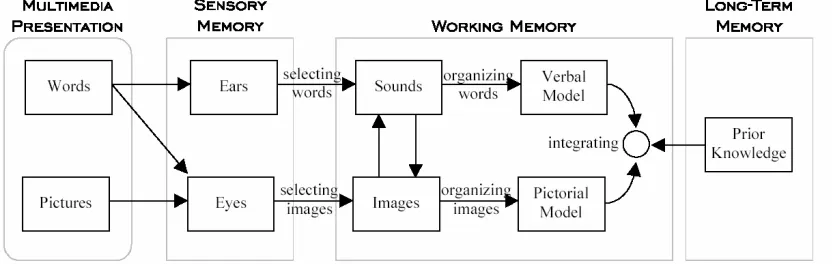
information, mentally organize the information into coherent structures, and mentally
integrate it with their prior knowledge. This process is illustrated in Figure 2.1 for a multimedia learning environment that provides verbal and visual stimuli.
Figure 2.1. A cognitive model of multimedia learning proposed by Mayer (1996;1997).
This above SOI model, put forward by Mayer (1996;1997), suggests that the learner engages in three important cognitive processes; the first of which is selecting. Here, the learner pays attention to and selects relevant information for further processing. The second cognitive process, organizing, is essentially the building of ‘links’ among and between the selected and retained information. Piavio (1986) called these ‘links’ connections and
One can reasonably conclude that haptic information, gained through the sensory
modality of touch, is nonverbal in nature. Consequently, one can assume that this haptic
information is processed and stored in the nonverbal or image based region of our working or
short-term memory. Moreover, there is a considerable amount of evidence indicating the type
of haptic information individuals find particularly salient and select to process (e.g., Klatzky,
Lederman & Matula, 1991;1993; Klatzky & Lederman, 2000). What is less clear, however, is
the representational form that selected haptic information takes as an individual attempts to
organize this information in memory. Additionally, the way in which this kind of sensory
information is integrated as an individual ‘makes meaning’ of perceived objects and events is
still largely unknown.
Haptic Perception and Selecting Information
“Touch provides information on the innards of objects, whereas the eye, remaining fixed on the outer surface of objects, plays a lesser role in developing the belief in the reality of the external world.” (Krueger, 1989, p.3)
The sensory channel of touch receives information, not just sensations (Kennedy, Gabias & Heller, 1992). Heller (1982) notes Reid’s early proposition (1764/1967) that the use of vision requires the learner to indirectly perceive attributes such as hardness, softness, motion, and texture that are originally known directly to the tactual sense. Based on the findings of over twenty years of research into human haptic perception, Lederman and Klatzky (e.g., 1983; 1987; 1990; 1999; 2002) have been able to identify precisely the type of haptic information that individuals find relevant and select for further processing during object exploration.
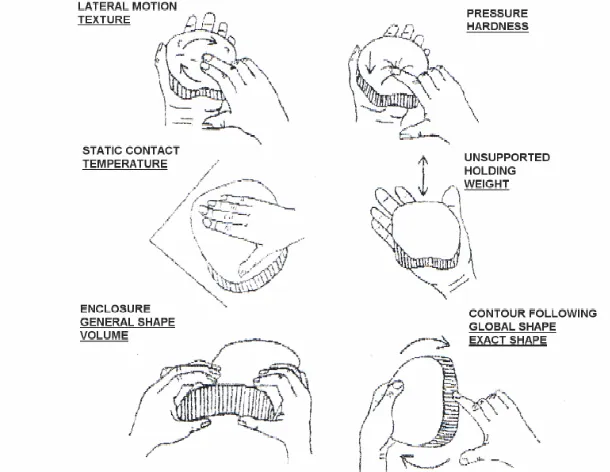
stereotypical and formulaic hand movements that individuals performing haptic explorations instinctively employ in order to extract information regarding an object’s properties (Figure 2.2). Each EP is associated with a particular object dimension which it is the optimal and preferred method for determining the property under unconstrained haptic exploration. An example of this is pressure (described as applying torque or normal forces to one part of the object while the object is stabilized) which yields information about the object’s compliance.
Lateral motion, associated with texture encoding, is characterized by production of shearing forces between skin and object. Contour following, where the hand maintains contact with a curve on an object, provides salient information about the shape and volume of the object. It is believed that these exploratory procedures maximize the sensory input corresponding to a certain object property, permitting increased ease of organizing and encoding (Klatzky, Lederman & Reed, 1987).
Table 2.1
Availability of EPs During Exploration with a Point-probe
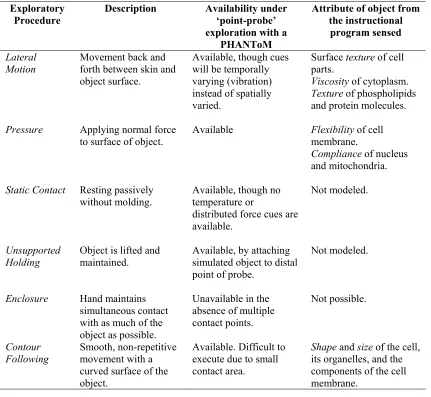
The last column of this table relates these point-probe interactions to the attributes or features of the virtual objects from the instructional program used in this study. It allows the user to see and “feel” a computer-based virtual model on an animal cell, depicting the 3-D nature and spatial arrangement of an animal cell including its typical parts or organelles. The structural differences (i.e. relative size, surface area, texture, shape, elasticity & rigidity) of the parts are emphasized. At a second level, the structure and function of the cell membrane
Exploratory Procedure
Description Availability under ‘point-probe’
exploration with a PHANToM
Attribute of object from the instructional
program sensed
Lateral Motion
Movement back and forth between skin and object surface.
Available, though cues will be temporally varying (vibration) instead of spatially varied.
Surface texture of cell parts.
Viscosity of cytoplasm. Texture of phospholipids and protein molecules. Pressure Applying normal force
to surface of object.
Available Flexibility of cell membrane.
Compliance of nucleus and mitochondria. Static Contact Resting passively
without molding.
Available, though no temperature or
distributed force cues are available.
Not modeled.
Unsupported Holding
Object is lifted and maintained.
Available, by attaching simulated object to distal point of probe.
Not modeled.
Enclosure Hand maintains simultaneous contact with as much of the object as possible.
Unavailable in the absence of multiple contact points.
Not possible.
Contour Following
Smooth, non-repetitive movement with a curved surface of the object.
Available. Difficult to execute due to small contact area.
Klatzky, Lederman, and Reed (1987) postulated that haptics is oriented toward the perception and subsequent encoding of material properties. Haptics is thought to be superior to vision in perceiving properties such as texture (roughness/smoothness, hardness/softness, wetness/dryness, stickiness, and slipperiness), weight, hardness, compliance, elasticity, and viscosity (Lederman, 1983; Zangaladze et al., 1999; Klatzky & Lederman, 2000). Whereas our vision dominates in the perception of geometricproperties like shape and size and color (Sathian et al., 1997; Verry, 1998; Klatzky & Lederman, 2000).
Given this, it is hypothesized that students in the present study will instinctually use vision to extract information regarding the shape and relative size of the cell and its
organelles, even when touch is available. Conversely, it is believed that individuals will find information about the virtual objects’ material properties salient during haptic exploration. For example the flexibility of the cell membrane, viscosity of the cytoplasm, compliance of the nucleus, and texture of the rough endoplasmic reticulum may be readily selected by students for further processing. Additionally, the haptic interface makes the simulation of the forces associated with the process of passive transport possible. Students can ‘sense’ the pull of a potassium ion through a protein channel, information that seems to be well suited for haptic perception.
Haptic Perception and Organizing Information
“In stark contrast to the voluminous literature on visual imagery, little is known about imagery associated with touch.” (Klatzky & Lederman, 2000, p. 242).
instructional program of this present research, touch and vision operate together but the nature and dynamics of this relationship remains uncertain.
What representational form does perceived haptic information take? Is haptic information combined with visual data to build a shared representation or are there distinct haptic images in our ‘memories’? There exist three basic views that may help explain how this type of perceptual information is processed (Turkewitz, 1994). The first idea maintains that information comes from separate sensory systems via independent pathways and it is often presumed to be sensory-specific at an “early” level, a dual coding approach. At a higher (conceptual), level information from all perceptual modalities is thought to be jointly
available. According to this view (e.g., Fodor, 1983) all visual processing would be independent of haptic processing and each would require its own memory storage system complete with distinct images or representations. A second notion is that perceptual
information is maintained in an amodal representation (Gibson, 1966; 1979) which receives inputs from all our sensory modalities. In this view, only one global representation is maintained and stored. Subsequently each piece of information, no matter how detected, is included in a representation of what is perceived.
There has been some effort to determine if information encountered through the sense of touch is represented in manner that is modality-specific or more general (e.g. spatial). Millar (1997) pointed to evidence for the existence of short-term memory in the tactual modality with a limiting span of two-three items (Watkins & Watkins, 1974; Millar, 1975). There is additional evidence for tactual coding during early learning of small patterns like Braille forms; coding that is in terms of tactual features such as texture or dot density, rather than being spatially mediated (Millar, 1997).
Klatzky, Lederman, and Metzger (1985) contend that the haptic modality constitutes an expert system. They extended this proposition by suggesting that our capacity to process information of a haptic nature is superior to vision and audition; citing that the haptic modality is not limited to a single sense organ or receptor but is instead a combination of several interrelated mechanisms; a system that is not subject to the same rapid decay of information observed for the icon and echo of very short-term sensory memory (Kiphart, Auday & Cross, 1988). Separate and distinct representations is suggested by other experiments on haptic object categorization, which indicate that people use different attributes to group objects, depending on whether the subjects are instructed to think about what the objects feel like vs. look like (Klatzky, Lederman, & Reed, 1987; Lederman,
Summers & Klatzky, 1996). This sort of ‘modality encoding bias’ may lead to the creation of modality-specific representations (Klatzky & Lederman, 2000).
knowledge in one’s memory (Tulving & Schacter, 1990). Srinivas, Greene, and Easton (1997) showed that both implicit and explicit tactual memory tests were affected by changes in the orientation and size of the forms between study and test; when the forms were left/right reversed or resized, priming produced by implicit memory vanished. In contrast, a visual version of the test was affected by orientation changes but not size changes. This suggests that the source of implicit memory in touch is not identical to that in vision, and that the functional representation in touch preserves the physical structure and scale of the touched objects.
Evidence of distinct but shared representations can be found in the research into cross-modal priming (implicit memory representation that is accessible multimodally) between the visual and haptic modalities. Easton, Srinivas and Green (1997) demonstrated substantial cross-modal priming between vision and touch with seen or felt words as stimuli, using word stem-completion as an implicit memory test. Reales and Ballesteros (1999) used common objects as stimuli and various implicit tests (speed of object naming, the level of completeness at which a fragmented picture could be identified, and speed of deciding whether a line drawing depicted a real object) to investigate implicit and explicit memory under both intra-modal (within one modality) and cross-modal conditions. Results indicated cross-modal and intra-modal priming (faster responses for previously studied objects), and in some cases the magnitude of the cross- and intra-modal priming effects were equivalent leading to the speculation that visual and haptic object representations are so similar that they might actually be shared between the two modalities.
whether the modality changed between vision and touch or was held constant between presentation and test. This cross-modal recognition became less accurate (though still above chance levels) when the objects were unfamiliar or when the old and new objects were different examples of the same category name. The authors maintained that the categorical effect observed was likely due to mediation at a higher (conceptual) level.
Aside from the above described behavioral studies there is a growing body of neurological evidence indicating that visual and haptic object representations are so similar that they might actually be shared. Several neuroimaging studies have indicated possible interactions between the visual and haptic systems. Researchers have used functional magnetic resonance (fMRI) imaging to measure the effects of cross-modal haptic-to-visual priming on brain activation (Sathian et al., 1997; Deibert et al., 1999; Zangaladze et al., 1999; Amedi et al., 2001). Results of these studies suggest that the neural substrate underlying both visual and haptic object recognition is found within the occipital cortex associated with visual processing. This overlap in some of the neural structures mediating haptic and visual processing of object structure suggests that the haptic system may exploit the highly developed object representation systems of the ventral visual pathway.
Haptic Perception and Integrating Information
"It is a truism of our educational creed that sensory impressions based on object lessons and motor response form the primary basis of thought in dealing with the later materials of knowledge." (McMurray, 1921, p. 3).
There is evidence that touch is a fully cognitive system providing the basis for conscious memory and learning (e.g., Loomis & Lederman, 1986; Klatzky & Lederman, 2002); however to this point there has been very little research exploring how the addition of haptic feedback impacts the way in which individuals integrate this information during the ‘meaning making’ process. The influence that this additional sensory modality and its accompanying information have on the way in which an individual makes connections
between prior knowledge and experiences to construct understandings has been understudied. The critical role of touch in ‘meaning making’ permeates the language that we often use to describe learning. We talk about “grasping the idea,” getting a “handle on a problem,” or being “touched by a reading.” Many educators believe that “hands-on” experiences, ones that actively involve students in the manipulation of objects, are powerful teaching tools.
Active touch involves intentional actions that an individual chooses to make. Sathian (1998) has suggested that involving students in consciously choosing to investigate the properties of an object is a powerful motivator and increases attention to learning. This assertion is supported by the results of an investigation into the influence of haptic feedback on middle and high school students’ concepts of small objects such as viruses (Jones et al., 2003; 2004). Jones et al. (2003; 2004) reported that students who received haptic feedback as part of microscopy experiments showed significantly better attitudes, suggesting that the increased sensory feedback and stimulation made the experience more engaging and motivating to students. This increase in attention may impact what and how students select information for processing.
In addition to such affective influences, the use of multiple senses in learning is thought to be involved in the development of more generalized cognitive processes, namely moving from concrete to abstract thinking (Loucks-Horsley et al., 1990). It has been noted that “hands-on” or sensory-motor experiences are necessary elements for the subsequent development of formal operations (Wadsworth, 1989). Educators traditionally maintain that the active physical manipulation and handling of objects is often a more effective way for students to learn complex and abstract concepts when compared to more passive modes of instruction (Glasson, 1989; Vesilind & Jones, 1996; Druyan, 1997).
laproscopic and endoscopic surgery. The virtual environments for this application can be programmed to be similar to the soft tissue inside the human body and the user can practice removing polyps and suturing tissue (Burdea et al., 1992; Jacobson, Kitchen & Golledge, 2000; Hayward et al., 2004).
It is thought that in these training scenarios the advantage of the addition of haptics is its impact on a person’s kinesthetic memory (the ability to remember limb position, velocity, etc.). In a review of the research into kinesthetic memory, Clark and Horch (1986) suggest that humans have a remarkable ability to remember positions of their limbs quite accurately and for long periods. Haptic training is different from visual training in that the learning that takes place is body centered. This approach may also be useful for complex, three or more dimensional, motor skills that are difficult to explain and describe verbally or even visually. Perhaps this active type of learning, encouraged by the use of haptics, has benefits over more passive observational learning (Laguna, 2000). Seemingly, similar results can be expected in the context of the classroom.
Another feature of haptic feedback, that may have a positive impact on the
gained through corporeal activity and physical work. They allow us to know places in intimate, unself-conscious ways that visual sensibilities cannot describe. Such combinations of sensibilities have been referred to as simultaneous perception;a wide range of the
experiences produced from these sources are not namable sensations, and hence have been long overlooked by researchers (Gibson, 1966). Straus (1966) defined this mind/body duality as two modes of personal experience: gnostic and pathic. The gnostic mode consists of ‘looking at’ objects as distinct from the self, and deals with cognition of the object. The pathic mode guides our perception in touching, and places emphasis on preconceptual
phenomenal experiences, and the changing ways in which things appear directly to the senses as we move through space.
Kilpatrick (1976) used kinesthetic feedback as an aid to 2-D and 3-D force field understandings. He showed that kinesthetic feedback improved user perception and
manipulation in a simple 3-D virtual world, even more so than did three-dimensional stereo viewing. Similarly, Brooks et al. (1990) found that understanding of the binding energy of a drug molecule was much clearer when forces were simulated using haptic feedback and added to a visual display of a simple 6-D (x, y, z, pitch, yaw, and roll) docking task. Brooks (1990) concluded that haptic augmentation of a visual display can improve the user’s perception of valid docking positions for drugs and enhance their understanding of why a particular drug docks well or poorly.
associated with middle school students’ improved understanding of thermal equilibrium. This tactile model did not incorporate haptics, rather it showed a hand next to the object with heat flow arrows flowing to or from the hand at varying rates depending on the temperature gradient between the hand and object in an attempt to indicate how hot or cold the object feels. In addition, the visualization used audio and text messages that described how the object feels (e.g., ‘‘This feels burning hot!’’). The results of this investigation showed that students that experienced this simulated tactile model of thermal sensation had a greater capability to describe why objects “feel” the way they do in regards to thermal equilibrium.
Additional evidence for the potential value of haptic stimulation in knowledge construction, meaning making, and learning is provided by a study that examined the effects of incorporating the haptic exploration of letters into a training program designed to develop understandings of the alphabetic principle among pre-reading kindergarten children
(Florence et al., 2004). Here the authors note that reading acquisition is broadly thought to consist of the development of phonological and visual representations as well as the
establishment of connections between these two types of representation. Yet much of the research assumes that it is an implicit process which is triggered by the learning of letter/sound correspondences.
the children in tracing a written word with their index finger while pronouncing it and looking at it. The results of this study showed that incorporating the haptic exploration increased the positive effects of the training on the understanding and use of the alphabetic principle in young children and their decoding skills. More importantly perhaps, the haptic exploration appeared to help students establish the referential links between the visual representations of the letters and the phonological representation of the corresponding sounds. It was suggested that the beneficial effect of incorporating the haptic modality could be due to various functional specificities of the sensory modalities (Gentaz & Rossetti, 1999; Hatwell, Streri & Gentaz, 2003). Including the haptic exploration led children to process the letters in a more sequential and analytical way, something which they do not do implicitly when the letters are presented in a visual form only.
Perhaps the addition of haptic feedback leads to more associative connections among existing images and prior knowledge, helping students create more ‘experiential’ meanings. This notion is supported by the work of Reiner (1999) in which she examined the role of tactile perception in the conceptual construction of forces and fields by employing a modified trackball that transferred a simulated force applied by a field to the learner’s hand. She
presented ‘embodied experiences’ as a way to explain the positive educational impact of haptics. That is to say, this learning environment stirs up tacit embodied knowledge, previously unexploited non-propositional knowledge. This type of knowledge is in
immediate (without the mediation of symbols and concepts) relation to objects and bodily acts. She goes on to suggest that haptic devices are interfaces that promote the use of bodily non-propositional knowledge in the building of more accurate mental models and
Learning is often defined as the construction of knowledge as sensory data are given meaning in terms of prior knowledge (Lochhead, 1988; Loucks-Horsley, et al., 1990; Tobin, 1990; Brooks & Brooks, 1993). Perhaps the addition of haptics affords students the
Chapter Three Methods
Overview
This chapter describes the research methodology used to answer the following research questions:
1) Does haptic feedback impact students’:
• ability to recognize and name the organelles found in a typical animal cell? • identification of the corresponding functions of an animal cell’s organelles? • knowledge of the process of diffusion?
• descriptions of the molecular structure of the cell membrane?
• understandings of the mechanisms involved in passive transport and the cell membrane’s selective permeability?
2) Does haptic feedback influence the way in which students select, organize, and integrate information about cell structure and functioning presented in the instructional program to construct their understandings?
3) Are there differences in students’ attitudes toward the instructional program for those who receive visual and haptic feedback compared to those who receive only visual feedback?
This methodology includes a discussion of the research design, followed by a description of the study site and its participants. Next, the computer-mediated instructional program and the user interface employed in the study are described. In addition, details about the instrumentation including their source, as well as validity and reliability information are given. The procedural details, from the perspective of an individual participant, are also outlined. A description of the research hypotheses, the scoring of the data generated for each hypothesis, and the analysis plan for the data are included. Finally, additional sources of data and their analyses are briefly discussed.
Research Design
This exploratory study employed a randomized pretest-posttest control group design to investigate the impact of haptic feedback on students’ understandings of the cell concepts
as described in the first chapter. Participating students were randomly assigned to one of two treatment groups. Both groups experienced the same core computer-mediated instructional program, the Cell Exploration (described further below). Students in the experimental group received bi-modal (visual and haptic) feedback as they completed the program. Conversely, members of the control group only received uni-modal (visual) information as they worked through the activity.
Study Site and Participants
were randomly assigned to either the experimental or control group (n = 40 each). These treatment groups are described in more detail in the section that follows.
Instructional Program
The computer-based Cell Exploration instructionalprogram was designed to allow students to follow on-screen instructions which prompted them to explore the structure and function of a typical animal cell. The exploration began with a computer generated virtual model that depicted the 3-D nature and spatial arrangement of an animal cell with its characteristic organelles. The program allowed students to rotate and zoom in or out on the image of the cell being modeled. The structural differences of the parts were emphasized. As students conducted their survey of the cell and encountered the various structural components with a point probe, descriptions of the parts appeared in a text box on the screen, as depicted in Figure 3.1 below.
Next, students viewed an animation that described the cell’s environment, the structure of the cell membrane, as well as the processes of simple and facilitated diffusion. Following the animation, students were given the opportunity to further investigate the structure of the cell membrane in a manner similar to the one described for the students’ investigation of the cellular organelles. This portion of the program involved another 3-D visualization that depicted the fluid mosaic model of the cell membrane and allowed the user to explore and gather information about the phospholipid bi-layer and protein construction. In the last section (shown in Figure 3.2) the program highlighted the mechanisms behind the cell membrane's selective permeability. Students investigated how certain molecules traverse the membrane via the various types of passive transport. In a game-like scenario students were prompted to try to pass these substances through the membrane and reach an equilibrium.
It is important to note that there is no audio feedback provided during any portion of the instructional program. During the course of the study, student’s progression through the program was monitored by a researcher who followed the Cell Exploration Guide (see Appendix A). This guide was intended to ensure that all students had a similar experience and attended to the same science content being presented.
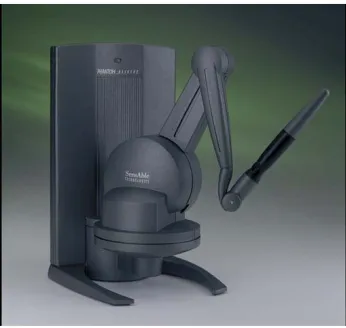
Students in the experimental group received haptic feedback via a PHANToM desktop device (www.sensabletechnologies.com) as they conducted their investigations. The PHANToM, one of the most commonly used haptic devices, is a small, desk-grounded robot-like arm that permits simulation of fingertip contact with virtual objects through a pen-robot-like stylus as shown in Figure 3.3. It tracks the x, y, and z Cartesian coordinates and pitch, roll, and yaw of the virtual point-probe as it moves about a three-dimensional workspace, and its actuators communicate forces back to the user's fingertips as it detects collisions with virtual objects, simulating the sense of touch (Salisbury et al., 1995).
This unique bi-directional interface afforded the students to the opportunity to “feel” the shape, size, texture, viscosity, and elasticity of the cellular structures. In addition, during the final part of the program students were able to “feel” the forces associated with the passive transport of the substances. For example, students in this group could “feel” the potassium ion being pulled through the protein channel and “feel” how the glucose molecule fit into its protein channel, causing a conformational change in the protein.
Students in the control or comparison group used the identical computer interface (PHANToM desktop device and laptop computer); however the haptic feedback was turned off during their exploration. As a result, control group participants experienced the same core instructional program but received only visual stimuli.
Instrumentation
Table 3.1
Summary of the Connections Among Learning Domains, Research Questions, and Data Sources
Domain Research Question Data Source Description
Cognitive Does haptic feedback impact students’ ability to recognize and name the organelles found in a typical animal cell?
Label the cell diagram (p. 3, #4)
Pre-and Post Assessment: objective recall & recognition/selection items
Does haptic feedback impact students’ identification of the corresponding functions of an animal cell’s organelles?
Match the cell part with its function (p. 5, #6)
Does haptic feedback impact students’ knowledge of the process of diffusion?
Diffusion Concept Evaluation Statement (p. 2, #3)
Pre-and Post Assessment: open-ended/supply items & drawing tasks
Does haptic feedback impact students’ descriptions of the molecular structure of the cell membrane?
Draw the cell membrane (p. 6, #7)
Does haptic feedback impact students’ understandings of the mechanisms involved in passive transport and the cell
membrane’s selective permeability?
Cell membrane-filter paper analogy (p. 4, #5) Selective permeability question (p. 6, # 8)
Cognitive
Does haptic feedback influence the way in which students select, organize, and integrate information about cell
structure and functioning?
‘Tell me everything that you know about a cell’ (p. 1, #1) Draw a cell (p. 1, #2)
Affective
Are there differences in students’ attitudes toward the instructional program for students who receive visual and haptic feedback compared to those who receive only visual feedback?
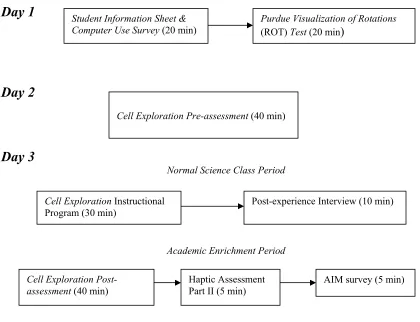
Assessment of Instructional Module (AIM)