ISSN 1729-5106
EAST AFRICAN JOURNAL
OF PHYSICAL SCIENCES
I
Volume 5 - Part 1 January 2004I
Contents
Editorial
1
Current-voltage characterization of doped polystyrene thin films with view to gas sensing.
A.B. Wafula &G. Katana. 3
An International Journal of Pure and Applied Science
The Effect of Quartz and Mullite Phases on Strength of TriaxialPorcelain.
F.W. Nyongesa &B.O. Aduda. 11
A study of angular correlation parameters using a distorted wave model.
C. S. Singh. 25
Flood hydro graph generation from small catchments in Kenya.
lO. Onyando & M.C. Chemelil. 31
Solution of doubly singular problem.
EAST AFRICAN JOURNAL OF PHYSICAL SCIENCES
An International Journal of Pure and Applied Science
East African Journal of Physical Sciences is published by the School of Pure and Applied Sciences, of Kenyatta University. The journal is produced by an editorial committee, with the advice of an international panel of referees. Each volume consists of two issues, to be published when sufficient processed material is at hand, without a pre-determined publication date. For guidelines on the submission of manuscripts, see inside back cover.
Addresses for correspondence: The Chief Editor, East African Journal of Physical Sciences,
School of Pure and Applied Sciences, Kenyatta University, P.o. Box 43844, Nairobi,
Kenya. E-mail: [email protected]
Chief Editor: Prof. S.c. Chhabra, Department of Chemistry
Editorial Committee
Dr. J.Laichena, Appropriate Technology Centre Dr. C. Onindo, Department of Chemistry Mr. K. Kibwage, Department of Computer Science
Dr. C. Wafula, Department of Mathematics Dr. W. Njoroge, Department of Physics
East African Journal of Physical Sciences 5(1): 25-30 (2004)
A study of angular correlation parameters using a distorted wave
model
C. S. Singh
Department ofPhysics, Kenyatta University, P. O.Box 43844, Nairobi, Kenya
We have used a distorted wave model suggested by Singh in calculating the angular correlation parameters f... and R for electron-hydrogen collision. In this model the initial state distorted wave is generated by the static potential in the initial state and the final state distorted wave is generated by a potential taken as the sum ofone.:}}aif ofthe initial state static potential plus one-half of the final state static potential. The results have been compared with other theoretical and experimental results.
Key words: electron impact excitation, angular correlation parameters, distorted wave method,
distortion potential ; !
INTRODUCTION
The distorted wave model suggested by Singh (Singh, 1993) was first used for 1s-2s excitation of hydrogen atom. At 54.4 eV electron impact energy it gave the best fit with the experimental differential cross section results compared with other distorted wave model results. Later it was
used (Onyango, 1996) for 1s-2p excitation of hydrogen atom by electron impact and it was
found that in this case the differential cross section results due to this model were not in as good agreement with the experimental results as the results due to same other distorted wave models. Looking at these two sets of results, we thought it necessary to make a study of angular correlation parameters
A
and R for e' - H scattering using this model, so that definite conclusion can be made on its suitability.THEORY
Distorted Wave Method
The distorted wave formula can be easily derived from the two-potential scattering model (Joachain, 1983). In this model the interaction potential is broken into two parts: one which is treated exactly and the other which can be solved in an approximate manner.
Let the total Hamiltonian H of the system of an electron (proj ectile) and an atom (target) be:
(1)
where
H,
is the Hamiltonian of the target atom plus the non-interacting projectile electron and V is the interaction between the electron and the atom.Now we divide the interaction potential into two parts
26 - Singh, Angular correlation parameters
and assume that the collision problem under the potential U can be solved exactly , that is the
solution of the equation
J
(H,
+
U)X = EX
(3)is known. E is the total energy of the system. The transition matrix for the excitation of initial state i
to final state f is giver ..'
T = (Xf
I
UI
\jJi>
+
(XfI
w
I
\f'i>
(4)Here 'Pand \jJare the solutions of the equations
(5)
and H\f' =E\f' (6)
\f'i satisfies the outgoing wave boundary conditions.
xris a solution to equation (3) with incoming wave boundary conditions. The T-matrix given
by relation (4) is exact but we cannot solve equation (6) to know \f' exactly. So, it is here that the
distorted wave method is introduced when we replace \f' in equation (4) with its approximation as X.
The wave function ofthe electron is distorted by the potential U. The T -matrix now takes the form
T
=
(XfI
UI
\jJi>
+
(XfI
w
I
Xi>
(7)Xi satisfies equation (3) with outgoing wave boundary conditions.
If we take U as the static potential of the initial or final target states or any linear combination
of these, the first term in equation (7) vanishes and we get
T = (Xf
I
w
I
Xi > (8)While applying the distorted wave method (expression 8) we first determine the distortion
potential U. There are numerous forms of it. But the most natural form is the static potential of the
target atom. Many calculations (Itikawa, 1986), using the static potential of the atom as the
distortion potential, have been performed with the following variations:
(i) initial state distorted wave is generated by the static potential in the initial state and
final state distorted wave is generated by the static potential in the final state,
(ii) both initial- and final-state distorted waves are generated by the static potential in the
initial state, and
(iii) both initial and final state distorted waves are generated by the static potential in the
final state.
In our model (Onyango &Singh 1997) the initial state distorted wave is generated by the static
potential in the initial state and the final state distorted wave is generated by a potential taken as the
sum of the one-half of the initial state static potential and one-half of the final state static potential.
Singh, Angular correlation parameters - 27
When the electron is in the initial state, for all the time it is in the field of the initial state of the target. Hence the distortion potential for the projectile electron in the initial state should be taken as the static potential of the target atom in itsinitial state.
When the energy from the projectile electron is transferred to the target atom, the atom takes time (transition time) to go to its final state. That is, there is a time lag between the time of transfer of energy and the instant when the atom reaches its final state. Thus the projectile electron in its final state 'sees' a potential which is intermediate bet~een the initial- and final-state static potentials. Hence the final state distortion potential has been taken as the sum of one-half of the initial state static potential and one-half of the final state static potential.
Angular Correlation Parameters
The angular correlation parameters A and R represent a more sensitive test of any theory. They are defined as follows:
A
=
(Jo/(Jand
where the spin average < > is defined as
*c _ 1 S*c S c T* T
<fm 1m>- V4[fm1m +31m fm]
with fmsthe spin independent singlet amplitude (direct + exchange) and fmT the triplet amplitude.
(direct
+
exchange) for exciting the magnetic sublevel m, the differential cross section for exciting a magnetic sublevel isand the total differential cross section (J is the sum'of (Jmover all magnetic sublevels.
RESUL TSAND DISCUSSION
one-28- Singh, Angular correlation parameters
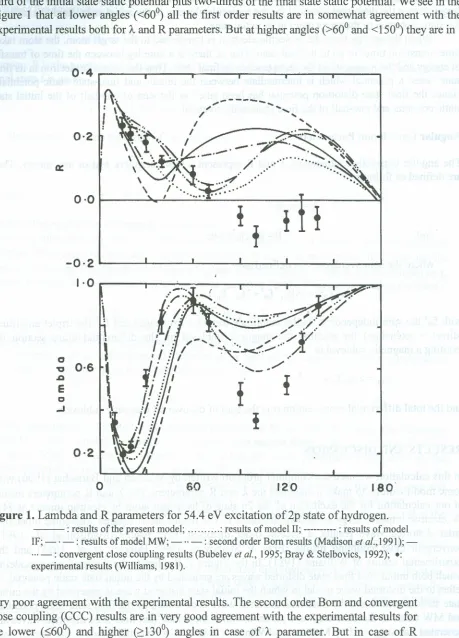
third of the initial state static potential plus two-thirds of the final state static potential. We see in the Figure 1 that at lower angles «60°) all the first order results are in somewhat agreement with the experimental results both for A and R parameters. But at higher angles (>60° and <150°) they are in
0·4
('t.
: \ .•.....
!
..
..
"
0·2
a::
0
·
0
!
t
-0·2
1·0
0
.'
'0 0·6
.Q
e
c ..J
~
0-2
0 80
120
180Figure 1.Lambda and R parameters for 54.4 eV excitation of2p state of hydrogen. --: results of the present model; :results of model II;--- :results of model IF;-. -: results of model MW;_ ..-: second order Born results (Madison et al.,1991);
-...-: convergent close coupling results (Bubelev et al.,1995;Bray &Stelbovics, 1992); -: experimental results (Williams, 1981).
Singh,.Angular correlation parameters - 29
parameter even these calculations are giving results which are poor at intermediate and higher angles. (Possibly because the R paraineter depends
-
directly
upon the complex nature of the amplitude.) At lower angles the R parameter results of the CCC and second order Born results are in very good agreement with the experimental results.In case of
A
Parameter, at lower angles, the MW results are best among the first order calculations and at higher angles all the first order results are infoor
agreement with the experimental results. In case of R parameter, at lower angles, up to 30 , all the first order results (except the IF results) are in good agreement with the experimental results. But in the range 30-60° the II results are the best. At higher angles all first order results are poor.CONCLUSION
From the above and the findings in earlier two papers (Onyango, 1996; Onyango & Singh 1997) we conclude that it cannot be said definitely which first order distorted wave method is the best one.
Their performance varies depending upon the situation being considered (that is which excitation process is being considered and at what impact energy). A distorted wave method may perform well for a particular excitation at a particular energy but it may not give good results for other excitation
.process or for the same excitation process but at different impact energies. Also, it may be concluded that a first order distorted wave method cannot be improved to the extent that its results can match with the second order results.
REFEllliNCES
Bray, I. & Stelbovics, A.T. 1992. Convergent close-coupling calculations of electron-hydrogen scattering. Physical Review A46: 6995-7011.
Bubelev, V.E., Madison, D.H., Bray, I. & Stelbovics, A.T. 1995. Theoretical cross sections, angular correlation parameters and polarization fractions for electron-hydrogen scattering. Journal of Physics B28: 4619-4638.
Itikawa, y. 1986. Distorted-wave methods in electron-impact excitation of atoms and ions.
Physics Report 143: 69-108.
Joachain, C.J. 1983. Quantum Collision Theory. North Holland Publishing Company,
Amsterdam.
Madison, D.H. & Bartschat, K. 1996. The distorted wave method for elastic scattering and atomic excitation. In: Computational Atomic Physics. Ed. K. Bartschat. Springer-Verlag, Berlin.
Madison, D.H., Bray, I. & McCarthy. I.E. 1991. Exact second-order distorted wave calculation for hydrogen including second-order exchange. Journal of Physics B24: 3861-3888.
Madison, D.H. & Winters, K.H. 1983. A second order distorted wave model for the excitation of the 2 lpstate of helium by electron and positron impact. Journal of Physics B16: 4437-4450. Onyango, D.O. 1996. A distorted wave method with alternative distortion potentials applied to
electron-hydrogen atom excitation. M.Sc. thesis, Kenyatta University, Nairobi.
30- Singh, Angular correlation parameters
Singh, C.S. 1993. An alternative form of distorted wave method. XVII! International Conference on Physics of Electronic and Atomic Collisions, July 21-27, 1993, Aarhus, Denmark.
Williams, J.F. 1981. Electron-photon angular correlations from the electron impact excitation of the