ISSN (Print) : 2320 – 3765 ISSN (Online): 2278 – 8875
I
nternational
J
ournal of
A
dvanced
R
esearch in
E
lectrical,
E
lectronics and
I
nstrumentation
E
ngineering
(A High Impact Factor, Monthly, Peer Reviewed Journal)
Website: www.ijareeie.com
Vol. 7, Issue 5, May 2018
Digital Control and Data Logging for Solar
Power Plant Using Raspberry-Pi
Akshaykumar Kadam, Tejashree Kasar, Sayali Sonje, Sampada Tavse
Department of Electronics and Telecommunication, M.M.C.O.E. Pune, India
ABSTRACT: The point of this paper is to show a sun powered vitality gathering innovation by a photovoltaic cell. To show this productive sun powered dispersed age framework, a double pivot sun oriented tracker is outlined. The tracker effectively tracks the sun and changes its position appropriately to boost the power yield. The planned following framework comprises of sensors, microcontroller operated control circuits to drive DC motor and gear bearing arrangements with supports and mounting. Two outfitted dc motor are utilized to move the solar panel so sun's shaft can stay lined up with the sunlight based board. It is also comprises of temperature and humidity sensor (DHT11) and is able to calculate wind speed and direction as well as rain drop. Temperature, humidity, voltage, current etc values are displayed on thingspeak server and stored on cloud to make this data accessible by user. Along with tracking sun direction it also monitors weather.
KEYWORDS: internet of things, smart city, solar panel.
I. INTRODUCTION
As early as the 7th century B.C., people used simple magnifying glasses to concentrate the light of the Sun into beams so that they would cause wood to catch fire. Swiss scientist Horace de Saussure built the world’s first solar collector in 1767. In the beginning of this century, scientists and engineers began researching ways to use solar energy in earnest. One important development was a remarkably efficient solar boiler invented by Charles Greeley Abbott, an American astrophysicist, in 1936. Solar energy is the solar radiation that reaches the earth. Every day Sun radiates or sends out an enormous amount of energy. Like the other stars, the Sun is a big ball of gases – mostly hydrogen and helium atoms. The hydrogen atoms in the Sun’s core combine to form helium and generate energy in a process called nuclear fusion. During nuclear fusion, the Sun’s extremely high pressure and temperature cause hydrogen atoms to come apart and their nuclei (the central cores of the atoms) to fuse or combine. Four hydrogen nuclei fuse to become one helium atom. But the helium atom contains less mass than the four hydrogen atoms that fused. Some matter is lost during nuclear fusion. The lost matter is emitted into space as radiant energy. Solar radiations are collected and concentrated with the help of solar collectors/concentrators. The resulting heat may be used to heat water, to provide heat for cooking and crop drying, to purify and desalinate sea water, for heat space in buildings, to provide process heat for industrial applications, provide space cooling 3 with absorptions coolers, or generate power using several thermodynamic processes.
Motivated by the concerns of climate change and high oil prices, and supported by renewable energy legislation and incentives, renewable power generation has experienced consistent growth in the last two decades. Unlike their conventional counterparts, the renewable energy sources are known to be much cleaner, and produce energy without the harmful effects of pollution. Solar photovoltaic (PV) is one of the fastest growing renewable energy technologies. PV technology is simple, elegant, and reliable. It requires no fuel, produces no emissions. But the efficiency of fixed solar panels is quite low as the position of sun changes continuously and hence it moves out of the area of maximum efficiency. Solar trackers are the most appropriate and proven technology to increase the efficiency of solar panels through keeping the panels aligned with the sun’s position.
ISSN (Print) : 2320 – 3765 ISSN (Online): 2278 – 8875
I
nternational
J
ournal of
A
dvanced
R
esearch in
E
lectrical,
E
lectronics and
I
nstrumentation
E
ngineering
(A High Impact Factor, Monthly, Peer Reviewed Journal)
Website: www.ijareeie.com
Vol. 7, Issue 5, May 2018
II. RELATED WORKS
The point of this paper is to show a sun powered vitality gathering innovation by a photovoltaic cell. The tracker effectively tracks the sun and changes its position appropriately to boost the power yield. The planned following framework comprises of sensors, microcontroller worked control circuits to drive DC engines and apparatus bearing game plans with backings and mountings. Two outfitted dc engines are utilized to move the sun oriented board so sun's shaft can stay lined up with the sunlight based board. [1]
The paper has introduced a novel and a basic control usage of a Sun tracker that utilized a solitary double pivot AC engine to take after the Sun and utilized a remain solitary PV inverter to control the whole framework. The proposed one-engine configuration was basic and independent, and did not require programming and a PC interface. A research facility model has been effectively manufactured and tried to check the adequacy of the control execution. Analysis comes about showed that the created framework expanded the vitality pick up to 28.31% for an incompletely shady day. The proposed system is a development up until now. [2]
From the work that has been done it is to be noticed that there has been a huge increment in the aggregate power created for the duration of the day. Around 29% augmentations were watched. The measure of additional power that it will produce is anticipated to be around 72KWH every year (for a 75 watt board). The task life of the sun based boards is around 20 years. So all in, it will produce a benefit while creating clean vitality. The productivity of the framework can be additionally expanded by considering double pivot following to cover north to south development of the sun. [3]
This paper shows the reproduction of continuous information procurement of a sun powered panelinLabVIEW. A model has been made where two Arduino were utilized. One is utilized for interfacing the sunlight based board with the PC for securing of information and the other one isused with the servomotor. The entire reenactment is performed with the assistance of LINX firmware wizard, which is accessible in LabVIEW Maker's Hub. As indicated by the gathered information, conduct and the voltage of the sun powered module was dissected. This paper depicts the plan of an ease, sun oriented following and constant information securing framework. [4]
The proposed cross breed sun powered following calculation consolidates the two sensors and numerical models to decide the exact sun's position, along these lines outfitting ideal sun oriented vitality for every climate condition. A website page was additionally created to encourage constant observing of sun oriented information. Thusly, the sun powered following procedure is completely robotized, expanding the accumulation and administration of sun oriented vitality for sun oriented warm frameworks. [5]
This article exhibits the plan procedure for an in-situ sun oriented board checking framework in light of wired and remote sensor arrange advancements. The proposed stage depends on wired systems administration advancements joined with short range low-control remote sensor hubs. Execution parameters are estimated for each PV board and are transmitted to a remote facilitator. Points of interest about the created stage are given preparatory outcomes. [6]
A reenactment has been done on hubs dissemination and an investigation for the plan of a hub with proper sensors considering the needs of the preparing shortcomings. At last a realistic UI is outlined and adjusted to tele-checking boards utilizing WSN. The essential consequences of reproduction are extremely promising. A cordial GUI utilizing abnormal state dialect Wincc was created to do the checking errands. [7]
This paper completely portrays a WSN appropriate for consideration in photovoltaic plants so as to enhance proficiency and advance vitality generation. This is accomplished by creating shrewd sensor hubs appended to each PV board in the plant and characterizing a correspondence convention that prevails with regards to taking all the data identified with the boards to a Monitoring Center, where it is shown and advantageously dissected. Such a power supply can be utilized by other sensors that get their vitality from PV boards should even now work amid the night. [8]
Directing in Wireless Sensor Networks needs to consider the restricted battery assets of the hubs. Sensor hubs can likewise be controlled by other vitality sources like sun powered vitality. This paper gives an audit of Environment observing utilizing Wireless Sensor Networks. The issues identified with condition sensor systems are featured. The continuous applications in condition checking are given accentuation on vitality protection. Besides in this paper we address the issue of searching vitality utilizing sunlight based controlled gadgets. [9]
ISSN (Print) : 2320 – 3765 ISSN (Online): 2278 – 8875
I
nternational
J
ournal of
A
dvanced
R
esearch in
E
lectrical,
E
lectronics and
I
nstrumentation
E
ngineering
(A High Impact Factor, Monthly, Peer Reviewed Journal)
Website: www.ijareeie.com
Vol. 7, Issue 5, May 2018
power paying little respect to engine speed.The built framework model can be connected in the local location for elective power age particularly for non-basic and low power apparatuses. [10]
III. PROPOSED ARCHITECTURE
Figure 1 shows the block diagram of solar power plant. It consists of solar panel, motor driver IC to drive motor connected to solar panel to rotate solar panel according to the set time and set direction at that particular time. Voltage sensor and current sensor are used to calculate voltage and current values solar panel converts intensity of light into electrical component like current and voltage. It is also comprises of temperature and humidity sensor (DHT11) and is able to calculate wind speed and direction as well as rain drop. Temperature, humidity, voltage, current etc values are display on thingspeak server and stored on cloud to make this data accessible by user. Along with tracking sun direction it also monitors weather.
Fig.1. Block Diagram of proposed system
IV. SYSTEM ALGORITHM
We propose an algorithm to describe the operation of the system.
A. Algorithm
Below is the algorithm of the proposed system
Step 1 Initialize the system.
Step 2 Monitor whether monitoring system, calculate value of wind speed and direction, temperature, humidity and rain drop.
Step 3 Calculate current and voltage using current and voltage sensor respectively.
Step 4 Rotate solar panel at set time.
Step 5 Store data generated in step 2, 3 and 4 on cloud.
Step 6 Update this information on ThingsPeak server.
ISSN (Print) : 2320 – 3765 ISSN (Online): 2278 – 8875
I
nternational
J
ournal of
A
dvanced
R
esearch in
E
lectrical,
E
lectronics and
I
nstrumentation
E
ngineering
(A High Impact Factor, Monthly, Peer Reviewed Journal)
Website: www.ijareeie.com
Vol. 7, Issue 5, May 2018
B. Flow Chart
Fig 2 Flow of system operation
V. RESULT
ISSN (Print) : 2320 – 3765 ISSN (Online): 2278 – 8875
I
nternational
J
ournal of
A
dvanced
R
esearch in
E
lectrical,
E
lectronics and
I
nstrumentation
E
ngineering
(A High Impact Factor, Monthly, Peer Reviewed Journal)
Website: www.ijareeie.com
Vol. 7, Issue 5, May 2018
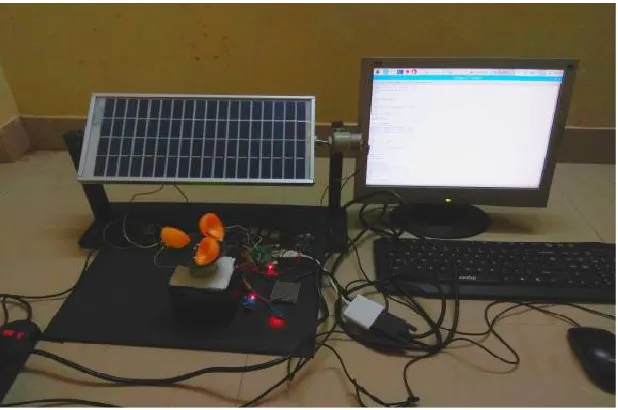
Fig 3Hardware model of the system
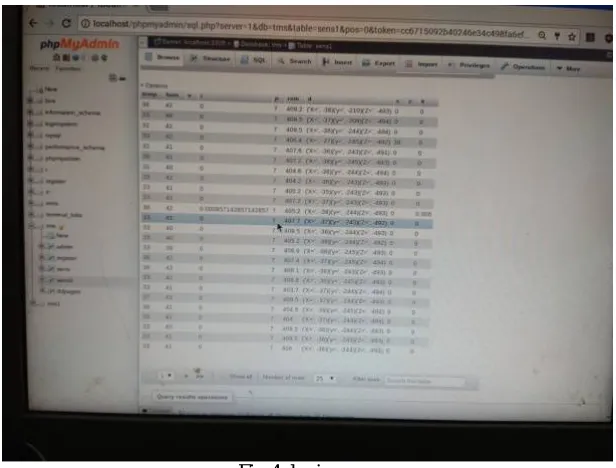
D. Web page
ISSN (Print) : 2320 – 3765 ISSN (Online): 2278 – 8875
I
nternational
J
ournal of
A
dvanced
R
esearch in
E
lectrical,
E
lectronics and
I
nstrumentation
E
ngineering
(A High Impact Factor, Monthly, Peer Reviewed Journal)
Website: www.ijareeie.com
Vol. 7, Issue 5, May 2018
ANALYSIS
Sr. No Time Rotation of solar panel (in Degree )
1. 10 AM 18
2. 12 PM 36
3. 02 PM 54
4. 04 PM 72
5. 06 PM 90
VI. CONCLUSION
The paper has presented a novel and a simple control implementation of a Sun tracker that consists of solar panel, motor driver IC to drive motor connected to solar panel for rotating solar panel according to the light direction. The solar panel direction is controlled by already set timing i.e. let set time for 12PM, at 12PM it should rotate to particular degrees. Voltage sensor and current sensor are used to calculate voltage and current values solar panel converts intensity of light into electrical component like current and voltage. From the work that has been done it is to be noted that there has been a significant increase in the total power generated throughout the day. About 29% increment was observed. The entire cost of the system being installed comes to about Rs1600 for every panel.
Future work is related to cost-optimization of the Smart Modules so that the system becomes more attractive to developers of PV plants. Also, and even though authors preferred defining a self-contained system that did not depend on third-party products, a system based on storing information in the cloud might be considered.
REFERENCES
[1] Automatic Dual Axis Sun Tracking System using LDR Sensor V Sundara Siva KumarȦ*and S Suryanarayana International Journal of Current
Engineering and Technology E-ISSN 2277 – 4106, P-ISSN 2347 – 5161
[2] Jing-Min Wang * and Chia-Liang Lu Design and Implementation of a Sun Tracker with a Dual-Axis Single Motor for an Optical Sensor-Based
Photovoltaic System Sensors 2013, 13
[3] Bipin Krishna Journal of Automation and Control Engineering Vol. 1, No. 4, December 2013 Tracking of Sun for Solar Panels and Real Time
Monitoring Using LabVIEW
[4] Shubhankar Mandal1 and Dilbag Singh Real Time Data Acquisition Of Solar Panel Using Arduino And Further Recording Voltage Of The
Solar Panel International Journal of Instrumentation and Control Systems (IJICS) Vol.7, No.3, July 2017
[5] JerinKuriakoseTharamuttama, Andrew Keong Ng Design and Development of an Automatic Solar Tracker World Engineers Summit – Applied
Energy Symposium & Forum: Low Carbon Cities & Urban Energy Joint Conference, WES-CUE 2017, 19–21 July 2017, Singapore
[6] P. Papageorgas1*, D. Piromalis2, K. Antonakoglou1, G. Vokas1, D. Tseles2 and K. G. Arvanitis Smart Solar Panels: In-situ monitoring of photovoltaic panels based on wired and wireless sensor networks TerraGreen 13 International Conference 2013 - Advancements in Renewable Energy and Clean Environment
[7] Ali Al-Dahoud Mohamed Fezari, FatmaZohraBelhouchetModelling and Simulation Remote Monitoring System using WSN for Solar Power
Panels 2014 First International Conference on Systems Informatics, 978-0-7695-5198-2/14
[8] Miguel J. Prieto *, Alberto M. Pernía, Fernando Nuño, Juan Díaz and Pedro J. Villegas Development of a Wireless Sensor Network for
Individual Monitoring of Panels in a Photovoltaic Plant Sensors 2014, 14, 2379-2396; doi:10.3390/s140202379
[9] R.A.Roseline, Dr.P.Sumathi Solar power for Wireless Sensor Networks in Environment Monitoring Applications-A Review International
Journal of Scientific and Research Publications, Volume 4, Issue 8, August 2014 1 ISSN 2250-3153
[10] Mayank Kumar Lokhande Automatic Solar Tracking System International Journal Of Core Engineering & Management (IJCEM) Volume 1,