Automatic Control, Optimal Placement and
Parameter Setting of TCSC in Power System
by Soft Computing Approach
A.Lumani
1, A.Hemani
2, G.Srikanth
3PG Student [PSA], Dept. of EEE, Gitam Engineering College, Hyderabad, Telangana, India1
UG Student, Dept. of ECE, Sri Indu College of Engineering & Technology, Hyderabad, Telangana, India2
PG Student [PSA], Dept. of EEE, Gitam Engineering College, Hyderabad, Telangana, India3
ABSTRACT: A Flexible Alternating Current Transmission Systems (FACTS) device plays a vital role in the power system performance. However, the location and the parameters of these devices in the system play a significant role to achieve such benefits, and also due to excessive cost these devices must be located optimally. In this paper a hybrid BBO with DE, namely BBO/DE is proposed is presented for finding out the optimal number, the optimal locations, and the optimal parameter settings of multiple Thyristor Controlled Series Compensator (TCSC) devices to achieve a maximum system load ability in the system with minimum installation cost of these devices and compare its performance with other few techniques. Validate of the proposed technique simulations is performed on IEEE 6-bus and IEEE 14-bus power systems. All the simulations show very encouraging results. The results are presented in the paper together with appropriate discussion
KEYWORDS: Power flow, Thyristor Controlled Series Capacitor (TCSC), GA, PSO, DE, BBO
I.INTRODUCTION
With ever-increasing demand for electricity, the power transfer grows, consequently the power system becomes increasingly more difficult to operate, and more insecure with unscheduled power flows and higher losses. An opening of unused potentials of transmission system due to environmental, right-of-way and costly problems is a major concern of power transmission network expansion planners and policy makers. Such kinds of devices are introduced in 1988 by Hingorani [1]. The objective of using FACTS devices in a power system is to bring systems under control and to transmit power, according to the characteristics of the power system.
FACTS technologies allow for improved transmission system operation with minimal infrastructure investment, environmental impact, and implementation time compared to the construction of new transmission line, offering utilities and industry the ability to:
(i) dynamically control, power flows on specific transmission and distribution routes,
(ii) allow secure loading of transmission and distribution lines to their full thermal capacity, and
(iii) Improve power quality. Nevertheless, in order to optimize and obtain the best possible benefits from their use, it is necessary to consider the following three main issues:
1) The types of FACTS controllers that should be used, 2) The settings of the FACTS controllers, and
3) The best location of the FACTS controllers in the transmission system.
factors. The following factors can be considered in the optimal installation of TCSC, the topology of the system, the stability margin improvement, the power transmission capacity increasing, and the power blackout prevention. Therefore, conventional power flow algorithm [2] should incorporate with TCSC considering one or all of the above mentioned factors. New algorithms have been developed in the last two decades for the purpose of the optimal power flow incorporating with TCSC device as well as for the optimal placement of TCSC.
This paper deals with the application of a new evolutionary optimization technique, a hybrid BBO with DE, namely BBO/DE is proposed to find out the optimal number, the optimal locations, and the optimal parameter settings of multiple TCSCs devices to maximize the system loadability with minimum cost of installation of these devices without any violations in the thermal or voltage limits, and compare its performance with Genetic Algorithm (GA), Particle Swarm Optimization (PSO) and Differential Evolution (DE) with the consideration of active power loss reduction in the power system.
II.SYSTEM MODEL AND ASSUMPTIONS
min 𝐹 = 𝑃𝐿𝐾
𝑛𝑡𝑙
𝑘=1
𝑃𝑔𝑖− 𝑃𝑑𝑖− 𝑉𝑖𝑉𝑗𝑌𝑖𝑗 𝑥𝑡𝑐𝑠𝑐 cos 𝛿𝑖𝑗 + 𝛾𝑗− 𝛾𝑖 = 0
𝑁
𝑗 =1
𝑄𝑔𝑖− 𝑄𝑑𝑖 − 𝑉𝑖𝑉𝑗𝑌𝑖𝑗 𝑥𝑡𝑐𝑠𝑐 sin 𝛿𝑖𝑗+ 𝛾𝑗 − 𝛾𝑖 = 0
𝑁
𝑗 =1
𝑃𝑔𝑖𝑚𝑖𝑛 ≤ 𝑃𝑔𝑖 ≤ 𝑃𝑔𝑖𝑚𝑎𝑥 ⩝ 𝑖𝜖 𝑁𝐺
𝑄𝑔𝑖𝑚𝑖𝑛 ≤ 𝑄𝑔𝑖 ≤ 𝑄𝑔𝑖𝑚𝑎𝑥 ⩝ 𝑖𝜖 𝑁𝐺
𝑉𝑖𝑚𝑖𝑛 ≤ 𝑉𝑖 ≤ 𝑉𝑖𝑚𝑎𝑥 ⩝ 𝑖𝜖 𝑁
𝛿𝑖𝑗𝑚𝑖𝑛 ≤ 𝛿𝑖𝑗 ≤ 𝛿𝑖𝑗𝑚𝑎𝑥 ⩝ 𝑖𝜖 𝑁
𝑥𝑡𝑐𝑠𝑐𝑚𝑖𝑛 ≤ 𝑥𝑡𝑐𝑠𝑐 ≤ 𝑥𝑡𝑐𝑠𝑐𝑚𝑎𝑥
𝛼𝑚𝑖𝑛 ≤ 𝛼 ≤ 𝛼𝑚𝑎𝑥
Where
F is the objective function
PLK is the active power loss in the Kth line
ntl is the number of lines in the system
N is the set of generation bus indices
Yij and θijare the magnitude and phase angle of element in admittance matrix
Pgiis the active power generation at bus i
Qgi is the reactive power load at bus i
Vi is the voltage magnitude at bus i
δij is the power angle
xtcsc is the reactance of TCSC as a function of 𝛼
𝛼 is the thyristor firing angle
III.EVOLUTIONARY ALGORITHMS
a. Genetic Algorithm (GA)
b. Particle Swarm Optimization (PSO)
PSO is originally attributed to Kennedy, Eberhart and Shi and was first intended for simulating social behaviour, as a stylized representation of the movement of organisms in a bird flock or fish school. Particle Swarm Optimization (PSO) is a computational method that optimizes a problem by iteratively trying to improve a candidate solution with regard to a given measure of quality. PSO is a meta-heuristic that makes few or no assumptions about the problem being optimized and can reach very large spaces of candidate solutions. The advantages of PSO are that it is attractive as there are few parameters to adjust and requires less computation time and memory.
c. Differential Evolution (DE)
Differential Evolution (DE), proposed by Price and Storn in 1997 is a powerful population based, simple, direct search algorithm, which uses generation-and-test feature for global optimization problems with real-valued parameters. The information on distance and direction from the existing population is used by DE to direct the further exploration. The advantages of DE are its uncomplicated structure, speed, robustness and ease of use. The first working principle of DE was proposed by Price and Storn in 1997 with single scheme. Later on, ten different schemes of DE was recommended by Price and Storn in 2005 and 2008. DE is superior at exploring the search space and locating the area of local optimum, but it is slow in exploitation of the solutions.
d. Biogeography Based Optimization (BBO)
Biogeography based optimization (BBO) is a new optimization algorithm, proposed by Simon and developed from the theory of biogeography. The study of the geographical distribution of biological organisms is known as Biogeography. Similar to Genetic Algorithms (GAs), BBO is a stochastic global optimizer based on the population of individuals. In original BBO algorithm, the solution of a set of population is represented as a vector of integers. Similar to other biology based algorithms, such as GAs and PSO, the Migration operator of BBO helps in sharing information between solutions. Because of this feature, BBO finds its application in the problems which uses GAs and PSO. However, apart from the above mentioned common features of BBO, it has certain unique features compared with other biology based algorithms, like maintaining its set of best solution throughout the iteration process. BBO was compared with seven state-of-the-art EAs by Simon. The results declare that BBO has good exploitation ability and performs well compared to other biology based algorithms.
IV.PROPOSED APPROACH: A HYBRID BBO WITH DE
As pointed out earlier, DE is good at exploring the search space and locating the area of global minimum. However, it is slow exploiting of the solution. On the other hand, BBO has a good exploitation for global optimization. Based on these considerations, in order to balance the exploration and the exploitation of DE, in this work, we propose a hybrid DE approach, called BBO/DE, which combines the exploration of DE with the exploitation of BBO effectively. A. Hybrid Migration Operator
The key work of BBO/DE is carried out by the hybrid migration operator, which hybridizes the migration operator of BBO with the DE operator, described in Algorithm 1. The core scheme of the projected hybrid migration operator is based on the following two considerations. First, the destruction of good solutions would be less, while poor solutions can inherit a lot of new characteristics from good solutions. In this sense, the existing inhabitants can be exploited adequately. Second, the mutation operator of DE is able to explore the new search space and build the algorithm to be healthier. From the analysis of the results obtained, it can be seen that the hybrid migration operator balances the exploitation of BBO and the searching of DE effectively.
Algorithm 1: Hybrid migration operator of BBO/DE 1: for i = 1 to NP
2: Select uniform randomly r1 ≠ r2 ≠ r3≠ i
3: jrand = rndint(1,D) 4: for j = 1 to D do 5: if rndreal(0, 1) < λi then
6: if rndrealj[0,1) < CR or j == jrand then
7: Ui(j) = X r1(j) + F(X r2 (j) - X r3 (j)) {The original mutation operator of DE} 8: else
9: Select Xk with probability ∞ μk 10: Ui(j) = Xk(j)
12: else
13: Ui(j) = Xj(j) 14: end if 15: end for 16: end for
B. Boundary Constraints
Title Trial parameters that go against the constraint limits should be returned back from the limit by the quantity of desecration to keep the solution of bound-constrained problems viable. In this work, the following repair rule is applied
X(i) = 𝒍𝒊+ 𝒓𝒏𝒅𝒓𝒆𝒂𝒍𝒊[𝟎, 𝟏] ∗ 𝒖𝒊− 𝒍𝒊 𝒊𝒇 𝑿 𝒊 < 𝒍𝒊
𝒖𝒊+ 𝒓𝒏𝒅𝒓𝒆𝒂𝒍𝒊[𝟎, 𝟏] ∗ 𝒖𝒊− 𝒍𝒊 𝒊𝒇 𝑿 𝒊 < 𝒖𝒊
(1)
Where rndreali [0, 1] is the uniform random variable from [0,1] in each dimension i.
C. Main Procedure
The hybrid BBO with DE technique is formulated by incorporating the aforementioned hybrid migration operator into DE and is described in Algorithm 2. The BBO/DE Compared with the original DE algorithm, BBO/DE requires only a little amount of additional computational cost in sorting the inhabitants and calculating the migration rates. Besides, BBO/DE is capable of exploring the new search space with the mutation operator of DE and in exploiting the population information with the migration operator of BBO. This feature of BBO/DE has made it possible to overcome the deficit of exploitation in the original DE algorithm.
Algorithm 2: Procedure for BBO/DE 1: Generate the initial population P
2: Evaluate the fitness for each individual in P 3: If the halting criterion is not satisfied 4: Sort the Population from worst to best
5: For each individual, map the fitness to the number of species
6: Calculate the immigration rate λi and the emigration rate μi for each individual Xi
7: Modify the Population with the hybrid migration operator shown in algorithm 1 8: Evaluate the offspring Ui
9: If offspring is better than Parent vector, then replace the parent vector with the new offspring.
V. RESULT AND DISCUSSION SMTB system without TCSC
Fig.1 SMTB system without TCSC
Fig.2 SMTB system without TCSC
CASE 1 This case is considered when the infinite bus is feeding the load through a line without any compensation. CASE 2 Generator feeding the load through Transmission Line Model with TCSC.
A.
Automatic Control Circuit for TCSCTCSC with automatic control circuit
Fig.3 SMTB system with automatic control of TCSC
Fig.4. Control circuit of TCSC
B.
Data acquisition for single phase systemAccording to the previous section, the overall arrangement data acquisition for single phase system is shown by the block diagram in the fig.
The fundamental requirement is that the voltage to be measured must be stepped down by factors that would not render the measured values inaccurate and hence unreliable. An analog to digital converter is added in order to facilitate an instantaneous reading of the phase voltages by the microcontroller. Control System Elements the microcontroller, which is used as part of the control system in voltage balancer, must be able to respond to the analog electrical quantities. The analog electrical quantity (i.e. Voltage) is to be converted into digital values suitable for the microcontroller by using an ADC converter. The block diagram of the completed control system is shown in fig.
Fig.5 Block Diagram of the Data acquisition system
Fig.6 Control System Architecture
The control scheme implemented for TCSC topology works as follows: 1. The amplitude of the bus voltage V is measured and filtered. 2. Then it is compared against the voltage reference Vref.
The voltage difference between the two signals is processed by a PI controller which causes a corresponding change in the firing angle α. The value provided by the PI controller is used as the input to the TCR firing control unit.
Laboratory Setup of SMTB Test System
Fig.7 Lab setup of SMTB system with TCSC
Fig.8 P-δ Curve without TCSC
Fig.9 P-δ Curve with TCSC Fig.10 P-V Curves with and without TCSC
The SMTB test system with a source feeding the RL load through a transmission line model and tested with and without TCSC. PV curves have been drawn for both the cases. The system stability has been assessed with PV curves. The results show that improvement in the stability margin. Series capacitive compensation is thus used to reduce the series reactive impedance to minimize receiving end voltage variation and the possibility of voltage collapse. It is also observed that the compensation by using this technique i.e TCSC is faster when compared to other compensating techniques such as mechanical switching and synchronous condensers.
C.
Simulation tool and power systemMatlab Codes for DE, GA, and a modified power flow algorithm to include TCSC were developed and incorporated together for the simulation purposes. To investigate the validation of the proposed techniques, both GA and DE algorithms have been tested on the following two test systems, IEEE 6-bus system, and an IEEE 14-bus system. The data for the above mentioned systems is taken from [20], [21] respectively.
Fig.11 IEEE 6-bus system
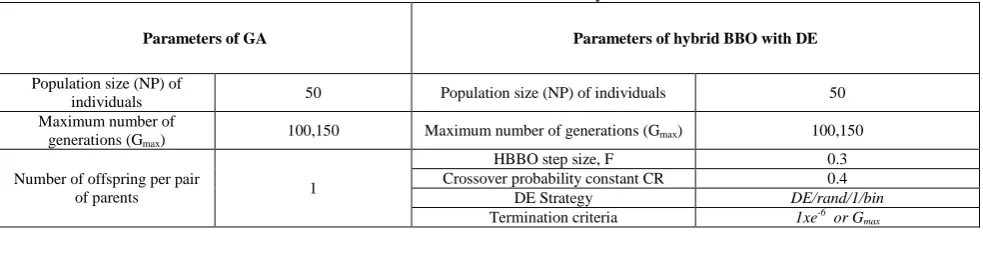
The proposed hybrid BBO with DE and GA techniques were implemented to find the optimal number, the optimal locations and the optimal parameter settings of multiple TCSCs devices in the network to minimize the installation cost of these devices with considering the increase of the system loadability. The other GA parameters are presented in Table I.
TABLE I. PARAMETERS VALUES FOR GA & hybrid BBO with DE
Parameters of GA Parameters of hybrid BBO with DE
Population size (NP) of
individuals 50 Population size (NP) of individuals 50
Maximum number of generations (Gmax)
100,150 Maximum number of generations (Gmax) 100,150
Number of offspring per pair
of parents 1
HBBO step size, F 0.3
Crossover probability constant CR 0.4
DE Strategy DE/rand/1/bin
Termination criteria 1xe-6 or Gmax
I. IEEE 6-bus test system.
This system consists of three generators, six buses, eleven transmission lines, and three loads. The simulation results obtained by applying both techniques shows that to increase the system loadability up to 10% one TCSC is required, and for increasing the system loadability between two TCSCs are required, while between increasing of system loadability we need at least three TCSCs. All the simulation results are obtained under the consideration of TCSCs devices installation cost and the thermal and voltage limits satisfactions. The optimal parameter settings, the percentage of compensation, and the minimum cost of installation of multiple TCSCs devices in this system obtained by both techniques are shown in Table
II. IEEE 14-bus test system.
This system consists of five generators, fourteen buses, twenty transmission lines, and eleven loads. In the Fig.6 Points A, B, C, D, and E, show the optimal number of TCSCs devices that should be installed in this system with respect to the corresponding load factor.
TABLE II. OPTIMAL LOCATIONS, PARAMETER SETTINGS, PERCENTAGE OF COMPENSATION, AND MINIMUM COST OF INSTALLATION OF MULTIPLE TCSCSOBTAINED BY BOTH TECHNIQUES
Te
ch
n
iq
u
e Location Setting TCSC
(p.u) XTCSC % o f C o mpe n sa ti o n S ys te m Load ab il ity Minimum Installation Cost in ($)
X 106
Line No. From Bus
To Bus
GA
3 1 2 0.021011 10%
10%
0.22651 4 2 5 -0.00122 32%
5 2 6 0.027989 15%
HBB
O 3 1 2 -0.00978 21%
0.28565 4 2 5 -0.01245 43%
8 3 5 0.02125 7%
TABLE III. OPTIMAL LOCATIONS, PARAMETER SETTINGS, PERCENTAGE OF COMPENSATION, AND MINIMUM COST OF INSTALLATION OF MULTIPLE TCSCS OBTAINED BY BOTH TECHNIQUES
Te
ch
n
iq
u
e Location Setting TCSC
(p.u) XTCSC % o f C o mpe n sa ti o n S ys te m Load ab il ity Minimum Installation Cost in ($)
X 106
Line No. From Bus
To Bus
GA
2 1 5 -0.06957 30%
20%
0.398653 3 2 3 -0.00496 25%
6 3 4 0.058669 39% 13 6 13 -0.02895 24% 20 13 14 -0.02956 10%
6 3 4 -0.02945 19% 7 5 4 -0.03125 70% 11 6 11 -0.00956 10% 20 13 14 -0.19585 48%
VI.CONCLUSION
The results show that there is improvement in the both synchronous and voltage stability margins, when TCSC is connected in the test system. Series capacitive compensation is thus used to reduce the series reactive impedance to minimize receiving end voltage variation and the possibility of voltage collapse and it can improve power flow capability of the line. A new evolutionary optimization technique a hybrid BBO with DE, namely BBO/DE is proposed and implemented in this paper to solve the optimization problem under consideration, the performance of the proposed technique was compared with Genetic Algorithm (GA). Three variables were considered to be optimized, the number of TCSCs devices, their locations, and their parameter settings. The maximization of system load ability of power system and the minimization of the investment cost of multiple TCSCs devices that should be installed were considered as the optimization criteria. The obtained results from the implementation of two proposed techniques showed that both techniques have performed well and can be successfully applied to the optimal location of the multiple TCSCs problem, while HBBO technique has superior features including high quality solution, stable convergence characteristic, and good computation efficiency. They also showed that the system loadability can be efficiently increased to a certain load factor. All obtained results validate and support the proposed techniques.
REFERENCES
[1] C. R. Fuerte-Esquivel, E. Acha, and H. Ambriz-Perez, “A thyristor controlled series compensator model for the power flow solution of practical power networks”, IEEE Trans. power system, Vol. 15, No. 1, February 2000, pp.58-64.
[2] K.S. Verma, S.N. Singh and H. O. Gupta, “ FACTS devices location for enhancement of total transfer capability”, IEEE Power Engineering Society Winter Meeting, Vol. 2, 28 Jan.-1 Feb. 2001, pp. 522 – 527.
[3] P. P. Narayana, and B.J. Praveen Kumar “ Optimal location and initial parameter settings of multiple TCSCs for reactive power planning using genetic algorithm”, IEEE Power Engineering Society General Meeting, Vol.1, 6-10 June 2004, pp. 1110 – 1114.
[4] L. Ippolito and P. Siano, “selection of optimal number and location of thyristor-controlled phase shifters using genetic based algorithms,” IEEE proc.-Gener. Trasm. Distrib., Vol. 151, No. 5, September 2004.
[5] D. Radu, and Y. Besanger, “ A multi-objective genetic algorithm approach to optimal allocation of multi-type FACTS devices for power system security,” IEEE Power Engineering Society General Meeting, 18-22 June 2006, pp. 8.
[6] G. Stephane, C. Rachid and J. G. Alain, “optimal location of multitype FACTS devices in a power system by means of genetic algorithms,”
IEEE Trans. Power systems, Vol. 16, No.3, August 2001, pp. 537-544.
[7] G. I. Rashed, H. I. Shaheen, S. J. Cheng, “Optimal Location and Parameter Setting of TCSC by Both Genetic Algorithm and Particle Swarm Optimization,” 2nd IEEE Conference on Industrial Electronics and Applications (ICIEA), Harbin, China, 23-25 May 2007.
[8] H. R. Baghaee, etal, “Power system security improvement by using differential evolution algorithm based FACTS allocation,” Power System Technology and IEEE power India Conference, POWERCON, 2008, pp. 1 - 6.
[9] Husam I. Shaheen, and S. J. Cheng, “Application of differential evolution algorithm for optimal location and parameters setting of UPFC considering power system security,” European Transactions on Electrical Power, Vol. 19, , 2009, pp. 911-932.
[10] Storn R, Price K. ,” Differential evolution-a simple and efficient adaptive scheme for global optimization over continuous spaces”, technical report, International Computer Science Institute, Berkley, 1995.
[11] D.E. Goldberg, Genetic Algorithms in Search Optimization and Machine Learning: Addison-Wesley Publishing Company, Inc., 1989. [12] D. A. Coley, An Introduction to genetic Algorithms for Scientists and Engineers, World Scientific Publishing Co., 1999.
[13] L. J. Cai, I. Erlich, “Optimal Choice and Allocation of FACTS Devices Using Genetic Algorithms,” Proc. On Twelfth Intelligent Systems Applications to Power systems Conference, pp.1-6, 2003.
[14] N.G.Hingorani and L. Gyugyi, Understanding FACTS, IEEE Press, New York, USA, 1999.
[15] R.M. Mathur and R.K. Varma, Thyristor-Based FACTS Controllers for Electrical Transmission Systems, IEEE Press and Wiley Interscience, New York, USA, Feb. 2002.
[16] P. Kundur, Power System Stability and Control, McGraw-Hill, Inc., New York, 1994.
[17] W.A.Lyon, Transient Analysis of Alternating Current Machinery, John Wiley, New York, 1954.
[18] N.Noroozian, M.Ghandari, "Improving Power System Dynamics By Series Connected FACTS Devices", IEEE Trans. Power Delivery, vol. 12, N 4, pp. 1635-1641, Oct. 1997.
[19] J. Wood and B. F. Woolenberg, Power Generation, Operation and Control, Wiley, 1996, ISBN:0-471-58699-4.