Western University Western University
Scholarship@Western
Scholarship@Western
Electronic Thesis and Dissertation Repository
4-22-2013 12:00 AM
Spatial Variation and Interpolation of Wind Speed Statistics and
Spatial Variation and Interpolation of Wind Speed Statistics and
Its Implication in Design Wind Load
Its Implication in Design Wind Load
Wei Ye
The University of Western Ontario
Supervisor
Dr. Hanping Hong
The University of Western Ontario Joint Supervisor Dr. Jinfei Wang
The University of Western Ontario
Graduate Program in Civil and Environmental Engineering
A thesis submitted in partial fulfillment of the requirements for the degree in Doctor of Philosophy
© Wei Ye 2013
Follow this and additional works at: https://ir.lib.uwo.ca/etd
Part of the Civil and Environmental Engineering Commons
Recommended Citation Recommended Citation
Ye, Wei, "Spatial Variation and Interpolation of Wind Speed Statistics and Its Implication in Design Wind Load" (2013). Electronic Thesis and Dissertation Repository. 1254.
https://ir.lib.uwo.ca/etd/1254
This Dissertation/Thesis is brought to you for free and open access by Scholarship@Western. It has been accepted for inclusion in Electronic Thesis and Dissertation Repository by an authorized administrator of
SPATIAL VARIATION AND INTERPOLATION OF WIND SPEED STATISTICS AND ITS IMPLICATION IN DESIGN WIND LOAD
(Thesis format: Integrated Article)
by
Wei Ye
Graduate Program in Engineering Science Department of Civil and Environmental Engineering
A thesis submitted in partial fulfillment of the requirements for the degree of
Doctor of Philosophy
The School of Graduate and Postdoctoral Studies The University of Western Ontario
London, Ontario, Canada
ii
ABSTRACT
Consideration of wind load is important for design of engineered structures. Codification of wind
load for structural design requires the estimation of the quantiles or return period values of the
annual maximum wind speed. The extreme wind speeds are estimated based on the measured
wind records at different meteorological stations and affected by the length of the wind record
(i.e., sample size) and other factors such as the surrounding terrain and so on. This study is
focused on 1) the spatial interpolation of wind speed statistics, 2) the potential of using regional
frequency analysis in estimating the extreme wind speed, and 3) the reliability of designed
structure at sites with and without sample size effects.
For the spatial interpolation, both code recommended values of the wind speed as well as those
based on at-site analysis are used, and commonly used spatial interpolation methods including 8
deterministic methods and 6 geostatistical methods have been applied. The preferred methods
for each data set are determined based on the (leave-one-out) cross validation analyses. It is
shown that the preferred method depends on the considered data set; the use of the ordinary
kriging is preferred if a single method is to be selected for all considered data sets.
The historical wind records and available meteorological stations are often short and insufficient
or unavailable, and the limited sample size will cause the uncertainty in the estimated quantiles.
To deal with the data insufficiency in the wind speed records at the meteorological stations, the
regional frequency analysis was applied to the data from the same 235 Canadian meteorological
iii
Canada. The obtained estimates of the quantiles of the extreme wind speed based on the regional
frequency analysis are compared with those obtained based directly on the at-site analysis. The
analysis uses the k-means, hierarchical and self-organizing map clustering to explore potential
clusters or regions; statistical tests are then applied to identify homogeneous regions for
subsequent regional frequency analysis. Results indicate that the k-means is the preferred
exploratory tool for the considered data and the generalized extreme value distribution provides a
better fit to the data than the Gumbel distribution for regional frequency analysis. However, the
former is associated with low values of the upper bound that do not influence the estimation of
10- to 50-year return period values of annual maximum wind speed but do influence the return
period values with return period greater than 500 years. Based on these observations, regional
frequency analysis may not be needed as an alternative to the at-site analysis.
Furthermore, since the estimated quantiles of the extreme wind speed at a site are uncertain due
to the limited sample size, the effect of this statistical uncertainty on the estimated return period
value of the wind speed and structural reliability is investigated and two strategies (i.e. (i) a low
return period for the nominal wind speed combined with a wind load factor greater than one and
(ii) a high return period for the nominal wind speed combined with unity wind load factor) for
specifying the factored design wind load are also evaluated to determine the optimal one. Results
indicate that at least 20 years of useable data are needed for a station to be included in the
extreme value analysis, and the first strategy is preferred to cope with sample size effect for the
design at a particular site or in a region with statistically homogeneous wind climate, while the
iv
coefficient of variation of annual maximum wind speed since it leads to better reliability
consistency.
Key words: extreme wind speed, quantile of wind speed, spatial interpolation, NBCC, kriging,
cross-validation, regional frequency analysis, k-means clustering, hierarchical clustering,
v
CO-AUTHORSHIP
A version of Chapter 2, co-authored by W. Ye and H. P. Hong, was submitted to the Canadian
Society of Civil Engineering conference to be hold in 2013.
Mr. S.H. Li has contributed to Chapter 5. A version of each of the chapters (Chapter 3, 4 and 5)
will be submitted for possible publication in a peer reviewed journal. These manuscripts will be
vi
ACKNOWLEDGEMENTS
First of all, my sincere thanks go to my supervisor Dr. Hanping Hong for his continuous
guidance and inspiration during my studies. Not only does he give us enlightenment and
suggestions in the academic life, but also he has an influence on us with his respectable
personality. It is my honor to work with such a brilliant and gracious mentor. I also would like to
express my sincere gratitude to my other supervisor Dr. Jinfei Wang for her advices and support
during my research. Although the thesis was not focused on the subjects that were originally
planned, her guidance and suggestions in the field of remote sensing and geographical
information science have been instrumental in my professional development. It is my wish that
some of the work initiated with her can be completed in near future.
Then, I would like to thank the colleagues and friends during this long journey: Weixian(Bob)
He, Shukai Kong, Chien-shen Lee, Li Tan, Ziran Hu, Yue Zhang, Taojun Liu, Chuiqing Zeng,
Thomas G. Mara, Shenwei Zhang, Sihan Li, Xiaojing Cui, Guigui Zu, Huamei Mo and Shucheng
Yang. Their sparkling suggestions and warm-hearted help on my research and everyday life are
really appreciated.
The financial support of the Natural Science and Engineering Research Council of Canada and
vii
Last but not the least, I would like to thank my parents: Yuezhen Liu and Ping Ye, and my
husband Jingsi Yang for their unselfish love and support. They have always been the source of
viii
TABLE OF CONTENTS
ABSTRACT II
CO-AUTHORSHIP V
ACKNOWLEDGEMENTS VI
TABLE OF CONTENTS VIII
LIST OF TABLES XIII
LIST OF FIGURES XV
LIST OF NOTATIONS XIX
CHAPTER 1 INTRODUCTION 1
1.1 Introduction 1
1.2 Objectives 4
1.3 Organization of the thesis 4
ix
References 7
CHAPTER 2 SPATIAL INTERPOLATION OF EXTREME WIND SPEEDS BASED ON CODE
SUGGESTED VALUES 9
2.1 Introduction 9
2.2 Spatial interpolation methods used for the numerical analysis 12
2.2.1 Deterministic methods 13
2.2.2 Geostatistical methods 14
2.3 Analysis results 15
2.3.1 Interpolated surfaces for the 50-year return period value of wind speed 15
2.3.2 Cross-validation statistics for the interpolated surfaces of the 50-year return period
value of wind speed 17
2.4 Conclusion 18
References 19
CHAPTER 3 COMPARISON OF SPATIAL INTERPOLATION TECHNIQUES FOR
EXTREME WIND SPEEDS OVER CANADA 29
3.1 Introduction 29
3.2 Extreme wind speed used for the analysis 32
3.3 Spatial interpolation methods used for the numerical analysis 35
x
3.3.2 Geostatistical methods 37
3.4 Analysis results 39
3.4.1 Cross-validation statistics for the mean and coefficient of variation surfaces 39
3.4.2 Interpolated surfaces for the quantiles of wind speed 42
3.5 Conclusions 46
References 47
CHAPTER 4 ESTIMATING EXTREME WIND SPEED BASED ON REGIONAL FREQUENCY
ANALYSIS 65
4.1 Introduction 65
4.2 Wind speed and estimated L-moment ratios 69
4.3 Identification of homogeneous regions and frequency analysis results 71
4.3.1 Forming potential homogeneous regions 71
4.3.2 Test for homogeneous regions 75
4.3.3 Probabilistic model selection and fitting 79
4.4 Comparison of quantiles estimated using at-site analysis and regional frequency
analysis 81
4.5 Conclusions 83
xi
CHAPTER 5 SAMPLE SIZE EFFECT ON THE RELIABILITY AND CALIBRATION OF
DESIGN WIND LOAD 101
5.1 Introduction 101
5.2 Effect of sample size on quantile and exceedance probability 104
5.2.1 Models and analysis procedure 104
5.2.2 Analysis results 108
5.2.2.1 Wind speed modeled as a Gumbel variate 108
5.2.2.2 Wind speed modeled using the generalized extreme value distribution 113
5.3 Effect of sample size on the reliability and required load factor 114
5.3.1 Consideration of limit state function 114
5.3.2 Numerical analysis results 116
5.4 Conclusions 119
References 121
CHAPTER 6 CONCLUSIONS 134
6.1 Summary 134
6.2 Conclusions 135
6.3 Limitations and future work 138
xii
APPENDIX B 146
xiii
LIST OF TABLES
Table 2.1 Statistics from the cross-validation analysis for deterministic methods. 21
Table 2.2 Statistics from the cross-validation analysis for geostatistical methods. 22
Table 3.1 Statistics from the cross-validation analysis for deterministic methods. 51
Table 3.2 Statistics from the cross-validation analysis for geostatistical methods. 51
Table 3.3 Statistics from the cross-validation analysis for T-year return period value of wind
speed by deterministic methods. 52
Table 3.4 Statistics from the cross-validation analysis for T-year return period value of wind
speed by geostatistical methods. 52
Table 3.5 Statistics from the cross-validation for the T-year return period value of wind speed
estimated using the mean and cov interpolated using deterministic methods. 53
Table 3.6 Statistics from the cross-validation for the T-year return period value of wind speed
estimated using the mean and cov interpolated using geostatistical methods. 53
Table 4.1 Results of hierarchical cluster analysis and statistics. 89
Table 4.2 Results of k-means cluster analysis and statistics. 90
Table 4.3 Results of SOM cluster analysis and statistics. 91
Table 4.4 Fitted distribution parameters and estimated ZrDist(r = 3 or 4) for each region identified
by using k-means clustering for NTC = 12. 92
xiv
Table 5.2 Return period TH corresponding to the condition Wx50 xTH for a Gumbel variate X.
125
xv
LIST OF FIGURES
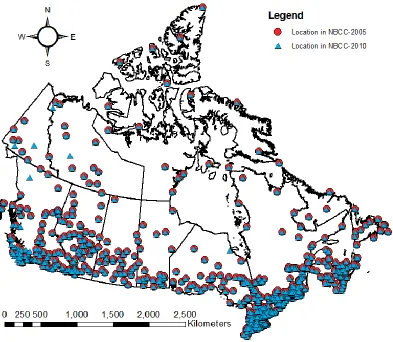
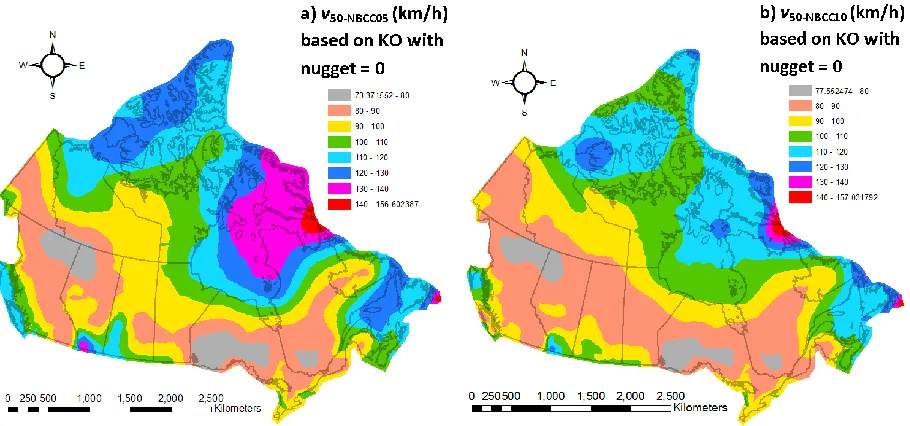
Figure 2.1 Locations tabulated in NBCC-2005 and NBCC-2010. 23
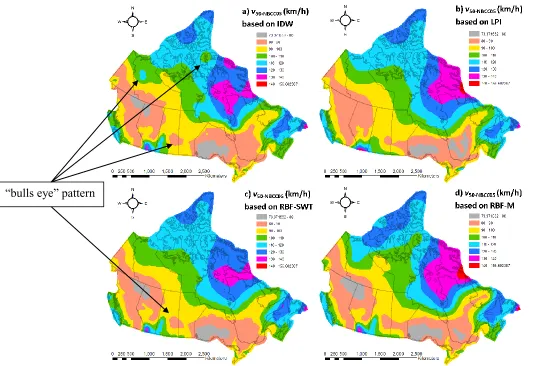
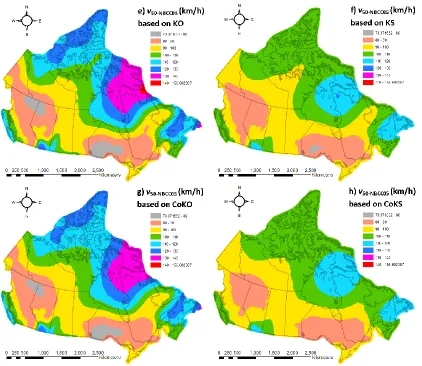
Figure 2.2 Interpolated surfaces based on v50-NBCC05 (In Figure 2.2 to Figure 2.4, v50-NBCC05 and
v50-NBCC10 represent the 50 year return period value of annual maximum wind speed
calculated from the tabulated wind pressure values in NBCC-2005 and NBCC-2010,
respectively.). 24
Figure 2.2 (cont.) Interpolated surfaces based on v50-NBCC05. 25
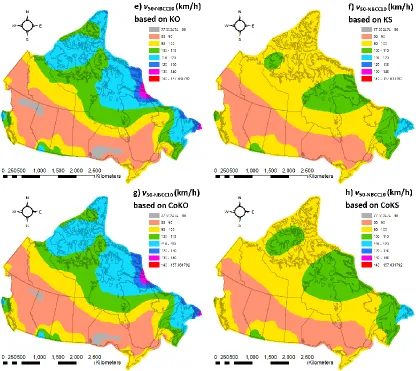
Figure 2.3 Interpolated surfaces based on v50-NBCC10. 26
Figure 2.3 (cont.) Interpolated surfaces based on v50-NBCC10. 27
Figure 2.4 Interpolated surfaces based on v50-NBCC05 and v50-NBCC10 using the KO with nugget set
equal to 0. 28
Figure 3.1 Locations of the meteorological stations considered in this study. 54
Figure 3.2 Histogram of the years of useable data for each station. 55
Figure 3.3 Histogram of the mean and coefficient of variation of the annual maximum
hourly-mean wind speed for each station. 56
Figure 3.4 Scatter plot of the mean versus of the coefficient of variation of the annual maximum
hourly-mean wind speed. 57
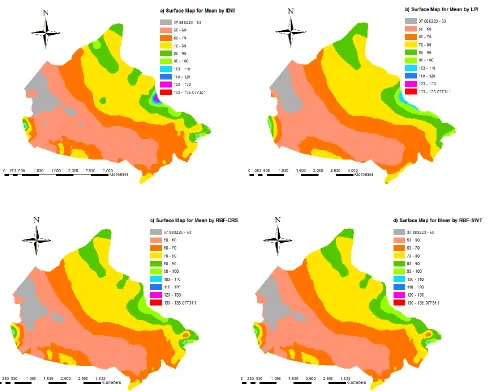
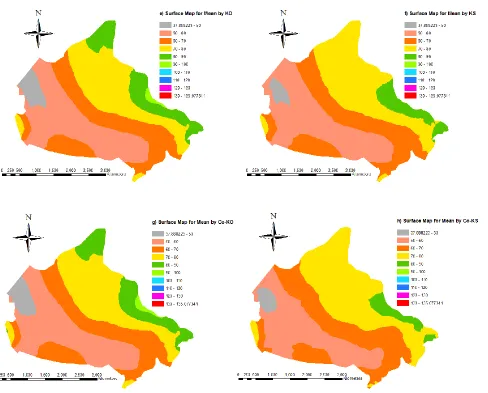
Figure 3.5 Interpolated surfaces of the mean of the annual maximum hourly-mean wind speed
(km/h) using different interpolation methods. 58
Figure 3.5 (cont.) Interpolated surfaces of the mean of the annual maximum hourly-mean wind
xvi
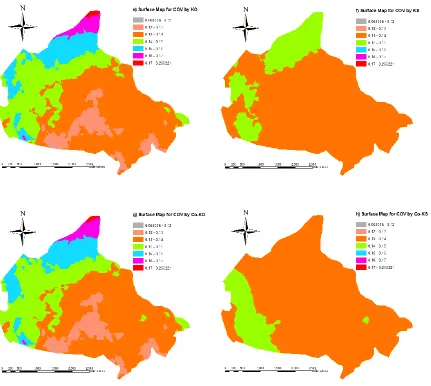
Figure 3.6 Interpolated surfaces of the cov of the annual maximum hourly-mean wind speed
using different interpolation methods. 60
Figure 3.6 (cont.) Interpolated surfaces of the cov of the annual maximum hourly-mean wind
speed using different interpolation methods. 61
Figure 3.7 Interpolated surface of the cov of the annual maximum hourly-mean wind speed using
the GPI. 62
Figure 3.8 Interpolated surfaces of the T-year return period value of the annual maximum
hourly-mean wind speed (km/h) using the RBF-CRS and RBF-SWT. 63
Figure 3.9 Interpolated surfaces of the T-year return period value of the annual maximum
hourly-mean wind speed (km/h) using the KO and Co-KO. 64
Figure 4.1 Meteorological stations considered for the extreme wind speed analysis. 93
Figure 4.2 Histogram of the mean and coefficeint of varaition of the annual maximum
hourly-mean wind speed of each considered station. 94
Figure 4.3 Variation of the L-moment ratios for the considered stations: a) L-cv, b) L-kurtosis
versus L-skewness (The station number is not in any preferred order). 95
Figure 4.4 Dendrogram showing up to 30 nodes along the bottom of the plot considering the
meteorological stations depicted in Figure 4.1 (The node along the horizontal axis represents
a meteorological station or a cluster of meteorological stations; the vertical axis represents
the city block metric distance between two stations or two clusters of stations calculated by
using variables normalized to within 0 to 1 or within -1 to 1.). 96
Figure 4.5 Identified clusters/regions and discordant stations: a) Hierarchical clustering analysis,
xvii
Figure 4.6 Scatter of the ratio vRE-T/vT for T = 50, 500 and 1000 years (The station number is not
in any preferred order). 98
Figure 4.7 Scatter of the ratio vRG-T/vT for T = 50, 500 and 1000 years (The station number is not
in any preferred order). 99
Figure 4.8 Contour maps of annual maximum wind speed based on vRE-T, vRG-T and vT for T =50,
500 and 1000 years. 100
Figure 5.1 Effect of sample size on
ˆ PEˆ(xˆT(ˆ))
E and
ˆ PEˆ(xˆT(ˆ))
SD for the coefficient
of variation of a Gumbel variate X equal to 0.05 and T = 50, 500 and 1000. 126
Figure 5.2 Effect of sample size on the statistics of ˆ( ˆ (ˆ))
L
T W
E x
P and ˆ(ˆ (ˆ))
H
T E x
P , for the
coefficient of variation of a Gumbel variate X equal to 0.10, αW = 1.4, TL = 50 and TH = 955.
127
Figure 5.3 Effect of sample size on ˆ
ˆ (ˆ)
/ ˆ ˆ (ˆ)
H
L T
T
Wx E x
E and
ˆ (ˆ)
/ ˆ ˆ (ˆ)
ˆ
W xTL SD xTH
SD for the coefficient of variation of a Gumbel variate X equal
to 0.10, αW = 1.4, TL = 50 and TH = 955. 128
Figure 5.4 Effect of sample size on
ˆ PEˆ(xˆT(ˆ))
E and
ˆ PEˆ(xˆT(ˆ))
SD for k of the GEVD
equal to -0.1 and -0.26, the coefficient of variation of 0.10 and, T = 50, 500 and 1000. 129
Figure 5.5 Effect of sample size on the statistics of ˆ( ˆ (ˆ))
L
T W
E x
P and ˆ(ˆ (ˆ))
H
T E x
P for the
model parameter k of the GEVD equal to -0.1 and -0.26, the coefficient of variation of 0.10,
αW = 1.4, TL = 50 and TH = 955. 130
Figure 5.6 Estimated Pf based on current NBCC-2010 code design requirements (i.e., αW equal
xviii
effect; b) Effect of n and RW/D on Pf; c) Effect of n and vX on Pf; d) Effect of n and RW/D on
the standard deviation of ˆ( (ˆT(ˆ))0)
f g x
P ; e) Effect of n and vX on the standard deviation
of ˆ( (ˆT(ˆ))0)
f g x
P . 131
Figure 5.7 Estimated Pf considering αW equal to 1.0 and use the equivalent TH (i.e., TH = 955,
500 and 295 years for vX equal to 0.1, 0.138 and 0.2 to select the reference wind pressure): a)
Without sample size effect; b) Effect of n and RW/D on Pf; c) Effect of n and vX on Pf; d)
Effect of n and RW/D on the standard deviation of Pf ˆ(g(xˆT(ˆ))0); e) Effect of n and vX
on the standard deviation of Pfˆ(g(xˆT(ˆ))0). 132
Figure 5.8 Estimated Pf considering αW equal to 1.0 and TH equal to 500 and 700 years: a)
Without statistical uncertainty and TH = 500 years; b) Effect of n and RW/D on Pf for TH =
500 years; c) Effect of n and vX on Pf for TH = 500 years; d) Without statistical uncertainty
and TH = 700 years; e) Effect of n and RW/D on Pf for TH = 700 years; f) Effect of n and vX
xix
LIST OF NOTATIONS
IN CHAPTER 2:
) , ( 0 0 ~
y x
Z = the predicted value at the unmeasured point (x0,y0)
) , (xi yi
Z = the measured value at the sample point (xi,yi)
i
w = the weight assigned to the sample point (xi,yi)
n = the number of sample points considered in the prediction
v50-NBCC05 = the 50-year return period value of annual maximum wind speed calculated from
the tabulated wind pressure values in NBCC-2005
v50-NBCC10 = the 50-year return period value of annual maximum wind speed calculated from
the tabulated wind pressure values in NBCC-2010
IN CHAPTER 3:
T = return period
mvo = the observed mean of the wind speed at a meteorological station
vvo = the observed coefficient of variation of the wind speed at a meteorological station
v = the wind speed
F(v) = the cumulative distribution function of the wind speed which follows the Gumbel
distribution
a = the scale parameter of the Gumbel distribution
u = the location parameter of the Gumbel distribution
xx
vTo = the observed T-year return period value of the wind speed at a meteorological station
vT(.) = the function of the T-year return period value of the wind speed at a meteorological
station with respect to the term(s) inside the parenthesis
vTs = the interpolated (estimated) T-year return period value of the wind speed
mvs = the estimated mean of the wind speed at one meteorological station
vvs = the estimated coefficient of variation of the wind speed at one meteorological station
σmvs = the standard error of mvs
σvvs = the standard error of vvs
vTsp = the estimated value of the T-year return period value of the wind speed
σTsp = the standard error of vTsp
vo T m v
= the first derivative of vT with respect to mvo evaluated at mvs
vo T v v
= the first derivative of vT with respect to vvo evaluated at vvs
2 2 vo T m v
= the second derivative of vT with respect to mvo evaluated at mvs
2 2 vo T v v
= the second derivative of vT with respect to vvo evaluated at vvs
IN CHAPTER 4:
λr = the r-th L-moment of the wind speed
τ = the L-coefficient of variation of the wind speed
τ3 = the L-skewness of the wind speed
xxi lr = the unbiased estimator of λr
bi = the parameters used to calculate lr
n = the size of a set of random sample
xj:n = the j-th ordered sample (in ascending order) of a set of random sample of size n
t = the biased estimator of τ
t3 = the biased estimator of τ3
t4 = the biased estimator of τ4
NTC = the total number of clusters (regions)
N = the total number of the stations or sites within one cluster (region)
ni = the number of the samples considered for the i-th station or site
F = the nonexceedance probability
Qi(F) = the quantile of the nonexceedance probability F
q(F) = the regional quantile of the nonexceedance probability F
μi = the scaling factor taken to be the mean value for the i-th station
Di = the discordancy measure for the i-th station (or site)
ti = the biased estimator of τ for the i-th station (or site)
t3,i = the biased estimator of τ3 for the i-th station (or site)
t4,i = the biased estimator of τ4 for the i-th station (or site)
ui =
ti t3,i t4,i
u = the mean value of ui
S = the sample covariance matrix
H = the heterogeneity measure
xxii
μV = the mean of the dispersion measure V
σV = the standard deviation of the dispersion V
t = the regional average L- coefficient of variation with stations weighted proportionally to
their record lengths
3
t = the regional average L- skewness with stations weighted proportionally to their record
lengths
4
t = the regional average L- kurtosis with stations weighted proportionally to their record
lengths
) (x
F = the cumulative distribution function of the kappa distribution
κ = the parameter of the kappa distribution
α = the parameter of the kappa distribution
h = the parameter of the kappa distribution
ξ = the parameter of the kappa distribution
) (x
FG = the cumulative distribution function of the Gumbel distribution
) (x
FGE = the cumulative distribution function of the generalized extreme value distribution
X = the random variable
x = the specific value of the random variable X
a = the scale parameter of the Gumbel distribution and the generalized extreme value
distribution
u = the location parameter of the Gumbel distribution and the generalized extreme value
distribution
k = the parameter of the generalized extreme value distribution
Dist
xxiii
Dist
Z4 = the goodness-of-fit measure based on the L-kurtosis
σ3 = the standard deviation of the regional average L-skewness
σ4 = the standard deviation of the regional average L-kurtosis
vRE-T = the T-year return period value of the annual maximum wind speed obtained based on
the regional frequency analysis and using the generalized extreme value distribution
vRG-T = the T-year return period value of the annual maximum wind speed obtained based on
the regional frequency analysis and using the Gumbel distribution
vT = the T-year return period value of the annual maximum wind speed obtained based on
the at-site analysis and using the Gumbel distribution
IN CHAPTER 5:
T = the return period
FGU(x;θ) = the cumulative distribution function of the Gumbel distribution
FGE(x;θ) = the cumulative distribution function of the generalized extreme value
distribution
) ; (
F = FGU(;) for the Gumbel distribution; = FGE(;) for the generalized extreme
value distribution
a = the scale parameter of the Gumbel distribution and the generalized extreme value
distribution
u = the location parameter of the Gumbel distribution and the generalized extreme value
distribution
xxiv
θ = (u, a) for the Gumbel distribution; = (u, a, k) for the generalized extreme value
distribution
X = the random variable representing the annual maximum hourly-mean wind speed
x = the specific value of the random variable X
vX = the coefficient of variation of the random variable X
μX = the mean of the random variable X
σX = the standard deviation of the random variable X
xT = the T-year return period value of the random variable X
T
xˆ = the estimator of the T-year return period value xT
ˆ = the estimator of θ
) ˆ ( ˆT
x = the same as xˆ , but to emphasize the uncertainty in T xˆ is due to the uncertainty in the T
estimated parameters ˆ
)) ˆ ( ˆ ( ˆ T E x
P = the probability that the estimated xˆT(ˆ) being exceeded
)) ˆ ( ˆ ( T
E x
P = the expected value of ˆ(ˆT(ˆ))
E x P ) ˆ ( ˆ
f = the joint probability distribution of the estimated distribution parameters ˆ
ˆ
E = the expectation of the item inside the parenthesis over ˆ
) (
ˆ
SD = the standard deviation of the item inside the parenthesis over ˆ
TL = a low return period
L
T
x = the return period value of the wind speed corresponding to the return period TL
αW = the wind load factor
xxv H
T
x = the return period value of the wind speed corresponding to the return period TH
) ˆ ( ˆ L T
x = the estimator of
L
T
x , but to emphasize the uncertainty in
L
T
xˆ is due to the
uncertainty in the estimated parameters ˆ
) ˆ ( ˆ H T
x = the estimator of
H
T
x , but to emphasize the uncertainty in
H
T
xˆ is due to the
uncertainty in the estimated parameters ˆ
(uˆ , aˆ) = the estimator of (u, a)
n = the sample size
50
x = the 50-year return period value of wind speed
R = the random variable representing the resistance
Rn = the nominal resistance
D = the random variable representing the dead load
Dn = the nominal dead load
W = the random variable representing the wind load effect
Z = the random variable representing the transformation factor
Wn = the nominal wind load
) (xT
g = the limit state function by considering the dead and wind loads alone
γR = the resistance factor
αD = the dead load factor
RW/D = the ratio of the factored design wind load to the factored design dead load
XR = R/Rn
XD = D/Dn
xxvi
) 0 )) ˆ ( ˆ ( (
ˆ
T
f g x
P = the probability of g(xˆT(ˆ))0considering the statistical uncertainty in
) ˆ ( ˆT
x which is caused by the uncertainty in the estimated parameters ˆ
) 0 )) ˆ ( ˆ (
( T
f g x
P = the expected value of Pfˆ(g(xˆT(ˆ))0) over ˆ
Pf = the simplified notation of Pf(g(xT) ≤ 0) or Pf (g(xˆT(ˆ))0)
β = the reliability index
Φ-1
1
Chapter 1
INTRODUCTION
1.1
Introduction
Wind load is an important factor in the design of engineered structures. It usually deals with the
strongest winds or extreme wind speeds that occur during the lifetime of the structure.
Codification of wind load for structural design requires the estimation of the quantiles or return
period values of the extreme wind speed. In the National Building Code of Canada (NBCC), the
extreme wind speed of interest represents the annual maximum of the moving average (AMMA)
of the 60-minute mean (i.e., hourly-mean) wind speed at a 10 m height in open country terrain, a
standard condition used in the NBCC (NRCC 2010). Unless otherwise indicated, in the
remaining part of this thesis the wind speed refers to the hourly-mean wind speed defined in the
previous sentence.
The extreme wind speeds are estimated based on the measured wind records at different
meteorological stations. However, it is unrealistic to set up meteorological stations everywhere.
For sites which are not covered by the measured values at meteorological stations, the statistics
and quantiles of the annual maximum hourly-mean wind speed could be spatially interpolated
from those measured. Although there are various spatial interpolation methods including the
deterministic methods and the geostatistical methods (Isaaks and Srivastava 1989, Cressie 1993,
Goovaerts 1997, Chiles and Delfiner 1999), it is difficult to draw a general conclusion indicating
which method convincingly outperforms the others because the adequacy of the methods is data
2
applications of spatial interpolation methods to climatic data deal with rainfall, relative humidity,
solar radiation and temperature (Apaydin et al. 2004). Luo et al. (2008) conducted a comparison
of seven interpolation methods for estimating the daily mean wind speed surface from data
across England and Wales. However, their observations may not be translated to other regions or
extreme values of the climatic data since their analysis was focused on average values of the
climatic data.
In this thesis, 14 different spatial interpolation methods are applied to the 50-year return period
value of the annual maximum hourly-mean wind speed tabulated in the last two versions of
NBCC (i.e. NBCC-2005 and NBCC-2010) as well as the at-site extreme value analysis results
from 235 meteorological stations (each station, except three stations, with more than 20 years of
useable data) in Canada. The preferred method(s) which can produce the best predictions for the
statistics and quantiles of the extreme wind speed are determined based on the (leave-one-out)
cross validation results.
As mentioned above, the statistics and quantiles of the extreme wind speed could be estimated
based on the at-site analysis of the annual maximum wind speed using records at different
meteorological stations. One possible limitation of such an at-site analysis of the annual
maximum wind speed is the insufficient historical wind records at the meteorological stations
because the scarcity of the useable historical data will cause the uncertainty in the estimated
quantiles. To overcome the problem with data deficiency, the “superstation” approach (Peterka
and Shahid 1998), regional frequency analysis (Hosking and Wallis 1997) or pooled frequency
3
method advocated by Hosking and Wallis (1997) is adopted to estimate the quantiles of the
annual maximum wind speed for Canada by using wind records from 235 meteorological
stations.
Given a specified or nominal wind load, the wind load factor is calibrated based on structural
reliability theory for selected target reliability indices (Madsen et al. 2006). In both NBCC-2005
and NBCC-2010, the 50-year return period value of the annual maximum hourly-mean wind
speed to calculate the nominal wind load and a wind load factor of 1.4 are adopted to achieve a
(50-year) target reliability index of 3.0 (i.e., failure probability of 1.35×10⁻³) (Bartlett et al. 2003a,
b). It should be noted that the combination of the nominal wind load and the load factor is not
unique because the selection of the return period to specify the wind speed or the reference wind
velocity pressure is not unique. The same target reliability is achieved as long as the factored
design wind load remains the same. However, as mentioned above, the annual maximum wind
records used to calculate the distribution model parameters of the annual extreme wind speed are
often limited, resulting in the estimated distribution model parameters to be uncertain. This
uncertainty can affect the calculated quantile or return period value of the wind speed as well as
the structural reliability. Therefore, with the statistical uncertainty in the probability distribution
model or its parameters for the annual maximum wind speed, two different approaches need to
be investigated for specifying the factored design wind load: a single set of low return period for
the specified wind speed combined with a wind load factor greater than 1.0 versus a single high
return period for the specified wind speed combined with a wind load factor of unity. The
selection of the optimal strategy is significant especially for a region or a country with spatially
4
1.2
Objectives
The present study is focused on the spatial variation and interpolation of the statistics of the
annual maximum hourly-mean wind speed and its implication in design wind load. The main
objectives are:
1) To select the preferred methods for interpolating the 50-year return period value of the
annual maximum hourly-mean wind speed tabulated in NBCC-2005 and NBCC-2010.
2) To select the preferred methods for interpolating the mean, coefficient of variation and
quantiles of the annual maximum hourly-mean wind speed in Canada and to investigate
the performance of different approaches in estimating the T-year return period value of
the wind speed.
3) To apply the regional frequency analysis method to estimate the quantiles of the annual
maximum wind speed for Canada and compare the results with those based on the at-site
analysis.
4) To investigate the influence of the limited sample size on the calibration of design wind
load and to select an optimal combination of the return period and the load factor for
specifying the wind load in codified design.
1.3
Organization of the thesis
Chapter 2 of this thesis discusses the spatial interpolation of the 50-year return period value of
the annual maximum hourly-mean wind speed tabulated in NBCC-2005 and NBCC-2010. 14
interpolation methods including both the deterministic methods and the geostatistical methods
5
the (leave-one-out) cross-validation analysis. Discussions and recommendations based on the
cross-validation results are provided for practical applications as well.
Chapter 3 is focused on the spatial interpolation of the statistics (i.e., mean and coefficient of
variation) and quantiles of the annual maximum hourly-mean wind speed in Canada. The
extreme wind records from 235 meteorological stations (each station, except three stations, with
more than 20 years of useable data) in Canada are considered. Similar to Chapter 2, 14
interpolation methods including deterministic methods and geostatistical methods are applied
and the (leave-one-out) cross-validation statistical analysis is carried out in order to compare the
performance of the considered methods. Following that, two possible approaches in estimating
the T-year return period value of the wind speed are considered: 1) directly interpolate it from T
-year return period value of the wind speeds at the meteorological stations, and 2) calculate it
using the mean and coefficient of variation (cov) of the extreme wind speed that are interpolated
from those obtained at meteorological stations. A comparison is conducted to investigate
whether the latter is an accurate substitute for the former.
Chapter 4 applies the regional frequency analysis method to estimate the quantiles of the annual
maximum wind speed for Canada. The same data used in Chapter 3 is considered in the analysis.
Potential homogeneous regions for the extreme wind speeds are identified by using three
different clustering methods (i.e. k-means clustering, hierarchical clustering and self-organizing
map clustering). The regional frequency analysis and statistical tests are then applied to the
identified regions. Quantiles of the annual maximum wind speed are estimated based on the
6
Potential implications of using the regional analysis results versus the at-site analysis results in
developing the wind hazard maps which are important for the development of codified structural
design are discussed.
Chapter 5 presents the influence of the limited sample size on the calibration of design wind load
and the evaluation of the optimal strategy for specifying the factored design wind load by using
the Monte Carlo technique. The two considered strategies are: a single set of low return period
for the specified wind speed combined with a wind load factor greater than 1.0 versus a single
high return period for the specified wind speed combined with a wind load factor of unity (e.g.,
the approach adopted in the NBCC versus the approach adopted in ASCE-7-10). The optimum is
judged based on the reliability consistency for a realistic range of the coefficient of variation of
the annual maximum wind speed, and the ratio of the design wind load to the design dead load.
Finally, in Chapter 6, the major conclusions of this thesis are summed up and the
recommendations for practical applications and future research are given as well.
1.4
Format of the thesis
This thesis is prepared in a manuscript format as specified by the School of Graduate and
Postdoctoral Studies at the University of Western Ontario. Each chapter, except Chapters 1 and 6,
7
References
Apaydin, H., Sonmez, F.K. and Yildirim, Y.E. 2004. Spatial interpolation techniques for climate
data in the GAP region in Turkey, Climate Research, 28: 31–40.
Bartlett, F.M., Hong, H.P. and Zhou, W. (2003). Load factor calibration for the proposed 2005
edition of the National Building Code of Canada: Statistics of loads and load effects,
Canadian Journal of Civil Engineering, 30(2): 440-448.
Bartlett, F.M., Hong, H.P. and Zhou, W. (2003). Load factor calibration for the proposed 2005
edition of the National Building Code of Canada: Companion-action load combinations,
Canadian Journal of Civil Engineering, 30(2): 429-439.
Chiles, J. and Delfiner, P. 1999. Geostatistics-modeling spatial uncertainty. John Wiley & Sons,
New York, NY, USA.
Cressie, N. 1993. Statistics for spatial data. John Wiley & Sons, New York, NY, USA.
Goovaerts, P. 1997. Geostatistics for natural resources evaluation. Oxford University Press,
New York, NY, USA.
Hosking, J.R.M. and Wallis, J.R. (1997). Regional frequency analysis: an approach based on
L-moments, Cambridge University Press, Cambridge, UK.
Isaaks, E.H. and Srivastava, R.M. 1989. An introduction to applied geostatistics, Oxford
University Press, New York, NY, USA.
Luo, W., Taylor, M.C. and Parker, S.R. 2008. A comparison of spatial interpolation methods to
estimate continuous wind speed surfaces using irregularly distributed data from England and
Wales,Int. J. Climatol. 28: 947–959.
Madsen, H. O., Krenk, S., and Lind, N. C. (2006). Methods of structural safety, Dover Ed.,
8
NRCC (2005). National Building Code of Canada. Institute for Research in Construction,
National Research Council of Canada, Ottawa, Ontario.
NRCC (2010). National Building Code of Canada. Institute for Research in Construction,
National Research Council of Canada, Ottawa, Ontario.
Peterka, J. and Shahid, S. (1998). Design gust wind speeds in the United States, Journal of
Structural Engineering, 124: 207–214.
Reed, D.W., Jacob, D., Robson, A.J., Faulkner, D.S., Stewart, E.J. (1999). Regional frequency
analysis: a new vocabulary, in Gottschalk, L., Olivry, J.-C., Reed, Rosbjerg (Eds.),
Hydrological Extremes: Understanding, Predicting, Mitigating, Proceedings of the
9
Chapter 2
SPATIAL INTERPOLATION OF EXTREME
WIND SPEEDS BASED ON CODE SUGGESTED
VALUES
2.1
Introduction
Nominal wind load is required in structural design and code calibration. In the last two
versions of the National Building Code of Canada (NBCC) (NRCC 2005, 2010), the
nominal design wind load is specified based on the reference wind velocity pressures
which are calculated using the estimated 50-year annual maximum hourly-mean wind
speeds (i.e., the 0.98 quantile of annual maximum hourly-mean wind speed) (NRCC
2010). The extreme wind speeds are estimated based on the wind records at different
meteorological stations, and considering expert opinion. Values are tabulated in
NBCC-2005 for 639 locations and NBCC-2010 for 675 locations. For sites which are not
covered by the tabulated values, the reference wind velocity pressures or the
corresponding 50-year return period values of the wind speed could be spatially
interpolated from those tabulated.
The spatial interpolation methods fall into two categories: 1) deterministic methods and 2)
geostatistical methods (Isaaks and Srivastava 1989, Cressie 1993, Goovaerts 1997, Chiles
and Delfiner 1999). The deterministic methods calculate the predictions from the
measured values (or values at sample points) based on either the extent of similarity or
10
include the inverse distance weighting, global polynomial interpolation, local polynomial
interpolation, and radial basis functions methods. They have no assessment of errors
associated with the predicted values. Geostatistical methods incorporate the randomness
into the interpolation and use the statistics of the measured values. The commonly used
geostatistical methods are kriging and co-kriging. In addition to predicting values, the
geostatistical methods evaluate the prediction error as well. The spatial interpolation
methods can be either an exact or an inexact interpolator. The exact interpolator provides
an estimated value that is the same as the measured value at a sample point. An inexact
interpolator predicts an estimate that differs from its known value at a sample point.
However, the method which provides the best predictions is usually not clear because the
adequacy of the methods is data dependent and different methods can result in
significantly different interpolated values. A (leave-one-out) cross-validation analysis can
be used to determine the best interpolation method among all potential methods. To
perform the cross-validation analysis, data at one or more measurement locations are
withheld and are predicted using a selected spatial interpolation method with the
remaining samples (Cressie 1993, Johnston et al. 2003); statistics of the differences
between the measured and predicted values obtained for the measurement locations are
evaluated and used as performance indicators.
A review of some of the applications of spatial interpolation methods to climatic data
given by Apaydin et al. (2004) shows that most applications and case studies deal with
11
difficult to draw a general conclusion indicating which method convincingly outperforms
the others. They applied six spatial interpolation methods to the climatic data of a region
in Turkey, and indicated that completely regularized spline and simple co-kriging are the
preferred methods based on the root mean square error (RMSE) in the cross-validation
analysis. A comparison of seven methods for interpolating the daily mean wind speed
surface from data across England and Wales was conducted by Luo et al. (2008). Their
results show that the co-kriging was most likely to produce the best estimation of a
continuous surface with temporal consistency, and that the co-kriging surfaces reflect the
wind features more accurately, especially in mountain areas, than the kriging surfaces
because of the use of terrain’s elevation as a covariate. However, the above observed
performance of the methods may not be translated to other regions or extreme values of
the climatic data since their analysis was focused on average values of the climatic data.
The present study is focused on the spatial interpolation of the 50-year return period
value (i.e. 0.98 quantile) of the annual maximum hourly-mean wind speed tabulated in
NBCC-2005 and NBCC-2010. The spatial distribution of the tabulated locations in
NBCC-2005 and NBCC-2010 are shown in Figure 2.1. The analysis is aimed at selecting
the preferred method for interpolation of extreme wind speeds. 14 interpolation methods
including both the deterministic methods and the geostatistical methods are employed in
this study. The (leave-one-out) cross-validation analysis was carried out to compare the
performance of the considered methods. Discussions and recommendations based on the
12
2.2
Spatial interpolation methods used for the numerical analysis
Interpolation methods are used to estimate values for spatially continuous phenomena
from the measured values at limited sample points. Nearly all spatial interpolation
methods are based on the same idea that the estimations are represented as the weighted
averages of the (measured) values at the sample points. The general estimation formula is
depicted as follows:
n i i i iZ x yw y x Z 1 0 0 ~ ) , ( ) , ( (2.1)
where ( 0, 0)
~
y x
Z represents the predicted value at the unmeasured point (x0,y0) ,
) , (xi yi
Z represents the measured value at the sample point (xi,yi), wi is the weight
assigned to the sample point (xi,yi), n is the number of sample points considered in the
prediction (Webster and Oliver, 2001). The specific mathematical formulation of each
interpolation methods may have some kind of variation on the general formula depicted
in Eq. (2.1). For example, different interpolation methods may have different ways to
assign the weights for each sample point, or a stationary or nonstationary mean may be
considered to exist among the sample points, or multi-variable instead of one single
variable may be involved. Eight deterministic methods (i.e., inverse distance weighting,
global polynomial interpolation, local polynomial interpolation, and five sub-types of
radial basis functions) and six geostatistical methods (i.e, various kriging and co-kriging)
are used in this study. Some explanations of the methods which are based on Isaaks and
Srivastava (1989), Cressie (1993), Goovaerts (1997), Chiles and Delfiner (1999) and
Johnston et al. (2003) are given below. For more details about the mathematical
13
described their implementation in ArcGIS that is employed for the numerical analysis in
the following sections.
2.2.1 Deterministic methods
The deterministic methods considered in the present study include the inverse distance
weighting (IDW) method, global polynomial interpolation (GPI) method, local
polynomial interpolation (LPI) method and radial basis functions (RBFs) method.
The IDW is based on a fundamental geographic principle that the observations at near-by
locations are more alike. It calculates the predictions using a linearly weighted
combination of a set of observed values, and the weight is a function of the inverse
distance resulting in a decrease of the influence of the measured location on the predicted
location as the distance increases. The parameter that controls the decrease is optimized
in ArcGIS. Since it is an exact interpolator, the IDW is likely to produce surfaces with
sharp peaks or troughs. It estimates surface values between the maximum and the
minimum of the measured values at sample points.
The GPI method uses a polynomial to fit the observed values and interpolate the surface.
The coefficients of the polynomials are determined by using a least-squares regression to
minimize the residuals. The GPI is an inexact interpolator and the smoothing of the
interpolated surface is determined by the order of the polynomial. The LPI method is
14
“window” and weights are considered. The coefficients of the polynomials in this case
depend on the moving window.
The RBFs, also known as splines, are exact deterministic interpolators which are
conceptually similar to fit a rubber membrane through measured values while minimizing
the total curvature of the surface. Splines are adequate for surfaces with gentle slopes and
are inadequate for surfaces defined by dataset with large changes within a short
horizontal distance. Unlike the IDW, splines can estimate surface values above the
maximum and below the minimum of the measured values. Five special splines (i.e.,
completely regularized spline (RBF-CRS), spline with tension (RBF-SWT), thin plate
spline (RBF-TPS), multiquadric (RBF-M), inverse multiquadratic (RBF-IM)) available in
ArcGIS are tested since the spline that is best suited to interpolate the extreme wind
speed is unknown.
2.2.2 Geostatistical methods
Unlike the deterministic methods, the geostatistical methods incorporate the concept of
randomness and provide both the predicted surfaces and the assessment of the errors
associated with the predicted values. The geostatistical methods employed in this study
are the kriging and co-kriging. Similar to the IDW, kriging uses a linear combination of
weighted measured values to generate estimates for unmeasured locations. However, the
weights in kriging are based not only on the distance between the measured locations and
the predicted location, but also on the spatial correlation (i.e., semi-variogram) of the
15
distance or directional bias exists in the data. Co-kriging is similar to kriging, except that
it incorporates additional covariates and the correlations among different variables.
Co-kriging can be effective for data with significant inter-variable correlation. In this study,
since the extreme wind speed could be affected by the terrain’s elevation, the
interpolation may be improved by using co-kriging with the terrain’s elevation at the
meteorological station as a covariate, which will be discussed in the next section.
Three different types of kinging and three different types of co-kriging (i.e., the ordinary
kriging (KO), simple kriging (KS), universal kriging (KU), ordinary co-kriging (CoKO),
simple co-kriging (CoKS), universal co-kriging (CoKU)) with spherical model for the
semi-variogram are used in the present study. The KO assumes that the interpolated
surface has an unknown but constant mean. The weights are determined based on the
minimization of the variance of the error of the prediction. The KS and KU are similar to
the KO, except that the KS assumes that the mean of the surface is a known constant; the
KO assumes that there is a trend in the local mean of the surface which can be defined by
a deterministic function.
2.3
Analysis results
2.3.1 Interpolated surfaces for the 50-year return period value of wind speed
Some interpolated surfaces of the 50-year return period value of wind speed by using
IDW, LPI, RBF-SWT, RBF-M, KO, KS, CoKO, and CoKS are illustrated in Figure 2.2
16
respectively. The surfaces generated by other interpolation methods are not included
because they produce very similar results or lead to relatively large RMSE. A comparison
of Figure 2.2 and Figure 2.3 shows that the interpolated surfaces based on NBCC-2010
are smoother than those based on NBCC-2005. In Figure 2.2, typical “bulls eye” patterns
can be observed from the surfaces interpolated by using the IDW as well as those by
using the RBF-SWT and RBF-M but with a lesser degree. This is expected because the
IDW, RBF-SWT and RBF-M are exact interpolators. Geostatistical methods, especially
the KS and CoKS, have significant smearing effect on the interpolated surfaces. In Figure
2.3Error! Reference source not found., the “bulls eye” pattern still exists in the
surfaces obtained by using the IDW and M; the surface obtained by using the
RBF-SWT does not exhibit that much of this pattern. Again, the use of the KS and CoKS
results in much smoother surfaces than others. In both Figure 2.2 and Figure 2.3, the
surfaces interpolated by using the kriging and co-kriging look pretty similar indicating
that there is no strong correlation between the extreme wind speed and the terrain’s
elevation.
It is noteworthy that the KO can be an exact interpolator by setting the nugget value equal
to zero. The interpolated surfaces obtained using the KO with zero nugget are depicted in
Figure 2.4. It can be observed that the smearing effect of the KO with nonzero nugget
was reduced and the “bulls eye” pattern starts to appear (especially on the surface based
17 2.3.2 Cross-validation statistics for the interpolated surfaces of the 50-year return
period value of wind speed
To determine the preferred interpolation methods, the cross-validation analysis was
carried out for the 14 considered spatial interpolation methods and the results are
tabulated in Table 2.1 and Table 2.2 for deterministic methods and geostatistical methods,
respectively. Statistics from the cross-validation for deterministic methods include the
mean of the prediction error (ME) and the RMSE. The method which produces the lowest
RMSE value and/or the ME value close to zero (i.e., least biased model) is considered as
the preferred one. It is observed from Table 2.1 that for NBCC-2005, the preferred
deterministic method to interpolate the 50-year return period value of wind speed is the
RBF-M. This preference is followed by the RBF-SWT, IDW, and RBF-CRS. For
NBCC-2010, the RBF-M, and IDW, providing similar ME and RMSE values, are the preferred
deterministic methods which are followed by the RBF-SWT, and RBF-CRS.
Besides the ME and RMSE, the statistics from the cross-validation analysis for the
geostatistical methods include the average standard error (ASE), the mean of
standardized prediction errors (M-SE), root mean square standardized prediction errors
(RMS-SE) (Johnston et al. 2003). As mentioned earlier, the geostatistical methods
provide predictions as well as the assessment of prediction standard errors. The ASE is
defined as the mean of the prediction standard errors; the standardized prediction error is
equal to the prediction error divided by the prediction standard error. The preferred
geostatistical method is selected based on the lowest RMSE, and/or RMS-SE close to one.
18
CoKO, is the preferred geostatistical methods for the 50 year return period value of wind
speed in NBCC-2005. The KS and CoKS, although giving smoother interpolated surfaces
than others, produce high RMSE values, and RMS-SE far away from one, therefore
cannot be considered as suitable for interpolating the extreme wind speeds in the present
study. The same results are shared for the 50 year return period value of wind speed in
NBCC-2010.
A comparison of the results in Table 2.1 and Table 2.2 indicates that for NBCC-2005, if
only the RMSE is considered, all the preferred deterministic methods including the
RBF-M, RBF-SWT, IDW and RBF-CRS are superior to the preferred geostatistical method –
the CoKO; the RBF-M, RBF-SWT and IDW also outperform the preferred geostatistical
method – the KO. For NBCC-2010, the preferred deterministic methods such as the
RBF-M and IDW outperform both the KO and CoKO, while other preferred deterministic
methods such as the RBF-SWT and RBF-CRS are considered to provide similar results
as the KO and CoKO.
2.4
Conclusion
The quantiles of the annual maximum hourly-mean wind speed tabulated in NBCC-2005
and NBCC-2010 are only for limited locations. For sites which are not covered by the
code values, spatial interpolation is required to estimate the quantiles of the extreme wind
speed. The present study is focused on the selection of the preferred method for spatially
interpolating the 50-year return period value of the annual maximum hourly-mean wind
19
been applied to the data tabulated for 639 locations in NBCC-2005 and 675 locations in
NBCC-2010. The interpolated surfaces and the statistics of the cross-validation analysis
indicate that for both NBCC-2005 and NBCC-2010, the RBF-M is the preferred
deterministic method and the KO is the preferred geostatistical method. The RBF-SWT,
RBF-CRS, and IDW produce comparable results as the RBF-M; the CoKO produces
comparable results as the KO. The KS and CoKS generate surfaces with significant
smearing effect. If the selection is based only on the RMSE value, the RBF-M
outperforms the KO.
References
Apaydin, H., Sonmez, F.K. and Yildirim, Y.E. 2004. Spatial interpolation techniques for
climate data in the GAP region in Turkey, Climate Research, 28: 31–40.
Chiles, J. and Delfiner, P. 1999. Geostatistics-modeling spatial uncertainty. John Wiley
& Sons, New York, NY, USA.
Cressie, N. 1993. Statistics for spatial data. John Wiley & Sons, New York, NY, USA.
Goovaerts, P. 1997. Geostatistics for natural resources evaluation. Oxford University
Press, New York, NY, USA.
Isaaks, E.H. and Srivastava, R.M. 1989. An introduction to applied geostatistics, Oxford
University Press, New York, NY, USA.
Johnston, K., Ver Hoef, J.M., Krivoruchko, K. and Lucas, N. 2003. ArcGIS 9, Using
ArcGIS Geostatistical Analyst, Redlands, CA: Environmental Systems Research
20
Luo, W., Taylor, M.C. and Parker, S.R. 2008. A comparison of spatial interpolation
methods to estimate continuous wind speed surfaces using irregularly distributed data
from England and Wales,Int. J. Climatol. 28: 947–959.
NRCC. 2005. National Building Code of Canada. Institute for Research in Construction,
National Research Council of Canada, Ottawa, Ontario.
NRCC. 2010. National Building Code of Canada. Institute for Research in Construction,
National Research Council of Canada, Ottawa, Ontario.
Webster, R. and Oliver, M. 2001. Geostatistics for Environmental Scientists. John Wiley
21
Table 2.1 Statistics from the cross-validation analysis for deterministic methods.
Methods
50-year return period value of wind speed in
NBCC-2005
50-year return period value of wind speed in
NBCC-2010
ME (km/h) RMSE(km/h) ME (km/h) RMSE(km/h) IDW -1.82E-01 5.49 -1.88E-02 5.39
GPI 2.67E-02 11.16 1.80E-02 8.84 LPI 2.20E-01 6.33 1.72E-01 6.03
RBFs
22
Table 2.2 Statistics from the cross-validation analysis for geostatistical methods.
Methods
50-year return period value of wind speed in NBCC-2005
50-year return period value of wind speed in NBCC-2010
ME (km/h)
RMSE (km/h)
ASE
(km/h) M-SE
RMS-SE
ME (km/h)
RMSE (km/h)
ASE
(km/h) M-SE
23
24
Figure 2.2 Interpolated surfaces based on v50-NBCC05 (In Figure 2.2 to Figure 2.4, v50-NBCC05 and v50-NBCC10 represent the 50 year return
period value of annual maximum wind speed calculated from the tabulated wind pressure values in NBCC-2005 and NBCC-2010,
25
26
27
28
29
Chapter 3
COMPARISON OF SPATIAL INTERPOLATION
TECHNIQUES FOR EXTREME WIND SPEEDS OVER
CANADA
3.1
Introduction
Specified extreme wind speed or its corresponding wind velocity pressure is tabulated in
structural design codes and used for design. Statistical methods and probabilistic models
used to estimate the wind speed for Canadian design code were presented by Yip et al.
(1995). Models and techniques used to estimate the quantiles of the extreme wind speed
for other countries and regions were presented, among others, by Peterka and Shahid
(1998), Holmes and Moriarty (1999), Palutikof et al. (1999), Simiu et al. (2001), Sacre
(2002), Kasperski (2002), and Harris (2005). The estimated extreme wind speed
represents those at the sites where the wind speeds are recorded. The specified values in
the 2010 version of the National Building Code of Canada (NBCC) are based on 50-year
return period value of annual maximum hourly-mean wind speed (i.e., the 0.98 quantile
of annual maximum hourly-mean wind speed) (NRCC 2010). The values tabulated in the
code for many locations are spatially interpolated from the extreme value analysis results
of wind records at the meteorological stations. The interpolation is partly based on expert
opinion. Furthermore, statistical characteristics of the annual maximum wind speed,
including the mean and coefficient of variation (cov), are needed to evaluate the
structural reliability (Madsen et al. 2006). The statistics can be spatially interpolated for