TEACHERS', METHODS AND
MATERIALS: EXPLORING
OPPORTUNITIES
AND CHALLENGES
IN
LEARNING TO READ IN PRIMARY
SCHOOLS IN TWO KENYAN CONTEXTS
Dr.Runo Mary
Department of Special Needs Education KenyattaUniversity
Email:[email protected]
Dr.Mugo John Kabutha UwezoKenya
Email:[email protected]
Pro£ Karugu Geoffrey Kamau
Department of Special Needs Education KenyattaUniversity
AathorNote
This paper is a product of a doctoral thesis completed at Kenyatta University. The work has witnessedthe cumulative contribution of manyscholars, all of whom we wish to acknowledge.
Abstract
Over recent decades, various studies have decried the rising numbers of non-readers in Kenyan classrooms, within the context of a growing global phenomenon. This study aimed at ascertaining teachers' capacity to teach reading, the materials that they utilize to teach reading, andthe overall challenges and opportunities in teaching reading. A mixed methods design was utilized,with a purposive sample of 8 urban (Nairobi) and 8 rural (Nyeri) primary schools, basedon the best and worst performing schools in the Kenya Certificate of Primary Education resultsof the year preceding the study.A total of 34 teachers participated in the study. Findings indicatethat nearly half of the teachers neither taught reading nor knew the methods to use in teaching reading. A third of the teachers (31.9%) used phonics, while another third favoured thewhole-word method. The study concludes that lower grade teachers are ill-equipped with methods of teaching reading, while remediation practice is hardly a focus. It would be necessary to introduce reading as a subject at the teacher training level, and designate reading time through the primary education course.
Reading in Global and Nadonal
Contexts
In recent decades, reading difficulty has been an area of interest to many educators both locally and globally. In the context of this paper, reading difficulties are understood as severe or significant discrepancies or delay in the acquisition of reading competency. For instance, a child with more than two years delay in development/ acquisition of reading skills as compared to his/her level would be termed as having a reading difficulty.According to Kirk, Gallagher and Anastasiow (2003),becoming a skilled reader is very important in the society and one who is not skilled in reading is at a great disadvantage, both in school and at the workplace. Despite this, various authors and studies have decried that literacy achievement is a widespread problem (Gove & Cvelich, 2010; Dubeck, Jukes & Okello, 2012), and that a number of learners are unable to use reading as a functional tool for learning, getting new information, ideas,attitudes and values (Lerner, 2006).
Globally, estimates of the prevalence of reading disabilities have been as varied as the number of the studies. Over the decades however, various studies have attempted to gaugethis measure. Ekwall (1976) estimated that learners with reading disabilities made up to between 2 and 30 per cent of the entire school-going population. However, his contemporaries argued that the prevalence depended on the definition used and the age of the population in consideration. Thus, the lower the class of learners studied, the higher the prevalence because of differing rates of maturation. In developing countries, estimates of children with reading disabilities (from grade 3) ranged between 20 and 30 per cent (Berger, Yule &Rutter1975; Eisenberg, 1978). Later, Spreen, Risser and Edgell (1995) arrived at the estimation that the total prevalence of all forms of dyslexia combined were 20% in the USA and 15.7% in Italy, for those having I.Q. of 80 and above, The Learning Disability Association of America (2005) estimated that 15% of the U.S.population, or one in seven Americans, has some type of learning disability.
In Kenya, reading in English is taught at primary school level (pre-unit to class 8) as a basic skill,in addition to listening, speaking and writing (KIE, 2002). After 9 years of age, which in Kenya places them in grade 4, the learners are expected to learn all the subjects in the school curriculum without any difficulties, using English as the instruction medium. Information about the stages of reading development indicates that learners starting at this level should read to learn,where they use reading as a functional tool for acquiring new knowledge (Mercer &Mercer, 2001). This is contrasted to earlier levels (pre-school to grade 3), in which children should learn to read(Chall, 1989).
complete the primary school cycle without having achieved the basic levels of reading and comprehension (Commeyras & Iyenga, 2007; Kirigia,1991; Uwezo, 2010/2011). Kang'ethe (1998)argues that as children grow older, they make more errors in reading because they tend to rely on visual clues rather than decoding the word and therefore deteriorate in acquiring appropriate reading skills. While the various learning assessments have given estimates of
the prevalence of non-readers, such studies are unable to exclude environmental, cultural, socio-economic and language disadvantages among the non-readers, and thus may not give
anaccurate picture of the levels of reading disabilities among the non-readers (Lyon, 1996).
Readingdifficulties among school-going children should be considered as a serious handicap
in life in that children who do not learn to read may not succeed in life (Lerner, 2006).While various policy documents regret the high levels of school failure and wastage, measured in
terms of school drop-out, repetition and absenteeism" we could argue that these phenomena are aggravated by the poor quality of learning, especially the weak foundations of. reading
and the subsequent frustration produced by learners' inability to read to learn.Indeed: reading
difficultieshave been attributed to the overall phenomena of drop-out (Jimmerson, Egeland,
Sroufe& Carlson, 2000), discipline problems and low self-esteem among learners (Wekesa,
Poipoi,Wanyama & Begi, 2012). Secondly, reading difficulties and the weak foundations to reading have been linked to teacher quality (Kingdon, 1998; MacCutchen, Abbott, Green,
Beretvas,Cox, Potter, Quiroga &Gray 2002; Saxena, Singh&Gupta,1996; Wekesa et al2012),
teacher experience (Bashir 1994; Mugo, Mwoma &Limboro 2011) and the general classroom
environment and practice. As Lerner (2006) argues, it is critical that teachers identify children withreading problems early and provide them with appropriate early interventions rather than practising the policy of wait-andfail method.
Asfollow-up to the question of teacher practice in reading, this study interrogated the methods usedby teachers in teaching reading, as well as the interventional strategies adopted by teachers againstreading difficulties.
C
onceptualizing
Learning to Read: Be-visiting
Jeanne ChaD
The ground-breaking research conducted by Chall (1983) illuminated the understanding of how children acquire the reading competency. Four key stages of reading development are established,which start with pre-reading (stage 0), birth to 6 years, where the learner grows in his/her control of language both in semantics and syntax. The child increases his/her conceptual knowledge and begins to develop an understanding of the world around him or
her. At this stage, the learner relies on non-visual information and contextual knowledge to
begin reading.He/she also begins to develop insights into the nature of words and begins to
realizethat words are made up of sounds. Stage 0 is followed by stage 1, which may be referred to asinitial reading or decoding stage(class 1 to 2 or ages 6-7).During this stage, the reader relies
heavily on the text and focuses attention on visual information. The child begins to stare at
print (decode) and sounding out words. At this stage, the child attempts to break the code of print, realizes that letters and letter combinations represent sounds, and is aware of vowels and vowel sounds.
Stage 2 known as confirmation of fluency is mainly for grade 2 and 3, or learners aged 7 to 8 years. At this stage, the child recognizes patterns of words and reaches a level of automaticity in word recognition. The child acquires orthographic knowledge of words. This stage is of gaining control of reading. Stage 3, which is the main focus of this study, is for grades 4 to 8, (9 to 14 year olds). This stage is unique in that the child reads for learning; in other words, the child uses reading as a tool while in stages 0 - 2, the child learns to read. At this stage, the child learns new information, ideas, attitudes and values. He/she grows in background knowledge, word meaning and cognitive abilities. Reading in this stage is essentially for facts and the reader typically comprehends from a singular viewpoint.
According to Gunning (1996), stage three is called reading to learn where learners are expected to refine their reading skills and apply them to obtain information from various types of texts. The researcher's opinion is that a non-reader in standard 4 may still benefit in basic academic skills if given proper remediation and especially if the teacher is aware that standard 4 and above is a crucial stage where learners should read by themselves and use the skill or reading to comprehend other academic skills.While, in all fairness, Chall's study should be termed as out-dated, we find much life into these arguments, and much application to our Kenyan situation. Indeed, the layout of our primary education structure, with a major break after 9 years (grade 3), is a clear alignment to the milestones of acquiring reading, and distinct differentiation of the levels of learning to read and reading to learn. Chall's theorization has hence influenced our thinking in writing this paper, and we wish to pay clear tribute to this author.
Study Methodology
This study adopted a mixed methods approach to interrogate teacher and classroom practices around reading difficulties. A teacher questionnaire was utilized as the main tool, and complemented by lesson observation and focus group discussion to achieve teacher consensus around a few key issues. The study included a total of 34 teachers in 16 schools: 8 schools in Nairobi (urban) and 8 schools in Nyeri (rural). The school sample was drawn from a combination of 1st and 4th quartiles in the school's performance (English subject mean score) in the Kenya Certificate of Primary Education (KCPE) (terminal examination of the primary cycle in Kenya), in the year that preceded data collection. Data were analysed following statistical and thematic analysis procedures respectively.
Teaching Reading in Nairobi and Nyeri Schools:
Interrogating Teacher Methods and Techniques
1987;Dubeck et al 2012; RWlO, 2009),alphabetic method (Heilman, Blair & Rupley, 1981; Maneno,2008), and the whole-word or look-say method (Dubeck et al,2012;Durkin 1983; Lerner 2000). This study sought to establish the approaches that teachers utilized in teaching reading.Foremost though, only 76% of the teachers confirmed that they taught reading to theirlearners, while 9% did not teach reading at all. Another 15% were undecided.
Ta
ble1: Methods used
by
teachers
in
teaching reading
Undecided
TQt
i
I
Analysisindicates that most teachers utilized either the phonic (31.9%) or the whole-word (31.9%)approaches. The alphabet method was utilized by only 5.6% of the teachers, while a few others utilized a method they referred to as language experience (4.2%). A significant proportion of teachers (11.2%) did not seem aware of the main methods of teaching reading, and indicated flashcards, sound and modelling word as among the reading methods they utilized.Another 11% of the teachers were undecided on the methods they used (would use), and did not respond to this question.
Beard (1987) justifies the effectiveness of the phonics method in teaching reading, arguing that the method has been in use since the middle of the 19th century. Phonics instruction is built upon teaching letter sound relationships. Learners are taught these techniques so that they are able to identify words that they do not recognize in print. According to Beard (1987), the method has three major purposes. First, the new reader learns that printed letters and letter combinations represent speech sounds, which are heard in words and that speech sounds heard in words are quite different from "cat" in the sentence "the cat ran after the mice". Second, the reader learns to blend the sounds represented bythe printed letters when he/she meets a word he/she does not recognize (Heilman et al. 1981).Third, the reader masters the use of all available cue systems in combination with letter-sound relationships, toidentify words and comprehend written text. In teaching phonics, word meanings and comprehension should be givenproper attention. In a study of schools at the coast of Kenya, Dubeck et al. (2012) argue that the teaching of letter-sound relationship as extremely efficient to teaching reading, and that systematic phonics instruction is a sure means of promoting reading achievement (citing Snow et al.1998 and NICHHD, 2000).
have phonological skills needed to effectively handle children with phonemic problems. The study also determined that children with learning disabilities who had phonological problems were labelled slow learners and could not get any assistance from their class teachers.
Arguably, the whole-word method (chanting, or look-say) is the most utilized method in teaching reading in Kenya (Dubeck et al. 2012). In this method, it is expected that learners will be able to identify words on sight without first having to go through conscious letter-by. letter analysis. The method is also referred to as "look and say" because learners are expected to say (identify) a word as soon as they look at it.According to Durkin (1983), whole word methodology is simply a matter of naming words and is used frequently by teachers and non
-teachers. Students establish automatic stimulus - response patterns for dozens of frequendy used words. Durkin (1983), further observes that these words must be "over-learned" to the point where recognizing words as whole words is automatic. .
The whole-word method demands memorization of words, and is less suitable to the Kenyan situation, where children learn English as either a second or third language. The challenge is that children need to first build a critical mass of spoken vocabulary, in order to integrate concept meanings. Learners who have reading difficulties may have problems with sight words (whole word) because many of them may have learnt to use phonics. According to Lerner (2000), for a student to read fluently; he or she must recognize words instandy, without hesitation or further analysis. Referring to the method aswhole word with extensive choral repetition, Dubeck et al (2012) contend that this method takes time, and memorization contributes more to language learning (vocabulary) than learning to read.
On the other hand, in the alphabet method (utilized by 5.6% of teachers in this study), the child learns to read by saying the names of the letters through which they learn to recognize and pronounce words (for example "em-ee-en), According to Beard (1987), the alphabet method overlaps with phonics in that the consonant letter names contain a phoneme with which they are commonly associated. The vowels also have names which contain ''long'' phonemes with which they are often associated (ae, ee, ie, oe, ue). While this study established use of the method, it is unclear on the extents of effectiveness of this method in teaching reading in Kenyan schools.
Teacher Training on Reading Methods
Further, teachers were asked to name the methods of teaching reading in which they had encountered during their pre-service training.In their responses, the phonics/phonetic method had the highest rating of 24 per cent, followed by the whole-word method at 14 per cent,
look-and-say at 11 per cent, and the alphabet method at 8 per cent and finally the language experience at 4 per cent. In the other instances (14%), teachers 'created own methods', and mentioned flashcards (4%), naming pictures (3%) and silent word (3%) as among the methods introduced at the teachers' training college.
Looking at the responses above, it is unclear as to whether teaching reading was systematically introduced during teacher training, or whether teachers had actually unlearnt it over the years.
Indeed, teachers (during focus group discussions) felt that they were not given adequate knowledge and variety of methods to use when teaching reading. The analysis points to limited knowledge on the methods of teaching reading, a finding that agrees with Wekesa et al.(2012) andDubeck et al (2012). The findings further agree with Wheelock (1995), who in a study for empowering teachers and learners, argues that improved learning depends on teachers who are knowledgeable about academic content and are able to employ a variety of teaching methodologies. Emphasizing on the value of teacher knowledge and skills, Newmann and Wehlage (1993) posit that authentic instruction should meet the standards of the following higher-order thinking, depth of knowledge, connectedness to the world, substantive conversation and social support for the student achievement. The foundation for these qualities stems from teacher training. As Blorneke (2012) proposes, it is important to interrogate the rangeof Opportunities to Learn (01L) exposed to teachers during training and the knowledge outcomes of teacher training as a critical component of the teacher education reform agenda.
Mate
rialsTeachers Utilize to Teach Reading
In the study, teachers were asked to name the teaching materials they used in reading. From the responses, the textbook was the most commonly utilized teaching material. The textbooks utilizedincluded Primary English (21%), New Peak Reader (21%), New Progressive English (19%),and Sound and Read (10%). However, it was difficult to ascertain whether they really used the books for teaching English language or teaching reading in English. Whilethese basic reader series could be used as an approach and material to teach reading, teachers may have been using them as only texts in teaching English language.
Toclarify further, teachers were asked to indicate other supplementary materials they used whenteaching reading. The materials named included storybooks, magazines, objects, poems, pictures, read books one and two, comic books, cut-out letters and Hash cards. From the responses given by the teachers above, it was quite clear that many teachers are not aware of the supplementary materials necessary for reading intervention. There was no mention of any computer-based tools, indicating non-utilization of technology (Mercer & Mercer 2001) to facilitatereading.
The Challenge
of Teaching
Reading
World over, it is documented that teachers face a myriad of challenges in teaching reading.
In this study, teachers were asked to identify the key challenges that they faced in teaching
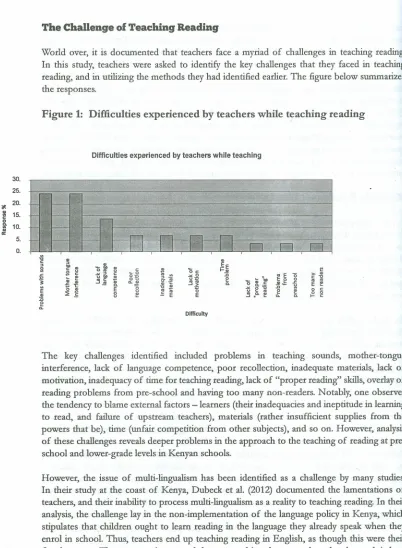
reading, and in utilizing the methods they had identified earlier. The figure below summarizes
the responses.
Difficulty
Figure 1: Difficulties experienced
byteachers while teaching reading
Difficulties expsrienced byteachers while teaching
30.
25.
'#. 20.
~
15. c: 0~
10...
a:5.
O.
~
-e " c:
"
"
~
Sl
L S
j L
"
E
~
"
::;;~
The key challenges identified included problems in teaching sounds, mother-tongue
interference, lack of language competence, poor recollection, inadequate materials, lack of motivation, inadequacy of time for teaching reading, lack of "proper reading" skills,overlay of
reading problems from pre-school and having too many non-readers. Notably, one observes
the tendency to blameexternal factors -learners (their inadequacies and ineptitude in learning
to read, and failure of upstream teachers), materials (rather insufficient supplies from the
powers that be),time (unfair competition from other subjects), and so on.However, analysis
of these challenges reveals deeper problems in the approach to the teaching of reading at pre-school and lower-grade levels in Kenyan pre-schools.
However, the issue of multi-lingualism has been identified as a challenge by many studies. In their study at the coast of Kenya, Dubeck et al. (2012) documented the lamentations of
teachers, and their inability to process multi-lingualism-as a reality to teaching reading. In their
analysis, the challenge lay in the non-implementation of the language policy in Kenya, which stipulates that children ought to learn reading in the language they already speak when they
enrol in school.Thus, teachers end up teaching reading in English, as though this were their
'I
andteacher turn to the look-say method, which is itself ineffective in teaching reading. Agreeing
tothis theory, Taylor et al. (1995) assert that children who come to school speaking other
languagesrather than the language used in the school may have problems in reading.
Theprevalence of many non-readers is a reality in Kenyan classrooms, and authors have argued
that teaching reading should no longer be a lower-grade affair, but that reading should be a
running subject through the primary school cycle (Runo, 2010). But even then, as Maneno
(2008)and Dubeck et al (2012) observe, teaching reading will remain a challenge, as long as
teachers do not possess adequate capacities and authority to teach reading, and especiallyin
usingsounds (phonemes) effectively in aiding the learning to read.
(Re
)mediating of Reading Difficulties
Researchhas demonstrated that readers can achieve at least grade-level reading skills if they are
givenintensive intervention to correct their reading deficiencies (Clay, 1985; Iversen &Turmer,
1993;Pinnel, 1989, Wasik&Slavin, 1993). In this study, teachers were first asked if they paid
anyattention to remediating reading difficulties among their learners. It emerged that 88 per
centof the teachers were carrying some sort of remediation, while 12 per cent were not certain
aboutthis. Further, teachers were asked to identify the strategies they utilized to remediate
readingdifficulties in learners.
Among the key strategies cited were use of ability grouping (about 18%), giving story books/
magazines to learners, identification of weak learners (over 12%) and use of peer teaching
(about5%). Others were varying methods of teaching, creating interest and advising parents to
help.While the responses are encouraging as evidence of the existence of remedial programmes
inour schools, concerns may be expressed .on the ampleness of teacher knowledge and skills to
implement impactful remediation.
Ithas been argued that remediation is a technical matter, and that it should be based upon
sound instructional principles focused upon the needs of the learners on the basis of careful
diagnosis (Wilson, 1972). Proper remediation calls for skilful teaching of the learners who are
inneed.Remediation falls into the following three categories (Wilson, 1972).To achieve this,
teacher knowledge on the existing possibilities of remediation methods is critical, and this
was evidently lacking, from the responses of the study participants. Teachers were unable to
differentiate between the key strategies and levels of on-the-spot, classroom,andclinicalremediation.
While the first one is conducted immediately a learner makes an error in reading, classroom
remediation calls for careful learner observation and diagnosis, and subsequent adjustment of
theinstructional strategy for thespecific reading problem identified. At the higher level,clinical
remediation is an off-site programme, targeted at serious reading deficiencies or disabilities,
preferablythrough expert referral.
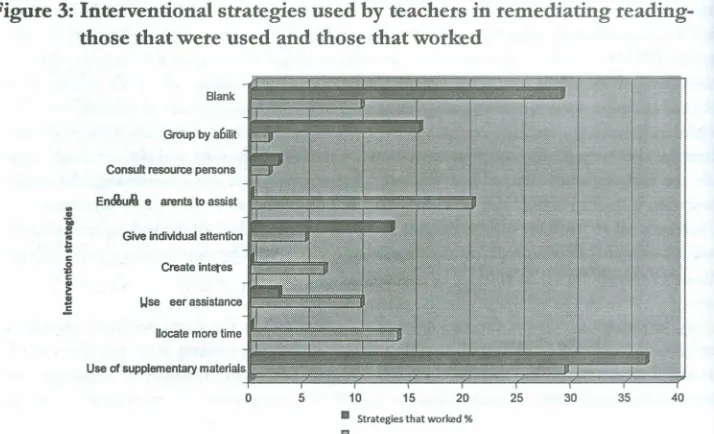
Seeking deeper reflection on the strategies that were working for them, teachers identified
three key approaches that delivered notable value in improving reading. First was the use of
more supplementary reading materials, cited by 30 per cent of the teachers. This perspective
providemore support to the beginning of reading. Stoodt (1981) suggested that teachers ne to create opportunities for learners to experience success by selecting materials that inter
them and those inline with student's level of ability.Use of supplementary materials was al identified as among the four strategies that were working in improving literacy achievementin primary schoolsatthecoast of Kenya (Dubeck et al). Indeed, increasing reading materialsnot
onlybrings excitement and contributes to the foundations of a reading culture, but contribute meaningfully to orienting children to knowledge seeking as part of lifelong learning (and prompts the reading tolearnanticipated later in the reading curve).
Second, teachers observed that abiliry grouping of learners was working in improving reading Teachers utilized this strategy to ensure that the motivation to read was maintained for every learner, while guarding against frustration for the poorer readers. This also allowed
for individualized attention, in supporting learning to read within the lesson time.Presslej Allington, Wharton-McDonald, Collins and Mandel (2001) ascertained in their study,that
ability grouping (by mixed or same-level ability depending on task) facilitated student literacy achievement. In their study, Dubeck et al (2012) identified ability grouping as the top key
strategy that was working in improving literacy, and presented contrasting viewpoints on the effectiveness of homogenous (same-level) and heterogeneous (mixed-level) groups in improving reading. From the narrative of teachers presented in their study, it emerges that
alternating these two approaches of ability grouping may lead to attaining equilibrium between supporting and encouraging poorer readers, while maintaining high reading motivation among the better readers,especially in large classrooms.
Third, teachers prioritised individual attention as a strategy that worked. Despite the large classrooms, teachers noted that sparing time to attend to poor readers, during the usual instructional time,can deliver value in improving reading in Kenyan classrooms.Other strategies
thatwerefound to work included use of peer assistance and consulting resource persons.
Figure 3
:
Interventio
nal strategies used
byteachers in remediating
reading-those
t
ha
t were used and those that worked
EndbuAl e arents to assist :;
f
Giveindividualattentionc
f
Createinteresj
IJse eer assistanceGrnup~mxlnli~II"IIII"II"
Consultresource persons
o 5 10 15 20 25 30 35 40
-
• Strategies that worked"Notably,parental participation was not identified as a working strategy by the study.This departs from thefindings of various studies that have underlined the worth of parental
contribution to the achievement of literacy in early years.For instance, Fantuzz (1995)
establishedthat learners who are given conducive conditions at home perceived themselves
moresocially confident and adjusted more positively in school. Dubeck et al (2012) also
identifiedparental participation as a clear missing link in improving literacy achievement in Kenyan schools.
Con
clusion
This paper has provided evidence on the teaching methods and materials, and explored the
challenges and opportunities encountered by teachers in teaching reading. What emerges
is that even with limited knowledge and skills in teaching reading, teacher agency exists in
Kenyan classrooms, and it should not be considered that nothing is happening. However, as
other Kenyan studies on reading have identified, the teacher capacity to teach reading is low,
identifiedin the limited knowledge on methods and strategies. We argue that there is need for
teacher support in teaching reading, and that there is need for mediation, for remediation to
be accepted as a running practice atthe various levels, and as a core component of teaching
reading.However, teacher professional development, and especially a classroom-based one
is called for, to facilitate expansion of choices in teaching reading, which every lower-grade
teacher should possess. Only then, can the many non-readers in our classrooms today find
support, and progress on time towards reading to learn.
REFERENCES
Bashir,S., (1994). Achievement Performance at the Primary Level in Public and Private Schools of Tamil Nadu. Indian Educational Review,29 (3-4): July- Oct.
Beard,R.(1987).Developing Reading 3-13. London: Hodder and Stoughton.
Berger, M., Yule, W, &Rutter, M. (1975). Attainment and adjustment in two geographical
areas: The prevalence of specific reading retardation. Br. T.Psychiatry 126:570-519.
Bickel,WE., &Bickel,
no.
(1986). Effective schools, classrooms, and instruction: Implications for special education. Exceptional Learners, VoL 52. No.6 489-500.Blomeke,S. (2012). Content, Professional Preparation and Teaching Methods: How Diverse
is Teacher Education across Countries? InComparative Education Review,Vol.56 No.
4, November 2012.
Chall,]., S (1989).Learning to Read: The Great Debate 20 years later- A response to "Debunking the
great phonics nryth" Phil Delta Kappan, 70, 521-538.
Clay,M. M. (1985).The EarlY Detection of Reading Dijftculties (3rd ed.), Auckland, New Zealand:
Heinmann.
Chall,].(1983).Stages of reading development.New York: Mc Graw-Hill.
Commeyras,M. &Iyenga, H. (2007). An Integrative Review of Teaching Reading in Kenyan
Primary Schools. In Reading Research QuarterlY 42 (2);
Dubeck, M, Jukes, M.&Okello , G. (2012).Early Primary Literacy Instruction in Kenya. In
Comparative Education Review,Vol.56, No.!. February 2012.
Eisenberg, L.(1978).Definition oj Dyslexia. their Consequencesfor Research and Policy.
Ekwall, E.E. (1976). Diagnosis and Remediation oj the Disabled Reader. Boston, Massachusetts:
Allyn and Bacon.
Fantuzz, ].w., Davis, G.Y,&Ginsburg, M.D.(1995). Effects of parent involvement in isolation
or in combination with peer tutoring on student self-concept and mathematics
achievement. JournaloJ Educational psychology.V88 No.2 272-292.
Gove, A.&Cvelich, P.K. (2010). Early Reading: Igniting Education for All.A report bythe
Early Grade Learning Community of Practice. RTI International. www.rti.org/
publications;
Government of Kenya (GoK) (2005).Sessional Paper No.1 of 2005 on Policy Framework on
Education, Training and Research. Government Printer, Nairobi.
Gunning, T. G. (1996). Creating Reading Instruction for al/ Children (2nd ed.) Boston, Allyn and
Bacon.
Heilman, A.W. Blair, T.R & Rupley, W.H. (1981). Principles and practices oj teaching. (5th ed.)
Columbus. Ohio: Charles E. Merril.
Iversen, S.&Tunmer. (1993). Phonological processing skills and the reading recovery program.
Journal oj Educational Psychology,85. 112-120.
Jimmerson, S., Egeland, B., Sroufe, L.A.,&Carlson, B. (2000). A Prospective Longitudinal Study
of High School Dropouts: Examining Multiple Predictors across Development. In
JournaloJ School Psychology38 (1).525-549.
Kang'ethe, R W. (1998). The Analysis of Oral Reading, Error Patterns of the Reading Disabled and the Normally Achieving Children on the Wise Range Achievement Test Reading
sub-test. Unpublished Master's Thesis, University of Toronto, Canada.
Kenya Institute of Education (KIE)(2002). Ministry oj Education, primary education syllabus volt.
Kenya. Kenya Institute of education.
Kingdon, G.G., (1998). How much do schools matter to pupil achievement in India.Journal
oj
Educational Planning and Administration, 12 (1).
Kirk, S.A., Gallagher, J.J.,&Anastasiow, NJ. (2003).Educating Exceptional Learners (10th Ed).
Boston, New York: Houghton Mifflin.
Kirigia, K. E. (1991). Assessment oj English Reading comprehension oj pupils completing primary
education. A case study of Meru Municipality zone. A Masters Research Thesis,
Kenyatta University.
Lerner,]. (2006).Learning Disabilities and Related Disorders: Characteristics and Teaching Strategies.
(10th ed.). Boston: Houghton Mifflin
Lipson, M. Y,&Wixson, K.K. (1997).Assessment &InstructionaloJ Reading and Writing Disability:
An Interactive Approach (2nd ed.). New York, Longman.
Lyon, G.R (1996).Learning Disabilities. In The Future oj Children, Vol.6 • No.1-Spring 1996.
MacCutchen, D., Abbott, RD., Green, L.B., Beretvas, S.N., Cox, S., Potter, S.P., Quiroga, T. &
Gray, A.L., (2002).Beginning Literacy: Links among Teacher Knowledge, Teacher
Practice, and Student Learning. InJournal oj Learning Disabilities 35 (1), 69-86.
Maneno, R.,]. (2008). Identification Processes oj.Articulatio» and Phonemic Disorders in Children with
Communication Disorders in primary Schools. Nairobi Province Kenya. A Ph.D Thesis
at Kenyatta University.
Mercer, C. D., & Mercer, A. R (2001). Teaching Students with Learning Problems. (6th Ed).
Mugo, J.K., Mwoma, T.B. & Limboro, C.M. (2011). Teaching for Improved Learning: A Classroom Observation and Communication Study. Report of a WERK/World Bank Study, November 2011.
Neuman, S.,(2004). The Effect of Print-Rich Classroom Environments on Early Literacy Growth. In Reading Teacher,58 (1):89-91.
Newmann, EM., & Wehlage, G.G. (1993).Five standards of authentic. Instruction. Educational leadership,50,78-12.
Pinnel, G.S. (1989). Reading Recovery: Helping at Risk Learners Learn to Read. Elementary SchoolJournal 90.161-184.
Pressley,M., Allington, RL., Wharton-McDonald, R, Collins, C.B.& Mandel, L.M. (2001).
uarning to Read: Lessons from Exemplary First-Grade Classrooms. New York: Guilford.
Runo,M. (2010). Identification of Reading Disabilities andTeacher-Orientation Challenges in Teaching Reading to Standard Five Learners inNyeri and Nairobi Districts, Kenya.
A PhD Research Thesis: Kenyatta University.
Saxena,RR, Singh, S., &Gupta, J.K., (1996).School Effectiveness and Learner Achievement at the Primary Stage. New Delhi: Vikas Publishing House.
Spreen,0.,Risser, A. H., & Edgell,D.(1995).Developmental Neuroprychology. New York: Oxford University Press.
Stoodt,B.D. (1981).Reading Instruction. Boston: Houghton Mifflin.
Taylor,B., Harris, L.A, Pearson, P.D., & Garcia, G.(1995).Reading Dijftculties. Instruction and Assessment (2nd Ed.). New York.:McGraw-hill.
Tompkins, G.~. (2004). Literacy for the 21st century: Teaching Reading and Writing in Grades 4 through 8. Columbus, Ohio: Pearson Prentice Hall.
Uwezo(2010). Ate Our Children Learning? Annual Learning Assessment Report, 2010.
Uwezo (2011). Are Our Children Learning? Annual Learning Assessment Report, 2011.
Wasik,B.A. , & Slavin, R.R (1993).Preventing Early Reading Failure with one-to-one Tutoring: A Review of Five programs. Reading Research QuarterlY. 28. 179-200.
Wafula,R
w.,
Poipoi, M.W., Wanyama, R & Begi S. N. (2012).Early Identification of Learning Disabilities among Standard Three Pupils of Public Primary Schools in Butere District, Kenya. InJournal of Emerging Trends in Educational Research and Policy Studies(JETERAPS) 3(5): 695-700
Wheelock,A. (1995). Empowered Teachers, Empowered Learners - Reforming Progress in Louisville} High Middle School Columbia University. NCREST Teachers College.