IoT Based Smart Home Automation Using
Renewable Energy Sources
Dipali D. Ghorpade1, Anjali M.Patki2
PG Student [Entc], Dept. of Entc, Indira College of Engineering, Pune, Maharashtra, India1
Prof and HOD, Dept. of Entc, Indira College of Engineering, Pune, Maharashtra, India2
ABSTRACT: In this paper, monitoring and remote control of domestic equipment based on IoT from an Android
application using Raspberry pi card is possible. The main objective of this paper is to automate all the devices i.e. home appliances through internet using Raspberry Pi, as well as we can have the security for the system by using sensors like PIR, LPG, temperature sensors. Which is a credit sized single board computer operating on Linux operating system. The algorithm is developed in Python language, which is default programming language of Raspberry Pi.. To minimize the amount of carbon emissions that we contribute towards the cumulative carbon emissions of this earth, Use of Renewable Energy Sources in Household application has always been the most effective method. By developing different codes the communication between the remote user, the web server, the raspberry pi card and the home components is possible.
KEYWORDS: Internet of things (IoT), raspberry pi, renewable energy sources, Home Automation, Sensors.
I.INTRODUCTION
Now a days Carbon emission of the planet earth has been increased in a large extent due to industrialization, automation, modern life of the people. Use of non-renewable energy sources is very much dependent for it, which has given rise to global warming due to depletion of ozone layer. Hence use of renewable energy sources is very much effective method to minimize the amount of carbon emission. Now use of renewable energy sources like solar energy is very much applicable to the home automation .Home automation includes all electronic components, subsystems of the house and company such as heating, garage door, entrance gate, shutters, electronic outlets etc. to meet the comfort needs such that energy management & optimization of lighting & heating, home automation has been developed to provide technical solutions. Hence improved through a use of communication network that includes a pair of twisted lines, fibre optics in a bus based network or an internet protocol as standards. The device technology & communication technology has been rapidly developed offers the facilities to development of the electronic systems [2]. In the large area of application i.e. monitoring and control in the industry, household equipment i.e. home automation, water monitoring, health monitoring etc. data acquisition plays very important role. Recent years there is requirement to do the long distance monitoring. Hence remote monitoring based on web is known as internet of things (IOT) framework is a choice. In which work has been designed, implemented to control& monitoring of household equipment. Where the data monitoring is possible by web browser & can be access via web browser devices i.e. computer, laptop or small mobile phone [2]. The proposed system designed and implemented a low cost credit card sized raspberry can be control through internet under the android environment, household equipment such as heating, water tank level motioning , air conditioning , gas sensing etc. Application consists to develop programs that allow to communication between a remote user using a smart phone, web browser and raspberry pi card that communicate with one or more interface cards to control the Equipment in the home using solar energy.[10] This would eventually put an impact on the total carbon emission due to generation process of power from non-renewable energy sources.
II.LITERATURE SURVEY
Application”, the system is easy to install and cost effective. This system executes remote Bluetooth innovation to give remote access from PC or with cell phones. This system has few limitations that are less area coverage, less flexibility and security.[3]“Control of Door and Home Security by Raspberry Pi through Internet”, the system is designed to work a system is being created to join any entryway with the web, so that the entrance control that system can be controlled from anyplace on the planet. Thus the system is difficult to operate and highly expensive. [4] “Design and Implementation of Home Automation system using Raspberry Pi”, the system is programmed to home appliances using Raspberry Pi through internet. Thus the system is complex and expensive. [6] “Design and Development of Activation and Controlling of Home Automation System through SMS using Micro-controller”, this system uses 8051 controller and GSM module to control home appliances when user is at far distance from home. The system is too expensive and less reliable.[8] “Android Based Home Automation Using Raspberry Pi”, this system automates through Android mobile using Wi-Fi as a communication network and Raspberry Pi acts as a processing unit.[9]HayetLamine, HafedhAbid implemented a Remote control of domestic equipment from an Android application based on Raspberry pi card. They offer the example of a system for controlling a remote shutter, using a "Raspberry pi" card for receiving commands from an Android application on mobile phone.[10]
III.PROPOSED SYSTEM OVERVIEW
IoT is nothing but the internet of things in which where daily life all things connected to internet and can be monitor & can be operate remotely from anywhere. Daily life things like green agriculture, environmental monitoring, industrial wireless sensor network or industrial management, urban management, Tele-medicine, intelligent transportation and smart homes etc. IoT devices can be used to monitor and control the electrical and electronic system used in various types of buildings (e.g Industrial , Institutions or residential).As shown in fig.1 Home automation systems are typically used to control ventilation, air conditioning, lighting, heating, appliances, entertainment and home security devices, communication systems to improve comfort, security and energy efficiency.
Here we are designing solar based home automation, where all equipment’s i.e. tank water level indicator, exact position of sun tracking solar panels, Entrance Door indicator etc. are interface with Raspberry pi Board. And this information of home automation, owner directly monitors and control through their mobile phone using IOT (Internet of Things).Here in this application all gadgets are controlled by Solar panels power we are designed first how much power taking by all equipment’s, because of that we are constructing a sun tracking system using 3 LDR sensors, through LDR sensor Raspberry pi knows exact position of sun so solar panel are also rotates through DC motor based tracker. Here we are using for tank water level indicator; we are using Float sensor placed in tank and measure water level. Depending upon water level i.e. lesser than set point water motor automatically ON from Raspberry pi through Relay. If there is any leakage in gas pipe it will also automatically indicating through sensor controlling Raspberry Pi. And also send the message to the owner to take action on it.Also Here we are using entrance door indicator so raspberry pi assemble with ultrasonic sensor if any one come close to the entrance door alarm will be ON automatically.
Fig1. Smart Home Architecture
IV. HARDWARE & SOFTWARE
A. Raspberry pi
This second generation Raspberry Pi has an upgraded Broadcom BCM2836 processor, which is a powerful ARM Cortex-A7 based quad-core processor that runs at 900MHz The Raspberry Pi 2 delivers 6 times the processing capacity of previous models.. The board also features an increase in memory capacity to 1Gbyte There is an Ethernet port which can be used to connect the board to a computer network. The board also has a SD card slot and the Raspberry pi is designed to boot from the SD card. The operating systems versions of Windows, Mac and Linux are available which can be installed in the Raspberry pi board.The chip specifically provides HDMI and there is no VGA support. The foundation provides Debian and Arch Linux ARM distributions and also Python as the main programming language, with the support for BBC BASIC, C and Perl.
Fig:2 Raspberry Pi
B.ADC module
MCP3208 include data acquisition, multi-channel data loggers, robotics, industrial automation, instrumentation and measurement, industrial PCs, motor control, smart sensors, portable instrumentation and home medical appliances.
C.Android application
Android application (apps) widely used by all smart mobile phones. The android applications built in PHP language. A signal is generated on clicking a specific buttons on the android application which shows the raspberry pi to is to do actions according to the predefined program. A software development kit (SDK) is typically a set of software development tools that allows the creation of applications for a certain software framework, hardware platform, software package, computer system, operating system, or similar platform. It may be something as simple as the implementation of one or more application programming interfaces (APIs) in the form of some libraries to interface to a particular Programming language or to include sophisticated hardware that can communicate with a particular Embedded. A typical Android app is designed for a smartphone even for a tablet PC running on the Android OS.
D.Raspbian operating system
Raspberry pi hardware is designed with raspbian free operating system based on debian. Having large no of 35,000 packages and pre-compiled software available for installation on Raspberry Pi. To improve stability and performance, it is still under development. Hence rapidly growing technology.
E. MySQL:
MySQL is a relational database management system (RDBMS). It is distributed under a dual GPL and Proprietary license. It is one of the database management software most widely used in the world.
V. SYSTEM IMPLEMENTATION
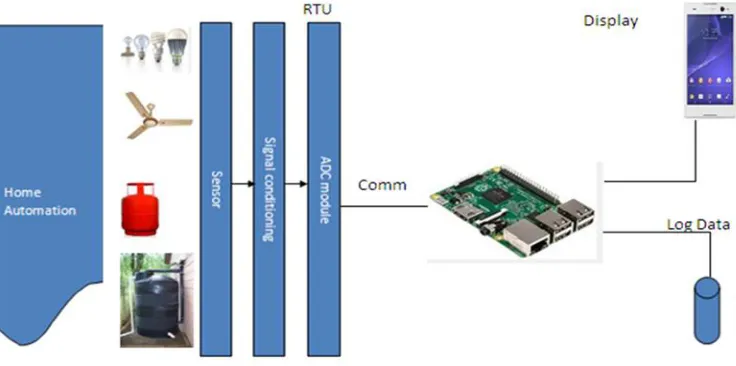
The designed system should be possible for remote data monitoring via web supported by open source software, able for reliable communication, and have a small portability. Therefore the system consists of analog sensors for the measurement of temperature, gas, float level etc. Signal conditioning module and ADC module along with the communication module which is supported by open source software. The block diagram of the system is presented in Fig. 3. The system should be able to monitor several parameters from a home. There is a signal conditioning module to improve the sensor output signal. The output of signal conditioning module is fed to the conversion and transmission module which consists of Raspberry Pi. The MCP 3208 is used as Analog to Digital Converter which send the converted data via serial communication to raspberry pi processor, Which is used as processor for data processing. It connected to the monitor and data storage card. In brief, it substitutes the computer function and offers the smaller dimension because Raspberry Pi is a single-board computer (SBC) on credit card size.
The main functionality of the Real Time Unit from fig. 3.is as follows. 1) Temperature measurement
The current temperature is converted to an appropriate voltage level using a 3 pin integrated circuit temperature sensor unit (IC LM35DZ). The three pins are ground (GND), voltage source (Vs) and output voltage (V out). Analog to Digital converter (ADC) converts the signal into digital value that is fed as input to the raspberry pi processor. LM35 series is precision integrated circuit temperature sensor whose output voltage can be linearly calibrated in degree Celsius i.e. Linear + 10.0 mV/°C scale factor with 0.5°C accuracy guarantee and rated for full -55°C to +150°C range. It operates in 4 to 30 volts and draws less than 60 μA.
2) Light Intensity measurement
A light/dark activated switch that is present is used to measure the light level which will turn on and off accordingly. A Light Depended Resistor (LDR) is used to measure the light level. The circuit has a transistor switch with the base connected to a voltage divider. The voltage divider has 50K potentiometer plus the protective resistor and LDR. When the light falls on the surface of LDR, the resistance of the LDR is changed. The more the light, the less the resistance, the less the voltage drop across it and vice versa. As the voltage drop increases, the VB of the BC547 transistor and ICE will also increase.
3) Water Level identifier
A float switch is a device used to detect the level of liquid within a tank. The switch may be used in a pump, an indicator, an alarm, or other devices. Float switches range from small to large and may be as simple as a mercury switch inside a hinged float or as complex as a series of optical or conductance sensors producing discrete outputs as the liquid reaches many different levels within the tank. Perhaps the most common type of float switch is simply a float raising a rod that actuates a micro switch.
4) Gas leakage detector
Sensitive material of MQ-6 gas sensor is SnO2, which with lower conductivity in clean air. When the target combustible gas exist, the sensor’s conductivity is higher along with the gas concentration rising. MQ-6 gas sensor has high sensitivity to Propane, Butane and LPG, also response to Natural gas. The sensor could be used to detect different combustible gas, especially Methane; it is with low cost and suitable for different application.
VI.TEST AND RESULTS A. Data Storage
There are two methods for data storage. The first, data is stored on file extension (.dat) on Raspberry Pi. The data on Raspberry Pi is stored for each parameter in the two types of files, datalog file (.dat) as shown in Fig 4. While backup data is stored in MySQL database.
B. Remote IO Function
Testing of remote IO function was carried out by Samsung smartphone based on android OS. In this test, the sensor inputs (AI) in the Digital output (DO) were investigated on smartphone display by typing the RTU IP Address via url on web browser. The test scheme is presented in Figure 5. And the display on smartphone is presented Fig 6.
Fig.5. The scheme of data plotting processed on the Raspberry Pi
Fig.6.The display of user interface on mobile device
When an unauthorised person or authorised person comes at the entrance of the door of the house, the remote user can open the door automatically. And also close the door by giving the command ‘door open ’and ‘door close’ respectively. Output of PIR sensor gives alarm when unauthorized person is detected. As there is LPG gas leakage in home, the ‘Gas Detected’ notification will be sent to the User.As there is increase in temperature above the temperature limit i.e.45 degree Celsius, the fan will be automatically on, and its value displayed on android mobile device. Similar manner the water level in tank or value of float sensor is displayed continuously.
VI. CONCLUSION
This paper aims a basic application of home automation using Raspberry Pi which can be easily implemented and used efficiently. . By developing and storing many codes in the web server, smart phone and the raspberry pi card, we can monitor and get remote command of multiple domestic equipment.It will be generic and flexible in a user friendly manner and can be extended for any future applications like power control, surveillance, etc, easily. Also it will control the security system and gas leakage with the help of given sensors. Due to easy implementation the designed system is very customizable according to needs. By this effective technique use of our renewable energy resources utilization is done in great extent. The integration of Internet of Things with existing smart home architecture, it may be more autonomous, more practice, and quite scalable saw the giant step and progress in the areas of technology and communication in our time .It will provide us numerous opportunities for improvements in our energy saving techniques.
REFFERENCES
[1] Shruti G. Suryawanshi, Suresh A. Annadate, “Raspberry Pi based Interactive Smart Home Automation System through E-mail using Sensors” International Journal of Advanced Research in Computer and Communication Engineering Vol. 5, Issue 2, February 2016.
[2] Mukesh Kumar, Sanjeev Sharma, and Mansav Joshi, “Design of Real Time Data Acquisition with Multi Node Embedded Systems,” IJCA., vol. 42, no. 11, pp. 6–12, 2012.
[3] R. A. Ramlee, M. H. Leong and R. S. S. Singh, “Bluetooth Remote Home Automation System Using Android Application”, International Journal of Engineering And Science, Volume-2, Issue 01, Pages: 149-153, 2013, ISSN: 2319 – 1813, ISBN: 2319 – 1805. K. R. Chowdhury, M. Di Felice, “Search: a routing protocol for mobile cognitive radio ad hoc networks,” Computer Communication Journal, vol. 32, no. 18, pp. 1983-1997, Dec.20
[4] Md. Nasimuzzaman Chowdhury, Md. ShibleeNooman, SrijonSarker, “Access Control of Door and Home Security by Raspberry Pi through Internet”, International Journal of Scientific & Engineering Research, Volume4, Issue11, november2013,ISSN:2229-5518.
[6] Bruhathireddy, Dr. G. N. Kodandaramaiah, M. Lakshmipathy “Design and Implementation of Home Automation system using Raspberry Pi”, International Journal of Science, Technology & Management, www.ijstm.com,Volume No. 03, Issue No. 12, December 2014,ISSN:2394-1537.
[7] Sarthak Jain, AnantVaibhav, Lovely Goyal, “Raspberry Pi based Interactive Home Automation System through E-mail”, International Conference on Reliability.
[8] Ch. NagaKotiKumar, Y.V.RaghuBabu, A.Gamya, P.Jainath, M.Vijay, “Design and Development of Activation and Controlling of Home Automation System through SMS using Micro-controller”, International Journal of Engineering Research and Applications, ISSN: 2248-9622. www.ijera.com. Vol.2, Issue2, Mar-Apr2012, pp.1349-1352.
[9] Shaiju Paul, Ashlin Antony and Aswathy. B. “Android Based Home Automation Using Raspberry Pi”, IJCAT-International Journal of computing and Technology, Volume-1, Issue1, February2014. M. Young, The Technical Writer's Handbook. Mill Valley, CA: University Science, 1989.