International Journal of Research (IJR)
e-ISSN: 2348-6848, p- ISSN: 2348-795X Volume 2, Issue 08, August 2015Available at http://internationaljournalofresearch.org
An Automated Resource Allocation for Qos Provision in a
Cloud-Based Multimedia Storage System
T Nagajyothi
1& Syed Abdul Moeed
21M.Tech Computer Science &Engineering, E-mail: [email protected]
2Assistant Professor, Department of CSE, E-mail: [email protected]
1,2 Balaji Institute of Engineering & Sciences Narsampet, Warangal, Telangana, India.
Abstract:
Data sharing in form of multi-media is more complicated as it utilizes more traffic in the internet, hence the concept of multimedia streaming has been introduced. But if user mobility is considered then as user is moving geographically to various locations with these mobile devices then he is connected to its local cloud to access the cloud services. Because of this mobility factor, network congestion may increase which causes degradation of QoS. And different Cloud providers are not in a position where they can easily build multiple Clouds to service different geographical areas like they do with services that run on individual servers. Hence, a new method for service delivery will take into account which will improve QoS in order to provide better QoE to the clients and better load management to the providers, as well as helps to reduce network congestion on a global scale. This paper gives a insight that as the demand for specific services increases in a location, it might be more efficient to move those services closer to that location Using an analytical framework. This will help to reduce high traffic loads due to multimedia streams and will offer service providers an automated resource allocation and management mechanism for their services.
Index Terms: Quality of Service (QoS);
Multimedia; Cloud computing; Web services;
Communication system traffic control
1.
INTRODUCTION
Cloud computing is a computing paradigm, where a large pool of systems are connected in private or public networks to provide
dynamically scalable infrastructure for
application, data and file storage. With the advent of this technology, the cost of computation, application hosting, content storage and delivery is reduced significantly. Security issues in cloud concerns mainly associated with security issue faced by cloud service providers and the service issues faced by customers. In cloud computing, users can outsource their computation and storage to servers (also called clouds) using internet. This frees users from the hassles of maintaining resources on-site.
International Journal of Research (IJR)
e-ISSN: 2348-6848, p- ISSN: 2348-795X Volume 2, Issue 08, August 2015Available at http://internationaljournalofresearch.org
privacy are thus very important issues in cloud computing. In one hand, the user should
authenticate itself before initiating any
transaction and on the other hand, it must be ensured that the cloud does not tamper with the data that is outsourced. When clients access multimedia objects from a content server, the content server must have sufficient disk and network to deliver the objects to the clients. Otherwise, it rejects the requests from the new clients. Thus, the popular content server can easily become the bottleneck in delivering multimedia objects. Therefore, server and network workloads are important concerns in designing multimedia storage systems over the Internet. Multimedia objects, like other traditional data files and Web pages, may be transferred across networks, such as the Internet. In order to provide efficient delivery of data across the networks, some data can be stored in the middle of the network. When requests for the same object have been received, the sedate can be used to satisfy the requests at the middle of the network instead of forwarding the request any further. This method to satisfy requests with previously accessed data is called caching. Since caching needs to consume a certain amount of storage space, the cache performance is affected by the size of the cache memory.
Cloud computing refers to the delivery of computing resources over the Internet in which large groups of remote servers are networked to allow the centralized data storage, and online access to computer services or resources. Cloud services are made available to users on demand via internet from cloud provider’s machines which we call them as servers. These servers are designed to provide easy, scalable access to applications, services and resources and are
totally managed by cloud service providers. A cloud service provider offers some component of cloud computing typically Infrastructure as a Service (IaaS), Software as a Service (SaaS) or Platform as a Service (PaaS).
Fig1: Cloud Infrastructure
International Journal of Research (IJR)
e-ISSN: 2348-6848, p- ISSN: 2348-795X Volume 2, Issue 08, August 2015Available at http://internationaljournalofresearch.org
2. RELATED WORK
An automated resource allocation is recently proposed architecture which improves the performance of cloud technologies. This architecture aims to improve the QoS and Quality of Experience (QoE) for multimedia applications. This is achieved by a ―Cloudlet‖ of servers running at the edge of a bigger Cloud. This architecture mainly handles requests closer to the edge of the Cloud and hence helps to reduce latency. If further processing is needed, then requests are sent to the inner Cloud, so the ―Cloudlets‖ are reserved for QoS sensitive multimedia applications. This aims to divide the network hierarchy within the Cloud, in such a way that physical machines that are closer to the Cloud’s outer boundaries will handle QoS sensitive services. Since these machines reside on the border of the Cloud, the data has to travel less distance within the Cloud before it is sent out to the clients. This not only improves QoE for clients but it also reduces network congestion within the Cloud.
Furthermore, all the research at present assumes that only one entity (the provider) is in control of a Cloud and as a result different providers cannot ―share‖ resources in a manner that can improve the utilization efficiency of their hardware. This can potentially lead to problems in the future as mobility and multimedia-rich content becomes more popular and high bandwidth data streams will have to travel great distances and reach moving targets. Cloud providers may find themselves in situations where their hardware resources are not adequate and they may have to create more Clouds to handle the load and relieve network congestion.
3. SYSTEM ARCHITECTURE
If the storage space is large, more objects can be stored on the cache storage and the probability of finding an object in the cache is thus high. The cache performs better. If the storage space is limited, only a few objects can be stored in the cache storage, and the probability of finding an object in the cache is low. As a result, the cache performance becomes low. Therefore, the cache size influences the cache performance. Since caching stores some previously fetched objects on the storage devices, the presence of an object exists on the storage devices significantly affects the efficiency of the caching. When a new object is being accessed, the cached mission policy decides whether an accessed object should be stored on to the cache devices. Since the cache performance increases monotonically with the number of objects in the cache, the cache storage space is often full in order to keep the most number of objects in the cache. When an accessed object needs to be stored and the cache space is full, the cache replacement policy decides which object should be deleted from the cache storage to release space.
Fig 2: System Architecture
International Journal of Research (IJR)
e-ISSN: 2348-6848, p- ISSN: 2348-795X Volume 2, Issue 08, August 2015Available at http://internationaljournalofresearch.org
There are active researches in providing QoS aware routing algorithm for mobile multimedia applications. Researches in the recent QoS routing in mobile ad hoc networks have been covered. One of the major functions at the transport layer is congestion control and the TCP protocol is the dominant protocol at the transport layer. TCP protocol is designed for the wired networks and is not efficient for wireless networks. It reduces the transmission rate when there is a packet loss, which suffers great performance degradation since the wireless channel generates a higher bit error rate. The transport layer protocol should be able to differentiate the packet losses generated by the congestion and by the channel errors.
4. IMPLEMENTATION
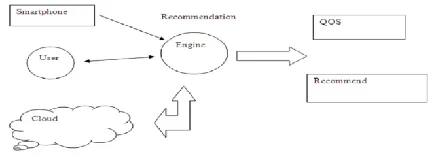
There are several factors that need to be considered in the provision of QoS, such as the limited resources on the mobile devices, heterogeneity, and roaming characteristics in the mobile computing environment. Power-efficient design of QoS is the common solution to address the limited battery on the mobile device. Context-aware middle-ware is used to overcome the heterogeneity issue in the mobile networks and provide context-aware QoS. Handover is essential in mobility management which provides QoS when the mobile devices move from one network to another network. The evolution of new applications and technologies, such as social multimedia and cloud computing, poses many challenges in the provision of QoS.In order to gather QoS data and know the network conditions in a specific area, we are using another mechanism that we call the QoS Monitor.
The power-aware multimedia solutions jointly design the video coding parameters and channel parameters to adapt to the video contents and underlying network conditions to minimize the total energy consumption. An efficient system should jointly consider three factors: bit rate, power consumption, and video quality. A balance needs to be achieved between power consumption in computation and communication
to provide energy efficient multimedia
applications. The goal is to minimize the total power consumption, subject to three constraints: the maximum video distortion to ensure satisfactory video quality, maximum end-to-end delay required by the application, and the maximum computational complexity provided by the mobile multimedia devices. Another goal is to minimize the video distortion, subject to the
maximum power consumption allowed,
maximum end-to-end delay, and maximum computation complexity. Power-rate-distortion analysis adds a new dimension power to the traditional rate-distortion analysis.
International Journal of Research (IJR)
e-ISSN: 2348-6848, p- ISSN: 2348-795X Volume 2, Issue 08, August 2015Available at http://internationaljournalofresearch.org
better suited to service a client request based on the location of the client, using this information. STAR achieve this functionality is by look up routing tables in order to identify which Cloud is closer to a user. Service to reject the new client and forward them to another Cloud if possible.
This gives control to service providers and also becomes a contingency mechanism in case STAR makes a wrong decision. The STAR server can be scaled similarly to the DNS system since it is essentially the same type of service albeit with some extra parameters. Once a Cloud ID is found, then the ID is resolved into the IP addresses of the Cloud controllers that the client can contact to access the service. The process is shown in the Fig. 2. It should be noted that alternatively the Cloud ID can be returned to the client, at which point, the client will have a choice of which DNS to use to find the IP addresses.
5. CONCLUSION
Efficient search on encrypted data is also an important concern in clouds. The clouds should not know the query but should be able to return the records that satisfy the query. Accountability of clouds is a very challenging task and involves technical issues and law enforcement. Neither clouds nor users should deny any operations performed or requested. In this paper, we studied the challenges which are faced by the mobile user in future networks. The service delivery models which are used currently are not that much sufficient and not consider the needs of mobile user in future. A cloud storage system was proposed in order to provide robust, scalable, highly available and load-balanced services. In the meantime, the system also needs to provide quality of service provision for
multimedia applications and services. The proposed system achieves the QoS in distributed environment which make the proposed system especially suitable to the video on demand service. It often provides different service quality to users with various types of devices and network bandwidth. We believe that our implementation will provide the better quality of service (QoS) as well as better quality of experience (QoE) to the user.
REFERENCES
[1] 2011 J. Somorovsky,et al., ―All your clouds belong to us—security analysis of cloud
management interfaces,‖ ACM Comput.
Commun.Security Conf.
[2] 2011 F. Zhang, et al., ―CloudVisor: retrofitting protection of virtual machines in multi tenant cloud with nested virtualization,‖ Symp. Operating Syst. Principles.
[3] 2012, S. Butt, et al., ―Self service cloud computing,‖ in ACM Comput. Commun Security Conf.
[4] 2012 V. Varadarajan, et al., ―Resource freeing attacks: improve your cloud performance (at your neighbor’s expense),‖ ACM Comput. Commun.Security Conf.
[5]. Govinda .K, Pavan Kumar Abburu, Gangi Prathap Reddy Govinda .K et.al / International Journal of Engineering.
[6]. Technology (IJET), Vol 5, Jun-Jul 2013, ISSN : 0975-4024.
International Journal of Research (IJR)
e-ISSN: 2348-6848, p- ISSN: 2348-795X Volume 2, Issue 08, August 2015Available at http://internationaljournalofresearch.org
Network and Operating System Support for Digital Audio and Video, 2000, pp. 55–64.
[8] Wenwu Zhu, Chong Luo, Jianfeng Wang, and Shipeng Li; ―Multimedia Cloud Computing‖
Digital Object Identifier
10.1109/MSP.2011.940269 Date of publication: 19 April 2011.
[9] Li Li, Xiong Li, Sun Youxia, and Liu Wen; ―Research On Mobile Multimedia Broadcasting
Service Integration Based On Cloud
Computing‖.
T Nagajyothi pursing M.Tech in Computer Science Engineering from JNTU Hyderabad. Her research area includes Programming Languages, Data Base Management Systems, Mobile Applications, Data Mining.