BER Analysis of Mobile WiMAX System
Using STBC Code in MIMO System under
AWGN and Other Channels
Jigeesha Joshi1, Vijay Mehta2, Kanak Kumar3
PG Scholar [DC], Dept. of ECE, Millennium Institute of Technology, Bhopal, M.P, India1
Purchase Manager, Dept. Of Purchase, Accutron INC, Ahmedabad, Gujarat, India2
H.O.D, Dept. of ECE, Millennium Institute of Technology, Bhopal, M.P, India3
ABSTRACT: Mobile WiMAX is a broadband wireless solution that enables the convergence of mobile and fixed
broadband network, through a common wide area broadband radio access technology and flexible network architecture. The Performance of mobile WiMAX with MIMO under varying channel is one of the interesting researches. Most of the existing systems, based on performance and evaluation under channel condition are limited to Rayleigh fading etc. in mobile WiMAX. In this paper we have analyzed MIMO Mobile WiMAX System using the STBC on the Bit error rate basis. We have compared the performance of the system under the different channel and different modulation schemes with convolutional code rates. Further we have shown the results in the graphical form using MATLAB.
KEYWORDS: WiMAX, MIMO, STBC, AWGN, Rayleigh, Rician.
I.INTRODUCTION
IEEE802.16e is a global broadband wireless access standard capable of delivering high data rates to fixed users as well as portable and mobile ones over long distance [1]. In mobile WiMAX air interface adopts Orthogonal Frequency Division Multiple Access (OFDMA) for improved multi-path performance in non-line-of sight (NLOS) environment. Mobile WiMAX extends the OFDM PHY layer to support terminal mobility and multiple–access. The resulting technology is Scalable OFDMA. Data streams to and from individual users are multiplexed to groups of sub channel on the downlink and uplink. By adopting Scalable PHY architecture, mobile WiMAX is able to support a wide range of bandwidths. The performance of the WiMAX (Worldwide Interoperability for Microwave Access) can be evaluated by using the Stanford University Interim (SUI) channel models which has a set of six channels for terrain types [3].With different data rates, coding schemes and modulation techniques. The mobile WiMAX standard builds on the principles of OFDM by adopting a Scalable OFDMA-based PHY layer (SOFDMA) [4]. SOFDMA supports a wide range of operating bandwidths to flexibly address the need for various spectrum allocation and application requirements.
The first WiMAX system is based on the IEEE 802.16-2004 standard [6]. The features to support mobile applications were added in December, 2005 to introduce 802.16e-2005. The resulting standard is referred to as mobile WiMAX. The mobile WiMAX system provides a large number of flexibility in terms of deployment options and potential applications. IEEE 802.16e is a promising technology for ensuring broadband access for the last mile connectivity. It provides a wireless backhaul network that enables high speed Internet access to residential, small and medium business customers, as well as Internet at a cost-effective, rapidly deployable solution access for WiFi hot spots and cellular base stations [7]. PHY layer of mobile WiMAX has scalable FFT size from 128 to 2048 point FFT and the range is from 1.6 to 5 Km at 5MHz.
made to develop MIMO-mobile WiMAX system using space time block codes to analyze the BER performance for adaptive and constant modulation schemes under different channels.
WiMAX comes as an alternative to cable and digital subscriber loop (DSL)[12]. WiMAX is based upon Orthogonal Frequency Division Multiplexing (OFDM) that provides very good spectral efficiency and resistance to multi-path propagation. It targets frequency bands below 11 GHz [3], can deliver data rates of 75 Mbps, cover ranges of 30km, and can provide secure delivery of content and support mobile users at vehicular speeds.
OFDM can significantly simplify the equalization problem. A frequency selective channel is approximately flat in each sub-channel. Instead of single carrier with high data rate, OFDM uses more subcarriers modulated with lower data rates. This leads to small channel variations in every sub-channel. Therefore the inter-symbol interference is reduced or even diminished.
II.RELATED WORK
Hadj Zerrouki & Mohamed Feham in 2010[13] published that IEEE 802.16e -2004 currently supports several multiple-antenna options including Space-Time codes (STC) Multiple-Input Multiple-Output (MIMO) multiple-antenna systems and Adaptive Antenna Systems (AAS). In this extension to basic SISO mode a number of 2x2 MIMO extensions are analyzed under different combinations of digital modulation (QPSK,QAM) and convolution code with ½, 3/4 rated codes.The book “Fundamental of wireless communication” mainly includes the research on the basic aspects of wireless communication along with many techniques to discover the utility of its modern era. MIMO would be the most innovative approach in the modern wireless system to improve the capacity with the highest superior quality. [14].P.Samundiswary & Ravi Rajan Prasad published in 2013about the performance analysis of MIMO-Mobile WiMAX system using STBC using different channels. From this paper we get an idea of inclusion of MIMO in mobile WiMAX system provides a robust platform for Space, Time and Frequency selective fading conditions and increases both data rate and system performance.[10]
III.WIMAX PHYSICALMODEL
The WiMAX physical layer model is based on OFDM (Orthogonal Frequency Division Multiplexing) technique [1-3, 6, 8, 10]. OFDM is the transmission scheme to enable high-speed data, video and multimedia communications which is used by various commercial broadband systems. OFDM is an elegant and efficient scheme for high data rate transmission in a non-line-of-sight radio environment. The physical layer model of WiMAX system is shown in figure 1. The various blocks of this model are explained below:
Randomization: It is the first process which is carried out in the WiMAX Physical layer after the data packet is
received from the higher layers and each of the burst in Downlink as well as in the Uplink is randomized. It is basically scrambling of data to generate random sequence in order to improve coding performance and data integrity of the input bits.
Forward Error Correction (FEC): It basically deals with the detection and correction of errors due to path loss and
fading that leads to distortion in the signal. There are number of coding systems that are involved in the FEC process like RS codes, convolution codes, Turbo codes, etc. Basically we will be focusing upon the RS as well as the convolution codes.
1. RS codes: These are non-binary cyclic codes that add redundancy to the data. This redundancy is basically addition
of parity bits into the input bit stream that improves the block errors.
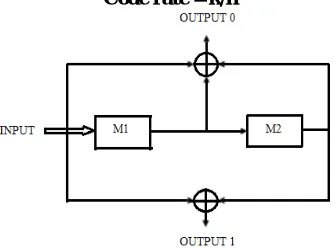
2. Convolution codes (CC): These CC codes introduce redundant bits in the data stream with the use of linear shift
Fig. 1 WiMAX OFDM physical layer model
These convolutional codes are used to correct the random errors and are easy to implement than RS codes. Coding rate is defined as the ratio of the input bits to the output bits. Higher rates like 2/3 and 3/4, are derived from it by employing “puncturing.” Puncturing is a procedure that involves omitting of some of the encoded bits in the transmitter thus reducing the number of transmitted bits and hence increasing the coding rate of the CC code and inserting a dummy “zero” metric into the convolution Viterbi decoder on the receive side of WiMAX Physical layer in place of the omitted bits. Code rate of convolution encoder is given
as:-Code rate = k/n
Fig. 2 Convolution Encoder; code rate=1/2, m=2
For Decoding the Viterbi algorithm is used at the receiver side of the PHY layer. To describe a convolution code, one need to characterize the encoding function (m), so that given an input sequence m, one can readily compute the output sequence U.
Interleaving:It aims at distributing transmitted bits in time or frequency domain or both to achieve desirable bit error
Modulation: This process involves mapping of digital information onto analog form such that it can be transmitted over the channel. A modulator is involved in every digital communication system that performs the task of modulation. Modulation can be done by changing the amplitude, phase, as well as the frequency of a sinusoidal carrier. In this paper we are concerned with the digital modulation techniques. Various digital modulation techniques can be used for data transmission, such as M-PSK and M-QAM, where M is the number of constellation points in the constellation diagram. Inverse process of modulation called demodulation is done at the receiver side to recover the original transmitted digital information.
Pilot Insertion
:
Used for channel estimation & synchronization purpose. In this step, pilot carriers are inserted whosemagnitude and phase is known to the receiver.
Inverse Fast Fourier Transform (IFFT): An Inverse Fast Fourier transform converts the input data stream from
frequency domain to time domain representing OFDM Subcarrier as the channel is basically in time domain. IFFT is useful for OFDM system as it generates samples of a waveform with frequency components satisfying the orthogonally condition such that no interference occurs in the subcarriers.
Similarly FFT converts the time domain to frequency domain as basically we have to work in frequency domain [9]. By calculating the outputs simultaneously and taking advantage of the cyclic properties of the multipliers FFT techniques reduce the number of computations to the order of N log N. The FFT is most efficient when N is a power of two.
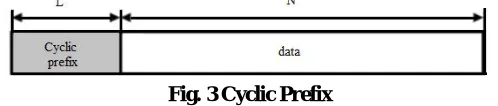
Cyclic Prefix: One way to prevent ISI is basically to create a cyclically extended guard interval in between the data
bits, where each of the OFDM symbol is preceded by a periodic extension of the signal itself which is known as the Cyclic Prefix as shown in fig. 3. When the guard interval is longer than the channel impulse response, or the multipath delay, the IS1 can be eliminated.
Fig. 3 Cyclic Prefix
Communication channels: Communication channels are kind of medium of communication between transmitter and
receiver. These channels are mainly divided into fast and slow fading channels. A channel is known as fast fading if the impulse response of the channel changes approximately at the symbol rate of the communication system, whereas in slow fading channel, impulse response stays unchanged for several symbols.
1. Additive White Gaussian Noise (AWGN): AWGN is a channel model in which the only impairment to
communication is a linear addition of wideband or white noise with a constant spectral density expressed as watts per hertz of bandwidth and a Gaussian distribution of amplitude. The model does not account for fading, frequency selectivity, interference, nonlinearity or dispersion. In the study of communication systems, the classical (ideal) AWGN channel, with statistically independent Gaussian noise samples corrupting data samples free of inter-symbol interference (ISI), is the usual starting point for understanding basic performance relationships. An AWGN channel adds white Gaussian noise in the signal that passes through it.
2. Rayleigh Fading Channel: Rayleigh fading is a statistical model for the effect of a propagation environment on a
radio signal such as that used by wireless devices. It assumes that the power of a signal that has passed through such a transmission medium (also called a communications channels) will vary randomly or fade according to a Raleigh distribution, the radial component of the sum of two uncorrelated Gaussian random variables. It is reasonable model for tropospheric and ionospheric signal propagation as well as the effect of heavily built up urban environment on radio signals. Raleigh fading is most applicable when there is non-line-of-sight between the transmitter and receiver. In a multipath propagation environment, the received signal is sometimes weakened or intensified. The signal level of the received wave changes from moment to moment. Multipath fading raises the error rate of the received data.
3. Rician Fading Channel: Rician fading is a stochastic model for radio propagation anomaly caused by partial
multipath interference), and at least one of the paths is changing (lengthening or shortening). Rician fading occurs when one of the paths, typically a line of sight signal, is much stronger than the others.
IV. WiMAX-MIMO SYSTEMS
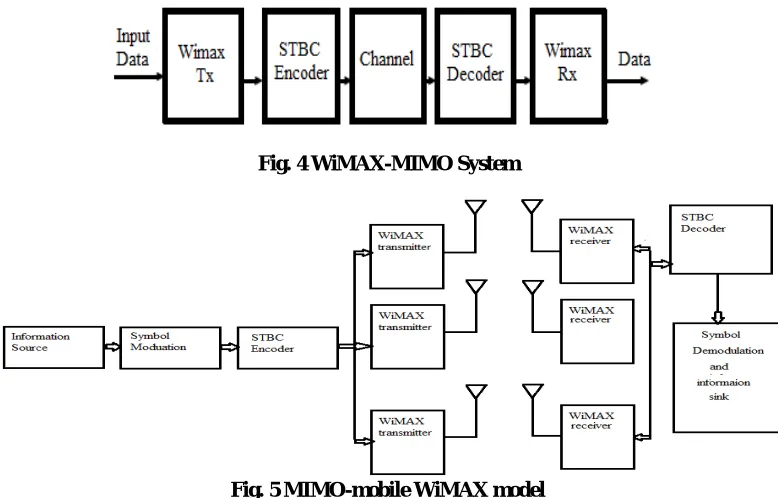
MIMO systems created according to the IEEE 802.16-2005 standard (WiMAX) under different fading channels can be implemented to get the benefits of both the MIMO and WiMAX technologies [1-4, 6-7, 9, 10]. Main aim of combining both WiMAX and Spatial multiplexing MIMO technique is to achieve higher data rates by lowering the BER and improving the SNR of the whole system. The proposed block diagram of WiMAX-MIMO systems is given in figure 4.
Fig. 4 WiMAX-MIMO System
Fig. 5 MIMO-mobile WiMAX model
The use of WiMAX technology with the MIMO technology provides an attractive solution for future broadband wireless systems that require reliable, efficient and high-rate data transmission. Employing MIMO systems in WiMAX [18] yields better BER performance compared to simple WiMAX protocol. Spatial multiplexing technique of MIMO systems provides spatial multiplexing gain that has a major impact on the introduction of MIMO technology in wireless systems thus improving the capacity of the system. Combining of both the systems involves employing STBC encoder and decoder at the transmitter and receiver side of WiMAX Physical Layer respectively.
V. SIMULATIONS AND RESULTS
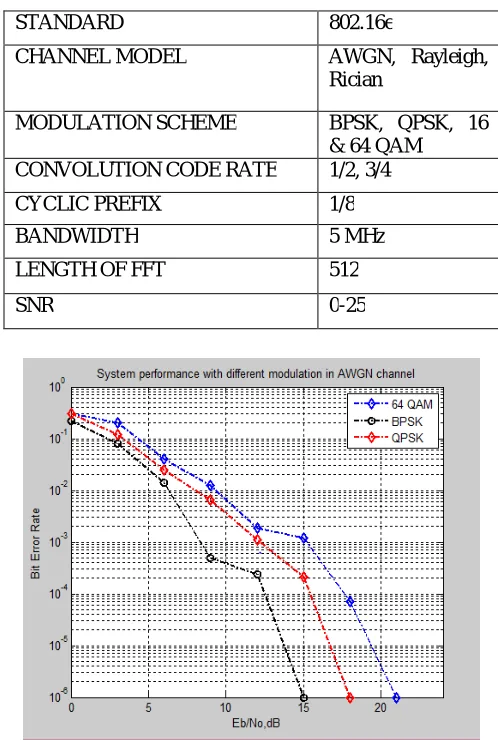
Table I. Simulations Parameters for different channels
STANDARD 802.16e
CHANNEL MODEL AWGN, Rayleigh,
Rician
MODULATION SCHEME BPSK, QPSK, 16
& 64 QAM CONVOLUTION CODE RATE 1/2, 3/4
CYCLIC PREFIX 1/8
BANDWIDTH 5 MHz
LENGTH OF FFT 512
SNR 0-25
Fig. 6 BER of MIMO-WiMAX system for different modulation in AWGN channel
Fig. 6 shows BER vs. SNR performance analysis of BPSK, QPSK and 16-QAM modulation technique over Additive White Gaussian Noise channel. BPSK has lower BER than QPSK and 16QAM. For ex. at SNR=6, BER in BPSK is 0.0025 where QPSK is 0.020 & 16QAM is around 0.4. At SNR=15 BPSK BER=10-6 but QPSK BER 10-4 and 16 QAM-BER 10-3.
Table II. Comparison of different modulation over AWGN channel
SNR(db) BPSK(BER) QPSK(BER) 16-QAM(BER)
6 0.025 0.034 0.04
Fig. 7 BER of MIMO-WiMAX system for different modulation with in Rayleigh Fading channel
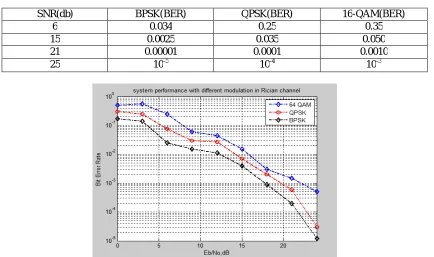
Fig. 7 shows performance analysis of BPSK, QPSK and16-QAM modulation technique over Rayleigh fading Channel. In graph as the value of SNR is increases, BER is a decrease in all three modulation technique. BER performance of BPSK is much better than QPSK and 16 QAM. Also QPSK is better than 16-QAM for higher SNR values.
Table III. Comparison of different modulation in Rayleigh channel.
SNR(db) BPSK(BER) QPSK(BER) 16-QAM(BER)
6 0.034 0.25 0.35
15 0.0025 0.035 0.050
21 0.00001 0.0001 0.0010
25 10-5 10-4 10-3
Fig. 8 BER of MIMO-WiMAX system for different modulation with in Rician channel
Table IV. Comparison of different modulation in Rician channel.
SNR(dB) BPSK(BER) QPSK(BER) 16-QAM(BER)
6 0.025 0.075 0.25
15 0.004 0.007 0.015
21 0.0002 0.0006 0.0015
25 10-5 ‹10-5 10-3
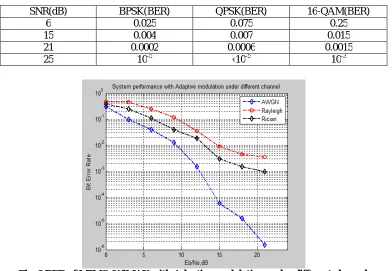
Fig. 9 BER of MIMO-WiMAX with Adaptive modulation under different channel.
Table V. Comparison of Adaptive modulation in different channel.
SNR(dB) AWGN(BER) Rician(BER) Rayleigh(BER)
6 0.04 0.11 0.25
15 10-4 10-3 10-2
21 10-6 10-3 10-2
Fig 9 shows under AWGN channel, the BER has a value near 10-6 at Eb/No of 21dB. While in Rician channel, the MIMO-WiMAX model achieves BER performance of about 10-3 at Eb/No of 21dB. This BER is worse in Rayleigh channel when compared to AWGN and Rician channels because of non-line of sight condition. For Rayleigh channel, the BER has value about 10-2 at Eb/No of 21 dB.
VI.CONCLUSION
REFERENCES
1. Md. Zahid Hasan, Md. AshrafulIslam, “Comparative Study of Different Guard Time Intervals to Improve the BER Performance of WiMAX Systems to Minimize the Effects of ISI and ICI under Adaptive Modulation Techniques over SUI-1 and AWGN Communication Channels”, (IJCSIS) International Journal of Computer Science and Information Security,Vol. 6, No.2, 2009.
2. Muquet, E. Biglieri, A. Goldsmith and H. Sari, “MIMO Techniques for Mobile WiMAX Systems”, SEQUANS Communications White Paper, pp 1-18, 2006.
3. W. A. C. Fernando, R.M.A.P. Rajatheva and K. M. Ahmed, “Performance of Coded OFDM with Higher Modulation Schemes”, International Conference on Communication Technology, Vol. 2, pp 1-5, 1998.
4. M. N. Khan, S. Ghauri, “The WiMAX 802.16e Physical Layer Model”, International Conference on Wireless, Mobile and Multimedia Networks, pp 117-120, 2008.
5. S. Bansal, R. Upadhyay, “Performance Improvement of Wi-Max IEEE 802.16e in Presence of Different FEC Codes”, First International Conference on Computational Intelligence, Communication Systems and Networks, IEEE Computer Society, pp 226-229, 2009.
6. Mai Tran, Dravid Halls, Andrew Nix, Angela Doufexi and Mark Beach, “Mobile WiMAX: Downlink Performance Analysis with Adaptive MIMO Switching”, Proceedings of IEEE Mobile WiMAX Symposium, California ,USA, pp. 147-151, 2009.
7. M. Wang, “WiMAX Physical Layer: Specifications Overview and Performance Evaluation”, 2nd IEEE CCNC Research Student Workshop, pp 10-12, 2011.
8. J. Mountassir, H. Balta, M. Oltean, M. Kovaci & A. Isar, “A Physical Layer Simulator for WiMAX in Rayleigh Fading Channel”, 6th IEEE International Symposium on Applied Computational Intelligence and Informatics , pp 281-281, 2011
9. K. Lee and D. Williams, “A space-time coded transmitter diversity technique for frequency selective fading channels,” Proceedings of IEEE Sensor Array and Multichannel Signal Processing Workshop, Cambridge, USA, pp.149–152, March 2000.
10. P.Samundiswary, Ravi Ranjan Prasad “Performance analysis of MIMO- Mobile WiMAX system using Space Time Block Codes under Different Channels” International Journal of Innovative Technology and Exploring Engineering (IJITEE) ISSN: 2278-3075, Volume-2, Issue-2, January 2013.
11. J.G.Andews, A.Ghoshand R.Muhamed,” Fundamentals of WiMAX Understanding broadband Wireless Networks, “Prentice Hall, Feb 2007. 12. E. Biglieri, R. Calderbank, T. Constantinides, A. Goldsmith, A. Paulraj, and H. V. Poor, “MIMO Wireless Communications”, Cambridge
University Press, 2006.
13. Hadi Zerrouki, Mohamed Feham “High Throughput of WiMAX MIMO-OFDM Including Adaptive Modulation and Coding” (IJCSIS) International Journal of Computer Science and Information Security, Vol. 7, No. 1, 2010.