ALBARAA ABUOBIEDA MOHAMMED ALI ABUOBIEDA
ALBARAA ABUOBIEDA MOHAMMED ALI ABUOBIEDA
A thesis submitted in fulfilment of the requirements for the award of the degree of
Doctor of Philosophy (Computer Science)
Faculty of Computing Universiti Teknologi Malaysia
ACKNOWLEDGEMENT
First and foremost, all praises be to the Almighty Allah (SWT), the Cherisher and the Sustainer of the world, praise be to Him who taught by the pen, taught man that which he does not know. A good number of people have been used by the Almighty God to achieve this giant stride. All these people deserved being commended for their efforts.
First on the list is my highly respected supervisor, Professor Dr. Naomie Binti Salim. She used her wealth of experience to give a very good direction in the work. Her regular motivation and encouragement coupled with her meticulous attention to details made this thesis a reality.
I am indebted a great deal to UTM and Faculty of Computing for providing a good office space and much needed resources for this research. In the same vain, I would like to thank my University, International University of Africa for providing the financial support for overseas training.
I would also like to thank my both parents, my brothers and sisters for their love, support and supplications. I so much appreciate your being there for me during trial periods.
ABSTRACT
ABSTRAK
INTRODUCTION
1.1 Introduction
Recently, several natural-language processing applications have been designed using intelligent and soft computing techniques to enable the computer systems to mimic the human text processing practices such as plagiarism detection, pattern recognition and machine translation. Intelligence techniques such as genetic algorithms, swarm intelligence, evolutionary algorithms, fuzzy logic and neural networks are often employed. Some of the main reasons behind enabling such mimic are because that computer systems are more precise and perform faster compared to human performance. Automatic text summarization is one of these natural language applications that use such techniques to optimizes it’s performance.
Text summarization is a process of summarizing texts into condensed forms Saggion and Poibeau (2013). If the summary is generated by a human, it is called “manual text summarization”, whereas if a summary is generated using the computer system it is called “automatic text summarization” (ATS). As this research concerns automatic text summarization, the rest of this section discusses automatic text summarization (ATS) approaches, styles, input size, and evaluation techniques.
more complex compared to extraction-based approach (Armanoet al., 2011).
The target summary can be employed and written in one of the following two styles (Gholamrezazadeh et al., 2009): “indicative summary” or “informative summary”. Indicative summary presents brief information of what is contained in the original document focusing on a certain topic. The generated summary of this kind is usually compressed between five to ten percent of the original text. An informative summary covers the most topics that arise within the original document. The generated summary of this kind is usually compressed between twenty to thirty percent of original text content. In addition, ATS researches cover two types of document input size i.e. single-document, and multi-document summarization.
Based on the processing level, the summarization techniques can be classified into three approaches: the surface, entity, and discourse (Mani and Maybury, 1999, Saggion and Poibeau, 2013). The surface level approach uses a shallow feature set to extract the most relevant sentences in a document to be included in the summary. The methods in entity level approach first extract entities and their relationships from the text, then model the extraction. In order to identify the salient entity-to-entity relationship from the text, there are several approaches that can be used such as a graph-based representation and a vector space model. The Discourse-Level approach concerns modelling the global structure of the text and its relationships such as: the rhetorical structure of the text (e.g., narrative and argumentation structure), document format (e.g., document outlines, hypertext mark-up) and topics threads (as they are exposed in the text).
(ROUGE) (Lin, 2004), and PYRAMID (Nenkovaet al., 2007). Both methods represent intrinsic automatic evaluations tools, and ROUGE is found to highly correlate with the results of human judgments (Lin, 2004).
The methods proposed in this research are for single document extraction based text summarization that produce informative summaries using techniques of surface-level processing approach.
1.2 Problem Background
Most research in the area of information retrieval (IR) aim to relieve high information load (e.g., Internet, documents) that users potentially face by proposing methods that are precisely targeted for retrieved results. Searching for the information of interest in a wide scope of knowledge is a very difficult task, and if the retrieval systems are imprecise (designed with poor quality) they may return missed-information or zero-sum results. In addition, exploring many documents one by one is time consuming. Accordingly, ATS researchers aim to mitigate or solve this problem by proposing methods that produce high quality summaries. The goal of the summary as a part of the IR system acts as a rapid guide to information of interest through presenting a condensed form of each document within the field of search.
The initially proposed methods for text summarization research are surface level (feature-scoring) approaches (Luhn, 1958, Baxendale, 1958, Edmundson, 1969). (Luhn, 1958) proposed a term-frequency approach to indicate term-importance within the context. (Baxendale, 1958) proposed a sentence position approach to enable the summarizer to identify the sentence importance within the document. Ten years later, (Edmundson, 1969) included the above two approaches and proposed a feature of pragmatic words (cue words such as “significant”, “key”, “idea” and so on). Since feature scoring approach presented significant results, researchers worked on proposing additional features to enhance the summarization quality.
generation. Similarly, the quality of the text summary is sensitive to these features as to how they are scored and weighted. Therefore, the need for a mechanism to differentiate between high and low importance features has emerged. To this end, many feature selection mechanism were proposed, but there is further need to design and build strong mechanisms in order to obtain higher qualified results. The Differential Evolution (DE) algorithm is an evolutionary algorithm that is able to carry out such a role and acts as a feature weighting machine learner. The DE has not been previously proposed as feature-weighting mechanism in text summarization problem; however, it has been employed in related fields such as document clustering, image classification and web data extraction (Abraham et al., 2006, Omran et al., 2005c). The following are the reasons of why the DE was chosen to solve the problem of automatic text summarization. The DE is a powerful algorithm for real parameter optimization (Storn and Price, 1997). A recent work published by (Das et al., 2009) reported that the DE algorithm has become quite popular in the machine intelligence and cybernetics communities. It has successfully been applied to different domains of science and engineering, such as mechanical engineering design (Joshi and Sanderson, 1999), signal processing (DAS and KONAR, 2006) and machine intelligence (Omranet al., 2005a). Section 2.4.1.1 provides in details the characteristics of the DE algorithm which make it strong and robust compare to other heuristic methods.
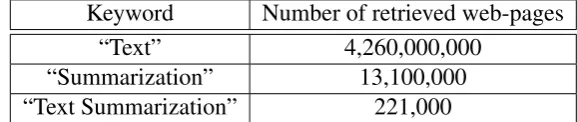
Table 1.1: Number of retrieved web-pages using Google search engine for certain keywords.
Keyword Number of retrieved web-pages
“Text” 4,260,000,000
“Summarization” 13,100,000 “Text Summarization” 221,000
of retrieved numbers of web pages with 3 keywords searched at the moment of writing this thesis. Employing the NGD in a small database search space resulted in improper score calculation (Alguliev and Aliguliyev, 2009). Hence, selecting a proper similarity measure plays an important role in adjusting data clustering (Jain et al., 1999). (Alguliev and Aliguliyev, 2009) computed the sentence centrality score after clustering the sentences. However, computing such a score prevents the method from capturing the full relationship between sentences in the document (Shen et al., 2007). Therefore, this study tries to utilize other similarity measures and different sentence scoring mechanisms; then, building a new diversity-based method using the DE algorithm. The method optimizes the clustering process by using an alternative similarity measure, the “Jaccard coefficient” (Jaccard, 1901) , and a “feature-scoring” mechanism for diverse sentence extraction in text summarization.
Naturally, the proposed methodologies are exposed to advantages and disadvantages. Although the optimization techniques are used to overcome some limitations of other proposed methods, they suffer many defects. (Jun et al., 2011) surveyed some evolutionary computing algorithms (ECAs). The survey discussed how the ECAs search performance could be optimized using machine learning techniques. This trend of research direction treated the term “Machine Learning for Evolutionary Computing (MLEC)” for the discussed purpose. The ECAs agreed in a general structure which includes the following stages: population initialization, fitness evaluation and selection, population reproduction and variation, algorithm adaptation, and local search. The survey viewed the algorithm defects and the successful solutions. Most of the techniques used to enhance the search performance of the ECAs are machine learning techniques; they have been initially used to train algorithms before addressing a targeted problem solution. Machine Learning (ML) techniques were used to optimize all stages of the ECAs. In the initial population stage, the machine learning (ML) techniques were used to:
3. Incorporate historical search performance.
The Opposition-based learning (OBL) is a machine learning technique that has been widely used to enhance the DE search performance by adjusting the following: initial population, the next generation of the population, and maintenance of population diversity (Rahnamayan and Tizhoosh, 2008). The OBL was tested on a numerical dataset (Rahnamayan and Wang, 2008) but neither tested on text data nor used for text summarization problems. In addition, the-state-of-the-art review exposed that fact that none of the proposed automatic text summarization studies built based on optimization techniques is included in the concept of the MLEC. So this study investigates the incorporation of OBL (Rahnamayan and Tizhoosh, 2008) to enhance the DE algorithm and test its performance in non-numerical datasets (text data).
This current work considers four important issues in text summarization: feature-weighting mechanism, diversity-based optimization and machine learning for ECAs, and a combination of these issues in a single hybrid model.
1.3 Problem Statement
By understanding the problem background, we found that designing a robust feature weighting mechanism is necessary for generating high quality summary. On the other hand, generating a summary with high diversity could lead to the inclusion of most of the topics existing in the input document. Furthermore, by not relying on the random estimation, it could improve the performance of the evolutionary algorithm which could subsequently enhance the quality of the generated summary. This research concerns sentence extraction to answer the following research questions:
• Can the evolutionary algorithm produce optimal weights for the selected features that produce a high quality summary?
• Can sentence selection based on an optimized cluster-based approach achieve better diversity in the summarization?
• Can the combination of the previous multiple techniques could exploit the advantages of each method then interact together to produce a summary best than previous methods?
1.4 Research Objectives
The main goal of this research is to introduce text summarization methods designed to solely use a functional approximation (randomized search) approach attached to different learning techniques. Several proposed text summarization research works have been designed using different and hybrid techniques such as functional approximation and approximate reasoning. The functional approximation includes evolutionary algorithms and neural networks, and the approximate reasoning includes probabilistic models and fuzzy logic. Therefore, this research investigates the following hypothesis: “Is a single meta-heuristic based method integrated with learning approaches able to generate higher quality summarization.” To achieve this goal, the following objectives have been fixed:
1. To investigate DE-based feature weighting method for text summarization. 2. To improve an existing diversity summary generation method using the
term-weighting approach and Jaccard similarity measure. In addition, to design a new real-to-integer data modulator for solving the discrete problem (clustering) for generating a high diverse summaries.
3. To investigate the opposition-based learning technique to optimize the summarization solutions generated from the Differential-Evolution algorithm. 4. To investigate a hybrid approach of differential evolution algorithm with
cluster-based approach to select diverse contents from the text for summarization purposes.
1.5 Research Scope
summarization applications that are designed using several hybrid techniques. The following aspects are the scope of this research:
1. The methods proposed in this research are for single document extraction based text summarization that produces informative summaries using techniques for surface-level processing. These methods were designed to use a Differential Evolution algorithm with feature-weighting approach, cluster-based approach, the opposition-based learning approach and hybrid-based approach.
2. For the evaluation of data, the DUC 2002 was selected as the test bed of each proposed method. DUC 2002 was chosen because it is the last dataset designed for single document summarization.
3. The Recall-Oriented Understanding for Gisting Evaluation (ROUGE) toolkit was selected to measure and evaluate the system”s generated summaries with reference summaries. In addition, the statistical significance test “Pearson Correlation Coefficient” is used to measure the agreement level between the proposed methods and the human method.
4. The proposed methods in automatic text summarization are evaluated and compared with well-known benchmark methods such as Microsoft Word summarizer and Copernic summarizer. The best and worst systems from the DUC 2002 summarization competition are also compared. In addition to these four methods, similar methods were selected from the literature that may have the same/similar structure and/or methodological functions to some of this study”s proposed methods.
1.6 Research Significance
instead of relying on random estimated solutions using Opposition-Based Learning (OBL) concept. Fourth: a hybrid model of all three techniques above are integrated together to utilize their advantages in a single model. The additional significance of this proposed model is that it was built by using a single optimization algorithm (DE); the DE was then appended and supplied with different learning techniques such as feature selection approach, cluster-based approach and opposition-based learning approach.
1.7 Contribution of the Study
The expected contributions of this research are as follows:
1. Extraction of the most important sentences can be obtained by identifying optimal feature weighting using differential evolution algorithm.
2. Achieving diversity in summarization and avoiding the data redundancy problem as obtained through the optimized cluster-based method. Mainly, this structured contribution encloses three sub-contributions as follow:
(a) NGD + DE-based Term-Weighting: A novel integration of the term-weighting approach with NGD similarity measure.
(b) DE + Jaccard: A novel integration of the Jaccard similarity measure with the DE algorithm
(c) Real-to-Integer Modulator: A novel real-to-integer value modulator is designed. This modulator aims to amend real values generated by the DE to integer-base values that enable the DE search in discrete space and fine-tune the cluster based problem.
3. Avoid reliance on random estimated solutions and produce more qualified summaries to exceed those of former approaches (1 and 2).
4. A hybrid model designed to integrate the advantages of all proposed contributions in order to improve the quality of summary generation.
1.8 Thesis Organization
Chapter 1, Introduction: this chapter discusses general issues concerning this research. It also states the problem background, the problem statement, research objectives, research scope, research significance, and expected contribution, respectively.
Chapter 2, this chapter reviews state-of-the-art approaches in the field of automatic text summarization. The chapter reviews recent surveys introduced in the field. Since this research proposes evolutionary algorithm based solutions, the chapter also reviews, in particular, most summarization research based on similar or other evolutionary algorithms. In addition, it reviews machine learning methods that have been presented to enhance the search performance of evolutionary algorithms. The chapter covers available datasets utilized in methodology evaluation as well as the evaluation of tools-kit.
Chapter 3, Research Methodology: this chapter defines the methodology followed in this research to achieve the study”s objectives. The main experiments of this study are: binary differential evolution based text summarization; diversity based differential evolution text summarization; opposition diversity based differential evolution text summarization, and hybrid model based differential evolution text summarization.
Chapter 4, Binary Differential Evolution Based Text Summarization: this chapter presents features the weighting method which uses the evolutionary algorithm Differential Evolution (DE). The DE is configured in binary mode in order to control probable score calculation. The method will be compared against “state of the art” methods and similar systems based on particle swarm optimization and generic algorithms.
Chapter 6, Opposition Diversity Based Differential Evolution Text Summa-rization: the main goal of this chapter is to avoid the problem of generating solutions based on random estimates. The problem of the application based on random estimates (guesses) is that it may give different solutions each time that are far from the optimal points. This chapter investigates the use of Opposition-based learning (OBL) to solve this issue for automatic text summarization. The OBL is proposed to make sure it is able to enforce DE generating solutions that are closer to optimal points than are traditional versions in text summarization.
Chapter 7, Hybrid model based on DE algorithm: this chapter aims to integrate the advantages of all proposed methods in one single (hybrid) model. The model initially extracts the optimal feature-weights assigned, then, calls on the methods proposed in Chapter Five to explore sentence diversity. Methods in Chapter Five are then automatically improved with a method component presented in Chapter Six. Finally, the optimized feature scores are employed for selecting the top “n” sentences.
TABLE OF CONTENTS
CHAPTER TITLE PAGE
DECLARATION ii
DEDICATION iii
ACKNOWLEDGEMENT iv
ABSTRACT v
ABSTRAK vi
TABLE OF CONTENTS vii
LIST OF TABLES xiii
LIST OF FIGURES xvi
LIST OF ABBREVIATIONS xx
LIST OF SYMBOLS xxi
LIST OF APPENDICES xxii
1 INTRODUCTION 1
1.1 Introduction 1
1.2 Problem Background 3
1.3 Problem Statement 6
1.4 Research Objectives 7
1.5 Research Scope 7
1.6 Research Significance 8
1.7 Contribution of the Study 9
1.8 Thesis Organization 9
2 LITERATURE REVIEW 12
2.1 Introduction 12
2.2 Introduction to Text Summarization 13
2.2.1 Input Factor 13
2.2.2 Purpose Factor 14
2.2.3 Output Factor 15
2.3.1 Surface, Entity, and Discourse Level
Approaches 16
2.3.2 Centrality-based Approaches 17
2.3.3 Machine learning-based approaches 19
2.3.4 Text Engineering Tools 20
2.3.4.1 Lexical Resources 21
2.3.4.2 General Architecture for Text
Engineering (GATE) 23
2.4 Evolutionary Computation (EC) 24
2.4.1 Differential Evolution 26
2.4.1.1 DE Characteristics 27
2.4.1.2 Binary DE 29
2.5 Evolutionary Computing Based Methods for Text
Summarization 31
2.5.1 DE-Based Text Summarization 32
2.5.2 PSO-Based Text Summarization 34
2.5.3 GA-Based Text Summarization 36
2.6 Machine Learning for Evolutionary Computing
(MLEC) 38
2.6.1 The Opposition Based Learning (OBL) 39 2.6.1.1 Opposite Numbers Concept 40 2.6.1.2 Implementing OBL in DE
Al-gorithm 41
2.7 Clustering Methods 43
2.7.1 K-means Clustering Algorithm 43
2.7.2 Clustering, Optimization and Text
Sum-marization 44
2.8 Sentence Similarity Measures 48
2.8.1 Jaccard Coefficient 49
2.8.2 Normalized Google Distance (NGD) 50
2.9 Hybrid Models 51
2.10 Text Summarization Corpuses 57
2.11 Evaluation Measure 57
2.11.1 Informativeness Evaluation Tools 59 2.11.2 Precision, Recall and F-measure 60 2.11.3 ROUGE: Automatic Summary Evaluation 61
2.11.4 Significant Testing Methods 64
3 RESEARCH METHODOLOGY 67
3.1 Introduction 67
3.2 Research Design 67
3.3 Operational Framework 68
3.3.1 Phase 1: Basic Elements 68
3.3.1.1 Collecting the DUC2002 Data
set 68
3.3.1.2 Text Data Preprocessing 70 3.3.1.3 The Selected Features 71 3.3.1.4 DE Control Parameters
Assign-ment 73
3.3.2 Phase 2: Binary Differential Evolution
Based Text Summarization (BiDETS) 74 3.3.2.1 DE Chromosome
Representa-tion and ConfiguraRepresenta-tion 75 3.3.2.2 Binary Modulation Formula 75 3.3.3 Phase 3: Diversity Differential Evolution
Based Text Summarization (DiDETS) 75
3.3.3.1 DE Data Modulator 76
3.3.3.2 DE Chromosome
Representa-tion and ConfiguraRepresenta-tion 76 3.3.3.3 The Selected Similarity
Mea-sures 77
3.3.3.4 Similarity Measure
Improve-ment 78
3.3.4 Phase 4: Opposition - Diverstiy Differen-tial Evolution Based Text Summarization
(O-DiDETS) 78
3.3.4.1 Opposite DE 79
3.3.4.2 The Selected Similarity
Mea-sures 80
3.3.5 Phase 5: Hybrid Differential Evolution
Based Text Summarization (HiDETS) 80 3.3.5.1 DE Modulator Operator 81 3.3.5.2 Binary Modulation Formula 81
3.3.5.3 Opposite DE 81
3.3.5.4 The Selected Similarity
Mea-sures 81
3.4.1 The Benchmark Methods 82
3.4.2 The State-of-the-art Methods 82
3.4.3 The Proposed Methods and Comparisons 83
3.5 Evaluation Design 83
3.5.1 Generalizing the proposed methods
re-sults via the confidence limits 84
3.6 Summary 84
4 BINARY DIFFERENTIAL EVOLUTION BASED TEXT
SUMMARIZATION (BIDETS) 85
4.1 Introduction 85
4.2 Materials and Method Configuration 86
4.2.1 Chromosome Encoding 86
4.2.2 DE Control Parameters Assignment 88
4.2.3 Objective Function 89
4.2.4 Selected Benchmarks and Similar
Meth-ods 89
4.2.5 Evaluation Tools and Measurement 90 4.3 Binary Differential Evolution Based Text
Summa-rization (BiDETS) Model 90
4.3.1 DEFS Model 90
4.3.1.1 Results and Discussion 92
4.3.2 DETS Model 94
4.3.2.1 Result Discussion 94
4.3.3 BiDETS: A declarative Example 101
4.4 Summary 104
5 DIVERSITY DIFFERENTIAL EVOLUTION BASED
TEXT SUMMARIZATION (DIDETS) 105
5.1 Introduction 105
5.2 Diversity Differential Evolution Text
Summariza-tion (DiDETS) Model 106
5.2.1 Materials Used 107
5.2.1.1 The Chromosome
Representa-tion 107
5.2.1.2 DE Control Parameters
Assign-ment 108
5.2.1.4 The Selected Similarity
Mea-sures 110
5.2.1.5 The Selected Features 111
5.3 The Proposed Methods 111
5.3.1 Method 1: Improving NGD Performance
using Term-Weighting Approach 112 5.3.1.1 Experimental Results 114
5.3.1.2 Discussion 115
5.3.2 Method 2: Improving The Cluster-based Accuracy using Jaccard Coefficient
Similarity Measure 117
5.3.2.1 Experimental Results 120
5.3.2.2 Discussion 121
5.3.3 Method 3: Designing An Improved
Real-to-Integer Modulator 123
5.3.3.1 A Real-To-Integer Modulator 123 5.3.3.2 Genetic Mutation Operator 125 5.3.3.3 Experimental Results 126 5.3.3.4 Comparison Against
Benchmark Methods 129
5.3.3.5 Discussion 131
5.3.4 DiDETS: A declarative Example 135
5.4 Summary 136
6 OPPOSITION DIFFERENTIAL EVOLUTION FOR
TEXT SUMMARIZATION (O-DIDETS) 139
6.1 Introduction 139
6.2 Population status production 140
6.3 Opposition Diversity Differential Evolution based
Text Summarization (O-DiDETS) 141
6.3.1 Opposition-based Population
Initializa-tion 143
6.3.2 Opposition-based Generation Jumping 143
6.4 Material Used 144
6.4.1 The Chromosome Representation 144 6.4.2 DE Control Parameters Assignment 144 6.4.3 The Selected Similarity Measures 145 6.4.4 Genetic Mutation and The New
6.4.5 The Selected Features 145
6.5 Experimental Result 145
6.5.1 Discussion 146
6.5.2 O-DiDETS: A declarative Example 150
6.6 Summary 152
7 HYBRID DIFFERENTIAL EVOLUTION BASED TEXT
SUMMARIZATION MODEL (HIDETS) 154
7.1 Introduction 154
7.2 The Proposed Hybrid Differential Evolution Based
Text Summarization (HiDETS) Model 155
7.2.1 The BiDETS Method 155
7.2.2 The DiDETS Method 156
7.2.3 The O-DiDETS Method 156
7.2.4 The HiDETS Models 157
7.3 Experimental Design 157
7.3.1 Compared Methods 158
7.4 Evaluation Results 160
7.5 Discussion 163
7.6 Summary 167
8 CONCLUSION AND FUTURE WORK 168
8.1 Introduction 168
8.2 The Proposed Methods (Study Contributions) 168 8.2.1 Binary Differential Evolution Based Text
Summarization (BiDETS) 169
8.2.2 Diversity Differential Evolution Based
Text Summarization (DiDETS) 171 8.2.3 Opposition Diversity Differential
Evo-lution Based Text Summarization
(O-DiDETS) 172
8.2.4 The Hybrid Differential Evolution Based
Text Summarization Model (HiDETS) 173
8.3 Future Work 174
8.4 Summary 175
REFERENCES 177
LIST OF TABLES
TABLE NO. TITLE PAGE
1.1 Number of retrieved web-pages using Google search engine
for certain keywords. 5
2.1 Text Summarization Taxonomy (Lloret and Palomar, 2012) 14 2.2 A cluster-based differences between state-of-the-art (GA and
DE) based methods and the current proposed method 45
2.3 Text Summarization Corpuses 58
3.1 Feature Score Vector Example 73
3.2 The Proposed Methods 83
4.1 Set A, B and C methods comparison using ROUGE-1 result at the %95-confidence interval, where (BiDETS) refers to a
method proposed in this Chapter. 95
4.2 Set A, B and C methods comparisons using ROUGE-2 result at the %95-confidence interval, where (BiDETS) refers to a
method proposed in this Chapter. 98
4.3 Set A, B and C methods comparisons using ROUGE-L result at the %95-confidence interval, where (BiDETS) refers to a
method proposed in this Chapter. 98
4.4 Pearson Correlation Significance Test for BiDETS method 100 5.1 Sentence-to-Sentence similarity scores using an improved
proposed DE-NGD-TW method 116
5.2 Sentence-to-Sentence similarity scores using DE-NGD 119 5.3 Sentence-to-Sentence similarity scores using DE-Jaccard 122 5.4 All proposed methods and their abbreviations 127 5.5 The Proposed Methods (1, 2,
DiDETS-3 and DiDETS-4) and a reference method (DE-NGD) comparison: average (recall, precision and F-measure) using
5.6 The Proposed Methods (1, 2, DiDETS-3 and DiDETS-4) and a reference method (DE-NGD) comparison: average (recall, precision and F-measure) using
ROUGE-2 at 95% confidence interval 128
5.7 The Proposed Methods (1, 2, DiDETS-3 and DiDETS-4) and a reference method (DE-NGD) comparison: average (recall, precision and F-measure) using
ROUGE-L at 95% confidence interval 128
5.8 Benchmark Methods used for Comparison 130
5.9 Comparison between All Proposed Methods and the Benchmark Methods: average recall, average precision, average F-measure using ROUGE-1 at the 95% confidence
interval 130
5.10 Comparison between All Proposed Methods and the Benchmark Methods: average recall, average precision, average F-measure using ROUGE-2 at the 95% confidence
interval 131
5.11 Comparison between All Proposed Methods and the Benchmark Methods: average recall, average precision, average F-measure using ROUGE-L at the 95% confidence
interval 131
5.12 Pearson Correlation Significance Test for DiDETS methods 134 6.1 The Proposed Methods [(BiDETS), (DiDETS-1, DiDETS-2,
DiDETS-3 and DiDETS-4) and (1, O-DiDETS-2, O-DiDETS-3, and O-DiDETS-4)] and The Reference Method (DE-NGD) comparison: average recall, average precision, average F-measure using ROUGE-1 at the 95%
confidence interval 146
6.2 The Proposed Methods [(BiDETS), (DiDETS-1, DiDETS-2, DiDETS-3 and DiDETS-4) and (1, O-DiDETS-2, O-DiDETS-3, and O-DiDETS-4)] and The Reference Method (DE-NGD) comparison: average recall, average precision, average F-measure using ROUGE-2 at the 95%
6.3 The Proposed Methods [(BiDETS), (DiDETS-1, DiDETS-2, DiDETS-3 and DiDETS-4) and (1, O-DiDETS-2, O-DiDETS-3, and O-DiDETS-4)] and The Reference Method (DE-NGD) comparison: average recall, average precision, average F-measure using ROUGE-L at the 95%
confidence interval 147
6.4 Pearson Analysis Correlation Results for O-DiDETS
meth-ods. 149
7.1 All Proposed Methods (BiDETS, DiDETS, O-DiDETS, and HiDETS), Hybrid GA and Hybrid-PSO Comparison: average recall, average precision, average F-measure using ROUGE-1
at the 95% confidence interval 160
7.2 All Proposed Methods (BiDETS, DiDETS, O-DiDETS, and HiDETS), Hybrid GA and Hybrid-PSO Comparison: average recall, average precision, average F-measure using ROUGE-2
at the 95% confidence interval 161
7.3 All Proposed Methods (BiDETS, DiDETS, O-DiDETS, and HiDETS), Hybrid GA and Hybrid-PSO Comparison: average recall, average precision, average F-measure using
ROUGE-L at the 95% confidence interval 161
7.4 Pearson Analysis Correlation Results for HiDETS methods. 165 A.1 The 100 documents used in all carried out methods 192
LIST OF FIGURES
FIGURE NO. TITLE PAGE
2.1 General Evolutionary Computing Framework 25
2.2 A general DE Operational Framework 28
2.3 Inversion Operator Alguliev and Aliguliyev 33
2.4 Opposition-based Learning Flowchart (Rahnamayan et al.,
2008b) 42
2.5 Chromosome two parts: Activation and Clusters (Das et al.,
2008) 46
2.6 Intersection between Two Sentences 49
2.7 Hybrid Fuzzy Swarm Diversity Model (Form-2) (Binwahlan
et al., 2010) 54
2.8 Hybrid-GA Model for Text Summarization (Suanmali et al.,
2011a) 56
3.1 Research Operational Framework 69
4.1 Chromosome Structure - Features Positions 87
4.2 Gene Value Modulation 88
4.3 General BiDETS Framework Structure using DEFS and
DETS models 91
4.4 Features Weights Extraction Using DEFS Model 93
4.5 Combination between DEFS and DETS Model Forming
BiDETS Model 95
4.6 An example of original document (DUC-2002, D075b,
Document Number: AP880428-0041) 96
4.7 The separated sentences of original document (DUC-2002, D075b, Document Number: AP880428-0041) after the
splitting process 97
4.8 The produced summary of original document (DUC-2002,
D075b, Document Number: AP880428-0041) 98
4.9 Set A, B and C methods comparisons using ROUGE-1
4.10 Set A, B and C methods comparisons using ROUGE-2
Avg R, Avg-P, and Avg F 99
4.11 Set A, B and C methods comparisons using ROUGE-L
Avg R, Avg-P, and Avg F 99
4.12 BiDETS: A declarative example 103
5.1 General Framework of DiDETS Model 107
5.2 Chromosome Representations and Encoding Sample 108 5.3 DE-NGD, DE-NGD-TW comparison: average recall, average
precision, average F-measure using ROUGE-1 at the 95%
confidence interval 114
5.4 DE-NGD, DE-NGD-TW comparison: average recall, average precision, average F-measure using ROUGE-2 at the 95%
confidence interval 115
5.5 DE-NGD, DE-NGD-TW comparison: average recall, average precision, average F-measure using ROUGE-L at the 95%
confidence interval 115
5.6 DE-NGD, DE-NGD-TW and DE-Jaccard comparison: av-erage recall, avav-erage precision, avav-erage F-measure using
ROUGE-1 at the 95% confidence interval 120
5.7 DE-NGD, DE-NGD-TW and DE-Jaccard comparison: av-erage recall, avav-erage precision, avav-erage F-measure using
ROUGE-2 at the 95% confidence interval 120
5.8 DE-NGD, DE-NGD-TW and DE-Jaccard comparison: av-erage recall, avav-erage precision, avav-erage F-measure using
ROUGE-L at the 95% confidence interval 121
5.9 Real-To-Integer Modulator 124
5.10 Genetic Mutation Operator 126
5.11 The Proposed Methods (1, 2, DiDETS-3 and DiDETS-4) and reference method (DE-NGD) comparison: average recall, average precision, average
F-measure using ROUGE-1 at the 95% confidence interval 128 5.12 The Proposed Methods (1, 2,
DiDETS-3 and DiDETS-4) and reference method (DE-NGD) comparison: average recall, average precision, average
F-measure using ROUGE-2 at the 95% confidence interval 129 5.13 The Proposed Methods (1, 2,
DiDETS-3 and DiDETS-4) and reference method (DE-NGD) comparison: average recall, average precision, average
5.14 BiDETS, DiDETS-1, DiDETS-2, DiDETS-3 and DiDETS-4, DE-G-N, Swarm-Diversity, Copernic, MS-word, Best System (B-sys) and Worst System (W-sys) comparison: average recall, average precision, average F-measure using ROUGE-1
at the 95% confidence interval 130
5.15 BiDETS, DiDETS-1, DiDETS-2, DiDETS-3 and DiDETS-4, DE-G-N, Swarm-Diversity, Copernic, MS-word, Best System (B-sys) and Worst System (W-sys) comparison: average recall, average precision, average F-measure using ROUGE-2
at the 95% confidence interval 132
5.16 BiDETS, DiDETS-1, DiDETS-2, DiDETS-3 and DiDETS-4, DE-G-N, Swarm-Diversity, Copernic, MS-word, Best System (B-sys) and Worst System (W-sys) comparison: average recall, average precision, average F-measure using
ROUGE-L at the 95% confidence interval 132
5.17 DiDETS: A declarative example 138
6.1 O-DiDETS General Framework Diagram 142
6.2 The Proposed Methods [(BiDETS), (DiDETS-1, DiDETS-2, DiDETS-3 and DiDETS-4) and (1, O-DiDETS-2, O-DiDETS-3, and O-DiDETS-4)] and The Reference Method (DE-G-N) comparison: average recall, average precision, average F-measure using ROUGE-1 at the 95%
confidence interval 147
6.3 The Proposed Methods [(BiDETS), (DiDETS-1, DiDETS-2, DiDETS-3 and DiDETS-4) and (1, O-DiDETS-2, O-DiDETS-3, and O-DiDETS-4)] and The Reference Method (DE-G-N) comparison: average recall, average precision, average F-measure using ROUGE-2 at the 95%
confidence interval 148
6.4 The Proposed Methods [(BiDETS), (DiDETS-1, DiDETS-2, DiDETS-3 and DiDETS-4) and (1, O-DiDETS-2, O-DiDETS-3, and O-DiDETS-4)] and The Reference Method (DE-G-N) comparison: average recall, average precision, average F-measure using ROUGE-L at the 95%
confidence interval 148
6.5 O-DiDETS: A declarative example 153
7.1 HiDETS Model Black-Boxes 158
7.2 General HiDETS Model Framework 158
7.4 HiDETS-2 Use The Proposed Real-To-Integer Modulator 159 7.5 All Proposed Methods (BiDETS, DiDETS, O-DiDETS, and
HiDETS), Hybrid GA and Hybrid-PSO Comparison: average recall, average precision, average F-measure using ROUGE-1 at the 95% confidence interval, where CL denotes to
Correlation Level 162
7.6 All Proposed Methods (BiDETS, DiDETS, O-DiDETS, and HiDETS), Hybrid GA and Hybrid-PSO Comparison: average recall, average precision, average F-measure using ROUGE-2 at the 95% confidence interval, where CL denotes to
Correlation Level 162
7.7 All Proposed Methods (BiDETS, DiDETS, O-DiDETS, and HiDETS), Hybrid GA and Hybrid-PSO Comparison: average recall, average precision, average F-measure using ROUGE-L at the 95% confidence interval, where CROUGE-L denotes to
Correlation Level 162
7.8 Methods Ranking using Pearson Correlation Coefficient Test
Based on ROUGE-1 166
7.9 Methods Ranking using Pearson Correlation Coefficient Test
Based on ROUGE-2 166
7.10 Methods Ranking using Pearson Correlation Coefficient Test
Based on ROUGE-L 167
LIST OF ABBREVIATIONS
ATS – Automatic Text Summarization DE – Differential Evolution
DUC – Document Understanding Conference EAs – Evolutionary Algorithms
EC – Evolutionary Computing
GA – Genetic Algorithm
ML – Machine Learning
MLEC – Machine Learning for Evolutionary Computing NGD – Normalized Google Distance
OBL – Opposition Based Learning PSO – Particle Swarm Optimization
LIST OF SYMBOLS
LIST OF APPENDICES
APPENDIX TITLE PAGE
A Dataset Description 191
B List of Stop Words 193
Abraham, A., Das, S. and Konar, A. (2006). Document clustering using differential evolution. In Evolutionary Computation, 2006. CEC 2006. IEEE Congress on. IEEE, 1784–1791. doi:10.1109/CEC.2006.1688523.
Achananuparp, P., Hu, X. and Shen, X. (2008). The evaluation of sentence similarity measures.Data Warehousing and Knowledge Discovery, 305–316.
Afantenos, S., Karkaletsis, V. and Stamatopoulos, P. (2005). Summarization from medical documents: a survey.arXiv preprint cs/0504061.
Ahandani, M. A. and Alavi-Rad, H. (2012). Opposition-based learning in the shuffled differential evolution algorithm.Soft Comput. 16(8), 1303–1337.
Al-Qunaieer, F. S., Tizhoosh, H. R. and Rahnamayan, S. (2010). Opposition based computing - A survey. InNeural Networks (IJCNN), The 2010 International Joint Conference on. 1–7.
Alguliev, R. and Aliguliyev, R. (2007). Experimental investigating the F-meaure as similarity measure for automatic text summarization. Applied and Computational Mathematics. 6(2), 278–287.
Alguliev, R. M. and Aliguliyev, R. M. (2009). Evolutionary Algorithm for Extractive Text Summarization.Intelligent Information Management. 1(2), 128–138.
Alguliev, R. M., Aliguliyev, R. M. and Isazade, N. R. (2012). DESAMC+DocSum: Differential evolution with self-adaptive mutation and crossover parameters for multi-document summarization.Knowledge-Based Systems.
Alguliev, R. M., Aliguliyev, R. M. and Mehdiyev, C. A. (2011a). An Optimization Model and DPSOEDA for Document Summarization. International Journal of Information Technology and Computer Science(IJITCS). 3(5), 59–68.
Alguliev, R. M., Aliguliyev, R. M. and Mehdiyev, C. A. (2011b). pSum-SaDE: a modified p-median problem and self-adaptive differential evolution algorithm for text summarization.Appl. Comp. Intell. Soft Comput. 2011, 11–11.
220–227.
Armano, G., Giuliani, A. and Vargiu, E. (2011). Studying the impact of text summarization on contextual advertising. In Database and Expert Systems Applications (DEXA), 2011 22nd International Workshop on. IEEE, 172– 176. Retrievable at http://ieeexplore.ieee.org/xpls/abs_all. jsp?arnumber=6059812.
Bandyopadhyay, S. and Maulik, U. (2002). Genetic clustering for automatic evolution of clusters and application to image classification.Pattern Recognition. 35(6), 1197– 1208.
Baxendale, P. B. (1958). Machine-made index for technical literature: an experiment. IBM J. Res. Dev. 2(4), 354–361.
Binwahlan, M., Salim, N. and Suanmali, L. (2009a). Swarm based features selection for text summarization. International Journal of Computer Science and Network Security IJCSNS. 9(1), 175–179.
Binwahlan, M., Salim, N. and Suanmali, L. (2009b). Swarm based text summarization. In Computer Science and Information Technology-Spring Conference, 2009. IACSITSC’09. International Association of. IEEE, 145–150.
Binwahlan, M., Salim, N. and Suanmali, L. (2009c). Swarm Diversity Based Text Summarization. InNeural Information Processing. Springer, 216–225.
Binwahlan, M. S., Salim, N. and Suanmali, L. (2010). Fuzzy swarm diversity hybrid model for text summarization.Information processing & management. 46(5), 571– 588.
Black, W., Elkateb, S. and Vossen, P. (2006). Introducing the Arabic WordNet Project. InIn Proceedings of the third International WordNet Conference (GWC-06.
Boros, E., Kantor, P. and Neu, D. (2001). A clustering based approach to creating multi-document summaries. InProceedings of the 24th Annual International ACM SIGIR Conference on Research and Development in Information Retrieval.
Boudabous, M. M., Chaaben Kammoun, N., Khedher, N., Belguith, L. H. and Sadat, F. (2013). Arabic WordNet semantic relations enrichment through morpho-lexical patterns. InCommunications, Signal Processing, and their Applications (ICCSPA), 2013 1st International Conference on. IEEE, 1–6.
Carbonell, J. and Goldstein, J. (1998). The use of MMR, diversity-based reranking for reordering documents and producing summaries. InProceedings of the 21st annual international ACM SIGIR conference on Research and development in information retrieval. ACM, 335–336.
Chang-Yong, L. and Xin, Y. (2004). Evolutionary programming using mutations based on the Levy probability distribution.Evolutionary Computation, IEEE Transactions on. 8(1), 1–13.
Chaves, R. P. (2001). WordNet and Automated Text Summarization. In NLPRS. 109–116.
Cilibrasi, R. L. and Vitanyi, P. M. B. (2007). The Google Similarity Distance. Knowledge and Data Engineering, IEEE Transactions on. 19(3), 370–383.
Cui, X., Potok, T. E. and Palathingal, P. (2005). Document clustering using particle swarm optimization. InSwarm Intelligence Symposium, 2005. SIS 2005. Proceedings 2005 IEEE. 185–191.
Cunningham, H. (2002). GATE, a general architecture for text engineering.Computers and the Humanities. 36(2), 223–254.
Da Cunha, I., Fernandez, S., Velzquez Morales, P., Vivaldi, J., SanJuan, E. and Torres-Moreno, J. (2007). A new hybrid summarizer based on vector space model, statistical physics and linguistics.MICAI 2007: Advances in Artificial Intelligence, 872–882.
Dancey, C. P. and Reidy, J. (2008). Statistics without maths for psychology. Pearson Education.
Dantzig, G. B. (1957). Discrete-variable extremum problems. Operations Research. 5(2), 266–288.
Das, S., Abraham, A., Chakraborty, U. and Konar, A. (2009). Differential Evolution Using a Neighborhood-Based Mutation Operator.Evolutionary Computation, IEEE Transactions on. 13(3), 526–553. ISSN 1089-778X. doi:10.1109/TEVC.2008. 2009457.
Das, S., Abraham, A. and Konar, A. (2008). Automatic Clustering Using an Improved Differential Evolution Algorithm.Systems, Man and Cybernetics, Part A: Systems and Humans, IEEE Transactions on. 38(1), 218–237.
doi/abs/10.1142/S1469026806001848.
Das, S. and Suganthan, P. (2011). Differential evolution: A survey of the state-of-the-art.Evolutionary Computation, IEEE Transactions on. 15(1), 4–31.
de Castro, L. N. (2007). Fundamentals of natural computing: an overview.Physics of Life Reviews. 4(1), 1–36.
Deng, C., Zhao, B., Yang, Y. and Deng, A. (2009). Novel binary differential evolution algorithm for discrete optimization. InNatural Computation, 2009. ICNC’09. Fifth International Conference on, vol. 4. IEEE, 346–349. Retrievable at http:// ieeexplore.ieee.org/xpls/abs_all.jsp?arnumber=5366344.
Dorigo, M., Maniezzo, V. and Colorni, A. (1996). Ant system: optimization by a colony of cooperating agents.Trans. Sys. Man Cyber. Part B. 26(1), 29–41.
Edmundson, H. P. (1969). New Methods in Automatic Extracting. J. ACM. 16(2), 264–285.
Engelbrecht, A. and Pampara, G. (2005). Binary differential evolution strategies. In Evolutionary Computation, 2007. CEC 2007. IEEE Congress on. IEEE, 1942–1947.
Fattah, M. A. and Ren, F. (2009). GA, MR, FFNN, PNN and GMM based models for automatic text summarization.Computer Speech and Language. 23(1), 126–144. Fellbaum, C. (2010). WordNet: An electronic lexical database. 1998. WordNet is
available from http://www. cogsci. princeton. edu/wn.
Ferreira, R., Lins, R. D., Freitas, F., Cavalcanti, G. D., Lima, R., Simske, S. J., Favaro, L. et al. (2013). Assessing Sentence Scoring Techniques for Extractive Text Summarization.Expert Systems with Applications.
Filippova, K., Mieskes, M., Nastase, V., Ponzetto, S. and Strube, M. (2007). Cascaded filtering for topic-driven multi-document summarization. In Proceedings of the Document Understanding Conference. 26–27.
Fuentes, M., Gonz´alez, E., FERRes, D. and RODRiguez, H. (2005). QASUM-TALP at DUC 2005 Automatically Evaluated with a Pyramid based Metric. InProceedings of Document Understanding Workshop (DUC). Vancouver, BC, Canada.
Gholamrezazadeh, S., Salehi, M. A. and Gholamzadeh, B. (2009). A Comprehensive Survey on Text Summarization Systems. InComputer Science and its Applications, 2009. CSA ’09. 2nd International Conference on. 1–6.
Gong, Y. and Liu, X. (2001b). Generic text summarization using relevance measure and latent semantic analysis. InProceedings of the 24th annual international ACM SIGIR conference on Research and development in information retrieval. ACM, 19– 25.
Gupta, P., Pendluri, V. S. and Vats, I. (2011). Summarizing text by ranking text units according to shallow linguistic features. InAdvanced Communication Technology (ICACT), 2011 13th International Conference on. IEEE, 1620–1625.
Haque, M. M., Pervin, S. and Begum, Z. (2013). Literature Review of Automatic Single Document Text Summarization Using NLP.
Harabagiu, S. M. and Lacatusu, F. (2002). Generating single and multi-document summaries with GISTEXTER. In Proceedings of the workshop on text summarization DUC 2002. 30–38.
Harman, D. and Liberman, M. (1993). Tipster complete.Corpus number LDC93T3A, Linguistic Data Consortium, Philadelphia.
Hasler, L., Orasan, C. and Mitkov, R. (2003). Building better corpora for summarization. InProceedings of Corpus Linguistics. 309–319.
He, X. and Han, L. (2007). A novel binary differential evolution algorithm based on artificial immune system. In Evolutionary Computation, 2007. CEC 2007. IEEE Congress on. IEEE, 2267–2272.
He, X., Zhang, Q., Sun, N. and Dong, Y. (2009). Feature selection with discrete binary differential evolution. In Artificial Intelligence and Computational Intelligence, 2009. AICI’09. International Conference on, vol. 4. IEEE, 327–330.
Hou, G. and Ma, X. (2010). A Novel Binary Differential Evolution for Discrete Optimization.Key Engineering Materials. 439, 1493–1498.
Hovy, E. and Lin, C.-Y. (1998). Automated text summarization and the SUMMARIST system.
Huang, A. (2008). Similarity measures for text document clustering. In Proceedings of the Sixth New Zealand Computer Science Research Student Conference (NZCSRSC2008), Christchurch, New Zealand. 49–56.
Hung, C. and Purnawan, H. (2008). A hybrid rough k-means algorithm and particle swarm optimization for image classification. MICAI 2008: Advances in Artificial Intelligence, 585–593.
Jain, A., Murty, M. and Flynn, P. (1999). Data clustering: a review.ACM computing surveys (CSUR). 31(3), 264–323.
Jing, R., H. Barzilay, McKeown, K. and Elhadad, M. (1998). Summarization evaluation methods: Experiments and analysis. InIn AAAI Symposium on Intelligent Summarization. 60–68.
John McCrae, P. B. P. C. T. D. A. G.-P. J. G. L. H. E. M.-P. D. S. T. W., Guadalupe Aguado-de-Cea (2012). Interchanging lexical resources on the Semantic Web. Language Resources and Evaluation. 46(4), 701–719. ISSN 1574-020X. doi: 10.1007/s10579-012-9182-3. Retrievable athttp://dx.doi.org/10.1007/ s10579-012-9182-3.
Joshi, R. and Sanderson, A. (1999). Minimal representation multisensor fusion using differential evolution.Systems, Man and Cybernetics, Part A: Systems and Humans, IEEE Transactions on. 29(1), 63–76. ISSN 1083-4427. doi:10.1109/3468.736361.
Julian Kupiec, F. C., Jan Pedersen (1995). A trainable document summarizer.
Jun, Z., Zhi-hui, Z., Ying, L., Ni, C., Yue-jiao, G., Jing-hui, Z., Chung, H. S. H., Yun, L. and Yu-hui, S. (2011). Evolutionary Computation Meets Machine Learning: A Survey.Computational Intelligence Magazine, IEEE. 6(4), 68–75.
Junhong, L. and Jouni, L. (2002). A fuzzy adaptive differential evolution algorithm. In TENCON ’02. Proceedings. 2002 IEEE Region 10 Conference on Computers, Communications, Control and Power Engineering, vol. 1. 606–611 vol.1.
Kan, M.-Y., Klavans, J. L. and McKeown, K. R. (2002). Using the annotated bibliography as a resource for indicative summarization.arXiv preprint cs/0206007. Karaboga, D. (2005). An idea based on honey bee swarm for numerical optimization.
Technical report. Erciyes University.
Kazantseva, A. (2006). An approach to summarizing short stories. In Proceedings of the Eleventh Conference of the European Chapter of the Association for Computational Linguistics: Student Research Workshop. (pp. 55–62).
Kennedy, J. and Eberhart, R. (1997). A discrete binary version of the particle swarm algorithm. In Systems, Man, and Cybernetics, 1997. Computational Cybernetics and Simulation., 1997 IEEE International Conference on, vol. 5. ISSN 1062-922X, 4104–4108 vol.5. doi:10.1109/ICSMC.1997.637339.
Khushaba, R. N., Al-Ani, A. and Al-Jumaily, A. (2008). Differential evolution based feature subset selection. In Pattern Recognition, 2008. ICPR 2008. 19th International Conference on. 1–4.
Hybrid Fuzzy GA-GP. In Fuzzy Systems, 2006 IEEE International Conference on. 977–983.
Kim, M. and Choi, K. (1999). A comparison of collocation-based similarity measures in query expansion.Information processing & management. 35(1), 19–30.
Kogilavani, A. and Balasubramanie, P. (2010). Clustering based optimal summary generation using Genetic Algorithm. In Communication and Computational Intelligence (INCOCCI), 2010 International Conference on. 324–329.
Kong, M. and Tian, P. (2005). A binary ant colony optimization for the unconstrained function optimization problem. InProceedings of the 2005 international conference on Computational Intelligence and Security - Volume Part I. CIS’05. Berlin, Heidelberg: Springer-Verlag. ISBN 3-540-30818-0, 978-3-540-30818-8, 682–687. doi:10.1007/11596448 101. Retrievable at http://dx.doi.org/10.1007/ 11596448_101.
Kraaij, W., Spitters, M. and Van Der Heijden, M. (2001). Combining a mixture language model and naive bayes for multi-document summarisation. In Working notes of the DUC2001 workshop (SIGIR2001), New Orleans. Citeseer.
Kumar, C., Pingali, P. and Varma, V. (2008). Generating personalized summaries using publicly available web documents. InWeb Intelligence and Intelligent Agent Technology, 2008. WI-IAT’08. IEEE/WIC/ACM International Conference on. (pp. 103–106). vol. 3.
Kuo, J.-J. and Chen, H.-H. (2008). Multidocument summary generation: Using informative and event words. ACM Transactions on Asian Language Information Processing (TALIP). 7(1), 3.
Kwedlo, W. (2011). A clustering method combining differential evolution with the¡ i¿ K¡/i¿-means algorithm.Pattern Recognition Letters. 32(12), 1613–1621.
Ledeneva, Y., Gelbukh, A. and Garca-Hernndez, R. (2008). Terms derived from frequent sequences for extractive text summarization. Computational Linguistics and Intelligent Text Processing, 593–604.
Lerman, K. and McDonald, R. (2009). Contrastive summarization: an experiment with consumer reviews. In Proceedings of human language technologies: The 2009 annual conference of the North American chapter of the association for computational linguistics, companion volume: Short papers. (pp. 113–116).
Lin, C.-Y. (2004). ROUGE: A Package for Automatic Evaluation of summaries. In Text Summarization Branches Out: Proceedings of the ACL-04 Workshop. 74 – 81.
Lin, C.-Y. and Hovy, E. (1997). Identifying topics by position. InProceedings of the fifth conference on Applied natural language processing. 283–290.
Lin, C.-Y. and Hovy, E. (2002). From single to multi-document summarization: a prototype system and its evaluation. InAssociation for Computational Linguistics. 457–464.
Lloret, E. and Palomar, M. (2012). Text summarisation in progress: a literature review. Artificial Intelligence Review. 37(1), 1–41.
Lu, Y., Lu, S., Fotouhi, F., Deng, Y. and Brown, S. (2004). FGKA: a fast genetic K-means clustering algorithm. In Proceedings of the 2004 ACM symposium on Applied computing. ACM, 622–623.
Luhn, H. P. (1958). The automatic creation of literature abstracts. IBM J. Res. Dev. 2(2), 159–165.
Luo, W., Zhuang, F., He, Q. and Shi, Z. (2010). Effectively Leveraging Entropy and Relevance for Summarization. InInformation Retrieval Technology: 6th Asia Information Retrieval Societies Conference, AIRS 2010, Taipei, Taiwan, December 1-3, 2010, Proceedings, vol. 6458. Springer, 241.
Macqueen, J. B. (1967). Some Methods for classification and analysis of multivariate observations. InProcedings of the Fifth Berkeley Symposium on Math, Statistics, and Probability, vol. 1. University of California Press, 281–297.
Mallipeddi, R., Suganthan, P. N., Pan, Q. K. and Tasgetiren, M. F. (2011). Differential evolution algorithm with ensemble of parameters and mutation strategies.Appl. Soft Comput. 11(2), 1679–1696.
Mani, I. (2001). Automatic summarization. vol. 3. John Benjamins Publishing Company.
Mani, I. and Maybury, M. (1999). Advances in automatic text summarization. MIT press.
Marcu, D. (1999). Discourse trees are good indicators of importance in text.Advances in automatic text summarization, 123–136.
Maynard, D., Tablan, V., Ursu, C., Cunningham, H. and Wilks, Y. (2001). Named entity recognition from diverse text types. InRecent Advances in Natural Language Processing 2001 Conference. 257–274.
Mori, T., Nozawa, M. and Asada, Y. (2005). Multi-answer-focused multi-document summarization using a question-answering engine. ACM Transactions on Asian Language Information Processing (TALIP). 4(3), 305–320.
Murad, M. and Martin, T. (2007). Similarity-based estimation for document summarization using Fuzzy sets. International Journal of Computer Science and Security. 1(4), 1–12.
Nenkova, A. (2006). Summarization evaluation for text and speech: issues and approaches.INTERSPEECH-2006, paper.
Nenkova, A., Passonneau, R. and McKeown, K. (2007). The pyramid method: Incorporating human content selection variation in summarization evaluation.ACM Transactions on Speech and Language Processing (TSLP). 4(2), 4.
Neto, J. L., Freitas, A. A. and Kaestner, C. A. A. (2002). Automatic text summarization using a machine learning approach.Advances in Artificial Intelligence, Proceedings. 2507, 205–215.
Neto, S. A. D. K. C. A. A. F. A. A., J. L. (2000). Generating text summaries through the relative importance of topics.Advances in Artificial Intelligence. 1952, 300–309. Nobata, C., Sekine, S., Murata, M., Uchimoto, K., Utiyama, M. and Isahara, H. (2001). Sentence Extraction System Assembling Multiple Evidence. InProceedings of the Second NTCIR Workshop Meeting. 319–324.
Norusis, M. (1990). SPSS advanced statistics user’s guide. SPSS Chicago.
Omran, M., Engelbrecht, A. and Salman, A. (2005a). Differential evolution methods for unsupervised image classification. InEvolutionary Computation, 2005. The 2005 IEEE Congress on, vol. 2. 966–973 Vol. 2. doi:10.1109/CEC.2005.1554795.
Omran, M., Salman, A. and Engelbrecht, A. (2005b). Dynamic clustering using particle swarm optimization with application in unsupervised image classification. InFifth World Enformatika Conference (ICCI 2005), Prague, Czech Republic. 199– 204.
Omran, M. G. H., Engelbrecht, A. P. and Salman, A. (2005c). Differential evolution methods for unsupervised image classification. InEvolutionary Computation, 2005. The 2005 IEEE Congress on, vol. 2. 966–973 Vol. 2.
Over, P., Dang, H. and Harman, D. (2007). DUC in context.Information processing & management. 43(6), 1506–1520.
Optimisation with angle modulation to solve binary problems. In Evolutionary Computation, 2005. The 2005 IEEE Congress on, vol. 1. IEEE, 89–96.
Papineni, K., Roukos, S., Ward, T. and Zhu, W.-J. (2002). BLEU: a method for automatic evaluation of machine translation. In Proceedings of the 40th Annual Meeting on Association for Computational Linguistics. ACL ’02. Stroudsburg, PA, USA: Association for Computational Linguistics, 311–318. doi: 10.3115/1073083.1073135. Retrievable at http://dx.doi.org/10.3115/ 1073083.1073135.
Passonneau, R. J. (2010). Formal and functional assessment of the pyramid method for summary content evaluation.Natural Language Engineering. 16(02), 107–131. Pearson, K. (1920). Notes on the history of correlation.Biometrika. 13(1), 25–45. Peng, C., Jian, L. and Zhiming, L. (2008). Solving 0-1 Knapsack Problems by
a Discrete Binary Version of Differential Evolution. In Intelligent Information Technology Application, 2008. IITA ’08. Second International Symposium on, vol. 2. 513–516. doi:10.1109/IITA.2008.538.
Peraki, R., Petrakis, E. G. and Hliaoutakis, A. (2012). An information retrieval system for expert and consumer users. InBioinformatics & Bioengineering (BIBE), 2012 IEEE 12th International Conference on. IEEE, 145–150.
Pooya Khosraviyan Dehkordi, H. K., Farshad Kumarci (2009). Text Summarization Based on Genetic Programming.Journal of Computing and ICT Research (IJCIR). Vol.3 No.1, 57–64.
Porter, M. F. (1997). An algorithm for suffix stripping, Morgan Kaufmann Publishers Inc. 313–316.
Pourvali, M. and Abadeh, M. S. (2012). Automated Text Summarization Base on Lexicales Chain and graph Using of WordNet and Wikipedia Knowledge Base. arXiv preprint arXiv:1203.3586.
Radev, D., Hovy, E. and McKeown, K. (2002). Introduction to the special issue on summarization.Computational linguistics. 28(4), 399–408.
Radev, D. R. and Tam, D. (2003). Summarization evaluation using relative utility. In Proceedings of the twelfth international conference on Information and knowledge management. ACM, 508–511.
Rahnamayan, S. and Tizhoosh, H. R. (2008). Differential Evolution Via Exploiting Opposite Populations, Springer Berlin Heidelberg, Studies in Computational Intelligence, vol. 155, chap. 8. 143–160.
initialization method for accelerating evolutionary algorithms. Computers and Mathematics with Applications. 53(10), 1605–1614.
Rahnamayan, S., Tizhoosh, H. R. and Salama, M. M. A. (2008a). Opposition-Based Differential Evolution. Evolutionary Computation, IEEE Transactions on. 12(1), 64–79.
Rahnamayan, S., Tizhoosh, H. R. and Salama, M. M. A. (2008b). Opposition versus randomness in soft computing techniques.Applied Soft Computing. 8(2), 906–918. Rahnamayan, S. and Wang, G. G. (2008). Solving large scale optimization problems
by opposition-based differential evolution (ODE).W. Trans. on Comp. 7(10), 1792– 1804.
Reed, J. W., Jiao, Y., Potok, T. E., Klump, B. A., Elmore, M. T. and Hurson, A. R. (2006). TF-ICF: A New Term Weighting Scheme for Clustering Dynamic Data Streams.
Ren Arnulfo Garca-Hernndez, G. M. M. n. H. D. J. C.-A. G. J. L. T. F., Yulia Ledeneva (2009). Comparing Commercial Tools and State-of-the-Art Methods for Generating Text Summaries.
Saggion, H. and Poibeau, T. (2013). Automatic Text Summarization: Past, Present and Future. In Poibeau, T., Saggion, H., Piskorski, J. and Yangarber, R. (Eds.) Multi-source, Multilingual Information Extraction and Summarization. (pp. 3–21). Theory and Applications of Natural Language Processing. Springer Berlin Heidelberg. ISBN 978-3-642-28568-4. doi:10.1007/978-3-642-28569-1 1. Retrievable at http://dx.doi.org/10.1007/978-3-642-28569-1_1.
Saggion, H., Radev, D., Teufel, S., Lam, W. and Strassel, S. (2002). Developing infrastructure for the evaluation of single and multi-document summarization systems in a cross-lingual environment.Ann Arbor. 1001, 48109–1092.
Salton, G. and Buckley, C. (1988). Term-weighting approaches in automatic text retrieval.Inf. Process. Manage. 24(5), 513–523.
Schilder, F. and Kondadadi, R. (2008). FastSum: fast and accurate query-based multi-document summarization. In Proceedings of the 46th Annual Meeting of the Association for Computational Linguistics on Human Language Technologies: Short Papers. (pp. 205–208).
Schuler, K. K. (2005). VerbNet: A broad-coverage, comprehensive verb lexi-con. Retrievable at http://repository.upenn.edu/dissertations/ AAI3179808.
Shahzad, F., Baig, A., Masood, S., Kamran, M. and Naveed, N. (2009). Opposition-Based Particle Swarm Optimization with Velocity Clamping (OVCPSO) Advances in Computational Intelligence, Springer Berlin / Heidelberg,Advances in Intelligent and Soft Computing, vol. 116. 339–348.
Shen, D., Sun, J.-T., Li, H., Yang, Q. and Chen, Z. (2007). Document summarization using conditional random fields. InIJCAI, vol. 7. 2862–2867.
Shi, Z., Melli, G., Wang, Y., Liu, Y., Gu, B., Kashani, M. M., Sarkar, A. and Popowich, F. (2007). Question answering summarization of multiple biomedical documents. In Advances in Artificial Intelligence. (pp. 284–295). Springer.
Song, W. and Park, S. C. (2008). An Improved Genetic Algorithm for Document Clustering with Semantic Similarity Measure.
Sridhara, G., Hill, E., Pollock, L. and Vijay-Shanker, K. (2008). Identifying Word Relations in Software: A Comparative Study of Semantic Similarity Tools. In Program Comprehension, 2008. ICPC 2008. The 16th IEEE International Conference on. ISSN 1092-8138, 123–132. doi:10.1109/ICPC.2008.18.
Steinbach, M., Karypis, G. and Kumar, V. (2000). A comparison of document clustering techniques. In KDD workshop on text mining, vol. 400. Boston, 525– 526.
Steinberger, J. and Jezek, K. (2004). Text summarization and singular value decomposition.Advances in Information Systems, Proceedings. 3261, 245–254. Steinberger, J. and Jezek, K. (2009a). Evaluation Measures for Text Summarization.
Computing and Informatics. 28(2), 251–275.
Steinberger, J. and Jezek, K. (2009b).Text Summarization: An Old Challenge and New Approaches Foundations of Computational, IntelligenceVolume 6, Springer Berlin / Heidelberg,Studies in Computational Intelligence, vol. 206. 127–149.
Steinberger, J., Kabadjov, M., Poesio, M. and Sanchez-Graillet, O. (2005). Improving LSA-based summarization with anaphora resolution. In Proceedings of the conference on Human Language Technology and Empirical Methods in Natural Language Processing. Association for Computational Linguistics, 1–8.
Suanmali, L., Salim, N. and Binwahlan, M. (2011a). Fuzzy Genetic Semantic Based Text Summarization. InDependable, Autonomic and Secure Computing (DASC), 2011 IEEE Ninth International Conference on. IEEE, 1184–1191.
Suanmali, L., Salim, N. and Binwahlan, M. S. (2011b). Genetic Algorithm Based for Sentence Extraction in Text Summarization.International Journal of Innovative Computing. 1(1).
Svore, K., Vanderwende, L. and Burges, C. (2007). Enhancing single-document summarization by combining RankNet and third-party sources. In Proceedings of the EMNLP-CoNLL. 448–457.
Teufel, S. and Van Halteren, H. (2004). Evaluating Information Content by Factoid Analysis: Human annotation and stability. InEMNLP. 419–426.
Van Rijsbergen, C. (1974). Foundation of evaluation. Journal of Documentation. 30(4), 365–373.
Vesterstrom, J. and Thomsen, R. (2004). A comparative study of differential evolution, particle swarm optimization, and evolutionary algorithms on numerical benchmark problems. In Evolutionary Computation, 2004. CEC2004. Congress on, vol. 2. 1980–1987 Vol.2.
Vossen, P. (1998). EuroWordNet: a multilingual database with lexical semantic networks. Kluwer Academic Boston.
Wan, X. and Xiao, J. (2007). Towards a unified approach based on affinity graph to various multi-document summarizations. InResearch and Advanced Technology for Digital Libraries. (pp. 297–308). Springer.
Wang, H., Wu, Z., Rahnamayan, S. and Wang, J. (2010a). Diversity Analysis of Opposition-Based Differential EvolutionAn Experimental Study Advances in Computation and Intelligence, Springer Berlin / Heidelberg, Lecture Notes in Computer Science, vol. 6382. 95–102.
Wang, L., Fu, X., Menhas, M. and Fei, M. (2010b). A modified binary differential evolution algorithm.Life System Modeling and Intelligent Computing, 49–57. Wilks, Y., Galescu, L., Allen, J. and Dalton, A. (2013). Automatic Metaphor Detection
using Large-Scale Lexical Resources and Conventional Metaphor Extraction. Meta4NLP 2013, 36.
Xin, Y., Yong, L. and Guangming, L. (1999). Evolutionary programming made faster. Evolutionary Computation, IEEE Transactions on. 3(2), 82–102.
& management. 41(1), 75–95.
Zajic, D., Dorr, B. and Schwartz, R. (2002). Automatic headline generation for newspaper stories. InProceedings of the workshop on text summarization. 78–85. Zha, H. (2002). Generic summarization and keyphrase extraction using mutual
reinforcement principle and sentence clustering. InProceedings of the 25th annual international ACM SIGIR conference on Research and development in information retrieval. ACM, 113–120.