(In) Measurement Journal, Vol 10, No 2, Apr-Jun 1992, pp.79-86.
Using Software Specification Methods
for Measurement Instrument Systems
Part 1: Structured Methods
L. Finkelstein(*), J. Huang(*), A.C.W. Finkelstein(+) and B. Nuseibeh(+)
(*) School of Engineering, City University, London EC1V 0HB, UK (+) Department of Computing, Imperial College, 180 Queen's Gate,
London SW7 2BZ, UK
Investigation has been undertaken into the use of software specification methods for instrument systems specification. In the first part of this paper, some of the well-known structured software specification methods are briefly evaluated against a set of criteria we established, in the context of measuring instrument systems. We then conduct a case study in the widely used CORE method. It has been established that CORE can provide systematic and effective support for functional requirement analysis of complex instruments and instrument systems. Its decomposition-based analysis helps to create complete and consistent functional requirement specification.
Keywords: Requirements specification, Measuring instrument systems, Structured methods
1. Introduction
The process of requirements specification is recognized as a critical activity in the development of engineering systems. Validated requirements specification documents may be used to legally bind clients and their suppliers, and form a vital reference against which designs may be verified.
2. Requirements specification of instrument and software systems
Let us start by providing a unified definition of requirements specification. We view a
requirements specification as a declarative description of the services a system should
provide, the constraints under which it must operate and standards the delivered system
must meet. A service may be an input-output transformation, materializing the inputs and
outputs into data in software systems, or power, signal or data in instrument systems.
Constraints typically include physical restrictions on the system such as size, weight and
operating/storage conditions. Standards the delivered system must conform to may include
reliability and maintainability.
The specification of services is known as the functional specification, whereas the
specification of constraints and standards as non-functional specification. The functional
aspects of a specification must describe a system's interface and its performance. Interface
specification includes the source/destination, type, range and format of inputs/outputs,
whereas performance specification may include dynamic response characteristics, system
response to external disturbances and exception conditions such as failures of power,
hardware, software, and so on. Non-functional specification encompass descriptions of
system reliability, limits on memory size, levels of operating/storage/transportation
temperature, pressure and humidity, physical characteristics such as size and weight,
maintenance specification, and so on.
With the notable exception of the defense industry [MIL-STD-490A, 1985], most
requirement specification documents in the instrument industry are produced without the
explicit use of specification methods. Frequently these documents are generated by the
modification of specifications of similar systems. On the other hand, with the "software
crisis" as a driving force, the software engineering community has been rapidly developing
a large number of specification methods. These have alleviated many of the difficulties of
software development, and their applications to the instrument community appears an
attractive proposition. What follows is a brief investigative review of some of the popular
3. Requirements Specification Method
Requirements specification methods provide prescriptive step-by-step guidance for the
production of requirements. They describe how and in what circumstances certain actions
may be performed during the specification process. Specifications may be produced by the
same method using different notations.
Predominant in the software engineering community are two types of specification
methods: formal and structured informal methods. In a formal method, the vocabulary,
syntax and semantics used for constructing a specification document are explicitly defined
[Cohen, 1986]. Formal specifications are therefore based on mathematical foundations,
including set theory and predicate logic. Although not based on mathematics, structured
methods are intended to bring a level of modularity and structure to specification documents
and their development process. Their main attraction lies in their explicit representation of
the structure of the functional aspects of specifications. Some of these methods are based
on system modelling, including data decomposition. Here details of system inputs, outputs
and actions (i.e. data processing activities) are identified. In the remainder of this paper, we
shall direct our efforts towards evaluating the applicability of such structured methods for
the specification of instrument systems. Results of study in formal specification methods
will be presented in the second part of the paper.
4. Evaluation Criteria for Requirements Specifications
A number of authors have set down software specification evaluation criteria [Cohen,
1986; Birrell & Ould, 1985; Balzer, 1986]. Although there is a variation in emphasis, these
criteria equally apply to the requirements specification of instrument systems. They include
understandability, testability, consistency, completeness, relevance, correctness, feasibility
and maintainability of the specifications.
The understandability criterion of such a specification requires it to be clear,
unambiguous and concise. When a specification is a contract between a client and the
supplier, all efforts should be made to avoid misunderstandings between the two sides. In
only one way to interpret the specification.
A specification should also be testable. Unquantifiable requirements such as 'as much
as possible' should be avoided.
Consistency requires that no two requirement statements contradict each other, and
words and terms have the same meaning throughout the document. Thus, mutually
exclusive statements and clashes in nomenclature should be avoided.
Completeness, relevance and correctness emphasize the need for a specification to
satisfy the client's requirements. Completeness implies that all client's needs are met,
relevance requires that only the client's needs are met, and correctness requires that the
client's needs are correctly expressed. Incomplete, irrelevant or incorrect specifications may
cause a considerable amount of legal and/or investment cost to all parties concerned.
A specification is feasible if and only if it can actually be satisfied using the available
resources, including tools, techniques, people and investment. This may mean carrying out
high-level designs, prototyping and third party consultancy.
Maintainability is important because specifications typically change and develop over
time. Specifications should thus be easy to modify, to minimize the costs for both client and
specifier.
Using the above criteria, we are now ready to evaluate a number of software
specification methods for the specification of instrument systems.
5. Requirements Specification Methods for Software Systems
This section of the paper presents a brief introduction to some of the well-known
requirements specification methods adopted in the software industry. We shall discuss two
categories of such methods, namely, those based on data-flow diagrams, and those on
various functional processes. A process is a transformation of input data into output data
according to some function. While a DFD diagram shows details of data transaction
processes, the purpose of an entity-relationship diagram (ERD) is to show the data entities
themselves and how they are related to one another. DFDs include both processes and data,
whereas ERDs concentrate on the data entities only. Entities are usually objects, for
example, customers, suppliers, parts, products. A relationship may exist between two
objects, e.g., a supplier "offers" a product, and a product "is bought from" a supplier.
In Structured Analysis (SA) [De Marco, 1978], a hierarchy of DFDs is first produced
to define the data flow between various functional processes and data stores. These
hierarchies are essentially top-down decompositions of the transformations of system
inputs to outputs. Named vectors, bubbles, straight double lines, and boxes are used to
represent data flows, processes, data stores and mere sources/sinks of data, respectively. A
Data Dictionary (DD) then provides a top-down decomposition of the data that appears in
the DFDs. DD definitions are given in terms of relational operators such as 'sequence',
'selection', and 'iteration'. For example, 'coupled_signal' can be one of 'AC coupled
signal', 'DC coupled signal', 'LF coupled signal' and 'HF coupled signal' (selection).
Finally, the processes in the lowest-level DFDs are called Primitive Processes, and they are
defined in so-called mini-specs using other specification tools, e.g. Decision Tables.
COntrolled Requirements Expression (CORE) [Systems Designers, 1985] is another
popular requirements specification method. A fundamental concept of CORE is that of
viewpoints. A viewpoint can be a physical or functional entity which stores or processes
information. Functions, subparts and components of a system, together with its
environment and operator can all be modelled as different viewpoints. In CORE, the
analysis and specification of user requirements is performed in a step-by-step manner
through a number of well-defined stages: Problem Definition, Viewpoint Structuring,
Tabular Collection, Data Structuring, Single Viewpoint Modelling, Combined Viewpoint
Modelling and Constraints Analysis. Problem Definition, together with Constraints
Analysis, describe a system's non-functional requirements, such as business objectives,
cost, timescale, reliability and environmental constraints. A system is then modelled as a
hierarchy of viewpoints at the Viewpoint Structuring stage. The various levels of
Single Viewpoint Modelling - the latter introducing additional timing and control
information. Input and output data associated with the viewpoints are then decomposed
during the Data Structuring stage. Finally, the Combined Viewpoint Modelling stage
produces an overall representation of the key processing activities across the entire system.
CORE can be used to analyse general information processing systems, be they software,
mechanical, electronic or social in nature.
Software Requirements Engineering Methodology (SREM) [Alford, 1980] models a
system as paths of data-processing in the from of R-NETs. These paths consist of input
messages, a sequence of processing tasks involving both data control flow, and output
messages. Paths may branch out under different control conditions. R-NETs can be
represented in a machine-readable Requirements Statement Language (RSL) which is then
translated into abstract form in the REVS (Requirement Engineering and Validation System)
relational database. Specifications in the REVS database may then be formally checked for
consistency and completeness. Furthermore, REVS may also be used in a Pascal-coded
simulation session to check whether algorithms exist to meet the specifications. Although
parts of SREM can be used manually, the SREM/REVS combination offers more benefits,
such as automated completeness and consistency checking, and automated requirements
documentation.
A popular method used in software industry is Jackson System Development (JSD)
[Jackson, 1983]. Its six steps extend across the entire software development phase,
including specification, design and implementation. A JSD specification is not based on
top-down functional decomposition and does not incorporate the concept of data flow.
Instead, it models the real world in terms of entities, and provides guidelines for the
analysis and structuring of these entities. In JSD, the distinction between specification and
design is not immediately apparent, as the first four steps all involve the user, and design
starts at the second step. Nevertheless, specification in JSD is largely carried out during the
first two steps, i.e. entity action and entity structure steps. Relevant real world entities and
their actions are listed during the first step. The lists may be as comprehensive as possible
to start with, but a number of guidelines are then applied to reduce the lists. During the
second step, entity structure diagrams for each entity listed during the first step are
and selection components. In other words, actions can be iterative, which are repeated zero
or more times; selective, only one of which takes place; or sequential, which are ordered in
time. Therefore, the diagram represents the time-ordering actions that constitute the lifetime
of the entity. Although entity action lists and entity structure diagrams do not form a
functional specification, they may greatly promote understanding between a system analyst
and the client.
Other specification techniques are being researched and developed. Some take the more
traditional approaches of information modelling such as DFDs and ERDs, and attempt to
develop formal specifications from these (e.g. Structured Common Sense, or SCS,
developed at Imperial College [Finkelstein and Potts, 1987], which guides the analyst
towards producing formal specifications in Modal Action Logic). Other methods take a
more "revolutionary" approach, exemplified in Object Oriented Analysis (Coad and
Yourdon, 1990).
6. Assessment of Current Methods for Instrument Systems Specification
We use the following criteria to evaluate the suitability of a particular method for the
requirements specification of instrument systems:
1. Does the method help and guide the specifier to produce an understandable,
consistent, complete, relevant, correct and feasible specification
2. Is the system model adopted in the specification method based on
input-output transformations ? [Finkelstein & Finkelstein,1987]
3. Does the method have supporting CASE tools ?
4. Does it provides guidelines for validation; e.g. for checking completeness
and consistency ?
CORE provides explicit rules for completeness and consistency checking for the
functional aspects of specifications. Unlike most of the methods described, CORE also
provides guidelines for eliciting non-functional requirements - although these are not
expressed in any formal notation. Supporting CASE tools are available from Systems
Imperial College [Nuseibeh, 1989].
SREM and SCS may also be feasibly applied to instrument system specification.
SREM has powerful supporting tools in its software support environment REVS, while the
temporal analysis of SCS is a useful feature frequently ignored by the other techniques.
7. Specifying an instrument system using CORE
To illustrate the advantages and problems associated with using CORE for instrument
system specification, we now conduct a case study of a simplified cathode-ray oscilloscope
(CRO).
The first stage of specification using CORE is Problem Definition, in which the
Customer Authority, Business Objectives, Principle Features of the System, Costs and
Timescales, and so on, are identified. We assume that the customer has given the following
functional description of a simplified single-channel CRO. It accepts a voltage signal as
input, and displays a plot of the input signal against time, on the scope's screen. Further
analysis is needed to produce a specification document, which will have to be approved by
the customer. While customer requirements must be satisfied in the final product, the
development process of this oscilloscope will have to be subject to time and financial
constraints. The production of such a detailed problem definition report involves
managerial, technical, financial and marketing personnel. Therefore, it will not be pursued
further in this paper. However, this phase of system analysis has been well-documented in
engineering system analysis literature [Sage, 1977].
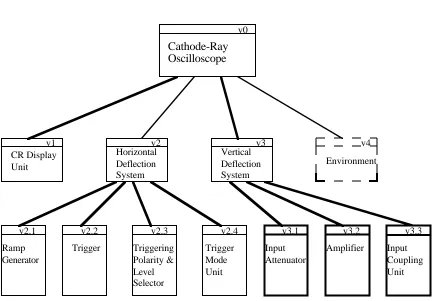
Having identified the problem, a functional structure of the system should now be
constructed in the "Viewpoint Structuring" diagram (Figure 1). A viewpoint can be a
physical or functional entity of the system under analysis. The term viewpoint is referred to
here as a functional entity of the oscilloscope system. First of all, "oscilloscope" can be
chosen as the top-level viewpoint of such a system, and "CR display" as a lower-level
viewpoint. The problem now is to construct other lower-level viewpoints such that they
We start from the output end of the transformation process. Two sets of plates, supplied
with voltages, are used to deflect a beam of electrons, producing a light spot on the CR
display screen at a certain position (X,Y). The vertical deflection plates are driven by the
input voltage signal, whereas the horizontal plates by a ramp voltage, thus causing the light
spot to sweep from left to right on the screen at a constant speed. Therefore, we have
another two lower-level viewpoints under "oscilloscope", i.e. "vertical deflection system"
and "horizontal deflection system".
The input signal may have an AC component with a big DC bias, and it is usually
desirable to see only the AC component on the oscilloscope. Therefore, an "Input Coupling
Unit" can be used to select the right coupling option. Since the input voltage is usually too
weak to cause the vertical deflection, we need an amplifier for the input signal.
Consequently, a viewpoint "Input Amplifier" is added under "vertical deflection system".
Usually, an "Input Attenuator" is also needed to produce user-adjustable sensitivity range
(mV/cm or V/cm).
Under "Horizontal deflection system", we need a "Ramp generator" which accepts a
series of impulse signals and produces a corresponding series of ramp voltage signals to
drive the horizontal plates. The impulse signals are generated by a "Trigger" on receiving
what is called a "trigger signal". Such a trigger signal can be the (amplified) input signal
itself, an external trigger signal, or a (50Hz) line signal. The operator selects an
appropriate trigger signal through a "Trigger mode unit", which may provide AC, DC, HF,
or LF coupling for the external trigger signal or the input signal. However, a coupled
signal can not directly be used by the trigger until the triggering polarity and triggering
threshold level are determined by the operator through, say, a "Triggering Polarity and
Lever Selector".
Having obtained the various levels of viewpoints, i.e. functional units of the
oscilloscope, we are now ready to draw the "Viewpoint Structuring" diagram, as shown in
Figure 1. This diagram will have to be approved by the Customer Authority.
It can be seen that the environment is modelled as an "indirect" viewpoint, i.e. a sole
signal flow is analysed throughout this study, rather than data flow. The operator only
provides control to the system, e.g. the selection of trigger mode.
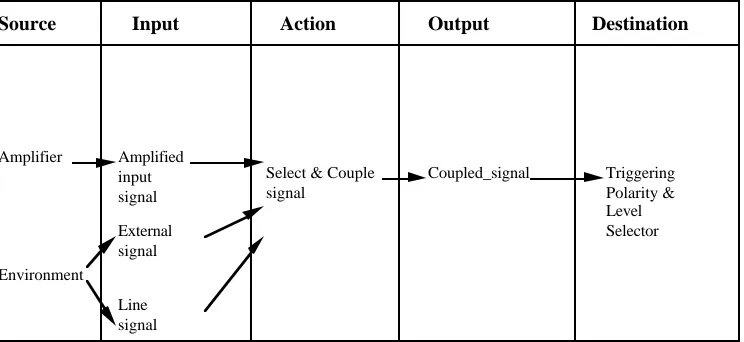
Tabular Collection Forms for each of the viewpoints are then produced, explicitly
stating the signal processing activities (Actions) of the direct viewpoints, the type and
source of input signals and the type and destination of output signals. Completeness
requires the analysis of all the relevant actions, signal inputs and signal outputs of all direct
viewpoints. All signal inputs must have a source and all signal outputs must have a
destination. Consistency also needs to be checked; for example, an output flow into a direct
destination viewpoint in one table, must be the same input signal in another table for this
viewpoint. There are 9 direct viewpoints in this study, and therefore 9 tabular collection
forms must be produced. Two of these forms are given in Figure 2 for demonstration
purposes.
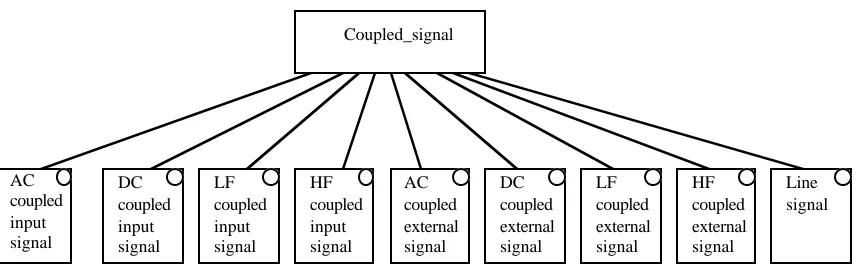
Next, at the Data Structuring stage (Signal Structuring to be precise), the signal outputs
of each direct viewpoint are analysed, giving top-down decomposition diagrams similar to
the viewpoint structuring diagram. Again, there are 9 such diagrams. Figure 3 shows that
the output of Trigger_Coupling_Unit, i.e. Coupled_signal, can be one of
AC_coupled_input_signal, DC_coupled_input_signal, LF_coupled_input_signal,
HF_coupled_input_signal, AC_coupled_external_signal, DC_coupled_external_signal,
LF_coupled_external_signal, HF_coupled_external_signal, and Line_signal.
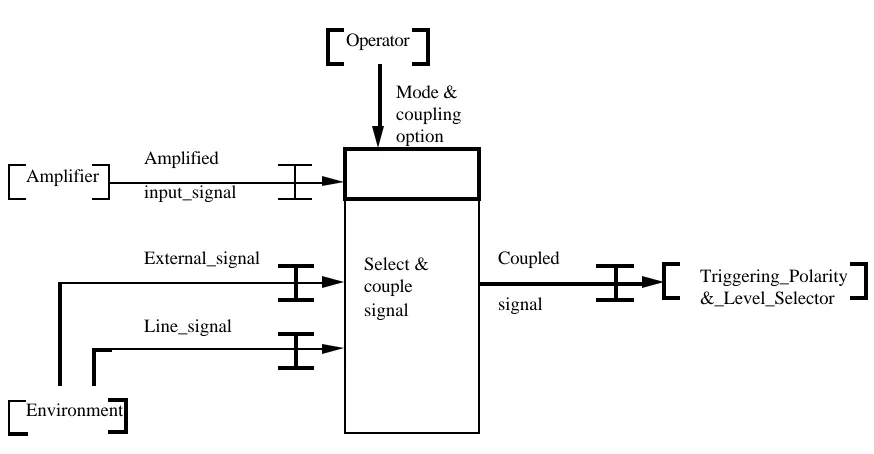
Single Viewpoint Modelling is then performed for each Viewpoint, resulting in
essentially another diagrammatic interpretation of the information in the Tabular Collection
Forms. The extra information at this stage includes inter-action data flows, the control of
actions (i.e. these actions are not primarily caused by the flow of input data, but by an
external control from another viewpoint, e.g. the "Operator"), and time-ordering of
actions. The Single Viewpoint Model diagram for the Trigger_Coupling_Unit is given in
Figure 4. The symbol I represents the so-called "channel flow" signal, i.e., all values of which must be processed.
The final diagrammatic representation is known as the Combined Viewpoint Model
represented. This diagram gives a systematic view of the signal flows and processing
actions across the whole system. The Combined Viewpoint Model diagram in Figure 5
shows one possible system scenario, in this case based on all the Single Viewpoint Model
diagrams.
Having completed functional analysis of the oscilloscope, from Viewpoint Structuring
to Combined Viewpoint Modelling, the functional aspects of a specification document can
be abstracted out from the Combined Viewpoint diagram, identifying data-flow and
control-flow interfaces between the system and external indirect viewpoints. These aspects of
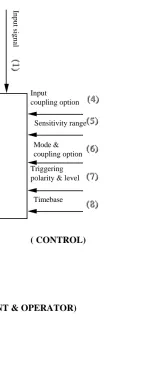
functional behaviour are presented in Figure 6. As can be seen, this diagram gives a more
detailed insight into the functionality of the oscilloscope then the initial problem statement
from the Customer Authority. This description, of course, must be approved by the
Customer Authority. A full functional specification for the oscilloscope, which defines
details for input, output and control, can be given as follows (Numbers of the statements
correspond with the numbers in Figure 6 for convenience of understanding).
General description: The function of the oscilloscope is to display traces of
voltage signal against time.
(1) Input signal: The bandwidth of input signal can range from 0 to 20MHz.
The rise time of a step response should be less than 20ns, with an
overshoot of no more than 1%. Input impedance must be 1MΩ || 30pF. The maximum value of input signal must not exceed 400V (DC + peak
AC).
(2) External trigger signal: The bandwidth of external signal should be from
0-40MHz.
(4) Input coupling option: The operator selects one of three input coupling
options, i.e. AC, DC or GND (ground).
(5) Sensitivity range: (Vertical deflection) sensitivity should be variable
between 5mV/cm and 20V/cm in 12 steps.
(6) Triggering mode and coupling option: Triggering sources include the
input signal itself, an external signal, or the 50Hz-line signal. The
operator selects triggering mode (input, external or line signal) and
external signal and input signal. HF and LF options should allow signal
components of 100kHz (-3dB) - 40 MHz (-3dB), 0-100kHz (-3dB) to
pass through, respectively.
(7) Triggering polarity and level: Triggering can be from positive or
negative slope, with threshold level of 5mm on the scope for input
signal, or 0.6V for external signal.
(8) Timebase: Timebase should be adjustable from 0.5us/cm to 0.2 s/cm in
18 steps.
(9) Traces: The CR screen should be rectangular, with internal graticule of 8
x 10 cm.
The last stage in CORE is Constraints Analysis. Virtually all the requirements which
can not be analysed in the diagrammatic sections should be described at this stage. They
include non-functional requirements such as physical constraints, cost and timescale
constraints, power consumption, and so on. Non-functional requirements can usually be
produced using traditional checklisting techniques, which may vary from company to
company. The following gives a (non-exhaustive) list of non-functional statements:
(10) Physical characteristics: Weight 7-8kg. Width 280-300mm. Height
140-150mm. Depth 380-390mm. Colour blue.
(11) Power consumption: 35-40W.
(12) Cost: No more than £350.
(13) Timescale: The development process must not take more than 8 months,
including design and manufacturing.
The end product of a CORE analysis should be an actual specification document, which
may consist of textual statements, tables, diagrams and, if necessary, some mathematical
expressions. Unfortunately, there exists no standard for the specific format of this
document in the instrument community. Different companies tend to create and adopt their
own specification style and format. Therefore, apart from the functional and non-functional
statements as given above, the authors do not attempt to produce a complete specification
The advantages of using CORE for the requirement analysis of this simplified
oscilloscope can now be discussed. A step-by-step analysis of information flows and
information processing activities can be performed using the CORE notation, with each
preceding step providing the basis for the current step of specification. This analysis helps
gain insight into the functional behaviour of the system under study. Also, completeness
and consistency checking on information transactions can be performed. Therefore, the
specific benefits of using CORE for functional requirements analysis are its explicit
graphical notation, and completeness and consistency checking rules. These benefits can be
best appreciated in complex instrument systems.
However, CORE loses much of its attraction if a measuring instrument or instrument
system (e.g. a pressure gauge), does not have many signal processing functions. A CORE
analysis document for such applications would then have a much larger Constraints
Analysis section than all the other sections put together. Obviously this problem is not
unique to CORE - there are no accepted methods for expressing non-functional
requirements.
While diagrams such as Combined Viewpoint Modelling are treated as part of a
specification of a software system, they can not be included in specifications of instrument
systems. Although decompositions help analysts gain insight into systems' functional
behaviour, they must not form part of a specification document.
8. Conclusions
Some of the well-known structured specification methods have been briefly examined
against a set of evaluation criteria, in the context of measuring instrument systems.
Promising techniques include CORE, SCS and SREM. Due to CORE's explicit graphical
notation, it provides systematic and effective support for functional analysis of complex
instrument systems, for example, oscilloscopes, spectrometers, process control and
instrumentation loop, and so on. Although decomposition details using the CORE notation
should not be included in a specification of instrument systems, the analysis process helps
to create complete and consistent functional specification. However, this advantage is not
Prototype automated tools for the generation of measuring system requirements, using
traditional checklisting approaches, are now available [Cook, 1988, 1990; Sydenham,
1990]. We are developing a prototype support environment for the specification of
instrument systems, based on the proposed ViewPoint development framework
[Finkelstein et al, 1990b]. This environment accommodates multiple representation and
development techniques, covering both software and hardware engineering disciplines.
9. Acknowledgements
The authors wish to thank the SERC for the SEED research grant. They would also like
to express their gratitude to Dr. S. Rozen, for his advice and criticism.
10. References
Alford M.W. 1980, Software Requirement Engineering Methodology (SREM) at the Age of Four, Proceedings of the Int. Computer Software & Applications Conf. , New
York: IEEE Computer Society Press, pp.866-874
Balzer R. & Goldman N. 1986, Principles of Good Software Specification and their Implications for Specification Languages, Software Specification Techniques (ed. Gehani,
N.H. & A.D. McGettrick)
Birrel N.D. & Ould M.A. 1985, A Practical Handbook for Software Development, Cambridge University Press
Coad P. & Yourdon E. 1991, Object-Oriented Analysis (2nd Edition), Yourdon Press
Cohen B., Harwood W. T. & Jackson M.I. 1986, The Specification of Complex Systems, Addison-Wesley
Measurement, Vol.6, No.4
Cook S.C. 1990, A Knowledge-Based System for Computer-Aided Generation of Measuring Instrument Specifications, PhD Thesis, City University, London
DeMarco T. 1978, Structured Analysis and Systems Specification, Yourdon Press
Finkelstein A.C.W. & Potts C. 1987, Building Formal Specifications Using Structured Common Sense, Proceedings of 4th International Workshop on Software
Specifiation and Design, Monterey, California, USA
Finkelstein A.C.W., Maibaum T. & Finkelstein L. 1990a, Engineering-in-the-Large: Software Engineering and Instrumentation, Proceedings of UK IT 1990,
Southampton, UK
Finkelstein A.C.W., Kramer J. & Goedicke M. 1990b, Viewpoint Oriented Software Development, Proceedings of the Third International Workshop on Software
Engineering and its Applications, Toulouse, France
Finkelstein L. & Finkelstein A.C.W. 1987, Instruments and Instrument Systems: Concepts and Principles, Systems & Control Encyclopedia (editor: M.G. Singh),
Pergamon Press, pp2527-2533
Jackson M.A. 1983, System Development, Prentice-Hall: London
MIL-STD-490A 1985, Military Standards: Specification Practices, United States of America Department of Defense
Nuseibeh B.A. 1989, CoreDemo: An Investigation into the Use of Object-Oriented Techniques for the Construction of CASE Tools, MSc Thesis, Imperial College, London
Sydenham P.H., Harris D.D. & Hancock N.H. 1990, MINDS - A Software Tool to Establish a Measuring System Requirement, Measurement, Vol. 8 No.1
Systems Designers 1985, CORE - the Method, User Manual
Cathode-Ray Oscilloscope
Environment
v2 v3 v4
v0
Ramp Generator
Trigger Trigger
Mode Unit
v2.1 v2.2 v2.3
Figure 1. Viewpoint Structuring
v2.4
Triggering Polarity & Level Selector Horizontal Deflection System CR Display
Unit v1
Vertical Deflection System
Input Attenuator
Amplifier
v3.1 v3.2 v3.3
Source Input Action Output Destination
Amplified input signal Amplifier
Select & Couple signal
External signal
Line signal Environment
Coupled_signal Triggering Polarity & Level Selector
V3.3 Triggering_Polarity_&_Level_Selector
Source Input Action Output Destination
V3.4 Trigger_Mode_Unit
Figure 2. Tabular Collection Trigger
Mode Unit
Coupled_signal Select triggering polarity & level
Coupled_signal
Outputs of Trigger_Coupling_Unit
Figure 3. Data Structuring AC
coupled input signal
DC coupled input signal
LF coupled input signal
HF coupled input signal
AC coupled external signal
DC coupled external signal
LF coupled external signal
HF coupled external signal
V3.4 Trigger_Mode_Unit
Amplifier
Line_signal
Environment
External_signal Select & couple signal
Figure 4. Single Viewpoint Modelling
Amplified
input_signal
Coupled
signal
Triggering_Polarity &_Level_Selector Mode &
Input signal
External trigger signal
Line signal
Traces
Figure 6. Functional behaviour of the oscilloscope
CATHODE-RAY
OSCILLOSCOPE
( INPUTS )
Sensitivity range
Mode & coupling option
Triggering polarity & level
Timebase
( OUTPUT )
( ENVIRONMENT)
( ENVIRONMENT & OPERATOR) ( CONTROL) Input coupling option ( ( 1 1 ) ) (( 22 )) ( ( 3 3 ) ) ( (44))
( (55))
( (66))
( (77))
( (88))