IMPROVED TCP VEGAS: EFFICIENT CONGESTION
CONTROL TECHNIQUE FOR IMPROVING THE
PERFORMANCE OF MANET
Ankit Jain
1, Suraj Malik
21
Information Technology, Mahamaya Technical University, Noida, (India)
2
Computer Science & Engineering, Mahamaya Technical University, Noida, (India)
ABSTRACT
TCP Vegas is an end to end approach that emphasizes packet delay, rather than packet loss and implemented at sender
site. TCP Vegas for Ad hoc network is a congestion avoidance protocol that uses conservative approach to determine
and control network state. But this conservation scheme is not good in all conditions and it can unnecessarily reduce the
size of congestion window. This paper proposes improved TCP Vegas an improvement over TCP Vegas in Ad hoc
network that utilizes round trip time variation of packets at sender side, short term throughput and inter-delay difference
at receiver side to measure the network state and then controls congestion window considering the path length and
network state. Simulation results show the improvement of 5 to 15 % over Ad hoc TCP Vegas in high mobility and high
traffic conditions.
Keywords: Ad Hoc Network, Congestion, TCP, Fuzzy Logic, MANET.
I INTRODUCTION
Ad hoc network is a temporary arrangement of devices− also known as a decentralized type of wireless network.[11] −to
makes communication among them possible. The network is ad hoc because it does not rely on a pre existing
infrastructure, that require no router or switches, the nodes themselves work as router to provide connectivity to other
nodes and as computer for its own [10].
The networks with highly mobile nodes have produced new challenges by introducing some considerations stemming
from the special characteristics of the wireless medium and the dynamic nature of the network topology. In an ad hoc
network each node participates in routing by forwarding data for other nodes, so the determination of which nodes
forward data is made dynamically on the basis of network connectivity.
It requires a robust and highly effective algorithm that can handle the challenges of these networks easily. In MANETs
the general TCP does not show very good performance as it fails to tackle the mobility induced through problems like
disconnection and reconnection. The route change induces out-of-order delivery of packets at end hosts. The
communication is affected by mainly the mobility of the nodes and also the error and contention prone wireless
To improve the performance of TCP in wireless networks we need to modify it. Many methods have been proposed to
improve the performance of TCP in MANETs. Among them TCP Vegas uses an end-to-end approach that
emphasizes packet delay, rather than packet loss and implemented at sender site, which is easy to implement and deploy
since it requires less changes at end hosts, provides the flexibility for backward compatibility, maintains end-to-end TCP
semantics.[14]
In this paper we propose an algorithm: improved-TCP Vegas (ITCP Vegas) to improve the performance of Ad hoc
network. For this purpose we tune the congestion window size considering network status adaptively by detecting and
reacting to different network conditions. To reduce the probability of unnecessary reduction in the congestion window
size the network condition is determined at both end and used for cross verification.
Since there may be a chance of backward path congestion which can affect the round trip time and thus the decision to
control congestion window size. This approach clearly distinguishes forward path congestion from backward path
congestion and thus reduces chance of unnecessary reduction of congestion window size. The changes introduced are
simple with respect to the implementation complexity. The paper is organized as follows: Section 2 describes the related
work in this area, section 3 discusses the proposed approach, section 4 covers proposed algorithm, and section 5
evaluates the proposed algorithm. Finally, Section 6 gives conclusion.
II RELATED WORK
In [1], Chen Y., Xue and K. Nahrstedt proposed an adaptive CWL (Congestion Window Limit), measured in number of
bytes, setting strategy to dynamically adjust CWL according to the current RTHC (Round Trip Hop Count i.e. the
number of hops of the path). To fully utilize the capacity of a network, the TCP connection should set its CWL equal to
the BDP (Bandwidth Delay Product i.e. the number of bits that can fill the link) [9]. The bandwidth of the path depends
upon the link capacity and the processing capability of nodes in the path. So the path’s bandwidth is taken as the
bandwidth of the lowest bandwidth link otherwise the extra bits will cause congestion at the node with minimum
available bandwidth. So to utilize available bandwidth the maximum burst size can be taken as the bottleneck bandwidth.
In [2], Kim, D. Bae, H. Toh, C. K. proposed TCP-Vegas-ad hoc protocol, which is made aware of RCs and uses the
correct BaseRTT values. Through simulations using ns-2, it was observed that the TCP-Vegas-ad hoc outperforms the
standard TCP-Vegas protocol, especially under high mobility scenarios over both reactive and proactive ad hoc routing
protocols.
The TCP Vegas [7] protocol is a congestion avoidance protocol that takes care of the network condition and according to
that determines the size of the sender congestion window. It determines the network state by the throughput difference of
the previous and the current RTT (round trip time) and accordingly if throughput decreases the congestion window size is
increased and when throughput increases the congestion window size is increased linearly. For this purpose it uses the
difference between the current and the lowest measured RTT [6].
In [13], Cheng-Yuan Ho, Yaw-Chung Chen proposed a mechanism to improve the performance of delay-based TCPs
BaseRTT if necessary by detecting the change of TTL (Time to Live value) value of two end-hosts. Based on the
simulation results, we demonstrate the effectiveness and utilities.
In [9] S. Biaz and N.H. Vaidya show that a single metric network status determination approach using RTT or
inter-arrival time of packets is not good enough, because of the noise associated with the measurements. So either the network
congestion may go undetected or congestion is falsely reported. Using measurements at both ends, the probability of
false estimation can be reduced. The metrics such as RTT or inter-arrival time increases when the network is congested.
In [10] Zhenghua Fu et al use four different parameters STT (short term throughput), IDD (inter delay difference), PLR
(packet loss ratio) and POR (out of order packet ratio) to determine different network conditions and to distinguish
among congestion, route change and channel error. This algorithm reduces the chance of false detection of congestion.
However it’s a receiver based mechanism, and if the acknowledgement lost the sender will response only after timeout
and will not be able to distinguish backward path congestion from forward.
In [12], Xia Li, Peng-Yong Kong and Kee-Chaing Chua proposed a packet-level model to investigate the impact of
channel error on the Transmission Control Protocol (TCP) performance over IEEE-802.11-based multihop wireless
networks. A Markov renewal approach is used to analyze the behavior of TCP Reno and TCP Impatient NewReno.
III DISCUSSIONS
In order to estimate base RTT correctly, the IP packet with RC field set and acknowledgement packet with RCN field set
can be used, and both should be delivered safely without facing packet loss [2]. Therefore we need a mechanism to
ensure reliable transmission of these messages. Currently many other existing protocols [8] also depend on the use of
explicit notification messages such as route failure and route reestablishment notification messages. The ICMP messages
about the route failure serves the same purpose, and the node detecting the route failure sends the route failure
notification to the sender of the packet and from this moment the next RTT is considered as the new valid base RTT. The
proposed technique ITCP Vegas utilizes the throughput difference to find out network conditions and use this to adjust
the congestion window with the information provided by the receiver through acknowledgement. The receiver measures
the network congestion through two parameters STT and IDD, if STT lies below 30% and the IDD lies above the 70% it
assumes as the indication of congestion in the network. But these measures do not clearly work well in non congestion
state.
Fig.1 (B) Fuzzy Membership Function for IDD
Fuzzy membership function in Fig. 1(b) is used for IDD. If IDD lies below 10 % of smoothed IDD then the membership
degree for this parameter is 0, if it is greater than 40 % then membership degree is 1, and If IDD lies in the range of 11 to
40% of smoothed IDD then the membership degree ranges from 0.1 to 0.99. Both STT and IDD are combined by
averaging their membership degree and if the result is greater than 0.5 it is indication of the congestion in the forward
path. In [10] it is observed that when the maximum network queue size exceeds half of the buffer capacity, IDD becomes
high and STT clearly low. So we use this observation by defining a value to be HIGH or LOW if respectively it is within
the top or bottom 30% of all samples. However, when the network queue size is small (non-congestion case), both IDD
and STT vary from LOW to HIGH. When node mobility is present, the two metrics become much noisier in
non-congestion state (i.e. small network queue). In the single metric-based non-congestion detection scheme using either IDD or
STT, the noise reduces the accuracy significantly when the network is not congested, especially in scenarios with
mobility and channel error. In the joint detection approach, we use both metrics to verify each other to improve the
accuracy. Specifically, we identify a congestion state when both IDD is HIGH and STT is LOW, and non-congestion
state if otherwise. Instead of just determining by the sharp boundaries i.e. 30% for STT and 70% for IDD we can utilize
fuzzy logic here which an also take into account the very high value for IDD and very low value for STT. So it will be
more accurate. The Fig. 1(a) and (b) shows the fuzzy membership function based on these observations. The round trip
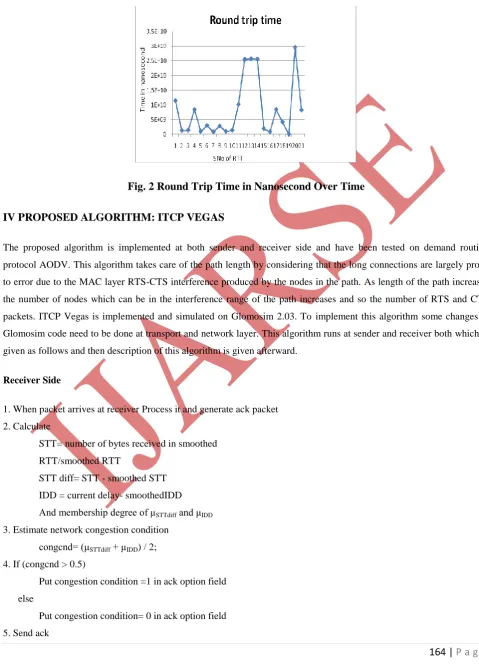
time changes dramatically over time as the number of connections increase or the congestion increase. The congestion is
controlled by reducing the number of packets in the network by reducing the congestion window size. The congestion in
forward and backward path both affects the round trip time. The bump in RTT in Fig. 2 is due to the congestion in
network. The mobility of the nodes also affects connectivity and can break the route and thus the new route may have
different RTT. One of the problems of mobile ad hoc network is route change, which occurs very frequently due to the
moving characteristics of the nodes. The earlier noted lowest RTT may be invalid for the new routes whether it is lower
or higher than the new RTT. If the new route is shorter than previous ones then new estimated RTT will automatically be
adopted as the lowest RTT and so it’s not an issue, but if the route is newer and new RTT is longer than previous then
new RTT should be adopted as lowest RTT.
Receiver sends the network state information in the ack (acknowledgement) packet to sender. The length of the path is
obtained from the hop count field of route reply packet at network layer. The CWL value is send to the sender by setting
the window field in the ack packet. The sender uses CWL value obtained from receiver and cwnd (congestion window
congestion. If Adaptive RTO approach is utilized, it can reduce the chance of wasting time and resources in case of
multiple packet losses or the acknowledgement losses due to congestion in backward path.
Fig. 2 Round Trip Time in Nanosecond Over Time
IV PROPOSED ALGORITHM: ITCP VEGAS
The proposed algorithm is implemented at both sender and receiver side and have been tested on demand routing
protocol AODV. This algorithm takes care of the path length by considering that the long connections are largely prone
to error due to the MAC layer RTS-CTS interference produced by the nodes in the path. As length of the path increases
the number of nodes which can be in the interference range of the path increases and so the number of RTS and CTS
packets. ITCP Vegas is implemented and simulated on Glomosim 2.03. To implement this algorithm some changes in
Glomosim code need to be done at transport and network layer. This algorithm runs at sender and receiver both which is
given as follows and then description of this algorithm is given afterward.
Receiver Side
1. When packet arrives at receiver Process it and generate ack packet
2. Calculate
STT= number of bytes received in smoothed
RTT/smoothed RTT
STT diff= STT - smoothed STT
IDD = current delay- smoothedIDD
And membership degree of μSTTdiff and μIDD
3. Estimate network congestion condition
congcnd= (μSTTdiff + μIDD) / 2;
4. If (congcnd > 0.5)
Put congestion condition =1 in ack option field
else
Sender side
1. Extract congestion condition information from the option field of the ack packet.
2. Estimate newRTT
3. If newRTT is smaller or the route is changed
BaseRTT=newRTT
(The route change is determined here by the information coming from the network layer if the path length is changed).
4. Calculate actual throughput and expected throughput
5. Obtain throughput difference Thdiff=expected throughput-actual throughput
6. If Thdiff × BaseRTT < α, absence of congestion
7. If Thdiff × BaseRTT > β, chance to be congested further
8. If the number of hops <=3 then
If Thdiff indicates no congestion then set
cwnd=cwnd+0.125* cwnd.
If Thdiff indicates congestion then set
cwnd=cwnd-0.125* cwnd.
Otherwise leave the congestion window size unchanged.
Else if Thdiff indicates congestion and receiver’s indication is no congestion then it means backward congestion and thus
no change in cwnd size
Else if Thdiff indicates congestion and receiver’s indication is congestion then there is forward congestion and then
cwnd= MAX (maximum segment size, cwnd/4)
10. Adjust the sender window size according to the congestion window size and send the packets if available in send
buffer.
11. End
The membership values of IDD and STT variable have been fixed on the trial and error basis. Short term throughput is
the number of bytes received in a short duration at the receiver. This algorithm uses averaging of the STT by giving 25%
weight to the current throughput and 75% to the previous value of the STT. This way it mitigates any unwanted variance
in the short term throughput, which may occur because of the idle condition of the sender. To calculate the short term
throughput the receiver uses a timer and monitors the packets coming without any loss or corruption in data. It then
compares the current STT with the smoothed STT.
The delay in packet traveling from sender to receiver is determined by the timestamp option field of the packet which
carries the sending time at the sender, and the current time at the receiver. There may be a drift in the timer of the sender
and receiver because of the absence of a global clock at the sender and receiver. For this purpose the smoothing of the
delay is important. The smoothing is done by taking the average of current delay and the previous delay, by giving 25 %
weight to current delay and 75% to the previous calculated delay i.e. smoothed delay.
The receiver then calculates the delay difference (IDD) from the current delay and smoothed delay. Both the STT
difference and the delay difference are then used to determine the network condition with the logic that if the number of
some unwanted condition in the network which is reducing the number of bytes received in a particular duration. This
duration is smoothed round trip time (weighted average of the current time duration and previous duration ) at the
receiver which is normally greater than the round trip time at the sender, and determined by the timestamp option field of
the packets being received at the receiver.
V SIMULATION AND EVALUATION
The throughput of the proposed algorithm with increasing mobility and the number of connections has been compared.
The simulation is done using Glomosim 2.03.
For the simulation the following parameters have been used-
SIMULATION-TIME 15M
TERRAIN-DIMENSIONS (1000, 1000)
MOBILITY (NONE, RANDOM-WAYPOINT 0 to 20m/s)
PROPAGATION-PATHLOSS FREE-SPACE
NOISE-FIGURE 10.0
TEMPARATURE 290.0
MAC-PROTOCOL 802.11
NETWORK-PROTOCOL IP
ROUTING-PROTOCOL AODV
The traffic injected is FTP
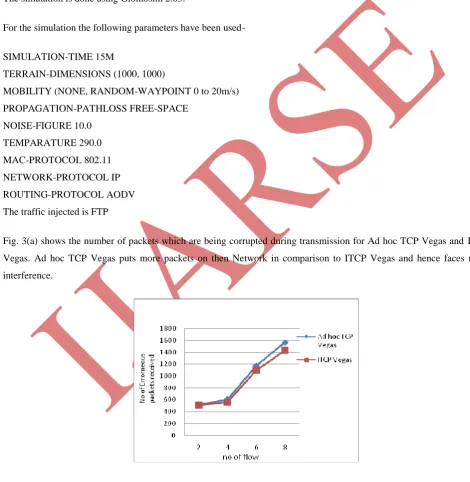
Fig. 3(a) shows the number of packets which are being corrupted during transmission for Ad hoc TCP Vegas and ITCP
Vegas. Ad hoc TCP Vegas puts more packets on then Network in comparison to ITCP Vegas and hence faces more
interference.
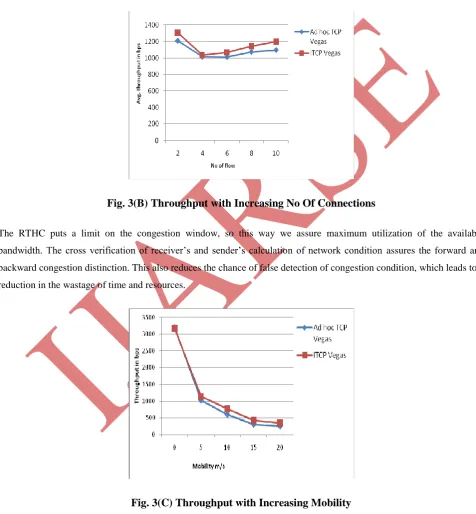
The throughput shown in the figures Fig. 3(b) and 3(c) are throughput per connection obtained by averaging total
throughput in simulation with the number of connections for particular mobility and then by averaging the result of each
simulation, for particular flow level in Fig. 3(b) and for particular mobility in Fig. 3(c).
The Fig. 3(b) clearly depicts that as the number of TCP connections increases the throughput decreases in all the
approaches but in such environment the ITCP Vegas handles the problem of false congestion detection and performs
better than the Ad hoc TCP Vegas.
Fig. 3(B) Throughput with Increasing No Of Connections
The RTHC puts a limit on the congestion window, so this way we assure maximum utilization of the available
bandwidth. The cross verification of receiver’s and sender’s calculation of network condition assures the forward and
backward congestion distinction. This also reduces the chance of false detection of congestion condition, which leads to a
reduction in the wastage of time and resources.
The linear reduction of the congestion window size and thus the traffic lets it free from sharp reduction of congestion
window size and helps in maintaining the congestion window in case of false detection. This way it avoids conservative
approach and invokes a slow start phase in false detection.
The graphs in Fig. 3 (b) and 3(c) specially have some anomaly in the curve as in case of Fig. 3(b) the throughput is lesser
than other cases. This is because the mobility of the nodes which brings some nodes together ans some far away, thus the
connectivity changes highly and for different nodes and mobility totally different path is generated in each case.
VI CONCLUSION
ITCP Vegas outperforms Ad hoc TCP Vegas implementation in all conditions, but its performance gets better than Ad
hoc TCP Vegas as the number of connections and mobility of nodes increases. The implementation of the proposed ITCP
Vegas algorithm is at the sender and the receiver only. The throughput comparison in Fig. 3(b) and 3(c) clearly depicts
that as the number of flow and the mobility of the nodes increases the throughput of both the protocols decrease but the
ITCP Vegas’ performance remains better than Ad hoc TCP Vegas. This way ITCP Vegas gives better performance in
high mobility, highly dense traffic and longer paths.
REFERENCE
[1] K. Chen, Y. Xue and K. Nahrstedt, “On Setting TCP’s Congestion Window Limit in Mobile Ad Hoc Networks”,
IEEE International Symposium on Computers and Communications, pp. 251-258, May 2003.
[2] Kim, D. Bae, H. Toh, C. K., “Improving TCP Vegas Performance Over MANET Routing Protocols”, IEEE
Transaction, vol. 56, no.1, pp. 372– 377, Jan 2007.
[3] L. Brakmo, L. Peterson, “TCP Vegas: End to end congestion avoidance on a global internet,” IEEE J. Sel. Areas
Commun., vol. 13, no. 8, pp.1465–1480, Oct. 1995.
[4] Yi-Cheng Chan, Chia-Tai Chan, Yaw-Chung Chen, Cheng-Yuan Ho, “Performance Improvement of Congestion
Avoidance Mechanism for TCP Vegas”, ICPADS04, pp. 605, 2004.
[5] S. Papanastasiou and M. Ould-Khaoua, ”Exploring the performance of TCP Vegas in mobile ad hoc networks”, Int.
J. Commun. Syst. Vol.17, no.2, pp. 163-177, Mar. 2004.
[6] S. Xu, T. Saadawi, and M. Lee, “Comparison of TCP Reno and Vegas in wireless mobile ad hoc networks”, in Proc.
IEEE LCN, pp.42-43, 2000.
[7] R. J. La, J. Walrand and V. Anantharam, “Issues in TCP Vegas”, UCB/ERL memorandum no. M99/3, Univ. Calif.
Berkeley, Jan 1999.
[8] Kai Chen, Yuan Xue, Samarth H. Shah and Klara Nahrstedt, “Understanding Bandwidth Delay Product in Mobile
Ad hoc Networks” Elsevier Computer Communications 27, pp. 923-934, 2004.
[9] S. Biaz and N. H. Vaidya,”Distinguishing congestion losses from wireless transmission losses”, IEEE 7th Int. Conf.
on computer communications and networks, October 1998.
[10]Zenghua Fu, Benjamin Greenstein, Xiaoqiao Meng, Songwu, “Design and Implementation of a TCP Friendly
Transpport Protocol for Ad Hoc Wireless Networks”, proceedings of the 10th IEEE International Conference on N
etwork Protocols, icnp02, pp. 216-225, 2002.
[12]Xia Li, Peng-Yong Kong and Kee-Chaing Chua, “DETECTING TCP Performance in IEEE-802.11-Based Ad Hoc
Networks with Multiple Wireless Lossy Links”, IEEE TRANSACTIONS ON MOBILE COMPUTING, VOL. 6, NO.
12, DECEMBER 2007.
[13]Cheng-Yuan Ho, Yaw-Chung Chen, “Improving Performance of Delay-Based TCPs with Rerouting”, IEEE
COMMUNICATIONS LETTERS, VOL. 11, NO. 1, JANUARY 2007.
[14]Chandra Prakash Sahu, Prem Shankar Yadav, Sachin Ahuja, Rajesh Prasad, “Optimistic congestion control to
improve the performance of Mobile Ad hoc Network”, Advance Computing Conference (IACC), 2013 IEEE 3rd