JOINT ADAPTIVE MODULATION FOR IMAGE
TRANSMISSION
Sneha Rajput
1, Kanchan Sharma
2 1,2Department of Electronics & Communication Engineering,
Delhi Technical University for Women New Delhi, (India)
ABSTRACT
In this paper, we propose a Joint Adaptive Modulation scheme for image transmission over AWGN channels. More
specifically, the scheme partitions the AC components of image information into different bit streams with unequal
importance Then, it decides on the modulation level that meets a better symbol error rate than the 64 QAM Scheme.
This SER is based on the Eb/No level as seen by the receiver and the sensitivity of the transmitted bit stream.
Simulation results show that the proposed scheme provides significant improvement SER when compared to
fixed-modulation based systems while maintaining relatively high peak signal-to-noise ratio (PSNR) and acceptable
perceptual quality. Transmission of multimedia information over wireless channels has gained increasing attention
because of its diversified applications. While wireless channels are characterized by their time-varying nature and
limited bandwidth, multimedia applications demand reliable channels and high data rates.
Keywords: Image Transmission, AWGN Channels, RLE Image Compression, DPCM Etc
I INTRODUCTION
Recently, wireless multimedia applications and services have undergone enormous development due to the
significant and continuing growth of wireless communications. These applications demand reliable channels and
high data rates. On the other hand, wireless channels are characterized by their limited bandwidth and time varying
conditions. The challenge raised by the wireless communication lies in the contradiction between the limited
bandwidth offered by the channel and the large volume of multimedia data as well as the strict quality of service
(QoS) parameters (such as bit error rate (BER), delay and latency) required by multimedia applications. The
wireless channel might also delay, lose, or corrupt individual packets. Losses have significant impact on the
perceived quality due to spatiotemporal error propagation. Thus, to achieve the required high data rates and
acceptable BER, the channel must be efficiently used to guarantee a maximum level of perceptual quality from the
end-user's perspective. [1]
In this study, we address the application of joint adaptive modulation and for multimedia transmission over wireless
fading channels. We propose a new approach for selecting the appropriate modulation level which considers the
perceptual quality and bandwidth efficiency. In this approach, the adaptation targets maximizing the bandwidth
all portions of the coded bit stream are equally important, our framework partitions the bit stream into sub-streams
with different quality and protects each sub stream based on its contribution to the final quality of the decompressed
image. An algorithm is developed and used to select the appropriate modulation mode in order to efficiently protect
the partitioned multimedia content against channel degradation. Simulation results show that adaptation according to
the channel condition enhances the spectral efficiency and gives acceptable immunity against channel variations.
While the adaptation according to the sensitivity of the compressed multimedia content proved to prevent the
channel from introducing unrecoverable errors and improve the quality of the reconstructed data.[3]
This in turns allows more information to be transmitted which also allows the use of fine quantization that result in
higher PSNR values. Recently, several studies considered the problem of adapting the source and channel code rates
in the context of image and video transmission. Based on the channel conditions, the authors in [3] studied the
impact of adapting the source code rate on transmission energy, latency, and the quality of the reconstructed image
by varying the quantization parameters. Several JSCC schemes with different objectives were introduced in [1], [2],
[5], [6], [7], [8] and the references there in. However, JSCC schemes have few limitations. For instance, the
introduced JSCC schemes ignore the impact of entropy coding whereby the occurrence of any error leads to error
propagation, the effect of which on the overall distortion cannot be estimated at the time of the encoding. Moreover,
optimizations in JSCC schemes are performed on a per image basis; therefore the parameters derived for each image
could be used to transmit that image only. The proposed scheme jointly considers the average energy-per-bit to
noise power spectral density ratio (Eb/No) as seen by the receiver and the sensitivity of the compressed bit stream to
achieve an optimal tradeoff between the image quality and the bandwidth efficiency.
1.1
System Model
To evaluate the performance of the proposed j o i n t adaptive modulation scheme, we simulated the
transmission of the 512x512 bitmap RGB image. The bit stream of the encoded image is divided into three
priority-levels bit streams. Each bit stream is modulated according to the proposed scheme and transmitted
over a AWGN channel. At the receiver, the signal is demodulated, decoded and combined to reconstruct the
received image
Figure 1 depicts the block diagram of the proposed end-to end image transmission scheme. The output of the source
encoder is divided into three different quality bit streams (i.e. with unequal importance). The first bit stream contains
the DC coefficients, which represents the average luminance of the 8 x 8 blocks of the image and hence is
are concentrated in the upper left parts of each of the 8 x 8 blocks of the image. With the low-frequency AC
coefficients, most of the details of the image could be recovered, however they are less important than the DC
coefficients. The third bit stream carries the high-frequency AC coefficients which generally represent the fine
details of the image. Since the human visual system is less sensitive to the information contained in the high
frequency AC coefficients (i.e. fine details), they are considered to be the least significant data. Whether the
transmission systems use fixed or 64 Quadrature Amplitude modulations, these systems do not take into
consideration the channel condition jointly with the importance of the transmitted bit stream. When a fixed
modulation level is used, independent of the channel state, the modulation level as set by the transmission algorithm
is typically decided to be for the worst-case scenario. This is true since this modulation level should achieve an
acceptable SER for the lowest possible Eb/No value. This is simply explained by the fact that using a lower
modulation level during the "good" channel conditions will hinder the transmission at higher rates that would have
been possible should the proper modulation level have been used. Thus, in the proposed transmission scheme,
adaptive modulation is adopted to improve the tradeoff between the Eb/No and the achieved PSNR as the channel
conditions vary with time.
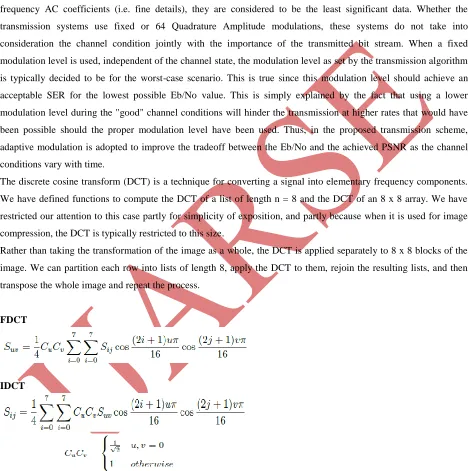
The discrete cosine transform (DCT) is a technique for converting a signal into elementary frequency components.
We have defined functions to compute the DCT of a list of length n = 8 and the DCT of an 8 x 8 array. We have
restricted our attention to this case partly for simplicity of exposition, and partly because when it is used for image
compression, the DCT is typically restricted to this size.
Rather than taking the transformation of the image as a whole, the DCT is applied separately to 8 x 8 blocks of the
image. We can partition each row into lists of length 8, apply the DCT to them, rejoin the resulting lists, and then
transpose the whole image and repeat the process.
FDCT
IDCT
Where Sij is the value of the pixel at position (i,j) in the block and Suv is the transformed (u,v) DCT coefficient.
II PERFORMANCE ANALYSIS
figure indicates the plot between SER & Eb/No. It shows the performance of the proposed scheme is
comparable to the performance of 64 QAM at low Eb/ N o values while the SER decreases at h i g h e r
Eb/ N o values. This behavior is simply explained by the fact that at low Eb/Novalues, t h e r e s u l t (value
of SER) of both schemes are almost same.
Figure1: SER Vs Eb/No
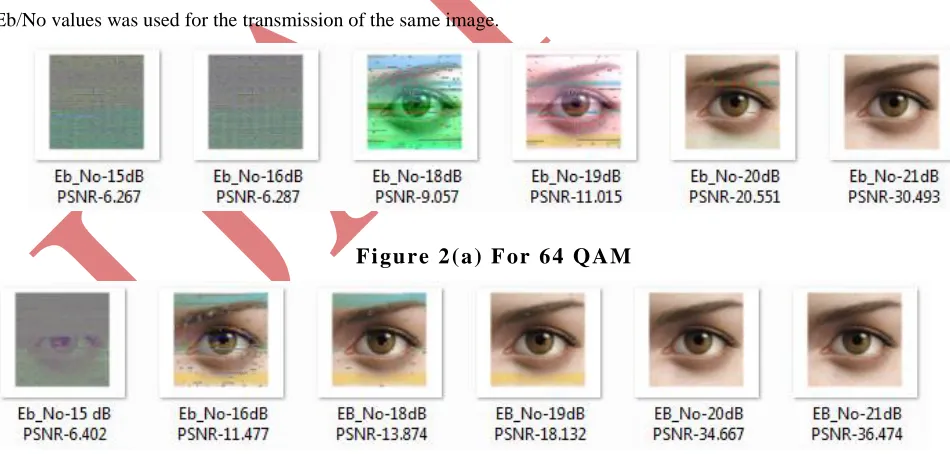
Figure 2: demonstrates the impact on the subjective (visual) quality of transmitted image using joint adaptive
modulation. In addition, and for the sake of comparison, the 64 QAM fixed modulation scheme with different
Eb/No values was used for the transmission of the same image.
F i gu re 2 ( a ) F or 6 4 Q A M
F i gu re 2 (b ) F or J oi nt A d a pti ve M od ul at i on
The quality degradation in the reconstructed image can be seen by comparing Figure 2-(a) & (b), the PSNR of the
image in case of 64 QAM is 6.287 while in case of Joint adaptive modulation is 11.477when Eb/No is 16 dB (Same
acceptable quality. So it can be summarized that Joint Adaptive Modulation is better than 64 QAM.
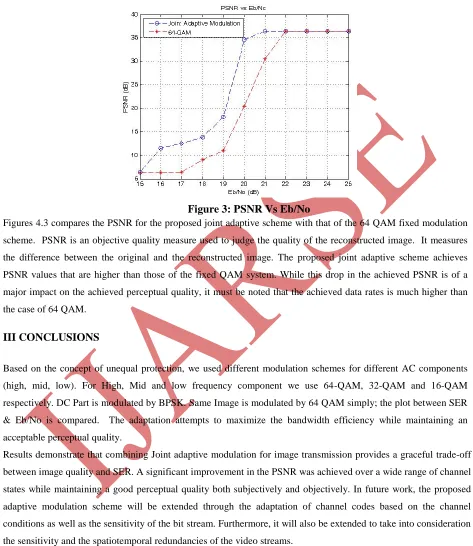
Figure 3: PSNR Vs Eb/No
Figures 4.3 compares the PSNR for the proposed joint adaptive scheme with that of the 64 QAM fixed modulation
scheme. PSNR is an objective quality measure used to judge the quality of the reconstructed image. It measures
the difference between the original and the reconstructed image. The proposed joint adaptive scheme achieves
PSNR values that are higher than those of the fixed QAM system. While this drop in the achieved PSNR is of a
major impact on the achieved perceptual quality, it must be noted that the achieved data rates is much higher than
the case of 64 QAM.
III CONCLUSIONS
Based on the concept of unequal protection, we used different modulation schemes for different AC components
(high, mid, low). For High, Mid and low frequency component we use 64-QAM, 32-QAM and 16-QAM
respectively. DC Part is modulated by BPSK. Same Image is modulated by 64 QAM simply; the plot between SER
& Eb/No is compared. The adaptation attempts to maximize the bandwidth efficiency while maintaining an
acceptable perceptual quality.
Results demonstrate that combining Joint adaptive modulation for image transmission provides a graceful trade-off
between image quality and SER. A significant improvement in the PSNR was achieved over a wide range of channel
states while maintaining a good perceptual quality both subjectively and objectively. In future work, the proposed
adaptive modulation scheme will be extended through the adaptation of channel codes based on the channel
conditions as well as the sensitivity of the bit stream. Furthermore, it will also be extended to take into consideration
REFERENCES
[1] M. Hassan and M. Krunz. “Video streaming over wireless packet networks: An occupancy-based rate adaptation
perspective”. IEEE Transactions on Circuits and Systems for Video Technology, 17(8): 1017- 1027, August
2007.
[2] Mohamed Hassan and Taha Landolsi. “A retransmission based scheme for video streaming over wireless
channels”. Wirel. Commun. Mob. Comput., 10(4):511-521, 2010.
[3] C.N. Taylor and S. Dey. “Adaptive image compression for wireless multimedia communication”. In
Communications, 2001. ICC 2001. IEEE International Conference on, volume 6, pages 1925 -1929 vol.6, 2001.
[4] N. Thomos, N.V. Boulgouris, and M.G. Strintzis. “Wireless image transmission using turbo codes and optimal
unequal error protection”. Image Processing, IEEE Transactions on, 14(11):1890 -1901, nov. 2005.
[5] Jianfei Cai and Chang Wen Chen. “Robust joint source channel coding for image transmission over wireless
channels. Circuits and Systems for Video Technology”, IEEE Transactions on, 10(6):962 -966, sep 2000.
[6] Jianhua Lu, K.B. Letaief, M.L. Liou, and lC.-I. Chuang. “Joint source and channel coding for mobile multimedia
communications”. In Vehicular Technology Conference, 1998. VT C 98. 48th IEEE, volume 2, pages 1224
-1228 vol.2, 18-21 1998.
[7] Mohamed Hassan and Marwan Krunz. “A rate control scheme for video streaming over wireless channels”. In
Proceedings of the IEEE GLOBECOM Conference, volume 6, pages 4071-4075, Dallas, Texas, Nov.-Dec. 2004.
[8] M. Hassan, L. Atzori, and M. Krunz. “Video transport over wireless channels: A duty-cycle approach for rate
control”. In Proceedings of the ACM International Conference on Multimedia, New York, NY, USA, November
2004.
[9] M.F. Sabir, H.R. Sheikh, Jr. Heath, R.w., and A.C. Bovik. “A joint source-channel distortion model for jpeg
compressed images”. Image P rocessing, IEEE Transactions on, 15(6):l349 -l364, june 2006.
[10] S. Appadwedula, D.L. Jones, K. Ramchandran, and I. Konzintsev. “Joint source channel matching for a
wireless communications link”. In Data Compression Conference, 1998. DCC '98. Proceedings, page 523, 30
1998.
[11] v. Raman and K.R. Namuduri. “Combined source-channel diversity scheme for image transmission over
wireless channels”. In Communications, 2005. ICC 2005. 2005 IEEE International Conference on, volume 2,
pages 1219 - 1223 Vol. 2, 16-20 2005.
[12] Hao Zhang and A. Gulliver. “A channel selective approach to wireless image transmission over fading
channels”. In Communications, Computers and Signal Processing, 2009. PacRim 2009. IEEE Pacific Rim
Conference on, pages 720 -724, 23-26 2009.
[l3] M. Torki and A. Hajshirrnohammadi. “Unequal power allocation for transmission of jpeg2000 images over
wireless channels”. In Global Telecommunications Conference, 2009. GLOBECOM 2009. IEEE, pages 1 -6,
[14] Mohamed EI-Tarhuni, Mohamed Hassan, and Akram Bin Sediq. “A joint power allocation and adaptive
channel coding scheme for image transmission over wireless channels”. International Journal of Computer
Networks & Communication (IJCNC), 2(3):14, May 2010.
BIOGRAPHIES
Ms. Sneha Rajput
(B. Tech, M. Tech) Research Scholar (IGDTUW New Delhi)
Mr. Kanchan Sharma
(B. Tech, M. Tech, Ph. D. (P)) Assistant Professor