for Residential Areas
Powered by Distributed Generation
By
Faizan Dastgeer
Submitted for the degree of Doctor of Philosophy
At
School of Engineering & Science Faculty of Health, Engineering & Science
“I, Faizan Dastgeer, declare that the PhD thesis entitled ‘DC Distribution Systems for Residential Areas Powered by Distributed Generation’ is no more than 100,000 words in length including quotes and exclusive of tables, figures, appendices, bibliography, references and footnotes. This thesis contains no material that has been submitted previously, in whole or in part, for the award of any other academic degree or diploma. Except where otherwise indicated, this thesis is my own work”.
Dated: December 2011
Table of Contents iii
List of Figures vi
List of Tables ix
List of Acronyms x
Abstract xi
Acknowledgement xiii
1 Introduction 1
1.1 Importance of Power Electronic Converters in a DC Distribution
System . . . 3
1.2 Publications . . . 4
1.3 Original Work . . . 5
1.4 Organization of this Thesis . . . 6
2 Literature Review 9 2.1 DC Power Distribution System . . . 10
2.2 Distributed Generation and Microgrids . . . 11
2.3 DC Distributed Power System and its Stability Issue . . . 14
2.4 Applications of DC Distributed Power Systems . . . 17
2.4.1 The International Space Station . . . 17
2.4.2 Shipboard Power Systems . . . 17
2.4.3 Advanced Automobiles . . . 18
2.5 Constant Power Loads . . . 19
Effects . . . 34
3 DC Distribution versus AC Distribution 38 3.1 Distribution System Modeling . . . 39
3.1.1 AC Distribution System Model . . . 41
3.1.2 DC Distribution System Model . . . 42
3.2 Results . . . 44
3.2.1 Comment on Results . . . 45
3.3 Minimum Required Efficiency for Power Electronic Converters in DC Distribution System . . . 46
3.3.1 Step 1 . . . 46
3.3.2 Step 2 . . . 48
3.4 Case Study . . . 51
3.5 Summary . . . 52
4 Hybrid of Voltage and Current Mode Control Technique 53 4.1 A Non-Linear State Space System Model . . . 56
4.2 HVC Control Technique . . . 58
4.2.1 HVC Control - Mathematical Proof . . . 59
4.2.2 Lower Limit of 𝐼𝐿−𝑃 𝑒𝑎𝑘 . . . 62
4.2.3 Shifting between Voltage and Current Mode Controls . . 62
4.3 Implementation of Controller for HVC Control Technique . . . . 63
4.4 Circuit based Simulation of System of Buck Converter and CPL with HVC Control . . . 66
4.5 A Closer Look on Switching Cycles of 𝑖𝐿 Wave . . . 71
4.6 Summary . . . 74
5 Power Transfer Portraits of the System 75 5.1 Similarity of System Oscillations with LC Oscillations . . . 76
5.2 System Time Intervals . . . 80
5.3 Power Transfer Portrait - For Stable System . . . 83
5.3.1 Varying Phase Difference . . . 85
5.4 An Insight Into System Stability . . . 87
5.5 Summary . . . 92
6 Mathematical Expressions Related to HVC Control 93 6.1 An Expression for Upper Peak of 𝑣𝐶 Wave . . . 94
6.1.5 Replacing𝑡23 with Quarter Time Period for a Naturally
Oscillating System . . . 101
6.2 Case of Lower Peak of 𝑣𝐶 . . . 103
6.3 Expression for Minimum Value of C . . . 105
6.4 Summary . . . 107
7 Closed Loop Control and Multi-Converter DPS 109 7.1 Introduction . . . 109
7.2 Performance of Open Loop System with Small Variations in CPL Value . . . 110
7.2.1 System Start up Issue . . . 112
7.3 Closed Loop System Operation . . . 113
7.4 Designing a Multi-Converter Distributed Power System . . . 118
7.5 Summary . . . 122
8 Summary and Future Work 126 8.1 Future Work . . . 128
A Systems of CPL loaded buck converter mentioned in the text132
2.1 Concept of a microgrid based on dc energy pool [21] . . . 15
2.2 Schematic diagram of a multi-converter dc DPS . . . 16
2.3 Constant power load behavior . . . 20
2.4 A source load system . . . 21
2.5 Schematic of a buck converter feeding a CPL . . . 28
2.6 Averaged circuit of buck converter feeding a CPL . . . 28
2.7 Schematic of a buck-boost converter . . . 33
3.1 Schematic view of the distribution system model . . . 40
3.2 Model of a typical building load with (a)AC power (b)DC power. D, A and I are categories of load as described in Table 3.2 . . . 41
4.1 Simulation waveforms of a system of buck converter loaded with a CPL starting in CCM . . . 54
4.2 Schematic of buck converter with a resistive load . . . 56
4.3 Schematic of buck converter loaded with a CPL . . . 57
4.4 Simulation waveforms of non-linear state space model of the system without any upper peak limit for𝑖𝐿 . . . 60
4.5 Simulation waveforms of non-linear state space model of the system controlled with HVC control with 𝐼𝐿−𝑃 𝑒𝑎𝑘 = 12A . . . . 61
4.6 Simulation waveforms of non-linear state space model of the system controlled with HVC control with 𝐼𝐿−𝑃 𝑒𝑎𝑘 = 8A . . . 61
4.7 Block diagram of HVC controller . . . 64
4.10 Simulation waveforms of circuit based model of the system con-trolled with HVC control at switching frequency of 50kHz . . . . 70 4.11 Load Result . . . 71 4.12 Magnified view of one cycle of 𝑖𝐿 wave . . . 72
4.13 Magnified view of single switching cycles in𝑖𝐿waveform (a)VMC
(b)CMC . . . 73 4.14 Peaks of 𝑖𝐿 close to 𝐼𝐿−𝑃 𝑒𝑎𝑘 . . . 74
5.1 Schematic diagram of buck converter loaded with a CPL . . . . 76 5.2 Schematic diagram of an LC Circuit . . . 77 5.3 Simulation waveforms of non-linear state space model of the
system controlled with HVC control with 𝐼𝐿−𝑃 𝑒𝑎𝑘 = 6.8A . . . . 78
5.4 LC oscillatory circuit behavior . . . 78 5.5 Single cycle of 𝑣𝐶 . . . 80
5.6 Single cycle of 𝑖𝐿 . . . 82
5.7 (a)Supplied and demanded power (b)Difference of power supply and demand . . . 83 5.8 Power Transfer Portrait . . . 84 5.9 A single cycle of LC oscillation system showing 900 phase
dif-ference . . . 86 5.10 Power transfer portrait for an unstable system (current and
volt-age are not to scale) . . . 88 5.11 Unstable System . . . 90
6.1 Averaged model for the system of buck converter and CPL . . . 94 6.2 Simulation waveforms of averaged model of the system showing
single cycles of 𝑣𝐶 and 𝑖𝐿 . . . 95
6.3 System power transfer portrait for the the quarter cycle 𝑄23 . . 98
6.4 Simulation waveforms of averaged system model with a
7.1 Increasing CPL value . . . 111
7.2 Reducing CPL value . . . 112
7.3 Schematic diagram of Closed Loop System . . . 114
7.4 (a) System Root Locus (Squares show poles, and circle shows compensator zero) (b)Step Response . . . 116
7.5 Closed Loop System Performance . . . 117
7.6 Problem associated with a basic PI controller . . . 117
7.7 A PI controller with Reset Scheme . . . 118
7.8 Closed Loop System Performance with Modified Controller . . . 119
7.9 Analyzing single converter system for a scenario where CPL will be 20kW (a) System Root Locus (b)Step Response . . . 121
7.10 Analyzing single converter system for a scenario where CPL will be 20kW and capacitance = 4C i.e. 400𝜇F (a) System Root Locus (b)Step Response . . . 123
7.11 System stabilized for CPL = 20kW and C = 400𝜇F (a) System Root Locus (b)Step Response . . . 124
7.12 Closed Loop System Performance of Averaged Multi-Converter System with Modified Controller. CPL values are, 0s-2s:16kW, 2s-4s:20kW, 4s-6s:18kW. . . 125
7.13 Closed Loop System Performance of Switched Multi-Converter System with Modified Controller - Startup CPL is 18kW, at 0.2s CPL is changed to 20kW, at 0.4s CPL is changed back to 18kW . . . 125
3.1 Energy Usage by Appliance Category . . . 39
3.2 Description of Categories with Percentage Loading . . . 39
4.1 Truth Table of SR Latch . . . 65
5.1 System Time Intervals . . . 81
6.1 Comparison of calculation of 𝑉𝑃 . . . 101
6.2 Calculation of 𝑉𝑃 using equation 6.23 . . . 102
6.3 Lower peak of 𝑣𝐶 for different cases of converter system II . . . 103
6.4 Lower peak of 𝑣𝐶 for different cases of converter system III . . . 105
AC Alternating Current
CCM Continuous Conduction Mode CMC Current Mode Control
CPL Constant Power Load DC Direct Current
DCM Discontinuous Conduction Mode DG Distributed Generation
DPS Distributed Power System EPS Electric Power System EV Electric Vehicle
FCV Fuel Cell Vehicle HEV Hybrid Electric Vehicle
HVC Hybrid of Voltage and Current mode control HVDC High Voltage Direct Current
IC Internal Combustion
ISS International Space Station LED Light Emitting Diode LHP Left Half Plane
PD Proportional Derivative PI Proportional Integral
Power system began its journey with DC power as pioneered by Edison. How-ever, this was soon rivalled by AC power and ultimately DC paradigm found itself quite obsolete, against the ongoing urge to adapt in favor of higher ef-ficiency. AC became the choice for power transfer in all areas of the power system namely generation, transmission, sub-transmission and distribution. However, just as history repeats itself, the fight between these two paradigms of power transfer was reignited as DC proved to be comparable and in certain cases better suited for power transmission eventually leading to the acceptance of HVDC transmission. Ironically, it was again the urge for higher efficiency that led to the shift in the choice and this time it was the AC system which found itself being questioned. DC power has begun a come back! Today, DC power is increasing its amount in the generation side due to the promotion of renewable/alternative energy sources. In this respect, solar energy may also be noted as producing DC output as well. Wind farms is one technology which uses AC/DC/AC conversion for connecting with the grid. Not only generation, DC is again showing its presence in consumer load side with modern appliances such as personal computers, laptops, mobiles, LED lighting etc. So, it can be observed that the battle of the currents, as it is referred to, has begun again! However, distribution system is one part of the power system where DC does not seem to have gained ground. In recent times, this area has witnessed a number of research efforts and DC distribution has been compared with the AC counterpart.
All thanks go to ALLAH, The God of the worlds. It is actually His help that I have received from various people and sources throughout the duration of my effort towards this doctorate degree. And as is the tradition of the world, I thank these people or sources for their time which they have given to me, or energy which they spent for me or making me go forward one way or the other. And this is a big list of characters. Just to mention a few of them, the list includes my supervisor Prof. Akhtar Kalam, my sponsor university University of Engineering and Technology Lahore, my colleagues Mr. Zaheer, Mr. Rizwan, Mr. Waqas and Shabbir.
Introduction
(Some of the content in this chapter has been presented at Australasian Uni-versities Power Engineering Conference (AUPEC) 2009 [1]). Years ago, alter-nating electric power outshined the direct version as the choice for a power system [2]. Apparently, the main reason was the ability of AC to be raised or lowered in voltage levels. This is because the equipment for allowing a change in voltage levels was an electromagnetic transformer, and it depended on the varying electric field which would in turn cause a varying magnetic field. This varying magnetic field leads to power transfer between the primary and sec-ondary windings of the transformer, and a voltage change can be achieved based upon number of turns of the primary and secondary windings.
Apparently, DC did not have any such mechanism of voltage step-up and step-down at that time and hence, it got outbid by the AC paradigm. DC power proposal provided by General Electric Company for the 1893 Chicago World’s Fair, got outbid by the AC power proposal given by Westinghouse, and around the same time DC also got outbid by AC for power generation from Niagara Falls [2]. The era of AC began, with DC being left only for some specialized purposes.
However, it seems that DC is finally on its return, after having solved the problem that once got it out of business. Today, power electronic converters can both step-up and step-down a DC voltage. DC has found itstransformers. Now after many years the age of DC seems to be on the return. In the field of electrical power transmission, DC has already proved to be more suc-cessful than AC. A number of transmission systems are DC now, and popular commercially available solutions like HVDC Light by ABB, and HVDC plus by Siemens are available.
grid. For offshore wind farms, HVDC link to onshore grid has proven to be more successful [3].
Other than wind, photo-voltaic cells produce DC output naturally. As more and more of these non-conventional sources get added to the system, this increases the amount of that power in the system which has been converted to AC from a previous DC state.
On the load side of the power system, electronic loads have witnessed a remarkable boom in recent times. The result is a tremendous increase in DC power consuming devices in homes and offices. These include devices like personal computers, printers, battery chargers etc. Even the modern electric lights are now employing internal electronic ballasts which require DC electric power. This leaves one last field in the power system where DC is yet to make its mark - the electrical power distribution system.
Although there already are some DC distribution systems present e.g. in the industries, yet the overall distribution scenario especially for the residential areas depicts alternating power only. It is this area where this thesis attempts to present its contribution.
1.1 Importance of Power Electronic
Convert-ers in a DC Distribution System
sys-in other words the losses occurrsys-ing sys-in these converters may be an important deciding factor in favor or against the DC distribution paradigm as opposed to the AC distribution.
Besides the efficiency issue of power electronic converters, another issue is ensuring stability of the overall system. In a way, the stability issue looks easy to deal with because in AC system the stability includes
∙ Voltage Stability
∙ Frequency Stability
∙ Rotor Angle Stability
while the DC system only has to deal with one issue i.e. voltage stability. However, in such a multi-converter system, ensuring overall system stability is not a simple task. In this regard, a number of research efforts, as presented in the Literature Review, have been conducted in the stability issue of a DC ‘Distributed Power System’ - which is a specialized power system with appli-cations such as shipboard power system, international space station, modern electric vehicles. This thesis presents work towards the stability issue of a DC DPS as well.
1. F. Dastgeer and A. Kalam, “Efficiency comparison of DC and AC dis-tribution systems for distributed generation”, Australasian Universities Power Engineering Conference, 2009, pp. 1-5.
2. F. Dastgeer and A. Kalam, “Evolution of dc distributed power system stability”,International Review of Electrical Engineering, part B, vol. 5, pp. 652-662, April, 2010.
3. F. Dastgeer and A. Kalam, “Operation of an open loop buck converter in continuous conduction mode loaded with a constant power load”, sub-mitted for a journal publication.
1.3 Original Work
A summary of the original work presented in this thesis is as follows:
1. An efficiency comparison of DC and AC power distribution systems has been performed and it is observed that for the assumed conditions, DC power system has better overall efficiency.
2. A mathematical technique is presented which allows to calculate the minimum required efficiency of power electronic converters in the DC distribution system, so that this system can have overall efficiency at least equal to that of a given AC distribution system.
to operate without being unstable, while in open loop and in continuous conduction mode. For the system of buck converter loaded with a CPL, mechanism of system instability has been explored and in light of this, how the proposed control technique (named as HVC control) keeps the system from instability has been brought out.
4. Mathematical relationships for the upper voltage peak as well as mini-mum required system capacitance are presented for the averaged model of the system of buck converter loaded with CPL operating under HVC control.
5. A multi-converter DC distributed power system has been simulated using HVC control.
1.4 Organization of this Thesis
This thesis comprises eight chapters. Organization of the remaining seven chapters is presented as follows:
Chapter 2 presents number of past efforts related to the current work. It presents literature review of past attempts in the area of DC power distribu-tion, as well as research efforts related to the stability issue of DC ‘Distributed Power Systems’.
comparable distribution option to the AC power. However, a very important parameter for the improved efficiency and hence feasibility of DC distribution is the efficiency of its power electronic converters -the DC transformers. Sub-sequent to the comparison, Chapter 3 presents a mathematical technique to determine the minimum required efficiency of power electronic converters in a DC system which makes it at least as efficient as a counterpart AC system.
From Chapter 4 onwards till Chapter 7, this thesis works on the stability issue of a DC ‘Distributed Power System (DPS)’ concept as that may be a potential future DC power distribution system for residential areas. Ensuring system stability is an important issue for the DC DPS, and a lot of research work has been performed related to this issue, some of which is discussed in the literature review. Chapter 4 presents a control technique that can allow a simple system of buck DC/DC converter loaded by a constant power load to operate without being unstable while remaining in open loop in continuous conduction mode. This is named as HVC (Hybrid of Voltage and Current mode control) control.
HVC control technique; Chapter 6 is kept solely for these. Mathematical equations for the system are derived on the basis of energy balance concept.
In chapter 7, there is an attempt to convert the small scale work presented in chapters 4 - 6 to large scale so that it may be used for the bigger goal of a DC power distribution system. This chapter begins with presenting close loop control with HVC control. This work is then extended to a multi-converter system and simulation results are presented.
Literature Review
(A certain content of this chapter has been presented at Australasian Univer-sities Power Engineering Conference (AUPEC) 2009 [1] as well as published in International Review of Electrical Engineering [4]). This chapter begins by presenting some of the past research efforts in the field of DC distribution system. Each of these is discussed with a short description, and it can be seen that DC power distribution is not a totally new concept.
Also, section 2.5 presents the concept of Constant Power Loads which is used in the research work related to DC DPS stability.
2.1 DC Power Distribution System
A number of research efforts ([5] - [10]) related to DC distribution are presented as follows: The author of reference [5] compares AC versus DC power for distribution within a building. The main idea is that DC may allow a lesser number of power conversion steps in the system. The author concludes that DC is not feasible because of losses occurring in AC-DC conversion for each house. However, DC is shown to be superior if local DC generation is present. In reference [6], another in-house DC distribution scheme is discussed. Up to three voltage levels are presented, being used at the same time. Although, requiring a lot of wiring, this scheme reduces number of power electronic con-verters in the house. However, the conclusion, as drawn out in this paper is that AC is better than DC and the author points out that this scenario may change if the grid becomes DC.
In reference [8], there is another comparison of AC and DC for low and medium voltage distribution systems. At the end of the paper, the conclusion is that the DC system can perform better if the losses in semiconductor devices are reduced by half.
The authors of reference [9] discuss feasibility of a DC system for com-mercial facilities. They assume that components for DC system are available in the market, and conclude 325 Volts as the most suitable voltage level for distribution within the facility, both technically and economically.
In reference [10], the authors determine maximum power transfer capability through continuation power flow method, of two DC systems, one with two lines and the other with three lines and an AC system. According to them the three wire DC system is ideal for replacing the AC system, as AC system has three lines as well. They conclude that by the use of DC, as much as tenfold increase can be achieved in the transmittable power.
The research effort discussed so far indicate that the concept of DC power distribution has been investigated in the past. The next section combines this idea with the modern concepts of microgrids.
2.2 Distributed Generation and Microgrids
own smaller tributary from the main canal and this tributary runs within the village. From this tributary, different fields are irrigated.
A conventional power system has centralized power generation such as dams or large thermal power plants. These are connected to the transmission system (like canals of the irrigation system), which brings power to the outskirts of a city. To this system, the local distribution system of the city is connected which provides power to its buildings (similar to the within village tributary). However, with the passage of time, the villagers realize that the tributary is not the only source of water they are bound to. A second source may be the very earth they irrigate. They begin to use electrical tubewells and draw water from the depths of the earth.
∙ Enhanced system reliability and security
∙ Relieved T & D congestion
∙ Increased security for critical loads
∙ Reduced emission of pollutants
∙ Reduced reserve requirements and associated costs
Besides the advantages of distributed generation, reference [12] mentions that further development is required in order to properly connect these new systems into the existing power system which was not designed to support active power generation at distribution level.
An idea of a microgrid was developed which will feed a certain locality based upon a power generating system available on the spot [16]. A microgrid is an entity in a power system having its own power generation and utilization, that can operate with or without the connection to the main power system. It can be composed of several types of devices as mentioned in reference [16]:
∙ power plants
∙ loads (controlled or uncontrolled by microgrid controller)
∙ energy storage units
The idea of microgrid has seen a lot of research efforts in recent times, some of the references are [16]-[21]. However, besides the usual AC microgrid; a number of research efforts on DC microgrids exist as well ([16], [20], [21]). Reference [20] investigates the idea of a DC microgrid for residential houses with each house having a cogeneration system. The authors mention that their results show that the system could supply high quality power to the loads against sudden load variation.
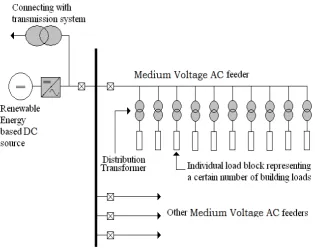
Reference [21] present the concept of a microgrid based on a DC energy pool. Fig. 2.1 presents the idea of the authors. The authors mention that energy from all the sources is be converted into DC and fed into the DC energy supplying network. The DC consumers take power directly while the AC customers take power after an inversion stage. Energy storage elements are there to cater for any mismatch between supply and demand of power.
2.3 DC Distributed Power System and its
Stability Issue
Figure 2.1: Concept of a microgrid based on dc energy pool [21]
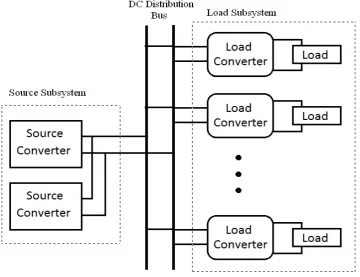
DC distributed power systems (DPSs) are essentially a multitude of power electronic converters, interfaced to one or more common DC buses. A DC DPS is different from a centralized power system in the sense that power conversion units are distributed and are located at the point-of-use as opposed to a central power conditioner. Fig. 2.2 shows a DC DPS with a source block consisting of two paralleled converters and arbitrary load converters. This figure may be compared with that of a DC microgrid as shown in Fig. 2.1
Stability is a core issue for the designers of a DC DPS. In such a multi-converter system, different power electronic multi-converters can be further loaded
Figure 2.2: Schematic diagram of a multi-converter dc DPS
with more converter units. This can lead to system instability because, al-though the individual converters are designed for stable operation; the in-tegrated system may have right half plane poles which will lead to system oscillations in the event of a small disturbance. This problem is further ag-gravated by the presence of constant power loads which behave as a negative impedance in the small signal system model.
Literature review related to the stability issue of DC DPS is presented subsequent to the next two sections, the first of which presents applications of DPS and the second discusses the concept of Constant Power Loads.
2.4 Applications of DC Distributed Power
Systems
DC DPS finds applications such as mainframe computers and similar electronic devices. Following are some of the major high power applications of a DC DPS:
2.4.1 The International Space Station
The international space station electric power system (ISS EPS) may be re-garded as one of the earliest highly multi-connected applications of a DC DPS. It was a complex system consisting of a fairly large number of DC/DC con-verters, back-up batteries and their associated charge/discharge units. The complete architecture consisted of both the 120-V American and 28-V Russian electrical networks, which were capable of exchanging power through dedicated isolating converters [23]. The system consisted of a higher voltage primary and a lower voltage more tightly regulated secondary DC bus.
2.4.2 Shipboard Power Systems
system where various zones separated by watertight bulkheads are powered by dedicated DC/DC converters [24]. In such a distribution system, AC power is first rectified to high voltage DC which is routed to different zones via the high voltage DC bus. Buck converters of individual zones, then convert this power according to the needs of loads of the zone [24].
2.4.3 Advanced Automobiles
Advanced automobile power systems are a relatively new and highly researched application of DC DPS. The trend of using electric power for the automobile propulsion system has brought forth new concepts such as electric vehicles (EVs), hybrid electric vehicles (HEVs) and fuel cell vehicles (FCVs). EVs use batteries and super capacitors for energy storage, however, there is no gen-eration of energy. On the contrary FCVs use fuel cells for energy gengen-eration which can be supplied to the system loads and/or it may be stored in bat-tery units connected to the main DC bus via charge/discharge converters or ultra-capacitors. In HEVs, conventional heat engine is present and its torque is mechanically coupled with the torque of electric propulsion system. High voltage DC is required by the electric traction system necessitating an HVDC bus. Overall, the power system is a multitude of power electronic converters interfaced to one or more DC buses.
2.5 Constant Power Loads
Power electronic converters with the requirement to maintain a constant value of output voltage and current increase/decrease their input current as in-put voltage decreases/increases respectively. This behavior is termed as con-stant power load (CPL) behavior and is opposite to that of a normal resistive load which increases/decreases its current as input voltage increases/decreases. Converter bandwidth plays an important role in this behavior with higher bandwidths leading towards ideal CPL behavior. A simple example of a CPL can be a DC motor drive which needs to provide a constant torque and a fixed rotational speed to the mechanical load. The drive will therefore sink constant power from its source which will lead to an increased current input if the input voltage drops and vice versa.
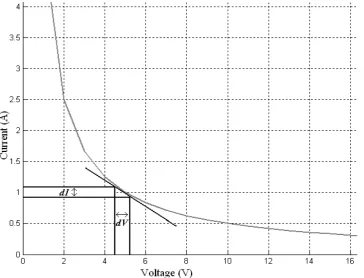
In small signal model, constant power loads show a negative impedance behavior. This unconventional behavior arises from the fact that, although the instantaneous impedance is always positive at any given time, the incremental value is negative. Fig. 2.3 shows the constant power behavior of a load (5 Watts) on VI axes plane. The CPL curve is linearized at a point and the incremental resistance is given as
𝑑𝑉
Figure 2.3: Constant power load behavior
As observed, increase in voltage leads to decrease of current and vice versa, causing negative value of the resistance. The negative impedance acts as a negative damping element and threatens to destabilize the system.
2.6 Brief History of Research Efforts in the
Field of DC DPS Stability
and input impedance of the DC/DC converter, in other words the impedances at the interface. This concept was later extended and applied to the stability of a DC/DC converter source block feeding a certain load.
Source impedance 𝑍𝑆 and load impedance 𝑍𝐿 are shown in Fig. 2.4. The
Figure 2.4: A source load system
ratio of 𝑍𝑆 to 𝑍𝐿 was termed as the loop gain and this ratio was used to
determine the stability of the integrated system. The name, loop gain, comes from the overall system input-to-output transfer function given as
𝑇𝑆𝐿= 𝑉𝑉𝑆𝑖 𝐿𝑜 =
𝑇𝑆𝑇𝐿
1 + (𝑍𝑆/𝑍𝐿) (2.2)
where this ratio appears as a system loop gain (𝑇𝑆 and 𝑇𝐿 are individual
The interface stability concept gained profound attention with the devel-opment of the International Space Station in the mid 90’s [23, 26]. The ISS electric power system (EPS) was one of the most complex DC distributed power systems of its time.
The ISS EPS engineers decided in favor of using the interface impedance ratio method for assessing the stability of the system as mentioned in reference [26]. A couple of years later, a major development for this method was made by the authors of reference [27] who provided a practical way which could be used to integrate large systems based upon modular approach. These authors assumed that 𝑍𝑆 is known for a system and they developed a criterion for the
input impedance of a load to be connected to this source such that the overall source load system remains stable. This criterion was based upon the idea of unacceptable phase bands on Bode plots for the input impedance of the load. If the phase of 𝑍𝐿 did not enter these unacceptable bands in the phase plot,
the system would be stable, even if ∣𝑍𝑆∣ > ∣𝑍𝐿∣ at these frequencies. This
unacceptable phase band was given by the expression
1800−𝑃 𝑀
1 <∠𝑍𝑆−∠𝑍𝐿< 1800+𝑃 𝑀2 (2.3)
The two phase margins (PM) were assumed to be 600 by the authors.
impedance stability technique, is a small signal technique and it did not ensure large signal stability. The authors mention that practical, analytical tools for ensuring large signal stability did not exist at that time, and for this task the ISS EPS team needed to include computer simulations and hardware testing in the system design.
The impedance stability criterion witnessed different small scale contribu-tions in its near future. The authors of reference [28] extended this concept to the case of multiple DC/DC converter sources paralleled together with master-slave current sharing. They derive expressions for individual source output admittances and design current sharing loop compensator for a stable system. In reference [29] the authors elaborated the forbidden region concept presented in reference [27] for a composite load, to the individual load modules of a com-posite load. On a Nyquist plot of𝑍𝑆/𝑍𝐿𝐾, where 𝑍𝐿𝐾 is the input impedance
of the kth load, this newly defined forbidden region for the kth load of the system was
𝑅𝑒( 𝑍𝑆
𝑍𝐿𝐾)≥=−
1 2
𝑃𝑙𝑜𝑎𝑑−𝑘
𝑃𝑠𝑜𝑢𝑟𝑐𝑒 (2.4)
𝑃𝑠𝑜𝑢𝑟𝑐𝑒 and𝑃𝑙𝑜𝑎𝑑−𝑘 are the power levels of the source and kth load respectively.
The corresponding allowable phase band on a Bode plot was given as
−900 −𝜙
𝑘 <∠𝑍𝑆−∠𝑍𝐿𝑘 < 900+𝜙𝑘 (2.5)
where
𝜙𝑘 =𝑎𝑟𝑐𝑠𝑖𝑛12𝑍𝑍𝐿𝑘𝑃𝑙𝑜𝑎𝑑−𝑘 𝑆𝑃𝑠𝑜𝑢𝑟𝑐𝑒
(2.6)
The authors of reference [30] present a practical way to measure the sta-bility margins of a system by online monitoring of the loop gain of a system. They choose 𝑆(𝜔) which is distance between the point (-1,0) and loop gain locus on the Nyquist plot as a quantifiable index of the stability margin and evaluate this by connecting an external perturbation current source 𝑖𝑝(𝑗𝜔) to
the DC bus and measuring the response current 𝑖𝑠(𝑗𝜔) of the system. 𝑆(𝜔) is
calculated as
𝑆(𝜔) = 𝑖𝑖𝑝(𝑗𝜔)
𝑠(𝑗𝜔)
(2.7)
Flanking the development of interface impedance stability criterion, there were other researches being carried out for stabilizing the system based upon classical and advanced control techniques. It was this stream of research which was later carried on in the 21st century while the former approach could not gain popularity. Because of the detailed involvement of transfer functions of individual converters, this approach was initially limited to only a few con-verters.
In reference [31] the authors present dynamics of a buck converter feeding a constant power load. They derive the line to output transfer function for
continuous conduction mode (CCM) in voltage mode control to be
𝐻𝑙−𝑜(𝑠) = 1−𝑠(𝐿/𝑅𝐷
𝑒) +𝑠2𝐿𝐶 (2.8)
where𝐷refers to duty cycle,𝐿and𝐶are converter inductance and capacitance and 𝑅𝑒 is given in terms of 𝐷, input voltage 𝑉𝑖 and output power 𝑃 as
𝑅𝑒= 𝐷
2𝑉2
𝑖
𝑃 (2.9)
attempted to ensure small signal stability of the system. Large signal stabil-ity still remained a challenging issue. This was dealt with the initiation of using advanced non-linear control techniques for DC DPS stability. One of these was sliding mode control explained for a Cuk converter in reference [34]. The second is feedback linearization as presented in reference [35, 36]. Unlike the usual process of linearization based upon Taylors series, the idea here is to choose such a non-linear control as can cancel out the non-linearity of the open loop system, so that the closed loop system becomes linear. This tech-nique attempted to establish feedback control based on non-linear coordinate transformation and tried to ensure an extended region of local stability [36]. After presenting this technique for a single buck converter loaded with a CPL, the authors extended it to two buck converters operating in parallel with equal current sharing. However this technique was later compared to the advanced synergetic control in reference [37] which showed superior performance besides boasting handling of system multi-connectivity and high-dimensionality. The pros and cons of synergetic control as well as other modern techniques for DC DPS stability are discussed in the following sections:
2.7 Phase Plane Analysis
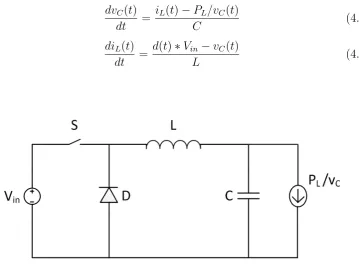
large can a large signal disturbance be for the system to regain stability after the transient. This technique determines a subset (called basin of attraction) of operating points in the super set of all possible operating points; so that this subset represents the stable region in the system state space. In other words, if the system is perturbed from its equilibrium operating point, but the shift in operating point does not move it beyond the basin of attraction, it will return to the equilibrium operating point. However, if the operating point is moved to a region outside the basin of attraction, this will lead to system instability as the operating point will not return to the equilibrium value. This is because of divergent nature of system state space trajectories outside the basin of attraction. Phase plane analysis technique can be illustrated with a simple buck converter feeding a CPL as shown in Fig. 2.5. Average model for this circuit is obtained by removing the fully controlled switch ‘S’and the diode‘D’while assigning the voltage source a value which is equal to the average voltage applied to the system. This voltage is given as𝑑(𝑡)∗𝐸 where
𝑑(𝑡)∈[0,1] is a continuous variable that models switching action and𝐸is the input voltage. The averaged model for this circuit is shown in Fig. 2.6.
The state space model of this system is given as:
𝑑𝑣𝐶(𝑡)
𝑑𝑡 =
𝑖𝐿(𝑡)−𝑃𝐿/𝑣𝐶(𝑡)
𝐶 (2.10)
𝑑𝑖𝐿(𝑡) 𝑑𝑡 =
𝑑(𝑡)∗𝐸−𝑣𝐶(𝑡)
Figure 2.5: Schematic of a buck converter feeding a CPL
Figure 2.6: Averaged circuit of buck converter feeding a CPL
where 𝑣𝐶(𝑡) and 𝑖𝐿(𝑡) are the state variables representing capacitor voltage
and inductor current respectively, 𝑃𝐿 is the CPL power, and 𝑑(𝑡) is the duty
cycle.
For the closed loop control of the system, choose a simple PD controller. This can be described as
where 𝑃 and 𝐷 are proportional and derivative gains, 𝑉𝑟𝑒𝑓 is the required
output voltage, 𝑥(𝑡) = (𝑣𝐶, 𝑖𝐿)𝑇 and
𝑢𝑒𝑞 = 𝑉𝐸𝑟𝑒𝑓 (2.13)
Based upon the definitions of control algorithm and d(t), there are three possible scenarios;
𝑑(𝑡) = 𝑢𝐶(𝑥(𝑡))𝑖𝑓 𝑢𝐶 ∈ (0,1) (2.14)
𝑑(𝑡) = 0𝑖𝑓 𝑢𝑐 <0 (2.15)
𝑑(𝑡) = 1𝑖𝑓 𝑢𝑐 >0 (2.16)
Corresponding to these values for 𝑑(𝑡), the system state space can be divided into three regions of operation.
𝑋0 ={𝑥(𝑡) :𝑑(𝑡) = 0} (2.17)
𝑋1 ={𝑥(𝑡) :𝑑(𝑡) = 1} (2.18)
𝑋01={𝑥(𝑡) :𝑑(𝑡)∈(0,1)} (2.19)
Reviewing phase plane analysis technique, it is noticed that this is merely an analysis technique and does not deal with control synthesis for stabiliz-ing the system. Also, apparently this technique has only been applied to a single source converter feeding a load. However, in practice there are many applications where source converters need to be paralleled and in such a case, the system contains as many state variables as the number of paralleled con-verters plus one. Since the number of states has increased, the application and visualization of phase plane analysis technique becomes challenging once again.
2.8 Synergetic Control
Control design for a DC distributed power system is plagued with problems such as non-linearity, multi-connectivity and high dimensionality [40]. Classi-cal control techniques find it difficult to struggle with all these issues of this complex system. Advanced techniques like sliding mode control [34] and feed-back linearization [36] attempt to mitigate the problem of non-linearity; how-ever the high order system dimensionality as well as the multiple connectivity still remain challenging issues.
analytical approach to control design for systems which are non-linear, multi-connected and highly dimensional [37]. However, here synergetic control theory is only described as applied to the DC DPS.
Synergetic control uses a non-linear system model and attempts to ensure a global or semi-global asymptotic stability [40]. It is based upon state space system modeling and it transforms the original or modified state space model into a new set of variables called macro-variables. These are then converted to manifolds and the control task is to move the system in an asymptotically sta-ble way towards the manifolds and then along the manifolds to the equilibrium point. To ensure stability, this technique derives stability conditions.
Considering the comparison of synergetic control technique with other tech-niques, large signal approach is what puts synergetic control ahead of classical control which designed the system for small signal stability. As mentioned by the authors of reference [23] working for the International Space Station, large signal stability could not be guaranteed by their techniques and they had to resort to hardware testing and extensive computer simulation to complete the stability triad. This also shows superiority of synergetic control to the mod-ern techniques of Pulse Adjustment Control and system damping variation as explained subsequently, as these techniques also ensure stability based upon
small signal modeling of the system. However, despite its advantages of supe-rior performance and designing control for complex systems, synergetic control technique shows oscillatory behavior for output voltage in discontinuous con-duction mode [37] and this needs to be mitigated by different techniques.
2.9 Pulse Adjustment Control Technique
Pulse adjustment control [45]-[47] is one of the latest control schemes designed for control and stabilization of converters loaded with CPLs. This digital con-trol technique stands out from the rest in the sense that it utilizes two different values of duty cycle for the same converter. It operates the converter in dis-continuous conduction mode which is its second most distinguishing feature.
Pulse adjustment control technique, demonstrated for buck-boost convert-ers, forces the converter to produce a number of high power and low power pulses in a certain time period. The low power pulse (LP), based upon the smaller duty cycle is designed so as to extract lesser energy from the converter voltage source than is required by the load. This causes output voltage to be reduced. The high power pulse (HP), based upon larger duty cycle works in the opposite manner and increases the output voltage. As a result, the pulse train of both these duty cycles maintains the output voltage within a small fluctuation of reference voltage.
Figure 2.7: Schematic of a buck-boost converter
in output voltage corresponding to a high power pulse as derived by the authors of [46] may be written as
△𝑣𝑂−𝐻𝑃 ∼= ( 𝑉𝑟𝑒𝑓 +𝐶𝑉 5 𝑟𝑒𝑓 𝐿𝑃2 𝐿 ) −
(𝐶𝑉5 𝑟𝑒𝑓 𝐿𝑃2 𝐿 − 𝑉2 𝑟𝑒𝑓𝐸 𝐿𝑃𝐿 𝐷𝐻𝑇𝑆+𝑉𝑟𝑒𝑓 )
𝑒𝐶𝑉𝑃𝐿𝐸𝑟𝑒𝑓3 𝐷𝐻𝑇𝑆 −
(
2𝑉𝑟𝑒𝑓 − √
𝑉2
𝑟𝑒𝑓 −2𝐶𝑃𝐿𝑡𝑂𝑁−𝐻 − √
𝑉2
𝑟𝑒𝑓 − 2𝐶𝑃𝐿𝑡𝑁−𝐻 )
(2.20)
where △𝑣𝑂−𝐻𝑃 represents output voltage variation for a high power pulse, 𝑃𝐿 represents the power of output CPL, 𝑇𝑆 represents switching time period, 𝑡𝑂𝑁−𝐻 represents the on time of switch S during a high power pulse and𝑡𝑁𝐻
represents the corresponding off time for both switches,𝑉𝑟𝑒𝑓 is required output
voltage and 𝐷𝐻 stands for duty cycle for the high power pulse.
The authors also derive an equation for output voltage variation in a low power pulse which can be obtained by replacing𝐷𝐻 by𝐷𝐿(duty cycle for low
1HP:1LP, 1HP:3LP and 2HP:1LP can be generated for ratio values of 1, 3 and 0.5 respectively. To analyze system stability using pulse adjustment control technique, the authors of reference [46] develop a small signal averaged model of the buck-boost converter loaded with a CPL and controlled by the two duty cycles 𝐷𝐻 and 𝐷𝐿. They derive the final condition for system stability to be
𝑇𝑆𝑉𝑖𝑛2
2𝐿 𝐷2𝐿< 𝑃𝐿 < 𝑇𝑆𝑉 2 𝑖𝑛
2𝐿 𝐷2𝐻 (2.21)
This is the range of CPL loads for which the controller can maintain output voltage and stabilize the system. The authors demonstrate this technique via simulation results.
Reviewing the pulse adjustment control technique, it is observed that the technique is still in its infancy and needs a lot of development. So far, it has only been demonstrated for buck-boost converter hasn’t been extended to the other two basic DC/DC converters. The next and major step would be extending this technique to multiple source converters paralleled together feeding a common load.
2.10 Varying System Damping to Cancel Out
Negative Resistance Effects
the advanced non-linear control techniques (feedback linearization, synergetic control) and is now in the era of digital control (pulse adjustment control). These techniques attempt to keep the system from going towards unbounded oscillations and thus keep it stable. However, another, relatively less popular approach for system stability is to alter the system in such a way that it becomes easy to design the controller or ensure stability.
An early work in this regard is done by the authors of reference [48] who propose an active bus conditioner which compensates the harmonic and reac-tive current present on the DC bus and acreac-tively damps out DC bus oscillations. This bus conditioner is an additional power electronic equipment that needs to be paralleled with the system load or the source. The working of this bus conditioner is explained on the basis of classical interface stability criterion utilizing impedance specifications. This device increases the input impedance of the load converter and thereby ensures that the minor loop gain𝑍𝑆/𝑍𝐿 does
not encircle the point (-1,0) on the Nyquist plot.
In recent times, the authors of references [22, 49] present similar concepts which introduce damping in the system to mitigate the negative impedance instability effect of CPLs and thus stabilize the open loop system, for which the closed loop design becomes easy to manage. They mention that increasing
the damping of the output LC filter compensates the negative impedance in-stability effect of CPLs, however, it also adds to the system losses. In order to overcome this problem, the authors present the idea of active damping in ref-erence [22] which is implemented by a virtual resistance that will increase the series resistance of the inductor used in the converter. Actual series resistance of the inductor 𝑅𝐿 is first measured and the necessary value is then calculated
using the condition
𝑅𝐿> ∣𝑅𝐿∣𝐶 (2.22)
In this equation 𝑅 represents parallel combination of a CPL and an ordinary resistive load as connected to the converter output. The authors derive this condition from small signal modeling of the system. To achieve the desired value of 𝑅𝐿, the authors compute 𝑅𝐿𝐴 which is the feedback gain producing
required damping. This value of 𝑅𝐿𝐴 is achieved by choosing from a network
of resistors in the feedback loop.
Reference [49] presents the idea of passive damping in such a way that the damping is operational only at the oscillation frequency of the system. At other frequencies, damping resistances are shorted out. The resonant frequency of an LC filter is given as
𝑓 = 1
2𝜋√𝐿𝐶 (2.23)
frequency, it should work the same as if the value of 𝑅𝐿 is otherwise increased
or a damping resistance is connected parallel to the CPL. For this concept of selective frequency damping, the authors present the concept of adding an auxiliary resistance (𝑅𝐴𝑈𝑋) to the buck converter. This resistance can either
be added parallel to the buck converter inductor or can be added as an RC system parallel to the load.
The authors mention that 𝑅𝐴𝑈𝑋 can be designed so as to be operational
DC Distribution versus AC
Distribution
(The content of this chapter has been presented at Australasian Universities Power Engineering Conference (AUPEC) 2009 [1]). This chapter presents an efficiency comparison of AC and DC distribution systems for residential areas with local (DC) distributed generation present in the system. It is shown that within the framework of assumptions, the two systems can be comparable in efficiency.
3.1 Distribution System Modeling
In order to model a residential distribution system; Energy Information Ad-ministration data [50] is used. It presents typical consumption of electricity in residential buildings for major categories of loads. A brief version of this data is presented in Table 3.1.
Table 3.1: Energy Usage by Appliance Category
No. Appliance Category Energy Usage(%)
1 Heating, Ventilation, Cooling 31.2
2 Kitchen Appliances 26.7
3 Water Heating 9.1
4 Lighting 8.8
5 Home Electronics 7.2
6 Laundry Appliances 6.7
7 Other Equipment 2.5
8 Other 7.7
This data is analyzed and loads are divided into three categories. Table 3.2 describes these categories and presents percentage loading of each of these categories in a typical building, based upon the data of [50].
Table 3.2: Description of Categories with Percentage Loading
Category Description Relative Percentage
A Loads utilizing AC power 52.6
D Loads utilizing DC power 16
to medium voltage feeders which start from the distribution grid. At the grid, the power source is a DC distributed generation system such as a fuel cell, photovoltaic, or a wind farm. The DC output power (intermediate step in case of wind farm) is inverted for AC distribution and then connected to the grid. In case of DC distribution, it is directly fed to the grid. The source is assumed to be sufficiently large to cater the needs of the particular system. During times of surplus power produced by the source, extra energy can be exported to the transmission system. Fig. 3.1 shows a simplified schematic view of the distribution system model.
3.1.1 AC Distribution System Model
The voltage chosen for medium voltage feeders, in case of AC distribution is 13.8 kV. For the sake of simplicity, one such feeder is considered in the simulation. It supplies power to 10 distribution transformers, each rated at 200 kVA, and assumed to be 97% efficient. Each of the transformers then supplies power at 230 Volts to 30 residential buildings. Within a building, heating loads and induction motor loads are assumed to be directly usable with 230 Volts. For DC loads, rectifiers are used. The efficiencies of power electronic converters are lower than electrical transformers, and this has been considered while choosing their values. Fig. 3.2 (a) shows a building load, based upon data of Table. 3.2 being used with AC distribution.
(a) (b)
Figure 3.2: Model of a typical building load with (a)AC power (b)DC power. D, A and I are categories of load as described in Table 3.2
input power of the system. The total load power is the same for both AC and DC systems. This power may be expressed as equation (3.1).
𝑃𝑡𝑜𝑡𝑎𝑙−𝑙𝑜𝑎𝑑𝑖𝑛𝑔 =𝑛𝐷∗𝑛𝐵∗𝐿𝑝𝐵; (3.1)
where 𝑛𝐷 represents number of distribuiton level transformers (or DC/DC converters in case of DC power distribuiton) in the system, 𝑛𝐵 stands for number of buildings served by one transformer (or DC/DC converter) and
𝐿𝑝𝐵 represents total load per building. Putting the corresponding values in equation (3.1) yields
𝑃𝑡𝑜𝑡𝑎𝑙−𝑙𝑜𝑎𝑑𝑖𝑛𝑔 = 10∗30∗15 = 1500𝑘𝑊 (3.2)
With the help of software simulation, the total input power of the AC system is determined to be 1757.8 kW. Efficiency of the system is calculated in equation (3.3).
𝜂= 𝑃𝑃𝑜𝑢𝑡𝑝𝑢𝑡
𝑖𝑛𝑝𝑢𝑡 ∗100 =
𝑃𝑡𝑜𝑡𝑎𝑙−𝑙𝑜𝑎𝑑𝑖𝑛𝑔
𝑃𝑡𝑜𝑡𝑎𝑙−𝑖𝑛𝑝𝑢𝑡 ∗100 =
1500
1757.8∗100 = 85.33% (3.3)
3.1.2 DC Distribution System Model
peak voltage value of the AC system is chosen as DC line-to-ground voltage.
𝑉𝑑𝑐−𝑙𝑔−𝑝𝑒𝑎𝑘=𝑉𝑎𝑐−𝑙𝑔−𝑝𝑒𝑎𝑘=𝑉𝑎𝑐−𝑙𝑔−𝑟𝑚𝑠∗
√
2 (3.4)
𝑉𝑑𝑐−𝑙𝑙 = 2∗𝑉𝑑𝑐−𝑙𝑔−𝑝𝑒𝑎𝑘 (3.5)
3.2 Results
Efficiencies of both AC and DC distribution systems; as determined in the previous sections, are compared and the DC system is found to be slightly more efficient than the AC counterpart. The DC system showed an efficiency of 87.8% as compared to 85.3% efficiency of the AC system. This can be at-tributed to no reactive currents flowing in the system, preventing the inversion stage of source DC power which occurs in case of the AC distribution system, and higher r.m.s voltage in case of DC system.
may be required to be tested for a system.
3.2.1 Comment on Results
Despite the fact that the results show an advantage of the new concept of DC distribution, nevertheless these results are based upon certain assump-tions. The most important of which is the values used for efficiencies of power electronic converters employed in the system. This, in particular, has been the case with a number of past papers [5], [7], [8] also, which used assumed values of converter efficiencies. These values often tend to be too high to be achievable for practical and economical reasons. Therefore the overall results of the research work become doubtful from a practical and economical point of view. A brief review of past papers shows that, DC is proved to be superior to AC in reference [5], for in-house distribution with a local DC generation, with converter efficiencies assumed to be 97.5%. The authors of reference [7] again show DC to be better than AC for low and medium voltage distribution but this effect is only observed at converter efficiencies of 99.5%. Similarly in reference [8] , the authors conclude that DC system does become better than AC if losses in semiconductor devices are reduced by half. This research work has assumed efficiency value of (95%) for power electronic converters.
be practically implemented only, if and when these minimum required values are achievable within the framework of economical and practical restraints.
The subsequent section presents a technique that allows finding out the minimum value of efficiency of power electronic converters to be employed in the DC system, which will make the DC system at least equally efficient as the counterpart AC system. If any values of efficiency higher than this calculated value are used, it will add to the advantage of the DC system.
3.3 Minimum Required Efficiency for Power
Electronic Converters in DC Distribution
System
This section briefly presents the steps leading to the formulation of a technique to calculate minimum required efficiency of power electronic converters in a DC distribution system which will make the system equivalent in efficiency to any given AC distribution system. A top-down approach is followed for the derivation of this technique i.e. calculations are started from the total input power of the system from the DC source, and are proceeded towards the lowest level of loads which are the individual categories of loads in residential buildings as listed in Table 3.2.
3.3.1 Step 1
distri-is the total power that will be taken in by the system. The value of 𝑃𝑖𝑛 will
be the same as for the AC distribution system since DC system has to match overall efficiency with the AC system while powering the same loads. 𝑃𝑖𝑛 can
be expressed in an equation form as
𝑃𝑖𝑛=𝛽.𝑃𝐼𝐷𝑋 +𝑙𝑖𝑛𝑒 𝑙𝑜𝑠𝑠𝑒𝑠 1 (3.6)
where 𝛽 is the number of distribution level DC/DC converters in the distri-bution system and the term 𝑙𝑖𝑛𝑒 𝑙𝑜𝑠𝑠𝑒𝑠 1 refers to the losses taking place in the distribution feeders transporting power from the bulk power source to the distribution level converters. For obtaining the value of 𝑃𝐼𝐷𝑋, an iterative
process is employed. To begin the iterative process a seed value is required for
𝑃𝐼𝐷𝑋 and to find out this value, the expression for 𝑃𝐼𝐷𝑋 is considered.
𝑃𝐼𝐷𝑋 = (𝛼.𝑃𝑏+𝑙𝑖𝑛𝑒 𝑙𝑜𝑠𝑠𝑒𝑠𝜂 2)
𝐷𝑋 (3.7)
where𝛼 is the number of residential buildings served by one distribution level DC/DC converter,𝜂𝐷𝑋 is the efficiency of the converter,𝑃𝑏 is the power input
in one building and the term 𝑙𝑖𝑛𝑒 𝑙𝑜𝑠𝑠𝑒𝑠 2 refers to the losses taking place in the power conductors running from a distribution converter to the associated buildings. It can be concluded that
𝑃𝐼𝐷𝑋 > 𝛼.𝑃𝑏 > 𝛼.(𝑃𝐼+𝑃𝐴+𝑃𝐷) (3.8)
equation (3.7) while the second part arises from the fact that total power input of a building is greater than the total power used by the loads because of losses taking place in household power electronic converters. Expression (3.8) allows to choose a suitable value for 𝑃𝐼𝐷𝑋 by assuming it to be slightly
higher (say 5%) than𝛼.(𝑃𝐼+𝑃𝐴+𝑃𝐷). Once this value of𝑃𝐼𝐷𝑋 is calculated,
the iterative process solves for voltage and current values at each distribution level converter, starting from the source side. When the far end is reached, the following equality is tested,
𝑉𝑐𝑎𝑙𝑐𝑢𝑙𝑎𝑡𝑒𝑑∗𝐼𝑐𝑎𝑙𝑐𝑢𝑙𝑎𝑡𝑒𝑑 =𝑃𝐼𝐷𝑋−𝑎𝑠𝑠𝑢𝑚𝑒𝑑 (3.9)
If the equality holds, then the value of 𝑃𝐼𝐷𝑋 assumed is the actual value
for the system. Otherwise, iteration is performed again with a modified value of 𝑃𝐼𝐷𝑋. The modification depends upon the results of the previous iteration.
Specifically, if
𝑉𝑐𝑎𝑙𝑐𝑢𝑙𝑎𝑡𝑒𝑑∗𝐼𝑐𝑎𝑙𝑐𝑢𝑙𝑎𝑡𝑒𝑑 < 𝑃𝐼𝐷𝑋−𝑎𝑠𝑠𝑢𝑚𝑒𝑑 (3.10)
then assumed value of 𝑃𝐼𝐷𝑋 is slightly reduced for the next iteration and vice
versa. A software program may be designed for this step, and the iterations may be terminated when product of voltage and current for the last distribu-tion level converter is suitably close to assumed value of 𝑃𝐼𝐷𝑋.
3.3.2 Step 2
buildings. Equation (3.7) is the starting point for this step. The line losses in this expression can be easily expressed as 𝐼2𝑅 losses with
𝐼 = 𝑃𝑉𝑏
𝑏 (3.11)
𝑅=𝑟1∗𝑙1 (3.12)
where𝑉𝑏 is voltage at each housing unit and𝑟1 and𝑙1 are resistance and length
of power conductors from distribution converter to individual buildings. The term𝑃𝑏 which symbolizes the power input in one building can be expressed as
𝑃𝑏 =𝑃𝐼+𝑃𝐴𝜂+𝑃𝐷
𝑃 𝐸𝐶 (3.13)
Substituting expressions of 𝑃𝑏 and 𝑙𝑖𝑛𝑒 𝑙𝑜𝑠𝑠𝑒𝑠 2 in equation (3.7), and
choos-ing a suitable value for 𝜂𝐷𝑋, the resultant can be simplified to produce the
following equation
𝑃𝐼𝐷𝑋 =𝑎.𝜂−2𝑃 𝐸𝐶+𝑏.𝜂𝑃 𝐸𝐶−1 +𝑐 (3.14)
where,
𝑎 = 𝑟1.𝑙1∗(𝑃𝑉𝐴2+𝑃𝐷)2
𝑏 ∗
𝛼
𝜂𝐷𝑋 (3.15)
𝑏=
[
(𝑃𝐴+𝑃𝐷) + 2𝑃𝐼(𝑃𝑉𝐴2+𝑃𝐷) 𝑏 ] ∗𝜂𝛼 𝐷𝑋 (3.16) 𝑐= [ 𝑃𝐼 +𝑃 2 𝐼 𝑉2
𝑏 ∗𝑟1𝑙1] ]
∗ 𝛼
𝜂𝐷𝑋 (3.17)
where 𝑎′ and 𝑏′ are the same as 𝑎 and 𝑏 while
𝑐′ = [
𝑃𝐼+ 𝑃 2 𝐼 𝑉2
𝑏 ∗𝑟1𝑙1] ]
∗ 𝜂𝛼
𝐷𝑋 −𝑃𝐼𝐷𝑋 (3.19)
Numerical analysis techniques such as bisection method may be applied to solve equation (3.18); or alternately 1/𝜂𝑃 𝐸𝐶 may be replaced by a dummy
variable ‘𝑥 which converts this equation to a quadratic equation as given in equation 3.20.
𝑎′.𝑥2+𝑏′.𝑥+𝑐′ = 0 (3.20)
This can be solved by quadratic equation formula to find x, and then𝜂𝑃 𝐸𝐶
can be calculated. The resultant value of 𝜂𝑃 𝐸𝐶 is the minimum efficiency
re-quired to make DC system at least as efficient as the AC system. If higher values for 𝜂𝑃 𝐸𝐶 are chosen, higher efficiency can be achieved for the DC
3.4 Case Study
A case study is presented in this Section which serves both as a demonstra-tion of the previously derived technique and as a verificademonstra-tion for it. The AC distribution system presented earlier, whose overall efficiency was reported in Section 3.2 to be 85.3%, is considered for the case study. The goal is to find out the efficiency of power electronic converters to be used in residential buildings, if the same system employs DC distribution and the overall system efficiency remains the same i.e. 85.3%.
Step 1 of the technique is executed and the iterations are performed by MATLAB code. After a certain number of iterations, the product of 𝑉𝑐𝑎𝑙𝑐𝑢𝑙𝑎𝑡𝑒𝑑
and 𝐼𝑐𝑎𝑙𝑐𝑢𝑙𝑎𝑡𝑒𝑑 is 173.37 kW while the value for 𝑃𝐼𝐷𝑋−𝑎𝑠𝑠𝑢𝑚𝑒𝑑 is 173.30 kW.
Since these values are fairly close, so this assumed value of 𝑃𝐼𝐷𝑋 is taken
to be the actual value for the system. In the next step i.e. step 2 of the technique, the previously calculated value of𝑃𝐼𝐷𝑋 is used for the calculations
of coefficients 𝑎′, 𝑏′ and 𝑐′ of equation (3.18). The values of various quantities
in the expressions for these coefficients are taken to be the same as in the case of AC distribution system. The only exceptions are the values of 𝑉𝑏 and 𝜂𝐷𝑋 which are taken to be 325 Volts and 95% respectively. Lastly, numerical
analysis is used to solve equation (3.18) and 𝜂𝑃 𝐸𝐶 is calculated to be 89.55%.
as the AC counterpart. To verify the technique, the above achieved value of
𝜂𝑃 𝐸𝐶 was used for the simulation of DC system just as the system of section
3.1.2, and efficiency of the DC system was calculated in the same way to be 85.37%. This value is approximately equal to the efficiency (85.3%) of the AC system to be replaced by DC distribution. Hence the technique was verified.
3.5 Summary
In this Chapter an efficiency comparison was made between DC and AC dis-tribution systems. For the assumed conditions, it was observed that the DC paradigm is better in efficiency than its AC rival. Furthermore, in this respect, a mathematical technique was presented which allows to find out the minimum required efficiency of power electronic converters in a DC distribution system that can make this system at least as efficient as an AC counterpart.
Hybrid of Voltage and Current
Mode Control Technique
(Some of the content in this chapter has been submitted for publication in In-ternational Journal of Engineering, Science and Technology, 2011 [51]). This chapter presents a current-limiting idea based control technique which can al-low a buck converter loaded by a constant power load to operate in open loop in continuous conduction mode without becoming unstable. Traditionally, such a system has been considered to be unstable (as discussed in Chapter 2). Trans-fer functions have been developed for this system in continuous conduction mode (CCM) and discontinuous conduction mode (DCM) and it is stated to be unstable in CCM with either current mode control (CMC) or voltage mode control (VMC).
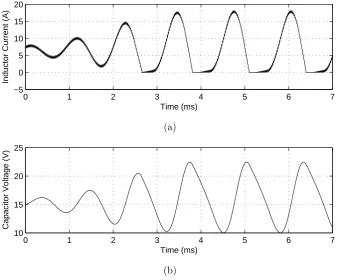
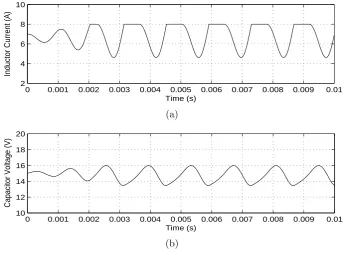
and the increasing current oscillations finally touch the lower limit for inductor current which is zero amperes. This leads to system operating mode shift from CCM to DCM. Then the system continues to operate with shifting operating modes while the oscillation amplitudes for current and voltage reach a certain fixed value. This can be observed in Fig. 4.1
0 1 2 3 4 5 6 7
−5 0 5 10 15 20
Time (ms)
Inductor Current (A)
(a)
0 1 2 3 4 5 6 7
10 15 20 25
Time (ms)
Capacitor Voltage (V)
(b)
Figure 4.1: Simulation waveforms of a system of buck converter loaded with a CPL starting in CCM
instability to marginal stability was putting a check or limit on 𝑖𝐿. Not only
does this limit prevent𝑖𝐿 from going below a certain value (i.e. zero amperes),
but it also eventually stops the increase in peak values of𝑣𝐶 and 𝑖𝐿, as can be
seen from Fig. 4.1.
So, this limit, although for the lower peak value of𝑖𝐿, serves to put a check
on the upper peak of 𝑖𝐿 as well. Based upon this idea, it can be argued, that
what if there could be a limit on the upper peak value which would put a check on lower peaks of 𝑖𝐿? If such a limit can be introduced in the system then
it might be stable or marginally stable in continuous conduction mode, if the lower peak is totally avoided. In other words, what if there is a limit on upper peak values of 𝑖𝐿 which can keep the system from being unstable as well as
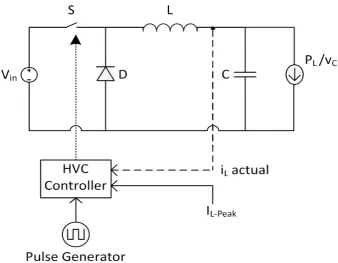
keep it in continuous conduction mode? This is an abstract discussion for the basic principle of the control technique (named HVC - Hybrid of Voltage and Current mode control) presented in this chapter which is based on the idea of current limiting. In this control technique, an upper limit is specified for 𝑖𝐿.
![Figure 2.1: Concept of a microgrid based on dc energy pool [21]](https://thumb-us.123doks.com/thumbv2/123dok_us/7934543.1317403/28.595.120.449.106.348/figure-concept-microgrid-based-dc-energy-pool.webp)