CHIMERA: Combining Ring-LWE-based Fully
Homomorphic Encryption Schemes
Christina Boura1,4, Nicolas Gama1,2, Mariya Georgieva2,3, and Dimitar Jetchev2,3
1 Laboratoire de Math´ematiques de Versailles, UVSQ, CNRS, Universit´e
Paris-Saclay, Versailles, France 2 Inpher, Lausanne, Switzerland 3
EPFL, Lausanne, Switzerland 4 Inria, Paris, France
Abstract. This paper proposes a practical hybrid solution for combin-ing and switchcombin-ing between three popular Rcombin-ing-LWE-based FHE schemes:
TFHE,B/FVandHEAAN. This is achieved by first mapping the different plaintext spaces to a common algebraic structure and then by applying efficient switching algorithms. This approach has many practical appli-cations. First and foremost, it becomes an integral tool for the recent standardization initiatives of homomorphic schemes and common APIs. Then, it can be used in many real-life scenarios where operations of dif-ferent nature and not achievable within a single FHE scheme have to be performed and where it is important to efficiently switch from one scheme to another. Finally, as a byproduct of our analysis we introduce the notion of a FHE module structure, that generalizes the notion of the external product, but can certainly be of independent interest in future research in FHE.
Keywords: fully homomorphic encryption, Ring-LWE, lattice based cryptography, floating point computation,TFHE,B/FV,HEAAN
1
Introduction
Homomorphic encryption enables computations on encrypted data without de-crypting it. Shortly after the development of the first fully homomorphic encryp-tion (FHE) scheme by Gentry [21], extensive research has been carried out on the design, implementation and cryptanalysis of various other FHE schemes.
It is thus of central importance to be able to use the optimal scheme for each type of operation in a particular computation. This motivates the need for building an efficient hybrid solution combining more than one scheme and switching between these schemes during the individual operations.
This paper proposes such a practical hybrid solution based on efficient switch-ing algorithms for three different Rswitch-ing-LWE schemes, where each scheme is best suited for certain types of operations: 1)TFHE [17, 16] particularly suitable for combinatorial operations on individual slots and tolerating large noise and thus, large multiplicative depth. 2)B/FV[6, 19, 12] allowing to perform large vectorial arithmetic operations as long as the multiplicative depth of the evaluated circuit remains small; 3)HEAAN[15, 14] - a mixed encryption scheme shown to be very efficient for floating-point computations.
We achieve such a hybrid solution by first mapping the different plaintext spaces of the different schemes to a common algebraic structure using certain natural algebraic homomorphisms. Once such a uniformization of the plaintext spaces has been achieved, we describe our scheme switching algorithms. The main idea here is to replace the expensive bootstrapping algorithms with more efficient key-switching operations. Recall that if S1 and S2 are two homomor-phic encryption schemes then the concept ofbootstrapping, originally introduced by Gentry [21], is a homomorphic evaluation (under the scheme S2) of the de-cryption function for the schemeS1. Since all Ring-LWE-based FHE decryption functions evaluate an inner product followed by a rounding function and since the rounding function is a step function, instead of first applying the expen-sive bootstrapping and then evaluating a function f, one can replace the last rounding step in the bootstrapping by a more general step functiong that ap-proximatesf and use a homomorphic lookup table evaluation. This is essentially the idea of the key-switching algorithms described in Section 2.2 that are later used to achieve a switch between the schemes in Sections 3 and 4. Note that the concept of functional key-switch is not new (it appeared already in the context ofTFHE [16] and implicitly in the work of Ducas and Micciancio [18]). Yet, its application to scheme switching presented in this work is novel.
To better explain the algebraic aspects of our approach, we letRm denote the quotient ring (Z/mZ)[X]/(XN + 1) for some integersm andN and we let
T = R/Z be the torus. To introduce the algebraic structure of the plaintext spaces inTFHE, we distinguish two different underlying encryption schemes (an encryption scheme on a ring and a homomorphic one on a module over that ring):
– TRGSW: encryption scheme on the ringR:=Z[X]/(XN + 1),
– TRLWE: HE scheme on theR-moduleTR:= (R[X]/(XN+ 1))/R.
On the other hand, the plaintext space ofB/FV isRp for some integerp(a prime, a power of 2 or a small number 1 mod 2N, depending on the functionality that we want) and the ciphertext space isR2
q for some larger integerq. Finally, HEAANhas for message space a ball of radiusB inRq with respect to a certain
`∞-norm defined in Section 2.4 and its ciphertext space isR2q.
It is not too hard to verify that in the three cases listed above, the ciphertext spaces share very similar algebraic structures. For B/FV and HEAAN this is trivial to do; for TFHE, it suffices to identify the ciphertext space R2
q with a subgroup of the torus (TN)2as follows: using thatR2
q '((Z/qZ)N)2, we simply identify q−1Z/Z
'Z/qZ, the latter being the multiplication-by-qisomorphism ofZ-modules.
Yet, the plaintext spaces area priori rather different. In order to apply any key-switching technique, one thus needs to uniformize them (i.e., map them to the same algebraic structure). In addition, this algebraic structure should carry a specific metric allowing us to quantify and measure the noise in the decryption function. We achieve this by using the plaintext space of TFHE, namelyR[X]/(XN+ 1) moduloZ(a space we introduce in Section 2 and denote byTRthroughout the paper). We then show how to map bothB/FVandHEAAN
plaintexts toTR in Sections 3 and 4.
Our hybrid solution has many practical applications. First and foremost, it becomes an integral tool for the recent standardization initiatives of homomor-phic schemes and common APIs [8], especially since TFHE, B/FV (Seal) and HEAANare part of this standardization process.
Then, imagine a scenario where operations on large datasets must be per-formed and a decision must be taken on the result. The first part would be easier via theB/FV scheme, whereas the decision function can be evaluated faster in TFHE. Therefore, one would like an efficient method to pass fromB/FVtoTFHE. Similarly, if more approximate computations have to be performed, one would benefit from a scheme switching betweenHEAANand TFHE. Another example comes from the recent Idash’18 Track 2 [2] competition on designing homomor-phic solutions for semi-parallel Genome Wide Association Studies (GWAS). One of the operations needed for the challenge required to compute homomorphically the product G−1
calculations inB/FVorHEAAN. In such a scenario, it is important to transform TFHEciphertexts to B/FV orHEAANones.
As a byproduct of our analysis of the three above schemes from the perspec-tive ofTFHE, we propose the general definition of aFHE module structure, that is, an external product allowing to homomorphically evaluate the action of the ring R on the module M wheneverM is equipped with an HE scheme and R
is equipped with a FHE scheme. This concept already appears in a particular case in [16] (named as external product), but it can certainly be of independent interest in future research in FHE. For instance, it permits to express the relin-earization in the internal products of HEAAN and B/FV in terms of the FHE module structure forTFHEand this without loss as it is the same algorithm.
T
TR
P=X−p
Ball∞(1
2ℓ) CN
2 TLWE
TRLWE B/FV
B/FV-Slot
B/FV-BigNum
TFHE Gate bootstrap
B/FV bootstrap
HEAAN bootstrap
TLWE TLWE
HEAAN-Slot
HEAAN P=p
P−1R/R
Fig. 1: Bridges between Ring-LWE homomorphic schemes. Plain arrows represent bridges between the different schemes. Dotted arrows represent inclusion. Finally, the spacesP=pandP =X−pare instantiations ofP−1R/R.
2
Preliminaries
Let T = R/Z be the real torus and let R = Z[X]/(XN + 1) be the ring of polynomials with integer coefficients modulo XN + 1. For a ring A (e.g., A =
Z,R,C), letRA:=R ⊗ZA=A[X]/(XN+ 1) be the ring of polynomials modulo
XN + 1 with coefficients in A. In particular, R = R
Z, so we interchangeably omit the index.
LetTR =RR/RZ (a.k.aR[X] modXN + 1 modZ) which we view as an R-module (it has no ring structure). We often refer to the left action ofRonTR as anexternal multiplicationwith coefficients inR. Moreover, letBbe the subset of all polynomials of RZ with coefficients in{0,1} (here, we identifyRZ'ZN as Z-modules in the natural way). Finally, ifx ∈ R, let Rx = R/xR and let
We use the`p-distance on theN-dimensional torus TN and writekx−ykp for the distance between two elements x, y ∈ T. Note that it satisfies ∀m ∈
Z,km·xkp ≤ |m| kxkp. For an integer element a∈TR, consider any represen-tative a(X) = a0+· · ·+aN−1XN−1 ∈ R[X]. We will (unambiguously) write
kakpfor the norm of the image of (a0, . . . , aN−1) inTN. The notion of Lipschitz function always refers to the`∞-distance: a functionf:Tm→Tn is said to be κ-lipschitz if kf(x)−f(y)k∞ ≤κkx−yk∞ for all inputs x, y, where k · k∞ is
the`-infinity norm.
In this work, we revisit the three scale-invariant families of HE schemes (TFHE in Section 2, B/FV in Section 3 and HEAAN in Section 4), all of them based on the Ring-LWE problem introduced in [24]. More precisely, we present a slightly different interpretation of these schemes through the concept of FHE module structure that provides a more conceptual interpretation of the corre-sponding homomorphic evaluation of the action of a ring on a module over that ring. More importantly, in the subsequent sections, we realize each of the plain-text spaces of the schemesB/FV,TFHEandHEAANas subsets of theR-module
TR which enables the scheme-switching algorithms.
2.1 The concept of FHE module structure
The definition below assumes that the decryption algorithms do not introduce any noise in the plaintext (i.e., the decryption is exactly the original message). Note that this allows for probabilistic encryption algorithms.
Definition 1 (Noiseless FHE Module Structure). By a noiseless FHE module structure, we mean a 7-tuple(R, M,EncR,DecR,EncM,DecM, )where
– Ris a ring with an encryption scheme(EncR,DecR)onRwithout decryption noise and with ciphertext spaceCR,
– M is an R-module with a homomorphic encryption scheme (EncM,DecM) without decryption noise and with ciphertext spaceCM,
– :CR× CM → CM is an operation (external product) satisfying DecM(EncR(r) EncM(m)) =r·m, ∀r∈R, m∈M.
Although quite general, the above definition has several drawbacks as detailed through the following remarks.
Remark 1. WhileTFHEfits exactly in this definition (with the algorithmsTRGSW and TRLWE), the schemeHEAANfalls outside of its scope, as its decryption is noisy (i.e., no rounding is used).
1. Abstracting an adequate model for the correctness of the decryption. 2. Abstracting the security properties of these schemes.
To address these two major questions, the pure probabilistic approach seems insufficient. In the next section, we will restrict the above definition toM =TR and use the metric properties of the torus to define a noisy version that would address points 1. and 2. above.
2.2 TFHE
Here, we revisit theTFHEscheme using the definition of the FHE module struc-ture. In practice, the definition of the FHE module structure does not directly apply to TFHE. One needs here a leveled version of this definition (i.e., after each operation, the standard deviation or the noise in the decryption increases until it is impossible to decrypt by rounding).
TFHE consists of three major encryption/decryption schemes, each repre-sented by a different plaintext space. First, the schemeTLWEencrypts messages over the entire torusTand produces ciphertexts inTN+1. The other two schemes are:
– TRGSWencrypts elements of the ringRZ(integer polynomials) with bounded
`∞-norms (of the corresponding vectors in ZN under the natural identifica-tionR 'ZN).
– TRLWEencrypts elementsµof theRZ-moduleTR that can also be viewed as elements ofTN via the natural bijectionT
R'TN.
There is an external product αdepending on a noise parameterα[16, Cor. 3.14] that we recall in detail in Theorem 1 below. This theorem yields a FHE module structure on the schemesTRGSW andTRLWE.
InTFHE,TLWEciphertexts of a messageµ∈Thave the form (a,b=hs,ai+
µ+e)∈TN+1wheres
∈ {0,1}N is the secret key,a
∈TN is uniformly random ande∈Tis sampled according to a noise distribution centered at zero. Similarly, forTRLWE, ciphertexts ofµ∈TR are of the form (a, b=s·a+µ+e)T2R where s∈ B,a∈TR is uniformly random ande∈TR.
The decryption in TLWE (resp.TRLWE) uses a secret κ-Lipschitz function (here,κ >0 is small and we mean ”with respect to the`∞-norm on the torus”) ϕs:TN ×T → T (resp. ϕs: TR×TR → TR) called phase parametrized by
a small (often binary) secret key s ∈ {0,1}N (resp. s
∈ B) and defined by (a,b)∈TN
×T7→b− hs,ai(resp. (a, b)7→b−s·a). The fact that the phase is aκ-Lipschitz function for small κ≤N+ 1 makes the decryption tolerant to errors and allows working with approximated numbers.
Sinceϕs(a, b) =b−s·a=µ+e, the decryptionµand the noise parameterα are the mean and the standard deviation of the phase functionϕs(a, b), respec-tively (here, the mean and standard deviation are computed over the random coins in the encryption algorithm). The expectation, variance and standard de-viation on the torus are well defined only for concentrated distributions (defined in [16, 2.1]) whose support is included in a ball of radius 1/4 (up to negligible tails). This is the case of the error distribution of T(R)LWE. More information on the definition of expectation and standard deviation for concentrated distri-butions on the torus can be found in [17, 16]. The benefit of the definition of the message as the expectation of the phase is that it is valid with infinite precision on any (discrete or non-discrete) subset ofTR . Note that this definition is only
useful for analysis (e.g., proving the correctness of the cryptosystem) and cannot be used for decryption since the expectation of the phase cannot be computed in practice from a single sample of the distribution.
Below, we describe the parameters and the algorithms that are used forTFHE with theTRLWEencryption scheme.
Parameters: A security parameterλand a minimal noise parameterα. These parameters implicitly define a minimal key sizeN. For more details see the FHE standardization workshop security document [3].
KeyGen/Phase: A uniformly random binary key s ∈ B. This key implicitly defines the secretphase function
ϕs:T2R→TR,(a, b)7→(b−s·a).
Encrypt (µ, s, α): To encrypt a message µ∈TR, choose a uniformly random a∈TR and a small Gaussian errore← DTR,α, and return
Encrypt(µ, s, α) =
def(a, s·a+µ+e).
DecryptApprox(c, s): (approx) Return ϕs(c) which is close to the actual message.
Decrypt(c, s,M): (rounded) Round ϕs(c) to the nearest point in M. Here,
M ⊂TRis subset of plaintext messages and the nearest point is with respect
to the distance function onTR'TN.
Messages(c): (probabilistic) This is the expectation ofϕs(c) (with respect to the random coins used in the noise). It can be viewed as a perfect decryption algorithm with infinite precision.
Public linear combination over RZ: return k
X
i=1
ai·ci, where ci ∈ T2R and
ai ∈ RZ fori= 1, . . . , k.
External product: Given aTRGSWciphertextAencrypting a messageµA∈
RZ and a TRLWE ciphertext b of a message µb ∈TR, compute A αb at precisionα >0, which encryptsµA·µb∈TR (see [16] and Theorem 1)
Apply a Z-module morphismf: use a key-switch algorithm (Theorem 2 and described in Algorithm 2 in [16]).
SampleExtracti(c) Given aTRLWEciphertextcof a messageµ∈ RZ, extract from c the TLWEsample that encrypts the ith coefficientµi with at most the same noise variance or amplitude asc(see [16] Section 4.2), defined as:
SampleExtracti(c) =
def((ai, ai−1, . . . , ai−N+1), bi).
To ease the reading of this paper, we specify only one particular instantia-tion ofTFHE5, all bit-decompositions are binary. We present all theorems with decomposition in base 2 (for bootstrapping, key-switch, external product and bitdecomp) to minimize the number of parameters in the formulas. To perform an operation at precision α 1 (i.e. noise standard deviation α during the operation), we always use `=−log2(α) terms in every bit decomposition.
The primary definition of α is the noise’s standard deviation during the current operation:αis thus not a static parameter of the framework. Then, the notions of noise rate, precision and approximate decomposition error, key-switch noise and bootstrapping noises are equal toαor proportional to it.
AnyTLWE,TRLWE,TRGSWciphertext, bootstrapping key or key-switching key given at a higher precision, can always be rounded and truncated to match the current precision α. Working with precision α implies a minimal size for the current binary key (as a simple rule of thumb, the minimal key size N
that provides 128-bit of security is roughly the smallest power of two larger than max(256,40|log2α|). The actual key size should be determined either from the standardization document [3] or from the LWE estimator by Albrecht et al. [4]. Whenever αvaries (e.g. increases after each multiplication, or decreases after a bootstrapping), we always use the last key-switching and bootstrapping operation to switch to the smallest possible key that matches from the security estimates.
External product. There is a compatibility between the ciphertexts ofTRGSW andTRLWEthat can be expressed algebraically in the following manner: observe that the plaintext space for TRGSW is the ring R and the plaintext space for TRLWEis theR-moduleTR. In this case, one can define the following external
product (a homomorphic action) (first introduced in [7] and formalized on the torus in [17]) ofRonTR:
Theorem 1. (External product [16, Cor. 3.14]) Letcr be aTRGSW ciphertext of a message r∈ RZ and let cm be a TRLWE ciphertext of a message m∈TR
such that cm is independent of the random coins used for cr. There exists a homomorphic external product algorithm (described explicitly in [16, Sec. 3.3])
5 With this choice, the parameters from [16] correspond to:k = 1,β = 1,Bg = 2,
and denoted bycr αcmsuch that Messages(cr αcm) =r·mwith noise standard deviation α >0 and
Var(Err(cr αcm))≤2`NVar(Err(cr)) + 1 +N
4 krk 2 2α
2+
krk22Var(Err(cm)). In general, this theorem will be used to multiply aTRLWEciphertextcmby a precomputedTRGSWciphertextcr(e.g., a ciphertext of the binary secret key in the case of bootstrapping): in this case, we can chooseVar(Err(cr)) =α2, and we havekrk22≤N (or even krk22= 1 ifTRGSW ciphertexts encrypt only single bits, as in [17] and [16]). In this case, the working precisionαequals the targeted output precision divided byN, so that the first two error terms in the theorem remain negligible.
Key-switching. In order to switch between the scalar and polynomial message spacesTandTR, the authors of [16] generalized the notions of sample extraction
and key-switching. On one side, aPubKS(f,KS,c1, . . . ,cn) algorithm homomor-phically evaluates linear morphismsf from anyZ-moduleTntoT
N[X] using the functional key-switching key KS. It is possible to evaluate also a private linear morphism, but the algorithm is slower.
Theorem 2. (Functional key-switch adapted from [16, Thm. 4.2]) GivenrTLWE ciphertextsci∈TLWES(µi), a publicκ-LipschitzZ-module homomorphism
f:Tr→TR
and KSi,j ∈ T(R)LWEK,α(Si2j) with standard deviation α and Si the i-th coef-ficient of the key S, Algorithm 2 described in [16] outputs a T(R)LWE sample
c∈T(R)LWEK(f(µ1, . . . , µr))such that
Var(Err(c))≤κ2max(Var(Err(ci))) +α2(`N2+
N
4). .
Non-linear functions. In TFHE, a negacyclic function f: T → T (i.e. f(x+ 1/2) = −f(x)) can be homomorphically applied to the phase of an individual TLWEciphertextc∈Tn+1with a n-bit keyK where each individual coefficient is rounded to the nearest multiple of 1/2N. More precisely, given the values
f(i/2N) fori= 0,1, . . . ,2N−1, [16, Alg.4] outputs a ciphertextc0 ∈TN+1 of the plaintextf(bϕK(c)e) encrypted with key S∈ {0,1}N.
Theorem 3. (Functional bootstrap adapted from [16, Thm. 4.3]) Given aTLWE ciphertext c ∈ Tn+1 encrypted with an n-bit key K ∈ {0,1}n where each in-dividual coefficient of c is rounded to the nearest multiple of 1/2N, a nega-cyclic function f: T→T restricted to(2N)−1Z/Z
⊂Tand a bootstrapping key
BK =TRGSWS(Ki) with standard deviation α, Algorithm 4 described in [16] outputs a TLWE sample c0 ∈TN+1 encrypting f(ϕK(c)) with key S ∈ {0,1}N such that:
Until now, the most frequent non-linear function used in bootstrapping is the rounding function, since rounding the phase of a ciphertext is equivalent to de-crypting it, and homomorphic decryption is the noise-reduction method proposed by Gentry in 2009 [21].
2.3 B/FV (Brakerski, Fan–Vercauteren, and Seal).
In this scheme, the message space is the finite ringRp= (Z/pZ)[X]/(XN+1) for some integer p(typically a power of 2 or a prime number). A messageµ∈ Rp is encrypted on a quotient ring Rq (for a larger modulus q) as a ciphertext (a, b) ∈ R2
q where a ∈ Rq is chosen uniformly at random and b is sampled from DRq,σ,s·a+pqµ. Here, DRq,σ,µ is the discrete Gaussian distribution overRq centered at µ with standard deviation σ (discrete means that the values are integers only). In addition,s∈ B is the secret key.
Homomorphic addition of two ciphertexts (a1, b1) and (a2, b2) is achieved by component-wise addition. The idea behind the homomorphic multiplication of two ciphertexts (a1, b1) and (a2, b2) is a technique referred to asrelinearization: one first lifts (ai, bi) ∈ R2q to (eai,ebi) ∈ R2 where each coefficient is lifted to [−q/2, q/2) and then view of µi as being expressed as a linear polynomial on
s (i.e., µi ∼
p
q(bi+s·ai)). One then computes the quadratic polynomial
cor-responding to the product, namely p
q(b1+s·a1)· p
q(b2+s·a2), and uses the
relinearization described in [19, p.7–9] to write this product as p
q(b+s·a) and
determine the coefficients (a, b)∈ Rq.
The noise amplitude grows by a small factor O(N) on average after each multiplication, so it is a common practice to perform amodulus-rescaling step, that divides and rounds each coefficient as well as the modulus qby the same scalar in order to bring the noise amplitude back to O(1) so that the subse-quent operations continue on smaller ciphertexts. For more details and formal definitions see [6, 19].
We will show in Section 3 how to embed the plaintext space ofB/FVin TR
and how to then use the TFHE module structure to evaluate the above B/FV homomorphic product in a natural way.
2.4 HEAAN
In this scheme, the message space is the subset ofRq containing all elements of norm≤Bfor some boundB, where the norm of an elementx∈ Rq is defined as
kexk∞. Herexe∈ RRis the minimal lift ofx, i.e., coefficients lifted to [−q/2, q/2).
the same formula as in B/FV including relinearization: if both input messages are bounded by B with O(1) noise, the product is a message bounded by B2 with noiseO(B), so it is a common practice at this point to perform a modulus-rescaling step that divides everything byB to bring the noise back toO(1) (see [15]). Unlike B/FV, this division in the modulus switching scales not only the ciphertext but also the plaintext by B. This can be fixed by adding a (public) tag to the ciphertext to track the number of divisions byBperformed (see more details in Section 4).
2.5 TR as the common plaintext algebraic structure
As mentioned earlier, the three homomorphic schemes use nearly the same ci-phertext space (up to rescaling by a factorq). In addition, all decryption methods make use of the phase function up to minor differences: b−saversusb+sain B/FVor
m
X
i=0
si·ai,s∈ R,ai∈TR for various values ofmin Seal [12]. Yet, the
plaintext spaces are`a prioridifferent as they are based on different mathematical structures (groups, rings, intervals, random sets).
In order to exploit the advantages of each scheme, we need to be able to homomorphically switch between the different plaintext spaces, and most im-portantly, to give a meaningful semantic to these transformations.
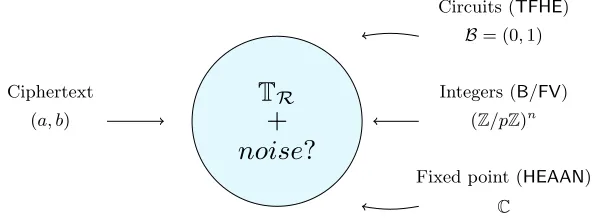
The main idea that enables us to give a meaningful semantic to the scheme switching transformation is to interpret all the plaintext spaces as being em-bedded in the same module TR as shown in Figure 2 and to use the distance function on the torus to quantify the transformation error. In this setting, all schemes use the same ciphertext spaceT2
R, the same key spaceBand the same
phase functionϕs(a, b) =b−s·a. Thus, the probabilistic characterization of the message and error as the expectation and the standard deviation of the TFHE phase, respectively, are automatically extended to all schemes.
T
R+
noise
?
Ciphertext(a, b)
Integers (B/FV)
(Z/pZ)n
Fixed point (HEAAN)
C
Circuits (TFHE)
B= (0,1)
2.6 Real and complex slots for B/FV, TFHEand HEAAN
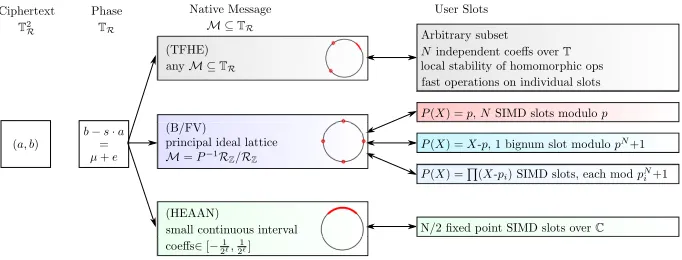
In this section we recall the representations of the plaintext spaces of the three schemes via theuser slots. This is indeed the representation used in the current implementations.
B/FV. InB/FV, homomorphic operations are performed either onN SIMD slots modulo a medium-size integerp[19, 12], or more recently, on a single big-number slot modulopN+ 1 [13]. In both cases, the set of these slots has a ring structure and is isomorphic to a quotient ofRZ by a principal ideal (thenative plaintext in [13]).
HEAAN. InHEAAN, homomorphic operations are performed onN/2 SIMD slots containing complex numbers in fixed-point representation with the same public exponent and the same precision. By interpolating the complex roots ofXN+ 1, the native plaintext can be mapped to small polynomials of TR (i.e., a
zero-centered ball of small fixed radius) since the complex DFT matrix is Hermitian. We achieve this in Section 4.
TFHE. Finally, inTFHE, the message space is an arbitrary subset ofTR, without any particular structure.
Preserving the user slots. In order to introduce the notion of slots (real or complex), we use the following two isomorphisms ofR-vector spaces:
RR'RN, f =a0+· · ·+aN−1XN−17→(a0, . . . , aN), (1) and
RR'CN/2, f 7→(f(ζ), f(ζ3), . . . , f(ζN−1)). (2) Here ζ =eπi/N is a primitive root of XN + 1. Representation (1) corresponds to what is called the coefficient packing and representation (2) corresponds to what is called the slot packing.
The unified native plaintext spaces and the correspondence with the user-space slots are shown in Figure 3.
3
A general abstraction of
B
/
FV
over the torus
The B/FV scheme is very efficient in evaluating arithmetic circuits (i.e. poly-nomials on the plaintext). Yet, huge slowdowns are observed when evaluating comparisons, the sign function or other non-linear decision diagrams that do not correspond to sparse low-degree polynomials. Here, we propose an alterna-tive approach that switches to a different scheme, and for instance, executes the non-arithmetic operation via TFHE’s gate bootstrapping. We explain how to represent the plaintext spaces in order to enable this conversion.
Originally, the construction ofB/FV usesRp as the plaintext space, where
Ciphertext Phase Native Message User Slots
(a, b) b−s·a
anyM ⊆TR
small continuous interval principal ideal lattice
local stability of homomorphic ops Arbitrary subset
P(X) =p,NSIMD slots modulop
P(X) =X-p, 1 bignum slot modulopN+1
N/2 fixed point SIMD slots overC fast operations on individual slots Nindependent coeffs overT
P(X) =Q(X-pi) SIMD slots, each modpN i+1 T2
R TR M ⊆TR
(TFHE)
(B/FV)
(HEAAN) M=P−1RZ/RZ
coeffs∈[−1 2`,21`] =
µ+e
Fig. 3: Unifying the plaintext space in RLWE-schemes. See the following sections for the definition of the notation.
numbers below), one can use an arbitrary element P ∈ R and take RZ/PRZ as the plaintext space. Following the ideas of [20, 13], given an elementP ∈ RZ that is invertible in RR, let L(P) and L(P−1) be the real lattices generated by the rows of the matrices associated toP and P−1, respectively. Recall that these are the matrices (with respect to the standard basis {1, X, . . . , XN−1}) corresponding to the linear transformation of the R-vector space RR that is multiplication by P. The native plaintext space M is precisely the subgroup
P−1
RZ/RZ⊂ RR/RZ=TR. We then have
P−1RZ/RZ' RP :=RZ/PRZ,
where the isomorphism is induced by u 7→ P ·u for u ∈ P−1
RZ/RZ. Thus,
M ' RP. Geometrically, M can be thought of as the vectors in the lattice
L(P−1) whose coordinates are taken moduloZ. Algebraically,Mis theP-torsion of theTR.
Via this isomorphism, the native plaintext space M is equipped with the following internal Mongomery-type product:
Definition 2 (Native plaintext product). Given an element P ∈ RZ as above, we define a productP:M × M → Mby µ1Pµ2:=P·µ1·µ2. Here, the product P ·µ1·µ2 is defined in RR by choosing arbitrary lifts ofµ1, µ2 to
P−1
RZ. Notice that this definition is independent of the choices of these lifts.
Multiplication in B/FV. We will now deploy our definition of an FHE module structure to recover the internal homomorphic product ofB/FVin terms of the external product. We view the plaintext spaceM :=RP as anR:=RZ-module and lets∈ B ⊂ RZ be the key.
Given aTRLWE ciphertext c = (a, b)∈ T2
R, we denote by (ea,eb) ∈ R2Z the optimal lift of c to R2
(a, b) that is a valid encryption of the product µ1Pµ2. Sinceµi =bi−s·ai fori= 1,2, we can write
µ1Pµ2=P
eb1eb2−s·(ea1eb2+d2eb1) +s2ea1ea2
.
We would like to define the internal product (a1, b1)P (a2, b2) as a pair (a, b) with the property that
DecM(a, b) =P
eb1eb2−s·(ea1eb2+ea2eb1) +s2ea1ea2
The important point here is that we would like to finda, b∈TR such that
a−s·b=Peb1eb2−s·(ea1eb2+ea2eb1) +s2ea1ea2
.
This would have been trivial without the s2 term. To deal with the latter, we use an encryptionEncR(s) =:RK(the relinearization key) and the definition of an FHE module structure to deduce that
s2ea1ea2=DecM(EncR(s) EncM(sea1ea2)). To summarize, we get
(a, b) = (ae1be2+ae2be1,eb1eb2) +RK (ea1ea2,0). Alternatively, the terms2
e
a1ea2can also be computed asRK0 EncM(ea1ea2) where RK0 =EncR(s2).
LettingRK be a relinearization key as above, that is aTRGSW encryption of swith key s (denoted byTRGSWs(s)), this analysis in the noiseless setting motivates the following definition of a B/FV internal homomorphic product in the presence of noise:
Definition 3 (Internal homomorphic product).We define the internal ho-momorphic product between two ciphertextsc1, c2∈(TR)2 asc1P,αc2 as fol-lows:
c1P,αc2= (C1, C0)−RK α(C2,0), (3)
whereC0=P·eb1·eb2,C1=P·(ea1·eb2+ea2·eb1)andC2=P·ea1·ea2.
Note that this definition of the internal homomorphicB/FVproduct relies on a precomputedTRGSWexternal product, or homomorphic action, which is faster than the internal product. The relation between the two products is possible thanks to the common plaintext space forB/FVandTFHE. A formulation closer to the originalB/FV relinearization presented in [6], [19] would rather takeRK0 an encryption ofs2 and compute (C
1, C0) +RK0 α(0, C2).
Proposition 1 (B/FV noise propagation). Let RK be a relinearization key, let c1, c2 be two TRLWE ciphertexts of µ1, µ2 ∈ M=P−1RZ/RZ, respectively, with the same key s∈ B as in Definition3. The internal homomorphic product
c1P,αc2 is then an encryption of µ1P µ2 and the noise variance satisfies
Var(Err(c1P,αc2))≤
1+N+N2
2 kPk 2
2max(Var(Err(ci)) +
2`N+N 2
+N
4
α2. (4)
Proof. Let µ1, µ2, e1, e2 ∈ RR be the smallest representatives of the message and error of c1 and c2, respectively. By definition, for each i = 1,2, we have
bi−s·ai =µi+ei+Ii where Ii is an integer and the variance ofIi is≤N.
ϕs(c1P,αc2) =C0+s·C1+s2·C2+Err(RK α(0, C2)) modZ = (b1−sa1)(b2−sa2)P+Err(RK α(0, C2)) modZ
= (µ1+e1+I1)(µ2+e2+I2)P+Err(RK α(C2,0)) modZ =µ1µ2P+e1µ2P+e2µ1P+e1e2P+e1I2P+e2I1P
+Err(RK α(C2,0)) modZ
=µ1P µ2+e1µ2P+e2µ1P+e1e2P+e1I2P+e2I1P +Err(RK α(C2,0)) modZ
Taking the expectation, since all multiples of ei as well as Err(RK (0, C2)) have a null expectation, the message ofc1P,αc2isµ1Pµ2. By bounding the
variance of each error term, we prove Eq. (4). ut
The working precisionαof the input ciphertexts is set in a way that the term inα2remains negligible compared to the first one in (4). Thus, the noise standard deviation multiplicative overhead is bounded byO(N||P||2) in the average case.
3.1 Bridging B/FV slots withTFHE
In the classical description ofB/FVor Seal,P(X) is usually chosen as a constant integer p. In this case, the plaintext space M consists in all the multiples of
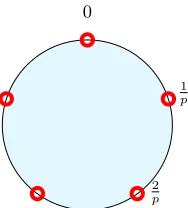
P−1=p−1mod (XN+ 1) modZ, which is a rescaling of the classical plaintext space description Rp (as shown in Figure 4). In particular, if XN + 1 has N roots modulop,Mis isomorphic toN independent integer slots modulop(else, there are less slots, in extension rings or fields). From a lattice perspective,Mis viewed as the orthogonal lattice generated by 1/pIN (IN is theN×N identity matrices). The packing radius ofMis 1/2pwhich is the maximal error tolerable by the phase. Rounding an element toMconsists of rounding each coordinate independently to the nearest multiple of 1/p.
In the literature, the isomorphism used to obtain the slot representation is
0
2
p
1
p
Fig. 4: TheB/FVplaintext space over theTR
modp). This isomorphism allows to manipulateN independent slots in parallel. Typical values areN = 215andp= 216+1 (allowing a very small noiseα
≈2−886 according to [8], so a multiplicative depth of≈28 without key-switch according to the propagation of Lemma 1).
If we identify a polynomial inRp with its coefficient vector in (Z/pZ)N, the bijection between the coefficients and the slot then corresponds to the Vander-monde matrix of (r0, . . . , rN−1) modp
VDM=
1 r1
0 · · ·r0N−1 1 r1
1 · · ·r1N−1 ..
. ... · · · ... 1r1
N−1· · ·rNN−−11
modp. (6)
B/FV → TFHE. In this section we show how B/FV ciphertexts, interpreted as TRLWE ciphertexts with plaintext (slots in) Rp, can be transformed into k independentTLWEciphertexts.
Let z = (z0, . . . , zN−1) ∈ (Z/pZ)N be a B/FV plaintext and, as in the previous section, let p−1
RZ/RZ ' (Z/pZ)N be the identification (5) and let
µ ∈ p−1
RZ/RZ ⊂ TR be the preimage of z. More generally, suppose that we
start with a Z-module homomorphism f: (Z/pZ)N
→ (Z/pZ)N with a ma-trix F ∈ MN(Z), where MN(Z) is the class of integer N×N matrices (this could arise in practice as either a projection, extraction or permutation of the slots) and get the outputf(z) as a polynomialPNi=0−1µ0
iXi∈p−1RZ/RZwhere6
µ0:= (µ00, . . . , µ0N−1) = 1
pf(z0, . . . , zN−1) modZ.
Then, by definition, we haveµ0 = (F·VDM)µ modZ, whereF·VDMcan be any integer representative ofF·VDM modp. In particular, we can always take the representative with all coefficients in [−p/2, p/2). This is a (N p/2)-Lipschitz
Z-module homomorphism, and can be evaluated via the functional key-switch 6 A priorif(z)∈(Z/pZ)Nis identified with an element ofR
pwhich is then identified
of Theorem 2 (see Algorithm 1). Coefficients can then be homomorphically ex-tracted as individualTLWEciphertexts with theSampleExtractofTFHE.
Algorithm 1Public Functional SwitchingB/FVtoTFHE
Input: TRLWE ciphertext c(X) = (a(X), b(X)) encoding N slots (z0, . . . , zN−1) modpwith keyK∈B, a publicZ-module homomorphismf: (Z/pZ)N→(Z/pZ)N with matrixF ∈ MN(Z), and key switch keyKSi,j ∈TLWES(K2ji), whereS∈B. Output: a TRLWEciphertextc0 ∈TR encrypted with keyS ∈ Bwhose message is
PN−1
i=0 µ 0
iXiwhere (µ00, . . . , µ0N−1) = 1
pf(z0, . . . , zN−1)
1: F0=F·V DM modp
2: ComputeB=F0(b(X))∈Tk
3: fori∈0→N−1do
4: ComputeAi=F0(Xia(X)) =A∈Tk
5: DecomposeAi=Plj=0Ai,j·2−j withAi,j ∈Bp
6: end for
7: return(0, B)−PN−1
i=0 Pl
j=0Ai,j·KSi,j
Proposition 2 (B/FVslots→TFHE).Letc= (a, b)∈T2
Rbe aTRLWE
cipher-text encrypting N slots (z0, . . . , zN−1) modp with key K ∈ B, let f: (Z/pZ)N
→ (Z/pZ)N be a public Z-module homomorphism with matrix
F ∈ MN(Z). Let KSi,j∈TRLWES,α(Ki/2j) be a key switching key(0≤i < N, 1 ≤j <log2α)and Ki is the i-th coefficient of K. By applying the functional key-switch of Theorem2 using the integer transformationF·VDM modpwhose coefficients are between [−p/2, p/2) and we obtain a TRLWE ciphertextc0 ∈TR
encrypted with keyS ∈ Bwhose message isPNi=0−1µ0iXiwhere(µ00, . . . , µ0N−1) = 1
pf(z0, . . . , zN−1). The noise variance satisfies
Var(Err(c0))≤
N p
2 2
Var(Err(c)) +α2
`N2+N 4
.
TFHE→ B/FV. Conversely, we would like to transformk independentTLWE ciphertexts (encryptions of messages (µ0, . . . , µk−1)∈Tk) into aTRLWE cipher-text with slots in Z/pZ. Again, we will need to define a Lipschitz Z-module homomorphism g: Tk → (Z/pZ)N. Unfortunately, since for all x ∈ Tk there existsy∈Tsuch thatx=p·y, we haveg(x) =p·g(y) = 0 in (Z/pZ)N and this implies thatg is zero everywhere, which is of limited interest.
Therefore, we need to restrict the message space only to multiples of 1/p
Then, letg: (Z/pZ)k
→(Z/pZ)N be a Z-linear map whose matrix Gis in
MN,k(Z). To obtain aB/FVciphertext whose slots areg(pµ0 modp, . . . , pµk−1 modp), the actual transformation to apply isVDM−1·G modp(see Algorithm 2). Again, we can choose the representative with coefficients in [−p/2, p/2) which is (N p/2)-Lipschitz.
Algorithm 2Public Functional SwitchingTFHEto B/FV
Input: k < N TLWE ciphertexts (ai, bi) encoding µi ∈ MN,k(Z) with key S ∈ B,
a public (N p/2)-Lipschitz Z-module morphism g : (Z/pZ)k → (Z/pZ)N, whose matrixG∈ MN,k(Z) andKSi=TRGSWK(Si).
Output: a B/FV ciphertext (a(X), b(X)) encoding a plaintext with slots are g(pµ0 modp, . . . , pµk−1 modp), with keyK∈ B
1: G0=V DM−1×G mod p 2: ComputeB=G0(b0, ..., bk)∈TR 3: fori∈0→N−1do
4: ComputeA[i] =G0(a0[i], ..., ak[i])∈TR 5: end for
6: return(0, B0)−PN−1
i=0 KSi (0, A 0
[i])
Bootstrapping inB/FV. If we want to decrease the noise of the output, different possibilities for the algorithm of bootstrapping exist in the literature [11, 19]. The first one is the naive bootstrapping, where we evaluate the rounding function. In this case for p > 2N + 1 prime (p = 1 modN), we need O(√p) internal products for the evaluation and we preserve theN slots. The second one is the bootstrapping proposed in [11], wherep=reis a power of a prime number, and we need only (e−1)(r−1) multiplications, but the number of slots is reduced.
3.2 Scheme-switching between B/FV-big-number and TFHE.
In the case of [13], using the NTRU trick [23], the plaintext space is R/(X− p)R 'Z/(1+pN)Z. Usually,pis small, butpN+1 is large, so a slot corresponding to Z/(1 +pN)Zallows us to perform arithmetic operations on big numbers. If
P =X−pthen the native plaintext spaceMisP−1R
Z/RZ with
P−1=−pN1+ 1 NX−1
i=0
pN−1−iXi.
Interestingly, since the leading coefficient of the polynomialP−1is 1/(pN+1), the isomorphismM ' 1
pN+1Z/Zcorresponds to extracting the coefficient inXN−1 (i.e. the mapµ=PNi=0−1µiXi7→µN−1 modZ). On this native plaintext space, the na¨ıve rounding algorithm computing µ = P−1
· bϕs(c)·Pe can solve the BDD problem up to a distance≈1/2p(which is the packing radius of the lattice
M; note that the vectorP ∈ RZ is a short vector). Here, byϕs(c), we mean an arbitrary lift inRR. This allows to operate on ciphertexts with very large noise
≈1/2√N p.
B/FV-big-number→msb-TFHE. Given aTRLWEciphertextc= (a, b)∈T2
R
encryptingµ∈TN with a keyK, to obtain theTLWEencryption of the most sig-nificant bit ofµwith keyK, it is enough to extractcN−1=SampleExtractN−1(c).
TFHE→B/FV-big-number. Conversely, to transformk < N TLWE indepen-dent ciphertextsc0, . . . ,ck−1encryptingµi=xi/p∈p−1Z/Z(forxi∈[0, p−1]) with key S ∈ BN into a TRLWE ciphertext encrypting the big-number R =
Pk−1
i=0 xipN−1−i modpN + 1 with key K ∈ B, we can return an encryption of (µ0, . . . , µk−1)→ Pki=0−1µiXN−1−i ∈p−1RR/RR. Indeed, this polynomial is very close to our targetP−1R mod
RZ. To that end, we can just apply the pub-lic key-switchc=PubKS(id,KS,(c0, . . . ,ck−1)), where the key-switching key is composed by KSi=TRGSWK(Si) to pack thekciphertexts as a single TRLWE ciphertext.
4
A general abstraction of
HEAAN
over the torus
interpreted in terms of the ratio between the diameter of the message space and the scale modulusqrather than the usual noise amplitude versus packing radius As we keep performing homomorphic operations, the message space diameter increases until the majority of the space is covered at this point, the scale in-variance property enables to extract the message as a classical LWE sample that can be processed, for instance, by TFHE. To fully enable this switch between schemes, it is necessary to relate the message spaces ofHEAANandTFHE.
Tags of ciphertexts. To do this, we revisit the representation ofHEAAN cipher-texts by adding the following three tags/parameters that we define and clarify below:
– L∈N: level exponent of the ciphertext - overall, it quantifies the maximum amount of homomorphic operations before performing a bootstrapping (the native plaintextkµk∞≤2−L),
– ρ∈N: bits of precision of the plaintext, that is, the number of bits in the mantissa. Since it is a global constant, we omit it in general.
– τ∈Z: slot exponent (order of magnitude of the complex values in each slot). Here, we use floating-point representation for which the exponent is public and fixed across all the coordinates of the vector and only the mantissa’s are secret. More precisely, a complex numberz is represented asz=m·2τ whereτ is public andm∈2−ρ
·(Z+iZ) with 0≤ |m|<1.
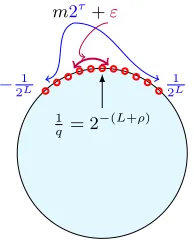
In Figure 5, we show the plaintext space (with the rounding error) using the tags defined before.
m2τ+ε
− 1 2L
1 2L
1
q = 2
−(L+ρ)
Fig. 5: TheHEAANplaintext space over theTR, where the errorεis an approximation error of the same order asα= 2−(L+ρ).
More precisely,Lis needed since HEAANcan be viewed as an instantiation ofTRLWEwhose native plaintext space is the subset of all polynomials µ∈TR
The plaintext space is always described with a global and fixed numberρof significant bits. One can define thenoise amplitude α:= 2−(L+ρ). Finally, since the goal is to representρ-bit fixed-point values of any order of magnitude, each ciphertext carries a public integer exponentτ ∈Zwhich represents the order of magnitude of its slots.
We choose these three tags because they are helpful for the parameter selec-tion of the cryptosystem (N and α) from the user point of view. For that, the first step is to fixρ, the precision needed at the end of the algorithm, the second step is to determine the range of each variable (so the slot exponentsτ): this can be done either from the domain of the evaluated function or experimentally by running the algorithm on a fake data. Then, using the noise propagation formula for elementary operations given in this section, we compute the smallest level exponent L >1 for each variable by traversing the arithmetic graph of the al-gorithm. Finally, we use the security API document [8] (or the LWE estimator) to find the smallest key size N that supports a noise rateα= 2−(L+ρ) to the desired security parameter.7 The originalHEAANchoice of tags is inherent and to determine the final system parameters, we have to solve a complex system of equations.
Complex-valued slots for plaintexts. Recall thatN is always a power of 2. Given a message µ ∈ RR where kµk∞ ≤ 2−L, its complex slots (z
1, . . . , zN/2) are defined as the (rescaled) evaluation on the complex roots of XN + 1, soz
k = 2L+τµ(ζ
k)∈C. We omit the values on the lastN/2 roots as they are complex conjugates of the first ones since µ is real. Ifkµk∞ ≈2−L, this indeed implies
that slot values|zk| ≈√N2τ and that the slot precision is up to 2τ−ρ.
In order to unify the message spaces, we redefine taggedHEAANciphertexts as a quadruple (a, b, τ, L)∈T2
R×Z×Nwhere (a, b) is aTRLWEciphertext. As
usual, the phase of a ciphertext is (b−s·a)∈TRand the message is the expec-tation of the phase. The slots of a ciphertext are the slots of its messageµ∈TR
represented by a lift in RR of small real norm ≤2−L. From a matrix point of view, the transformation between the coefficients and the slots is the multiplica-tion with 2τ+L times the complex DFT matrix ofζ
k. We have (z1, . . . , zN/2) = DFT·(µ0, . . . , µN−1) and (µ0, . . . , µN−1) = 2Re(IDFT·(z1, . . . , zN/2)).
DFT=
1 ζ1
1 · · ·ζ1N−1 1 ζ1
2 · · ·ζ2N−1 ..
. ... · · · ... 1ζ1
N/2· · ·ζ N−1 N/2
,IDFT=
1 N
1 1 · · · 1 ¯
ζ1
1 ζ¯21 · · · ζ¯N/21 ..
. ... · · · ... ¯
ζ1N−1ζ¯2N−1· · ·ζ¯N/2N−1
(7)
Tag propagation formulas. We now describe the tag propagation formulas for the homomorphic operations over the slot representation of the ciphertext8:
7
There is a very light dependency requirementρ≥log2(N) in the noise propagation formula of the product, but in general, choosingρ≥15 should be enough.
8
The identities below are approximate since the sum of two normal distributions
Addition HeaanAdd((c1, τ1, L1),(c2, τ2, L2))→
c= 2τ1+L1−τ−Lc
1+ 2τ2+L2−τ−Lc2 modZ,
τ= max(τ1, τ2) + 1,
L= min(L1+τ1, L2+τ2)−τ
Proof. We can check that this transformation changes the slot value into 2τ+Lµ(ζ
k) = 2τ1+L1µ1(ζk) + 2τ2+L2µ2(ζk) = (z1+z2), that proves the cor-rectness of the sum of two slots. The fact that τi+Li −τ −L ≥ 0, for
i∈ {1,2} means that the sum is an integer combination of the ciphertexts. At the end, we verify that
kµ(X)k∞≤2τ1+L1−τ−Lkµ1(X)k∞+ 2τ2+L2−τ−Lkµ2(X)k∞≤ ≤2τ1+L1−τ−L−L1+ 2τ2+L2−τ−L−L2 ≤2−L.
Decrease level HeaanRSL→L0((c, τ, L), L0< L)→(2L−L 0
c0 modZ, τ, L0)
Proof. We verify that the slot values are preserved and that kµ(X)k∞ <
2L−L0
kµ0(X)k
∞≤2L−L 0
−L= 2−L0
.
Binary Shift (multiply by 2t) HeaanBS(t,(c, τ, L))→(c, τ+t, L)
Proof. Slots are indeed transformed as z0 = 2τ+t+Lµ(ζ
k) = 2tz where t is the shift andz= 2τ+Lµ(ζ
k) is the slot value. Since the TRLWE part does not change, the native plaintext does not change either and the bound 2−L is preserved.
Multiplication by a constant HeaanMultCst(a∈Z s.t.|a| ≤2ρ,(c, τ, L)
→
(a·c modZ, τ+ρ, L−ρ)
Proof. We can check that multiplication with a ≤ 2ρ transforms the slot value into z0 = 2τ+Laµ(ζ
k) = az Note that the combination of constant integer multiplication and binary shift allows to multiply by an arbitrary fixed-point plaintext of precisionρ.
Constant slot-wise multiplication HeaanSlotMult((u1, . . . , uN/2),(c, τ, L)) Letu1, . . . , uN/2 be N fixed-point complex slots of the same order of mag-nitude (e.g.uk= (xk+iyk).2−ρ wherexk, yk are integers in [−2ρ,2ρ]. Interpolate (or find by least mean square) an integer polynomiald(x) with coefficients in [−2ρ,2ρ] and t an integer exponent such that the slots of
d(X)2t are all good approximations of z
1, . . . , zN/2, up to precision 2t−ρ. Namely,
|d(ζk)2t−uk| ≤2t−ρ for allk∈[1, N/2]. (8) variables are independent which needs not be the case as they are distributions over ciphertexts), but, for any practical purposes, is close enough to a normal distribution with zero mean and standard deviationσ=pσ2
X+σY2. In addition, the Gaussian
Then all we need is to multiply the input ciphertext byd(x) and shift the result byτ bits. The level decreases byρbits, where 2ρ is the norm ofd.
d(X)∈ RZ(kdk∞≤2ρ),(c, τ, L) :
d(X)·c modZ, τ0 =τ+ρ+t, L0 =L−ρ.
Proof. It follows from (8) thatz0
k= 2τ
0+L0
µ(ζk)d(ζk) = 2τ+Lµ(ζk)d(ζk)2t=
zk·(uk+εk) where|zkεk| ≤2τ
0
−ρand that the native plaintext norm verifies
||µ0(X)||
∞≤2−L+ρ= 2−L 0
.
Slot-wise precomputed secret multiplication : HeaanPrivSlotMult(TRGSW(D),(c, τ, L))
In the previous multiplication,d(x) can be provided encrypted as aTRGSW ciphertext ofD.
General multiplication HeaanMult((c1, τ1, L0),(c2, τ2, L0)) use the Algorithm 3 below, proved in Proposition 3.
Algorithm 3HEAAN homomorphic product onTR
Input: Two HEAAN ciphertexts (a1, b1, τ1, L1), (a2, b2, τ2, L2) ∈ T2×Z×N whose slots are (z1(1), . . . , z
(1)
N/2) and (z (2) 1 , . . . , z
(2)
N/2) under the same keys and precision
ρ >log2N.
Output: aHEAANciphertext (a, b, τ, L) whose slots arezj=z(1)j z
(2)
j forj∈[1, N/2]
with the same keys
1: Setτ =τ1+τ2 (slot exponent)
2: SetL0= min(L1, L2) and useHeaanRSLi→L0 to decrease both ciphertexts to levelL
0
3: Letq= 2L0+ρ,α=q−1, andL=L0−ρ
4: Round (ai, bi) to the nearest multiple ofα=q−1.
5: Let (a, b) = (a1, b1)q,α(a2, b2) (with q,α the internal homomorphic product
defined in the Definition 3) 6: return(a, b, τ, L)
Proposition 3 (HEAAN product).Let(a1, b1, τ1, L1),(a2, b2, τ2, L2)∈T2R×
Z×N whose slots are (z(1)1 , . . . , z (1)
N/2) and (z (2) 1 , . . . , z
(2)
N/2) under the same key
s. Suppose that the precision ρ is larger than log2N. Algorithm 3 computes a HEAAN ciphertext(a, b, τ, L)whose slots are zj =z(1)j z
(2)
j forj ∈[1, N/2] with the same key ssuch thatVar(Err((a, b))) remains implicitly 4−L−ρ.
Proof. (sketch) Since Algorithm 3 rescales both ciphertexts to the same level, we can assume that both inputs have the same levelL0. Compared to the proof of Lemma 1, defining the same auxiliary quantitiesC0,C1,C2, we have
ϕs(a, b) =µ1qµ2+e2µ1q+e1µ2q+e1e2q+e2I1q+e1I2q +Err(RK α(C2,0)) mod 1
Here, the terms e1I2q and e2I1q disappear because ei are exact multiples of 1
q after the rounding. The expectation of the phase is still µ1 q µ2, so the output slots containzk =qµ1(ζk)µ2(ζk)2τ+L=z1,kz2,k sinceL= 2L0−log2(q). The native plaintext µ1qµ2 itself is bounded by q2−2L
0
= 2L0+ρ−2L0 = 2−L. The phase variances ofe2µ1q,e1µ2qare bounded by
q2−L02−L0−ρ 2
= 4−L−ρ,
e1e2q by 4−L−2ρ, andVar(Err(RK α(C2,0))≤
2`N+N24+Nα2
≤N2α2
≤
4log2(N)−L0
−ρ <4−L0
≤4−L−ρ because ρ > log
2(N). Overall, the output noise standard deviation is 2−L−ρ, which corresponds toρbits of fixed-point precision.
u t
4.1 Scheme switching between TFHE and HEAAN
TFHE → HEAAN Let S = (S1, . . . , Sn) ∈ {0,1}n be a TLWEkey and let N be the power of 2 in theHEAAN cryptosystem. Let (a1, b1), . . . ,(aN/2, bN/2)∈
Tn
×TbeTLWEciphertexts encrypted under the secret keyS. For every 1≤k≤ N/2, letνk =ϕS(ak, bk) be their phases. Suppose that N is the modulus used in HEAANand K ∈ Bis a HEAAN secret key. Here, we describe an algorithm (functional switching fromTFHEtoHEAAN) that outputs aHEAANciphertext (a, b, τ, L) which, when decrypted with the key K, yields a vector of size N/2 whose components are the complex values zk = exp(2πiνk) for 1 ≤ k ≤N/2. This allows us to evaluate trigonometric polynomials and have various practical applications such as evaluating continuous functions via rapid convergence of Fourier series. We describe this algorithm as a variant of the bootstrapping for HEAAN[14].
Letting BKi = TRGSWK(Si) be the components of the bootstrapping key BK, this algorithm is a combination of a homomorphic evaluation of the modZ operation (the bootstrapping proposed byHEAANin [14]) and a multiplications with theDFTmatrix in order to switch between coefficients and slots.
Once we have the complex exponential, we can represent any other piecewise continuous function f from T to C and obtainf(ν1), . . . , f(νN/2) in the slots, by just evaluating the first terms of the Fourier series off.
Proposition 4 (Functional switching TFHE toHEAAN). In the setting de-scribed above where the noise standard deviation is α and the precision param-eter is ρ∈N, Algorithm 4 computes a HEAAN ciphertext(a, b, τ, L)decrypting to(z1, . . . , zN/2) under K and having precision ρ,p=√ρ+ log2(2πn/√ρ)and level ciphertext exponent
L=−log2α−(p+ log2ρ)ρ− 1 2
log2
−2nNlog2α+n 1 +N
4
.
Algorithm 4SwitchingTFHEto HEAAN
Input: N/2TLWEciphertexts (ak, bk), 1≤k≤N/2 whose phases areνk∈Tunder
the same keyS∈ {0,1}n
andBKi=TRGSWK(Si).
Output: AHEAAN ciphertext (a, b)∈T2
Rat levelLthat decrypts (underK) to the slots (z1, . . . , zN/2) wherezk=e2πiνk andνk=ϕS(ak, bk).
1: LetAbe theN/2×(n+1) real matrix whereAi,jis the representative of thej-th
co-efficient ofai∈[−1/2,1/2) and the last columnAj,n+1contains the representative ofbj∈[−1/2,1/2).
2: Letp=√ρ+ log2(2πn/ √
ρ)
3: ComputePj←
1
2pNRe(IDFT∗Aj) for 1≤j≤n+ 1. Here,Pj is the polynomial
whose slots are 21pAj.
4: c←(0,2−(L+(p+1)ρ)P
n+1)−Pnj=1BKj α(0,2−(L+(p+1)ρ)Pj).
5: LetC= (c, τ = 0, L+ (p+ 1)ρ)
6: Evaluate homomorphically E = √
ρ−1 X
k=0
ik k!C
k
using Paterson–Stockmayer
algo-rithm [25] (in depth log2ρ), HeaanMult for non-constant multiplications and HeaanSlotMultfor constant multiplications. Here, E has parametersτ = 0 and levelL+pρ.
7: forj= 1 topdo
8: E←HeaanMult(E,E) (the newE has parametersτ= 0 and levelL+ (p−j)ρ) 9: end for
10: returnEat levelL
rescaled ciphertextνk/2pis guaranteed to be bounded byn/2p. We first compute a good approximation, up to an error ≤2−ρ, for exp(2πiν
k/2p) using the first
√ρ terms of the Taylor expansion of the exponential function. For instance,
the Taylor–Lagrange inequality gives
exp(ix)− √ρ −1 X k=0 (ix)k
k! ≤
|x|√ρ
√ρ! , so for
x ≤ n/2p, it suffices to choose p = √ρ+ log
2(2πn/√ρ) to get the required approximation within 2−ρ. Then, we square and multiply (we square and square in this case) the result to raise exp(2πiνk/2p) to the power 2p to obtain the desired plaintext exp(2πiνk). From Theorem 1 on the external product forTFHE, the noise of the ciphertextcof line 4 is
Var(Err(c))≤(−2nlog2αN+n 1 +N
4 )α 2
≤4−L−(p+log2(ρ))ρ.
We then evaluate the Taylor expansion of the complex exponential (up to degreed=√ρ) via the algorithm of Paterson–Stockmayer [25]: this requires a depth of 2 log2d = log2ρ, it uses 3
√
d non-constant (HeaanMult) as well as d
constant multiplications (HeaanSlotMult). After this step, the level decreases by ρtimes the multiplicative depth, so the level ofE is ≤L+pρ. Finally, we square the ciphertextptimes to obtain the desired result.
HEAAN → TFHE. Conversely, to switch from HEAAN to TFHE ciphertexts, we use the observation that a HEAAN ciphertext of level 1 is automatically a TFHE ciphertext. Starting from a ciphertext HEAAN of level L, we use the level decrease function HeaanRSL→1 followed by a slot extraction to obtain a TFHEciphertext ofµ. Here, by slot extraction, we mean the slots to coefficients procedure described in [14] to extractHEAAN slots into coefficients of TRLWE (i.e. applying theIDFTcomplex transformation homomorphically).
4.2 Non-linear functions in HEAAN
InHEAAN, non-linear functions can be evaluated via approximations by either complex-valued polynomials (via traditional products) or trigonometric polyno-mials (Fourier approach within the bootstrapping).
As explained in [5], Fourier series of smooth and regular functions con-verge rapidly: for instance, the Fourier series of aC∞-function converges
super-algebraically and if one smooths any periodic function by convolution with a small Gaussian, its Fourier series converges exponentially fast. However, the convergence is slower if the function has discontinuities (pointwise convergence inΩ(1/k)), or discontinuities in its derivative (uniform convergence inΩ(1/k2)) wherek is the number of harmonics used in the series.
Compared to classical approximations of functions by polynomials in [22, 10] (i.e. Taylor series or Weierstrass approximation theorem), Fourier series have three main advantages: they do not diverge to ∞ outside of the interval (bet-ter numerical stability), the Fourier coefficients are small (square integrable), and the series converge uniformly to the function on any interval that does not contain any discontinuity in the derivative.
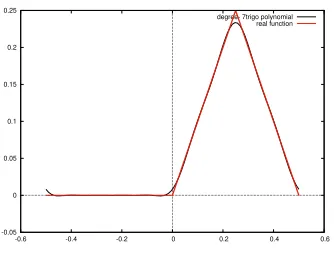
With this bootstrapping trick,HEAANcan at the same time evaluate a non-linear function and bootstrap its output to a levelLeven higher than its input. Taking this fact into account, instead of writingReLU(x) = max(0, x) as12(|x|+x) like inTFHE, where the term +x/2 is not bootstrapped, it is actually better to extend the graph ofReLUfrom a half period (−1/4,1/4) directly to a 1-periodic continuous function and to decompose the whole graph as a Fourier series. In the latter case, the output level Lcan be freely set to an arbitrary large value. Figure 6 shows a degree-7 approximation of the odd-even periodic extension of the graph ofReLU(x).
5
Implementation of some major components of Chimera
Some of the algorithms presented in this paper have been implemented and tested in the context of an IDash 2018 [2] submission described in [9]. This submission was selected in October 2018 to be among the finalists of the competition.
-0.05 0 0.05 0.1 0.15 0.2 0.25
-0.6 -0.4 -0.2 0 0.2 0.4 0.6 degree- 7trigo polynomial
real function
Fig. 6:ReLU(on the right) forHEAAN
gmp limbs, and polynomial multiplications are implemented via the complex FFT. Since the total precision required was always lower than 128 bits for ex-ternal products and 192 bits for inex-ternal products (so at most two or three gmp limbs), there was no advantage in switching to an alternative RNS/NTT repre-sentation. All bit-decompositions for the TRGSW external products (also used in the internal product) have been carried-on in base 216 and 232rather than in base 2. The implemented algorithms are:
– Evaluation of a sigmoid on a TLWE ciphertext via gate bootstrapping followed by a functional key-switch toHEAAN (noise reduction from (α= 2−7,N= 650) to (α= 2−80,N = 4096)). The time for the evaluation of the bootstrapped sigmoid is: 32s for the bootstrapping toTLWEand 7s for the public key-switchTLWEtoTRLWE.
– External product to multiply HEAAN ciphertext by a fresh TRGSW ci-phertext, using both the slot packed ciphertexts (N/2 slots) and coefficient-packed ciphertexts (N slots). The time is 80ms with parametersα= 2−80,
N= 4096.
– TRLWE internal product for HEAANslotwise multiplication, using the tagging system proposed here, and relinearization via the external product formula. The time is 160ms for parametersα= 2−80,N = 4096.
– Evaluation of the non-linear function log|x| on 1024 slots in parallel during the bootstrapping for HEAAN(Algorithm 4), versus the traditional bootstrapping followed by a Taylor approximation.
Future Work
References
1. TFHE: Fast Fully Homomorphic Encryption over the Torus. https://tfhe.github.io/tfhe/.
2. Track 2: Secure parallel genome wide association studies using homomorphic en-cryption. www.humangenomeprivacy.org/2018/competition-tasks.html, 2018. 3. M. Albrecht, M. Chase, H. Chen, J. Ding, S. Goldwasser, S. Gorbunov, S. Halevi,
J. Hoffstein, K. Laine, K. Lauter, S. Lokam, D. Micciancio, D. Moody, T. Morrison, A. Sahai, and V. Vaikuntanathan. Homomorphic encryption security standard. Technical report, HomomorphicEncryption.org, Toronto, Canada, November 2018. 4. M. R. Albrecht, R. Player, and S. Scott. On the concrete hardness of learning with
errors. J. Mathematical Cryptology, 9(3):169–203, 2015.
5. C. Boura, I. Chillotti, N. Gama, D. Jetchev, S. Peceny, and A. Petric. High-precision privacy-preserving real-valued function evaluation. IACR Cryptology ePrint Archive, 2017:1234, 2017.
6. Z. Brakerski. Fully homomorphic encryption without modulus switching from clas-sical gapsvp. In CRYPTO 2012, volume 7417 ofLNCS, pages 868–886. Springer, 2012.
7. Z. Brakerski and R. Perlman. Lattice-based fully dynamic multi-key FHE with short ciphertexts. InCRYPTO 2016, Part I, LNCS, pages 190–213, 2016. 8. M. Brenner, W. Dai, S. Halevi, K. Han, A. Jalali, M. Kim, K. Laine, A. Malozemoff,
P. Paillier, Y. Polyakov, K. Rohloff, E. Sava¸s, and B. Sunar. A standard api for rlwe-based homomorphic encryption. Technical report, HomomorphicEncryption.org, Redmond WA, July 2017.
9. S. Carpov, N. Gama, M. Georgieva, and J. R. Troncoso-Pastoriza. Privacy-preserving semi-parallel logistic regression training with fully homomor-phic encryption. Cryptology ePrint Archive, Report 2019/101, 2019. https://eprint.iacr.org/2019/101.
10. H. Chabanne, A. de Wargny, J. Milgram, C. Morel, and E. Prouff. Privacy-preserving classification on deep neural network. Cryptology ePrint Archive, Re-port 2017/035, 2017. https://eprint.iacr.org/2017/035.
11. H. Chen and K. Han. Homomorphic lower digits removal and improved FHE bootstrapping. InEUROCRYPT 2018, Proceedings, Part I, volume 10820 ofLNCS, pages 315–337. Springer, 2018.
12. H. Chen, K. Laine, and R. Player. Simple encrypted arithmetic library - SEAL v2.1. InFinancial Cryptography and Data Security - FC 2017, pages 3–18, 2017. 13. H. Chen, K. Laine, R. Player, and Y. Xia. High-precision arithmetic in
homomor-phic encryption. InCT-RSA 2018, LNCS, pages 116–136, 2018.
14. J. H. Cheon, K. Han, A. Kim, M. Kim, and Y. Song. Bootstrapping for approximate homomorphic encryption. In EUROCRYPT 2018, Proceedings, Part I, volume 10820 ofLNCS, pages 360–384. Springer, 2018.
15. J. H. Cheon, A. Kim, M. Kim, and Y. S. Song. Homomorphic encryption for arithmetic of approximate numbers. In ASIACRYPT 2017, Proceedings, Part I, volume 10624 ofLNCS, pages 409–437. Springer, 2017.
16. I. Chillotti, N. Gama, M. Georgieva, and M. Izabach`ene. TFHE: Fast Fully Homo-morphic Encryption over the Torus. IACR Cryptology ePrint Archive, 2018:421. 17. I. Chillotti, N. Gama, M. Georgieva, and M. Izabach`ene. Faster fully
18. L. Ducas and D. Micciancio. FHEW: bootstrapping homomorphic encryption in less than a second. In EUROCRYPT 2015, Proceedings, Part I, volume 9056 of LNCS, pages 617–640. Springer, 2015.
19. J. Fan and F. Vercauteren. Somewhat practical fully homomorphic encryption. IACR Cryptology ePrint Archive, 2012:144, 2012.
20. M. Geihs and D. Cabarcas. Efficient integer encoding for homomorphic encryption via ring isomorphisms. InLATINCRYPT 2014, LNCS, pages 48–63.
21. C. Gentry. Fully homomorphic encryption using ideal lattices. In STOC 2009, pages 169–178, 2009.
22. R. Gilad-Bachrach, N. Dowlin, K. Laine, K. E. Lauter, M. Naehrig, and J. Werns-ing. Cryptonets: Applying neural networks to encrypted data with high through-put and accuracy. InProceedings of the 33nd International Conference on Machine Learning, ICML 2016, New York City, NY, USA, June 19-24, 2016, pages 201–210. 23. J. Hoffstein and J. Silverman. Optimizations for NTRU, January 2000.
24. V. Lyubashevsky, C. Peikert, and O. Regev. EUROCRYPT, chapter On Ideal Lattices and Learning with Errors over Rings, pages 1–23. Springer, 2010. 25. M. Paterson and L. J. Stockmeyer. On the number of nonscalar multiplications