Android Controlled RC Car Unit
Sujata Rathod, Vinay Bansal Computer Department
Smt Indira Gandhi College of Engineering Navi Mumbai, India
Kishor T. Patil Computer Department
Smt Indira Gandhi College of Engineering Navi Mumbai, India
Abstract—An enhanced model of a remote controlled car (RC) unit designed on Arduino micro controller, and controlled by smart phone running on android application is proposed. The RC car is meant to be used in search mission in the occurrence of natural disaster. It is designed to be controlled wirelessly, as well as, it also avoid hitting the obstacles.The car uses bidirectional DC motors connected with motor driver. It is equipped with Infrared sensor, a Wi-Fi camera controlled by servo motor, Bluetooth module (HC-05) chip, 9V power battery, and Arduino Mini Pro micro controller board.The android application, uses embedded orientation sensor of smart phone, then perform the calculations to map motor values, providing full control to rotation of RC car. The control commands are transmitted to car through Bluetooth, and camera data is transmitted by car to smart phone using Wi-Fi in real time.
Keywords— android; video streaming; RC; obstacle detection; camera
I. INTRODUCTION
An open-source platform Android has been widely used in smart phones. Android has complete software package consisting of an operating system, middleware layer and core applications. Android application, Smart phones are becoming each time more powerful and equipped with several accessories that are useful for Robots. [1]
Physical “Bots” or “Robots”, on other hand, use microcontrollers like arduino due to their multiple advantages like small size, less resource requirements etc. These micro-controllers give option of different type and accordingly various sizes. Micro-controllers can also perform calculations, but are restricted to simpler ones, due to limited resources [2].
In robotics, obstacle avoidance is the task of satisfying some control objective subject to
non-intersection or non-collision position constraints. In unmanned air vehicles, it is a hot topic. What is critical about obstacle avoidance concept in this area is the growing need of usage of unmanned aerial vehicles in urban areas for especially military applications where it can be very useful in city wars. Normally obstacle avoidance is considered to be distinct from path planning in that one is usually implemented as a reactive control law while the other involves the pre-computation of an obstacle-free path which a controller will then guide a robot along.[3]
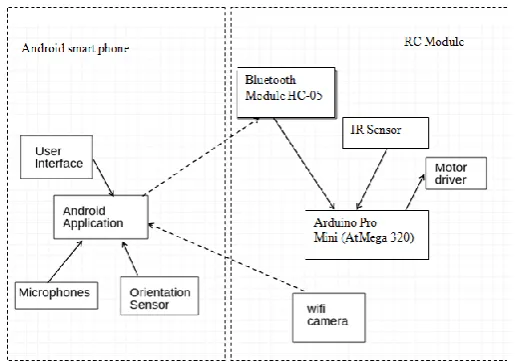
In this paper, we are developing a RC unit car with the feature of real time video streaming and it also can detect the obstacle ahead of its path which is called obstacle detection. This RC unit car is controlled by android smart phone. The Wi-Fi camera on RC unit is capable of transmitting real-time video data to Smartphone or any other display device using Wi-Fi.
II. RELATED WORK
Similar systems with android and arduino interaction have been proposed earlier. Different modes using different prototypes are implemented for different applications. An system named AndroRC by Yuxinzing [4], very well implemented the modules with android and arduino communication for search mission. The system (AndroRC) requires two different Arduino boards (Mega and Uno) for RC unit. The motion is constrained to four directions due to use of servo motors for turning.
A vision-based obstacle avoidance algorithm is also implemented for a small indoor mobile robot built from low-cost and off-the-shelf electronics [5] where vision-based obstacle detection algorithm is fast and works with very low resolution images.
Ultrasonic sensor (US) is widely used sensor in mobile applications for distance measurements which helps in obstacle detection [6-9]. Using both the sensors that is Ultrasonic sensor (US) and Infrared (IR) sensors is also implemented [10] that system is intended to be use by the elderly and people with vision impairment.
Another system proposed by R. Manduchi is a system with obstacle detection technique, based on stereo range measurements, that does not rely on typical structural assumption on the scene. [11]
III. SYSTEM DESCRIPTION
A. Android Smartphone
Android is a mobile operating system (OS) currently developed by Google, based on the Linux kernel and designed primarily for touchscreen mobile devices such as smartphones and tablets. Android's user interface is based on direct manipulation, using touch gestures that loosely correspond to real-world actions, such as swiping, tapping and pinching, to manipulate on-screen objects, along with a virtual keyboard for text input. The android Smartphone in this project, acts as a control remote as well as data display monitor for the robot unit. The android smarphone, already equipped with communication technology : Bluetooth is used to communicate to the robot wirelessly. Also, the different sensors, like accelerometer etc. are used to enhance to control flexiblity.
B. User Interface
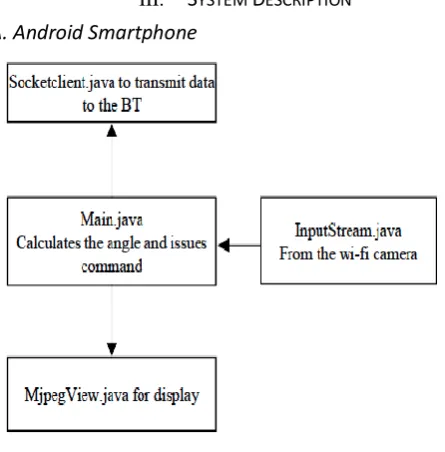
The user interface, of the overall system, is provided using the custom made android application using Graphical User Interface (GUI). The GUI provides user, the various control modes, to Control dynamically the robot unit. The real-time camera streaming data, from the RC unit is shown to user through this interface. The start of android application, forces connection establishment with RC unit through Bluetooth. The user interface is also responsible for obstacle detector distance measurement and other settings of robot unit.The GUI of android provides a user friendly realtime experience to the user, to control the robot. Fig. 2 Main Blocks of Android Application
C. The Android Application
sends a "1" to the Arduino MEGA board, which then translates into "forward” propulsion. The application is designed to be intuitive.
D. RC Module
The main working unit of the system is the RC Car unit. This unit consists of the Arduino chip, the motor driver, Bluetooth receiver, and sensors like sharp IR sensor and wireless video camera. The Arduino Uno, a small android chip, resides at the heart of the unit. It is responsible to communicate with android smartphone, using the Bluetooth module and control the motors using the motor driver. The unit is powered using 9V battery connected to this Arduino chip. The command to control the module is received using Bluetooth module HC-05.
E. Sensors
There are two major types of Sharp's infrared (IR) sensors based on their output: analog rangers and digital detectors. Analog ranges provide information about the distance to an object in the ranger's view. Digital detectors provide a digital (high or low) indication of an object at or closer than a predefined distance.
IV. SYSTEM FEATURES
A. Obstacle Detection
The system uses obstacle detection mechanism, using which the obstacles in front of the RC unit can be detected. An IR sensor is used, which get exact value of obstaclewhenan obstacle is less than Specified distance in front of sensor.The arduino board gets the distance value, and checks if the obstacle distance is less than the threshold value. If the obstacle distance is less than the threshold value, the RC unit stops at its position.
B. Video Streaming
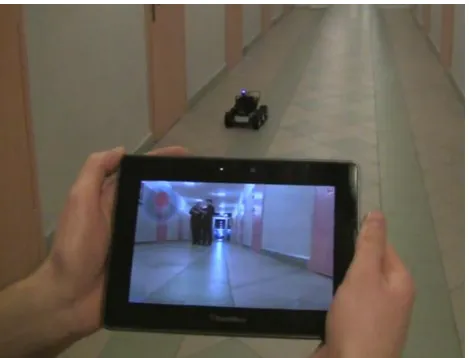
The RC Car unit is fitted with a Wi-Fi camera that transmit Real-time video data to Smartphone, or any other display device. The video streaming can give real-time information about the objects in front of the car unit. This data may be used for preventing obstacles, or can be useful for its application, like Human Search Mission.
Fig. 3 Real Time Video Streaming
C. Control modes
The Android infrastructure allows user to design superior user interface along with full resource utilization. Different controlling modes can be provided to user, like accelerometer control, joystick control or button control. Along with these, special modes like voice control with voice reorganization or gesture control can be provided using android capabilities and Google, API’s. The technologies of Google, which are currently in development process like Virtual Reality (VR), can be used in future to enhance system control.
D. Zero Turn Mechanism
The system is designed in a way to give complete flexibility to RC unit to navigate to remote places easily. To achieve this, the car is capable of spinning around its central axis, and do not need to follow a circular path as it turns. The car can spin around its Z-axis by allowing synchronized inverse rotation of its left and right wheel sets, effectively giving it “zero” turning radius.
V. OBSERVATIONS AND RESULT
The system is cost efficient, and size is reduced by 60% from the current system. The power consumption of complete system is reduced by 50%, as system runs on 9V Volt battery with 1A Current.
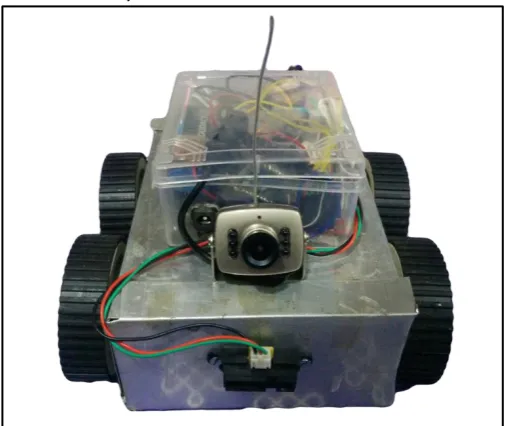
Fig. 4 Front View of RC Unit
Fig. 5 Application showing Different Control Modes
Fig. 6 Application Motion control mode
VI. CONCLUSION AND FUTURE WORK
We have proposed an enhanced model of RC car unit controlled wirelessly using Android smartphone, Which is intended to be used in search missions, in case of natural disasters. The control commands are transmitted to car through Bluetooth, and camera data is transmitted bycar to smart phone using Wi-Fi in real time. It is designed to implement dynamic path planning algorithm, to autonomously avoid hitting the obstacles. This model is intended to be size and cost efficient and thus better than previous such implementations. The custom design application should provide better and real-time experience to the user, controlling the RC Unit. The android application, uses embedded orientation sensor of smart phone, then perform the calculations to map motor values, providing full control to rotation of RC car.
The important functionality in future will be added: 1) Make use of more different sensors.
2) Control RC Unit design using Smart-watch.
3) Implement Artificial intelligence to autonomously search for people.
REFERENCES
[1] Mrumal.K.Pathak, Javed Khan, Aarushi Koul, Reshma Kalane, Raunak Varshne, “Robot Control Design Using Android Smartphone”, Journal Of Business Management And Economics.
[2] http://home.roboticlab.eu/en/microcontrollers [3] https://en.wikipedia.org
Computer Engineering New York Institute of Technology
[5] Nara, S. Takahashi, S.,“Obstacle Avoidance Control for Mobile Robots based on Vision”,SICE-ICASE, 2006. International Joint Conference.
[6] Al-Aubidy, K.M., “GPRS-Based Remote Sensing and Teleportation of A Mobile Robot”, Systems, Signals & Devices (Ssd), 2013 10th International Multi-Conference.
[7] Mohammad Hazzaz Mahmud, Rana Saha, Sayemul Islam ,“Smart walking stick - an electronic approach to assist visually disabled persons”, International Journal of Scientific & Engineering Research, Volume 4, Issue 10, October-2013.
[8] Ansari, M.A., Umrani, F.A., “SONAR Based Obstacle Detection and Avoidance Algorithm”, Signal Acquisition and Processing, 2009. ICSAP 2009. International Conference.
[9] Kalmegh, S.K.,Samra, D.H., Rasegaonkar, N.M., “Obstacle Avoidance For A Mobile Exploration Robot Using A Single Ultrasonic Range Sensor”, Emerging Trends in Robotics and Communication Technologies (INTERACT), 2010 International Conference.
[10] Johann Borenstein, Yoram Koren, “Obstacle A
voidance with Ultrasonic Sensors”, IEEE Journal of Robotics And Automation, Vol. 4, No. 2, April I988
[11] R. Manduchi, “Obstacle Detection and Terrain
Classification for Autonomous Off-Road Navigation” ,2005 Springer Science + Business Media, Inc. Manufactured in The Netherlands.
[12] Seung Keun Cho, Hong Zhe Jin, Jang Myung Lee, Bin
Yao, “Teleoperation of a Mobile Robot Using a Force-Reflection Joystick With Sensing Mechanism of Rotating Magnetic Field”,IEEE/ASME Transactions On Mechatronics ,February 2010 17
[13] H. Rezaee ,F. Abdollahi, “A Decentralized
Cooperative Control Scheme With Obstacle Avoidance for a Team of Mobile Robots” ,IEEE Transactions on Industrial Electronics.
[14] M. A. Qadeer ,R. Ahmad,M. S. Khan, T.Ahmad,“Real
time video streaming over heterogeneous networks”,Advanced Communication Technology, 2009. ICACT 2009. 11th International Conference
[15] Will Hrudey, Ljiljana Trajkovid “Streaming Video
Content Over IEEE 802.16/WiMAX Broadband Access”Simon Fraser University Vancouver, British Columbia
[16] Meng Guo, Mostafa H. Ammar, “Scalable live video
streaming to cooperative clients using time shifting and video patching”,IEEE INFOCOM 2004
[17] S. Wee,Wai-tian Tan ,J. Apostolopoulos , M.
Etoh,“Optimized video streaming for networks with varying delay”,Multimedia and Expo, 2002. ICME '02. Proceedings. 2002 IEEE International Conference.
[18] E. Zerman, G. B. Akar, “Demo paper: Real time 3D video streaming: A mobile approach”,Multimedia and Expo Workshops (ICMEW), 2013 IEEE International Conference.
[19] Dapeng Wu, Y. T. Hou , Wenwu Zhu , Ya-Qin
Zhang, “Streaming video over the Internet: approaches and directions”,IEEE Transactions on Circuits and Systems for Video Technology
[20] Martin Kennedy, Hrishikesh Venkataraman,
Gabriel-Miro Muntean, “Dynamic Stream Control for Energy Efficient Video Streaming”, Broadband Multimedia Systems and Broadcasting (BMSB), 2011 IEEE InternationalSymposium.
[21] Chinmay Kulkarni, Suhas Grama, Pramod Gubbi
Suresh, Chaitanya Krishna, Joseph Antony, “Surveillance Robot Using Arduino Microcontroller, Android APIs and the Internet”, 2014 First International Conference on Systems Informatics, Modelling and Simulation.
[22] LorenzoKeller,Anh Le, Blerim Cici,“MicroCast:
Cooperative Video Streaming on
Smartphones”,MobiSys'12 Proceedings of the 10th international conference on Mobile systems, applications, and services.
[23] Muhammad Mubashir,Ling shao, “A survey on fall
detection: Principles and approaches”, Elsevier 2012.
[24] Raphael Labayrade, Didier Aubert, Jean-Philippe
Tarel, “Real Time Obstacle Detection in Stereovision on Non Flat Road Geometry Through ‘V-disparity’ Representation”, Intelligent Vehicle Symposium, IEEE,2002
[25] Massimo Bertozzi, Alberto Broggi, “GOLD: A Parallel
Real-Time Stereo Vision System for Generic Obstacle and Lane Detection”, IEEE Transactions On Image Processing, Vol. 7, No. 1, January 1998.
[26] Raphael Labayrade, Cyril Royere, Dominique
Gruyer, Didier Aubert Livic,“Cooperative Fusion for Multi-Obstacles Detection With Use of Stereovision and Laser Scanner”,2005 Springer Science + Business Media, Inc. Manufactured in The Netherlands.
[27] Dimitrios Dakopoulos, Nikolaos G.