Leakage-Resilient Client-side Deduplication of Encrypted Data in Cloud Storage
Jia Xu
Institute for Infocomm Research
Ee-Chien Chang
National University of Singapore
Jianying Zhou
Institute for Infocomm Research
Abstract—Cloud storage service is gaining popularity in re-cent years. Client-side deduplication is an effective approach to save bandwidth and storage, and adopted by several cloud storage services including Dropbox, MozyHome and Wuala. Security flaws, which may lead to private data leakage, in the existing client-side deduplication mechanism are found recently by Harniket al.(S&P Magazine, ’10) and Haleviet al.(CCS ’11). Halevi et al. identified an important security issue in client-side deduplication which leads to leakage of users’ private files to outside adversaries, and addressed this issue by constructing schemes which they calledproofs of ownership (PoW). In a proof of ownership scheme, any owner of the same file F can prove to the cloud storage that he/she owns fileF in a robust and efficient way, in the bounded leakagesetting where a certain amount of efficiently-extractable information about fileF is leaked. In this paper, we make two main contributions:
• We construct a hash function Hk : {0,1}M → {0,1}L with time complexity in O(M+L), which isnon-linear and provably pairwise-independent in the random oracle model. We apply the constructed hash function to obtain a proof of ownership scheme, which is provably secure w.r.t. any distribution of input file with sufficient min-entropy, in the random oracle model. In contrast, the PoW scheme (the last and the most practical construction) in Haleviet al. is provably secure w.r.t. only a particular type of distribution (they call it a generalization of “block-fixing” distribution) of input file with sufficient min-entropy, in the random oracle model. The constructed hash function may have independent interest.
• We propose the first (to the best of our knowledge)
solution to support cross-user client-side deduplication of encrypted data in the bounded leakage setting. Particu-larly, we address another important security issue in client-side deduplication— confidentiality of users’ sensitive files against the honest-but-curious cloud storage server. We emphasize that “convergent encryption”, which encrypts a file F using hash value hash(F) as encryption key, is not leakage-resilient and is thus insecure in the setting of PoW. Therefore, the direct combination of a PoW scheme and convergent encryption is not a solution for client-side deduplication over encrypted data.
Keywords-Cloud Storage, Client-side Deduplication, Proofs of Ownership, Privacy, Leakage-Resilient, Pairwise Indepen-dent Hash
I. INTRODUCTION
Cloud storage service is gaining popularity. To reduce resource consumption in network bandwidth and storage, many cloud storage services including Dropbox [17] and Wuala [48] employs client-side deduplication [46]. That is, when a user tries to upload a file to the server, the
server checks whether this particular file is already in the cloud (uploaded by some user previously), and saves the uploading process if it is. In this way, every single file will have only one copy in the cloud (Single Instance Storage). SNIA white paper [39] reported that the deduplication technique can save up to 90% storage, dependent on applications.
According to Halevi et al. [25] and Dropship [19], an existing implementation of client-side deduplication is as below: Cloud user Alice tries to upload a file F to the cloud storage. The client software of the cloud storage service installed on Alice’s computer, will compute and send the hash valuehash(F)to the cloud server. The cloud server maintains a database of hash values of all received files, and looks up the value hash(F)in this database. If there is no match found, then file F is not in the cloud storage yet. Alice’s client software will be required to uploadF to the cloud storage, and the hash valuehash(F)
will be added into the look-up database. If there is a match found, then fileF is already in the cloud storage, uploaded by other users or even by the same user Alice before. In this case, uploading of file F from Alice’s computer to the cloud storage is saved, and the cloud server will allow Alice to access the fileFin its cloud storage. We may refer to the above client-side deduplication method as “hash-as-a-proof” method. Note that in this method, the hash value
hash(F) serves two purposes: (1) it is an index of file
F, used by the cloud server to locate information of F
among a huge number of files; (2) it is treated as a “proof” that Alice owns file F. Previously, Dropbox1 applied the above “hash-as-a-proof” method on block-level cross-users deduplication [25][19].
A. Security Concerns
Different users may possess some identical sensitive files for many reasons, even if they have no knowledge on each other. For example they may receive a classified or copyright-protected file directly or indirectly from the same source. Partial information of these sensitive files could be leaked via various channels [25, 26] by some owners intentionally or unintentionally. Despite its
icant benefits in saving resource, client-side deduplication may bring in new security vulnerability and lead to leakage of users’ sensitive files, especially when a certain amount of partial information of these files have already been leaked.
1) Data Privacy against Outside Adversaries: Recently, an attack on hash-as-a-proof method in popular cloud storage service like Dropbox and MozyHome is pro-posed [25, 19]: If the adversary somehow has the short hash value of a file stored in the cloud storage, he/she could fool the cloud server that he has the file by presenting only the hash value as “proof” in the client-side deduplication process, and thus gain access to that file via the cloud. This attack is practical and does not require the adversary to find a collision of the hash function, since client software of cloud service can be easily bypassed. For example, an adversary may develop his/her own version of client software using public API2, and manipulate the computation result of hash function.
2) Data Privacy against Inside Adversaries (Cloud Storage Servers): Confidentiality of users’ sensitive data against the cloud storage server itself is another important security concern that is not addressed by Haleviet al.[25]. As long as it is possible, prudent users hope to ensure that the cloud storage server is technically unable to access their data. Dropbox claims they protect users’ data with AES encryption. However, the encryption keys are chosen and kept by Dropbox itself. It is reported that, Dropbox mistakenly kept all user accounts unlocked for almost 4 hours, due to a new bug in their software [47]. If users’ data are encrypted on client side and the encryption keys are kept away from Dropbox, then there will be no such single point of failure of privacy protection of all users’ data, even if Dropbox made such mistakes or was hacked in. Very recently, a bug in Twitter’s client software is discovered [44], which allows adversary to access users’ private data.
It is worth to point out that, cloud storage service providers, including Amazon (S3), Apple (iCloud), Drop-box, Google (Drive) and Microsoft (SkyDrive), explicitly or implicitly declare that they reserve rights to access users’ files, in their official statements of privacy pol-icy [10, 2, 27, 18, 24, 30].
3) A New Attack—Divide and Conquer: Let us consider an example: A classified document consists of many pages. Although the whole document has sufficient min-entropy to the view of adversaries, the first page has very low min-entropy, say 1 bit min-entropy which indicates “Accep-tance” or “Rejection”. Suppose this classified document is stored in a cloud storage, which supports block-level cross-user deduplication. Then the adversary could recover the 1 bit unknown information in the first page, through the
2Dorpbox provides public API. Furthermore, such attacks can not be eliminated just by hidding API, since the adversary could perform reverse-engineering attack to guess the communication protocol between client and server of the cloud service.
block-level deduplication3. This is because: (1) dedupli-cation inevitably provides adversaries a way to do brute force search for unknown information, and (2) block-level deduplication that divides a file into blocks and applies deduplication on each block, will isolate min-entropy of each block, and allow adversaries to do brute force search in a much smaller search space. It is not unusual that a file with high min-entropy contains some part, which has very low min-entropy compared to its bit-length. Deterministic encryption scheme also need resolve this issue [31]. We emphasize that block-level cross-user client-side deduplication should not be applied over sensitive files.
4) Poison Attack: When a fileF is encrypted on client side, the cloud server is unable to verify consistency between the meta-data and ciphertext of fileFuploaded by a user. A malicious user may substitute the valid ciphertext
CF with an equal size poisoned file before uploading it to the cloud. Suppose a subsequent user Carol uploads the same fileF to the cloud, she will be told thatF is already in cloud and uploading ofF is saved. She may delete her local copy of F to save local storage, and will retrieve fileF from the cloud when necessary. However, what she can retrieve from the cloud is a poisoned file—her file
F is lost! This attack is also known as Target Collision attack[43].
5) Plausible Approaches:
Convergent Encryption. Intuitively, convergent encryp-tion [15, 16] together with PoW might provide a soluencryp-tion for client-side deduplication of encrypted files: Encrypt fileF to generate ciphertextCF with hash value hash(F) as encryption key and then apply PoW scheme over CF. Indeed, cloud storage service provider Wuala [48] adopts convergent encryption to encrypt users files on client side and supports cross-user deduplication. However, the threat models of PoW [25] and convergent encryption are incompatible. In the setting of PoW [25] where a bounded amount of efficiently-extractable information about the file
F can be leaked, convergent encryption is insecure, since its short encryption key is generated from the input file in a deterministic way and could be leaked. Roughly speaking, convergent encryption is as insecure as “hash-as-a-proof” method (i.e using hash valuehash(F)as a proof of ownership of fileF), in the presence of leakage. There-fore, all existing works on applying convergent encryption method to implement deduplication of encrypted data (e.g. [43, 3, 29]) are insecure in the bounded leakage setting of PoW [25].
Per-User Encryption Key.Another approach is that each cloud user chooses his/her own per-user encryption key, and all files uploaded to the cloud by the same user will be deterministically encrypted under this user’s encryption
key. If a single user uploads the same file more than once to the cloud, the subsequent upload will be saved. This approach only allows deduplication of files that belong to the same user, which will severely whittle down the effect of deduplication. In this paper, we are interested in the deduplication cross different users, that is, identical duplicated files from different uses will be detected and removed safely.
6) Current states of various Cloud Storage Services:
We collect some technique information about various cloud storage service in Table I. All information comes from public official blogs, white papers, private communication with these cloud storage service providers, or through simple experiments with their public service. We notice that Microsoft SkyDrive and Google Drive do not provide client-side deduplication function, even within a single user account. We conjecture that all cloud storage service with simple web access support (i.e. without requiring special browser plug-in) either do not encrypt users’ data or encrypt users’ data on server side only.
Table I
COMPARISON OF VARIOUS CLOUD STORAGE SERVICES.
Name Deduplication Cross-User Encryption Dropbox [17] Yes No(See footnote 1) Server side enc SpiderOak [40] Yes No [41] Client side enc
Wuala [48] Yes Yes Convergent enc
B. Our results and contribution
1) Overview of proposed scheme: We briefly describe the proposed client-side deduplication scheme over en-crypted files as below.
First Upload of FileF.Suppose Alice is the first user who uploads a sensitive file F with size ≥32MB to the cloud storage. She will independently choose a random AES key
τ, and produces two ciphertexts: The first ciphertext CF is generated by encrypting file F with encryption key τ
using AES method; the second ciphertextCτ is generated by encrypting the short AES key τ with file F as the encryption key using somecustom encryption method(See Figure 1(a)). Next, Alice will compute a long (e.g.32MB) digest4H
k(F)with public random keyk, using our custom designed pairwise independent hash functionHk, and build a Merkle Hash TreeMHTF,kover Hk(F). LetπF denote the value at the root ofMHTF,k(See Figure 1(b)). Finally, Alice will send a hash valuehash(F), two ciphertextsCF andCτ, and a short valueπF to the cloud storage server. The cloud storage server will add a short entry (key = hash(F); value = (hash(CF), Cτ, πF)) into its lookup database, where the hash valuehash(CF)is computed by the cloud storage server.
Subsequent Upload of File F. Suppose another user Carol tries to upload the same fileF into the cloud, after
4Similar to Halevi et al. [25], for small file F with size |F| ∈ [ρ,32MB), Alice hashesFintoLbits digest, whereLis the max multiple ofρin the range[ρ,|F|].
Long User FileF Short Secret Keyτ
CiphertextCF=Encτ(F) CiphertextCτ=EncdF(τ)
Plaintext Plaintext
Encryption Key Encryption Key
(a) The generation of large ciphertextCF and short ciphertextCτ.
b
b b
Long User FileF
Hk(F) Pairwise-Independent
HashHk
πF
Merkle Hash Tree
(b) The generation of short summary valueπF from fileF.
Figure 1. Illustration of the proposed solution.
Alice has already uploaded F. Carol sends hash value
hash(F)to the cloud storage server, and the cloud storage server finds a match of hash(F) in its lookup database. The cloud storage server also finds the corresponding meta data—(hash(CF), Cτ, πF). Carol first proves to the cloud storage server that she indeed owns fileF, using a
privacy-preservingproof of ownership scheme and without revealingusefulinformation ofF: The cloud storage server asks for the value associated to a randomly chosen leaf node (say the i-th leaf node) in the Merkle Hash Tree
MHTF,k. Carol re-computes the long digest Hk(F) with the same public random keyk, re-builds the Merkle Hash Tree overHk(F), and finds the valuevi associated to the queried leaf node. Then, Carol can prove to the cloud storage server thatviis the correct value fori-th leaf using the Merkle Hash Tree MHTF,k, and the cloud storage server can verify Carol’s proof against the root valueπF provided by Alice.
Iff the cloud storage server is convinced, it will send the short ciphertextCτ to Carol. Carol can decryptCτ using fileF as decryption key and obtain the secret AES keyτ. Carol can encrypt her fileF with AES keyτ to generate
CF and send the hash valuehash(CF)to the cloud storage server. The cloud will compare Carol’s version of hash value hash(CF) with the one computed by itself. If the two hash values are different, then with overwhelming high probability5, either Alice has launched a poison attack on fileF, or Carol is cheating, or both. If Alice is honest, she can recover file F from the cloud, and present file F as
a proof; if Carol is honest, she can present her local copy ofF as a proof.
After this, assuming that both Alice and Carol are honest, Carol may remove the local copy of fileF if she likes and keeps the AES key τ safely in local storage. Carol can always recover file F by downloading the ciphertextCF from the cloud and decrypting it with key τ.
2) Our Contributions: In this paper, we focus on cross-user client-side deduplication over cross-users’ sensitive data files, and protect data privacy from both outside adver-saries and the honest-but-curious cloud storage server. Our contributions in this paper can be summarized as below: • In Section III, we propose a formulation for
client-side deduplication of encrypted files, by enhancing the formulation of PoW [25]. Our formulation protects confidentiality of users’ sensitive files against both mali-cious outside adversaries and honest-but-curious inside adversaries. Furthermore, our formulation also protects an important type of partial information (particularly, any physical bits) of users’ sensitive files, although the nature of deduplication implies that semantic-security is unachievable.
• In Section IV, we propose the first weakly-secure (Def-inition 3) client-side deduplication scheme of encrypted files in the bounded leakage setting, by enhancing the convergent encryption method. We prove its security in Theorem 2.
• In Section V, we propose the first strongly-secure (Definition 3) client-side deduplication scheme of en-crypted files in the bounded leakage model. We prove its security in Theorem 6 in the bounded leakage setting, in the random oracle model. This scheme consists of two main components: one is the weakly-secure client-side deduplication scheme in Section IV, and the other is a new proof of ownership scheme proposed in Sec-tion V-A. The new PoW scheme is the first practical and provably secure construction for proof of ownership, w.r.t. any distribution of input file with sufficient min-entropy, under the formulation of Halevi et al. [25]. The new PoW scheme is designed by instantiating the generic framework of Haleviet al.[25] with a novel and efficient pairwise-independent hash function Hk with large output size, where the contribution in construction of Hk will be described separately.
• In Section V-A1, we construct a keyed hash function
Hk :{0,1}M → {0,1}ρ` with large output size, based on an underlying keyed hash function hk with output size equal to a constant ρ (e.g. ρ = 256). We prove in Theorem 4 that Hk is pairwise independent, if hk is 4`-independent. If the hash function hk is instanti-ated as hk(x) = SHA256(kkx), then the computation complexity ofHk is in O(M+ρ`).
The next Section II briefs the background and discusses related works. Experiment result is reported in Section VI. Section VII concludes this paper.
II. BACKGROUND ANDRELATED WORKS
A. Background
1) Pairwise-Independent Hash Family: In general, Wegman and Carter [8, 45] defined that, a hash family
{Hk:M→ {0,1}L}is`-independent, if for any`distinct inputsxi∈M, for anyyi∈ {0,1}L(yi’s are not necessar-ily distinct), i∈[1, `],Prk[V1≤i≤`Hk(xi) =yi] = 2−`L. Particularly, `-independent hash family with`= 2 is also calledpairwise-independent[8, 45].
It is worth to point out that, pairwise-independent hash requires large key size such that the key length should be at least double of the digest length, which is prohibitively expensive in the applications in PoW [25]. In both this paper and Halevi et al.[25], short hash key are used due to the random oracle model.
Linear Hashing.Matrix multiplication and linear equation system are a useful technique to construct independent hash family [42, 5]. A simple example is the inner-product-hash function [42, 5]: the inner-product-hash output is the inner product of the key vector and the input vector in a proper field.
In general, such linear hashing satisfies the following property, which is undesirable in our study: Given a lot of hash outputs {(ki,Hki(x))} on the same secret input x, one can efficiently recoverx, by solving a large equation system. We also notice that Halevi et al. [25] gave up linear hashing due to its slow performance when output size is large (say,32MB). In this paper, we seek practical non-linear pairwise independent hash.
Tabulation Hashing. Tabulation hashing [9, 36] is a different strategy to construct independent hash family. It constructs hash function by combining table lookup with XOR operation. Our construction and proof of the proposed 2-independent hash borrows some ideas from tabulation hashing [36].
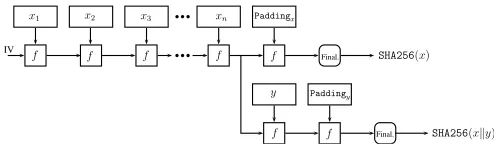
2) Structure of SHA256 Hash Function: In the under-lying Merkle-Damg˚ard construction of SHA256 [33], an input file with some additional padding bits appended at the end, will be divided into 512-bits blocks. Then each block will be processed iteratively using an underlying fixed-input-length compression functionf, in order from left to right in a deterministic way (See Figure 2).
Our Observation.For any bit-stringsxandy, the compu-tation ofSHA256(x)and the computation ofSHA256(xky), will be identical6 in the processing of the first
|x| bits of input. By saving the repeated computation steps, one can compute the two hash valuesSHA256(x)andSHA256(xky)
together as fast as computing only a single hash value
SHA256(xky) (See Figure 2). The construction of our proposed hash function in this paper exploits this property to achieve high performance.
We remark that, (1) the above property also applies on
SHA512, and Sponge function [6] based hash function (e.g. aSHA3 candidate Keccak Hash [7]); (2) the above idea is
Final. Paddingx
f f f f f
x1 x2 x3 bbb xn
bbb
y Paddingy
f f Final. IV
SHA256(x)
SHA256(xky)
Figure 2. Illustration of fast computation of two hash valuesSHA256(x) andSHA256(xky), where stringx=x1kx2k. . .kxn. For simplicity, we
assume that stringyis short and the length of stringxis a multiple of 512—the block size ofSHA256[33].
related to the length extension attack on hash function, but with very different purpose. It is possible that a hash function, which is resistant to length extension attack, still satisfies the above property.
B. Related works
1) Proofs of Ownership: To prevent private data leakage to outside adversary, Haleviet al.[25] proposed a notion of “proofs of ownership” (PoW). In a PoW scheme, any owner of a fileF, without necessarily knowing other own-ers ofF, can efficiently prove to the cloud storage server that he/she owns the fileF; any outside adversary cannot prove that he/she has the file F with probability larger than a predefined threshold, even if a certain amount of efficiently-extractable information of fileFis leaked to the adversary. Such leakage may occur after a proof session between the adversary and the cloud server completes, and before a new proof session between them starts.
Haleviet al.[25] proposed three constructions. The first construction encodes a file using some error erasure code, and then applies the standard Merkle Hash Tree proof method over the encoded file. The second construction is a generic framework. Let Hk : {0,1}M → {0,1}L be anypairwise independent hash family. Given a file F of
M bits long, the second construction computes the hash value Hk(F) with a public randomness k as hash key and applies the standard Merkle Hash Tree proof method over the L bits value Hk(F). The third construction is the most practical one. It designs an efficient hash family
H0k :{0,1}M
→ {0,1}L and applies the standard Merkle Hash Tree proof method over H0k(F). However, their construction of H0k is not pairwise-independent (even if in the random oracle model). Consequently, the generic framework in the second construction cannot apply and a new security proof is required. As the authors explicitly mentioned, Haleviet al.[25]’s security proof for their third construction has some limitations: (1) the proof assumes that the file F is sampled from a particular type of distribution (Haleviet al.[25] called this distribution as a generalization of “block-fixing distribution”); (2) the proof is given “under the unproven assumption that their scheme will generate a good code” [25] (See Theorem 3 in their paper [25] ); (3) the proof is given in random oracle model, whereSHA256is treated as a random function.
Following the generic framework given in the second
construction of Haleviet al.[25], we propose a practical construction of hash functionHkand obtain a PoW scheme based onHk. We prove thatHk is pairwise independent in the random oracle model. Although it is still in the random oracle model, our security proof of the proposed PoW scheme has two advantages over Haleviet al.[25]: (1) it applies to anydistribution of files, instead of a particular type of distribution; and (2) it only relies on well-known assumption that AES encryption is semantic secure.
In addition, this paper also aims to protect data privacy against honest-but-curious cloud storage server, and pro-poses the first secure solution for client-side deduplication over encrypted files in the bounded leakage setting.
2) Extremely Efficient “PoW”: Very recently, Pietro and Sorniotti [37] proposed an efficient “PoW” scheme: They use the projection of the file F onto K 7 randomly selected bit-position i1, . . . , iK as the “proof” of own-ership of the file F, that is, the knowledge of bit-string
F[i1]k. . .kF[iK] is a “proof” of ownership of fileF. This scheme is extremely efficient. However this work [37] has at least these limitations: (1) it does not protect privacy against honest-but-curious cloud storage server; (2) it requires that all leakage of file F to the outside adversary occurs before the very first execution of their proof protocol; (3) it is secure only if the min-entropy of file F to the view of adversaries is close to the bit-length of file F, after the leakage occurs. Thus it tolerates a little amount of leakage and achieves very weak security under the formulation of Haleviet al. [25].
3) Existing Attempt for Privacy-Preserving PoW: Re-cently, Ng et al. [32] made an attempt to support PoW over encrypted files. Their method encrypted files on client side and shared the encryption key among a group of users who know each other. Their method applies existing scheme [12] to do key management within the group, and focus on formulating and devising proofs of ownership scheme in a privacy preserving manner.
Here we brief their PoW scheme as below: A file is divided into many blocks xi’s, and a commitment ci is computed from each xi under a secret key. Then the standard Merkle Hash Tree method applies over the commitments(c1, c2, . . .). After the completion of Merkle
Hash Tree proof protocol, the verifier knows some commit-ment valueci, and the prover has to show that he/she has the knowledge of some secret valuexiwhose commitment is ci, without revealing information onxi to the verifier.
We observe that their proof of knowledge ofxi against ci is similar to the generalized Okamoto-Identification scheme [34], given by Alwen et al. [1]. This proof of identification scheme allows the verifier to efficiently de-cide whether the secret value xi is equal to any given candidate valuex, thus allows brute-force search ofx.
In summary, Ng et al. [32]’s PoW scheme has the following limitations: (1) it is very slow in computation: in
every execution of the proof protocol, to generate all com-mitment valuesci’s,|F|/1024number of exponentiations8 in a modulo group of size≈21024are required where
|F|
denotes the bit-length of fileF; (2) the encryption key is shared among a group of “friends”, which is not suitable for client-side deduplication over encrypted files, since in current typical client side duplication setting, owners of the same file will be anonymous to each other; (3) it suffers from “divide and conquer attack” mentioned previously in Section I-A3, although (i) it is provably privacy-preserving under their formulation [32] and (ii) it is applied in file-level instead of block-file-level.
In an extreme example, a large fileF withL bits min-entropy to the view of the curious cloud server is divided into L blocks xi’s where each xi has exactly 1 bit min-entropy to the view of the curious cloud server. If Ng et al. [32]’s method is applied over such a file F, then the honest-but-curious cloud server could learn everything of the file efficiently in timeO(L) instead of O(2L)during the proof process, by brute-force searching of the value of each xi independently. In contrast, if the proposed scheme in this paper applies over the same file F, any efficient curious cloud server or outside adversary cannot recover the file and cannot obtain the bit valueF[i]at any bit-position i in file F, assuming F[i] was unknown to adversaries before the execution of the proof protocol.
Another recent work [49] combines proofs of storage (i.e POR [28] and PDP [4]) with proofs of ownership.
The security goal of this paper can be roughly de-scribed as “privacy-preserving PoW” and is close to Zero-Knowledge Proof of Identification [21, 20]. However, the latter are designed for short identification and impractical in our problem, since the counterpart of identification in our problem could be a large file (say1GB).
III. LEAKAGE-RESILIENTCLIENT-SIDE
DEDUPLICATION: SECURITYMODEL
In this section, we propose a security formulation for client-side deduplication of encrypted files, by enhancing the PoW formulation [25].
A. System Model and Trust Model
1) Cloud Storage Server: Cloud Storage Server (Cloud Server or Cloud for short) is the entity who provides cloud storage service to various users. Cloud Storage Server has a small and fast primary storage and a large but slow secondary storage. Although the computation power (CPU, I/O, network bandwidth, etc) of Cloud Storage Server is much stronger than a single average user, the average computation power per each online user is usually very limited. We assume that the small and fast primary storage is well-protected from outside adversaries, and the large
8One such group exponentiation requires more than 3 milliseconds in a model PC, which means that it requires more than 3000 seconds to generate all commitments for a file of size 1 giga-bits. Such expensive operation will be executed every time when a user tries to upload the same file to the cloud.
but slow secondary storage could be visible to outside adversaries.
An example of cloud storage server is Dropbox [17]. Users’ files uploaded to Dropbox are actually stored in Amazon’s S3 data center (i.e. Dropbox’s secondary storage) and Dropbox only runs relatively small server to manage meta data (i.e. Dropbox’s primary storage). Another cloud storage service provider Wuala [48] stored users’ files in P2P network (the secondary storage) in the early stage of the company.
2) Cloud Users: Many cloud users may upload their files to the cloud storage and possibly remove their lo-cal copies. These users may download files, which are uploaded by themselves, from cloud storage. File sharing among users is not the focus of this paper, although it can be achieved along with our solution for encrypted data.
3) Bounded Leakage of Users’ Files: In the setting of PoW in Halevi et al. [25], a bounded amount of efficiently-extractable information of the input fileF could be leaked by other owners of the same (or even similar) file unintentionally or intentionally. We treat this as a side channel leakage of the sensitive file F.
4) Adversaries: We consider two types of adversaries: Malicious outside adversary and honest-but-curious Cloud server.
Malicious Outside Adversary.The outside adversary may obtain some knowledge (e.g. a hash value) of the file of interest via some channels, and plays a role of cloud user to interact with the cloud server.
Semi-honest Inside Adversary (Honest-but-Curious Cloud Server). This honest but curious cloud storage server (also known as inside adversary) will maintain the integrity of users’ files and availability of the cloud service, but is curious about users’ sensitive files. This could capture at least the following cases in real world applications:
1) Some technical employee or even the owner of the cloud tries to access user data due to some reason. 2) The company, which provide the cloud storage
ser-vice, made careless technical mistakes which may leak users’ private data, e.g. introducing a software bug. It is reported that Dropbox [47] made users’ data open to public for almost 4 hours due a new software bug. Very recently, a bug is discovered in one of Twitter’s official client software, which allows attackers to access users’ accounts [44].
3) The cloud storage server is hacked in.
B. Syntax Definition
A Client-side Deduplication (called CSD for short) scheme (E,D, P, V) consists of four algorithms E, D,
P andV, which are explained as below:
• E(F,1λ) → (τ, C0, C1): The probabilistic encoding
as a part, and a long encoding C1. C0 will be stored
in cloud server’s small and secure primary storage and
C1will be stored in cloud server’s large but potentially
insecure secondary storage. The lengths of τ and C0
should be both inO(λ).
• D(τ, C1)→ F: The deterministic decoding algorithm
takes as input a secret keyτ and the long encodingC1,
and outputs a file F.
• hP(F),V(C0)i → (y0; y1, y2): The prover algorithm
P, which takes a file F as input, interacts with the verifier algorithm V, which takes a short encoding C0
as input. At the end of interaction, the prover algorithm
P gets outputy0∈ {τ,⊥}and the verifier algorithmV
gets output(y1, y2)wherey1∈ {Accept,Reject}and y2∈ {hash(C1),⊥}.
Definition 1 (Correctness). We say a CSD scheme
(E,D,hP,Vi) is correct, if the following conditions hold with overwhelming high probability (i.e.1−negl(λ)): For any data fileF ∈ {0,1}∗ and any positive integerλ, and
(τ, C0, C1) :=E(F,1λ),
• D(τ, C1) =F.
• hP(F),V(C0)i= (τ; Accept,hash(C1)).
Here the hash value hash(C1) is required, in order to
defend poison attack. In case that the cloud does not have plaintext of file F, the cloud storage server alone is not able to decide whether a given tuple(hash(F), C0, C1)is
consistent or inconsistent (i.e. poisoned).
C. Security Definition
The original formulation of PoW proposed by Halevi [25] has two limitations: it does not address the protection of partial information of users’ files against outside adversary; it does not address the protection of confidentiality of users’ files against curious cloud server. Since the nature of client-side deduplication allows any user (including adversaries) to do equality test (i.e. check whether the file on client side is identical to the file on server side), any solution to client-side deduplication (in-cluding PoW schemes) cannot achieve semantic security, that is, any solution will leak some partial information that will allow the adversary to do brute force search for users’ secret files.
In this subsection, we will propose a security formula-tion for client-side deduplicaformula-tion, to address the above two limitations of PoW [25]. Our formulation will address the protection of useful partial information (particularly any physical bit in the sensitive file F) from the malicious outside adversary or the honest-but-curious cloud server: Roughly speaking, PPT outside/inside adversary cannot learn anynewinformation on any physical bitF[i]of file
F from client-side deduplication process beyond the side channel leakage.
The CSD security game GCSD
A (ξ0, ξ1) between a
PPT adversary A and a challenger w.r.t. CSD scheme
(E,D,hP,Vi) is defined as below, where ξ0 > ξ1 ≥
λ. Here ξ0 is the lower bound of min-entropy of the
challenged file F at the beginning of the game, and the adversary is allowed to learn at most (ξ0−ξ1) bits
information of fileF from the challenger.
Setup. The description of (E,D,hP,Vi) is made public. Let F be sampled from any distribution over {0,1}M with min-entropy≥ξ0. where the public integer parameter M ≥ξ0is polynomially bounded inλ. The challenger runs
the encoding algorithm to obtain(τ, C0, C1) :=E(F,1λ).
The challenger sendsC1andhash(F)to the adversaryA. Learning-I. The adversary Acan adaptively make poly-nomially many queries to the challenger, where concurrent queries are not allowed9 and each query is in one of the following forms:
• ENCODE-QUERY: The challenger responses the i-th ENCODE-QUERY by running the probabilistic encod-ing algorithm on F to generate (τ(i), C(i)
0 , C (i) 1 ) :=
E(F,1λ)and sending (C(i) 0 , C
(i)
1 )to the adversary.
• VERIFY-QUERY: The challenger, running the prover algorithm P with input F, interacts with adversary
A which replaces the verifier algorithm V, to obtain
(y0;y1, y2) := hP(F),Ai. The adversary knows the
values of y1 andy2.
• PROVE-QUERY: The challenger, running the verifier algorithmV with inputC0, interacts with the adversary
A which replaces the prover algorithm P, to obtain
(y0;y1, y2) :=hA,V(C0)i. The adversaryAknows the
value ofy0.
• LEAK-QUERY(Func): This query consists of a PPT-computable function Func. The challenger responses this query by computing y :=Func(F) and sendingy
to the adversary. The adversary can make polynomially many queries in this type, subject to a constraint: the sum (denote this sum with Y) of bit-lengths of all function outputsy’s is smaller than (ξ0−ξ1).
Note: According to Lemma 2.2 in Dodiset al.[14], at most Y<(ξ0−ξ1)bits information (in term of entropy) about file
F will be leaked to the adversary via thisLEAK-QUERY. Commit.The adversary Achooses a subset ofv indices
i1, . . . , ivfrom[1,|F|], wherev≥1andv+Y ≤ξ0−ξ1.
The challenger finds the subsequenceα ∈ {0,1}v of F, such that, for eachj ∈[1, v], α[j] =F[ij]. The challenger chooses a random bit b ∈ {0,1} and sets αb := α and α1−b
$
←− {0,1}v. The challenger sends (α
0, α1) to the
adversaryA.
Guess-I.LetViewCommit
A denote the view of the adversary
Aat this moment. GivenViewCommit
algorithm (called “extractor”) A∗ outputs a guess bA∗ ∈
{0,1} of valueb.
Note: It is possible (and potentially acceptable) thatbA∗ = b with probability noticeably larger than 1/2. See our requirement in Definition 3 (especially Equation(1)and (2)).
Learning-II. This phase is identical to the Learning-I
phase, except that the adversary cannot make any LEAK-QUERY.
Guess-II. The adversary A outputs a guess bA ∈ {0,1} of valueb, and a guessFA∈ {0,1}|F|of the file F.
Based on the above generic security game GCSD A , we will define the weakly/strongly-secure games against out-side/inside adversaries in the following Definition 2.
Definition 2. Define four new security games based on the generic gameGCSD
A (ξ0, ξ1)as below
• Gw-A,outCSD(ξ0, ξ1): Identical to the generic game, ex-cept that adversary A makes only LEAK-QUERY in
Learning-I phase.
• Gw-A,inCSD(ξ0, ξ1): Identical to the generic game, except that (1) adversary A makes only LEAK-QUERY in
Learning-I phase and (2) the challenger sends C0 to
the adversary A in the very beginning of the Commit
phase.
• Gs-ACSD,out(ξ0, ξ1): Identical to the generic game, except that adversary A makes only PROVE-QUERY and
LEAK-QUERYinLearning-Iphase.
• Gs-ACSD,in (ξ0, ξ1): Identical to the generic game, except that (1) adversary A makes only ENCODE-QUERY,
VERIFY-QUERY and LEAK-QUERY in Learning-I
phase and (2) the challenger sendsC0to the adversary
A in the very beginning of theCommitphase.
In each of the four new security games, the adversary A can makeENCODE-QUERY,PROVE-QUERYand VERIFY-QUERY, but not LEAK-QUERY, inLearning-IIphase. Definition 3 (Strongly-Secure/Weakly-Secure CSD). Let integerλbe the security parameter and ξ0> ξ1 ≥λ. At first, define two conclusion statementsC1,C2as below
C1: Pr[Afinds fileF inGuess-IIphase] ≤ negl(λ), i.e.
Pr[FA=F]≤negl(λ).
C2: There exists some PPT extractor algorithm A∗, such that
Pr[AfindsbinGuess-IIphase]
≤Pr[A∗findsbinGuess-Iphase] +negl(λ). (1)
Equivalently, the above Equation(1)can be written as
Pr[bA=b]≤Pr[bA∗=b] +negl(λ). (2) We say aCSD system(E,D,hP,Vi)is
• (ξ0, ξ1)-weakly-secure against outside adversary, if for any PPT adversary A, conclusions C1 and C2 hold in the security game Gw-CSD
A,out (ξ0, ξ1);
• (ξ0, ξ1)-weakly-secure against inside adversary, if for any PPT adversary A, conclusions C1 and C2 hold in the security game Gw-CSD
A,in (ξ0, ξ1);
• (ξ0, ξ1)-strongly-secure against outside adversary, if for any PPT adversary A, conclusions C1 and C2 hold in the security game Gs-CSD
A,out(ξ0, ξ1);
• (ξ0, ξ1)-strongly-secure against inside adversary, if for any PPT adversary A, conclusions C1 and C2 hold in the security game Gs-CSD
A,in (ξ0, ξ1). Remarks on the security formulation.
• Our formulation (particularly, Equation (1) and (2) in Definition 3) requires that Pr[bA = b] ≤ Pr[bA∗ = b] +negl(λ), which means the adversaryAessentially cannot learn any new information on physical bits
F[i1]. . . F[iv] in fileF duringLearning-II phase. We emphasize that it is important to asksomeextractorA∗ instead of the adversaryAto make a guessbA∗ before Learning-II, to exclude a trivial attack: Adversary
A intentionally outputs a random guess of b before
Learning-II, and outputs its maximum-likelihood of b
after Learning-II, in order to increase the difference between success probability in Guess-I and Guess-II. Note that this requirement follows the style of original definition of semantic security (Definition 5.2.1 in Goldreich [22]).
• The adversary is allowed to obtain the long encodingC1
of users’ data fileFin the above security game, since in real applications,C1 is typically stored in the large but
potentially insecure secondary storage, as mentioned in Section III-A1.
• Both gameGwA-CSD,in (ξ0, ξ1)and gameGsA-CSD,in (ξ0, ξ1)
al-low the honest-but-curious cloud storage server to know the short encodingC0onlyafter theLearning-Iphase.
This is due to a fundamental limitation—all LEAK-QUERYs have to be made before the adversary (i.e. the server) knows the value C0, otherwise, the adversary
can obtain the encryption key τ by making a LEAK-QUERY(FuncC0), whereFuncC0(F) =hP(F),V(C0)i. Therefore, no secure CSD scheme exists in this case. • A CSD scheme does not have any master secret key.
Therefore, the adversary A himself/herself can find answers to any queries w.r.t any input file F0 that is owned byA, without help of the challenger.
• If the long encodingC1is obtained by encrypting fileF
using the convergent encryption [15, 16], i.e. encrypting the file F under AES method with some hash value
hash0(F)as encryption key, then the adversary (i.e. the curious cloud server) will have both ciphertext C1 and
decryption key hash0(F), and thus obtain the file F, where
– C1 is given by the challenger in the security game; – hash0(F) can be obtained by making a
LEAK-QUERY.
Therefore, convergent encryption is insecure in our security game due to the bounded leakage setting.
D. Background on formulation of Proofs of Ownership
definitions and analyze the relationship between their formulation of PoW and our formulation ofCSD. Readers can find more details on PoW in Haleviet al. [25].
Definition 4 (Proofs of Ownership [25]). A proof of ownership scheme consists of a probabilistic algorithm
S and a pair of interactive algorithm hP,Vi, which are described as below:
• S(F,1λ) → ψ: The randomized summary function S
takes a file F and the security parameter λas input, and outputs a short summary value ψ where the bit-length of ψis inO(λ).
• hP(F),V(ψ)i → Accept or Reject: The prover al-gorithm P which takes as input a file F, interacts with the verifier algorithm V which takes as input a short summary value ψ, and outputs either acceptor
reject.
We point out, the efficiency requirement excludes some straightforward secure methods: For example, both prover and verifier have access to the fileF and compute a key-ed hash value overF with a randomly chosen nonce as hash key per each proof session.
Figure 3. Convert scheme PoW = (S,hP,Vi) to schemeCSD = (E,D,hP,Vi). LetE= (KeyGen,Enc,Dec)be a symmetric encryp-tion scheme.
E(F,1λ)
1) τ :=KeyGen(1λ)
∈ {0,1}λ. 2) CF :=Encτ(F).
3) ψ:=S(F,1λ). 4) Cτ:= (τ, ψ).
D(τ, CF) 1) F0 :=Dec
τ(CF) 2) OutputF0.
hP(F0), V(C τ)i
V1↔P1: Run interactive algorithm
hPoW.P(F0),PoW.V(ψ)
i. The verifier obtains outputv∈ {accept,reject}.
V2: If v = accept, send y0 := τ to the prover,
and computey1=accept and computey2:=
hash(CF). Otherwise, reject and abort.
Lemma 1. Let PoW and CSD be as in Figure 3 and ξ0 > ξ1 ≥λ. If and only if PoWis secure with leakage threshold(ξ0−ξ1), slacknessλand negligible soundness error (as defined in Definition 2 of Halevi [25]), conclusion
C1 (as defined in Definition 3) holds in security game
Gs-CSD
A,out(ξ0, ξ1)w.r.t. schemeCSDagainst any PPT outside adversaryA.
The above Lemma 1 can be proved straightforwardly from the security formulation of PoW [25] and our formu-lation ofCSD. We save the details due to space constraint.
IV. WEAKLY-SECURECLIENT-SIDEDEDUPLICATION
A. Construction
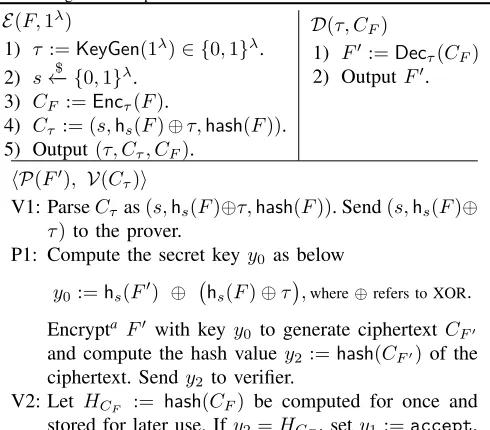
We present the construction of a CSD scheme WEAK-CSD= (E,D,hP,Vi)in Figure 4. Suppose Alice
is the first user who uploads file F. She will execute algorithmEwith fileF and security parameter1λas input and obtain a short secret encryption keyτ, a short encoding
Cτ ∈ {0,1}3λ and a long encoding CF. Alice will send both Cτ and CF to the cloud storage server Bob. Bob will compute the hash value hash(CF), put Cτ in secure and small primary storage, and put CF in the potentially insecure but large secondary storage. At the last, Bob will add (key = hash(F),value = (hash(CF), Cτ) into his lookup database. Suppose Carol is another user who tries to upload the same file F after Alice. Carol will send
hash(F) to the cloud storage server Bob. Bob finds that
hash(F)is already in his lookup database. Then Bob who is running algorithm V with Cτ as input interacts with Carol who is running algorithm P with F as input. At the end of interaction, Carol will learn τ and Bob will compare the hash valuehash(CF)provided by Carol with the one computed by himself. Later, Carol can download
CF from Bob at any time and decrypt it to obtain the file F by running algorithm D(τ, CF).
Figure 4. The construction of a weakly-secure CSD, denoted as WEAK-CSD. LetE= (KeyGen,Enc,Dec)be a symmetric encryption scheme withλ(=ρ) bits long key length andhk:{0,1}∗→ {0,1}ρ
be a key-ed hash function. Notice that the random coin ofEncwill be put in the generated ciphertext.
E(F,1λ)
1) τ:=KeyGen(1λ)
∈ {0,1}λ. 2) s←− {$ 0,1}λ.
3) CF :=Encτ(F).
4) Cτ:= (s,hs(F)⊕τ,hash(F)). 5) Output (τ, Cτ, CF).
D(τ, CF) 1) F0:=Dec
τ(CF) 2) OutputF0.
hP(F0),
V(Cτ)i
V1: ParseCτas(s,hs(F)⊕τ,hash(F)). Send(s,hs(F)⊕ τ)to the prover.
P1: Compute the secret keyy0 as below
y0:=hs(F0) ⊕ hs(F)⊕τ,where⊕refers to XOR.
Encrypta F0 with key y
0 to generate ciphertext CF0 and compute the hash value y2:=hash(CF0) of the ciphertext. Send y2 to verifier.
V2: Let HCF := hash(CF) be computed for once and stored for later use. Ify2=HCF, sety1:=accept, otherwisey1:=reject.
aAs mentioned in the overview in Section I, this encryption step is
required to compute the hash valuehash(CF0), which will help the verifier (i.e. cloud storage server) to detect poison attack.
Theorem 2. Let ξ0 > ξ1 = 2λ. Suppose the encryp-tion scheme E is semantic secure (Definition 5.2.1 in Goldreich [22]) and the hash function hk is a random oracle. Then the WEAK-CSD scheme in Figure 4 is
Alternatively, if {hk} is a non-linear pairwise-independent hash family, the above theorem can also be proved with ξ0 > ξ1 = 2λ+O(λ) based on the leftover
hash lemma [5], in the standard model. We will leave this proof in the full version of this paper.
B. Comparison with Convergent Encryption
1) Our solution is a natural extension of convergent encryption: In our scheme WEAK-CSD given in Figure 4, the encryption of file F is(s,hs(F)⊕τ,Encτ(F)). This encryption method can be treated as a natural extension of convergent encryption which overcomes the below shortcomings of convergent encryption.
Revocation of encryption key. It is very difficult, if not impossible, to revoke the encryption key of con-vergent encryption, when the current encryption key is compromised. Suppose a user tries to encrypt fileF using
hash(F)as AES encryption key, and finds that the value ofhash(F)has already been revealed to Internet by some other owner of file F. He may switch to use hash0(F)
as encryption key where hash0(·) is another secure hash function. Meanwhile, the user has to broadcast this switch of hash function to all future users. This approach will face two issues: (1) The number of different secure hash function is very limited. (2) Users may abuse the above hash-revoking functionality. A natural fixes to the above two issues are: (1) Use a secure key-ed hash function and revoke the hash key if necessary. (2) It is not necessary that every user adopts the same hash function (i.e. the same keyed-hash function and hash key) to generate the AES encryption key. Every user can independently choose a new hash key without notifying others. As a result, a user can encrypt a fileF in this way: Randomly choose a hash keysand generate the ciphertext(s,AEShs(F)(F)). Can any hash value be a valid encryption key? It is a coincidence that the range of hash function (e.g.SHA256) is consistent with the key space of encryption method (e.g. AES). Many other encryption schemes have special key generating algorithm and the generated key should have a particular structure, for example, some public key en-cryption schemes. Therefore, convergent enen-cryption cannot generalize to generic encryption scheme. Our proposed encryption method overcomes this weakness, by invoking the key generating algorithm of the underlying encryp-tion method to generate an encrypencryp-tion key and protect this generated encryption key using a one-time pad. Let
(KeyGen,Enc,Dec)be the underlying encryption method. The ciphertext ofFwill be(s,hs(F)⊕τ,Encτ(F)), where the hash keys is randomly generated and the underlying encryption keyτ is generated by algorithmKeyGen.
Leakage Resilient. More importantly, convergent en-cryption is insecure if a bounded amount of efficiently-extractable information of the plaintext F is leaked. Our encryption method is resilient to such bounded leakage of the plaintext F, in the random oracle (assuming h is a random oracle) or in the standard model (assuming h is pairwise-independent hash function).
2) Advantage of Convergent Encryption: Convergent encryption can be used for both client-side and server-side deduplication. In contrast, our encryption method can be used only for client-side deduplication, since the one round interaction in the client-side deduplication is essential for our solution to synchronize the hash key. Unsurprisingly, both convergent encryption and our encryption method are not semantically secure [22].
V. STRONGLY-SECURECLIENT-SIDEDEDUPLICATION In this section, we will construct a new PoW scheme by devising an efficient pairwise-independent hash function with large output size, and propose a strongly-secureCSD scheme, denoted as STRONG-CSD, by combing the newly constructed PoW scheme with the weakly-secure CSD scheme WEAK-CSD.
A. A New Proof of Ownership Scheme
Halevi et al.[25] proposed a generic framework, which combines any pairwise-independent hash function with large output size and the standard Merkle Hash Tree proof method, to construct PoW scheme. Halevi et al. [25] also proposed a practical PoW scheme which is secure w.r.t. a particular type of distribution of input file with sufficient min-entropy. In this subsection, following the generic framework [25], we will propose a new PoW scheme which is provably secure w.r.t. anydistribution of input file with sufficient min-entropy, by devising a novel and efficient pairwise-independent hash function with large output size.
1) A New Keyed-Hash Function with Large Output Size: We are going to construct a hash function Hk with large output size (i.e. ρ` bits), using an underlying hash function hk with small output size (i.e. ρbits). We expect the constructed hash function Hk to be pairwise independent if the underlying hash function hk is 4` -independent. The details of the construction is in Figure 5. LetHk(·)be the subroutine defined in Figure 5. Roughly speaking, the constructed hash function Hk(F) can be summarized as Hk(F) ⊕ Reverse1(Hk(Reverse0(F))),
where Reverse0 and Reverse1 are bit-level and
block-level reverse operations, respectively. Notice that none of the following constructions is pairwise-independent: (1)
Hk(F); (2) Hk(F)⊕ Hk(Reverse0(F)); (3) Hk(F) ⊕
Reverse1(Hk(F)).
Lemma 3. Let Hk : {0,1}≥ρ` → {0,1}ρ` be the hash function constructed in Figure 5 using the underlying hash function hk : {0,1}∗ → {0,1}ρ. Given an input file F ∈ {0,1}∗ with bit-length
|F| ∈[ρ`,264), we have the following conclusions on the complexity ofHk(F): • Suppose the complexity of computation of hk(x) is in
O(|x|). Then the complexity ofHk(F)is inO(|F| ×`). • Suppose hk(x) = SHA256(kkx) and ρ = 256. Then
Hk(F)can be computed in timeO(|F|+`).
complexity of Hk(F) is in O(|F| +`), which in turn implies the above Lemma 3. The details of proof is saved due to space constraint.
Figure 5. Construction of a keyed-hash functionHk with output size
equal toρ`bits, using an underlying keyed-hash functionhkwith output
size equal toρbits.
Input: The input is a file F ∈ {0,1}∗ with bit-length
|F|, whereρ`≤ |F|<264and integersρand`are
public system parameters. The hash keyk is from the key space of the hash functionh.
1) Define a subroutineHk as below:
a) The input is a bit-string w1kw2k. . .kw`, where each substring wi has equal bit-length, and “k” denotes the string concatenation operator.
b) For each i ∈ [1, `], compute ui :=
hk(w1kw2k. . .kwi)∈ {0,1}ρ.
c) The output is u1ku2k. . .ku`∈ {0,1}ρ`.
2) Let Len∈ {0,1}64 be the 64 bits big endian integer
representation of the bit-length of file F. Pad file F
intoF∗ as below:
F∗=Pad(F)def
= ‘0’kLenkFk‘1’k ‘0| {z }’. . .‘0’ Rnumber of‘0’
kLenk‘1’,
whereRis the smallest nonnegative integer such that the bit-length ofF∗ is a multiple of `, i.e. 1 + 64 +
|F|+ 1 +R+ 64 + 1 mod`= 0.
3) Computey1ky2k. . .ky`:=Hk(F∗), where eachyi ∈
{0,1}ρ.
4) Computez1kz2k. . .kz` :=Hk(F∗), where eachzi ∈
{0,1}ρ andF∗ is the bit-string obtained by reversing the order of bits in F∗.
Output:The output is
Hk(F) def
= y1ky2k. . .ky`
⊕z`k. . .kz2kz1
,
where⊕denotes the XOR operator.
Theorem 4. Let Hk : {0,1}≥ρ` → {0,1}ρ` be the hash function constructed in Figure 5 using the underlying hash function hk : {0,1}∗ → {0,1}ρ. If {hk} is a 4 `-independent hash family, then {Hk} is a 2-independent ( i.e. pairwise independent) hash family. (The proof is in Appendix B)
The combination of the above Theorem 4 and Theorem 2 in Halevi et al. [25], directly implies the following conclusion:
Corollary 5. A protocol where the input file is first hashed to aρ`-bit value using pairwise-independent hash function
Hk constructed in Figure 5, and then we run the Merkle Hash Tree protocol on the resultingρ`-bit value, is a proof-of-ownership as per Definition 2 in Haleviet al.[25], with leakage thresholdρ`·(1
3− 1
2ρ). Here ρis the block size. It is worth to point out that in Halevi et al. [25], a
pairwise-independent hash with large output size is re-quired, in order to achieve a trade-off between security and computation efficiency. In this paper, such hash function has an additional new role: protect privacy of users’ files from the verifier (i.e. the cloud server) during the proof protocol.
B. Main Construction: Strongly-SecureCSD Scheme
Our main construction is given in Figure 6 and has been briefed previously in Section I-B1.
Figure 6. The construction of a strongly-secure CSD, denoted as STRONG-CSD. Let (E0,D0,hP0,V0i) be the weakly-secure CSD
scheme WEAK-CSD in Figure 4 andPoW = (S,P,V) be the PoW scheme specified in Corollary 5.
E(F,1λ)
1) (τ, Cτ, CF) :=E0(F,1λ).
2) π:=PoW.S(F,1λ). 3) Output (τ,(Cτ, π), CF).
D(τ, CF) 1) F0 :=
D0(τ, CF) 2) OutputF0.
hP(F0),
V(Cτ, π)i (Round complexity isO(1)) P1↔V1: RunhPoW.P(F0),PoW.V(π)
i. If its output is
reject, then abort and reject.
P2↔V2: Run hP0(F0),V0(Cτ)i to obtain output
(τ0;v, H
CF0)wherev∈ {accept,reject}.
Theorem 6. Letξ0> ξ1= 2λ. Lethk(x) =SHA256(kkx) and k∈ {0,1}256. Let(
E0,D0,hP0,V0i) be the(ξ0, ξ1) -weakly-secureCSD schemeWEAK-CSDin Figure 4 and
PoW= (S,P,V)be the PoW scheme specified in Corol-lary 5 with leakage threshold not greater than (ξ0−ξ1) (i.e. ρ`·(1
3 − 1
2ρ) ≤ (ξ0−ξ1)). Suppose hash function
hk is a random oracle. Then the client-side deduplication schemeSTRONG-CSDconstructed in Figure 6 is(ξ0, ξ1) -Strongly-Secure against outside adversary (inside adver-sary, respectively). (The proof is in Appendix C)
Notice that the leakage rate [13] (i.e. the ratio of the amount of leakage to the entropy of the sensitive file) of our main scheme STRONG-CSD is1−ξ1/ξ0= 1−2λ/ξ0,
which is close to 1 for largeξ0 (e.g.λ= 256, ξ0= 32×
223).
VI. PERFORMANCE
We have implemented a prototype of the proposed scheme STRONG-CSD with SHA256 as the full domain hashhash(·),SHA256(kkx)as the keyed-hashhk(x), and
AESencryption10as the semantic-secure symmetric cipher
E. The hash function SHA256 [33] and the symmetric cipherAES[11] are provided in OpenSSL [35] library (ver-sion 1.0.0g). The whole program is written in C language and compiled with GCC 4.4.5. It runs in a single process, except that the computation of the proposed hash function
Hk runs in two parallel processes. Our implementation is
not optimized and further performance improvements can be expected.
The test machine is a laptop computer, which is equipped with a 2.5GHz Intel Core 2 Duo mobile CPU (model T9300), a 3GB PC2700-800MHZ RAM and a 7200RPM hard disk. The test machine runs 32 bits version of Gentoo Linux OS with kernel 3.1.10. The file system is EXT4 with 4KB page size.
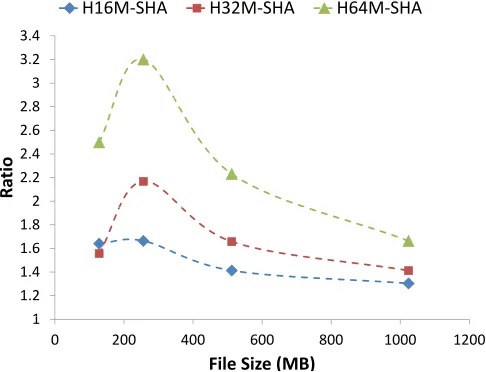
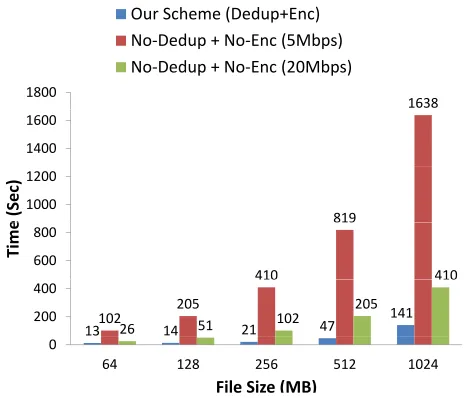
We run the hash functionHk and the proposed client-side deduplication scheme STRONG-CSD over files of size 128MB, 256MB, 512MB, and 1024MB, respectively. The running time of the hash function Hk and SHA256 is reported in Figure 7(a), and the ratio of the running time ofHk to the running time of SHA256 is reported in Figure 7(b). The running time of the proof protocol (i.e. interactive algorithmhP,Vi) in STRONG-CSD is reported in Figure 8, compared with network transfer time of test files without encryption or deduplication. The running time of encoding algorithmEis very close to (and smaller than) the interactive algorithmhP,Vi. Here we save the actual running time forE. All measurement represents the mean of 5 trails. Since the variants are very small, we do not report it.
We observe that, for small files, the saving in uploading time is small if the network upload speed is as fast as 5Mbps or even 20Mbps, but saving in server storage still matters to the cloud storage server. We remark that, leakage resilient server-side deduplication over encrypted files remains an open problem.
VII. CONCLUSION
In this paper, we addressed an important security con-cern in cross-user client-side deduplication of encrypted files in the cloud storage: confidentiality of users’ sensitive files against both outside adversaries and the honest-but-curious cloud storage server in the bounded leakage model. On technique aspect, we made two contributions: (1) we constructed a novel and efficient hash function with large output size (e.g. 32MB) which is pairwise-independent in the random oracle model; (2) we enhanced and general-ized the convergent encryption method, and the resulting encryption scheme could support client-side deduplication of encrypted file in the bounded leakage model.
The proposed hash function may have independent interests. Design of practical and provably secure proof of ownership scheme (client-side deduplication scheme, respectively) in the standard model remains an open prob-lem.
REFERENCES
[1] Jo¨el Alwen, Yevgeniy Dodis, and Daniel Wichs. Leakage-Resilient Public-Key Cryptography in the Bounded-Retrieval Model. In CRYPTO ’09: Annual International Cryptology Conference on Advances in Cryptology, pages 36–54, 2009.
[2] Amazon. AWS Customer Agreement. http://aws.amazon.com/ agreement/.
[3] Paul Anderson and Le Zhang. Fast and secure laptop backups with encrypted de-duplication. InProceedings of the 24th international
16
SHA256 H16M H32M H64M
14
10 12
e
c)
6 8
ime
(S
e
4 6
Ti
0 2
0
0 100 200 300 400 500 600 700 800 900 1000 1100 File Size (MB)( )
(a) Comparison of running time between our proposed hash function and
SHA256.H64Mdenotes our hash function Hk with output size equal to
64MB. Similar forH16MandH32M.
3.4
H16M‐SHA H32M‐SHA H64M‐SHA
3 3.2
2 4 2.6 2.8
2 2.2 2.4
Ra
tio
1.6 1.8
1 1.2 1.4
1
0 200 400 600 800 1000 1200
File Size (MB)( )
(b) The ratio of running time of proposed hash function to the runnig time of
SHA256.H64M-SHAdenotes the ratio of running time of our hash function Hkwith output size equal to 64MB to the running time ofSHA256. Similar
forH16M-SHAandH32M-SHA.
Figure 7. Comparison of the performance between our proposed hash functionHk andSHA256.
conference on Large installation system administration, LISA’10, pages 1–8, 2010.
[4] Giuseppe Ateniese, Randal Burns, Reza Curtmola, Joseph Herring, Lea Kissner, Zachary Peterson, and Dawn Song. Provable data possession at untrusted stores. InCCS ’07: ACM conference on Computer and communications security, pages 598–609, 2007. [5] Boaz Barak, Yevgeniy Dodis, Hugo Krawczyk, Olivier Pereira,
Krzysztof Pietrzak, Franc¸ois-Xavier Standaert, and Yu Yu. Leftover Hash Lemma, Revisited. InCRYPTO, pages 1–20, 2011. [6] Guido Bertoni, Joan Daemen, Micha¨el Peeters, and Gilles Van
Assche. Cryptographic sponge functions. http://sponge.noekeon. org/CSF-0.1.pdf.
[7] Guido Bertoni, Joan Daemen, Micha¨el Peeters, and Gilles Van Assche. The Keccak sponge function family. http://keccak.noekeon. org/.
[8] Lawrence Carter and Mark Wegman. Universal classes of hash functions (Extended Abstract). InSTOC ’77: ACM symposium on Theory of computing, pages 106–112, 1977.
Our Scheme (Dedup+Enc) No‐Dedup + No‐Enc (5Mbps)
1638 1800
No‐Dedup + No‐Enc (20Mbps)
1400 1600
819 1000
1200
e
(Sec)
410 410
600 800
Tim
e
102 205
410
26 51 102
205
410
13 14 21 47
141 200
400
0
64 128 256 512 1024
File Size (MB)( )
Figure 8. Comparison between the running time of the proof protocol (i.e. interactive algorithm hP,Vi ) of our client-side deduplication scheme STRONG-CSD and the network transfer time of files without encryption.
functions. In Journal of Computer and System Sciences, pages 143–154, 1979.
[10] CNET. Who owns your files on Google Drive? http://news.cnet.com/8301-1023 3-57420551-93/
who-owns-your-files-on-google-drive/.
[11] Joan Daemen and Vincent Rijmen.The Design of Rijndael: AES -The Advanced Encryption Standard. 2002.
[12] Ernesto Damiani, S. De Capitani di Vimercati, Sara Foresti, Sushil Jajodia, Stefano Paraboschi, and Pierangela Samarati. Key manage-ment for multi-user encrypted databases. InStorageSS ’05: Pro-ceedings of ACM workshop on Storage security and survivability, pages 74–83, 2005.
[13] Yevgeniy Dodis, Kristiyan Haralambiev, Adriana L´opez-Alt, and Daniel Wichs. Efficient Public-Key Cryptography in the Presence of Key Leakage. InASIACRYPT ’10: ADVANCES IN CRYPTOLOGY, pages 613–631, 2010.
[14] Yevgeniy Dodis, Rafail Ostrovsky, Leonid Reyzin, and Adam Smith. Fuzzy Extractors: How to Generate Strong Keys from Biometrics and Other Noisy Data.SIAM J. Comput., 38(1):97–139, 2008.
[15] John Douceur, Atul Adya, William Bolosky, Dan Simon, , and Marvin Theimer. Reclaiming space from duplicate files in a serverless distributed file system. In ICDCS ’02: International Conference on Distributed Computing Systems, 2002.
[16] John Douceur, William Bolosky, and Marvin Theimer. US Patent 7266689: Encryption systems and methods for identifying and coalescing identical objects encrypted with different keys, 2007. [17] Dropbox. Dropbox. http://www.dropbox.com/.
[18] Dropbox. Dropbox Privacy Policy. https://www.dropbox.com/ privacy.
[19] Dropship. Dropbox api utilities, April 2011. https://github.com/ driverdan/dropship.
[20] Uriel Feige, Amos Fiat, and Adi Shamir. Zero Knowledge Proofs of Identity. InSTOC ’87: ACM symposium on Theory of computing, pages 210–217, 1987.
[21] Amos Fiat and Adi Shamir. How to prove yourself: practical solutions to identification and signature problems. InCRYPTO ’86: Advances in cryptology, pages 186–194, 1987.
[22] Oded Goldreich. Foundations of Cryptography: Volume 2, Basic Applications. 2004.
[23] Oded Goldreich. Foundations of Cryptography: Volume 2, Basic Applications (Chapter 5, Exercise 18). 2004.
[24] Google. Google Terms of Service). http://www.google.com/ policies/terms/.
[25] Shai Halevi, Danny Harnik, Benny Pinkas, and Alexandra Shulman-Peleg. Proofs of ownership in remote storage systems. InCCS ’11:
ACM conference on Computer and communications security, pages 491–500, 2011.
[26] Shulman-Peleg A. Harnik D., Pinkas B. Side Channels in Cloud Services: Deduplication in Cloud Storage. IEEE Security and Privacy Magazine, special issue of Cloud Security, 8(6), 2010. [27] Apple Inc. Apple Privacy Policy (Covering iCloud). http://www.
apple.com/privacy/.
[28] Ari Juels and Burton S. Kaliski, Jr. Pors: proofs of retrievability for large files. In CCS ’07: ACM conference on Computer and communications security, pages 584–597, 2007.
[29] Luis Marques and Carlos Costa. Secure deduplication on mobile devices. InOSDOC ’11: Workshop on Open Source and Design of Communication, pages 19–26, 2011.
[30] Microsoft. Microsoft Services Agreement). http://windows. microsoft.com/en-US/windows-live/microsoft-service-agreement. [31] Ilya Mironov, Omkant Pandey, Omer Reingold, and Gil Segev.
Incremental deterministic public-key encryption. Accepted by EU-ROCRYPT ’12; full paper available in Cryptology ePrint Archive, Report 2012/047, 2012. http://eprint.iacr.org/.
[32] Wee Kenong Ng, Yonggang Wen, and Huafei Zhu. Private data deduplication protocol. InSAC 12’: ACM Symposium on Applied Computing, 2012.
[33] NIST. National Institute of Standards and Technology. Secure hash standard (SHS). FIPS 180-2, August 2002.
[34] Tatsuaki Okamoto. Provably Secure and Practical Identification Schemes and Corresponding Signature Schemes. In CRYPTO ’92: Annual International Cryptology Conference on Advances in Cryptology, pages 31–53, 1993.
[35] OpenSSL. OpenSSL Project. http://www.openssl.org/.
[36] Mihai Patrascu and Mikkel Thorup. The power of simple tabulation hashing. InSTOC ’11: ACM symposium on Theory of computing, pages 1–10, 2011.
[37] Roberto Di Pietro and Alessandro Sorniotti. Boosting Efciency and Security in Proof of Ownership for Deduplication. InASIACCS ’12: ACM Symposium on Information, Computer and Communications Security, 2012.
[38] Jesse Walker Shay Gueron, Simon Johnson. Sha-512/256. Cryptol-ogy ePrint Archive, Report 2010/548, 2010. http://eprint.iacr.org/. [39] SNIA. Understanding Data De-duplication Ratios. white paper. [40] SpiderOak. SpiderOak. https://spideroak.com/.
[41] SpiderOak-Blog. Why SpiderOak doesn’t de-duplicate data across users.
[42] D. R. Stinson. Universal hash families and the leftover hash lemma, and applications to cryptography and computing.Journal of Combinatorial Mathematics and Combinatorial Computing, 42:3– 31, 2002.
[43] Mark Storer, Kevin Greenan, Darrell Long, and Ethan Miller. Secure Data Deduplication. InStorageSS ’08: ACM international workshop on Storage security and survivability, pages 1–10, 2008. [44] Twitter. Tweetdeck. http://money.cnn.com/2012/03/30/technology/
tweetdeck-bug-twitter/.
[45] Mark Wegman and Larry Carter. New Hash Functions and Their Use in Authentication and Set Equality.J. Comput. Syst. Sci., pages 265–279, 1981.
[46] Wikipedia. Comparison of online backup services. http://en. wikipedia.org/wiki/Comparison of online backup services. [47] wired.com. Dropbox Left User Accounts Unlocked for 4 Hours
Sunday. http://www.wired.com/threatlevel/2011/06/dropbox/; http: //blog.dropbox.com/?p=821.
[48] Wuala. Wuala. http://www.wuala.com/.
[49] Qingji Zheng and Shouhuai Xu. Secure and efficient proof of storage with deduplication. In CODASPY ’12: ACM conference on Data and Application Security and Privacy, pages 1–12, 2012.
APPENDIXA. PROOF OFTHEOREM2
Proof: For any PPT outside adversary ACSD against the WEAK-CSD scheme in Figure 4, we construct a PPT adversary AE against the underlying encryption schemeE, based onACSD.
Construction ofAE: The adversaryAEis given a ciphertextCF =
E.Encτ(F)where the encryption keyτand the input fileFare unknown
andFhas at leastξ0bits min-entropy.AEis allowed to learn any output of Func(F)from the oracleOF, where the PPT-computable function