EVALUATION OF TEACHERS’ ATTITUDES TOWARDS ACADEMIC PERFORMANCE OF STUDENTS WITH DISABILITIES IN SELECTED
REGULAR SECONDARY SCHOOLS IN BAUCHI STATE, NIGERIA
BY
MUHAMMAD HAMMA E83F/29137/2014
A RESEARCH THESIS SUBMITTED IN PARTIAL FULFILMENT OF THE REQUIREMENTS FOR THE DEGREE OF DOCTOR OF PHILOSOPHY (SPECIAL NEEDS EDUCATION) IN THE SCHOOL OF EDUCATION OF
KENYATTA UNIVERSITY
DECLARATION
I declare that, this thesis is my original work and has not been presented for a degree in any other university. This research thesis has been complemented by referenced sources duly acknowledged. Where text, data, graphics, pictures, and tables have been borrowed from other sources, including the internet, the sources were specifically accredited, and references cited using current APA style by anti-plagiarism regulations.
Signature: --- Date: --- Muhammad Hamma
E83/29137/2014
We confirm that the work reported in this thesis was carried out by the candidate under our supervision as university supervisors.
Signature: --- Date: --- Professor Geoffrey Kamau Karugu
School of Education
Department of Special Needs Education Kenyatta University
Signature: --- Date: --- Dr. Franciscah Irangi Wamocho
School of Education
DEDICATION
ACKNOWLEDGEMENT
In the first instance, I will start by expressing sincere gratitude to the Almighty Allah the omniscient, omnipotent and omnipresent for making me able to witness the completion of this momentous mission. Peace and endless blessings upon His noble Prophet (SAW).
My earnest gratitude goes to my supervisors as well as mentors Professor Geoffrey Kamau Karugu and Dr. Franciscah Irangi Wamocho who tirelessly supervised, guided and advised me on every single step of this research journey which made my research successful. It is whole-heartedly clear that your good supervision and advices on my research work proved to be the landmark effort toward the success of my work.
I would like to thank the entire staff of the Special Needs Education Department, Kenyatta University, most especially the immediate outgone and the current chairpersons (Dr. Nelly Otube and Dr. Beatrice Bunyasi Awori) for their motherly advice and encouragement which proved to be a milestone for the accomplishment of this work.
I am grateful to my lovely wives (Maryam Yunusa and Hauwa’u Ibrahim Abubaka) and my children (Firdausi, Aishatu Walida, Adamu, Safiya, Umar faruq and Ruqayya Baraka) for their patience, moral and emotional support while I was hunting for this great triumph.
TABLE OF CONTENTS
DECLARATION... ii
DEDICATION... iii
ACKNOWLEDGEMENT ... iv
TABLE OF CONTENTS ... vi
LIST OF TABLES ... xi
LIST OF FIGURES ... xiii
ABBREVIATIONS AND ACRONYMS ... xiv
ABSTRACT ... xvi
CHAPTER ONE: INTRODUCTION AND BACKGROUND TO THE STUDY .1 1.0 Introduction ...1
1.1 Background to the Study ...1
1.2 Statement of the Problem ...6
1.3 Purpose of the Study ...7
1.4 Objectives of the Study ...8
1.5 Research Questions ...8
1.6 Significance of the Study ...9
1.7 Limitations and Delimitations of the Study ...10
1.7.1 Limitations of the Study ...10
1.7.2 Delimitations of the Study ...10
1.8 Assumptions of the Study ...10
1.9 Theoretical and Conceptual Framework ...10
1.9.1 Theoretical Framework ...10
1.9.1.1 Bandura’s Social Learning Theory. ...11
1.10 Conceptual Framework ...15
1.11 Definition of Operational Key Terms ...17
CHAPTER TWO: REVIEW OF RELATED LITERATURE ...19
2.0 Introduction ...19
2.1 An Overview of Inclusive Education ...19
2.1.1 Full Inclusion ...23
2.1.2 Partial Inclusion ...24
2.1.3 Benefits of Inclusive Education for Students without Disabilities ...26
2.1.5 Attitudes ...30
2.2 Factors that Influence Attitudes in School ...31
2.2.1 Disability Type and Teachers’ Attitudes towards Academic Performance of Students with Disabilities ...31
2.2.2 Gender and Teachers’ Attitudes towards Academic Performance of Students with Disabilities ...33
2.2.3 Years of Study and Teachers’ Attitudes towards Academic Performance of Students with Disabilities ...35
2.2.4 Professional Training and Teachers’ Attitudes towards Academic Performance of Students with Disabilities ...35
2.2.5 Teachers’ Attitudes towards Inclusion of Students with Disabilities ...37
2.3 Instructional Strategies Used by Teachers ...39
2.3.1 Teacher Directed Instruction ...41
2.3.1.1 Explicit Instruction...41
2.3.1.2 Strategy Instruction ...42
2.3.2 Collaboration ...43
2.3.3 Co-Teaching ...43
2.3.4 Parallel Instruction ...44
2.3.5 Community-based Instruction ...45
2.3.6 Instructional Grouping ...45
2.3.6.1 Cooperative Learning...46
2.3.6.2 Peer Tutoring ...46
2.3.6.3 Small Group Instruction ...47
2.3.7 Metacognitive Strategies ...48
2.3.7.1 Study Skills ...49
2.3.7.2 Concept Mapping ...49
2.3.7.3 Reciprocal Teaching ...49
2.4 Regular Teachers’ Working Experience ...50
2.5 Administrators’ Support and Provision towards Inclusive Education ...52
2.6 Comparison of Students’ Academic Performance ...55
2.7 Summary of Literature Review ...57
CHAPTER THREE: RESEARCH DESIGN AND METHODOLOGY ...60
3.0 Introduction ...60
3.2 Research Variables ...60
3.2.1 Independent Variables ...61
3.2.2 Dependent Variables ...61
3.2.3 Intervening Variable ... 61
3.3 Location of the Study ...61
3.4 Target Population ...62
3.5 Sampling Technique and Sample Size ...63
3.5.1 Sampling Techniques ...63
3.5.1.1 Sampling of Schools ...63
3.5.1.2 Sampling of the Teachers...64
3.5.1.3 Sampling of the Administrators ...64
3.5.1.4 Sampling of Students with Disabilities ...64
3.5.1.5 Sampling of Students without Disabilities ...64
3.5.2 Sample Size ...65
3.6 Research Instruments ...65
3.6.1 Interview ...65
3.6.2 Scales/Questionnaire ...66
3.6.2.1 Attitudes Towards Inclusion in Africa Scale (ATIAS) ...66
3.6.2.2 Littrell’s Survey on Administrators Support (LSAS) ...67
3.6.2.3 Questionnaire on Instructional Strategy (QIS) ...67
3.6.3 Students’ Examination Records (SER) ...67
3.7 Piloting the Study and Pre-Testing the Instruments ...68
3.7.1 Validity ...68
3.7.2 Reliability ...69
3.8 Data Collection Procedure ...69
3.9 Data Analysis ...70
3.9.1 Quantitative Data Analysis ...70
3.9.2 Qualitative Data Analysis ...70
3.10 Ethical and Logistical Considerations ...71
3.10.1 Ethical Considerations ...71
3.10.2 Logistical Considerations...71
4.1 Introduction ...73
4.2 General and Demographic Information ...74
4.2.1 Rate of Return on Research Instruments ...74
4.2.2 Demographic Information ...75
4.2.2.1 Gender ...75
4.2.2.2 Marital Status of the Respondents ...75
4.2.2.3 Qualifications of the Respondents ...76
4.2.2.4 Type of Schools ...78
4.3 Regular Teachers’ Attitudes towards Inclusion of Students with Disabilities in Selected Secondary Schools in Bauchi State ...79
4.3.1 The Behavioral Issues of Students with Special Needs in an Inclusive classroom ...79
4.3.2 The Needs of Students with Special Needs in an Inclusive Classroom ...81
4.3.3. The Resource Issues Needed for the Education of Students with Special Needs in an Inclusive Classroom ...83
4.3.4 The Professional Competency of Teachers in Teaching Students with Special Needs in an Inclusive Classroom ...85
4.4 Instructional Strategies used by Regular Teachers in Teaching Students with Disabilities in Regular Secondary Schools ...89
4.5 Previous Working Experience of the Regular Teachers in the Selected Secondary Schools in Bauchi State...92
4.5.1 Working Experience of the Regular Teachers ...93
4.5.2 Regular Teachers, Working Experience versus Attitudes towards Students with Disabilities ...94
4.6 Support and Provision given by the Administrators towards the Education of Students with Disabilities in regular school settings ...97
4.6.1 The Materials and Equipment Available in the schools...97
4.6.2 Administration Support to the Regular Teachers towards the Education of Students with Disabilities in Regular SecondarySschools of Bauchi State ...99
4.6.3 Interview with Principal on the Administrative Support towards Inclusion of Students with Disabilities in to Regular Secondary Schools ...102
4.7.1 Results of Students with Disabilities from all the three Zones ... 105
4.7.2 Comparison Between the Academic Performance of Students with and without Disabilities ...109
CHAPTER FIVE: SUMMARY, CONCLUSION, AND RECOMMENDATIONS ...116
5.1 Introduction ...116
5.2 Summary ...116
5.2.1 Summary of Finding on Regular Teachers Attitudes towards the Inclusion of Students with Disabilities ...116
5.2.2 Summary of Findings on the Instructional Strategies used by Regular Teachers ...117
5.2.3 Summary of Finding on the Regular Teachers’ Work Experience ...118
5.2.4 Summary of Finding on the Supports and Provision given to Regular Teachers by the Administrators ...118
5.2.5 Summary of Findings on the Differences between the Academic Performance of Students with and without Disabilities ...118
5.3 Conclusion ...119
5.4 Recommendations ...120
5.4.1 Policy Recommendations ...120
5.4.2 Recommendations for Future Research ...121
REFERENCES ...122
APPENDICES ...136
Appendix I: Map of Nigeria is showing all the thirty-six states with the study state ...136
Appendix II: Study locale showing the map of Bauchi state’s three zones ...137
Appendix III: Attitudes Towards Inclusion in Africa Scale (ATIAS) ...138
Appendix IV: Administrative (principal’s) Support and Provision ...141
Appendix V: Interview Guide for Principal...144
Appendix VI: Instructional Strategy used by Teachers ...146
Appendix VII: Observation Checklist: School and Classroom Observation Checklist ...147
Appendix VIII: Research Approval from Kenyatta University ...148
Appendix IX: Research Approval from Bauchi State Ministry of Education ...149
LIST OF TABLES
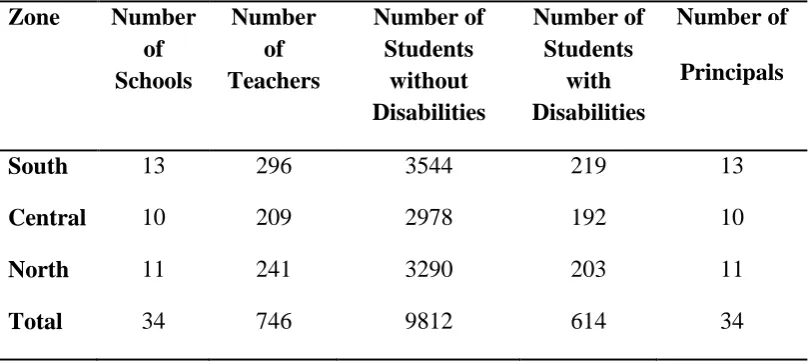
Table 3.1: Target population ...63
Table: 3.2: Distribution of the sample size from the target population ...65
Table 4.1: Rate of return on research instruments used in this study ...74
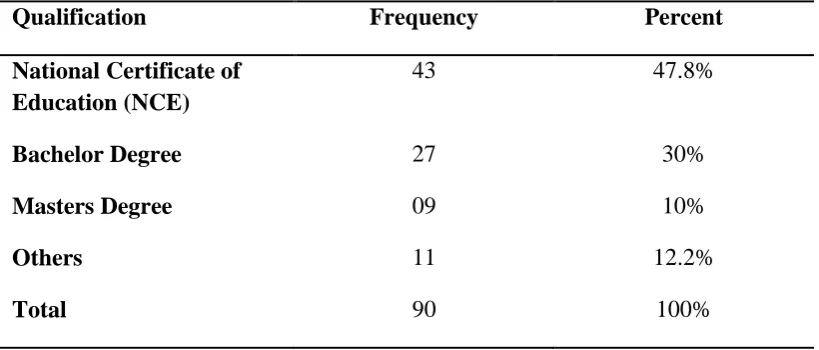
Table 4.2: Qualifications of the respondents ...77
Table 4.3: Responses of Regular Teachers Attitudes towards Inclusion base on Students’ Behavioral Issues ...80
Table 4.4: Responses of Regular Teachers on their Attitudes towards the Inclusion of Students with Disabilities based on Students’ Needs ...82
Table 4.5: Responses of Regular Teachers on their Attitudes towards the Inclusion of Students with Disabilities Based on Resource Issues ...84
Table 4.6: Responses of Regular Teachers on their Attitudes towards the Inclusion of Students with Disabilities based on Teachers’ Professional Competency...86
Table 4.7: Responses of Regular Teachers on the Instructional Strategies ever used in Teaching Students in Regular Secondary Schools ...90
Table 4.8: The Influence of Regular Teachers’ Working Experience on their attitudes towards Students with Disabilities ...94
Table 4.9: Materials and Equipment available in the Schools ...97
Table 4.10: Responses of Regular Teachers on the Administration Support on their Work ...100
Table 4.11: Marks of students with Special needs on English and Mathematics for three terms in the South Zone Schools (Zone A) ...105
Table 4.12: Marks of Students with Special needs on English and Mathematics for three terms in the Central Zone Schools (Zone B) ...106
Table 4.13: Marks of students with Special needs on English and Mathematics for three terms in the North Zone Schools (Zone C) ...107
Table 4.14: All students’ marks of English and Mathematics for three terms South Zone Schools (Zone A)...109
Table 4.16: All students’ marks of English and Mathematics for three terms North Zone Schools (Zone C) ...112 Table 4.17: Comparison Between the Results of Students with and without
LIST OF FIGURES
Figure 1.1: Conceptual framework ...15
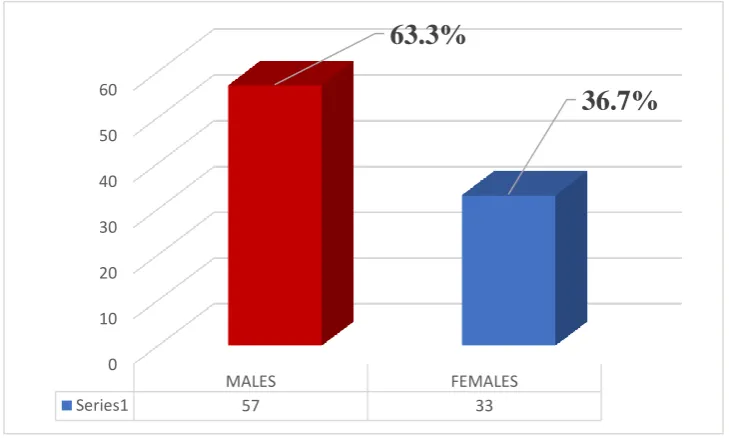
Figure 4.1: Gender of the respondents by frequency and percentage ...75
Figure 4.2: Marital status of the respondents ...76
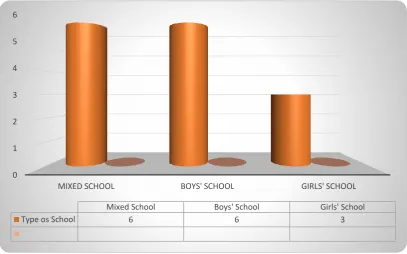
Figure 4.3: Type of schools ...78
Figure 4.4: Regular Teachers’ Years of Work Experience ...93
ABBREVIATIONS AND ACRONYMS ATIAS: Attitudes towards Inclusion in Africa Scale
EFA: Education for All
HI: Hearing Impairment
HND: High National Diploma
IDEA: Individual with Disability Education Act
IDEIA: Individual with Disability Education Improvement Act IEP: Individualized Educational Plan
JSS: Junior Secondary School
LGs: Local Governments
LSAS: Littrell’s Survey of Administrators Support.
MoE: Ministry of Education
NCE: National Certificate of Education NCE: National Certificate of Education NDD: Nigerians with Disability Decree NDDL: Nigerian Disability Discrimination Law
NPE: National Policy on Education
PALS: Peer-Assisted Learning Strategies PD: Physical Disabilities
PTC: Pivotal Teacher Certificate
QIS: Questionnaire on Instructional Strategies REITS: Regular Education Initiative Teaching Survey SPSS: Statistical Package for Social Science
SWOD/(SW): Students Without Disabilities
TASSN: Teachers’ Attitudes Towards Students with Disabilities UNCRPD: United Nations Convention on the Rights of Persons with
Disabilities
UNESCO: United Nations Educational Scientific and Cultural Organization
USA: United States of America
VI: Visual Impairment
WHO: World Health Organization
ABSTRACT
CHAPTER ONE
INTRODUCTION AND BACKGROUND TO THE STUDY 1.0 Introduction
Presented in this section are the background to the study, statement of the problem, purpose of the study, objectives, research questions, the significance of the study, assumptions, limitation and delimitations, theoretical and conceptual framework and definitions of operational terms.
1.1 Background to the Study
Inclusion was defined by UNESCO (2005) as a process through which the diverse educational needs of all students will be addressed through full involvement and encouragement in learning philosophies and communities as well as reduction of segregation within and from all forms of learning. Inclusion therefore, encompasses modifications and changes in the strategies, techniques/methods, content and structure with a shared vision which cover all individuals within a given age range. Through inclusion, the differences that exist between the regular system of education and special education would be eliminated by providing a proper system of education relevant and suitable to all learners in their local schools irrespective of their cultural or disability levels.
learners with special needs into a general education classroom in the name of inclusion where every student is considered a full member, and where the educational needs of all the students will be achieved. This movement is positioned within an agenda of social justice, which contends that fairness to individuals must involve getting an access by learners to their community schools. This program was endossed by the Policies of United Nations towards the rights of individuals such as the UN Standard Rules on the Equalization of Opportunities for Persons with Disabilities (1993); the UN Convention on the Rights of the Child, 1989; the Salamanca Declaration of (1994), at which about 300 individuals from 92 countries and twenty five international organizations gathered in the city of Salamanca, Spain from 7th- 10th June 1994 for the purpose of furthering the goals of Education For All (EFA) by recommending changes in policies to uphold the approach of inclusion and the current Sustainable Development Goals (SDG, 2015).
Educational policies in both developing and advanced nations responded to the social justice agenda of educating students with special needs in regular schools. The right of children with special needs in the United States were preserved in the statute, Education for all Handicapped Children Act 1975; the IDEA, 1990, 1997, 2004, 2008). In United Kingdom, the Warnock Report of (1978) which directly led to the promulgation of Education Act (1981), which was modified to the Education Act (1993) in which the rights of learners with special needs to be members of regular schools was established.
learners with disabilities. They contend that inclusive education can empower equal opportunities by providing a conducive learning environment, facilities and material through which the educational needs of learners can be addressed together in age appropriate regular classrooms. Teachers as well as parents, who view inclusive education positively, disregard special education program (Magumise & Sefotho, 2018).
In Nigeria, the National Policy of Education (NPE, 2004) orders the integration of all learners with disabilities into regular classrooms and free education for all exceptional students at any level. However, based on the above, only a few states implemented the inclusive education in Nigeria; other states are just beginning by creating piloting units in some schools (Fakolade, Adeniyi, & Tella, 2009). This study evaluated regular teachers’ attitudes towards the academic performance of learners with disabilities in the piloting inclusive classrooms in some selected secondary schools in Bauchi state.
who declined, 80% of them indicated that inclusion would not work and they were ready to either change schools or stop working in preference of working in inclusive schools. Based on these findings, the researcher concluded that such negative attitudes of the teachers would affect the students’ performance, (Familia-Garcia, 2001).
In Ghana, Ocloo & Subbeya (2008), examined the factors that predisposed teacher’s perceptions, and attitudes, towards inclusion of learners with disabilities into regular classrooms. Their findings showed that regular teachers were fully aware of the inclusion program and maintained positive attitudes towards it, but declared that insufficient materials, equipment, and resources would not make inclusion a reality (Ocloo & Subbeya, 2008).
In Cameroon Ngwokabuenui (2013), investigated attitudes of principals towards inclusion of children with disabilities into regular classrooms and its effects on their academic performance. The results showed that the principals expressed positive attitudes towards inclusion of individuals with disabilities into regular schools and their positive attitudes led to the students’ positive results. The researcher, therefore, concluded that the principals’ knowledge of special education laws had a significant effect on the attitudes they had towards including students with disabilities.
toward individuals with disabilities (visual and hearing impairment) found the following responses:
Send them to beg.
I am shame of them.
It is not my business.
Something good ought to be done for them.
Gani said that, the first two responses above are the attitudes of the relatives and families of the people with disabilities. The third response represents the reactions of those who do not have people with disabilities in their family. The last response is for few people such as religious leaders, teachers of special need people and some of their parents/guardians. Ozoji (1988) recorded the following attitudes when conducted a research on the attitude of the community toward people with visual impairment;
Attitude of protection. This simply means the community realized that people
with disabilities have special problems, and therefore need special treatment.
Hostile attitude. That is the attitude of maltreatment, cheating as well as denying their rights.
Attitude of indifference or neutral attitude (I don’t care attitude).
Acceptance attitude.
Ozoji, puts forward that attitudes of Nigerians toward people with disabilities is negative but have started changing.
regular teachers displayed favorable attitudes towards learners with disabilities. Only sixteen percent of the teachers portrayed negative attitudes towards the students and seven percent of the teachers, held neutral views. He therefore, recommended for other studies to be carried out in the other parts of Nigeria.
Bauchi State has been chosen as the study location for this study because students with disabilities in the state complained regarding their inability to access the regular schools physical environment, use of non-inclusive teaching methods by the regular teachers, non-inclusive assessment strategies. This therefore made them prefer going to the special schools than the inclusive secondary schools.
It was against this background that the researcher evaluated the regular teachers’ attitudes and its effects on the academic performance of students with and without disabilities in the selected secondary schools in Bauchi State, Nigeria.
1.2 Statement of the Problem
Individuals with disabilities in Bauchi State were educated in a segregated setting (special school) by special education teachers since, 1984. Currently, in compliance with the global mission on inclusive education and based on the provisions of the Nigerian National Policy on Education (NPE, 2008) some regular secondary schools started catering for all students in the same classrooms under inclusive education program. Most of the students with disabilities in the state prefer the segregated special schools than their neighboring inclusive education schools (Sirajo, 2013).
physical environment, use of non-inclusive teaching methods by the regular teachers, inclusive assessment strategies and inadequate provision for curricular and non-curricular activities.
Research also indicated that many regular teachers in Nigeria were trained when special education courses were not part of the teacher training programs and those taught recently lacked adequate professional training to work with all categories of learners in inclusive settings. Because the special education courses in the regular teacher training programs were inadequate, only two unit were offered in some schools and four in others (Agomoh, 2012).
Oluremi (2015), investigated the attitudes of teachers towards students with special needs in government secondary schools of Southeastern Nigeria. The results indicated that, almost three quarters of teachers displayed an affirmative attitudes towards students with disabilities, and the students performed better. Hence, he recommended for other studies to be conducted in the other geographical zones of the country to fill in the gap in knowledge.
This study aims at evaluating the regular teachers’ attitudes towards the academic performance of learners with disabilities in selected secondary schools in Bauchi State, (Northern) Nigeria.
1.3 Purpose of the Study
1.4 Objectives of the Study This study sought to:
i. Investigate regular teachers’ attitudes towards inclusion of students with disabilities in regular secondary schools in Bauchi state.
ii. Assess instructional strategies used by regular teachers in teaching students with disabilities in regular secondary schools.
iii. Explore previous working experience of regular teachers in the selected secondary schools in Bauchi state.
iv. Examine support and provisions given by administrators towards the education of students with disabilities in regular secondary schools.
v. Compare academic performance of students with and without disabilities in regular classrooms in selected secondary schools of Bauchi State.
1.5 Research Questions
i. What is the general attitudes of regular teachers towards students with disabilities in some selected regular secondary schools in Bauchi State?
ii. What are the instructional strategies used by regular teachers in teaching students in regular school settings in Bauchi state?
iii. What is the previous working experience of the regular teachers teaching in the selected secondary schools?
iv. What are the supports and provisions given by administrators towards inclusion of students with disabilities in selected secondary schools?
1.6 Significance of the Study
This study intended to complement existing studies and contribute to a new knowledge gap in the area of inclusive education for individuals with hearing, visual and physical impairments.
Inclusive education was chosen to be a topic of this study because there is a global quest towards inclusion of all persons with disabilities as endossed by the United Nations policies on the rights of individuals such as the UN Standard Rules on the Equalization of Opportunities for Persons with Disabilities (1993); the UN Convention on the Rights of the Child, 1989 and the current Sustainable Development Goals (SDG) 2015-2030.
1.7 Limitations and Delimitations of the Study 1.7.1 Limitations of the Study
This study was conducted in one of the Nigerian States, therefore its findings cannot be generalized.
1.7.2 Delimitations of the Study
Even though there are many subjects taught in secondary schools, this study was narrowed to the evaluation of regular teachers’ attitudes towards the academic performance of learners with disabilities on English language and Mathematics subjects in some selected secondary schools of south, central and north zones of Bauchi State, Nigeria.
1.8 Assumptions of the Study
In this study, the following assumptions were made:
i. Both the regular teachers, learners with disabilities and administrators were willing to participate in the study.
ii. Participants were truthful and honest in their responses to the interviews and questionnaires.
1.9 Theoretical and Conceptual Framework 1.9.1 Theoretical Framework
1.9.1.1 Bandura’s Social Learning Theory.
Bandura’s Social Learning Theory is well recognized for its clarification of how information is acquired by people and how individuals acquire certain attitudes either positive or negative. Bandura maintained that people acquire knowledge through several means, either directly or indirectly. The direct learning may include imitation or modeling from one person to the other. People can also learn indirectly through observation of other peoples’ behavior. He further stressed that almost all learning phenomena emanating from direct experiences of an individual occur through the observation of another person’s behaviors and their outcomes.
Therefore, if an individual can learn through the observation of someone else behaviors, it is rational to arrive at the conclusion that negative or positive attitudes can be obtained through the process of social learning (Antonak & Livneh, 1988).
In addition to the social learning theory, Lev Vygotsky’s Guided Learning theory also has an impact on inclusion. According to him, the Zone of Proximal Development (ZPD) indicates that when students are directed by a grown-up or when interacting with more skillful mates, their learning will be more effective. This is because a capable person will collaborate and support the child by helping him to progress from where he is at the moment to where he can reach with help. This person achieves this accomplishment using prompts, cues, encouragement, joint participation, modeling, explanation, leading questions, discussion, and controlling the attention of a child which are all characteristics of inclusion (Miller, 2011). Persons with special needs can learn from their colleagues without disabilities with the support of adult supervision. For instance McDuffie, Scruggs & Mastropieri, (2009) found peer tutoring to be effective for learners with disabilities.
Therefore, Vygotsky’s theory of ‘Zone of Proximal Development’ presents the background for efficient inclusion tutoring and learning in a regular classroom. Going by the theory, ‘learning’ is a trail, and ‘zone’ refers to the space amid things which students can do alone and things that they can do with the support of skilled ones, like colleagues or tutors. With ZPD, the students will be progressing from what they know to what they do not know with the assistance of skilled ones. Going by the above, Rowlands (2006), claims that learning takes place usually when assistance is given.
a time when he/she will start riding the bicycle himself/herself. This knowledge is acquired through dialogue when the training is in progress. Also, the support given to individuals at this stage will be significant for their future development.
Next stage is for him to practice alone with no support from other individuals, although perfection has not been completely accomplished (Pettigrew & Akhurst, 1999).
The third stage is for the student to effectively initiate a certain task, but along the way realized that it will be difficult for him/her to complete, due to inherent reasons, like tension/anxiety, ailment, or any other problem. The student in this situation may require various support from others (Lee, 2000).
The last stage is if the task has been successfully completed, and carried out efficiently in an assimilated manner, which finally indicates that the assignment has been mastered. At this stage, support from skilled ones is no longer required and learning becomes self-regulated. At this stage, the learner will practice and complete an assignment without help or intervention from other individuals. For instance, if individuals are given research projects on a certain topic, they possess the skills and knowledge to do it by following all its required stages and techniques (Pettigrew & Akhurst, 1999).
1.10 Conceptual Framework
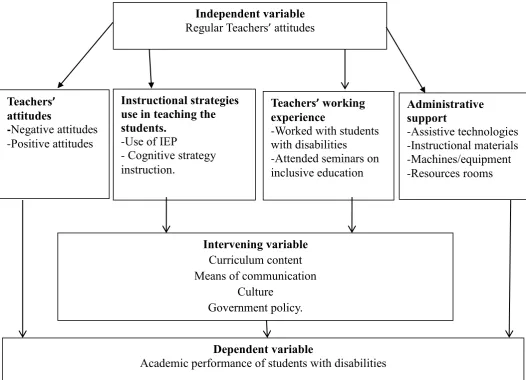
The relationship between the independent variable (Regular teacher’s attitudes) and its influence on the dependent variable (Academic performance of students with disabilities).
Figure 1.1: Conceptual framework Source: Researcher’ own (2016)
As indicated in Figure1.1, the independent variable (Regular teachers’ attitudes) affects the dependent variable (academic performance of students with disabilities) through negative or positive attitudes of the teachers, teachers’ working experience, instructional materials and support and provisions by the administrators. More so,
Independent variable Regular Teachers’ attitudes
Teachers’
attitudes
-Negative attitudes -Positive attitudes
Instructional strategies use in teaching the students.
-Use of IEP
- Cognitive strategy instruction.
Teachers’ working experience
-Worked with students with disabilities -Attended seminars on inclusive education Administrative support -Assistive technologies -Instructional materials -Machines/equipment -Resources rooms Dependent variable
Academic performance of students with disabilities Intervening variable
Curriculum content Means of communication
1.11 Definition of Operational Key Terms
Academic Performance: is the extent to which students achieve their short or long term educational goals usually measured by examination or continuous assessment.
www.ehow.com/academic/performanceRetrieved 28th August 2015
Attitudes: a predisposition or inclination to respond positively or negatively towards a person, object, certain idea, or situation.
www.dictionary.reference.comRetrieved 14th August 2015
Disability: functional limitation or a condition that restricts the activity of an individual (IDEA, 2004).
Evaluation: is an appraisal of something to determine its worth or fitness. http://www.vocabulary.com. Retrieved 24th November 2015
Impairment: is any anomaly whether complete or incomplete loss of the function of the body parts, organs or systems; this may be due directly or indirectly to pathology or injury and may be either temporary or permanent (Keane, 2003)
that it is the duty of the general system of education to educate all children (UNESCO, 2005).
Inclusive Education: is an educational arrangement where all learners share in all facets of ongoing education that will meet his/her unique needs in a regular classroom with similar-aged children (Community Living Ontario, 2015).
Negative attitudes: intimidating attitudes demonstrated towards individuals with disabilities.www.dictionary.reference.com Retrieved 14th August 2015
Performance: the accomplishment of a given task measured against preset known standards of accuracy. www.ehow.com/academic/performance Retrieved 28th August 2015.
Positive attitudes: encouraging attitudes demonstrated towards individuals with disabilities.www.dictionary.reference.com Retrieved 14th August 2015
Special Education Needs: Refers to some forms of support in education required by an individual with disabilies to carry out a given activity (Ozoji, 2006).
CHAPTER TWO
REVIEW OF RELATED LITERATURE 2.0 Introduction
Presented in this chapter is the review of related literature which focuses on the objectives of the study: the teachers’ attitudes towards inclusion; the teachers’ working experience; instructional strategies use by regular education teachers in an inclusive classroom; supports and provisions given by the administrators on inclusive education and the performance of learners with disabilities in an regular school settings.
2.1 An Overview of Inclusive Education
Today, it is widely accepted that inclusion maximizes the potential of vast majority of students, ensures their rights, and is the preferred educational approach for the 21st century. Unfortunately, the philosophy has not always been widely held. Our thinking and acceptance has evolved rapidly over the last century and continues to evolve, in response to political beliefs.
special classes, at first did not exist .later, they were developed as a place for students who could not meet the standard and keep peace with fellow class mates. Many authorities in the field agreed that segregated special classes were not appropriate educational sittings for most students with special needs for it was cleared that educating students with special needs in isolated setting minimized, rather than maximized their potential.
consensus that all children have the right to a common education in their locality regardless of their background, attainment or disability. Despite the consensus on the right to education, children with disabilities are still perhaps the group most excluded from schools and within the education system.
Inclusive education has evolved from a movement associated with the struggle against exclusion of learners with disabilities. However, inclusion as such is not a concept that can be clearly and easily defined.
Children with special needs could be seen as those children with situational disadvantages due to physical, mental, or emotional impairments as well as those who experience difficulties in learning at any time during their school age.
Some advantages of inclusive special education is that children who would otherwise not get a chance to study with other children are being offered the opportunity to be educated. Hence, inclusion in education is an approach to educating children or students with special educational needs. Under the inclusion model, students with special needs spend most or all of their timewith non-disabled students (UNESCO, 2003).
Inclusion of learners with disabilities into regular classrooms in the current educational system has become more predominant (Winzer, 1998). Studies conducted in different parts of the world have affirmed that many factors ought to be considered in determining the inclusion success (Huber, Fiorello & Rosenfeld 2001). The most important factors include teachers’ attitudes towards inclusion and teachers’ professional competency in instructing both students with and without speccial needs (Avramidis, Bayliss, & Burden, 2000; Forlin, 2001). This study therefore, examined one of the factors which is the ‘regular teachers’ attitudes towards students with disabilities and how it affects their academic performance in an inclusive setting.
Kronberg (1992) described inclusion as a value to live in communities where individuals are considered as equal members and by supporting each other to work together in order to exploit individuals’ potential. Lerner (2000), indicated that the philosophical thoughts of inclusion are regularization of persons with disabilities into integrated classes and the removal of all forms of labels for the students with disabilities.
Lerner (2000), proposed that, the term inclusion may have different interpretations among which is enclosure of all students from all classes of disabilities with all levels of severity into a general education classroom (full inclusion), and placement of certain individuals with disabilities into regular classroom from time to time (partial inclusion). Full inclusion model encompasses the breaking down of all instructional systems of special as well as general education, joining them into one instructional system in line with the educational needs of all learners in a classroom (Stainback & Stainback, 1988) and converting educational settings into inclusive communities where everyone is celebrated as a full member (Villa, Thousand, Meyers & Nevin, 1996).
Leiberman, 1985; Vergason & Anderegg, 1989; Roberts & Mather, 1995; Fuchs & Fuchs, 1995).
2.1.1 Full Inclusion
In an attempt to support their arguments, full inclusionists (supporters of full inclusion) referred to the lack of practical indications to validate the process of classifying learners and their special programs (Reynolds, Walberg & Wang, 1987). This group of scholars argued that only very little evidence can show that students with disabilities perform better or need a special school setting for their learning to take place (Madden & Slavin, 1983 Gartner & Lipsky, 1987).
Numerous studies conducted in the past have showed that the exclusion of learners with disabilities into segregated classes or schools as the case may be, is detrimental to their social development and academic performance and such students appeared to achieve better in regular classrooms than the segregated settings (Baker, Walberg & Wang, 1995). Shepard, Vojir & Smith (1983), established in their findings that, the procedures of classifying students with disabilities are mostly not consistent or inaccurate. Differentiating between levels of severity of a disability is often not conducted in a sophisticated manner.
them to resource rooms for further instructions. Researchers have indicated that students with all levels of learning disabilities can be maintained in the regular classroom for the whole school day and their academic achievement level higher when compared with those achieved in segregated classroom settings (Bear & Proctor, 1990; Banerji & Daily, 1995).
Supporters of full inclusion have it in mind that there are social and emotional benefits for students with disabilities when mingled into a regular classroom. Among the social benefits are the opportunities to make friends and free interaction without a feeling of inferiority in mind. By learning in the regular classroom, learners with disabilities will get more time to make and maintain relationships with their normal or non-disabled peers (Stainback & Stainback, 1992). In inclusive classrooms, students with disabilities are less stigmatized and more recognized by their counterparts, and they display more self-confidence than those in special education classes or schools (Stainback & Stainback, 1996; Gartner & Lipsky, 1987).
The provisions of American Public Law desires effective educational services meant for students with disabilities, but it did not in any circumstance need a special education system where students can be educated separately as a result of their disabilities. Gartner and Lipsky (1987), emphasized that unification of general and special educations will require certain fundamental changes and a paradigm shift on the way educators perceive differences among individuals with special needs.
2.1.2 Partial Inclusion
(Kaufman, 1993; Vaughn & Schumm, 1995; Fuchs & Fuchs, 1994; Zigmond, 2003; Kauffman & Mock, 2002; Roberts & Mather, 1995;) in the field of inclusive education have expressed concerns on whether or not full inclusion will be suitable for all students. These researchers have emphasized on the impact of sustaining a variety of services for individuals with disabilities outside the regular classroom base on the following reasons.
(a) The advocates of partial inclusion believe that there is insufficient research and preparation on how to handle learners with different categories of disabilities and their severity level in regular education setting by regular teachers (Messinger, 1985; Lieberman, 1985; Kaufman, Gerber, & Semmel, 1988; Vergason & Anderegg, 1989).
(b) They maintain that most of the students with disabilities particularly those with very severe or profound conditions may require individualized educational program (IEP) and explicit instruction, which is believed by these scholars to be complex and challenging to provide in a regular school setting.
(c) Children with disabilities may occasionally require different services which cannot be achieved by general education teachers (such as physical therapy, speech therapy) and it is not fair to deny such services as a result of full inclusion system.
noncompliance with it will amount to the violation of the students’ civil rights (Kauffman & Hallahan, 1995).
Advocates of partial inclusion went further to argue that, even though some researchers endorsed the positive trends of inclusion agendas (Banerji & Dailey, 1995; Baker, Walberg & Wang, 1995; Bear & Proctor, 1990), other researchers reported an unsatisfactory and substandard academic and social accomplishment through inclusion programs (Zigmond & Baker, 1990; Fox & Ysseldyke, 1997). In their studies, Roberts & Mather (1995), established that if provided with proper support, some of the individuals with learning disabilities will be able to benefit in the general education setting, but other students who have a severe or profound learning difficulties may require more rigorous services, which cannot be provided in general education classrooms. It is without a doubt that inclusion can be advantageous for some learners with disabilities, but it is pertinent to know that not all students with disabilities can fully profit from inclusion.
2.1.3 Benefits of Inclusive Education for Students without Disabilities
It is without doubt that, inclusive education affords a variety of social as well as academic benefits for students with special needs through interacting with their counterparts. Such benefits include higher achievement in language and positive relationships with normal peers among others.
researches had confirmed that, including learners with special needs into general education classrooms does not in any way harm students without disabilities. Instead, it may even earn them some social as well as academic benefits.
Quite a lot of contemporary researches indicated a neutral or positive impacts on students without disabilities of being taught in the same classrooms with students having disabilities. In the year 2007, scholars from the University of Manchester analytically assessed a huge number of researches by focusing on the consequences of educating both students in inclusive classrooms. After reviewing twenty six (26) research works that were done in Canada, Ireland, Australia and the United States, the researchers established that fifty eight percent (58%) of the studies indicated students without disabilities to experience no effects. While twenty three percent (23%) of the studies portrayed them to have positive effects towards their academic performance for being taught together with students with special needs (Kalambouka, Farrell, Dyson, & Kaplan, 2007).
Research from large-scale longitudinal studies in several countries (including the United States, United Kingdom, Canada, and Finland) also showed that the inclusion of students with special needs does not lead to negative consequences for normal students. Examining the reading achievement of 3rd grade students in the United States from Kindergarten Unit, Gandhi (2007) established no indication that normal students were negatively affected for being taught together with learners with disabilities.
A research conducted by Farrell, Dyson, Polat, Hutcheson & Gallannaugh (2007), primary and secondary school students of British showcased no practically meaningful relationship between the percentage of students with special needs in a school and the academic performance of students without disabilities in that school. Friesen, Hickey & Krauth (2010) studied students of 4th and 7th grades and found a similar conclusion. They established that having students with learning and behavioral problems in an inclusive classroom did not in any way affected the reading and numeracy examination scores of students without disabilities. Their findings supported the study of Hanushek, Kain, & Rivkin (2002) who found that the quantity of students with special needs in a mainstreamed classroom was not related with the academic accomplishment of normal students.
Critics of inclusive education were of the opinion that disorderly behavior of students with severe emotional disabilities may divert the attention of teachers away from concentrating on the academic achievements of all students. Even though most of the research reviewed in this studies show that inclusive instruction yields positive or neutral effects on the academic success of students without disabilities, there are some indication that the including many students with severe emotional disorders in one classroom can yield distinctive challenges for teachers skills (Fletcher, 2010).
2.1.4 Benefits of Inclusive Education for Students with Disabilities
For long, research indicated that instructing learners with special needs in inclusive settings was effective and can yield a very good social and academic benefits for both students with and without disabilities.
The evidence noticing the academic benefits of inclusion was not restricted to the United States only. Researchers in other countries such as Norway surveyed about 500 students with disabilities in secondary school for approximately six years. After efficient control of other factors associated with students’ accomplishment, they established that students who were educated in inclusive settings were more likely to get good results than those educated in a segregated special classes (Myklebust, 2007). Another study done in the Netherlands, Peetsma, Vergeer, Roeleveld, & Karsten (2001), compared the academic progress of about 200 seven and eight year-old students with behavioral and learning disorders who were enrolled in regular and special education programs. The students were followed for four years and their findings showed that, included students with disabilities out-performed their counterpart in special education programs.
2.1.5 Attitudes
An attitude as a term was introduced in 1862 by a British psychologist Herbert Spencer as indicated by Allport, (1954) in his book “The nature of prejudice”. Throughout the years, many definitions of attitudes arose, but almost all the scholars concured that some mechanisms of attitudes remain equal such as attitude is learned from others; attitudes differ in quality and amount; attitudes are constant (even rigid); attitudes are multifaceted behaviorally and attitudes are complex (Antonak & Livneh 1988).
behavior, and cognition termed as the ABCs of attitudes. Affect means the emotions of attitudes (e.g., likes and dislikes), behavior describes actions that are associated with internal attitudes while cognition explains how formation and association of an attitudes towards an idea or object are kept (Slininger, Sherrill, Jankowski, 2000).
An attitude has been defined by Katz, (1960) as “predisposition of the individual to evaluate some symbols or objects or aspects of his world in a favorable or unfavorable manner.” Allport based his definition on affect component and defined attitudes as the degree of affect toward or against an object or values. While Hilgard and Atkinson (1967) described attitudes as “an orientation towards or away from some object, concept, or situation, and a readiness to respond in a predetermined manner to these, or related objects, concepts, or situations.”
Other researchers including Krech, Crutchfield, and Ballachey (1962), in their definition emphasized on behavior and affect, and they affirmed that attitudes are continuing systems of negative and positive evolutions and feeling of emotions with regard to a social phenomenon. Even though abstract in several definitions, an attitude has been recognized as a concrete threat for learners with special needs.
2.2 Factors that Influence Attitudes in School
Some of the demographic categories identified as having an impact on attitudes towards students with disabilities in schools include disability type, gender, level of education, cultural orientation, contact level, year in school and working experience.
2.2.1 Disability Type and Teachers’ Attitudes towards Academic Performance of Students with Disabilities
with orthopedic disabilities. Their study proved that, students studying in colleges displayed more positive attitudes to special needs students in wheelchairs than those with other disabilities such as visual impairment. These findings also proved that the types of disability influences attitudes formation. In another study, Parashar, Chan, & Leierer (2008), found that disability type of a person contributes to the attitudes formation towards him/her. Several studies were conducted in relation to teachers’ attitudes towards students’ type of disability. Cook (2001), related the attitudes of teachers towards students with severe disability to those with mild disabilities. The findings indicated that students with particular behavioral disorders or learning disabilities were chosen more significantly by the teachers for inclusion, than those with other disabilities (e.g., multiple disabilities, cognitive, orthopedic, visual, hearing, and autism).
Alghazo & Naggar-Gaad (2004), pointed out that teachers maintained a more affirmative attitudes towards students with specific learning difficulties, physical disabilities and visual impairment than those with cognitive. This therefore, indicated that many teachers maintained unfavorable attitudes towards including students with mental disabilities and behavioral difficulties. However, Glaubman & Lifshitz (2001), posited that teachers were of different attitudes with regards to a type of disability. They went further to point out that teachers display the greatest readiness towards the inclusion of learners with physical disabilities.
obtained among students with severe/profound mental retardation as well as emotional and behavioral disorders.
Children with learning difficulties make up the largest group of children with special needs. Learning difficulties range from mild, through moderate and severe, to profound and multiple learning difficulties. Children with severe, profound, and multiple learning difficulties are small in number compared with those who have mild or moderate learning difficulties who make up the majority of this group. Children identified as having mild learning difficulties experience problems in acquiring basic literacy and numeracy skills. Children with moderate learning difficulties are, in addition, likely to have delayed speech and language development, poor social skills, and also may exhibit emotional or behavioral difficulties. Children with severe learning difficulties are likely to have substantial problems in all these areas as well as possible problems in learning basic self-help skills such as dressing and toileting. Children with profound or multiple learning difficulties will encounter major challenges in acquiring all of the above skills.
2.2.2 Gender and Teachers’ Attitudes towards Academic Performance of Students with Disabilities
the United States (Upton & Harper, 2000; Hunt & Hunt, 2000). Gething (1991) documented that females had extensively more encouraging attitudes towards individuals with disabilities than their male counterparts in Australia. The study also revealed that, even when the attitudes of students of various age groups were compared, female students appeared to display more positive attitudes. Studies done in Japan and France established no variation between the genders while in Denmark, India and Israel, male students displayed more favorable attitudes than the female ones (Yuker & Block, 1986).
Upton and Harper (2002), studied undergraduate students’ attitudes towards students with disabilities. Their study investigated many important factors that influence attitudes formation, among which gender was inclusive. After studying 852 normal students as well as 71 students with disabilities, their findings showed that female students displayed more favorable attitudes than male students. They concluded that though female students showcased more positive attitudes and students who were newly enrolled had more favorable attitudes than the returning ones. Rao (2004), reviewed literature on the studies of attitudes and found gender to be a vital factor, which could encourage attitudes formation among students. Rao resolved that though gender contributes in attitudes formation, level of individual’s education did not in any way affect females’ attitudes towards disabilities.
Opdal, Wormes, & Habayeb (2001), found that female teachers appeared to be more accommodating towards inclusion than male teachers. Their study revealed that of the 59% of the male teachers supported inclusion of learners with disabilities into regular classrooms, while female teachers were 69% supportive to the idea of inclusion in their answers. On the other hand, the above results appeared to go contrary to the findings of Parasuram, (2006) who indicated that no differences existed between the two genders towards inclusion of individuals with disabilities.
2.2.3 Years of Study and Teachers’ Attitudes towards Academic Performance of Students with Disabilities
Almost all the studies conducted on students’ attitudes towards inclusion measured the impact of years in school on those attitudes (Asmus & Galloway, 1985; Semmel & Dickson, 1966; Antonak; 1981). Most of the studies established that students’ years in school contributed to predisposed attitudes towards students with disabilities. Upton & Harper (2002) and Pitman & Slate (1994), concluded that more of years study for student lead to positive attitudes he/she would display in dealing to students with disabilities. The finding also revealed that attitudes could possibly differ between postgraduates and undergraduate students because the duration they may spend in school appeared to have an influence on their attitudes. Yuker (1994), discovered that higher level of education was associated with favorable attitudes towards students with special needs in America.
2.2.4 Professional Training and Teachers’ Attitudes towards Academic Performance of Students with Disabilities
learners with disabilities. Avramidis & Kalyva (2007), established that teachers who spend long-term in training maintained more favorable attitudes in comparison to those served for a short term or no training at all. Their finding indicated that the more knowledgeable a teachers are about disability, the more favorable their attitudes may be towards inclusive education and persons with disabilities. Attitudes of teachers are also influenced by the knowledge and information they have about individuals with disabilities. Batsiou, Bebetsos, Panteli & Antoniou (2008), established a good association between knowledge and attitudes as well as information and attitudes. Lifshitz, Glaubman, & Issawi (2004), examined the effects of in-service training on teachers’ attitudes. The findings confirmed that after teachers participated in an in-service training their attitudes changed and their scores on the attitudes scale improved significantly.
This is contrary to the findings of Wilkins & Nietfeld (2004), who recorded that no variation existed among the two groups, the experimental group (who participated in the service training) and the control group. Their findings revealed that the in-service training given to the teachers did not in any way impact on their attitudes towards inclusion programs.
Similar results were recorded by Kim, Snel & Park (2005), who investigated the influence of written information on the attitudes of teachers towards inclusion programs. They distributed a weekly bulletin to general education teachers who served as the experimental group. The newsletters contained news on special education, students with disabilities, information from special needs classrooms, and feedback on inclusion from teachers of integrated classes. The findings of the study revealed that teachers who read the bulletin displayed more encouraging attitudes towards inclusion of persons with disabilities than those who did not read the newsletter.
2.2.5 Teachers’ Attitudes towards Inclusion of Students with Disabilities
In the USA, a study was conducted by Kenneth, Linscott, & Galis (1996), a total of 714 teachers and middle school principals were randomly chosen to respond to questions about the inclusion of learners with disabilities. The result revealed that principal and special education teachers appeared to display more encouraging attitudes than the regular teachers.
In Ghana, as in many parts of Africa, culture, social status, and religion had interacted and influenced people's perceptions and attitudes towards disability (Tahidu, 2014). In a study conducted on the attitudes of students towards persons with disabilities in Ghana, Slikker (2009), concluded that teachers and students held an unfavorable attitudes towards students with special needs. In another study, Ocloo & Subbeya (2008), examined the factors that predisposed teachers’ views, attitudes, and perceptions towards the inclusion of individuals with disabilities into regular classrooms. The findings indicated that most of the teachers had information on inclusion, had a favorable attitudes towards it, but complained that insufficient resources would make its implementation difficult (Ocloo & Subbeya, 2008).
In Nigeria, Fakolade et al. (2009), conducted research on attitudes of teachers towards learners with disabilities in an inclusive setting. The findings revealed that female teachers were found to maintain more encouraging attitudes towards inclusion of learners with disabilities than male teachers.
2.3 Instructional Strategies Used by Teachers
Schmidt, Greenman, and Rozendal (2002), identified that if inclusive classrooms are really intended to be different from the regular classrooms where students with special needs were removed as a result of poor achievement, then a thorough examination of instructional strategies, context and content of what will be taught must be done. Their study also identified several mechanisms that convert a regular classroom into an inclusive one. In such setting, students’ needs are accomplished and teachers are prepared to make the necessary adjustments in their instructional methods and use of teaching/learning materials (Schmidt, Rozendal, Greenman, 2002).
A huge number of researchers have concentrated on the best instructional strategies to be employed in teaching students in an inclusive classroom. The researchers, however, differ in the phrases they use in describing their findings. King-Sears (1997), referred his research as ‘best academic practice for inclusive classroom,' Schmidt, Rozendal, & Greeman (2002), called it ‘research-based practices for inclusion,' and King-Sears & Cummings (1996), referred to it as ‘inclusive practices of classroom teachers.' These researchers specified that teachers who displayed negative attitudes towards inclusion tend to employ less effective instructional strategies, which result in increasingly poor performance of learners with disabilities who were included in inclusive classrooms (Nutter, 2011). Bender, Vail, & Scott (1995) investigated the types of instructional strategies that were implemented in mainstreamed classrooms, and how the use of instructional strategies relates to teachers' attitudes towards mainstreaming.
strategies than teachers with more negative attitudes towards mainstreaming and that negative attitudes towards mainstreaming appear to have a direct link to the infrequent use of instructional strategies that are useful in facilitating mainstreaming. In addition, Bender (1990) suggests that although the results did not indicate any direction of causal effects, there appears to be the possibility of a potentially negative interaction cycle through which teachers who are less positive about mainstreaming utilize effective teaching strategies less often which in turn may contribute to a decrease in their mainstreaming efforts, thereby resulting in their attitudes about mainstreaming becoming even more cynical.
According to Mastropieri & Scruggs (2004), the views and attitudes of regular teachers about teaching students with disabilities are learned and seem to be inclined to the level of one’s education and previous contact that the teacher has regarding a certain person or group of persons. Keenan (1997), contended that whenever a teacher increases his knowledge on the process of integrating learners with disabilities and the channels of addressing the students’ needs, such an individual is minimizing the level of his negative attitudes towards inclusion. In another perspectives, some researchers revealed that most of the teachers are not sure of meeting the student's needs in an inclusive setting even after undergoing a staff development training. Some teachers doubt whether they are competent to handle the students and whether the support and resources needed for the program were adequately provided (Kearney & Durand, 1992 and Avramidis, Burden & Bayliss, 2000).
processes, which can be chained to a variety of methods of teaching. A good and efficient instruction strategy involves planning, implementing strategies, managing, delivering, and assessing instructional outcome (Ysseldyke & Salvia, 1995). Some of the instructional strategies include but are not limited to:
2.3.1 Teacher Directed Instruction
There are two instructional strategies (Explicit instruction and Strategy instruction) concerning the theme of teacher-guided teaching because both methods share the common features of teacher directions, participation, planning, and implementation.
2.3.1.1 Explicit Instruction
2.3.1.2 Strategy Instruction
Students need strategies to efficiently and effectively study new information and resolve problems. Learners with and without disabilities are required to be educated on explicit strategies which would help them learn new information even though some students often develop strategies independently (Rosenberg, McLesky & Westling, 2008). Many teachers model and instruct students on different methods, tools, techniques or techniques that allow them to finish assignments successfully using strategy instruction. The aim of using strategy instruction is to equip the students academically so that they can be independent learners. While using strategy instruction technique, teachers are required to exemplify the use of the strategy and give them sufficient time to have rehearsals on using strategy tasks effectively (Mercer & Mercer, 2001). Strategy instruction is in some instances described using terms such as self-monitoring, self-questioning strategies, conspicuous strategies, and metacognitive strategies.