Available Online atwww.ijcsmc.com
International Journal of Computer Science and Mobile Computing
A Monthly Journal of Computer Science and Information Technology
ISSN 2320–088X
IMPACT FACTOR: 6.017
IJCSMC, Vol. 6, Issue. 3, March 2017, pg.72 – 83
Image De-Noising using Wavelets-
A Clustering Based Method
Raja Singh, Sudhanshu Pathak, Amit Kumar
Computer Science and Engineering in IIT (B.H.U) Varanasi (India)
Electrical and Electronics Engineering from Prestigious V.I.T University, Vellore (Tamil nadu -India) Electrical and Electronics Engineering from Prestigious V.I.T University, Vellore (Tamil nadu -India)
[email protected], [email protected], [email protected]
Abstract- In the process of image acquisition and transmission, noise is always contained inevitably. So it is necessary to image de-noising processing to improve the quality of image. Generally speaking, each algorithm has some filtering and threshold parameters. Taking variety kinds of images into account, it is a key problem of how to set these parameters in de-noising algorithms under different conditions to achieve better performance. There are many algorithms for the determination of the parameters, and each of them has its application field. Because the wavelet transform has good performance, therefore, it has been widely applied as a kind of signal and image processing tools. In this paper, wavelet transform is used in the image de-noising and we propose a new algorithm similar to k-means clustering in machine learning which gives better performance and Experimental results show the validity of the new algorithm.
Keywords- image de-noising, wavelet transform, k-means clustering, mean filter, median filter
1.
Introduction-
smoothing filter, such as Gauss filter], will cause the detail information loss of image. In recent years, a large number of complex de-noising algorithms mean of nonlinear filter has appeared. Common algorithms include a variety of adaptive median filter algorithms: the wavelet threshold (also called wavelet shrinkage) algorithm, the anisotropic diffusion equation algorithm , the total variation minimization algorithm , non-local mean filter algorithm , etc.
At present, the noisy image restoration methods are mainly as the following three:
a.) Mean Filter Principle
Mean filter is also known as the linear filter, and the main methods are the neighborhood average method. The basic principle of linear filtering is to replace the original image pixel values with mean values. That is to say, for the current pixel ( x, y) , we should select a template, which is composed of a plurality of pixels in its neighbor. Mean values for all pixels would be calculated and the give the mean values to the current pixel (x,y) as the gray( x,y)g in the points on the process image. This means:
Where, s means template, and M is the total number of pixels including current pixel the template. Mean filter using neighborhood average method is applicable to remove granular noise in the scanning image. Neighborhood average method effectively suppresses the noise. But during the process of calculating the average value, scenery edge points would be processed too. Then, the image would be in the state of low resolution. Based on this situation, the improved algorithm is proposed to realize various mean filters, and new mean filter is developed, such as weighted mean filter, gray minimum variance mean filter, K nearest neighbor mean filter, symmetric neighbor mean filter and so on. When these filters are working, scene boundary smoothing is avoided, and it can greatly reduce the fuzzy image.
b.) The Median Filter
Median filtering is a nonlinear filtering technique. The advantage of the median filter is simple operation and faster speed, and it has excellent performance in filtering adding white noise and long tail noise. But for some more details, especially for a point, line and multi spire image should not use median filtering. In order to expand the scope of its application, the median filter has many improved algorithms, such as weighted median filter, switching median filter algorithm based on threshold, and adaptive median filter. In the weighted median filter, pixels within the window are to assign different weights to adjust the contradiction between noise suppression and detail preservation. However, the method obtains more effective detail preserving ability at an expense of noise suppression compared with a traditional filter. In switching median filter algorithm, it is based on threshold and gets the better effect by median filter for noise point and the flat region. This algorithm does not deal with the details in order to obtain good protection effect. For adaptive median filter, it can be used to deal with a high probability impulse noise. When it is processing, its neighborhood region can be changed rely on a certain condition. Its advantage is saving details in processing the smooth non impulse noise.
C.)Wavelet Transform
Besov space and other linear estimators cannot get the same result, much attention has been paid on it. Wavelet thresholding is a nonlinear method, and denoising purpose can be achieved according to the process of wavelet coefficients in the wavelet domain. Its theoretical premise is coefficients of the image followed Gauss distribution, and wavelet coefficient with absolute larger magnitude is mainly obtained from the transformed signal and wavelet coefficient with absolute smaller magnitude is mainly obtained from the noise signal transformed. Then we can clear the noise by setting a threshold.
In this paper, wavelet transform is used in the image denoising, and a new type of algorithm is used to de-noise image. The main contribution of the paper is to the proposal of a new algorithm for image denoising using wavelet transform.
D.)
K-means clustering algorithm
K-means is one of the simplest unsupervised learning algorithms that solve the well-known clustering problem. The procedure follows a simple and easy way to classify a given data set through a certain number of clusters (assume k clusters) fixed apriority. The main idea is to define k centers, one for each cluster. These centers should be placed in a cunning way because of different location causes different result. So, the better choice is to place them as much as possible far away from each other. The next step is to take each point belonging to a given data set and associate it to the nearest center. When no point is pending, the first step is completed and an early group age is done. At this point we need to re-calculate k new centroids as barycenter of the clusters resulting from the previous step. After we have these k new centroids, a new binding has to be done between the same data set points and the nearest new center. A loop has been generated. As a result of this loop we may notice that the k centers change their location step by step until no more changes are done or in other words centers do not move any more
Finally, this algorithm aims at minimizing an objective function knows as squared error function given by:
2.
Proposed Algorithm: -
This algorithm tries to combine the features of both the spatial filters and wavelets based filters using procedure similar to k-means clustering in order to obtain better results
Algorithm step wise-
Step1- apply wavelet transform on the given image so that we can have its detailed and approximate coefficients
Step2-then we have to determine the value of thresholding using the spatial filter technique- here we took the mean of the pixel as the threshold for the same after that we applied soft/hard threshold to reduce the noise level
Step3- now we know that the detailed coefficient has be penalized and the points left in the detailed coefficient are the noisy points. now similar to k-means clustering algorithm we consider these noisy points as cluster center , number of clusters is equal to the number of noisy points In the detailed coefficients but here instead of determining the position of cluster we fix the cluster at the position of the noisy point then we travers the image pixel by pixel to assign them to given any one of the given clusters after this traversal every pixel in the image has been assigned to a cluster based on the distance it has from the cluster .the pixel has been assigned to the cluster which has minimum Euclidian distance from the pixel
Now we for every cluster we have we calculate the mean of pixels that has been assigned to it and store it.
Now let threshold that was the mean of pixels of image bet, let the number of noisy points left in the detailed coefficient be clust ,that is clust is the number of cluster points now we define an array cl[] of size clust*2 to store the position of each cluster point .then we define an array im[] of size I*J*K to store the assigned cluster of each pixel where [I J K]=size(noisy _image) we also define an array mean[ ] of size k to store the mean value of each cluster.
a-)
clust=0; //number of clusters
for i from 1 to I{
for j in 1 to J{
for k in 1:K{
if (pixel_value>0)
clust++
} } }
b-)
cl[clust][2]; //for storing cluster position
r=0;
for i from 1 to I{
for j in 1 to J{
for k in 1:K{
if (pixel_value>0)
cl[r][1]=I;
cl[r][2]=j;
r++; } } }
now we have stored all the cluster position in array cl[][]
c-) cluster assignment
im[I][J][K]
for i from 1 to I{
for j in 1 to J{
for k in 1:K{
min=dis(cl[1][1],cl[1][2],I,j) //calculates distance between points (x1,y1)and (x2,y2) by dis
(x1,y1,x2,y2)
for 1 to clust{
m=dis(cl[l][1],cl[l][2],I,j)
if(min>m)
min=m
im[i][j][k]=l //assigning cluster
}}}}
d-)
mean[clust] //to store the mean value of each cluster array
for l=1:clust sum=0;
n=0;
for i=1:I for j=1:J for k=1:K
if(im(i,j,k)==l) sum=sum+x(i,j,k); n=n+1;
end end end end
meanl)=(sum/n); if(sum==0) mean(l)=0; end
end
Step4-
Now we apply inverse wavelet transform to get the denoised image back but noisy points that were left in detailed coefficients were still there so to remove those points we have calculated the cluster position and mean value for each cluster so that we can now replace the noisy point with the optimized value we obtained in step3
Now we set a window size of 2 & 1 so that we can replace the noisy point with the our optimized value and the space around it that is pixel’s around it can also be replaced by the same value based on the window size.
Hence reducing the noise level in our image
now we have calculated mean value for each cluster
w=2//window size
for l in 1 to clust { k=1; u=cl(i,2)-k; d=cl(i,2)+k; l=cl(i,1)-k; r=cl(i,1)+k;
if(me(i)>sum)
if(l>=2 && r<J && u>=2 && d<I ) y(l,u,1)=me(i);
y(cl(i,2),u,1)=me(i); y(r,u,1)=me(i);
y(l,cl(l,2),1)=me(i);
y(cl(l,1),cl(l,2),1)=me(i); y(r,cl(l,1),1)=me(i);
y(l,d,1)=me(i);
y(cl(l,1),d,1)=me(i); y(r,d,1)=me(i);
y(l-1,u-1,1)=me(i); y(l,u-1,1)=me(i); y(l-1,u,1)=me(i); y(cl(i,2),u-1,1)=me(i); y(r,u-1,1)=me(i);
y(r+1,u-1,1)=me(i); y(r+1,u,1)=me(i);
y(l-1,cl(l,2),1)=me(i); y(r+1,cl(l,1),1)=me(i);
y(l-1,d+1,1)=me(i); y(l,d+1,1)=me(i); y(l-1,d,1)=me(i);
y(cl(l,1),d+1,1)=me(i); y(r,d+1,1)=me(i);
y(r+1,d+1,1)=me(i);y(r+1,d,1)=me(i);}
3.
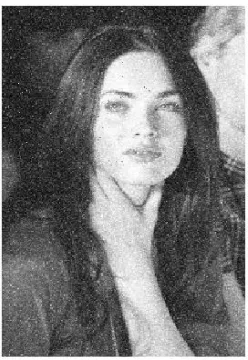
Original image noisy image
Intermediate cluster- assignments step de-noised image using improved algorithm
It is an image of Megan fox a famous movie star.
Table comparing the PSNR values for the different type of noisy images using traditional method and new proposed method
Noise type PSNR using traditional technique PSNR using proposed method
Gamma noise image 15.8 15.9
Gaussian noise image 21.7 21.7 Salt and pepper image 21.2 21.7
Poisson image 32.3 32.3
4.
Conclusion
Future Work:-
In this proposed method we have used mean to decide thresholding value methods like vishu shrink , bayes shrink and other complicated methods can be used instead.
Then after assigning clusters to the pixels we have taken mean of the pixels in the given cluster we could have taken median or any other complicated statistical function like used in lee filter etc.
So in future we could work on these proposed fields to further improve the image quality and we can have combinations of these technique’s to get a better result
Acknowledgement
We want to thank our friends and family for their providing continuous support .
References
*1+. L. X. Wen and L. C. Ying, “An optional Gauss filter image de-noising method based on difference image fast fuzzy clustering”, Applied Mechanics and Materials, (2013), pp. 411-414, 1348-1352.
*2+. C. Nicola, S. Lorenzo and V. Luisa, “Image focusing using Gauss-Laguerre circular harmonic filters”, 2011 Joint Urban Remote Sensing Event, JURSE 2011 - Proceedings, (2011), pp. 309-312.
[3]. B. –P. Wang, J. –L. Fan, W. –X. Xie and Y- Ho. Xin, “Adaptive filter for removing image Gauss noise based histogram, Systems Engineering and Electronics, vol. 26, no. 1, (2004), pp. 1.
[4]. Z. Liu, T. He, Y. He and Y. Yu, “Discussion on the wavelet adjustment factor threshold noise reduction technology based on DSP”, Advanced Materials Research, (2011), pp. 317-319, 1201-1204.
*5+. J. Tang, Y. Xie, Q. Zhou, M. Tang and P. Li, “Study of the construction of complex threshold for complex wavelet transform suppressing noise”, Transactions of China Electrotechnical Society, vol. 23, no. 10, (2008), pp. 121-128.
*6+. I. Mitsuru, M. Reiko and I. Kuniharu, “A new evaluation method for image noise reduction and usefulness of the spatially adaptive wavelet thresholding method for CT images”, Australasian Physical and Engineering Sciences in Medicine, vol. 35, no. 4, (2012), pp. 475-483.
*7+. O. Tischenko, C. Hoeschen and E. Buhr, “An artefact-free, structure-saving noise reduction using the correlation between two images for threshold determination in the wavelet domain’, Progress in Biomedical Optics and Imaging - Proceedings of SPIE, vol. 5747, no. II, (2005), pp. 1066-1075.
[9] C. R. Johnson, Jr, E. Hendriks, I. J. Berezhnoy, E. Brevdo, S. M. Hughes, I. Daubechies, J. Li, E. Postma, and J. Z. Wang, “Image processing for artist identification: Computerized analysis of vincent van gogh’s painting brushstrokes,” Signal Process. Mag., vol. 25, pp. 37–48, 2008.
*10+ B. Mahdian and S. Saic, “A bibliography on blind methods for identifying image forgery,” Image Commun., vol. 25, no. 6, pp. 389–399, Jul. 2010.
[11] E. J. Candès and D.L.Donoho ,“Ridgelets : Akey to higher dimensional intermittency,”Phil.Trans.R.Soc.Lond.A,pp.2495–2509,1999.
[12] M.N.DoandM.Vetterli,“Thefiniteridgelettransformforimagerepresentation,” IEEE Trans. Image Process., vol. 12, no. 1, pp. 16–28, Jan. 2003.
---X---
Authors –
Raja Singh is an undergraduate current pursuing degree in B.Tech in computer science and engineering in IIT (B.H.U) Varanasi (India). His research interests include computer graphics, probability and statistics, image processing, computer vision, wireless sensors and artificial intelligence.
Email [email protected]
Sudhanshu Pathak is an undergraduate current pursuing B.E in Electrical and Electronics Engineering from prestigious V.I.T University, Vellore(Tamilnadu-India).His research interests include Digital image processing, Machine learning, Computer Graphics, Statistics and Data analytics ,Power electronics and Computer Vision.
Email [email protected]
Amit Kumar is an undergraduate current pursuing B.E in Electrical and Electronics Engineering from prestigious V.I.T University, Vellore(Tamil nadu-India).His research interests include Digital image processing, Machine learning, Computer Graphics, Robotics and Computer Vision, App Developer, currently working on IOT.