Authenticated Key Exchange Protocols with Enhanced Freshness Properties
Hai Huang, Zhenfu Cao
Abstract—In this paper, we investigate the security model for authenticated key exchange protocols. We observe that there is further room to extend the latest enhanced Canetti-Krawczyk (eCK) model.
We further enhance the freshness definition for the three-pass authenticated key exchange protocols such that our new definition gives the adversary more capabilities. We point out that the three-pass authenticated key exchange protocols generi-cally transformed from the two-pass authenticated key exchange protocols secure in the eCK model can not be secure in our new security definition. We then introduce a new authenticated key exchange protocol SIG-DH+ and prove that it satisfies our new
definition.
Index Terms—Authenticated key exchange, Random oracle, Provably secure, eCK model
I. INTRODUCTION
Key exchange (KE) is a traditional primitive of cryptog-raphy. It enables two parties, Alice (A) and Bob (B), to establish a shared session key over an insecure channel. Later, the shared session key can be used to efficiently ensure data confidentiality and integrity between AandB using efficient symmetric encryptions and message authentication codes.
The seminal paper of Diffie and Hellman [9] provides the first solution called Diffie-Hellman (DH) key exchange protocol to this issue. However, the original DH key exchange protocol is only secure against a passive adversary. To resist an active adversary (an active person in-the-middle), we need to provide the basic DH protocol with authentication. This is authenticated key exchange (AKE) in which both parties are assured that no other parties aside from their intended peers may learn the established session key.
A key exchange protocol is said to provide key confirmation, if both parties are sure that the intended peers really hold the session key. A protocol which is an authenticated key exchange with key confirmation protocol is called AKC protocol [4].
A lot of desirable properties for AKE protocols have been identified:
• Known-key security: It is reasonable to assume the adver-sary has the ability to learn the session keys except for the one under attack. A protocol is said to be known-key secure if the compromise of one session key should not compromise other session keys.
• Forward security: If the static keys of one party or two parties are compromised, the adversary can not obtain the previously established session keys.
• Key compromise impersonation resistance: Suppose A’s static key is compromised. Clearly, the adversary can arbitrarily masquerade asAin future. However, we want to guarantee that the adversary cannot masquerade as another partyB to communicate with partyA.
Hai Huang and Zhenfu Cao (email: {[email protected], [email protected]}).
• Ephemeral key reveal resistance: If the adversary obtains the ephemeral keys of the related sessions, the session key under attack still remains secure.
The authenticated key exchange protocols have been estab-lished to be surprisingly difficult to design. The traditional trial-and-error design method has led to the situation that the flaws in the protocols have taken many years to discover. This has highlighted the importance of examining these protocols in a formal security model.
Bellare and Rogaway [2] first propose a formal security model for authentication and key distribution. They model the adversary’s capability by providing it with oracle queries, e.g. Send, Reveal and Test queries. Since then, there have been several extensions to the model [3], [1], [6]. Choo, Boyd and Hitchcock [8] compare the most commonly used security models for key exchange protocols. All these models attempt to cover as many of these properties as possible.
A. Related Work
The CK model.Canetti and Krawczyk [6] extend the security definition for the AKE protocols by adding the Session-StateReveal queries, which allows the adversary to reveal the internal state information of the parties. However, the CK model prohibits the adversary from making SessionStateRe-veal queries against the Test session and its matching session. Another potential weakness of the CK model is the Corrupt query. Once corrupted, the party will be under the control of the adversary. From the moment on, the adversary is no longer allowed to attack these sessions owned by the corrupted party (no longer fresh). This actually excludes the key compromise impersonation (KCI) attack.
Canetti and Krawczyk [6] provide a generic construction called authenticator which transforms a two-pass DH protocol secure in the authenticated model (AM) to a three-pass AKE protocol named SIG-DH secure in the unauthenticated model (UM).
The eCK model.Recently, LaMacchia, Lauter and Mityagin [14], [15] present a new security model for AKE protocols, the enhanced Canetti-Krawczyk (eCK). The eCK model removes the SessionStateReveal query and instead introduces a new kind of query called EphemeralKeyReveal, which models the adversary’s capability to learn the randomness of the target session instead of its internal states.
Another change is that the eCK model replaces the Corrupt query with the StaticKeyReveal query by which the adversary learns the static key of the target party without fully controlling the party. By this, the eCK model covers the KCI attack.
More specifically, the adversary’s capability is enhanced to the extent that the adversary is allowed to make arbitrary queries against the Test session and its matching session except for both EphemeralKeyReveal and StaticKeyReveal queries against one of the parties.
The authors also introduce a two-pass AKE protocol named NAXOS [14], [15] and show that it is secure under the gap assumption [17] in the eCK model. For other two-pass AKE protocols in the eCK model, see [16], [20].
Two-pass vs. three-pass.As shown by Krawczyk [13], if the adversary is actively involved with the choice of the DH values
X, Y at a session, no two-pass AKE protocols can achieve forward security. So the best the two-pass AKE protocols can achieve is the weak form of forward security (wFS). In addition, the three-pass AKE protocols can provide key confirmation property while no two-pass AKE protocols can. By adding two message authentication codes (MAC) keyed with the session keys generated by two parties into the two-pass AKE protocols, we can get the corresponding three-two-pass AKE protocols. This is an established method to transform the two-pass AKE protocols to the three-pass AKE protocols [1], [13].
While the freshness definition for the two-pass AKE proto-cols in the eCK model above is very strong one, there seems to be room to improve the freshness definition for the three-pass AKE protocols due to the reason which will be further explained in section III-B.
B. Our Contributions
We further enhance the freshness definition for the three-pass AKE protocols in the eCK model. More specifically, in the case that no sessions matching to the Test session exist, we allow that the adversary makes both StaticKeyReveal and EphemeralKeyReveal queries against the Test session (Note that in the eCK model, the adversary is just allowed to make one of these two queries). By this, our new definition gives the adversary more capabilities. We point out that those three-pass AKE protocols transformed from two-pass AKE protocols secure in the eCK model by the method above (adding two MACs) can not be secure in our new security definition for the three-pass AKE protocols.
We then introduce a new authenticated key exchange proto-col SIG-DH+ using a generic deterministic signature scheme and prove that it satisfies our new definition.
C. Organization
The paper is organized as follows. In section II, we review the related building techniques. In section III we review the eCK security model and propose our improved one. Then we propose our generic three-pass AKE protocol and give the security proof in our new model in section IV. Finally, concluding remarks are made in section V.
II. PRELIMINARIES
In this section, we present several established results and tools needed in this paper.
A. CDH Assumption
Let the value κbe the security parameter. LetG=hgibe
a cyclic group of prime orderq andg ∈G be the generator.
Define CDH(X, Y) :=YxwhereX =gx, Y =gy.
For any probabilistic polynomial time (PPT) algorithm A,
P r[A(G, g, X =gx, Y =gy) =CDH(X, Y)]≤(κ).
where x, y ∈ Zq and (κ) is negligible. The probability is
taken over the coin tosses ofA, the choice ofgand the random choices of x, yinZq.
We denote bySucccdh
G (κ)the adversary’s success
probabil-ity.
B. Digital Signature Scheme [11]
A signature scheme Σ:=(Gen,Sign,Verify) consists of the following algorithms:
• Gen: A probabilistic algorithm that on input a security
parameter1κoutputs a private keyskand public keypk. • Sig: On input a private keyskand messagem∈ {0,1}κ,
the algorithm (possibly probabilistic) outputs a signature
δ.
• Verify: On input a public key pk, message m and its signatureδ, the algorithm (deterministic) outputs 1 if the signature is valid. Otherwise outputs 0.
A signature is called to be existentially unforgeable under chosen message attacks (EU-CMA), if for any polynomial time adversary with access to the oracle Sig(sk,·), the probability Succeu−cmaΣ (κ)that the adversary outputs a pair(m, δ)such that Verify(pk, m, δ)=1 but the adversary never makes oracle queries on messagem is negligible.
III. SECURITYMODEL
A. Review of the eCK model
We first review the original eCK model, in which authors give the freshness definitions for both the two-pass and three-pass AKE protocols1. However, in this section we just consider
three-pass AKE protocols. For the details of the original eCK model, see [14], [15].
Participants.We model the protocol participants as a finite set
Uof fixed size with eachIDibeing a probabilistic polynomial time (PPT) Turing machine. Each protocol participantIDi ∈
U may execute a polynomial number of protocol instances in parallel. We will refer to s-th instance of participantIDi
communicating with peer IDj as ΠsIDi,IDj(i, j ∈ N) (a
sessionor an instance).
Adversary Model. The adversary M is modeled as a PPT Turing machine and has full control of the communication network and may eavesdrop, delay, replay, alter and insert messages at will. We model the adversary’s capability by providing it with oracle queries.
• EphemeralKeyReveal(ΠsIDi,IDj) The adversary obtains the ephemeral private key of Πs
IDi,IDj. These queries
1Actually, the paper in [14] considers the case for both the three-pass and
are motivated by practical scenarios, such as if session-specific secret information is stored in insecure memory on device or if the random number generator of the party is corrupted.
• SessionKeyReveal(ΠsID
i,IDj)The adversary obtains the session key for a session s of IDi, provided that the session holds a session key.
• StaticKeyReveal(IDi) The adversary obtains the static private key of IDi.
• EstablishParty(IDi) The query models that the adver-sary can arbitrarily register a legal user on behalf of the party IDi. In this way the adversary gets the party
IDi’s static private key and totally controls the partyIDi.
Parties against whom the adversary does not issue this query are called honest.
• Send(ΠsID
i,IDj, m) The adversary sends the message
m to the session s executed by IDi communicating
with IDj and gets a response according to the protocol specification.
• Test(ΠsID
i,IDj) Only one query of this form is allowed for the adversary. Provided that the session key is defined, the adversaryM can execute this query at any time. Then depending on a randomly chosen bit b, with probability 1/2 the session key and with probability 1/2 a uniformly chosen random valueζ∈ {0,1}κ is returned.
Definition 1 (Matching Session): Let Πs
IDi,IDj be a com-pleted session with public output(IDi, X, Y, IDj), whereIDi
is the owner of the session, IDj is the peer, and X isIDi’s
outgoing message,Y isIDj’s outgoing message. The session
Πt
IDj,IDi is called the matching sessionof Π
s
IDi,IDj, if the output of Πt
IDj,IDi is (IDj, Y, X, IDi) (note that Π
t IDj,IDi may still be incomplete).
Definition 2 (Freshness for Three-Pass AKE Protocols):
Let instance Πs
IDi,IDj be a completed session, which was executed by an honest party IDi with another honest party IDj. We defineΠs
IDi,IDj to befreshif none of the following three conditions hold:
• The adversaryM reveals the session key ofΠs
IDi,IDj or of its matching session (if the latter exists).
• IDj is engaged in session ΠtIDj,IDi matching to
Πs
IDi,IDj andM either reveals:
– both StaticKey of IDi and EphemeralKey of
Πs
IDi,IDj; or
– both StaticKey of IDj and EphemeralKey of
ΠtID
j,IDi.
• No sessions matching to ΠsIDi,IDj exist and M either reveals:
– both StaticKey of IDi and EphemeralKey of Πs
IDi,IDj; or
– StaticKey of IDj before the completion of Πs
IDi,IDj.
Definition 3 (AKE Security): As a function of the security parameterκ, we define the advantageAdvake
M,Σ(κ)of the PPT adversary M in attacking protocolΣas
AdvM,akeΣ(κ)def= |2·SuccakeM,Σ(κ)−1| HereSuccake
M,Σis the probability that the adversary queries the
Test oracle to afreshinstanceΠs
IDi,IDj, outputs a bit
ˆ b such
thatˆb=b, where the bit bis used by the Testoracle. We call the authenticated key exchange protocol Σ to be AKE secure if for any PPT adversary M the function
Advake
M,Σ(κ)is negligible.
B. Enhancing the definition of AKE security
While the freshness Definition 2 gives the adversary very strong capabilities, we find that there still is room for improve-ment. Note that in the case that there are no sessions matching to the Test sessionΠs
IDi,IDj, the Test sessionΠ
s
IDi,IDj will reject this session except for negligible probability, i.e. the Test session does not generate a session key at all in this case. So it is not necessary to prohibit both the StaticKeyReveal(IDi) and
the EphemeralKeyReveal(Πs
IDi,IDj) queries as the freshness Definition 2 does. In view of this, we give our new freshness definition.
Definition 4 (Enhanced Freshness for Three-Pass AKE Protocols):
Let instance Πs
IDi,IDj be a completed session, which was executed by an honest party IDi with another honest party IDj. We defineΠs
IDi,IDj to befreshif none of the following three conditions hold:
• The adversaryM reveals the session key ofΠs
IDi,IDj or of its matching session (if the latter exists).
• IDj is engaged in session ΠtID
j,IDi matching to
ΠsIDi,IDj andM either reveals:
– both StaticKey of IDi and EphemeralKey of
Πs
IDi,IDj; or
– both StaticKey of IDj and EphemeralKey of
Πt IDj,IDi.
• No sessions matching toΠsID
i,IDj exist andM reveals:
– StaticKey of IDj before the completion of
ΠsIDi,IDj.
Definition 5 (Enhanced AKE Security): We say that an
AKE protocol satisfies the enhanced AKE security if it satisfies the Definition 3 where the freshness from Definition 4.
In contrast to the freshness Definition 2, our new freshness Definition 4 relaxes the third condition such that the adversary is allowed to revealbothIDi’s static keyand the ephemeral key ofΠs
IDi,IDj. In other words, our enhanced AKE definition gives the adversary stronger capabilities.
Remark 1:We claim that the proven three-pass AKE protocols such as SIGMA [12], [7] and SIG-DH [6] are clearly not se-cure in our new model (even in the eCK model) since the final session key is only determined bygxywhereX =gx, Y =gy
are two ephemeral DH values which can be directly obtained via EphemeralKeyReveal queries against Test session and its matching session by the adversary.
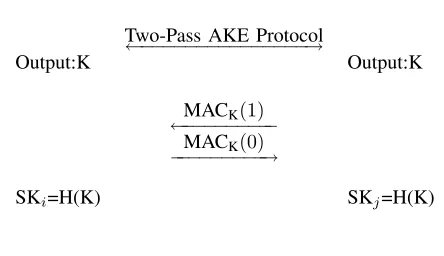
What we want to stress here is that even the three-pass AKE protocols transformed from the two-pass AKE protocols [14], [15], [16], [20] secure in the eCK model areno longer
secure in our new model either. For clarity of exposition, Fig. 1 illustrates the generic construction in which we can obtain a three-pass AKE protocol by merging messages.
IDi IDj
Two-Pass AKE Protocol ←−−−−−−−−−−−−−−−→
Output:K Output:K
MACK(1) ←−−−−−−−−−
MACK(0) −−−−−−−−−→
SKi=H(K) SKj=H(K)
Fig. 1. The Generic Three-Pass Authenticated Key Exchange Protocol
ephemeral key ofΠs
IDi,IDj provided that no sessions matching toΠs
IDi,IDj exist. We give the attack against this protocol as follows:
First the adversary masquerades as some party, say IDj,
to take part in the two-pass AKE protocol with IDi. Then the
adversary revealsbothIDi’s static keyandthe ephemeral key of ΠsIDi,IDj. Next with these values it can compute the value K and produce the message authentication code MACK(1)
itself. Finally, IDi will accept this session and believe its peer
is IDj.
IV. THESIG-DH+PROTOCOL
In this section, we propose a new three-pass AKE proto-col called SIG-DH+ which is secure in our enhanced AKE security definition.
A. Setup
Let the value κbe the security parameter. Let G=hgibe a cyclic group of order q with a generator g∈G. LetG∗ be the non-identity elements set of G. Let H1 : {0,1}∗ → Zq
and H : {0,1}∗ → {0,1}κ be two hash functions modeled
as random oracles. We denote by pkU, skU the public key and private key of party U respectively. Let SIGU(m)be a deterministic signature on message m generated by party U
using its private key skU.
B. Protocol description
Assume Alice(A) and Bob (B) are two parties.
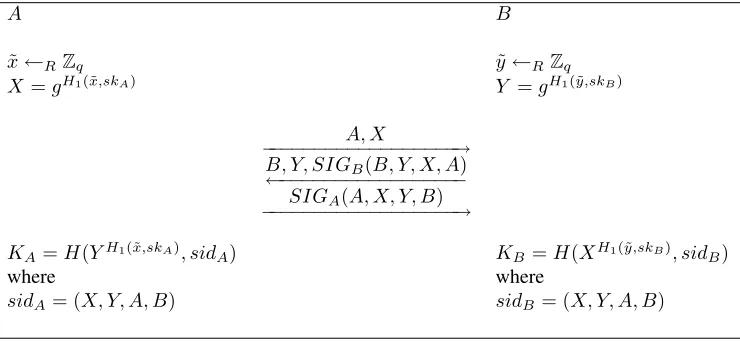
1. A(initiator) chooses an ephemeral private keyx˜∈Zq at
random, computes and sends X =gH1(˜x,skA) toB. 2. Upon receivingX, partyB(responder) verifies thatX ∈
G∗. If so, B randomly chooses y˜∈Zq, computesY = gH1(˜y,skB) and sends B, Y, SIG
B(B, Y, X, A) to party A.
3. Upon receiving message from B, party A checks if
Y ∈ G∗ and verifies the signature. If so, A
re-turns SIGA(A, X, Y, B) to party B, and keeps KA = H(YH1(˜x,skA), sidA) as the session key where sidA =
(X, Y, A, B).
4. Party B verifies the received signature. If so, B keeps
KB = H(XH1(˜y,skB), sidB) as the session key where
sidB = (X, Y, A, B).
C. Rationale
In contrast to the SIG-DH protocol [6] where each party, say A, chooses the ephemeral keyxand sends X =gx, the
main difference in the SIG-DH+protocol is that partyAsends
X =gx, where xis computed by combining the ephemeral
keyx˜ and the static key skA.
Intuitively, by combining the ephemeral key and static key, the SIG-DH+ protocol can resist those attacks that reveal one of the ephemeral key and static key, while the SIG-DH protocol is vulnerable to the attacks which only reveal the ephemeral key. The technique has been used to construct the
two-passAKE protocol in the eCK model [14], [15], [20]. On the other hand, as shown in [14], [15], if the signatures in the SIG-DH protocol are instantiated by a randomized signature such as ElGamal [10], Schnorr [18], the adversary can obtain the long-term secret key of the party by revealing the random coins used in signature generation. This is why we use the deterministic signature2 in the SIG-DH+ protocol. Moreover, in the SIG-DH+protocol each party, say B, only uses its static key skB to generate the signature. Without the static key skB, it is not possible for the adversary to masquerade as party B against its peer party A even if the adversary obtains the static key and ephemeral key of party A.
D. Security Proof
Theorem 1: Suppose that the CDH assumption for group
Gholds, the signature scheme is deterministic and EU-CMA
secure,H1, H are hash functions modeled as random oracles, then the proposed scheme in Fig. 2 is a secure authenticated key exchange protocol in the sense of the Definition 5. The adversaryM’s advantage AdvMake(κ)is bounded by
2
q2
s 2κ +
(2qs+qr)2
2κ +n·Succ eu−cma
Σ (κ) +qs·Succ
cdh
G (κ)
where n is the number of honest parties activated by the adversary, qs and qr are the upper bound on the maximum number of protocol sessions and random oracle queries by the adversary, Succeu−cmaΣ (κ) is the adversary’s probability in breaking the deterministic signature scheme.
The security proof of this theorem appears in Appendix A.
V. CONCLUSIONS
In this paper, we have investigated the security model for authenticated key exchange protocols.
We further enhance the freshness definition for the three-pass authenticated key exchange protocols. We point out that those three-pass AKE protocols generically transformed from two-pass AKE protocols secure in the eCK model can not be secure in our new security model for the three-pass AKE protocols.
We then introduce a new authenticated key exchange proto-col SIG-DH+ using a generic deterministic signature scheme and prove that it satisfies our new definition.
2The short signature proposed by Boneh,Lynn and Shacham (BLS) [5] is
A B
˜
x←RZq y˜←RZq
X =gH1(˜x,skA) Y =gH1(˜y,skB)
A, X
−−−−−−−−−−−−−−−−−−→ B, Y, SIGB(B, Y, X, A) ←−−−−−−−−−−−−−−−−−
SIGA(A, X, Y, B) −−−−−−−−−−−−−−−−−−→
KA=H(YH1(˜x,skA), sidA) KB =H(XH1(˜y,skB), sidB)
where where
sidA= (X, Y, A, B) sidB= (X, Y, A, B)
Fig. 2. The proposed SIG-DH+ protocol
REFERENCES
[1] M. Bellare, D. Pointcheval, and P. Rogaway. Authenticated key exchange secure against dictionary attacks. In EUROCRYPT, pages 139–155, 2000.
[2] M. Bellare and P. Rogaway. Entity authentication and key distribution. In D. R. Stinson, editor, CRYPTO, volume 773 of Lecture Notes in Computer Science, pages 232–249. Springer, 1993.
[3] M. Bellare and P. Rogaway. Provably secure session key distribution: the three party case. InSTOC, pages 57–66. ACM, 1995.
[4] S. Blake-Wilson, D. Johnson, and A. Menezes. Key agreement protocols and their security analysis. In M. Darnell, editor,IMA Int. Conf., volume 1355 ofLecture Notes in Computer Science, pages 30–45. Springer, 1997.
[5] D. Boneh, B. Lynn, and H. Shacham. Short signatures from the Weil pairing.In Proceedings of Asiacrypt 2001, volume 2248 of LNCS, 2001. [6] R. Canetti and H. Krawczyk. Analysis of key-exchange protocols and their use for building secure channels. In B. Pfitzmann, editor,
EUROCRYPT, volume 2045 of Lecture Notes in Computer Science, pages 453–474. Springer, 2001.
[7] R. Canetti and H. Krawczyk. Security analysis of IKE’s signature-based key-exchange protocol. In M. Yung, editor,CRYPTO, volume 2442 of
Lecture Notes in Computer Science, pages 143–161. Springer, 2002. [8] K.-K. R. Choo, C. Boyd, and Y. Hitchcock. Examining
indistinguishability-based proof models for key establishment protocols. In B. K. Roy, editor,ASIACRYPT, volume 3788 ofLecture Notes in Computer Science, pages 585–604. Springer, 2005.
[9] W. Diffie and M. E. Hellman. New directions in cryptography. IEEE Transactions on Information Theory, IT-22(6):644–654, 1976. [10] T. ElGamal. A public key cryptosystem and a signature scheme
based on discrete logarithms.IEEE transactions on information theory, 31(4):469–472, 1985.
[11] S. Goldwasser, S. Micali, and R. L. Rivest. A digital signature scheme secure against adaptive chosen-message attacks. SIAM J. Comput., 17(2):281–308, 1988.
[12] H. Krawczyk. Sigma: The ’SIGn-and-MAc’ approach to authenticated diffie-hellman and its use in the ike-protocols. In D. Boneh, editor,
CRYPTO, volume 2729 ofLecture Notes in Computer Science, pages 400–425. Springer, 2003.
[13] H. Krawczyk. HMQV: A high-performance secure Diffie-Hellman protocol. In V. Shoup, editor,CRYPTO, volume 3621 ofLecture Notes in Computer Science, pages 546–566. Springer, 2005.
[14] B. LaMacchia, K. Lauter, and A. Mityagin. Stronger security of au-thenticated key exchange. Cryptology ePrint Archive, Report 2006/073, 2006. http://eprint.iacr.org.
[15] B. A. LaMacchia, K. Lauter, and A. Mityagin. Stronger security of authenticated key exchange. In W. Susilo, J. K. Liu, and Y. Mu, editors,
ProvSec, volume 4784 of Lecture Notes in Computer Science, pages 1–16. Springer, 2007.
[16] T. Okamoto. Authenticated key exchange and key encapsulation in the standard model. InASIACRYPT, pages 474–484, 2007.
[17] T. Okamoto and D. Pointcheval. The gap-problems: A new class of problems for the security of cryptographic schemes. In K. Kim, editor,
Public Key Cryptography, volume 1992 ofLecture Notes in Computer Science, pages 104–118. Springer, 2001.
[18] C. Schnorr. Efficient signature generation by smart cards. Journal of cryptology, 4(3):161–174, 1991.
[19] V. Shoup. Sequences of games: a tool for taming complexity in security proofs.IACR eprint report, 332, 2004.
[20] B. Ustaoglu. Obtaining a secure and efficient key agreement protocol from (H)MQV and NAXOS.Des. Codes Cryptography, 46(3):329–342, 2008.
APPENDIXA
Theorem 1. Suppose that the CDH assumption for group
Gholds, the signature scheme is deterministic and EU-CMA
secure,H1, Hare hash functions modeled as random oracles,
then the proposed scheme in Fig. 2 is a secure authenticated key exchange protocol in the sense of the Definition 5. The adversaryM’s advantage Advake
M (κ)is bounded by
2
q2
s 2κ +
(2qs+qr)2
2κ +n·Succ eu−cma
Σ (κ) +qs·Succ
cdh
G (κ)
Proof. We give the proof using a sequence of games [19]. We let the adversaryM interact with simulatorS, who offers the real protocol environment to M in the first game, and subsequently change the simulator’s behavior without affecting the adversaryM’s success probability significantly. In the last game, the adversary M’s success probability is equal to (or negligibly close to) the target probability.
Assume thatnis the number of the honest parties activated by the adversary, qs andqr are the maximum number of the
sessions and random oracle queries by the adversary. LetSi
be the event that the adversary M correctly guesses the bit
b used in the Test session in Gamei andi is the adversary
M’s advantage in Gamei. i.e. i=|2·P r[Si]−1|. We have
i−1 = |2·P r[Si−1]−1|
≤ |2·P r[Si−1]−2·P r[Si]|+|2·P r[Si]−1|
≤ 2· |P r[Si−1]−P r[Si]|+i (i= 1,2, ...,6)
Game 0: This game corresponds to the real attack. By definition, we have
Advake M,Σ(κ)
def
Game 1:The game is the same as Game 0 except thatSfails if an event Repeatoccurs. Hence
|P r[S1]−P r[S0]| ≤P r[Repeat]; 0≤2·P r[Repeat] +1
The eventRepeathappens when a party chooses two identical random ephemeral keys in two different sessions. As there are at most qs sessions, we have
P r[Repeat]≤ q2s 2κ.
Game 2:The game is the same as Game 1 except thatSfails if an event Collusionoccurs. Hence
|P r[S2]−P r[S1]| ≤P r[Collision]; 0≤
2·P r[Collision] +1
The eventCollisionhappens when the random oraclesH1, H produces a collusion for any of inputs. Each session requires two random oracles queries. Since there are at mostqssessions
andqr oracle queries by the adversary, the probability of the
eventCollision is
P r[Collision]≤(2qs+qr)2 2κ .
Game 3: This game is identical to Game 2 except that the simulator aborts if eventNo-Matchingoccurs. We have
|P r[S3]−P r[S2]| ≤P r[No-Matching]; 2≤
2·P r[No-Matching] +3.
The eventNo-Matchinghappens if some sessionΠs IDi,IDj accepts and there are no sessions Πt
IDj,IDi match-ing to it. Here we require that the adversary has not asked StaticKeyReveal(IDj) query before the completion of
ΠsID
i,IDj. In order to estimate the probability of the event
No-Matching, we show how to use the adversaryM to construct an EU-CMA forgerF¯against the signature scheme as follows:
¯
F’s operation: F¯ is given a public keypk and has access to the corresponding signature oracle. F¯’s goal is to forge a signature corresponding to public key pk.
¯
F randomly chooses one ofnhonest parties, sayIDj, and sets party IDj’s public key to be pk. For all other honest parties, F¯ assigns the public/private key pairs itself. All the adversaryM’s Send queries to parties can be answered by the simulator, since the simulator has their private keys, except for the party IDj whose public key ispk.
To answer Send queries to party IDj (acting as re-sponder) , the simulator F¯ chooses y, y˜ ∈ Zq,
com-putes Y = gy, and calls its signature oracle to get its
response (IDj, Y, SIGIDj(IDj, Y, X, IDi)), where IDi is party IDj’s peer and X is party IDi’s outgoing message. Later on, the valuey˜is kept as the ephemeral key and used to answer the EphemeralKeyReveal query. Now the simulation provided by F¯ is accurate.
On the other hand, since the session Πs
IDi,IDj may be an initiator session or a responder session, we consider two subcases below.
CASE 1: Assume thatΠs
IDi,IDj is an initiator session. If Πs
IDi,IDj is invoked as an initiator oracle, then at some time τ0, ΠsIDi,IDj receives the activation flag and returns X = gH1(˜x,skIDi) to the adversary. If Πs
IDi,IDj is
to accept, it must receive a flow of the form (IDj, Y = gy, SIG
IDj(IDj, Y, X, IDi)), where X is produced by the simulator F¯. If the adversary M succeeds against the ses-sion Πs
IDi,IDj, i.e. Π
s
IDi,IDj accepts and there is no oracle
Πt
IDj,IDi matching to Π
s
IDi,IDj, the simulator halts and outputs the valid signatureSIGIDj(IDj, Y, X, IDi)).
CASE 2:Assume that Πs
IDi,IDj is a responder session. IfΠs
IDi,IDj is invoked as a responder oracle, then at some timeτ1,ΠsIDi,IDj receives the first message, sayX, from the adversary and returns(IDi, Y =gH1(˜y,skIDi), SIGIDi(Ui, Y,
X, Uj)) to the adversary. If ΠsIDi,IDj is to accept, it must later receive a flow of the form SIGIDj(IDj, X, Y, IDi), where Y is produced by the simulator F¯. If the adversary
M succeeds against the session Πs
IDi,IDj, i.e. Π
s IDi,IDj accepts and there is no oracle Πt
IDj,IDi matching to
Πs
IDi,IDj, the simulator halts and outputs the valid signature
SIGIDj(IDj, X, Y, IDi). So we have
P r[No-Matching]≤n·Succeu−cmaΣ (κ)
Game 4: In this game, we add following rule: S randomly chooses a value s∗ ∈ {1, ...qs} as the Test session. Assume
that two communicating parties are A andB. We denote by
Πs
A,B the Test session.S aborts if the Test session does not
occur in the sessionΠs
A,B. We have
3=qs·4.
Game 5:In the game we replaceH1(˜x, skA)withxwhenever it is computed in the Test sessionΠsA,B, wherex←RZq.
Sim-ilarly,H1(˜y, skB)is replaced withy whenever it is computed in the matching session, wherey←RZq.
Since in this game the adversary is passive, i.e. it can not actively choose the DH values X, Y at a session, and there must be a session matching to the Test session. An active adversary will have caused Game 3 to abort. According to freshness definition 4, in this case the adversary can only reveal one of ephemeral key and static key of both the Test session and its matching session. So the probability of the adversary in Game 4 and Game 5 is identical. Hence
P r[S6] =P r[S5]
Game 6:In this game we replace the session key KA of the Test session with a random stringR∈ {0,1}κ. Similarly, the
session keyKB of the matching session is replaced with the same random stringR.
The adversary can distinguish Game 6 and Game 5 only if it asks random oracleH with input (CDH(X, Y), sidA)or
(CDH(X, Y), sidB). We get
|P r[S6]−P r[S5]| ≤SucccdhG (κ); 5≤2·SucccdhG (κ) +6.
Finally, it is easy to see that in Game 6, we have
|P r[S6]|= 12; 6= 0.