Anonymous Multi-Receiver Public Key Encryption
Based on Lucas Sequences
L houssain El Fadil
1, Abdelkader MOUMEN
2and Mohamed BOUYE
31Department of Mathematics, King Khalid University. Faculty of Sciences, B.P. 1000, Abha, Kingdom of Saudi Arabia.
1Polydisciplinary Faculty of Ouarzazat P.O. Box 638, Ouarzazat- Morocco.
2Department of Mathematics, King Khalid University. Faculty of Sciences, B.P. 1000, Abha, Kingdom of Saudi Arabia.
3Department of Mathematics, King Khalid University. Faculty of Sciences, B.P. 1000, Abha, Kingdom of Saudi Arabia.
Abstract
Multi-receiver encryption enables a sender to encrypt a message and transmit the cipher-text to a set of authorized users, while no one out this group of authorized users can decrypt the message. Multi-receiver encryption is of great importance in many sectors such as broadcast communication, cloud computing, wireless communications, networking applications, e-voting, lottery, and medical applications. This paper proposes an ecient multi-receiver public key encryption scheme based on Lucas sequences. The results of the computational analysis show that, projected scheme is better against renown attacks and prevailing anonymous multi-receiver algorithms.
Keywords: Lucas sequences, public key cryptosystems, Multi-receiver encryption scheme, Chinese Remainder Theorem, Anonymity.
1 Introduction
The goal of the multi-receiver encryption is to securely transmit any message to all authorized receivers via insecure channels. There are several proposed multi-receiver encryption schemes in the literature based on dierent technical [18, 7, 1, 14, 19, 21, 4, 9, 11].
In their paper Smith and Lennon [17], were the rst to introduce linear sequences in cryptog-raphy in 1993. They suggested that the second order linear sequences could be used instead of the standard exponentiation used in RSA. Two years later, Chi-Sung et al has shown that the security
of Lucas functions is polynomial-time equivalent to the generalized discrete logarithm problems [2]. In 2012, El Fadil proposed a cryptosystem based on second order linear sequences in which semantic security is ensured [10]. Moreover, as linear sequences are not multiplicative, the main advantage of Lucas cryptosystems is that they are not formulated in terms of exponentiation. This would make them invulnerable to various well known attacks that threaten the security of more traditional cryptosystems like RSA and Die Hellman [5]. However, many current network-ing applications involve multiple receivers and one-to-one type of encryption is not appropriate for such type of applications. The main motivation of multiple receivers is to secure that group communications which getting popularity in dierent domains.
In this paper, we propose a novel multi-receiver public key encryption scheme based on Lucas sequences. From analysis results, it is clear that our approach is more ecient and satisfying anonymity of receivers as compared to existing schemes. Section 2, consists of brief description of the second order linear sequences ("Lucas sequences") and their cryptography properties. After that, we present a new approach in Section 3 with security and computation analysis. Finally, we give our conclusion in Section 4.
2 Second order linear sequences ("Lucas sequences")
In this section, the main cryptographic properties of Lucas sequences are studied. A computa-tional method to evaluate the kth term are given, together with an analysis of its computational
cost.
Throughout this section :
• pis a prime integer.
• Fp=Z/pZthe nite eld of pelements.
• (a, b)∈Z2 such thatb≡1(modp).
• f(X) =X2
−aX+bis primitive polynomial overFp[X]. • A=Fp[X]/(f(X)).
• α= ¯X the class ofX modulo the principal ideal ofFp[X]generated byf(X). • For everyx∈A,lx be the linear map ofAdened bylx(y) =xy.
• T(x) =T r(lx)the trace ofx,T r(lx)the trace of the linear maplx.
• N(x) =det(lx)the norm ofx, det(lx)is the determinant of the linear maplx. • Dene the sequences(a)as follows :
k∈Z, sk(a) =T(αk)for every integer. (1)
Remark 2.1 Since f(α) = 0 and the map trace is linear, it follows that :
sk+2(a)≡ask+1(a)−sk(a)(mod p)modulo p. (2)
So, s(a) is a second order linear sequence (Lucas sequence), called the characteristic sequence
generated by a.
Remark 2.2 Let lk be the endomorphism ofAdened by :
lk(x) : A −→ A
x 7−→ lk(x) =αkx
Mk its matrix with respect to the basis (1, α).
ThenM0=
1 0
0 1
andM1=
0 −1 1 ¯a
.
2.1 Cryptographic properties
The cryptographic applications of Lucas sequences are listed in [16, 15]. To make this concept easy for the reader, we present some of these results in a more accessible form and without proofs.
1. For every integerk,sk(a)≡αk+α−k (mod p)andsk(a)≡s−k(a)(mod p).
2. For every integerskande,se(sk(a))≡ske(a)(mod p).
3. Leta∈Zsuch thatpdoes not dividea2−4.
Iff(X)is a primitive polynomial overp, thenπ=p+ 1is the period ofs(a). More general
ifa2−4
p
=−1, thenf(X)is irreducible. SoN(α) =α1+p= 1. Thus the periodπof s(a)
divides p+ 1. Ifa2−4
p
= 1, thenf(X) is reducible. The fact thatA 'Fp×Fp implies
that the periodπofs(a)isp−1, where−pis the Legendre symbol.
For the two rst points, if f(X)is irreducible inFp[X], thenN(α) =αp+1≡1(modp).
Therefore :
sp+1(a) ≡ αp+1+α−(p+1)
≡ N(α) +N(α−1)
= 2
= s0(a)(modp)andπdividesp+ 1.
Iff(X)is a primitive polynomial modulop, thenαgenerates the multiplicative group(A∗, .)with
cardinal order p2
−1 andπis exactlyπ=p+ 1.
Corollary 2.3 For every integer e such thatgcd(e, π) = 1, where thegcdis the greatest common divisor, the map :
Luce : Fp −→ Fp
a 7−→ se(a)
is a one-one correspondence.
Proof: Indeed, sincegcd(e, π) = 1, then we can use the Euclid algorithm to calculate the inverse
dofemoduloπ. That means there exists an integerksuch thatde= 1 +kπ. Hence :
sd(se(a)) ≡ sde(a) ≡ s1+kπ(a) ≡ s1(a)
≡ a(mod p).
Lemma 2.4 Lete∈Nsuch thatgcd(e, π) = 1 and letc=se(a). Thenpdoes not dividec2−4 if
and only ifpdoes not divide a2
−4and a2−4
p
=c2−4
p
.
Proof: Since a≡sd(c)(modp), wheredis the inverse ofemoduloπ, it suces to show that if
a2−4
p
= 1, thenc2−4
p
= 1too.
So, assume that a2−4
p
= 1, then α ∈Fp. Thus, αe ∈ Fp and fc(X) = X2−cX+ 1 splits in
Fp[X];fc(X)≡(X−αe)(X−α−e)(modp). Therefore, i.e.,
c2−4
p
= 1.
2.2 Computation Method and analysis
Lemma 2.5 For every integern, set sn:=sn(a)(modp). Then
i) s2n ≡ s2n−2,
Proof: Letnandm be two integers.
snsm ≡ (αn+α−n)(αm+α−m)(modp) ≡ (αn+m+α−n−m) + (αn−m+α−n+m
2 )
≡ sn+m+sn−m(mod p).
Therefore,
sn+m≡snsm−sn−m(mod p).
In particular, we have i) and ii).
Letk= 2rm, wheremis an odd integer. To computes
k, rst we computesm, thens2m:
s2m≡s2m−2
s4m≡s22m−2 · · · ·
sk ≡s22r−1m−2.
Then to computesk, we needr multiplications modulopand we needsm.
Let m=
l−1
X
i=0
ki2l−1−i. For every 0 ≤ i < l−1, let fi+1 = 2fi +ki+1 and f0 = k0. Then fl−1=k. For0≤i < l−1and assume that,sfi−1 andsfi−1+1 are computed. Then
ifki= 0, then
sfi ≡ s2fi−1s
2
fi−1−2
sfi+1 ≡ s2fi−1+1≡sfi−1(a)sfi−1+1−a
ifki= 1, then
sfi ≡ s2fi−1+1≡sfi−1sfi−1+1−a
sfi+1 ≡ s2(fi−1+1)≡s
2
fi−1+1−2
Computation Algorithm. This method warrant thatskcan be computed in about the same
length of time as thekthpower is computed in the RSA method. But in the computation of s m,
having to compute two numbers at each stage does slow the computation down a little, but there are optimizations in the calculation which mean that the total amount of computation is only about half less than the amount needed for the RSA system. Therefore, to compute sk(a), the
total number of multiplications modulo pislog2(k).
3 Main results
In this section we describe some applications of Lucas sequences, in more details : Lucas multi-receiver encryption scheme and Lucas Die-Hellman key exchange extended to a group of communications. Through this section, n=pq is an RSA integer,a∈Zsush thatgcd(n, a) = 1, (sn)n is the Lucas sequence generated byf =x2−ax+ 1, and f is a primitive polynomial over
Fp andFq.
3.1 Multi-receiver encryption scheme
Algorithm 1: Computation Algorithm.
1. Input: k= 2r
l−1
X
i=0
ki2i anda, where k0= 06 andkl−16= 0. 2. Output: sk.
3. s0= 2,s1=a.
4. forifrom 0 to l−1do
5. ifki= 0thens1=s1s0−a,s0=s20−2 6. else then s0=s1s0−a,s1=s2
1−2 7. End if
8. End for. 9. Return (s0). 10. s=s0.
11. forifrom 1 to rdo 12. s=s2
−2.
13. End for. 14. Return (s).
1. Keys generation : First, assume that there are r+ 1 users. Any user selects s ≤ r authorized receivers u1,· · ·, us such that each one has one public key pair (ni, ei), where
everyni=piqi is an RSA integer, ei is coprime to (pi∓1)(qi∓1)andn1,· · · , nr, nr+1 are pairwise coprime.
2. Encryption procedure : A sender uses allsreceivers public keys to encrypt the message and then broadcasts the ciphertext to thesauthorized receivers as follows :
(a) Assume that he needs to send a message0< m < N to theslegitimate receivers, where N is the minimum of allni.
(b) Then for every i = 1, . . . , s, he calculates ci = sei(m). As n1,· · ·, ns are public and pairwise coprime.
(c) He uses the Chines Remainder Theorem to calculate the integer c such that for every i= 1, . . . , s,c≡ci (mod ni).
(d) Then He broadcasts the ciphertextc to thesreceivers.
3. Decryption procedure : When a autorized receiveri receives the ciphertextc, he will compute his private keydi as follows :
(a) First he calculatesci ≡c (modni),pi =
c2 i−4
pi
andqi =
c2 i−4
qi
. (b) He calculates his private keydi :
the inverse ofei moduloπ= (pi−pi)(qi−qi).
(c) Finally, he calculatesm≡sdi(ci)(mod ni). Proof :
Encryption :
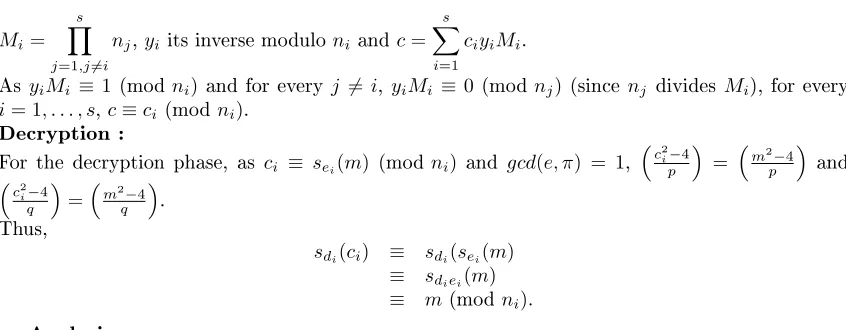
Mi= s
Y
j=1,j6=i
nj,yi its inverse moduloni andc= s
X
i=1
ciyiMi.
As yiMi ≡ 1 (modni) and for every j 6= i, yiMi ≡0 (modnj) (since nj divides Mi), for every
i= 1, . . . , s,c≡ci (modni).
Decryption :
For the decryption phase, as ci ≡ sei(m) (mod ni) and gcd(e, π) = 1,
c2 i−4
p
= m2−4
p
and
c2 i−4
q
=m2−4
q
. Thus,
sdi(ci) ≡ sdi(sei(m)
≡ sdiei(m)
≡ m(mod ni).
Analysis :
Now, we will discuss security, computation cost and the anonymity of receivers of the proposed scheme. The anonymity means that the identities of receivers can be protected. We will compare the computation cost of our scheme and other existing schemes.
3.1.1 Security
Since this scheme uses "LUC" cryptosystem, the security of the scheme is the same as mono-cast "LUC" cryptosystem. Namely, if Oscar wants to decrypt the encrypted messagec, rst of all he needs to break the LUC cryptosystem, which is cryptographically equivalent to the security of RSA [17, 2].
3.1.2 Anonymity of Receivers
When a sender broadcasts the ciphertext nobody in the group except the sender knows who is the receiving end.
3.2 Die-Hellmane Key exchange extended to a group of
communica-tion
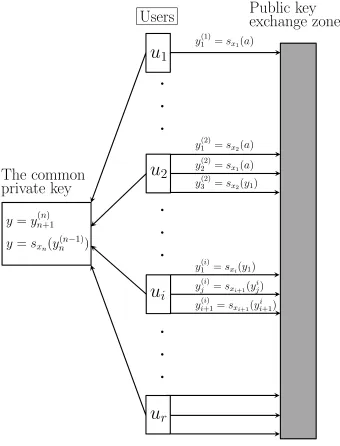
The standard Die-Hellman key exchange was rst proposed in 1976 [20]. After that there have been eorts to extend its simplicity to a group setting. The main motivating factor is the increasing popularity of various types of group applications and the need of doing it securely. Since key distribution is the cornerstone of secure group communication, it has naturally received a lot of attention. Notable solutions have been proposed but some of theme are only of theoretical interest, while the security of some others remains unproven (See for example [12, 8, 3, 13]). In this paper, a natural extension of Die-Hellman key exchange, based on Lucas sequences is proposed, see Figure 1.
Letn=pqbe an RSA integer,abe an integer such thatX2
−aX+ 1is a primitive polynomial
modulopand moduloqtoo.
Assume thatr usersu1,· · · , ur , whose have access to a public key data (n, a)and each one
has his private keyxi, want to agree on a shared secret key. Then :
The second oneu2, makes public(y(2)1 , y (2) 2 , y
(2)
3 ), where :
y1(2)=sx2(a),
y2(2)=sx1(a),
y3(2)=sx2(y1).
(3)
The notation yji means that this quantity is published by thejthuser.
The third makes public(y1(3), y (3) 2 , y
(3) 3 , y
(3)
4 ), where :
y(3)1 =sx3(y
2 1), y(3)2 =sx3(y
2 2), y(3)3 =y
2 3, y(3)4 =sx3(y
2 3).
(4)
Once theithuser makes public the tuple (y(i) 1 ,· · · , y
(i)
i+1). The(i+ 1)th makes public(y(i+1)
1 ,· · ·, y (i+1)
i+2 ), where for everyj= 1,· · ·i, : y(ji+1)=sxi+1(y
(i)
j ),
y(i+1i+1)=y (i)
i+1, y(i+2i+1)=sxi+1(y
(i)
i+1).
(5)
Finally, the last userun makes public(y1(n),· · · , y (n)
n )and keeps secret the common private
keyy=yn(n+1) =sxi(y (n)
i ).
Each userui, i= 1,· · ·n−1can calculates the same value y=sxi(y (n)
i ).
The common private key isy=yn(n+1). Indeed,
y=sxn(y (n−1)
n )
=sxn(sxn−1(...(sx1(a))...))
=sxnxn−1....x1(a). Computation analysis:
We compare the performance monocast "LUC" encryption and L. Harn et al. scheme [11] with the presented scheme. From Table 1 one can see that proposed scheme is more computationally ecient than the scheme proposed in [11], see Table 1.
4 Conclusion
Acknowledgments
The authors extend their appreciation to the Deanship of Scientic Research at King Khalid University for funding this work through General Research Project under grant number (G.R.P-86-38).
References
[1] A. Fiat and M. Naor, Broadcast encryption, in Proceeding of Advances Cryptology - Crypto, LNCS 839, pp. 480-491, Springer-Verlag, California, USA, Aug. 1994.
[2] Chi-Sung Laih, Fu-Kuan Tu, Wen-Chun Tai, On the security of the Lucas function, Information Processing Letters 53(1995), pp 243-247.
[3] Chin Chen Chang, Tzong Chen Wu, and C.P. Chen. The Design Of A Conference Key Distribu-tion System. In Advances in Cryptology -AUSCRYPT'92, Lecture Notes in Computer Science, pages 467-474. Springer- Verlag, Berlin Germany, December 1992.
[4] C. I. Fan, L. Huang, and P. Ho, Anonymous multi-receiver identity-based encryption, IEEE Transations on Computers, vol. 59, no. 9, pp. 1239-1249, Sep. 2010.
[5] D. Bleichenbacherl, W. Bosma, and K. Lenstra, Some Remarks on Lucas-Based Cryptosystems, Advances in Cryptology - CRYPT0 '95, LNCS 963, pp. 386-396, 1995
[6] Douglas R. Stinson, Cryptography Theory and Practice, Third edition 2006, Chapman, Hall/CRC, Taylor and Francis Group.
[7] G. H. Chiou and W. T. Chen, Secure broadcasting using the secure lock IEEE Transations on Software Engineering, vol. 15, no. 8, pp. 929-934, Aug. 1989.
[8] Hugh Harney, Carl Muckenhirn, and Thomas Rivers. Group Key Management Protocol (GKMP) Architecture. INTERNET-DRAFT, September 1994.
[9] H. Ghodosi, J. Pieprzyk, and R. Safavi-Naini, Dynamic threshold cryptosystems: a new scheme in group oriented cryptography, in Proceeding of Pragocrypt'96: the 1st International confer-ence on the Theory and Applications of Cryptology, pp. 370-379, Prague, Czech Republic, Sep. 1996.
[10] L. El Fadil, A Public-Key Cryptosystem Based on Lucas Sequences, Palestine Journal of Mathematics Vol. 1(2) (2012) 148-152.
[11] L. HARN, C.- C. CHANG, and H.-L. WU, An Anonymous Multi-Receiver Encryption Based on RSA, Journal of Network Security, Vol.15, No.4, PP.307-312, July 2013.
[12] M. Steiner, G. Tsudik and M. Waidner, Die-Hellman Key Disrtribution Extended to Group Communication, Proceding of the 3rd ACM conference on computer and communications se-curity, March 14-16 (1996), new Delhi.
[13] M. Burmester and Y. Desmedt. A Secure And Ecient Conference Key Distribution Sys-tem. In I.B. Damgard, editor, Advances in Cryptology, EUROCRYPT'94, Lecture Notes in Computer Science. Springer-Verlag, Berlin Germany, 1994.
[14] M. Bellare, A. Boldyreva, and S. Micali, Public-key encryption in a multi-user setting: secu-rity proofs and improvements, in Proceeding of Advances Cryptology - Eurocrypt 2000, LNCS 1807, pp.259-274, Springer-Verlag, Bruges, Belgium, May 2000.
[15] P. Ribenboim, The Little Book of Big Primes, Springer-Verlag, 1991.
[16] P. Smith. LUC Public Key System : A secure Alternative to RSA. Dr. Dobb's Journal, January 1993.
[18] S. Berkovits, How to broadcast a secret, in Proceeding of Advances Cryptology - Euro-crypt'91, LNCS 547, pp. 535-541, Springer-Verlag, Brighton, UK, Apr.1991.
[19] S. Berkovits, How to broadcast a secret, in Proceeding of Advances Cryptology - Euro-crypt'91, LNCS 547, pp. 535-541, Springer-Verlag, Brighton, UK, Apr.1991.
[20] W. Die and M. E. Hellman, New directions in cryptography, IEEE Trans. Inform. Theory, vol. IT-22, (1976), pp. 644-654.
[21] X. Du, Y. Wang, J. Ge, and Y. M. Wang, An ID-based broadcast encryption scheme for key distribution, IEEE Transations Broadcast, vol. 51, no. 2, pp. 264-266, June 2005.
Users
u
1
u
2
u
i
u
r
The common
private key
Public key
exchange zone
y
=
y
n(n+1)y
=
s
xn(
y
(n−1)n
)
y
(1)1=
s
x1(
a
)
y
(2)1=
s
x2(
a
)
y
(2)2=
s
x1(
a
)
y
(2)3=
s
x2(
y1
)
y
(1i)=
s
xi(
y1
)
y
(ji)=
s
xi+1(
y
i j
)
y
(i+1i)=
s
xi+1(
y
i i+1
)
·
·
·
·
·
·
·
·
·
Monocast LUC encryption L. Harn, et al. scheme Our scheme Sender n/2×TE_1024 n×TE_1024 n/2×TE_1024
Receiver TD TD TD
Rounds of transmission n 1 1
Anonymity of receivers No Yes Yes