A Secure and Optimal Method of Steganography Using Bit Combination
and Dynamical Rotation over Addresses.
Author’s Name 1:Okello Moses Oyaro Permanent affiliation: Jaso Skynet Technology
Permanent Address: Gulu, Uganda E-mail: [email protected]
ABSTRACT: Steganography is the branch of cryptology that deals with concealing information inside another information. it’s prefer over cryptography as it hides a message inside another innocent looking message, while cryptography shows scrambled message that might arouse attention of an attacker, however the challenges in steganography is the modification of carrier that causes some abnormalities which is detectable and often the methods are not optimize. This paper presents a novel approach in cryptography and steganography, which utilizes mathematical concept of bits combination to optimize time of transmission using sets of multiple transmitter, and receiver’s addresses where each abstractly represents a bits combination without itself modified. In addition, the paper introduces a concept of dynamical clockwise and anti-clockwise rotation of bits combination over addresses after every transmission to reinforce resistivity against steganalysis.
Keywords: General Mathematics, Combinatorial, Algebra, Steganography, Probability, Cryptography.
1. BACKGROUND
Steganography[1,2,3] is the science of hiding secret data in a cover medium in order to produce a stego-medium in which data are undetectable to all except the recipient. Traditional steganography methods try to hide information in the Noise of the data by distorting original data just enough to embed a message without this distortion being noticeable. Steganography is derived from a finding by Johannes Trithemus meaning, “Covered writing” [4, 5]. It hides a message inside another message without drawing any suspicion to others so that its intended recipient [6] can only detect the message. While steganography hide the existence of a message, It is not enough to simply encipher the traffic, as criminals detect, and react to the presence of encrypted communications, But when information hiding is used, even if an attender tap the transmitted object, he or she cannot surmise the
communication since it is carried in a hidden way. Limitation of cryptography is that the third party is always aware of the communication because of the unintelligible nature of the text. Steganography overcomes this limitation by hiding message in an innocent looking object called carrier, cover, or stego-object. In addition, still attacker can be attracted towards encrypted data due to different form of data. Therefore, this limitation can be overcome by using steganography [7].Moreover, some organization or government may not allow encrypted communication [8]. Therefore, steganography is the best way for secret communication. Furthermore, It is an ever-growing research topic as the idea of hiding information attracts many researchers [9] although steganography techniques provide us with some more secure communication, the modification is traceable by using some brand-new “steganalysis” tools [10]. Good Steganography method when mixed with cryptography technique using dynamical key [11] either Asymmetric or symmetric encryption [12] and applying concept of multichannel and cryptography [13] becomes extremely powerful. . However, in my previous work [14], discusses the drawback of most steganography methods, which are due to modification of carrier, and that it gives loophole for some sophisticate algorithm or statistical method to detect steganography flow. Nevertheless, this problem can be solve in this proposed novel methods, which does not modify anything. In addition, the fact that most method hide a single bit one after another, it is extremely difficult to attained optimal transmission base on time for transmitting these floods of binaries and the proposed method introduces bit combination to combat such problem. Network steganography is prefer over image steganography as image often may be modified during transmission due to either image filtering, resizing, scaling, transformation and many others. This may distort the hidden information such that the final recipients does not get the right message, as for example Least Significant Bits (LSB) method is very vulnerable to image modification.
2. STEGANOGRAPHY METHODS
This paper presents a theoretical mathematical approach in security(Network steganography), which utilizes mathematical concept of combinatorial, and binary string concatenation by combining bits to optimize time of transmission, using multiple transmitters and receivers addresses, for example email addresses, mail addresses, phone numbers, or network ports or addresses and many others where each is assigned a bits combination. In
addition, the paper present the concept of dynamical clockwise and anti-clockwise rotation of bits combination over the given transmitter-receiver addresses after every transmission to reinforce resistivity against any form of security analysis like (Steganalysis) or cryptanalysis.
2.1 BITS COMBINATORIAL. This section presents the concept of combination of bits such that maximum bits can be send at once by making a given address represent such bit combination. Below shows examples of bits
combination. In addition, how a formulae for calculating total number of possible bits combination “C” given that a
number of bits to be combine is “n”. Let Ψ be set of string of bit combinations resulting from a given combinatorial such that Ψ = {𝜓0, 𝜓1, 𝜓2, 𝜓3, . . 𝜓𝐶−2, 𝜓𝐶−1} and 𝐶 is the total number of elements of Ψ excluding empty set
Ψ = {∅}.
One by one binary combination; Ψ ={0 ,1} so total combination are 𝐶=2and n=1 however for Two binary combination, the possibility are Ψ ={00 ,01 ,10,11} and total combination 𝐶=2where n=2
For three binary combination, Ψ ={000 , 001 ,010 ,100 ,011,101,110 ,111} total combination 𝐶 = 23where 𝑛=3 For four binary combination are; Ψ ={0000, 0001, 0010, 0100,1000,0011,0101, 1111, … . } and total
combination 𝐶 = 16 where n=4
Therefore, the pattern keep on increasing such that the power of possible binary combination “C” for a given bit combine “n” can be express as 𝐶 = 2𝑛.
From the above, it is clearly evidence that, for binaries combination, the maximum possible binary combination "𝐶" is as below where “n” is the total number of binaries combination.
given that Ψ = {𝜓0, 𝜓1, 𝜓2… , 𝜓(2𝑛−2), 𝜓(2𝑛−1)}. Total element of set Ψ can be express as follows.
𝐶 = 2𝑛
Prove of Equation 𝐶 = 2𝑛 above.
By using Kleene Star formulae [15] derived from Kleene plus Let Kleene plus be V+ and Kleene star beV∗
Therefore,
V+= ⋃∞ V𝑛 𝑛=1
implies that V∗= ⋃ V𝑛 𝑛∈ℕ ⋃ ∅
𝑉+= {𝑉
1∪ 𝑉2∪ 𝑉3… . 𝑉𝑛} And Given that V0= ∅ an empty set and Kleene Star is given as V∗=V0∪V+
𝑉∗= {V
0∪ 𝑉1∪ 𝑉2∪ 𝑉3… . 𝑉𝑛}
If V= {“𝑧”, ”𝑦”}, then V∗= {∅, ”z", "y", " zz", "zy", "yz", "yy", "zzz", "zzy", "zyz", "zyy", . . . }
If V= {"𝑥", “𝑧”, ”𝑦”}, then V∗= {∅, "x", ”z", "y", "xxx", " xxz", "xxy", "xzz", "xyy", "yzx", . . . }
Now substituting z=0, y=1 as binary character of string, the above can be rewritten as below.
If V= {0,1}, then V∗= {∅, 0, 1, 00, 01, 10, 11, 000, 001, 010, 011, . . . }
Given that, V0= ∅ for any alphabet,the set of all strings over V of length 𝑛 is denoted as V𝑛. If V = {"z", "y"},
then V∗= {∅, "z", "y", "zz", "zy", " yz", " yy", … . }.
Substituting that with binary bit of string, becomes V = {0,1} then V∗= {∅, 0,1, 00, 01, 10, 11 … }.
For, V1= { 0,1}. and then the total element of the sets in V1 is given as 𝐶 = 2, 𝐶 = 21
However, V2= { 00, 01, 10, 11}. and then the total element of the sets in V2 is given as 𝐶 = 4, 𝐶 = 22 with the
exception of the empty set V0= ∅. Therefore, the total is minus one.
𝐶 = 2𝑛
End of prove.
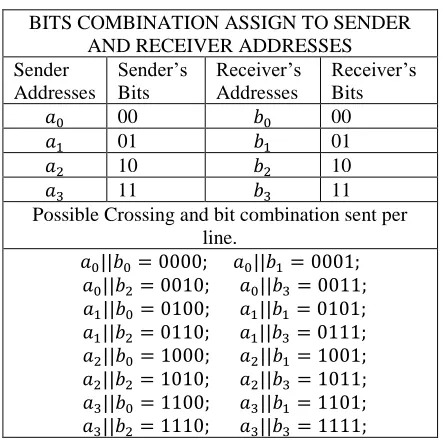
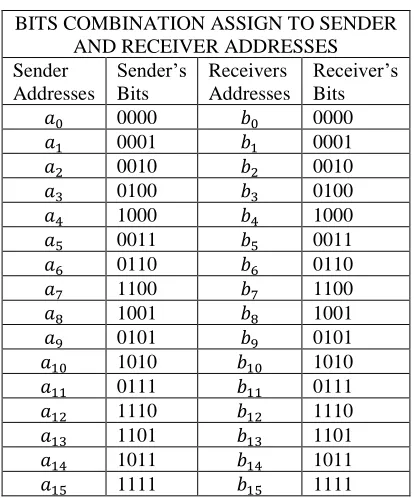
For more example, see Table (I, II, III) where a binary combination is assign to addresses.
2.2 MULTI-ADDRESS RELATIONSHIP : Given two sets of addresses A and B with an equal number of elements
{(𝑎, 𝑏): 𝑎 ∈ 𝐴, 𝑏 ∈ 𝐵} such that each element of one set is maximally relating to all the elements of the other sets and the inverse relationship holds true ( 𝐴 = {𝑎0, 𝑎1, 𝑎2, … . 𝑎𝑖} ∶ 𝑖 ∈ ℕ 𝑎𝑛𝑑 𝐵 = {𝑏0, 𝑏1, 𝑏2, … . 𝑏𝑗}: 𝑗 ∈ ℕ) The relationship of the two sets "𝐴" and "𝐵" can be describe as; ℛ ⊆ 𝐴𝑥𝐵 = {(𝑎, 𝑏): 𝑎 ∈ 𝐴, 𝑏 ∈ 𝐵}. For the inverse case where the receiver wants to reply to the sender, the relationship inverse hold true as express ℛ−1=
{(𝑎, 𝑏): (𝑎, 𝑏) ∈ ℛ}𝑥 and 𝑞 are total elements of sets 𝐴 and 𝐵 respectively.
Therefore since the transmission is related, such that, {𝑎, 𝑏} ∈ ℛ, a ℛ b, Maximum crossing among addresses " ℒ"
for sending information can be express as ℒ = (𝑞 ∗ 𝑥) ⟹ 0 < ℒ ≤ (𝑞 ∗ 𝑥); ℒ ∈ ℕ and to calculate total number of cross transmission is below, provided relationship holds true.
2.2.1 CONDITION 1: when (𝑞 ≠ 𝑥 ) and 𝑞 = 𝐶 , 𝑥 = 𝐶
𝑓𝑜𝑟 𝑥 < 𝑞; 𝑥 = 2𝑛; 𝑞 = 𝑥2𝑚 given that 𝑚 ∈ ℕ Therefore 𝑞 = 2𝑛+𝑚
When condition one is encounter, it depict relationship of many to one or one to many or in other word a relation where total from one side does not equal to the total from the other side but to accommodate same bits combination from both side of sender and receiver such that equations holds true, “𝑞” must be equal to “𝑥”. Which certifies in the below condition 2: So, when 𝑥 < 𝑞, it can be express as 𝑥 = 2𝑛 , 𝑞 = 2𝑛+𝑚 given that
𝑚 ≥ 0 . Therefore ℒ = 𝑥𝑞 and by substituting value of q and x; ℒ = 2𝑛∗ (2𝑛+𝑚)
ℒ = 22𝑛+𝑚
However, the total addresses "d" should be equal to the number of the maximum possible binary combination at each side of sender and receiver’s addresses.
𝑥 = 𝐶 , 𝑞 = 𝐶 Therefore; 𝑞 = 2𝑛 ; 𝑥 = 2𝑛+𝑚; since 𝑞 ≠ 𝑥 total addresses or ports "d" is as below. d= 𝑥 + 𝑞 ⟹ d= 2𝑛+ 2𝑛+𝑚
Factoring out 2𝑛 from the above equation, then below is the final equation for total addresses base on Condition one above.
d= 2𝑛(1 + 2𝑚)
2.2.2 CONDITION 2: when (𝑞 = 𝑥) and (𝑞 = 𝐶, 𝑥 = 𝐶)
The above condition 2 shows where all sender set of elements are equally relating to all the other elements of the receiving set. Since ℒ = 𝑥𝑞 can be expresses as ℒ = 𝑞2 or ℒ = 𝑥2 by making either 𝑞 = 𝑥 or 𝑥 = 𝑞.
But the total addresses should be equal to the number of the maximum possible binary combination where
𝑥 = 𝐶, 𝑞 = 𝐶 Therefore, 𝑞 = 2𝑛 , 𝑥 = 2𝑛 Therefore, total addresses or ports "d" is as below.
d= 𝑞 + 𝑥 ; d= 2𝐶
d= 2(𝑛+1)
therefore d= 2(𝑛+1)
Substituting 𝑞 = 2𝑛 , 𝑥 = 2𝑛into ℒ and a new equation, which only holds when condition 2 is true such that 𝑞 = 𝑥 and 𝑞 = 2𝑛, 𝑥 = 2𝑛 and ℒ = (2𝑛∗ 2𝑛)
ℒ = 22𝑛.
Or, from condition 1, by letting 𝑚 = 0 and substituting into equation ℒ = 22𝑛+𝑚 therefore, ℒ = 22𝑛+0
ℒ = 22𝑛
2.2.3 CONDITION 3: when (𝑞 > 𝐶, 𝑥 > 𝐶) and (𝑥 = 𝑞)
In this scenario when the available addresses are more than the bit combination 𝑥 > 2𝑛 and 𝑞 > 2𝑛. Here I introduce a new two variables (ℓ , 𝜆) ∈ ℕ. , 0≤ ℓ ≤ (𝑥 − 2𝑛) and
0 ≤ 𝜆 ≤ (𝑞 − 2𝑛)
Therefore, 𝑥 = 2𝑛+ ℓ and 𝑞 = 2𝑛+ 𝜆 given that ℒ = 𝑥𝑞
ℒ = (2𝑛+ ℓ)(2𝑛+ 𝜆)
ℒ = 22𝑛+ 2𝑛(ℓ + 𝜆) + ℓ𝜆
Given that 𝑑= 𝑥 + 𝑞 therefore 𝑑= (2𝑛+ ℓ) + (2𝑛+ 𝜆)
𝑑= 2𝑛+1+ ℓ + 𝜆
2.2.4 CONDITION 4: when (𝑞 > 𝐶, 𝑥 > 𝐶) and (𝑥 ≠ 𝑞)
Base on condition 3 above, and condition 1, the below conditions are made. Combination 𝑥 > 2𝑛 and
𝑞 > 2𝑛+𝑚. When 𝑥 < 𝑞, it can be express as 𝑥 = 2𝑛+ ℓ such that; 0 ≤ ℓ ≤ (𝑥 − 2𝑛) and 𝑞 = 2𝑛+𝑚+ 𝜆 , and 0 ≤ 𝜆 ≤ (𝑞 − 2𝑛+𝑚).
Given that ℒ = 𝑥𝑞 and ℒ = (2𝑛+ ℓ)(2𝑛+𝑚+ 𝜆)
ℒ = 22𝑛+𝑚+ 2𝑛(𝜆 + ℓ2𝑚) + ℓ𝜆
And, the total addresses formulae as d= 𝑥 + 𝑞 where d= (2𝑛+ ℓ) + (2𝑛+𝑚+ 𝜆)
d= 2𝑛(1 + 2𝑚) + ℓ + 𝜆
Prove of the Formulae ℒ = 22𝑛
The formulae is precise and base on condition 2 when (𝑞, 𝑥) ∈ 2𝑛 or when 𝑞 = 𝐶, 𝑥 = 𝐶 and 𝑥 = 𝑞 such that, 𝑚 = 0, ℓ = 0, 𝜆 = 0
Given that ℒ = 𝑥𝑞 and by making “q” subject of the equation. 𝑞 =ℒ
𝑥 ⟹ 𝑞 = 𝑥 −1ℒ
Substituting value of, ℒ = 22𝑛 and 𝑥 = 𝐶 = 2𝑛 into equation above
𝑞 = (2𝑛)−1∗ 22𝑛 ⟹ 𝑞 = 2(−𝑛+2𝑛) ⟹ 𝑞 = 2𝑛
On the other hand, since 𝑞 = 𝑥 given that; 𝑞 = √ℒ, by substituting value of ℒ = 2𝑛.
𝑞 = √(2)2𝑛 ⟹ (√(2)2𝑛 )2= (𝑞)2
Introducing logarithm on both side of the above equation such that:
log( 22𝑛) = log(𝑞2) ⟹ 2n ∗ log(2) = 2 ∗ log(𝑞)
Making “n”, the subject of the equation.
𝑛 =2∗log(𝑞)
2∗log(2) Given that 𝑞 = 2 𝑛
Substituting the value of q into equation and a new equation is form below.
𝑛 =log(2𝑛)
log(2) , 𝑛 = 𝑛∗log(2)
log(2) ⟹ 𝑛 = 𝑛log22 ⟹ 𝑛 = 𝑛
End of Prove.
Determination of maximum value of 𝑛 that can accommodate any given value of 𝑥, 𝑞, 𝐶 , ℒ 𝑜𝑟 d i. Given 𝐶 = 2𝑛 ; 𝑛 = ⌊log
2𝐶⌋ ii. Given ℒ = 22𝑛; 𝑛 = ⌊0.5 log
2ℒ⌋ iii. Given d= 2(𝑛+1); 𝑛 = ⌊log
2d⌋ − 1 iv. 𝑥 = 2𝑛 𝑛 = ⌊log
2𝑥⌋ v. 𝑞 = 2𝑛 𝑛 = ⌊log
2𝑞⌋ Expression of 𝐶 in term of ℒ Or "d" from above.
𝐶 = 2⌊0.5 log2ℒ⌋ Or 𝐶 = 2⌊log2d⌋−1
Expression of ℒ in term of 𝐶 Or "d"
ℒ = 22⌊log2𝐶⌋ Or ℒ = 22⌊log2d⌋−2 Expression of "𝑑" in term of 𝐶 Or ℒ
d = 2⌊log2𝐶⌋+1 Or d = 2⌊0.5 log2ℒ⌋+1
Example 1: Given total sender addresses as 𝑥 = 23 and receiver addresses is 𝑞 = 35
i. Determine the maximum value of 𝑛 that can accommodate in the addresses.
Solution:
For 𝑥 = 23, 𝑛 = ⌊log2𝑥⌋, maximum 𝑛 = 4, 𝑥 = 24+ 7 given that ℓ = 𝑥 − 2⌊log2𝑥⌋ For 𝑞 = 35, 𝑛 = ⌊log2𝑞⌋, maximum 𝑛 = 5, 𝑞 = 25+ 3 and given that 𝜆 = 𝑞 − 2⌊log2𝑞⌋ Therefore, expression of 𝑥 𝑎𝑛𝑑 𝑞 are as below;
𝑥 = 2𝑛+ ℓ given that 𝑛 = 4, ℓ = 7
𝑞 = 2𝑛+𝑚+ 𝜆 given that 𝑛 = 4, 𝑚 = 1, 𝜆 = 3
ii. Using the above solution from i,, it can be shown that the formulae ℒ = 𝑥𝑞 is the same as
ℒ = 22𝑛+𝑚+ 2𝑛(𝜆 + ℓ2𝑚) + ℓ𝜆 And d =𝑥 + 𝑞 the same as d= 2𝑛(1 + 2𝑚) + ℓ + 𝜆 Solution:
ℒ = 𝑥𝑞; ℒ = 23 ∗ 35 = 805
ℒ = 22∗4+1+ 24(3 + 7 ∗ 21) + (7 ∗ 3) = 805 d= 23 + 35 = 58
d= 24(1 + 21) + 7 + 3 = 58
2.3 CONCATENATION OF BITS COMBINATION.
The concept of concatenation is mainly use in formal language theory like in programming languages and pattern matching (including regular expressions). Concatenation of two strings 𝑎 and 𝑏 is often denoted as 𝑎𝑏, 𝑎||𝑏, or, in the Wolfram Language , 𝑎 < > 𝑏 [16]. However throughout this text, it is denoted as a||𝑏 . From the two sets of strings of binary assigned to addresses A and B, the concatenation 𝐴||𝐵 consists of all strings of the
form 𝑎||𝑏 where “a” is a binary string from A and “b” is a string from B, or formally
A||B= {a||b: a∈A, b∈B} For concatenation of a string set and a single string, and vice versa.
A||b = {a||b: a∈A} and a||B = {a||b: b∈B}
However, as given by the work of Eric W Weisstein[16], the concatenation of two or more numbers is the number formed by concatenating their numerals. He gave an example, the concatenation of 1, 234, and 5678, which is 12345678. And that the value of the result depends on the numeric base. He further presented the formula for the concatenation of numbers 𝑝 and 𝑞 in base 𝛽 as.
𝑝||𝑞 = 𝑝𝛽𝑙(𝑞)+ 𝑞 Where 𝑙(𝑞) = ⌊log
𝛽𝑞⌋ + 1
𝑙(𝑞) Is the number length of "𝑞" in base "𝛽" and ⌊𝑥⌋ is the floor function.
The above work well when "𝑝" is a non-floating point number or number without decimal point like 𝑝 = 23, 𝑝 = 12
etc but for floating point number like 𝑝 = 5.56, 𝑞 = 34.03 etc., it yield different result when compared with a number concatenation treated as string.
In addition, numbers with zero in front like for example 𝑞 = 0045, 𝑞 = 034, 𝑞 = 00018, yield less floor function not as intended as zero before a number is disregarded unless it is before a decimal point.
Therefore, throughout this paper, binaries, or stream of bits are treated as string and string concatenation formulae and rules/law are applied as below.
2.3.1 ASSOCIATIVE LAW: Rules of Binary operation applicable to string Concatenation here below.
For the binary operation, is associative and repeated application of the operation produces the same result regardless how valid pairs of parenthesis are inserted in the expression. A product of two elements (addresses or bits
combination) ((𝑎 , 𝑏): 𝑎 ∈ 𝐴, 𝑏 ∈ 𝐵) may be written in five possible ways as below.
1. ((𝑎||𝑏)||𝑎)||𝑏 2. (a||b)||(a||b) 3. (a||(b||a))||b 4. a||((b||a)||b) 5. a||(b||(a||b))
Since the product operation is associative, the generalized associative law says that all these formulas will yield the same result, making the parenthesis not relevant. Thus, "the" product is as below:
a||b||a||b
For example involving bits combination, Binary concatenation and port assignment, for one by one combination and concatenation see Table I, for two by two bits combination and concatenation see Table II and for four by four bits, combination and concatenation see Table III. In addition, since we are dealing with 8-bits binary system, “n” should be {1, 2, 4} or factors of 8 eg. {8, 16, 24, 32, 40, 48…}.however the combination here and bits assignment order are describe below.
2.3.2 ORDER OF CONCATENATION AFTER TRANSMISSION. Given time series of transmission, as
𝑇 = {𝑡0, 𝑡1, 𝑡2, … , 𝑡𝑛} such that (𝑡𝑛> 𝑡𝑛−1> 𝑡𝑛−2> 𝑡𝑛−3> ⋯ > 𝑡1> 𝑡0)
By defining sender to receiver order as 𝑂𝑆𝑅 and receiver to sender order as 𝑂𝑅𝑆
And from receiver to sender order 𝑂𝑅𝑆= (𝑏||𝑎)𝑡0||(𝑏||𝑎)𝑡1||(𝑏||𝑎)𝑡2|| … … ||(𝑏||𝑎)𝑡𝑛
Table I. Showing one by one bits combination BIT ASSIGN TO SENDER AND RECEIVER
ADDRESSES Sender Addresses Sender’s Bit Receiver’s Addresses Receiver’s Bit
𝑎0 0 𝑏0 0
𝑎1 1 𝑏1 1
Possible Crossing and bit combination sent per line.
𝑎0||𝑏0= 00; 𝑎0||𝑏1= 01;
𝑎1||𝑏0= 10; 𝑎1||𝑏1= 11;
Base on the above combination, to send letter ‘H’=01101001. Can be such that each transmission carries two bits by reference from the above table, addresses relation can be as below to send the bits.
𝑂𝑆𝑅= (𝑎0||𝑏1)𝑡0||(𝑎1||𝑏0)𝑡1||(𝑎1||𝑏0)𝑡2||(𝑎0||𝑏1)𝑡3 ⟹ 01⏞ 𝑎0||𝑏1
|| 10⏞
𝑎1||𝑏0
|| 10⏞
𝑎1||𝑏0
|| 01⏞
𝑎0||𝑏1
⟹ 01101001 For reply reverse condition holds true as below;
𝑂𝑅𝑆= (𝑏0||𝑎1)𝑡0||(𝑏1||𝑎0)𝑡1||(𝑏1||𝑎0)𝑡2||(𝑏0||𝑎1)𝑡3 ⟹ 01⏞ 𝑏0||𝑎1
|| 10⏞
𝑏1||𝑎0
|| 10⏞
𝑏1||𝑎0
|| 01⏞
𝑏0||𝑎1
⟹ 01101001 Joining the binaries, its then 01101001. However, calculating maximum crossing is below:
ℒ = 22𝑛 ; 𝑛 = 1 𝑡ℎ𝑒𝑟𝑒𝑓𝑜𝑟𝑒 ℒ = 22= 4
Total addresses: d= 2(𝑛+1) ; 𝑛 = 1 , ⟹ d= 2(1+1) therefore d= 4 For more example, see Table II, where two bits combine to make maximum bits. Table II. Showing two by two bits combination BITS COMBINATION ASSIGN TO SENDER
AND RECEIVER ADDRESSES Sender Addresses Sender’s Bits Receiver’s Addresses Receiver’s Bits
𝑎0 00 𝑏0 00
𝑎1 01 𝑏1 01
𝑎2 10 𝑏2 10
𝑎3 11 𝑏3 11
Possible Crossing and bit combination sent per line.
𝑎0||𝑏0= 0000; 𝑎0||𝑏1= 0001;
𝑎0||𝑏2= 0010; 𝑎0||𝑏3= 0011;
𝑎1||𝑏0= 0100; 𝑎1||𝑏1= 0101;
𝑎1||𝑏2= 0110; 𝑎1||𝑏3= 0111;
𝑎2||𝑏0= 1000; 𝑎2||𝑏1= 1001;
𝑎2||𝑏2= 1010; 𝑎2||𝑏3= 1011;
𝑎3||𝑏0= 1100; 𝑎3||𝑏1= 1101;
Base on the above combination, to send letter ‘H’=01101001 Separating into two four by four bits for each transmission carries four bits.
𝑂𝑆𝑅= (𝑎1||𝑏2)𝑡0||(𝑎2||𝑏1)𝑡1 ⟹ 0110⏞ 𝑎1||𝑏2
|| 1001⏞
𝑎2||𝑏1
= 01101001 For reply from receiver back to sender,
𝑂𝑅𝑆= (𝑏1||𝑎2)𝑡0||(𝑏2||𝑎1)𝑡1 ⟹ 0110⏞ 𝑏1||𝑎2
|| 1001⏞
𝑏2||𝑎1
= 01101001 Total maximum crossing among addresses are as below.
ℒ = 22𝑛 ; 𝑛 = 2 therefore ℒ = 24= 16
Total port/addresses required for assigning 4 bits combination at once is as below. d= 2(𝑛+1) ; 𝑛 = 2 , d= 23 ; d= 8
Table III. Showing four by four bits combination Assignment BITS COMBINATION ASSIGN TO SENDER
AND RECEIVER ADDRESSES Sender
Addresses
Sender’s Bits
Receivers Addresses
Receiver’s Bits
𝑎0 0000 𝑏0 0000
𝑎1 0001 𝑏1 0001
𝑎2 0010 𝑏2 0010
𝑎3 0100 𝑏3 0100
𝑎4 1000 𝑏4 1000
𝑎5 0011 𝑏5 0011
𝑎6 0110 𝑏6 0110
𝑎7 1100 𝑏7 1100
𝑎8 1001 𝑏8 1001
𝑎9 0101 𝑏9 0101
𝑎10 1010 𝑏10 1010
𝑎11 0111 𝑏11 0111
𝑎12 1110 𝑏12 1110
𝑎13 1101 𝑏13 1101
𝑎14 1011 𝑏14 1011
𝑎15 1111 𝑏15 1111
Since the total bit for sender is sixteen, and for receiver is sixteen, therefore, total maximum crossing is as below: ℒ = 22𝑛 ∶ 𝑛 = 4 Therefore ℒ = 28= 256
Base on the above combination, to send letter ‘H’=01101001, Can be separated into two 4 by 4 bits combination and sent at once in a single transmission so each transmission will carry one character of 8-bits (1 byte)
𝑂𝑆𝑅= (𝑎6||𝑏8)𝑡0 ⟹ 𝑎6||𝑏8= 01101001⏞ 𝑎6||𝑏8
For reply,
𝑂𝑅𝑆= (𝑏6||𝑎8)𝑡0 ⟹ 𝑏6||𝑎8= 01101001⏞ 𝑏6||𝑎8
d= 2(𝑛+1)∶ 𝑛 = 4 , ⟹ d= 2(4+1) ⟹ d= 25 ; d= 32
As shown above in Table (I, II, III), the number of possibilities in a binaries combination is given as 𝐶 = 2𝑛 and therefore number of crossing in transmission is given as ℒ = 22𝑛 base on condition 2 when 𝑞 = 𝑥 = 𝐶.
2.4 BIT ROTATION OVER ADDRESSES: Let Ψ represent sets of bit combination over addresses A, or B. for subscribe of Ψ𝐼 "𝐼" is the current position of bit combinationover a given addresses A or B of index 𝐼, and “J” represents total transmission time such that( 𝐼 ∈ ℕ, 𝐽 ∈ ℤ ). In addition, Q is the maximum addresses ( 𝑄 ∈ ℕ ) or in other word, totals elements of set A or B. for example if 𝜓2= 𝑎2= 𝑏2
However, for Circum-rotation, Q is the total circumference of a circle 𝑄 = 2𝜋𝑟 ; such that radius of a circle can be express as
𝑟 = 𝑄
2𝜋 In addition, substituting when 𝑄 is exactly equal to 𝐶 such that 𝑄 = 𝐶 = 2
𝑛 radius becomes 2𝑛=
2𝜋𝑟 ⟹ 𝑟 =(2)𝑛−1
𝜋 .
Given a bit combination, “C” can rotate over elements of either set A or B after every transmission such that the rotation is either clockwise or anti-clockwise.
{
𝐴 = {𝑎𝑄−1, 𝑎𝑄−2, . . 𝑎2. 𝑎1, 𝑎0} OR 𝐴 = {𝑎0, 𝑎1, 𝑎2… , 𝑎𝑄−2. 𝑎𝑄−1}
𝐵 = {𝑏𝑄−1, 𝑏𝑄−2… 𝑏2, 𝑏1, 𝑏0} 𝑂𝑅 𝐵 = {𝑏0, 𝑏1, 𝑏2… 𝑏𝑄−2, 𝑏𝑄−1}
Ψ = {𝜓𝑄−1, 𝜓𝑄−2… 𝜓2, 𝜓1, 𝜓0} OR Ψ = {𝜓0, 𝜓1, 𝜓2, . . 𝜓𝑄−2, 𝜓𝑄−1}
Below is the general equation, and conditions for the rotation in the positive direction or clockwise direction and Negative or anti-clockwise direction.
Let modular (mod) or remainder operator for dividing a number by another be (𝑚𝑜𝑑 =⊘ ) to avoid confusing mod with other letter symbols presented here in the paper.
For instance 𝐴 𝑚𝑜𝑑 𝐵 = 𝑅 can be express as 𝐴 ⊘ 𝐵 = 𝑅 𝑜𝑟 5 𝑚𝑜𝑑 4 = 1 can be written as 5 ⊘ 4 = 1
2.4.1 POSITIVE (CLOCKWISE) ROTATION
𝑓(𝐽, Ψ, 𝑄, 𝐼) = {
Ψ𝐼+𝐽, 0 ≤ 𝐽 < 𝑄 ∶ (𝐼 + 𝐽) < 𝑄
Ψ((𝐼+𝐽) ⊘𝑄 ), 0 ≤ 𝐽 < 𝑄 ∶ (𝐼 + 𝐽) ≥ 𝑄 Ψ𝐼+(𝐽⊘𝑄), 𝐽 ≥ 𝑄 ∶ (𝐼 + (𝐽 ⊘ 𝑄)) < 𝑄
Ψ(𝐼+(𝐽⊘𝑄))⊘𝑄, 𝐽 ≥ 𝑄 ∶ (𝐼 + (𝐽 ⊘ 𝑄)) ≥ 𝑄
2.4.2 NEGATIVE (ANTI-CLOCKWISE) ROTATION
𝑓(𝐽, Ψ, 𝑄, 𝐼) =
{
Ψ𝐼+𝐽, − 𝑄 < 𝐽 ≤ 0 ∶ (𝐽 + 𝐼) ≥ 0
Ψ(𝐼+𝐽)+𝑄, − 𝑄 < 𝐽 ≤ 0 ∶ ( 𝐽 + 𝐼) < 0
Ψ𝐼+(𝐽⊘−𝑄), 𝐽 ≤ −𝑄: ( 𝐼 + (𝐽 ⊘ −𝑄)) ≥ 0
Ψ(𝐼+(𝐽⊘− 𝑄))+𝑄, 𝐽 ≤ −𝑄 ∶ ( 𝐼 + (𝐽 ⊘ −𝑄)) < 0
Prove of the Equation above
The proved is by symmetrical which means if a given rotation ends with maximum number such as Q therefore Q+1 is equals to initial position which is one; and given as ((𝑄 + 1) ⊘ 𝑄) = 1 implying the rotation repeats itself time and again. However for rotation that starts from zero as initial position, (𝑄 ⊘ 𝑄) = 0 and its maximum rotation is
(𝑄 − 1) not 𝑄 which the entire proof is base on.
Substituting Q in the equation with 2𝑛given that Q=q=x=C so:
𝑓(𝐽, Ψ, 𝑛, 𝐼) = {
Ψ𝐽+𝐼, 0 ≤ 𝐽 < 2𝑛: (𝐼 + 𝐽) < 2𝑛
Ψ((𝐼+𝐽)⊘2𝑛 ), 0 ≤ 𝐽 < 2𝑛: (𝐼 + 𝐽) ≥ 2𝑛
Ψ(𝐽⊘2𝑛)+𝐼, 𝐽 ≥ 2𝑛: ((𝐽 ⊘ 2𝑛) + 𝐼) < 2𝑛
Ψ(𝐼+(𝐽⊘ 2𝑛)) ⊘ 2𝑛, 𝐽 ≥ 2𝑛: (𝐼 + (𝐽 ⊘ 2𝑛)) ≥ 2𝑛
After every Q rotation, index should be equal to zero where. 𝐽 = 𝑄 = 2𝑛 In addition, substituting into above equation gives the below new equation.
𝑓(𝐽, Ψ, 𝑛, 𝐼) =
{
Ψ2𝑛+𝐼, 0 ≤ 𝐽 < 2𝑛: (𝐼 + 2𝑛) < 2𝑛
Ψ((𝐼+2𝑛)⊘2𝑛 ), 0 ≤ 𝐽 < 2𝑛: (𝐼 + 2𝑛) ≥ 2𝑛
Ψ(2𝑛⊘2𝑛)+𝐼, 𝐽 ≥ 2𝑛: ((2𝑛⊘ 2𝑛) + 𝐼) < 2𝑛
Ψ(𝐼+(2𝑛 ⊘2𝑛)) ⊘2𝑛, 𝐽 ≥ 2𝑛: (𝐼 + (2𝑛⊘ 2𝑛)) ≥ 2𝑛
Now making initial position of a given bits any number from zero to a number less than Q or 0 ≤ 𝐼 < 2𝑛 the resultant rotation should be exactly the same as that initial position.
Let 𝐼 = 0 and substituting in the above.
𝑓(𝐽, Ψ, 𝑛, 𝐼) = {
Ψ2𝑛+0=0 |2𝑛=0, 0 ≤ 𝐽 < 2𝑛∶ (𝐼 + 2𝑛) < 2𝑛 𝑃𝑟𝑜𝑣𝑒𝑑 𝑤ℎ𝑒𝑛 2𝑛= 0
Ψ((0+2𝑛) ⊘ 2𝑛 )=0, 0 ≤ 𝐽 < 2𝑛: (𝐼 + 2𝑛) ≥ 2𝑛 𝑃𝑟𝑜𝑣𝑒𝑑
Ψ(2𝑛 ⊘2𝑛)+0=0, 𝐽 ≥ 2𝑛∶ ((2𝑛 ⊘ 2𝑛) + 𝐼) < 2𝑛 𝑃𝑟𝑜𝑣𝑒𝑑
Ψ(0+(2𝑛 ⊘2𝑛)) ⊘2𝑛=0, 𝐽 ≥ 2𝑛: (2𝑛+ (2𝑛⊘ 2𝑛)) ≥ 2𝑛 𝑝𝑟𝑜𝑣𝑒𝑑
End of prove
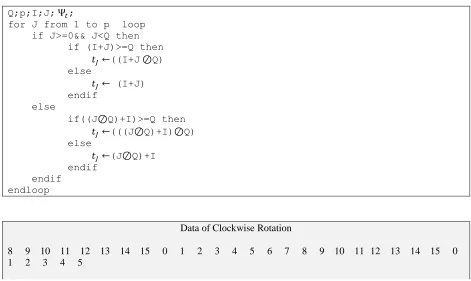
Algorithm 1: written base on Clockwise Rotation and Data proves rotation pattern as it increases see Fig 1 Initialization of variables
Q;p;I;J; Ψ𝑡;
for J from 1 to p loop if J>=0&& J<Q then if (I+J)>=Q then
𝑡𝐽←((I+J ⊘Q)
else
𝑡𝐽← (I+J)
endif else
if((J⊘Q)+I)>=Q then
𝑡𝐽←(((J⊘Q)+I)⊘Q)
else
𝑡𝐽←(J⊘Q)+I
endif endif
endloop
Data of Clockwise Rotation
8 9 10 11 12 13 14 15 0 1 2 3 4 5 6 7 8 9 10 11 12 13 14 15 0 1 2 3 4 5
Prove of Anticlockwise by symmetry.
Substituting Q in the equation for anticlockwise rotation with 2𝑛given that Q=C so Q = 2𝑛.
𝑓(𝐽, Ψ, 𝑛, 𝐼) = {
Ψ𝐼+𝐽, −2𝑛< 𝐽 ≤ 0: (𝐽 + 𝐼) ≥ 0
Ψ(𝐼+𝐽)+2𝑛, −2𝑛< 𝐽 ≤ 0: ( 𝐽 + 𝐼) < 0
Ψ𝐼+(𝐽 ⊘ −2𝑛), 𝐽 ≤ −2𝑛: ( 𝐼 + (𝐽 ⊘ −2𝑛)) ≥ 0
Ψ(𝐼+(𝐽 ⊘ −2𝑛))+(2𝑛), 𝐽 ≤ −2𝑛: ( 𝐼 + (𝐽 ⊘ −2𝑛)) < 0
After every Q rotation, index should be equal to zero where. 𝐽 = −𝑄, 𝐽 = −2𝑛 , by substituting into above equation such that.
𝑓(𝐽, Ψ, 𝑛, 𝐼) = {
Ψ𝐼−2𝑛, −2𝑛< 𝐽 ≤ 0: (−2𝑛+ 𝐼) ≥ 0
Ψ(𝐼−2𝑛)+2𝑛, −2𝑛< 𝐽 ≤ 0: ( −2𝑛+ 𝐼) < 0
Ψ𝐼+(−2𝑛 ⊘ −2𝑛), 𝐽 ≤ −2𝑛: ( 𝐼 + (−2𝑛⊘ −2𝑛)) ≥ 0
Ψ(𝐼+(−2𝑛 ⊘ −2𝑛))+(2𝑛), 𝐽 ≤ −2𝑛: ( 𝐼 + (−2𝑛⊘ −2𝑛)) < 0
Now making initial position of a given bits any number from zero to a number greater than –Q. The resultant rotation should be the same as that initial position.
Let 𝐼 = 0 and substituting into above equation.
𝑓(𝐽, Ψ, 𝑛, 𝐼) =
{
Ψ(0−2𝑛)=0 | 2𝑛=0, −2𝑛< 𝐽 ≤ 0: (−2𝑛+ 𝐼) ≥ 0, 𝑃𝑟𝑜𝑣𝑒𝑑
Ψ(0−2𝑛)+2𝑛=0, −2𝑛< 𝐽 ≤ 0 ∶ ( −2𝑛+ 𝐼) < 0 , 𝑃𝑟𝑜𝑣𝑒𝑑
Ψ0+(−2𝑛 ⊘ −2𝑛)=0, 𝐽 ≤ −2𝑛∶ ( 𝐼 + (−2𝑛⊘ −2𝑛)) ≥ 0, 𝑃𝑟𝑜𝑣𝑒𝑑
Ψ(0+(−2𝑛 ⊘ −2𝑛))+(2𝑛)=0| 2𝑛=0, 𝐽 ≤ −2𝑛∶ ( 𝐼 + (−2𝑛⊘ −2𝑛)) < 0, 𝑃𝑟𝑜𝑣𝑒𝑑
End of prove.
Algorithm 2: Written base on Anticlockwise Rotation and Data proves rotation pattern as it decreases see Fig 2 Initialization of variables
Q;J;I;i;P;Ψ𝑡;
for i from 1 to P loop
J←(-i)
if J>-Q&&J<=0 then
if (I+J)>=0 then
𝑡𝑖←(I+J)
else
𝑡𝑖←((I+J)+Q)
endif else
if(I+ (J⊘-Q))>=0 then
𝑡𝑖←(I+ (J⊘-Q))
else
𝑡𝑖←((I+ (J⊘-Q)) +Q)
endif endif
endloop
Data of Anticlockwise Rotation
4 3 2 1 0 15 14 13 12 11 10 9 8 7 6 5 4 3 2 1
0 15 14 13 12 11 10 9 8 7
Fig 2; Shows Data for anticlockwise Rotation and initial Position is five and total addresses are sixteen 3. OPTIMAL TIME PERFORMANCE
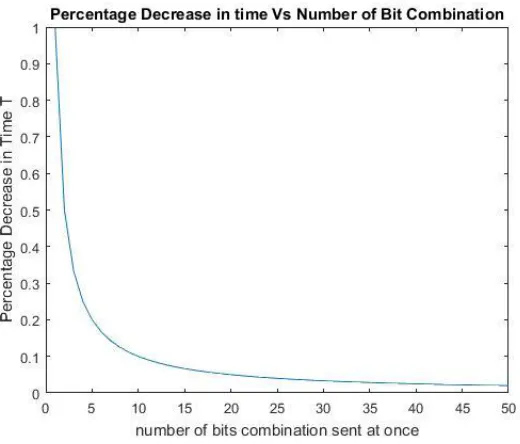
Since this combine bits such that two or more bit can be send at once, so time of transmission reduces significantly, as many bits can be send at once.
Let "𝑡" be time required for sending total of “𝜂” bit combination at once. And “k” is a constant unit time per one bit transmission such that
𝜂𝑡 ∝ 𝑘 ⟹ 𝜂𝑡 = 𝑘
𝑡 =𝑘
𝜂 𝑏𝑢𝑡 𝜂 = 𝑛 + 𝑛
𝑡 = 𝑘 2𝑛
Prove by Analysis
If: 1 bit takes “k” time for transmission. 2 bits takes ½ of “k” time of transmission. 3 bits takes 1/3 of “k” times of transmission. What about “ 𝜂” given bits combination sent at once "𝜂" Bits takes 1
𝜂 𝑘 times of transmission,but from Table (I, II, III), one transmission carries 2n such that at the sender port contains n bit while at the receiver port represent another n bits so a total of n + n = 2n bits per transmission, therefore 𝜂 = 𝑛 + 𝑛 = 2𝑛 bits per transmission.
End of Prove.
If 𝑡 = 𝑘
2𝑛. Therefore 𝑛→∞lim( 𝑡 = 𝑘
2𝑛) ≈ 0 ; given that 𝑘 = 1
However, for cases where 𝑥 ≠ 𝑞 at sender side carries 𝑛 combination of bit while at receiver side carries 𝑛 + 𝑚
combination of bits.
𝜂 = 𝑛 + (𝑛 + 𝑚) ; 𝑡 = 𝑘
2𝑛+𝑚
Fig 3: Graph of percentage decrease in time against Bit Combination
4. SECURE ANALYSIS USING PROBABILITY.
This section shows how resistive the method is from someone or a program that need to detect it by applying probability theory.
Let sample space be 𝜏 for a total addresses at either sender or receiver’s side where a bit combination can occupy at a given time. Therefore, the probability that a chosen bit combination occupy such address is as below:
𝑝𝑟𝑜𝑏𝑎𝑏𝑖𝑙𝑖𝑡𝑦(𝑃) =1
𝜏 |𝜏 = 𝑞, 𝜏 = 𝑥, 𝜏 = 2
𝑛 ⟹ 𝑃 = 1 2𝑛
For the probability that it is not is given as 𝑃′= (1 − 1 2𝑛). lim
𝑛→∞(1 − 1 2𝑛) ≈ 1
However, the probability that a chosen transmission carries the right bits combination is different from above as the sample space is from equation and equal to maximum crossing, a combination of bits between sender and receiver addresses send at once. Let sample space be maximum crossing between sender and receiver’s addresses
i. ℒ = 22𝑛 when (𝑞, 𝑥) = 𝐶 and (𝑥 = 𝑞) 𝑝𝑟𝑜𝑏𝑎𝑏𝑖𝑙𝑖𝑡𝑦(𝑃) =1
ℒ ; 𝑃 = 1 2(2𝑛)
Probability that it is not, is given as 𝑃′= (1 − 𝑃)
lim
𝑛→∞(1 − 1 2(2𝑛)) ≈ 1
ii. ℒ = 22𝑛+𝑚 when (𝑞, 𝑥) = 𝐶 and (𝑥 ≠ 𝑞) 𝑝𝑟𝑜𝑏𝑎𝑏𝑖𝑙𝑖𝑡𝑦(𝑃) =1
ℒ ; 𝑃 = 1 2(2𝑛+𝑚)
Probability that it is not, is given as 𝑃′= (1 − 𝑃)
iii. ℒ = 22𝑛+ 2𝑛(𝜆 + ℓ) + ℓ𝜆 . when (𝑞, 𝑥) = 𝐶 and (𝑥 = 𝑞) 𝑝𝑟𝑜𝑏𝑎𝑏𝑖𝑙𝑖𝑡𝑦(𝑃) =1
ℒ ; 𝑃 = 1
Probability that it is not, is given as 𝑃′= (1 − 𝑃) iv. ℒ = 22𝑛+𝑚+ 2𝑛(𝜆 + ℓ2𝑚) + ℓ𝜆 when (𝑞, 𝑥) = 𝐶 and (𝑥 ≠ 𝑞) 𝑝𝑟𝑜𝑏𝑎𝑏𝑖𝑙𝑖𝑡𝑦(𝑃) =1
ℒ ; 𝑃 =
1
22𝑛+𝑚+2𝑛(𝜆+ℓ2𝑚)+ℓ𝜆
Probability that it is not, is given as 𝑃′= (1 − 𝑃)
Example 2: Given a bits combination n=3 after J=11 times of transmission in clockwise rotation. In addition, an initial position of the bits I= 3.
a) What is the new position of the bits combination Ψ3? Solution:
Therefore: 𝑄 = 23∶ 𝑛 = 3 𝑎𝑛𝑑 𝑄 < 𝐽
𝑓(𝐽, Ψ, 𝑛. 𝐼) = Ψ(𝐽 ⊘2𝑛)+𝐼, 𝐽 ≥ 2𝑛 𝑓(𝐽, Ψ, 𝑛, 𝐼) = Ψ(11⊘ 23)+3 𝑓(𝐽, Ψ, 𝑛, 𝐼) = Ψ6
The new position or index is six (6). So if on sender addresses is 𝑎3 𝑡𝑜 𝑎6 or for receiver address, it is from 𝑏3 𝑡𝑜 𝑏6.
b) Assuming after example 1, and rotating in anti-clockwise for 19 times transmission. What is the new position of the bits?
Solution:
Therefore: 𝑄 = −23 ; 𝑛 = 3 𝑎𝑛𝑑 𝐽 ≤ −𝑄 and position I=6 is a new position after clockwise rotation. And since anti-clockwise, J=-19
𝑓(𝐽, Ψ, 𝑛, 𝐼) = Ψ(𝐽 ⊘−2𝑛)+𝐼, 𝐽 ≤ −2𝑛 𝑓(𝐽, Ψ, 𝑛, 𝐼) = Ψ(−19 ⊘ − 23)+6 𝑓(𝐽, Ψ, 𝑛, 𝐼) = Ψ−3+6=3 So new position= 3
The new position or index is six (6). So if on sender addresses is 𝑎6 𝑡𝑜 𝑎3 or for receiver address, it is from 𝑏6 𝑡𝑜 𝑏3.
Example 3: A person want to send a hidden message by post office mail, from country “A” to country “B” using 8-bits binary system such that the mail carries normal message without being modified:
a) How many mail addresses are requires from sender and receiver country so that at least each mail sent carries a character of 8-bits?
Solution:
This can be separated into two 4 by 4 bits where 𝑛 = 4 see Table III for reference, such that at sender carries 4-bits and receiver’s carries 4-bits.
Thirty-two addresses, sixteen mail addresses at both sender and receiver’s side.
b) From Table III As a references for the initial bit combination position for both address at sender and receiver’s, what is the new position of the bits such that at sender address, bits are rotated clockwise while at the receiver’s address, bits are rotated anti-clockwise? Sender wants to send a word of 50 characters ending with character “o”.
Solution:
8-bit for letter “o”=01101111 breaking into 4 by 4 its 0110 and 1111 From Table III, initial position of 0110 = 𝑎6= 6 and for 1111 = 𝑏15= 15 Sender side Rotation Clockwise.
I=6, Q=C= 16, J=50 times.
𝑓(𝐽, Ψ, 𝑛, 𝐼) = Ψ(𝐽 ⊘𝑄)+𝐼, 𝐽 ≥ 𝑄 ; (𝐽 ⊘ 𝑄) < 𝑄 So, 𝑓(𝐽, Ψ, 𝑛, 𝐼) = Ψ(50⊘16)+7= Ψ9 𝑛𝑒𝑤 𝑝𝑜𝑠𝑖𝑡𝑖𝑜𝑛 = 8 Receiver side Rotation Anti-Clockwise. I=15, Q= -C=-16, J=-50 times.
𝑓(𝐽, Ψ, 𝑛, 𝐼) = Ψ𝐼+(𝐽 ⊘ 𝑄), 𝐽 ≤ −𝑄 ; (𝐽 ⊘ 𝑄) < 0 So𝑓(𝐽, Ψ, 𝑛, 𝐼) = Ψ15−(−50 ⊘−16)= Ψ15−2 𝑛𝑒𝑤 𝑝𝑜𝑠𝑖𝑡𝑖𝑜𝑛 = 13
Overall position for the bit combination over address after 50 times transmission bits rotation is as below:
𝑓𝑟𝑜𝑚 (𝑎6||𝑏15) 𝑡𝑜 (𝑎8||𝑏13).
c) What is the percentage reduction in time of transmitting the bits? Solution: 𝑡 = 𝑘
2𝑛 ; 𝑛 = 4, 𝑘 = 1
Time of transmission percentage decrease= 1
2∗4= 0.125 percentage.
d) What is the probability that a chosen address contains the right bits combination given that total bits combination 𝑛 = 4 ?
Solution:
Sample spaces (total addresses over which a bit combination can occupy is as below)
𝐶 = 𝑞 = 2𝑛 ; 𝑛 = 4 ⟹ 𝑞 = 24= 16
Probability=1
𝑞 ; 𝑞 = 2
𝑛 ⟹ 1 2𝑛=
1
16= 0.0625.
e) How many address and bit combination is required such that each mail sent carries two characters of 8-bit system at once or at a single transmission?
Solution:
Total bits for two character implies one-character at sender and another one at receiver side At sender and receiver each, need a total of 𝑛 = 1 ∗ 8 = 8 bits combination
5. CONCLUSION
Base on proves, examples and analysis, it is practically impossible to detect hidden information flow. Decrypting a hidden message is extremely hard as nothing modifies like in other steganography methods, which involve modification of the carrier. Besides that, due to the rotation of bits combination over given addresses after every transmission makes it difficult to decipher the hidden contents, and lastly by using combination technique enable transmitting many bits at once unlike in other method where a single bits is transmitted one after another. However transmission should be sequential not simultaneous to avoid confusion.
6. ACKNOWLEDGEMENT.
Special thanks to my Mother Mrs Adong Josephine and my father Mr Oyaro Silvio and my Siblings for their continual supports.
7. REFERENCE
[1] D. Artz, “Digital steganography: Hiding data within data,” IEEE InternetComputing, vol. 5, no. 3, pp. 75–80, May/Jun. 2001.
[2] F. Petitcolas, R. J. Anderson, and M. G. Kuhn, “Information hiding—Asurvey,” Proc. IEEE: Special Issue on Protection of Multimedia Content, vol. 87, no. 7, pp. 1062–1078, Jul. 1999.
[3] N. Provos and P. Honeyman, “Hide and seek: An introduction to steganography,” IEEE Security and Privacy, vol. 1, no. 3, pp. 32–44, May/Jun. 20
[4] L. Y. Por, and B. Delina, “Information hiding- a new approach in text steganography,” 7th WSEAS Int. Conf. on Applied Computer and Applied Computational Science, 2008, pp. 689-695.
[5] L. Y. Por, T. F. Ang, and B. Delina, “WhiteSteg- a new scheme in information hiding using text
steganography,” WSEAS Transactions on Computers, vol.7, no.6, pp. 735-745, 2008.
[6] S. Changder, D. Ghosh, and N. C. Debnath, “Linguistic approach for text steganography through Indian text,”
2010 2ndInt. Conf. on Computer Technology and Development, 2010, pp. 318-322.
[7] Kefa. Rabah, “Steganography-the art of hiding data,” Information Technology Journal, vol.3, pp. 245-269, 2004.
[8] Sandib Bobade, Rajeshawari Goudar, “Secure Data Communication Using Protocol Steganography in
IPv6,2015” International Conference on Computing Communication Control and Automation IEEE 2015 [9] Jun O Seo, Sathiamoorthy Manoharan, Aniket Mahanti “network Steganography and steganalysis a concise
Review ” 2016 2nd IEEE international conference on Applied and theoretical Computing and Communication
Technology.
[10] Chengshen Yuan, Zhihua Xia,Xingming Sun “Coverless image Steganography base on SIFT and BOF”, Journal of Internet Technology 2017, P435-442
[11] Huy Hoang Ngo, Xianping Wu, Phu Dung Le, Cambel Wilson, and Balasubramaniam Srinivasan “Dynamic key Cryptography and Applications” International journal for network security, Vol 10 N0.3, PP.161-174 may 2010.
[12] William Stallings, “Cryptography and network security principles and practice”, Pearson, 2017.
[13] Omego Obinna, Eckhard Pfluegel,Charles A.Clark and Martin J Tunnicliffe “A Multi-Channel Steganography protocol for a Secure SMS Mobile Banking” the 12th international conference for internet technology and secure
transactions(ICITST-2017).
[14] M. Okello, "A New Timing Steganography Algorithm in Real-Time Transmission Devices," 2018 IEEE 18th International Conference on Communication Technology (ICCT), Chongqing, 2018, pp. 880-884.
doi: 10.1109/ICCT.2018.8600103
[15] Ebbinghaus, H.-D.,Flum, J.,Thomas, Wolfgang,”Mathematical Logic” (2nd ed.). New York: Springer. p. 656. ISBN 0-387-94258-0
[16] Weisstein, Eric W. “Concatenation.” From MatheWorld—A Wolfram
WebResource. http://mathworld.wolfram.com/Concatenation.html Author’s Biography (QR Code for ORCID)