Improvement on Gas Leakage Detection and Location
System Based On Wireless Sensor Network
1 Ganesh D, 2 Anilet Bala.A
1 Post Gradutate Research scholar, 2 Assistant Professor 1
Electronics and Communication Engineering,
1SRM University, Chennai , India.
________________________________________________________________________________________________________
Abstract - In the large petrochemical industry, one of the most concerning problem is the leakage of toxic gas. To solve this problem, it is necessary to locate the leak points and feed the possible location of leak points back to rescuers. Although some researchers have previously presented several methods to locate leak points, they ignored the impact of external factors, such as wind, and internal factors, such as the internal pressure of equipment, on the accurate detection of leak points. Thus here we are using the gas sensor which placed in the leak points, which senses the concentration value of toxic gases such as carbon mono-oxide and it imitates to the mobile device when the concentration value exceeds the normal value. The signal given to the PIC microcontroller which intimates the mobile device through zigbee communication module. This article proposes context-aware system architecture for leak point detection in the large scale petrochemical industry. This architecture is a new scheme for accurate leak point detection, which is more consistent with practical application in the large scale petrochemical industry.
Index terms- GSM module, Zigbee communication module, leak points, gas sensor, wireless sensor network.
________________________________________________________________________________________________________
1. INTRODUCTION
In the near future, ambient intelligence (AmI) will be in most houses in different ways. Wireless sensor networks (WSNs) are commonly recognized as one of the technological cornerstones of AmI. Sensor Networks are agile, low-cost, low power and can collect a huge
Using a biological analogy, a sensor network can be seen as the sensory system of the intelligent environment “organism”. Sensor networks are irregular aggregations of communicating sensor-nodes, which collect and process information coming from on-board sensors, and they exchange part of this information with neighboring nodes or with nearby collection stations.
Sensor networks promise to revolutionize sensing in a wide range of application domains because of their reliability, accuracy, flexibility, cost effectiveness and ease of deployment. Several applications have been described for WSNs using gas sensors, despite of the youth of these devices, mainly outdoor applications, i.e. Fire detection, chemical processes and environment a nd indoor applications like room environment monitoring or air quality monitoring. Recently, with increasing living standards and expectations for comfortableness, the use of residential air conditioning is becoming widespread. The control and monitoring of indoor atmosphere conditions represents an important task with the aim of ensuring suitable working and living spaces to people. However, the comprehensive air quality monitoring which include monitoring of temperature, humidity, air quality, etc., is not so easy to be monitored and controlled. This work shows a simple approach of a sensor network to monitor several parameters interesting for the indoor environment control, like temperature, humidity, light and air quality.
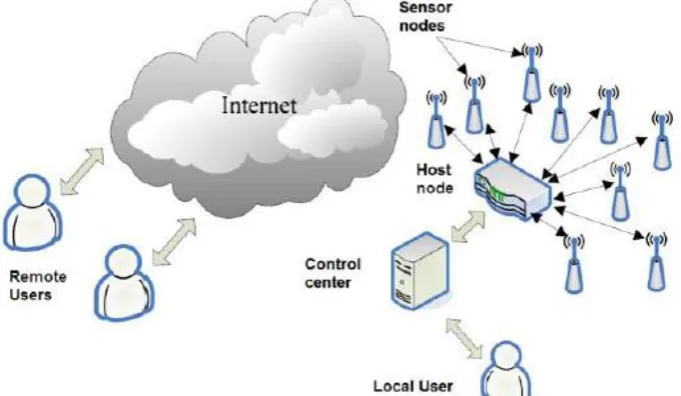
Sensor nodes are systems of low cost, small size, and low consumption, capable of getting information from the environment, processing it, and sending it to the Information Management System (IMS). They comprise the following elements:
(1) Microcontroller system (computer of low cost, low consumption, and small chip) that is the core of the node. Unfortunately, these characteristics imply certain limitations, especially for memory and computing power.
(2) Power supply unit. Although there are nodes that can be connected to the main power supply, WSNs usually require autonomous functioning, so this system often comprises batteries or even energy- harvesting systems. Unlike most computer systems (where power supply is a secondary aspect), WSNs heavily depend on this aspect.
(3) WSN, whose range is usually short, due to the energy restrictions mentioned above.
(4) Transducers, which allow the node to obtain data from the surroundings for later processing and transmission. These devices are the cornerstone of the different types of sensor node. Obviously, they should be compatible with WSN features.
(5) Occasionally (not shown in Figure 1), the system is completed with actuators, which can act on the surroundings, then giving rise to the so-called WSANs (Wireless Sensor and Actuator Networks).
II EXISTING SYSTEM
In the present day, they are using gas detectors which detects the gas leakage and intimates the signal to the control room. After getting the signal, they will sent the workers to the specific leak points and they will overcome the problem. The main disadvantage in this system is, its takes more time for this process around 15 to 20 minutes.
III.PROPOSED SYSTEM
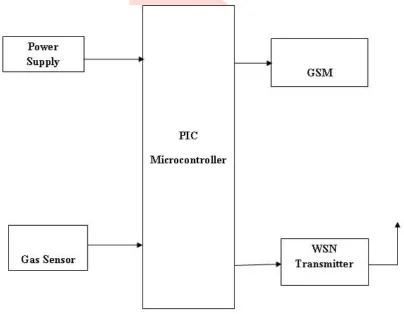
Block diagram for transmitter section
The sensor node equipped with a PIC16F877A microcontroller, a wireless mo- dem, a power supply, and MQ5 gas sensor. In addition, to support continuous monitor- ing of the environment, we have carefully chosen low power consumption components and energy saving modes during the sensor node development.
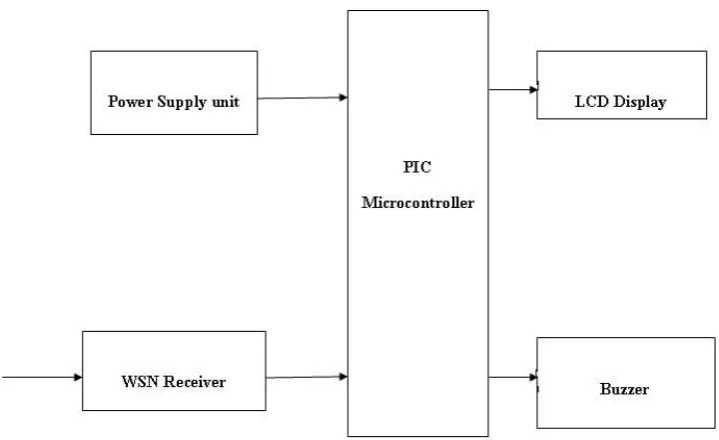
Figure 2 Block diagram for receiver section
The range of wireless transmission is extended using the relay nodes, which sup- port communication between the sensor node and network coordinator. Whenever a hazardous gas is detected in the atmosphere, the network coordinator alarms an operator by the GSM/GPRS. The sensor node monitors the combustible gas concentration in the environment. It is set up for several ranges of gas concentration, as we discuss below. Wireless communication between the sensor node and the network coordinator is implemented via the relay node.
This system provides highly secured and reliable data transmission over the net- work. Also alerts the appropriate authority upon detecting the leakage of LPG and combustible gases and abnormality in the system will trigger an alarm situated; a text message can be send to anywhere in the globe using a global system of mobile communication (GSM) modulator.
IV. PIC MICROCONTROLLER
PIC is a family of modified Harvard architecture microcontrollers made by Microchip Technology, derived from the PIC1650 originally developed by General Instrument's Microelectronics Division. The name PIC initially referred to "Peripheral Interface Controller" now it is "PIC" only.
PIC16F877A
The PIC16F877 Microcontroller includes 8kb of internal flash Program Memory, together with a large RAM area and an internal EEPROM. An 8-channel 10-bit A/D convertor is also included within the microcontroller, making it ideal for real-time systems and monitoring applications. All port connectors are brought out to standard headers for easy connect and disconnect. In-Circuit program download is also provided, enabling the board to be easily updated with new code and modified as required, without the need to remove the microcontroller.
All the necessary support components are included, together with a Power and Programming LED for easy status indication. Plus a reset switch for program execution and a RS232 connection for data transfer to and from a standard RS232 port, available on most computers.
V. RESULT
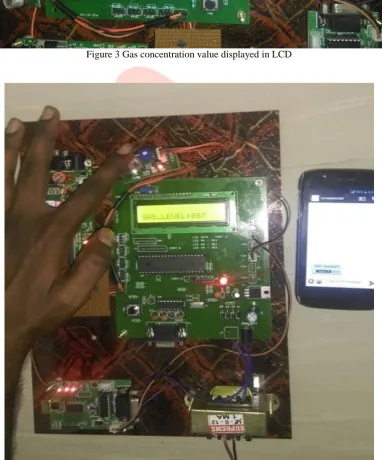
Figure 3 Gas concentration value displayed in LCD
Figure 4 Message intimates when gas concentration value exceeds
when the gas concentration valve exceeds the normal value, the alarm signal has to be intimated to the mobile device through zigbee communication module along with numerical updates. Also we can use GSM to find the location of the leak points. This process can be done faster than the existing process.
VII. REFERENCE
1. Fraiwan, L. (2011). “A wireless home safety gas leakage detection system.” Biomedical Engineering (MECBME). 11 – 14.
2. Johansson, A. (2008). “Model-based gas leakage detection and isolation in a pressur- ized system via laguerre spectrum analysis.” IEEE international conference on control applications, Vol. vol.1. 212 – 216.
3. Ping, D. (2012). “Development on gas leak detection and location systembased on zigbee.” Intelligent Control and Automation (WCICA). 429 – 432.