
Morpho-syntactic Information for Automatic Error Analysis of Statistical
Machine Translation Output
Maja Popovi´c? Hermann Ney?
Adri`a de Gispert† Jos´e B. Mari ˜no†
Deepa Gupta⊥ Marcello Federico⊥
Patrik Lambert† Rafael Banchs†
?
Lehrstuhl f¨ur Informatik VI - Computer Science Department, RWTH Aachen University, Aachen, Germany †
TALP Research Center, Universitat Polit`ecnica de Catalunya (UPC), Barcelona, Spain ⊥
ITC-irst, Centro per la Ricerca Scientifica e Tecnologica, Trento, Italy
{popovic,ney}@informatik.rwth-aachen.de {agispert,canton}@gps.tsc.upc.es
{gupta,federico}@itc.it {lambert,banchs}@gps.tsc.upc.es
Abstract
Evaluation of machine translation output is an important but difficult task. Over the last years, a variety of automatic evalua-tion measures have been studied, some of them like Word Error Rate (WER), Posi-tion Independent Word Error Rate (PER) and BLEU and NIST scores have become widely used tools for comparing different systems as well as for evaluating improve-ments within one system. However, these measures do not give any details about the nature of translation errors. Therefore some analysis of the generated output is needed in order to identify the main prob-lems and to focus the research efforts. On the other hand, human evaluation is a time consuming and expensive task. In this paper, we investigate methods for using of morpho-syntactic information for auto-matic evaluation: standard error measures WER and PER are calculated on distinct word classes and forms in order to get a better idea about the nature of translation errors and possibilities for improvements.
1 Introduction
The evaluation of the generated output is an impor-tant issue for all natural language processing (NLP) tasks, especially for machine translation (MT). Au-tomatic evaluation is preferred because human eval-uation is a time consuming and expensive task.
A variety of automatic evaluation measures have been proposed and studied over the last years, some of them are shown to be a very useful tool for com-paring different systems as well as for evaluating improvements within one system. The most widely used are Word Error Rate (WER), Position Indepen-dent Word Error Rate (PER), the BLEU score (Pap-ineni et al., 2002) and the NIST score (Doddington, 2002). However, none of these measures give any details about the nature of translation errors. A rela-tionship between these error measures and the actual errors in the translation outputs is not easy to find. Therefore some analysis of the translation errors is necessary in order to define the main problems and to focus the research efforts. A framework for hu-man error analysis and error classification has been proposed in (Vilar et al., 2006), but like human eval-uation, this is also a time consuming task.
The goal of this work is to present a framework for automatic error analysis of machine translation output based on morpho-syntactic information.
2 Related Work
proposed in (Banerjee and Lavie, 2005). However, error analysis is still a rather unexplored area. A framework for human error analysis and error clas-sification has been proposed in (Vilar et al., 2006) and a detailed analysis of the obtained results has been carried out. Automatic methods for error anal-ysis to our knowledge have not been studied yet.
Many publications propose the use of morpho-syntactic information for improving the perfor-mance of a statistical machine translation system. Various methods for treating morphological and syntactical differences between German and English are investigated in (Nießen and Ney, 2000; Nießen and Ney, 2001a; Nießen and Ney, 2001b). Mor-phological analysis has been used for improving Arabic-English translation (Lee, 2004), for Serbian-English translation (Popovi´c et al., 2005) as well as for Czech-English translation (Goldwater and Mc-Closky, 2005). Inflectional morphology of Spanish verbs is dealt with in (Popovi´c and Ney, 2004; de Gispert et al., 2005). To the best of our knowledge, the use of morpho-syntactic information for error analysis of translation output has not been investi-gated so far.
3 Morpho-syntactic Information and Automatic Evaluation
We propose the use of morpho-syntactic informa-tion in combinainforma-tion with the automatic evaluainforma-tion measures WER and PER in order to get more details about the translation errors.
We investigate two types of potential problems for the translation with the Spanish-English language pair:
• syntactic differences between the two lan-guages considering nouns and adjectives
• inflections in the Spanish language considering mainly verbs, adjectives and nouns
As any other automatic evaluation measures, these novel measures will be far from perfect. Pos-sible POS-tagging errors may introduce additional noise. However, we expect this noise to be suffi-ciently small and the new measures to be able to give sufficiently clear ideas about particular errors.
3.1 Syntactic differences
Adjectives in the Spanish language are usually placed after the corresponding noun, whereas in En-glish is the other way round. Although in most cases the phrase based translation system is able to han-dle these local permutations correctly, some errors are still present, especially for unseen or rarely seen noun-adjective groups. In order to investigate this type of errors, we extract the nouns and adjectives from both the reference translations and the sys-tem output and then calculate WER and PER. If the difference between the obtained WER and PER is large, this indicates reordering errors: a number of nouns and adjectives is translated correctly but in the wrong order.
3.2 Spanish inflections
Spanish has a rich inflectional morphology, espe-cially for verbs. Person and tense are expressed by the suffix so that many different full forms of one verb exist. Spanish adjectives, in contrast to English, have four possible inflectional forms de-pending on gender and number. Therefore the er-ror rates for those word classes are expected to be higher for Spanish than for English. Also, the er-ror rates for the Spanish base forms are expected to be lower than for the full forms. In order to investi-gate potential inflection errors, we compare the PER for verbs, adjectives and nouns for both languages. For the Spanish language, we also investigate differ-ences between full form PER and base form PER: the larger these differences, more inflection errors are present.
4 Experimental Settings
4.1 Task and Corpus
Training corpus: Spanish English
full Sentences 1281427
Running Words 36578514 34918192 Vocabulary 153124 106496 Singletons [%] 35.2 36.2
13k Sentences 13360
Running Words 385198 366055
Vocabulary 22425 16326
Singletons [%] 47.6 43.7
Dev: Sentences 1008
Running Words 25778 26070 Distinct Words 3895 3173 OOVs (full) [%] 0.15 0.09
OOVs (13k) [%] 2.7 1.7
Test: Sentences 840 1094
Running Words 22774 26917 Distinct Words 4081 3958 OOVs (full) [%] 0.14 0.25
[image:3.612.79.313.51.317.2]OOVs (13k) [%] 2.8 2.6
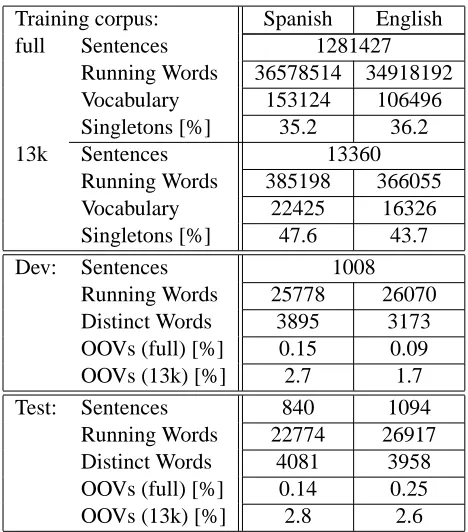
Table 1: Corpus statistics for the Spanish-English EPPS task (running words include punctuation marks)
corpus). The statistics of the corpora can be seen in Table 1.
4.2 Translation System
The statistical machine translation system used in this work is based on a log-linear combination of seven different models. The most important ones are phrase based models in both directions, additionally IBM1 models at the phrase level in both directions as well as phrase and length penalty are used. A more detailed description of the system can be found in (Vilar et al., 2005; Zens et al., 2005).
4.3 Experiments
The translation experiments have been done in both translation directions on both sizes of the corpus. In order to examine improvements of the baseline sys-tem, a new system with POS-based word reorderings of nouns and adjectives as proposed in (Popovi´c and Ney, 2006) is also analysed. Adjectives in the Span-ish language are usually placed after the correspond-ing noun, whereas for English it is the other way round. Therefore, local reorderings of nouns and
ad-Spanish→English WER PER BLEU full baseline 34.5 25.5 54.7
reorder 33.5 25.2 56.4 13k baseline 41.8 30.7 43.2 reorder 38.9 29.5 48.5
English→Spanish WER PER BLEU full baseline 39.7 30.6 47.8
[image:3.612.330.540.51.206.2]reorder 39.6 30.5 48.3 13k baseline 49.6 37.4 36.2 reorder 48.1 36.5 37.7
Table 2: Translation Results [%]
jective groups in the source language have been ap-plied. If the source language is Spanish, each noun is moved behind the corresponding adjective group. If the source language is English, each adjective group is moved behind the corresponding noun. An adverb followed by an adjective (e.g. ”more important”) or two adjectives with a coordinate conjunction in be-tween (e.g. ”economic and political”) are treated as an adjective group. Standard translation results are presented in Table 2.
5 Error Analysis
5.1 Syntactic errors
As explained in Section 3.1, reordering errors due to syntactic differences between two languages have been measured by the relative difference between WER and PER calculated on nouns and adjectives. Corresponding relative differences are calculated also for verbs as well as adjectives and nouns sep-arately.
English output 1− PER WER
full nouns+adjectives 24.7 +reordering 20.8
verbs 4.1
adjectives 10.2
nouns 20.1
13k nouns+adjectives 25.7 +reordering 20.1
verbs 4.6
adjectives 8.4
nouns 19.1
Spanish output 1− PER WER
full nouns+adjectives 21.5 +reordering 20.3
verbs 3.3
adjectives 5.6
nouns 16.9
13k nouns+adjectives 22.9 +reordering 19.8
verbs 3.9
adjectives 5.4
[image:4.612.111.278.48.369.2]nouns 19.3
Table 3: Relative difference between PER and WER [%] for different word classes
is more important when only small amount of train-ing data is available. As mentioned in Section 3.1, the phrase based translation system is able to gen-erate frequent noun-adjective groups in the correct word order, but unseen or rarely seen groups intro-duce difficulties.
Furthermore, the results show that the POS-based reordering of adjectives and nouns leads to a de-crease of the PER/WER difference for both out-puts and for both corpora. Relative decrease of the PER/WER difference is larger for the small corpus than for the full corpus. It can also be noted that the relative decrease for both corpora is larger for the English output than for the Spanish one due to free word order - since the Spanish adjective group is not always placed behind the noun, some reorderings in English are not really needed.
For the verbs, PER/WER difference is less than 5% for both outputs and both training corpora, in-dicating that the word order of verbs is not an
im-English output PER full verbs 44.8 adjectives 27.3 nouns 23.0 13k verbs 56.1 adjectives 38.1 nouns 31.7
[image:4.612.374.495.50.264.2]Spanish output PER full verbs 61.4 adjectives 41.8 nouns 28.5 13k verbs 73.0 adjectives 50.9 nouns 37.0
Table 4: PER [%] for different word classes
portant issue for the Spanish-English language pair. PER/WER difference for adjectives and nouns is higher than for verbs, for the nouns being signifi-cantly higher than for adjectives. The reason for this is probably the fact that word order differences in-volving only the nouns are also present, for example “export control = control de exportaci´on”.
5.2 Inflectional errors
Table 4 presents the PER for different word classes for the English and Spanish output respectively. It can be seen that all PERs are higher for the Spanish output than for the English one due to the rich in-flectional morphology of the Spanish language. It can be also seen that the Spanish verbs are espe-cially problematic (as stated in (Vilar et al., 2006)) reaching 60% of PER for the full corpus and more than 70% for the reduced corpus. Spanish adjectives also have a significantly higher PER than the English ones, whereas for the nouns this difference is not so high.
Results of the further analysis of inflectional er-rors are presented in Table 5. Relative difference between full form PER and base form PER is sig-nificantly lower for adjectives and nouns than for verbs, thus showing that the verb inflections are the main source of translation errors into the Spanish language.
cor-Spanish output 1−PERb PERf
full verbs 26.9 adjectives 9.3
nouns 8.4
13k verbs 23.7
adjectives 15.1
[image:5.612.126.262.51.152.2]nouns 6.5
Table 5: Relative difference between PER of base forms and PER of full forms [%] for the Spanish output
pus base/full PER difference for verbs and nouns is basically the same as for the full corpus. Since nouns in Spanish only have singular and plural form as in English, the number of unseen forms is not partic-ularly enlarged by the reduction of the training cor-pus. On the other hand, base/full PER difference of adjectives is significantly higher for the small corpus due to an increased number of unseen adjective full forms.
As for verbs, intuitively it might be expected that the number of inflectional errors for this word class also increases by reducing the training corpus, even more than for adjectives. However, the base/full PER difference is not larger for the small corpus, but even smaller. This is indicating that the problem of choosing the right inflection of a Spanish verb ap-parently is not related to the number of unseen full forms since the number of inflectional errors is very high even when the translation system is trained on a very large corpus.
6 Conclusion
In this work, we presented a framework for auto-matic analysis of translation errors based on the use of morpho-syntactic information. We carried out a detailed analysis which has shown that the results obtained by our method correspond to those ob-tained by human error analysis in (Vilar et al., 2006). Additionally, it has been shown that the improve-ments of the baseline system can be adequately mea-sured as well.
This work is just a first step towards the devel-opment of linguistically-informed evaluation mea-sures which provide partial and more specific infor-mation of certain translation problems. Such
mea-sures are very important to understand what are the weaknesses of a statistical machine translation sys-tem, and what are the best ways and methods for improvements.
For our future work, we plan to extend the pro-posed measures in order to carry out a more de-tailed error analysis, for example examinating dif-ferent types of inflection errors for Spanish verbs. We also plan to investigate other types of translation errors and other language pairs.
Acknowledgements
This work was partly supported by the TC-STAR project by the European Community (FP6-506738) and partly by the Generalitat de Catalunya and the European Social Fund.
References
Bogdan Babych and Anthony Hartley. 2004. Extending bleu mt evaluation method with frequency weighting. In Proc. of the 42nd Annual Meeting of the
Associa-tion for ComputaAssocia-tional Linguistics (ACL), Barcelona,
Spain, July.
Satanjeev Banerjee and Alon Lavie. 2005. Meteor: An automatic metric for mt evaluation with improved correlation with human judgements. In 43rd Annual
Meeting of the Assoc. for Computational Linguistics: Proc. Workshop on Intrinsic and Extrinsic Evaluation Measures for MT and/or Summarization, pages 65–72,
Ann Arbor, MI, June.
Adri`a de Gispert, Jos´e B. Mari˜no, and Josep M. Crego. 2005. Improving statistical machine translation by classifying and generalizing inflected verb forms. In
Proc. of the 9th European Conf. on Speech Commu-nication and Technology (Interspeech), pages 3185–
3188, Lisbon, Portugal, September.
George Doddington. 2002. Automatic evaluation of ma-chine translation quality using n-gram co-occurrence statistics. In Proc. ARPA Workshop on Human
Lan-guage Technology, pages 128–132, San Diego.
Sharon Goldwater and David McClosky. 2005. Improv-ing stastistical machine translation through morpho-logical analysis. In Proc. of the Conf. on Empirical
Methods for Natural Language Processing (EMNLP),
Vancouver, Canada, October.
Young-suk Lee. 2004. Morphological analysis for statis-tical machine translation. In Proc. 2004 Meeting of the
Evgeny Matusov, Gregor Leusch, Oliver Bender, and Hermann Ney. 2005. Evaluating machine transla-tion output with automatic sentence segmentatransla-tion. In
Proceedings of the International Workshop on Spoken Language Translation (IWSLT), pages 148–154,
Pitts-burgh, PA, October.
Sonja Nießen and Hermann Ney. 2000. Improving SMT quality with morpho-syntactic analysis. In COLING
’00: The 18th Int. Conf. on Computational Linguistics,
pages 1081–1085, Saarbr¨ucken, Germany, July.
Sonja Nießen and Hermann Ney. 2001a. Morpho-syntactic analysis for reordering in statistical machine translation. In Proc. MT Summit VIII, pages 247–252, Santiago de Compostela, Galicia, Spain, September.
Sonja Nießen and Hermann Ney. 2001b. Toward hier-archical models for statistical machine translation of inflected languages. In Data-Driven Machine
Trans-lation Workshop, pages 47–54, Toulouse, France, July.
Sonja Nießen, Franz J. Och, Gregor Leusch, and Her-mann Ney. 2000. An evaluation tool for ma-chine translation: Fast evaluation for mt research. In
Proc. Second Int. Conf. on Language Resources and Evaluation (LREC), pages 39–45, Athens, Greece,
May.
Kishore Papineni, Salim Roukos, Todd Ward, and Wie-Jing Zhu. 2002. BLEU: a method for automatic eval-uation of machine translation. In Proc. of the 40th
Annual Meeting of the Association for Computational Linguistics (ACL), pages 311–318, Philadelphia, PA,
July.
Maja Popovi´c and Hermann Ney. 2004. Towards the use of word stems & suffixes for statistical machine trans-lation. In Proc. 4th Int. Conf. on Language Resources
and Evaluation (LREC), pages 1585–1588, Lissabon,
Portugal, May.
Maja Popovi´c and Hermann Ney. 2006. POS-based word reorderings for statistical machine translation. In
Proc. of the Fifth Int. Conf. on Language Resources and Evaluation (LREC), Genova, Italy, May.
Maja Popovi´c, David Vilar, Hermann Ney, Slobodan Joviˇci´c, and Zoran ˇSari´c. 2005. Augmenting a small parallel text with morpho-syntactic language resources for Serbian–English statistical machine translation. In
43rd Annual Meeting of the Assoc. for Computational Linguistics: Proc. Workshop on Building and Using Parallel Texts: Data-Driven Machine Translation and Beyond, pages 41–48, Ann Arbor, MI, June.
David Vilar, Evgeny Matusov, Saˇsa Hasan, Richard Zens, and Hermann Ney. 2005. Statistical machine transla-tion of european parliamentary speeches. In Proc. MT
Summit X, pages 259–266, Phuket, Thailand,
Septem-ber.
David Vilar, Jia Xu, Luis Fernando D’Haro, and Her-mann Ney. 2006. Error analysis of statistical machine translation output. In Proc. of the Fifth Int. Conf. on
Language Resources and Evaluation (LREC), page to
appear, Genova, Italy, May.
Richard Zens, Oliver Bender, Saˇsa Hasan, Shahram Khadivi, Evgeny Matusov, Jia Xu, Yuqi Zhang, and Hermann Ney. 2005. The RWTH phrase-based statis-tical machine translation system. In Proceedings of the
![Table 4: PER [%] for different word classes](https://thumb-us.123doks.com/thumbv2/123dok_us/741411.1084374/4.612.374.495.50.264/table-per-for-different-word-classes.webp)
![Table 5: Relative difference between PER of baseforms and PER of full forms [%] for the Spanishoutput](https://thumb-us.123doks.com/thumbv2/123dok_us/741411.1084374/5.612.126.262.51.152/table-relative-difference-baseforms-forms-spanishoutput.webp)
