1
Advanced Blind Walking Stick: A Review
Ms. Pragati M. Dabhade
1, Ms. Priyanka B. Susar
2, Ms. Pooja O. Jadhao
3, Ms. Arti P. Dhoran
4Prof. Gopal N. Dhoot
5Final year student of E&TC Engg Department1,2,3,4, Assistant Professor HOD of E&TC Engg Department5 Pankaj Laddhad Institute of Technology and Management Studies, Buldana 1,2,3,4,5
Email: [email protected] ,[email protected], [email protected],[email protected], [email protected]
Abstract-
This paper provides the review of the advanced blind walking stick. In this paper, the different sensors such as ultrasonic sensor, water sensor, IC LM35, LDR are covered which is going to used in the implementation of the actual advanced blind walking stick. This paper also provides the information about the GPS and GSM modules which are going to be used in the blind stick. Thus this paper provides the overall review of the advanced blind walking stick.
This paper presents a theoretical model and a system concept to provide a smart electronic aid for blind people. The system is intended to provide overall measures to detect the obstacles. The aim of the overall system is to provide an efficient navigation aid for blind which gives a sense of artificial vision by providing information about the environmental scenario of static and dynamic objects around them. All the sensors are used to detect the obstacles and to guide the user towards the available path. Output is in the form of voice which the blind person can hear. GPS is the acronym for global positioning system. It is employed to find the position, velocity and time of user which is located on the earth. By using GSM system an automatic message will be sent on the saved number when the user is in danger.Keywords -ATmega328, ultrasonic sensor, water sensor, LDR, LM35, GSM, GPS
1. INTRODUCTION
We all know that vision is the most important part of human life. Without vision, life becomes very difficult and colorless; Vision helps us to get information from surrounding. In fact 83% of information being gets from the environment via sight. This shows the importance of vision in human life. According to WHO survey in 2014, 285 billion people in the world with visual impairment, 39 billion of which are blind and 246 with low vision [1]. This is the big number of visually challenged people.
Normally, the people which are visually challenged can used the walking canes and guiding dogs. This is traditional way to guide the blind but by considering this aids of guiding blind people, one question arises that, Is these aids are really safe and secure? The answer of this question is no, because we are dealing with the human being and the value of life of human is just more than anything in this world .
As the technology increases rapidly, lot of problems and difficulties are getting overcome by using the various technologies. By considering the difficulties of the blinds life and by using technologies there are various devices made for blind people for safety and security independently. According to this fact, we are also developing one technology for guiding the blind people from various obstacles by using at mega 328 microcontroller and various sensors [7].
We proposed a new solution for blind people for their navigation, safety and security. We are using
total four sensors in our system that are ultrasonic sensor, water sensor, fire sensor, light sensor for detecting various obstacles. We are also using a bluetooth technology for getting the stick if stick gets misplaced. All the programming is inserted in the at - Mega 328 microcontroller. This is 8 bit RISC architecture and finally by using all this sensors, the system is modified in the form of walking stick, we have given the name of this system as ‘Advanced Blind Walking Stick’. The detail working and all procedure of this system is provided in the proposed solution section.
2. LITERATURE REVIEW
S. Gangwar (2011) designed a smart stick for blind which can give early warning of an obstacle using ultrasonic sensors. After identifying the obstacles, the stick alerts the visually impaired people using vibration signals.
S. Chew (2012) proposed the smart white cane called Blind spot that combines GPS technology, social networking and ultrasonic sensors to help visually impaired people to navigate public space [7].
2 Mohd Helmyabd Wahab and Amirul A. Talibetal
(2011) developed a cane could communicate with users through voice alert and vibration signal. Ultrasonic sensors are used to detect obstacle in front and this information will be sent in the form of voice signal. This voice signal is send via speaker to the user. Here, blind people might find it difficult in travelling without any emergency alert rather than having only ultrasonic sensors.
Alejandro R. Garcia Ramirez and Renato Fonseca Livramento da Silvaetal (2012) designed an assistive technology device called the electronic long cane which fits inside the handle of a traditional long cane. The system was designed using haptic sensors to detect obstacles above the waistline. It works in such a way when an obstacle is detected. The cane vibrates or makes a sound. However, this system only detects obstacle above the waistline.
[image:2.595.73.291.328.567.2]3. PROPOSED SYSTEM
Fig. 1. Architecture of Advanced Blind Walking Stick
The working principle of the Advanced Blind Walking Stick is totally depends on the AVR microcontroller. Four sensors are interfaced with the AVR microcontroller namely ultrasonic sensor, water sensor, fire sensor, light sensor. GPS and GSM technology also interfaced with microcontroller.
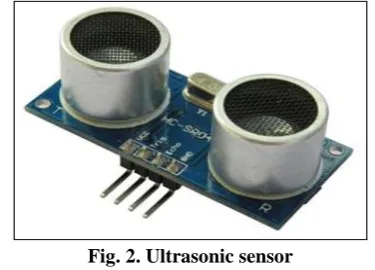
The ultrasonic sensor is used to detect the obstacles in the path of the blind person. The obstacle may be vehicles, walls or anything which comes in front of ultrasonic sensor. The ultrasonic sensor will transmits the ultrasonic waves just like Radar or sonar systems [5]. On sensing obstacles, the sensor passes this data to the microcontroller. The micro-controller then processes this data and calculates if the obstacle is close enough. If the obstacle is detected then the
controller sends a signal with the use of head phone which will hear by the user.
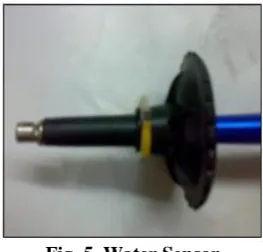
Water sensor is used to detect the spoilage of water in the path of the blind person. The water sensor consists of two probes as a sensor. When these two probes comes in contact with the water it will send a signal with the use of head phone to convey the user that there is a detection of obstacle in the path.
The fire sensor is used in order to detect the fire to save the blind one from any harm to cause. The fire sensor is used in combination with the light dependent resister and IC LM35 .As the fire sensor is combination of heat and light, if the output of light dependent resister and IC LM 35 is detected at same time microcontroller consider it as the fire and it will alert the user by hearing the sound with the help of head phone.
One more feature is get added into this in order to detect the light or darkness in the room using the light dependent resister. There is one more advance implementation is provided if there is misplace of stick then switch is given by which the user will be able to find the stick.
Atmel’s at mega 328 microcontroller is used in this project. The microcontroller is interfaced with the five sensors as mentioned above. The main provision of providing this microcontroller is serial peripheral inter face pin which is available as three ports and two timers.
4. OBSTACLE DETECTION UNIT
4.1. Ultrasonic Sensor
An ultrasonic sensor is a device that works in much same way as RADAR and SONAR. In fact, ultrasonic sensors mimic bats and other animals’ natural ability to use ultrasonic frequencies for navigation [3].
Fig. 2. Ultrasonic sensor
[image:2.595.321.509.549.684.2]3 proximity, or distance measuring applications. These
[image:3.595.368.500.166.292.2]devices typically transmit a short burst of ultrasonic sound toward a target which reflects the sound back to the sensor. The system then measures the time for the echo to return to the sensor and computes the distance to target using the speed of sound in the medium. The first step toward identifying the right proximity sensor for your application is to understand the fundamental ultrasonic properties of the transmission medium and the way they influence the measurement and system operation [3].
Fig. 3. Object detection of ultrasonic sensor
4.2. Fire Sensor
The fire sensor is formed by the combination of IC LM35 and light dependent resistor (LDR). IC LM35 is nothing but the temperature sensor. IC and LDR is used for sensing the light. The working of LDR is that when the light is incident on the circuit the resistor gets changed and light is sensed by the value of resistor. If the output of LM35 is temperature and the output of LDR is light is sensed and at the same instant of time then microcontroller can sense it as a fire then it can send alert signal to the user or we can say to the blind person who is using the stick through headphone [4].
Fig. 4. Fire Sensor (combination of LDR & LM35)
4.3. Water Sensor
For detecting the spoilage of water on the ground space is detected by the water or flood sensor [2].The water sensor consist of the two probes which are coming outside at bottom side from the stick with small circuitry. When the water is spoiled at the ground space then that two probes of water sensors are comes in contact with the water and we know that water is a good conductor of electricity so that the circuit is completed and the current will starts flowing
through it. This phenomenon is used to sense the water. By using this phenomenon , if the water is get detected by the stick, the microcontroller can sends the alert signal to the user or blind person by using the headphone in the form of voice.
Fig. 5. Water Sensor
4.4. Temperature Sensor
We used here IC LM35 as a temperature sensor. With LM35, temperature can be measured more accurately than with a thermistor. It also possesses low self heating and does not cause more than 0.10C temperature rise in still air. The figure shows the pin configuration of IC LM 35 which is having three pins that are VCC, output, and ground namely. Pin configuration is given below along with the pin diagram in figure (6).
Fig 6. Pin Diagram of LM35
4.5. Light Sensor
The light dependent resistor is very useful in light or dark sensor circuit as light sensor as well as to detect the fire .Normally the resistance of LDR is very high, sometimes as high as1000 ohms, but when they are illuminated with light, resistance drops dramatically.
[image:3.595.81.283.237.334.2]4 4.6. Microcontroller
In our project, we are using an AT mega 328 microcontroller. It belongs to Atmel’s AVR series microcontroller family. The acronym AVR has been reported to stand for advanced virtual RISC, but it has also been rumored to stand for the initials chips designers: Alf and vegard [RISC]. Atmel says that the name AVR is not an acronym and does not stand for anything in particular [3].
Fig.8. Microcontroller AT Mega 328
ATmega328 is a low power CMOS 8 bit microcontroller based on the AVR enhanced RISC architecture. AT Mega 328 is popular and mostly used because it has low cost, wide availability, large user based, free development tools and serial programming (and reprogramming with flash memory) capability. AT Mega 328 have 28 pins. Two for power (Pin No.10:+5V, Pin No.11: Ground), two for oscillator (Pin No: 12, 13), one for reset (Pin No.9), three for providing necessary power and reference voltage to its internal ADC, and 32(4*8) I/O pins [1].
4.7. GSM and GPS Module
We are using GPS and GSM module for detecting the exact location and sending location to the numbers which are already saved in it which is useful for blind person who is using the stick. GPS and GSM modules are interfaced with the at mega 328 microcontroller according to its output, controller can get the action and sends the SMS alert to the relative of the blind person [1].
5. CONCLUSION
In this paper, we have analyzed various approaches and devices that help for navigation of blinds. The use of ultrasonic sensor, GPS and GSM will help us to overcome the drawbacks by providing better accuracy.
The main objective is to assists blind or visually impaired people to safely move among obstacles and other hurdles faced by them in their daily life. The smart system has been tested in laboratory environment. Using this guiding system, blind people can travel in the unknown areas independently. Less
training time period is required to use this smart system. The solution developed is a low cost and user friendly navigational aid for the visually impaired. In future GPS based bus information module with user request can be designed.
ACKNOWLEDGMENT
The student authors of this paper sincerely would like to thank to our Honorable Principal Dr. P.M. Jawandhiya, HOD E&TC Engg Prof. G.N.Dhoot for providing us the opportunity and their valuable guidance and support to complete the work.
REFERENCES
[1] N Hemalatha1, S Dhivya 2 , M Sobana 2 , R Viveka 2 , M Vishalini 2 ;UG Student, Dept. of EEE, Velammal Engineering College, Chennai, Tamilnadu, India” Adaptable Handy Clench for Destitute of Vision using GSM” International Journal of Advanced Research in Electrical, Electronics and Instrumentation Engineering (An ISO 3297: 2007 Certified Organization) Vol. 3, Special Issue 4, May 2014)
[2] Badoni1and Sunil Semwal1; Discrete Distance and Water Pit Indicator Manoj using AVR AT mega8 in Electronic Travel Aid for Bind person ; International Journal of Disaster Recovery and Business Continuity Vol. 2, November, 2011
[3] Osama Bader AL-Barrm & Jeen Vinouth;
Department of Electronics Computer
Engineering Caledonian College of
Engineering, Muscat, Sultanate of Oman; International Journal of Latest Trends in Engineering and Technology (IJLTET);
[4] Deekshith B NP Shwetha M 2P,Amritha PadmakarPP , Gouthami H NPP, Nafisa SultanaP Assistant professor, Dept. of Telecommunication Engineering, GSSSIETW, Mysuru; GPS Base Virtual Eye For Visionless International Journal of Scientific Engineering and Applied Science (IJSEAS) - Volume-1, Issue4, July 2015ISSN: 2395-3470
[5] Johann Bornstein and Yoram Koren (April 1988), Obstacle Avoidance with Ultrasonic Sensors ROBOGA IEEE Journal of Robotics and Automation, Vol 4, No 2.
[6] Shamsi, M.A.; Al-Qutayri, M.; Jeedella, J.; Blind assistant navigation system Biomedical Engineering (MECBME), 2011 1st Middle East Conference on 21-24 Feb. 2011
9507190-0-5 AUTHOR’S BIOGRAPHY:
Ms.Pragati M. Dabhade.
Completed diploma in Electronics and Telecommunication Engg from MSBTE, Mumbai in 2013.
Currently pursuing her Bachelor degree in Electronics & Telecommunication Engg from PLITMS, Buldana, SGBAU Amravati, Maharashtra State, India.
Ms.Priyanka B. Susar
Completed diploma in Electronics and Telecommunication Engg from MSBTE, Mumbai in 2013.
Currently pursuing her Bachelor degree in Electronics & Telecommunication Engg from PLITMS, Buldana, SGBAU
Maharashtra State, India
Ms.Arti P. Dhoran
Completed diploma in Electronics and Telecommunication Engg from MSBTE Mumbai in 2013. Currently pursuing her bachelor degree in Electronics & Telecommunication. Engg from PLITMS, Buldana, SGBAU Amravati, Maharashtra State, India.
Prof.Gopal N.Dhoot
Assistant Professor & Head of Department, PLITMS, Buldana. B.E (E&TC Engg) from SSGMCE, Shegaon.
M.E (Comm.Engg) from SGDCOE, Jalgaon.
Ms.Pooja O. Jadhao