Name Origin Recognition Using Maximum Entropy Model
and Diverse Features
Min Zhang
1, Chengjie Sun
2, Haizhou Li
1, Aiti Aw
1, Chew Lim Tan
3, Xiaolong Wang
21
Institute for Infocomm
Research, Singapore
{mzhang,hli,aaiti} @i2r.a-star.edu.sg
2
Harbin Institute of
Technology, China
{cjsun,wangxl} @insun.hit.edu.cn
3
National University of
Singapore, Singapore
tancl@comp. nus.edu.sg
Abstract
Name origin recognition is to identify the source language of a personal or location name. Some early work used either rule-based or statistical methods with single knowledge source. In this paper, we cast the name origin recognition as a multi-class classification problem and approach the problem using Maximum Entropy method. In doing so, we investigate the use of differ-ent features, including phonetic rules, n
-gram statistics and character position infor-mation for name origin recognition. Ex-periments on a publicly available personal name database show that the proposed ap-proach achieves an overall accuracy of 98.44% for names written in English and 98.10% for names written in Chinese, which are significantly and consistently better than those in reported work.
1
Introduction
Many technical terms and proper names, such as personal, location and organization names, are translated from one language into another with approximate phonetic equivalents. The phonetic translation practice is referred to as transliteration;
conversely, the process of recovering a word in its native language from a transliteration is called as
back-transliteration (Zhang et al, 2004; Knight
and Graehl, 1998). For example, English name “Smith” and “史 密 斯 (Pinyin1: Shi-Mi-Si)” in
1
HanyuPinyin, or Pinyin in short, is the standard
romaniza-Chinese form a pair of transliteration and back -transliteration. In many natural language
process-ing tasks, such as machine translation and cross-lingual information retrieval, automatic name transliteration has become an indispensable com-ponent.
Name origin refers to the source language of a name where it originates from. For example, the origin of the English name “Smith” and its Chi-nese transliteration “史密斯 (Shi-Mi-Si)” is Eng-lish, while both “Tokyo” and “东京 (Dong-Jing)” are of Japanese origin. Following are examples of different origins of a collection of English-Chinese transliterations.
English: Richard-理查德 (Li-Cha-De) Hackensack-哈肯萨克
(Ha-Ken-Sa-Ke)
Chinese: Wen JiaBao-温家宝 (Wen-Jia-Bao)
ShenZhen–深圳(Shen-Zhen) Japanese: Matsumoto-松本 (Song-Ben)
Hokkaido-北海道(Bei-Hai-Dao) Korean: Roh MooHyun-卢武铉
(Lu-Wu-Xuan)
Taejon-大田(Da-Tian) Vietnamese: Phan Van Khai-潘文凯
(Pan-Wen-Kai)
Hanoi-河内(He-Nei)
In the case of machine transliteration, the name origins dictate the way we re-write a foreign word. For example, given a name written in English or Chinese for which we do not have a translation in
a English-Chinese dictionary, we first have to de-cide whether the name is of Chinese, Japanese, Korean or some European/English origins. Then we follow the transliteration rules implied by the origin of the source name. Although all English personal names are rendered in 26 letters, they may come from different romanization systems. Each romanization system has its own rewriting rules. English name “Smith” could be directly transliterated into Chinese as “史密斯(Shi-Mi-Si)” since it follows the English phonetic rules, while the Chinese translation of Japanese name “Koi-zumi” becomes “小泉(Xiao-Quan)” following the Japanese phonetic rules. The name origins are equally important in back-transliteration practice. Li et al. (2007) incorporated name origin recogni-tion to improve the performance of personal name transliteration. Besides multilingual processing, the name origin also provides useful semantic in-formation (regional and language inin-formation) for common NLP tasks, such as co-reference resolu-tion and name entity recogniresolu-tion.
Unfortunately, little attention has been given to name origin recognition (NOR) so far in the litera-ture. In this paper, we are interested in two kinds of name origin recognition: the origin of names written in English (ENOR) and the origin of
names written in Chinese (CNOR). For ENOR,
the origins include English (Eng), Japanese (Jap), Chinese Mandarin Pinyin (Man) and Chinese
Can-tonese Jyutping (Can). For CNOR, they include
three origins: Chinese (Chi, for both Mandarin and Cantonese), Japanese and English (refer to Latin-scripted language).
Unlike previous work (Qu and Grefenstette, 2004; Li et al., 2006; Li et al., 2007) where NOR was formulated with a generative model, we re-gard the NOR task as a classification problem. We further propose using a discriminative learning algorithm (Maximum Entropy model: MaxEnt) to solve the problem. To draw direct comparison, we conduct experiments on the same personal name corpora as that in the previous work by Li et al.
(2006). We show that the MaxEnt method effec-tively incorporates diverse features and outper-forms previous methods consistently across all test cases.
The rest of the paper is organized as follows: in section 2, we review the previous work. Section 3 elaborates our proposed approach and the features.
Section 4 presents our experimental setup and re-ports our experimental results. Finally, we con-clude the work in section 5.
2
Related Work
Most of previous work focuses mainly on ENOR although same methods can be extended to CNOR. We notice that there are two informative clues that used in previous work in ENOR. One is the lexical structure of a romanization system, for example, Hanyu Pinyin, Mandarin Wade-Giles, Japanese
Hepbrun or Korean Yale, each has a finite set of syllable inventory (Li et al., 2006). Another is the phonetic and phonotactic structure of a language, such as phonetic composition, syllable structure. For example, English has unique consonant clusters such as /str/ and /ks/ which Chinese, Japanese and Korean (CJK) do not have. Considering the NOR solutions by the use of these two clues, we can roughly group them into two categories: rule-based methods (for solutions based on lexical structures) and statistical methods (for solutions based on phonotactic structures).
Rule-based Method
Kuo and Yang (2004) proposed using a rule-based method to recognize different romanization system for Chinese only. The left-to-right longest match-based lexical segmentation was used to parse a test word. The romanization system is con-firmed if it gives rise to a successful parse of the test word. This kind of approach (Qu and Grefen-stette, 2004) is suitable for romanization systems that have a finite set of discriminative syllable
in-ventory, such as Pinyin for Chinese Mandarin. For
the general tasks of identifying the language origin and romanization system, rule based approach sounds less attractive because not all languages have a finite set of discriminative syllable
inven-tory.
Statistical Method
1) N-gram Sum Method (SUM): Qu and
probabil-ity p c c c( i i−1 i−2)for 3-character c c ci i−1 i−2 rather than
the commonly used conditional probabil-ity p c c c( |i i−1 i−2). Therefore, the so-called trigram
in Qu and Grefenstette (2004) is basically a sub-string unigram probability, which we refer to as the n-gram (n-character) sum model (SUM) in this paper. Suppose that we have the unigram count
1 2
( i i i )
C c c c− − for character substring c c ci i−1 i−2 , the
unigram is then computed as:
1 2
normalized by the sum of all 3-character string counts in the name list for the language of interest. For origin recognition of Japanese names, this method works well with an accuracy of 92%. However, for English and Chinese, the results are far behind with a reported accuracy of 87% and 70% respectively.
2) N-gram Perplexity Method (PP): Li et al.
(2006) proposed using n-gram character perplexity
c
PP to identify the origin of a Latin-scripted name.
Using bigram, thePPcis defined as:
1
where Ncis the total number of characters in the
test name, ciis the ith character in the test name.
1
( |i i )
p c c− is the bigram probability which is
learned from each name list respectively. As a function of model, PPc measures how good the
model matches the test data. Therefore, PPccan be
used to measure how good a test name matches a training set. A test name is identified to belong to a language if the language model gives rise to the minimum perplexity. Li et al. (2006) shown that
the PP method gives much better performance than the SUM method. This may be due to the fact that the PP measures the normalized conditional probability rather than the sum of joint probability. Thus, the PP method has a clearer mathematical interpretation than the SUM method.
The statistical methods attempt to overcome the shortcoming of rule-based method, but they suffer from data sparseness, especially when dealing with a large character set, such as in Chinese (our experiments will demonstrate this point empiri-cally). In this paper, we propose using Maximum Entropy (MaxEnt) model as a general framework
for both ENOR and CNOR. We explore and inte-grate multiple features into the discriminative clas-sifier and use a common dataset for benchmarking. Experimental results show that the MaxEnt model effectively incorporates diverse features to demon-strate competitive performance.
3
MaxEnt Model and Features
3.1 MaxEnt Model for NOR
The principle of maximum entropy (MaxEnt) model is that given a collection of facts, choose a model consistent with all the facts, but otherwise as uniform as possible (Berger et al., 1996).
Max-Ent model is known to easily combine diverse fea-tures. For this reason, it has been widely adopted in many natural language processing tasks. The MaxEnt model is defined as:
( , ) where
c
iis the outcome label,xis the given obser-vation, also referred to as an instance.Z
is a nor-malization factor. N is the number of outcome labels, the number of language origins in our case.1
, , ,
2 Kf f
L
f
are feature functions and1
,
2, ,
Kα α
L
α
are the model parameters. Each pa-rameter corresponds to exactly one feature and can be viewed as a “weight” for the corresponding fea-ture.In the NOR task, cis the name origin label; xis a personal name,
f
iis a feature function. Allfea-tures used in the MaxEnt model in this paper are binary. For example:
1, " "& (" ") ( , )
0, j
if c Eng x contains str
f c x
In our implementation, we used Zhang’s maxi-mum entropy package2.
3.2 Features
Let us use English name “Smith” to illustrate the features that we define. All characters in a name
are first converted into upper case for ENOR be-fore feature extraction.
N-gram Features: N-gram features are
de-signed to capture both phonetic and orthographic structure information for ENOR and orthographic information only for CNOR. This is motivated by the facts that: 1) names written in English but from non-English origins follow different phonetic rules from the English one; they also manifest different character usage in orthographic form; 2) names written in Chinese follows the same pronunciation rules (Pinyin), but the usage of Chinese characters
is distinguishable between different language ori-gins as reported in Table 2 of (Li et al., 2007).
The N-gram related features include:
1) FUni: character unigram <S, M, I, T, H>
2) FBi: character bigram <SM, MI, IT, TH>
3) FTri: character trigram <SMI, MIT, ITH >
Position Specific n-gram Features: We
in-clude position information into the n-gram fea-tures. This is mainly to differentiate surname from given name in recognizing the origin of CJK per-sonal names written in Chinese. For example, the position specific n-gram features of a Chinese name “温家宝(Wen-Jia-Bao)” are as follows:
1) FPUni: position specific unigram <0温(Wen), 1家(Jia), 2宝(Bao)>
2) FPBi: position specific bigram <0温家(Wen-Jia), 1家宝(Jia-Bao)>
3) FPTri: position specific trigram <0温家宝(Wen-Jia-Bao)>
Phonetic Rule-based Features: These features
are inspired by the rule-based methods (Kuo and Yang, 2004; Qu and Grefenstette, 2004) that check whether an English name is a sequence of sylla-bles of CJK languages in ENOR task. We use the following two features in ENOR task as well.
1) FMan: a Boolean feature to indicate whether a name is a sequence of Chinese Mandarin Pinyin.
2) FCan: a Boolean feature to indicate whether a name is a sequence of Cantonese Jyutping.
Other Features:
1) FLen: the number of Chinese characters in a given name. This feature is for CNOR only. The numbers of Chinese characters in per-sonal names vary with their origins. For ex-ample, Chinese and Korean names usually
consist of 2 to 3 Chinese characters while Japanese names can have up to 4 or 5 Chi-nese characters
2) FFre: the frequency of n-gram in a given name. This feature is for ENOR only. In CJK names, some consonants or vowels usually repeat in a name as the result of the regular syllable structure. For example, in the Chinese name “Zhang Wanxiang”, the bigram “an” appears three times
Please note that the trigram and position spe-cific trigram features are not used in CNOR due to anticipated data sparseness in CNOR3.
4
Experiments
We conduct the experiments to validate the effec-tiveness of the proposed method for both ENOR and CNOR tasks.
4.1 Experimental Setting
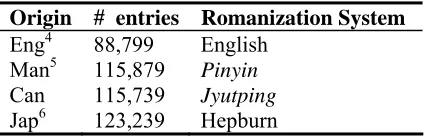
Origin # entries Romanization System
Eng4 88,799 English Man5 115,879
Pinyin
Can 115,739 Jyutping
Jap6 123,239 Hepburn
Table 1: DE: Latin-scripted personal name corpus for
ENOR
Origin # entries
Eng7 37,644 Chi8 29,795 Jap9 33,897
Table 2: DC: Personal name corpus written in Chinese
characters for CNOR
3 In the test set of CNOR, 1080 out of 2980 names of Chinese origin do not consist of any bigrams learnt from training data, while 2888 out of 2980 names do not consist of any learnt trigrams. This is not surprising as most of Chinese names only have two or three Chinese characters and in our open testing, the train set is exclusive of all entries in the test set.
4 http://www.census.gov/genealogy/names/ 5 http://technology.chtsai.org/namelist/
6 http://www.csse.monash.edu.au/~jwb/enamdict_doc.html 7 Xinhua News Agency (1992)
Datasets: We prepare two data sets which are
col-lected from publicly accessible sources: DE and DC
for the ENOR and CNOR experiment respectively.
DE is the one used in (Li et al., 2006), consisting of personal names of Japanese (Jap), Chinese (Man), Cantonese (Can) and English (Eng) origins. DC consists of personal names of Japanese (Jap), Chi-nese (Chi, including both Mandarin and Canton-ese) and English (Eng) origins. Table 1 and Table 2 list their details. In the experiments, 90% of en-tries in Table 1 (DE) and Table 2 (DC) are ran-domly selected for training and the remaining 10% are kept for testing for each language origin. Col-umns 2 and 3 in Tables 7 and 8 list the numbers of entries in the training and test sets.
Evaluation Methods: Accuracy is usually used to
evaluate the recognition performance (Qu and Gregory, 2004; Li et al., 2006; Li et al., 2007).
However, as we know, the individual accuracy used before only reflects the performance of recall
and does not give a whole picture about a multi-class multi-classification task. Instead, we use precision
(P), recall (R) and F-measure (F) to evaluate the
performance of each origin. In addition, an overall accuracy (Acc) is also given to describe the whole
performance. The P, R, F and Acc are calculated
as following:
#
# correctly recognized entries of the given origin P
entries recognized as the given origin by the system =
# #
correctly recognized entries of the given origin R
entries of the given origin =
all correctly recognized entries Acc
all entries =
4.2 Experimental Results and Analysis
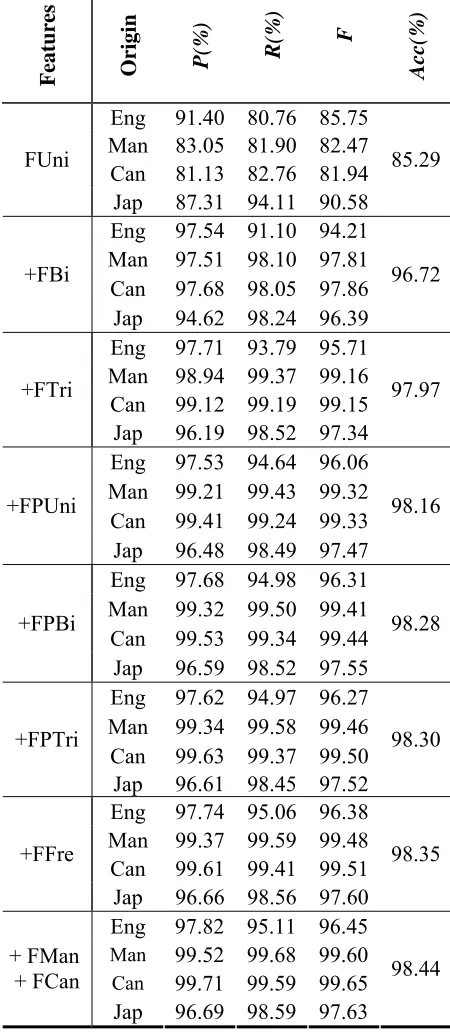
Table 3 reports the experimental results of ENOR. It shows that the MaxEnt approach achieves the best result of 98.44% in overall accuracy when combining all the diverse features as listed in Sub-section 3.2. Table 3 also measures the contribu-tions of different features for ENOR by gradually incorporating the feature set. It shows that:
1) All individual features are useful since the performance increases consistently when more features are being introduced.
2) Bigram feature presents the most informa-tive feature that gives rise to the highest
performance gain, while the trigram feature further boosts performance too.
3) MaxEnt method can integrate the advan-tages of previous rule-based and statistical methods and easily integrate other features.
Features Origin P(%)
R(%) F
Acc(
%)
Eng 91.40 80.76 85.75 Man 83.05 81.90 82.47 Can 81.13 82.76 81.94 FUni
Jap 87.31 94.11 90.58
85.29
Eng 97.54 91.10 94.21 Man 97.51 98.10 97.81 Can 97.68 98.05 97.86 +FBi
Jap 94.62 98.24 96.39
96.72
Eng 97.71 93.79 95.71 Man 98.94 99.37 99.16 Can 99.12 99.19 99.15 +FTri
Jap 96.19 98.52 97.34
97.97
Eng 97.53 94.64 96.06 Man 99.21 99.43 99.32 Can 99.41 99.24 99.33 +FPUni
Jap 96.48 98.49 97.47
98.16
Eng 97.68 94.98 96.31 Man 99.32 99.50 99.41 Can 99.53 99.34 99.44 +FPBi
Jap 96.59 98.52 97.55
98.28
Eng 97.62 94.97 96.27 Man 99.34 99.58 99.46 Can 99.63 99.37 99.50 +FPTri
Jap 96.61 98.45 97.52
98.30
Eng 97.74 95.06 96.38 Man 99.37 99.59 99.48 Can 99.61 99.41 99.51 +FFre
Jap 96.66 98.56 97.60
98.35
Eng 97.82 95.11 96.45 Man 99.52 99.68 99.60 Can 99.71 99.59 99.65 + FMan
+ FCan
Jap 96.69 98.59 97.63
98.44
Features Eng Jap Man Can
FMan -0.357 0.069 0.072 -0.709 FCan -0.424 -0.062 -0.775 0.066
Table 4: Features weights in ENOR task.
Feature Origin P
Eng 97.89 98.43 98.16 Chi 95.80 95.03 95.42 FUni
Jap 96.96 97.05 97.00
96.97
Eng 96.99 98.27 97.63 Chi 96.86 92.11 94.43 +FBi
Jap 95.04 97.73 96.36
96.28
Eng 97.35 98.38 97.86 Chi 97.29 95.00 96.13 +FLen
Jap 96.78 97.64 97.21
97.14
Eng 97.74 98.65 98.19 Chi 97.65 96.34 96.99 +FPUni
Jap 97.91 98.05 97.98
97.77
Eng 97.50 98.43 97.96 Chi 97.61 96.04 96.82 +FPBi
Jap 97.59 97.94 97.76
97.56
Eng 98.08 99.04 98.56 Chi 97.57 96.88 97.22 FUni
+FLen +
FPUni Jap 98.58 98.11 98.34
98.10
Table 5: Contribution of each feature for CNOR
Table 4 reports the feature weights of two fea-tures “FMan” and “FCan” with regard to different origins in ENOR task. It shows that “FCan” has positive weight only for origin “Can” while “FMan” has positive weights for both origins “Man” and “Jap”, although the weight for “Man” is higher. This agrees with our observation that the two features favor origins “Man” or “Can”. The feature weights also reflect the fact that some Japanese names can be successfully parsed by the Chinese Mandarin Pinyin system due to their
simi-lar syllable structure. For example, the Japanese name “Tanaka Miho” is also a sequence of Chi-nese Pinyin: “Ta-na-ka Mi-ho”.
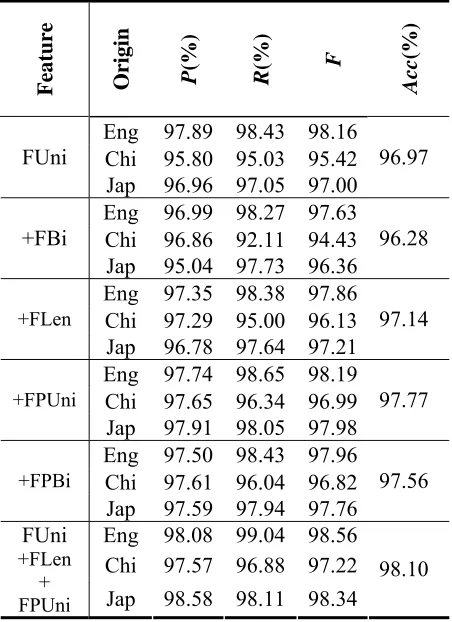
Table 5 reports the contributions of different features in CNOR task by gradually incorporating the feature set. It shows that:
1) Unigram features are the most informative 2) Bigram features degrade performance. This
is largely due to the data sparseness prob-lem as discussed in Section 3.2.
3) FLen is also useful that confirms our intui-tion about name length.
Finally the combination of the above three use-ful features achieves the best performance of 98.10% in overall accuracy for CNOR as in the last row of Table 5.
In Tables 3 and 5, the effectiveness of each ture may be affected by the order in which the fea-tures are incorporated, i.e., the feafea-tures that are added at a later stage may be underestimated. Thus, we conduct another experiment using "all-but-one" strategy to further examine the effective-ness of each kind of features. Each time, one type of the n-gram (n=1, 2, 3) features (including or-thographic n-gram, position-specific and n-gram frequency features) is removed from the whole feature set. The results are shown in Table 6.
Features Origin P(%)
R(%) F
Acc(
%)
Eng 97.81 95.01 96.39 Man 99.41 99.58 99.49 Can 99.53 99.48 99.50 w/o
Uni-gram
Jap 96.63 98.52 97.57
98.34
Eng 97.34 95.17 96.24 Man 99.30 99.48 99.39 Can 99.54 99.33 99.43 w/o
Bi-gram
Jap 96.73 98.32 97.52
98.26
Eng 97.57 94.10 95.80 Man 98.98 99.23 99.10 Can 99.20 99.08 99.14 w/o
Tri-gram
Jap 96.06 98.42 97.23
97.94
Table 6: Effect of n-gram feature for ENOR
Table 6 reveals that removing trigram features affects the performance most. This suggests that trigram features are much more effective for ENOR than other two types of features. It also shows that trigram features in ENOR does not suf-fer from the data sparseness issue.
accuracy is obtained when removing unigram fea-tures, which is much lower than 98.10% when bi-gram features are removed. This suggests that uni-gram features are very useful in CNOR, which is mainly due to the data sparseness problem that bigram features may have encountered.
4.3 Model Complexity and Data Sparseness
Table 7 (ENOR) and Table 8 (CNOR) compare our MaxEnt model with the SUM model (Qu and Gregory, 2004) and the PP model (Li et al., 2006).
All the experiments are conducted on the same data sets as described in section 4.1. Tables 7 and 8 show that the proposed MaxEnt model outper-forms other models. The results are statistically significant (
χ
2 test with p<0.01) and consistent across all tests.Model Complexity:
We look into the complexity of the models and their effects. Tables 7 and 8 summarize the overall accuracy of three models. Table 9 reports the numbers of parameters in each of the models. We are especially interested in a comparison between the MaxEnt and PP models because their perform-ance is close. We observe that, using trigram fea-tures, the MaxEnt model has many more parame-ters than the PP model does. Therefore, it is not surprising if the MaxEnt model outperforms when more training data are available. However, the ex-periment results also show that the MaxEnt model consistently outperforms the PP model even with the same size of training data. This is largely at-tributed to the fact that MaxEnt incorporates more robust features than the PP model does, such as rule-based, length of names features.
One also notices that PP clearly outperforms SUM by using the same number of parameters in ENOR and shows comparable performance in CNOR tasks. Note that SUM and PP are different in two areas: one is the PP model employs word length normalization while SUM doesn’t; another that the PP model uses n-gram conditional prob-ability while SUM uses n-character joint probabil-ity. We believe that the improved performance of PP model can be attributed to the effect of usage of conditional probability, rather than length nor-malization since length nornor-malization does not change the order of probabilities.
Data Sparesness:
We understand that we can only assess the ef-fectiveness of a feature when sufficient statistics is available. In CNOR (see Table 8), we note that the Chinese transliterations of English origin use only 377 Chinese characters, so data sparseness is not a big issue. Therefore, bigram SUM and bigram PP methods easily achieve good performance for Eng-lish origin. However, for Japanese origin (repre-sented by 1413 Chinese characters) and Chinese origin (represented by 2319 Chinese characters), the data sparseness becomes acute and causes per-formance degradation in SUM and PP models. We are glad to find that MaxEnt still maintains a good performance benefiting from other robust features.
Table 10 compares the overall accuracy of the three methods using unigram and bigram features in CNOR task, respectively. It shows that the MaxEnt method achieves best performance. An-other interesting finding is that unigram features perform better than bigram features for PP and MaxEnt models, which shows that data sparseness remains an issue even for MaxEnt model.
5
Conclusion
We propose using MaxEnt model to explore di-verse features for name origin recognition. Ex-periment results show that our method is more ef-fective than previously reported methods. Our contributions include:
1) Cast the name origin recognition problem as a multi-class classification task and propose a MaxEnt solution to it;
2) Explore and integrate diverse features for name origin recognition and propose the most effective feature sets for ENOR and for CNOR
In the future, we hope to integrate our name origin recognition method with a machine translit-eration engine to further improve translittranslit-eration performance. We also hope to study the issue of name origin recognition in context of sentence and use contextual words as additional features.
References
Adam L. Berger, Stephen A. Della Pietra and Vincent J. Della Pietra. 1996. A Maximum Entropy Approach to Natural Language Processing. Computational Lin-guistics. 22(1):39–71.
on Document Analysis and Information Retrieval, 275–282.
Kevin Knight and Jonathan Graehl. 1998. Machine Transliteration. Computational Linguistics. 24(4), 599-612.
Jin-Shea Kuo and Ying-Kuei Yan. 2004. Generating Paired Transliterated-Cognates Using Multiple Pro-nunciation Characteristics from Web Corpora. PA-CLIC 18, December 8th-10th, Waseda University, Tokyo, Japan, 275–282.
Haizhou Li, Shuanhu Bai and Jin-Shea Kuo. 2006. Transliteration. Advances in Chinese Spoken Lan-guage Processing. World Scientific Publishing Com-pany, USA, 341–364.
Haizhou Li, Khe Chai Sim, Jin-Shea Kuo and Minghui Dong. 2007. Semantic Transliteration of Personal Names. ACL-2007. 120–127.
Xinhua News Agency. 1992. Chinese Transliteration of Foreign Personal Names. The Commercial Press Yan Qu and Gregory Grefenstette. 2004. Finding
ideo-graphic representations of Japanese names written in Latin script via language identification and corpus validation. ACL-2004. 183–190.
Min Zhang, Jian Su and Haizhou Li. 2004. Direct Or-thographical Mapping for Machine Translation. COLING-2004. 716-722.
Trigram SUM Trigram PP MaxEnt
Origin # training
entries
# test
entries P (%) R(%) F P(%) R(%) F P(%) R(%) F
Eng 79,920 8,879 94.66 72.50 82.11 95.84 94.72 95.28 97.82 95.11 96.45
Man 104,291 11,588 86.79 94.87 90.65 98.99 98.33 98.66 99.52 99.68 99.60
Can 104,165 11,574 90.03 93.87 91.91 96.17 99.67 97.89 99.71 99.59 99.65
Jap 110,951 12,324 89.17 92.84 90.96 98.20 96.29 97.24 96.69 98.59 97.63
Overall Acc (%) 89.57 97.39 98.44
Table 7: Benchmarking different methods in ENOR task
Bigram SUM Bigram PP MaxEnt
Origin # training
entries
# test
entries P(%) R(%) F P(%) R(%) F P(%) R(%) F
Eng 37,644 3,765 95.94 98.65 97.28 97.58 97.61 97.60 98.08 99.04 98.56
Chi 29,795 2,980 96.26 87.35 91.59 95.10 87.35 91.06 97.57 96.88 97.22
Jap 33,897 3,390 93.01 97.67 95.28 90.94 97.43 94.07 98.58 98.11 98.34
Overall Acc (%) 95.00 94.53 98.10
Table 8: Benchmarking different methods in CNOR task
# of parameters for ENOR # of parameters for CNOR
Methods
Trigram Unigram Bigram
MaxEnt 124,692 13,496 182,116
PP 16,851 4,045 86,490
SUM 16,851 4,045 86,490
Table 9: Numbers of parameters used in different methods
SUM PP MaxEnt
Unigram Features 90.55 97.09 98.10
Bigram Features 95.00 94.53 97.56