Speech Translation Performance of Statistical Dependency Transduction
and Semantic Similarity Transduction
Hiyan Alshawi and Shona Douglas AT&T Labs - Research
Florham Park, NJ 07932, USA hiyan,shona @research.att.com
Abstract
In this paper we compare the performance of two methods for speech translation. One is a statistical dependency transduc-tion model using head transducers, the other a case-based transduction model in-volving a lexical similarity measure. Ex-amples of translated utterance transcrip-tions are used in training both models, though the cabased model also uses se-mantic labels classifying the source utter-ances. The main conclusion is that while the two methods provide similar transla-tion accuracy under the experimental con-ditions and accuracy metric used, the sta-tistical dependency transduction method is significantly faster at computing trans-lations.
1 Introduction
Machine translation, natural language processing, and more generally other computational problems that are not amenable to closed form solutions, have typically been tackled by one of three broad approaches: rule-based systems, statistical mod-els (including generative modmod-els), and case-based systems. Hybrid solutions combining these ap-proaches have also been used in language pro-cessing generally (Klavans and Resnik, 1996) and more specifically in machine translation (for exam-ple Frederking et al. (1994)).
In this paper we compare the performance of two methods for speech translation. One is the statistical dependency transduction model (Alshawi and
Dou-glas, 2000; Alshawi et al., 2000b), a trainable gener-ative statistical translation model using head trans-ducers (Alshawi, 1996). The other is a case-based transduction model which makes use of a semantic similarity measure between words. Both models are trained automatically using examples of translated utterances (the transcription of a spoken utterance and a translation of that transcription). The case-based model makes use of additional information in the form of labels associated with source language utterances, typically one or two labels per utterance. This additional information, which was originally provided for a separate monolingual task, is used to construct the lexical similarity measure.
In training these translation methods, as well as their runtime application, no pre-existing bilingual lexicon is needed. Instead, in both cases, the initial phase of training from the translation data is a sta-tistical hierarchical alignment search applied to the set of bilingual examples. This training phase pro-duces a bilingual lexicon, used by both methods, as well as synchronized hierarchical alignments used to build the dependency transduction model.
In the experiments comparing the performance of the models we look at accuracy as well as the time taken to translate sentences from English to Japanese. The source language inputs used in these experiments are naturally spoken utterances from large numbers of real customers calling telephone operator services.
In section 2 we describe the hierarchical align-ment algorithm followed by descriptions of the translation methods in sections 3 and 4. We present the experiments in section 5 and provide concluding remarks in section 6.
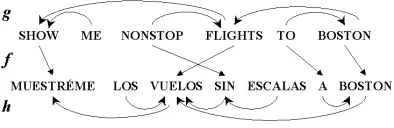
Figure 1: Alignment mapping , source head-map
, and target head-map
2 Hierarchical alignments
Both the translation systems described in this pa-per make use of automatically created hierarchical alignments of the source and target strings of the training corpus bitexts. As will be described in sec-tion 3, we estimate the parameters of a dependency transduction model from such alignments. In the case-based method described in section 4, the align-ments are the basis for the translation lexicon used to compute substitutions and word-for-word transla-tions.
A hierarchical alignment consists of four func-tions. The first two functions are an alignment
mapping from source words to target words
(which may be the empty word ), and an
in-verse alignment mapping from target words to
source words . (The inverse mapping is needed to handle mapping of target words to ; it coincides
with for pairs without .) The other two functions
are a source head-map
mapping source dependent words to their heads
in the source string, and a target head-map mapping target dependent
words to their head words in the target string.
An example hierarchical alignment is shown in Fig-ure 1.
A hierarchical alignment is synchronized (i.e. corresponds to synchronized dependency trees) if, roughly speaking, induces an isomorphism
be-tween the dependency functions
and (see
Alshawi and Douglas (2000) for a more formal def-inition). The hierarchical alignment in Figure 1 is synchronized.
In some previous work (Alshawi et al., 1998; Al-shawi et al., 2000a; AlAl-shawi et al., 2000b) the train-ing method constructs synchronized alignments in which each head word has at most two dependent phrases. Here we use the technique described by
Alshawi and Douglas (2000) where the models have greater freedom to vary the granularity of phrase lo-cality.
Constructing synchronized hierarchical align-ments for a corpus has two stages: (a) computing co-occurrence statistics from the training data; (b) searching for an optimal synchronized hierarchical alignment for each bitext.
2.1 Word correlation statistics
For each source word in the dataset, a translation
pairing cost is assigned for all possible translations in the context of a bitext . Here and
are usually words, but may also be the empty word
or compounds formed from contiguous words; here we restrict compounds to a maximum length of two words.
The assignment of these lexical translation pair-ing costs may be done uspair-ing various statistical mea-sures. The main component of is the so-called
correlation measure (see Gale and Church (1991)) normalized to the range ! with indicating
per-fect correlation. In the experiments described in this paper, the cost function relating a source word (or
compound) in a bitext with a target word (or
com-pound) is
"# %$
" '&)("#
where(*+ is a length-normalized measure of
the apparent distortion in the positions of and in
the source and target strings of . For example, if
appears at the middle of the source string and
ap-pears at the middle of the target string, then the dis-tortion is . We have found that, at least for our data,
this pairing cost leads to better performance than the use of log probabilities of target words given source words (cf. Brown et al. (1993)).
The value used for
is first computed from counts of the number of bitexts in the training set in which and co-occur, in which only appears, in
which only appears, and in which neither of them
2.2 Optimal hierarchical alignments
We wish to find a hierarchical alignment that re-spects the co-occurrence statistics of bitexts as well as the phrasal structure implicit in the source and tar-get strings. For this purpose we define the cost of a hierarchical subalignment to be the sum of the costs
+ of each pairing" -,. , where is the
(sub)alignment mapping function.
The complete hierarchical alignment which min-imizes this cost function is computed using a dy-namic programming procedure. This procedure works bottom-up, starting with all possible sub-alignments with at most one source word (or com-pound) and one target word (or comcom-pound). Adja-cent source substrings are then combined to deter-mine the lowest cost subalignments for successively larger substrings of the bitext satisfying the con-straints for synchronized alignments stated above. The successively larger substrings eventually span the entire source string, yielding the optimal hierar-chical alignment for the bitext.
At each combination step in the optimization pro-cedure, one of the two source subphrases is added as a dependent of the head of the other subphrase. Since the alignment we are constructing is synchro-nized, this choice will force the selection of a target dependent phrase. Our current (admittedly crude) strategy for selecting the dependent subphrase is to choose the one with the highest subalignment cost, i.e. the head of the subphrase with the better sub-alignment becomes the head of the enlarged phrase.
Recall that the initial estimates for
are computed from co-occurence counts for" in bitexts. In the
second and subsequent rounds of this procedure, the
values are computed from co-occurence counts for in pairings in the alignments produced by the previous round. The improvement in the models re-sulting from this re-estimation seems to stabilize af-ter approximately five to ten rounds.
3 Statistical Dependency Transduction
The dependency transduction model is an automati-cally trainable translation method that models cross-lingual lexical mapping, hierarchical phrase struc-ture, and monolingual lexical dependency. It is a generative statistical model for synchronized pairs of dependency trees in which each local tree is
pro-duced by a weighted head transducer. Since this model has been presented at length elsewhere (Al-shawi, 1996; Alshawi et al., 2000a; Alshawi and Douglas, 2000), the description in this paper will be relatively compact.
3.1 Weighted finite state head transducers
A weighted finite state head transducer is a finite state machine that differs from ‘standard’ finite state transducers in that, instead of consuming the input string left to right, it consumes it ‘middle out’ from a symbol in the string. Similarly, the output of a head transducer is built up middle-out at positions relative to a symbol in the output string.
Formally, a weighted head transducer is a 5-tuple: an alphabet / of input symbols; an alphabet 0 of
output symbols; a finite set1 of states243566678279; a
set of final states:<;=1 ; and a finite set> of state
transitions. A transition from state 2 to state 2 has
the form ?
2@82
ABC%8DE
where is a member of/ or is the empty string ;
is a member of 0 or ; the integer A is the input
position; the integer C is the output position; and
the real numberD is the weight of the transition. The
roles of 2 , 27, , and in transitions are similar to
the roles they have in left-to-right transducers, i.e. in transitioning from state2 to state 2F, the transducer
‘reads’ input symbol and ‘writes’ output symbol
, and as usual if (or ) is then no read
(respec-tively write) takes place for the transition.
To define the role of transition positions A and
C , we consider notional input (source) and output
(target) tapes divided into squares. On such a tape, one square is numbered , and the other squares are
numbered GHI666 rightwards from square , and
J
G
J
HI666 leftwards from square . A transition
with input position A and output position C is
in-terpreted as reading from square A on the input
tape and writing to squareC of the output tape; if
squareC is already occupied then is written to the
next empty square to the left ofC ifCLKM , or to the
right of C if CONP , and similarly if input was
al-ready read from positionA , is taken from the next
unread square to the left ofA ifAQKM or to the right
3.2 Dependency transduction models
Dependency transduction models are generative
statistical models which derive synchronized pairs of dependency trees, a source language dependency tree and a target dependency tree. A dependency tree, in the sense of dependency grammar (for exam-ple Hays (1964), Hudson (1984)), is a tree in which the words of a sentence appear as nodes; the parent of a node is its head and the child of a node is the node’s dependent.
In a dependency transduction model, each syn-chronized local subtree corresponds to a head trans-ducer derivation: the head transtrans-ducer is used to con-vert a sequence consisting of a head word and its
immediate left and right dependent words to a se-quence consisting of a target word andSUTV
immedi-ate left and right dependent words. (Since the empty string may appear in a transition in place of a source or target symbol, the number of source and target de-pendents can be different.) When applying a depen-dency transduction model to translation, we choose the target string obtained by flattening the target tree of the lowest cost recursive dependency derivation that also yields the source string.
For a dependency transduction model to be a sta-tistical model for generating pairs of strings, we as-sign transition weights that are derived from condi-tional probabilities. Several probabilistic parameter-izations can be used for this purpose including the following for a transition with head words and
and dependent words and :
W
X2
A%CZY82[ \6
Here2 and27 are the from-state and to-state for the
transition andA andC are the source and target
posi-tions, as before. We also need parametersW X2U3]Y
for the probability of choosing an initial head trans-ducer state2\3 given a pair of words " heading
a synchronized pair of subtrees. To start the deriva-tion, we need parametersW
X^_3G[37 for the
prob-ability of choosing `3 ,[3 as the root nodes of the
two trees.
These model parameters can be used to generate pairs of synchronized dependency trees starting with the topmost nodes of the two trees and proceeding recursively to the leaves. The probability of such a
derivation can be expressed as:
W
X^_-35G37
W
Xacb#d!efd
whereW
Xagb'efh is the probability of a subderivation
headed by and , that is
W
Xacbefh %$
W
X23]Y
i
3!jkjl
W
X2 knm'o k k A k C k Y82 k
W
Xa b#pXefp
for a derivation in which the dependents of and
are generated byq transitions.
The parameters of this probabilistic synchronized tree derivation model are estimated from the results of running the hierarchical alignment algorithm de-scribed in section 2 on the sentence pairs in the train-ing corpus. For this purpose, each synchronized tree resulting from the alignment process is assumed to be derived from a dependency transduction model, so transition counts for the model are tallied from the set of synchronized trees. (For further details, see Alshawi and Douglas (2000).)
To carry out translation with a dependency trans-duction model, we apply a “middle-out” dynamic programming search to find the optimal derivation. This algorithm can take as input either word strings or word lattices produced by a speech recognizer. The algorithm is similar to those for context free parsing such as chart parsing (Earley, 1970) and the CKY algorithm (Younger, 1967). It is described in Alshawi et al. (2000b).
4 Similarity Cased-Based Transduction
4.1 Training the transduction parameters
Our semantic similarity transduction method is a case-based (or example-based) method for transduc-ing source strtransduc-ings to target strtransduc-ings that makes use of two different kinds of training data:
r
method to construct a probabilistic bilingual lexicon, while the source side is used as the set of examples for matching.
r
A mapping between the source strings and sub-sets of a (relatively small) set of classes, or la-bels. The idea is that the labels give a broad classification of the meaning of the source strings, so we will refer to them informally as “semantic” labels. In our experiments, these classes correspond to 15 call routing destina-tions associated with the transcribed utterances. For the purposes of the case-based method, this data is used to construct a similarity measure between words of the source language.
As noted earlier, the alignment algorithm de-scribed in section 2 is applied to the translation pairs to yield a set of synchronized dependency trees. Us-ing the resultUs-ing trees, the probabilities of a bilUs-ingual lexicon, i.e.
W
sY
where is a source language word, and is a
tar-get language word, are estimated from the counts of synchronized lexical nodes. (Since the synchronized trees are dependency trees, both paired fringe nodes and interior nodes are included in the counts.) In this probabilistic lexicon, may be , the empty symbol,
so source words may have different probabilities of being deleted. However, for insertion probabilities, we assume thattuvhY\ w$x , to avoid problems with
spurious insertions of target words.
The labels associated with the source strings were originally assigned by manual annotation for the purposes of a different research project, specifically for training an automatic call routing system, us-ing the methods described by Gorin et al. (1997). (Many of the training sentences are assigned mul-tiple labels.)
For the translation task, the labels are used to compute a similarity measureyQzo-{ as a
diver-gence between a probability distribution conditional on source wordwo and a corresponding distribution
conditional on another source word
{ . The
distri-butions involved, W
X|}YZo! and
W
X|Y~{7 , are those
for the probabilityW
X8Y that a source string which
includes word has been assigned label. The
sim-ilarity measureyQwo-{7 is computed from the
rel-ative entropy a (Kullback Leibler distance
(Kull-back and Leibler, 1951)) between these distribu-tions. To make the similarity measure symmetrical, i.e. yQo-{7 $yQ-{ho! , we take the average
of two relative entropy quantities:
yQ o { $ 7GH Xa
W
X|Y o YnY
W
X|Y { &
a
W
X|Y-{7 YnY
W
X|}Yo
Of course, this is one of many different possible similarity measures which could have been used (cf Pereira et al. (1993)), including ones that do not de-pend on additional labels. However, since seman-tic labels had already been assigned to our train-ing data, the distributions seemed like a convenient rough proxy for the semantic similarity of words in this limited domain.
4.2 Case-based transduction procedure
Basically, the transduction procedure (i) finds an instance vV]T8 of the translation training pairs for
which the example source string V provides the
“best” match to the input source string , and (ii)
produces, as the translation output, a modified ver-sion of the example target stringT , where the
modifi-cations reflect mismatches betweenV and the input.
For the first step, the similarity measure between words computed in terms of the relative entropy for label distributions is used to compute a distance
(vV@GVhH]
between two source stringsV o andV { . The
(seman-tically influenced) string distance ( , is a weighted
edit distance (Wagner and Fischer, 1974) between the two strings in which the cost of substituting one source word -o for another z{ is provided by the
“semantic” similarity measure yQ%o-{7 . A
stan-dard quadratic dynamic programming search algo-rithm is used to find the weighted edit distance be-tween two strings. This algorithm finds a sequence of edit operations (insertions, deletions, and substi-tutions) that yield V5H from V@ so that (vV@GV5H] , the
sum of the costs of the edit operations, is minimal over all such edit sequences.
The weighted edit distance search is applied to
and each example source string V to identify the
minimal over all example source strings. The cor-responding sequence of edits for this minimal dis-tance is used to compute a modified versionT from
T . For this purpose, the source language edits are
“translated” into corresponding target language edits using the probabilistic bilingual lexicon estimated from aligning the training data. Specifically, for each substitution Zo -{ in the edits resulting
from the weighted edit distance search, a substitu-tion o { is applied to T . Here k is chosen so
thatW
hk8Ywkv is maximal. The translated edits are
applied sequentially toT to giveT.
The modified example target string T is used as
the output of this translation method unless the min-imal edit distance between and the closest example
V exceeds a threshold determined experimentally.
(For this purpose, the edit distance is normalized by utterance length.) If the threshold is exceeded, so that no “sufficiently close” examples are available, then a word-for-word translation is used as the out-put by simply applying the probabilistic lexicon to each word of the input. It is perhaps worth men-tioning that the statistical dependency transduction method does not need a such a fall-back to word-for-word translation: the middle-out (island parsing) search algorithm used with head transducers grace-fully degrades into word-for-word translation when the training data is too sparse to cover the input string.
5 Experiments and results
5.1 Data set
The corpora for the experiments reported here con-sist of spoken English utterances, paired with their translations into Japanese. The English utterances were the customer side of actual AT&T customer-operator conversations. There were 12,226 training bitexts and an additional 3,253 bitexts for testing. In the text experiments, the English side of the bitext is the human transcriptions of the recorded speech; in the speech experiments, it is the output of speech recognition. The case-based model makes use of additional information in the form of labels associ-ated with source language utterances, classifying the source utterances into 15 task related classes such as “collect-call”, “directory-assistance”, etc.
The translations were carried out by a
commer-cial translation company. Since Japanese text has no word boundaries, we asked the translators to insert spaces between Japanese characters whenever they ‘arose from different English words in the source’. This imposed an English-centric view of Japanese text segmentation.
5.2 Evaluation metrics
We use two simple string edit-distance evaluation metrics that can be calculated automatically. These metrics, simple accuracy and translation accuracy, are used to compare the target string produced by the system against the reference human translation from held-out data. Simple accuracy (the ‘word accu-racy’ of speech recognition research) is computed by first finding a transformation of one string into an-other that minimizes the total number of insertions, deletions and substitutions. Translation accuracy in-cludes transpositions (i.e. movement) of words as well as insertions, deletions, and substitutions. We regard the latter measure as more appropriate for evaluation of translation systems because the simple metric would count a transposition as two errors: an insertion plus a deletion. If we writeS for the
num-ber of insertions,( for deletions,V for substitutions,
T for transpositions, and for number of words in
the reference translation string, we can express the metrics as follows:
simple accuracy$
J
Ss&(}&VG h
translation accuracy$
J
Ss&(&VZ&RT8 h
Since a transposition corresponds to an insertion and a deletion, the values ofS and( will be different
in the expressions for computing the two accuracy metrics. The units for string operations in the evalu-ation metrics are Japanese characters.
5.3 Experimental conditions and results
The following experimental systems are evaluated here:
Word-Word A simple word for word baseline method in which each source word is replaced with the most highly correlated target word in the training corpus.
Simple Translation accuracy accuracy Word-Word 37.2 42.8 Stat-Dep 69.3 72.9 Sim-Case 70.6 71.5
Table 1: Accuracy for text (%)
Simple Translation accuracy accuracy Word-Word 29.2 33.7 Stat-Dep 57.4 59.7 Sim-Case 59.4 60.2
Table 2: Accuracy for speech (%)
Sim-Case The semantic similarity case-based method described in section 4.
Table 1 shows the results on human transcriptions of the set of test utterances.
Table 2 shows the test set results of translating automatic speech recognition output. The speech recognizer used a speaker-independent telephony acoustic model and a statisical trigram language model.
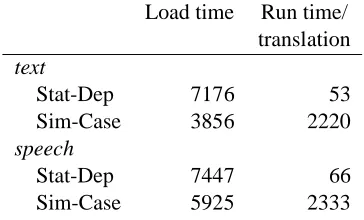
Table 3 shows the speed of loading (once per test set) and the average run time per utterance transla-tion for the dependency transductransla-tion and case-based systems.
6 Concluding Remarks
In this paper we have compared the accuracy and speed of two translation methods, statistical depen-dency transduction and semantic similarity cased-based transduction. The statistical transduction model is trainable from unannotated examples of sentence translations, while the case-based method additionally makes use of a modest amount of an-notation to learn a lexical semantic similarity func-tion, a factor in favor of the dependency transduction method.
In the experiments we presented, the transduc-tion methods were applied to translating automatic speech recognition output for English utterances into Japanese in a limited domain. The evaluation metric used to compare translation accuracy was an automatic string comparison function applied to the output produced by both methods. The basic result
Load time Run time/ translation
text
Stat-Dep 7176 53
Sim-Case 3856 2220
speech
Stat-Dep 7447 66
Sim-Case 5925 2333
Table 3: Translation time (ms)
was that translation accuracy was very similar for both models, while the statistical dependency trans-duction method was significantly faster at produc-ing translations at run time. Since trainproduc-ing time for both methods is dominated by the alignment training phase they share, training time issues do not favor one method over the other.
These results need to be interpreted in the rather narrow experimental setting used here: the amount of training data used, the specific language pair (En-glish to Japanese), the evaluation metric, and the uncertainty in the input strings (speech recognition output) to which the methods were applied. Fur-ther research varying these experimental conditions is needed to provide a fuller comparison of the rela-tive performance of the methods. However, it should be possible to develop algorithmic improvements to increase the computational efficiency of similarity cased-based transduction to make it more compet-itive with statistical dependency transduction at run-time.
References
H. Alshawi and S. Douglas. 2000. Learning depen-dency transduction models from unannotated exam-ples. Philosophical Transactions of the Royal Soci-ety (Series A: Mathematical, Physical and Engineer-ing Sciences), 358:1357–1372, April.
H. Alshawi, S. Bangalore, and S. Douglas. 1998. Learning Phrase-based Head Transduction Models for Translation of Spoken Utterances. In Proceedings of the International Conference on Spoken Language Processing, pages 2767–2770, Sydney, Australia.
[image:7.612.70.251.76.230.2]H. Alshawi, S. Bangalore, and S. Douglas. 2000b. Learning dependency translation models as collections of finite state head transducers. Computational Lin-guistics, 26(1), January.
H. Alshawi. 1996. Head automata for speech transla-tion. In International Conference on Spoken Language Processing, pages 2360–2364, Philadelphia, Pennsyl-vania.
P.J. Brown, S.A. Della Pietra, V.J. Della Pietra, and R.L. Mercer. 1993. The Mathematics of Machine Trans-lation: Parameter Estimation. Computational Linguis-tics, 16(2):263–312.
J. Earley. 1970. An Efficient Context-Free Parsing Algo-rithm. Communications of the ACM, 13(2):94–102.
R. Frederking, S. Nirenburg, D. Farwell, S. Helmreich, E. Hovy, K. Knight, S. Beale, C. Domashnev, D. At-tardo, D. Grannes, and R. Brown. 1994. Integrating translations from multiple sources within the pangloss mark iii machine translation. In Proceedings of the first conference of the Association for Machine Trans-lation in the Americas (AMTA-94), Maryland.
W.A. Gale and K.W. Church. 1991. Identifying word correspondences in parallel texts. In Proceedings of the Fourth DARPA Speech and Natural Language Pro-cessing Workshop, pages 152–157, Pacific Grove, Cal-ifornia.
A.L. Gorin, G. Riccardi, and J.H. Wright. 1997. How may I help you? Speech Communication, 23(1-2):113–127.
D. G. Hays. 1964. Dependency theory: a formalism and some observations. Language, 40:511–525.
R.A. Hudson. 1984. Word Grammar. Blackwell, Ox-ford.
Judith L. Klavans and Philip Resnik, editors. 1996. The Balancing Act: combining Symbolic and Statistical Approaches to Language. The MIT Press.
S. Kullback and R. A. Leibler. 1951. On information and sufficiency. Annals of Mathematical Statistics, 22:76– 86.
F. Pereira, N. Tishby, and L. Lee. 1993. Distributional clustering of English words. In Proceedings of the 31st meeting of the Association for Computational Lin-guistics, pages 183–190.
Robert A. Wagner and Michael J. Fischer. 1974. The string-to-string correction problem. Journal of the As-sociation for Computing Machinery, 21(1):168–173, January.
D. Younger. 1967. Recognition and Parsing of Context-Free Languages in Time . Information and Control,